display TOYOTA VERSO S 2011 Owners Manual
[x] Cancel search | Manufacturer: TOYOTA, Model Year: 2011, Model line: VERSO S, Model: TOYOTA VERSO S 2011Pages: 664, PDF Size: 160.56 MB
Page 390 of 664
3905-5. Using the driving support systems
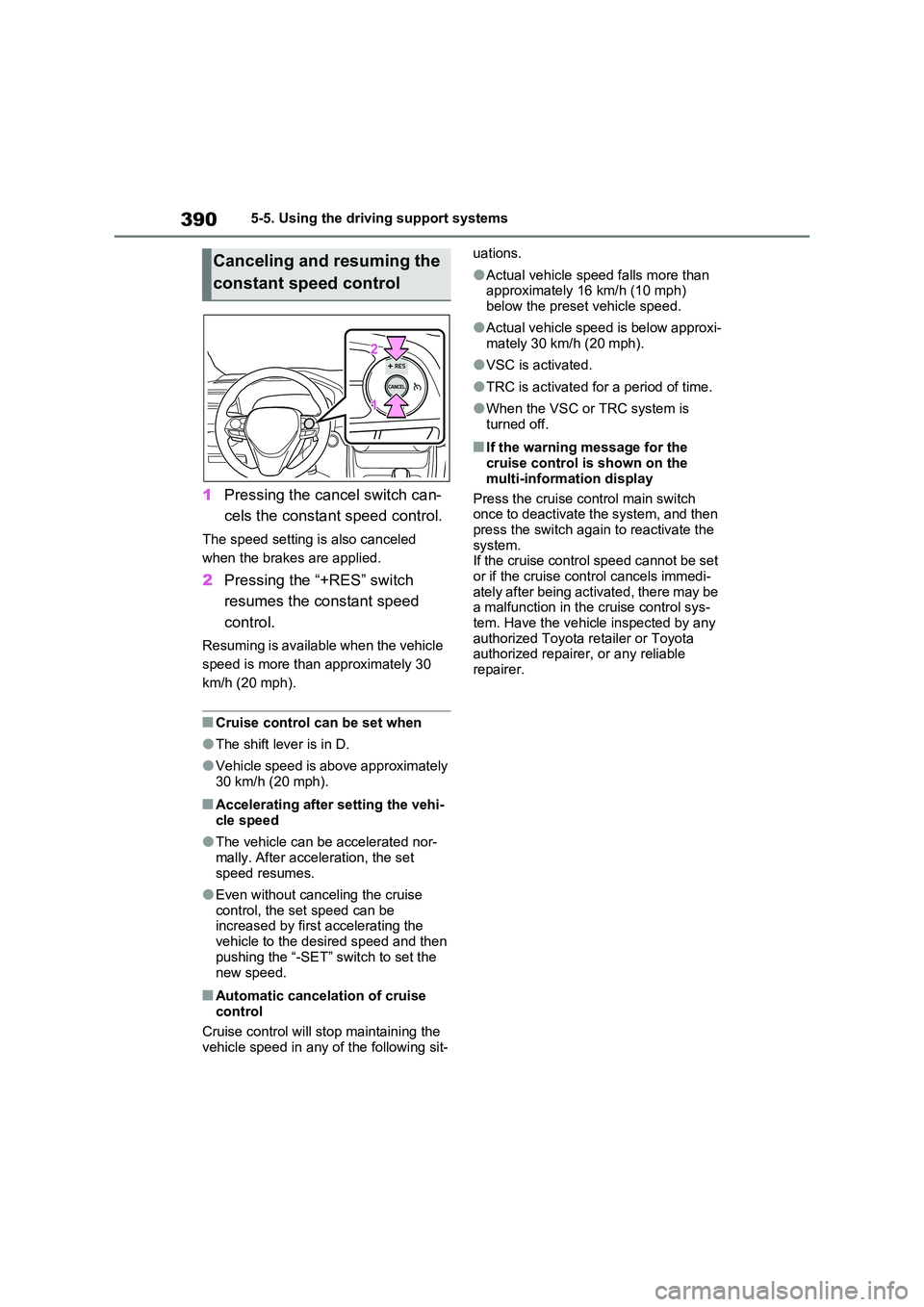
1Pressing the cancel switch can-
cels the constant speed control.
The speed setting is also canceled
when the brakes are applied.
2 Pressing the “+RES” switch
resumes the constant speed
control.
Resuming is available when the vehicle
speed is more than approximately 30
km/h (20 mph).
■Cruise control can be set when
●The shift lever is in D.
●Vehicle speed is above approximately 30 km/h (20 mph).
■Accelerating after setting the vehi-
cle speed
●The vehicle can be accelerated nor-
mally. After acceleration, the set speed resumes.
●Even without canceling the cruise control, the set speed can be increased by first accelerating the
vehicle to the desired speed and then pushing the “-SET” switch to set the
new speed.
■Automatic cancelation of cruise control
Cruise control will stop maintaining the
vehicle speed in any of the following sit-
uations.
●Actual vehicle speed falls more than approximately 16 km/h (10 mph)
below the preset vehicle speed.
●Actual vehicle speed is below approxi-
mately 30 km/h (20 mph).
●VSC is activated.
●TRC is activated for a period of time.
●When the VSC or TRC system is turned off.
■If the warning message for the cruise control is shown on the
multi-information display
Press the cruise control main switch once to deactivate the system, and then
press the switch again to reactivate the system.If the cruise control speed cannot be set
or if the cruise control cancels immedi- ately after being activated, there may be a malfunction in the cruise control sys-
tem. Have the vehicle inspected by any authorized Toyota retailer or Toyota authorized repairer, or any reliable
repairer.
Canceling and resuming the
constant speed control
Page 392 of 664
3925-5. Using the driving support systems
release when the desired speed is
reached.
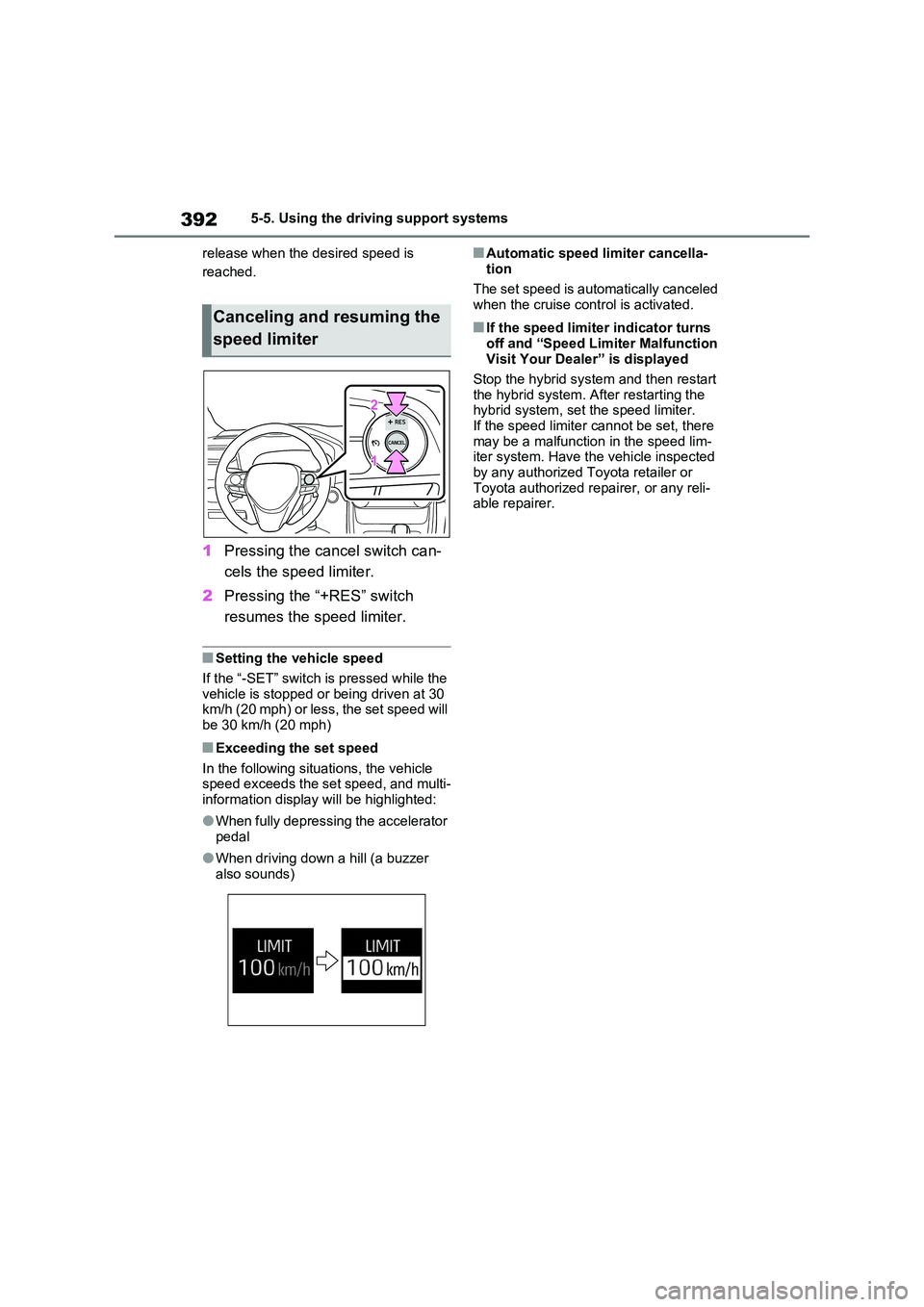
1 Pressing the cancel switch can-
cels the speed limiter.
2 Pressing the “+RES” switch
resumes the speed limiter.
■Setting the vehicle speed
If the “-SET” switch is pressed while the
vehicle is stopped or being driven at 30 km/h (20 mph) or less, the set speed will be 30 km/h (20 mph)
■Exceeding the set speed
In the following situations, the vehicle speed exceeds the set speed, and multi-information display will be highlighted:
●When fully depressing the accelerator pedal
●When driving down a hill (a buzzer also sounds)
■Automatic speed limiter cancella-
tion
The set speed is automatically canceled when the cruise control is activated.
■If the speed limiter indicator turns
off and “Speed Limiter Malfunction Visit Your Dealer” is displayed
Stop the hybrid system and then restart
the hybrid system. After restarting the hybrid system, set the speed limiter.If the speed limiter cannot be set, there
may be a malfunction in the speed lim- iter system. Have the vehicle inspected by any authorized Toyota retailer or
Toyota authorized repairer, or any reli- able repairer.
Canceling and resuming the
speed limiter
Page 393 of 664
393
5
5-5. Using the driving support systems
Driving
*: If equipped
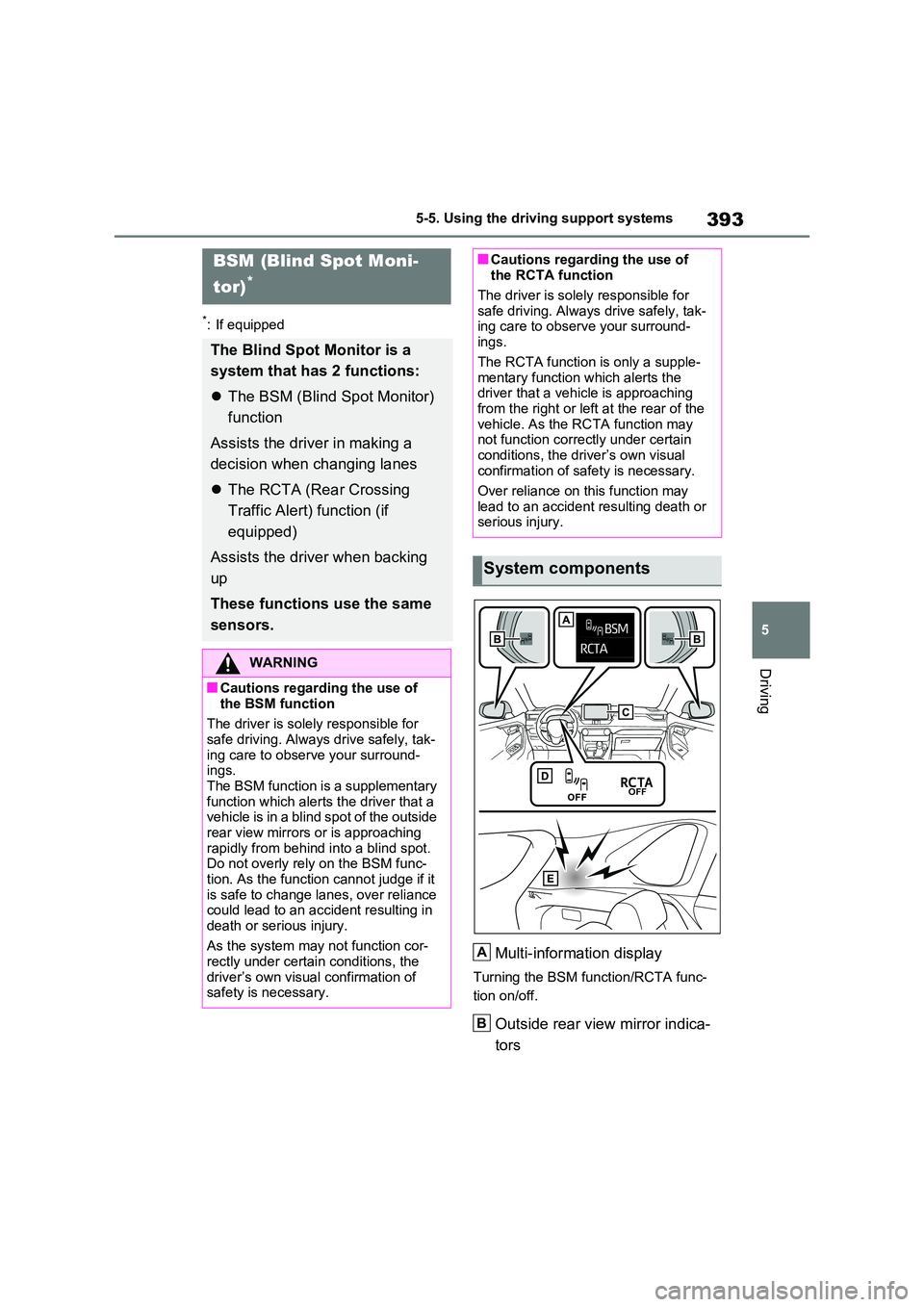
Multi-information display
Turning the BSM function/RCTA func-
tion on/off.
Outside rear view mirror indica-
tors
BSM (Blind Spot Moni-
tor)*
The Blind Spot Monitor is a
system that has 2 functions:
The BSM (Blind Spot Monitor)
function
Assists the driver in making a
decision when changing lanes
The RCTA (Rear Crossing
Traffic Alert) function (if
equipped)
Assists the driver when backing
up
These functions use the same
sensors.
WARNING
■Cautions regarding the use of
the BSM function
The driver is solely responsible for
safe driving. Always drive safely, tak- ing care to observe your surround-ings.
The BSM function is a supplementary function which alerts the driver that a vehicle is in a blind spot of the outside
rear view mirrors or is approaching rapidly from behind into a blind spot. Do not overly rely on the BSM func-
tion. As the function cannot judge if it is safe to change lanes, over reliance could lead to an accident resulting in
death or serious injury.
As the system may not function cor- rectly under certain conditions, the
driver’s own visual confirmation of safety is necessary.
■Cautions regarding the use of the RCTA function
The driver is solely responsible for
safe driving. Always drive safely, tak- ing care to observe your surround-ings.
The RCTA function is only a supple- mentary function which alerts the driver that a vehicle is approaching
from the right or left at the rear of the vehicle. As the RCTA function may not function correctly under certain
conditions, the driver’s own visual confirmation of safety is necessary.
Over reliance on this function may
lead to an accident resulting death or serious injury.
System components
A
B
Page 394 of 664
3945-5. Using the driving support systems
BSM function:
When a vehicle is detected in a blind
spot of the outside rear view mirrors or
approaching rapidly from behind into a
blind spot, the outside rear view mirror
indicator on the detected side will illumi-
nate. If the turn signal lever is operated
toward the detected side, the outside
rear view mirror indicator will flash.
RCTA function:
When a vehicle approaching from the
right or left at the rear of the vehicle is
detected, both outside rear view mirror
indicators will flash.
Monitor screen display (RCTA
function only)
If a vehicle approaching from the right
or left at the rear of the vehicle is
detected, the RCTA icon (P.411) for
the detected side will be displayed.
BSM OFF indicator/RCTA OFF
indicator
When the Blind Spot Monitor is dis-
abled, the BSM OFF indicator illumi-
nates.
When the RCTA function is disabled,
the RCTA OFF indicator illuminates.
RCTA buzzer (RCTA function
only)
If a vehicle approaching from the right
or left at the rear of the vehicle is
detected, a buzzer will sound from
behind the rear seat.
The BSM function and the RCTA
function can be enabled/disabled
on the screen of the multi-infor-mation display. (P.186)
The BSM function/RCTA function will
be enabled each time the power switch
is turned to ON.
■Outside rear view mirror indicators
visibility
In strong sunlight, the outside rear view
mirror indicator may be difficult to see.
■Hearing the RCTA buzzer
The RCTA buzzer may be difficult to
hear over loud noises such as high
audio volume.
■When “Blind Spot Monitor Unavail-
able” or “RCTA Unavailable” is
shown on the multi-information
display
The sensor voltage has become abnor-
mal, or water, snow, mud, etc., may be
built up in the vicinity of the sensor area
of the rear bumper. (P.408)
Removing the water, snow, mud, etc.,
from the vicinity of the sensor area
should return it to normal.
Also, the sensor may not function nor-
mally when used in extremely hot or
cold weather.
■When “Blind Spot Monitor Malfunc-
tion Visit Your Dealer” or “RCTA
Malfunction Visit Your Dealer” is
shown on the multi-information
display
There may be a sensor malfunction or
misaligned. Have the vehicle inspected
at any authorized Toyota retailer or
Toyota authorized repairer, or any reli-
able repairer.
■Customization
Some functions can be customized.
(P.186)
Turning the BSM func-
tion/RCTA function on/off
C
D
E
Page 408 of 664
4085-5. Using the driving support systems
■Vehicles that can be detected
by the Blind Spot Monitor
The BSM function uses radar sen-
sors to detect the following vehicles
traveling in adjacent lanes and
advises the driver of the presence
of such vehicles via the indicators
WARNING
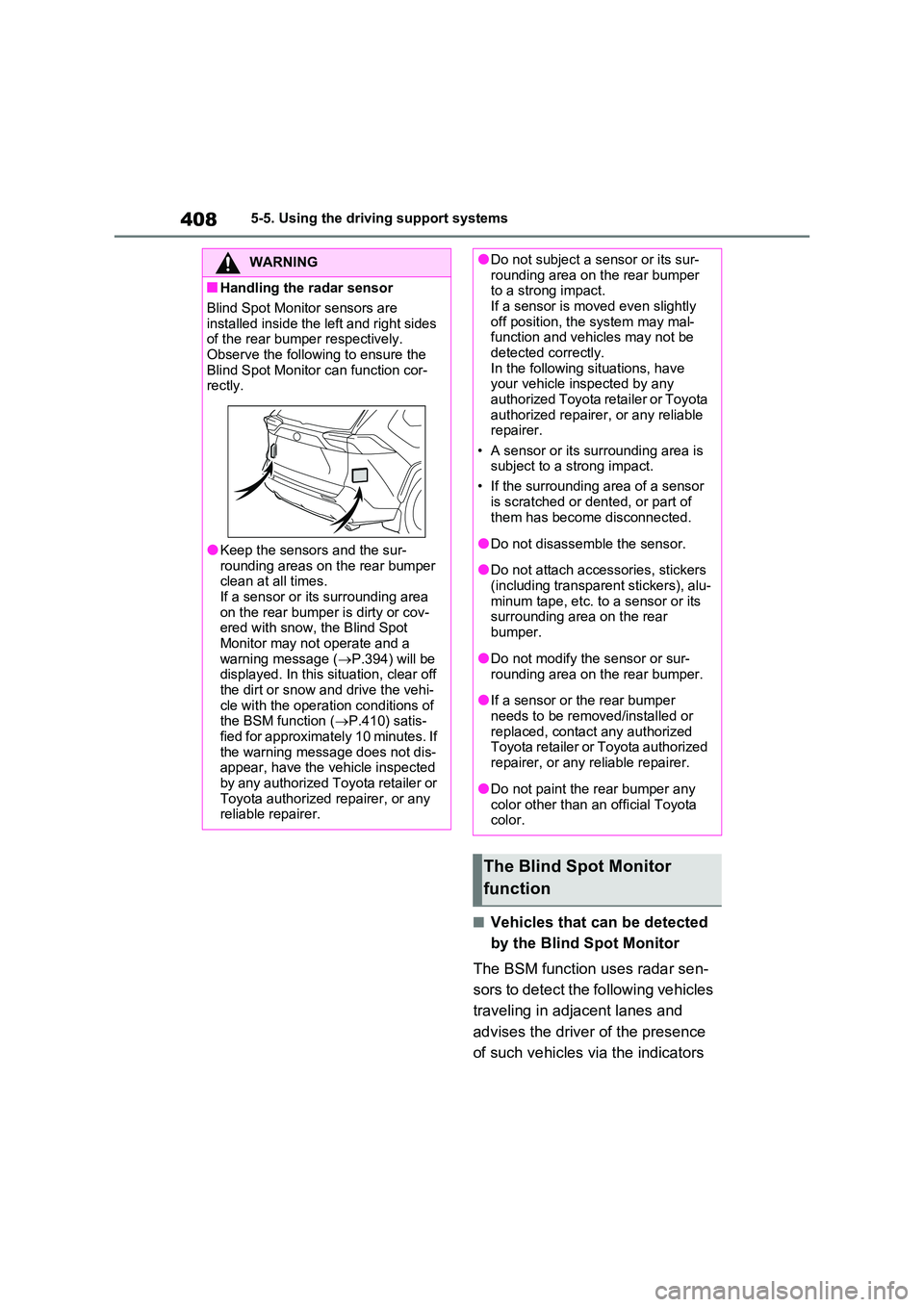
■Handling the radar sensor
Blind Spot Monitor sensors are
installed inside the left and right sides of the rear bumper respectively. Observe the following to ensure the
Blind Spot Monitor can function cor- rectly.
●Keep the sensors and the sur-rounding areas on the rear bumper clean at all times.
If a sensor or its surrounding area on the rear bumper is dirty or cov-ered with snow, the Blind Spot
Monitor may not operate and a warning message ( P.394) will be displayed. In this situation, clear off
the dirt or snow and drive the vehi- cle with the operation conditions of the BSM function ( P.410) satis-
fied for approximately 10 minutes. If the warning message does not dis-appear, have the vehicle inspected
by any authorized Toyota retailer or Toyota authorized repairer, or any reliable repairer.
●Do not subject a sensor or its sur-rounding area on the rear bumper to a strong impact.
If a sensor is moved even slightly off position, the system may mal-function and vehicles may not be
detected correctly. In the following situations, have your vehicle inspected by any
authorized Toyota retailer or Toyota authorized repairer, or any reliable repairer.
• A sensor or its surrounding area is subject to a strong impact.
• If the surrounding area of a sensor
is scratched or dented, or part of them has become disconnected.
●Do not disassemble the sensor.
●Do not attach accessories, stickers
(including transparent stickers), alu- minum tape, etc. to a sensor or its surrounding area on the rear
bumper.
●Do not modify the sensor or sur-
rounding area on the rear bumper.
●If a sensor or the rear bumper
needs to be removed/installed or replaced, contact any authorized Toyota retailer or Toyota authorized
repairer, or any reliable repairer.
●Do not paint the rear bumper any
color other than an official Toyota color.
The Blind Spot Monitor
function
Page 411 of 664
411
5 5-5. Using the driving support systems
Driving
●Instances of the BSM function unnec-
essarily detecting a vehicle and/or
object may increase in the following
situations:
• When the sensor is misaligned due to
a strong impact to the sensor or its
surrounding area
• When the distance between your vehi-
cle and a guardrail, wall, etc. that
enters the detection area is short
• When driving up and down consecu-
tive steep inclines, such as hills, dips
in the road, etc.
• When vehicle lanes are narrow, or
when driving on the edge of a lane,
and a vehicle traveling in a lane other
than the adjacent lanes enters the
detection area
• When driving on roads with sharp
bends, consecutive curves, or uneven
surfaces
• When the tires are slipping or spinning
• When the distance between your vehi-
cle and a following vehicle is short
• When an accessory (such as a bicycle
carrier) is installed to the rear of the
vehicle
• When the vehicle throws up water or
snow behind.
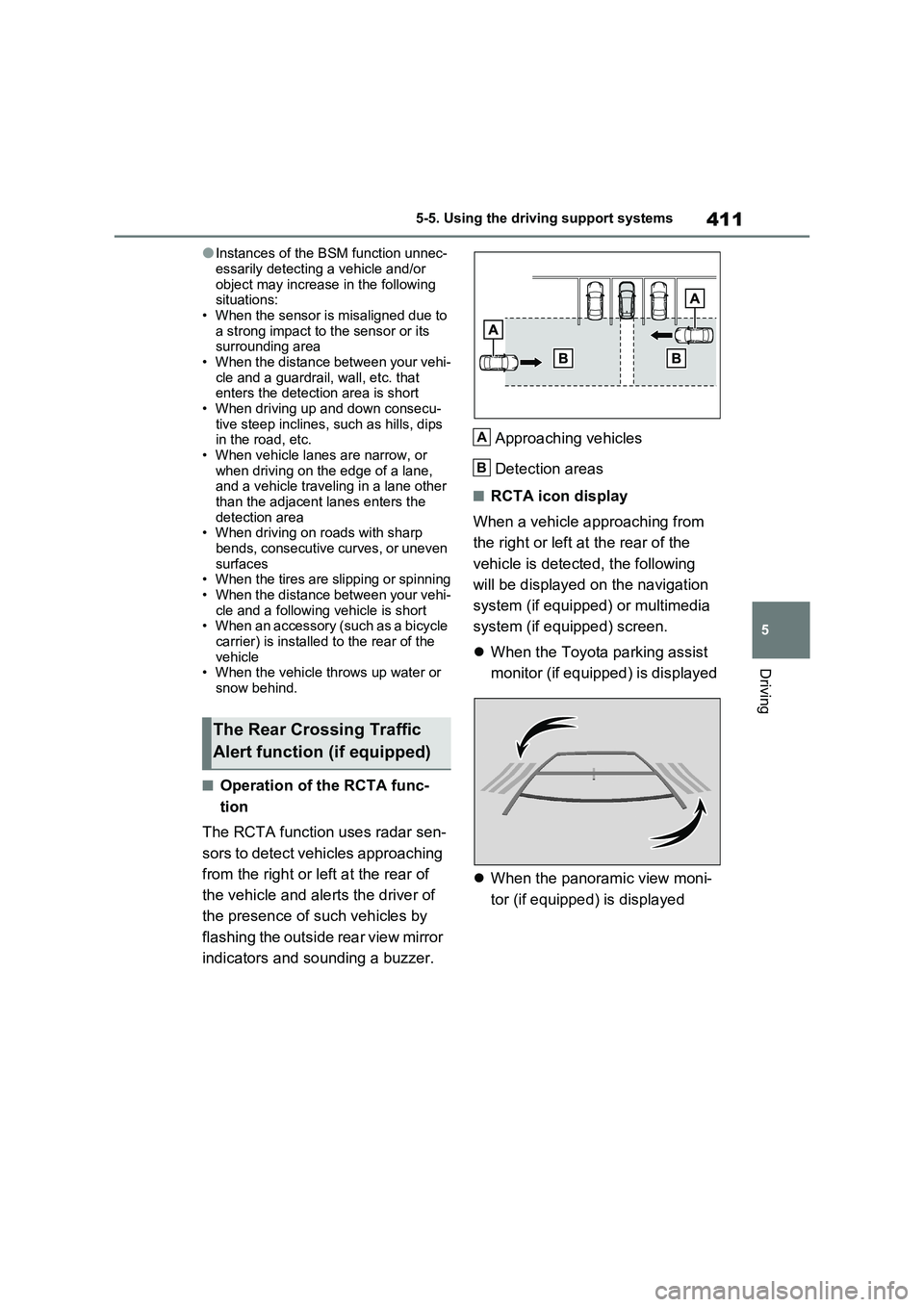
■Operation of the RCTA func-
tion
The RCTA function uses radar sen-
sors to detect vehicles approaching
from the right or left at the rear of
the vehicle and alerts the driver of
the presence of such vehicles by
flashing the outside rear view mirror
indicators and sounding a buzzer.Approaching vehicles
Detection areas
■RCTA icon display
When a vehicle approaching from
the right or left at the rear of the
vehicle is detected, the following
will be displayed on the navigation
system (if equipped) or multimedia
system (if equipped) screen.
When the Toyota parking assist
monitor (if equipped) is displayed
When the panoramic view moni-
tor (if equipped) is displayed
The Rear Crossing Traffic
Alert function (if equipped)
A
B
Page 412 of 664
4125-5. Using the driving support systems
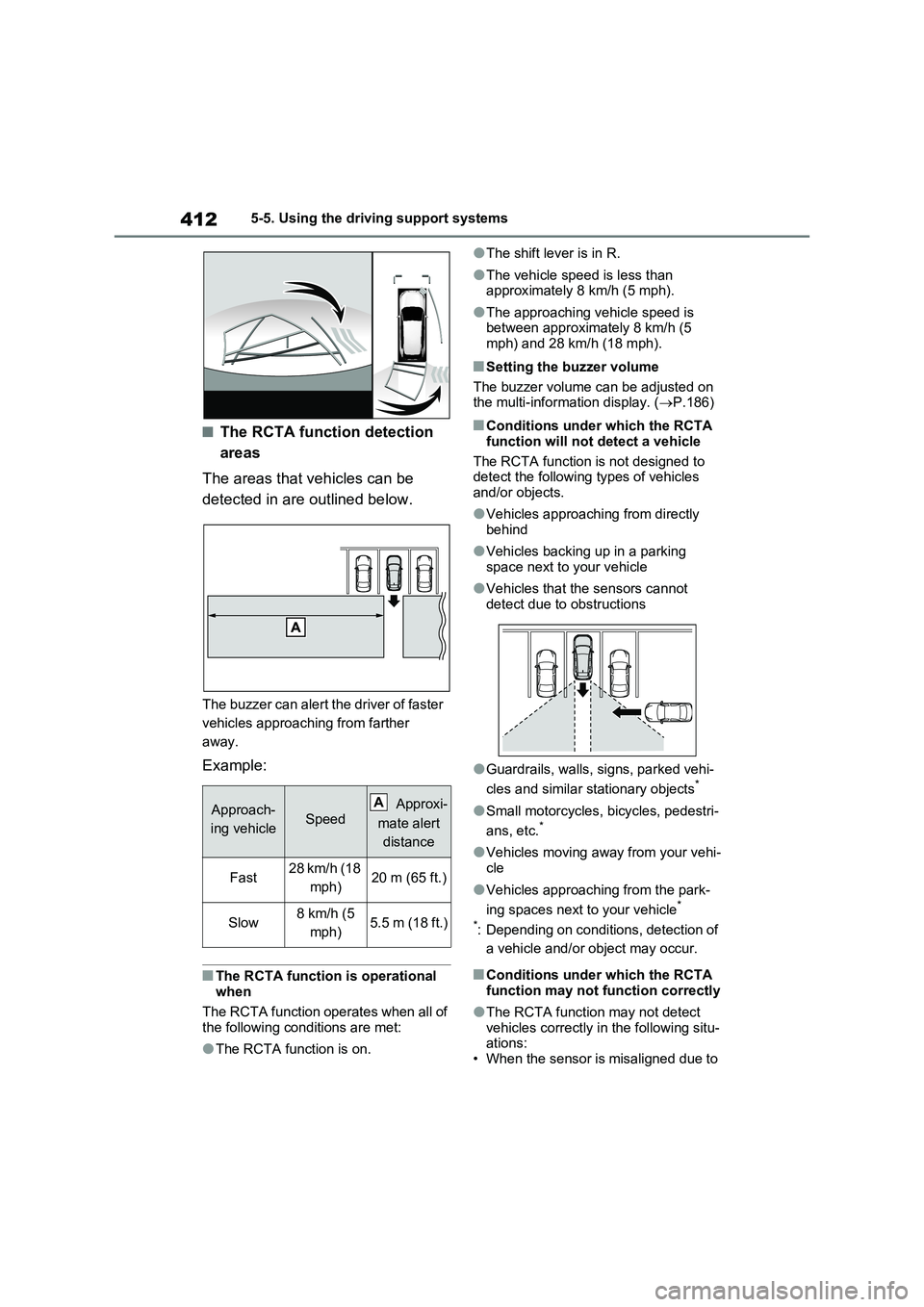
■The RCTA function detection
areas
The areas that vehicles can be
detected in are outlined below.
The buzzer can alert the driver of faster
vehicles approaching from farther
away.
Example:
■The RCTA function is operational
when
The RCTA function operates when all of
the following conditions are met:
●The RCTA function is on.
●The shift lever is in R.
●The vehicle speed is less than
approximately 8 km/h (5 mph).
●The approaching vehicle speed is
between approximately 8 km/h (5
mph) and 28 km/h (18 mph).
■Setting the buzzer volume
The buzzer volume can be adjusted on
the multi-information display. (P.186)
■Conditions under which the RCTA
function will not detect a vehicle
The RCTA function is not designed to
detect the following types of vehicles
and/or objects.
●Vehicles approaching from directly
behind
●Vehicles backing up in a parking
space next to your vehicle
●Vehicles that the sensors cannot
detect due to obstructions
●Guardrails, walls, signs, parked vehi-
cles and similar stationary objects*
●Small motorcycles, bicycles, pedestri-
ans, etc.*
●Vehicles moving away from your vehi-
cle
●Vehicles approaching from the park-
ing spaces next to your vehicle*
*
: Depending on conditions, detection of
a vehicle and/or object may occur.
■Conditions under which the RCTA
function may not function correctly
●The RCTA function may not detect
vehicles correctly in the following situ-
ations:
• When the sensor is misaligned due to
Approach-
ing vehicleSpeed Approxi-
mate alert
distance
Fast28 km/h (18
mph)20 m (65 ft.)
Slow8 km/h (5
mph)5.5 m (18 ft.)
A
Page 414 of 664
4145-5. Using the driving support systems
*: If equipped
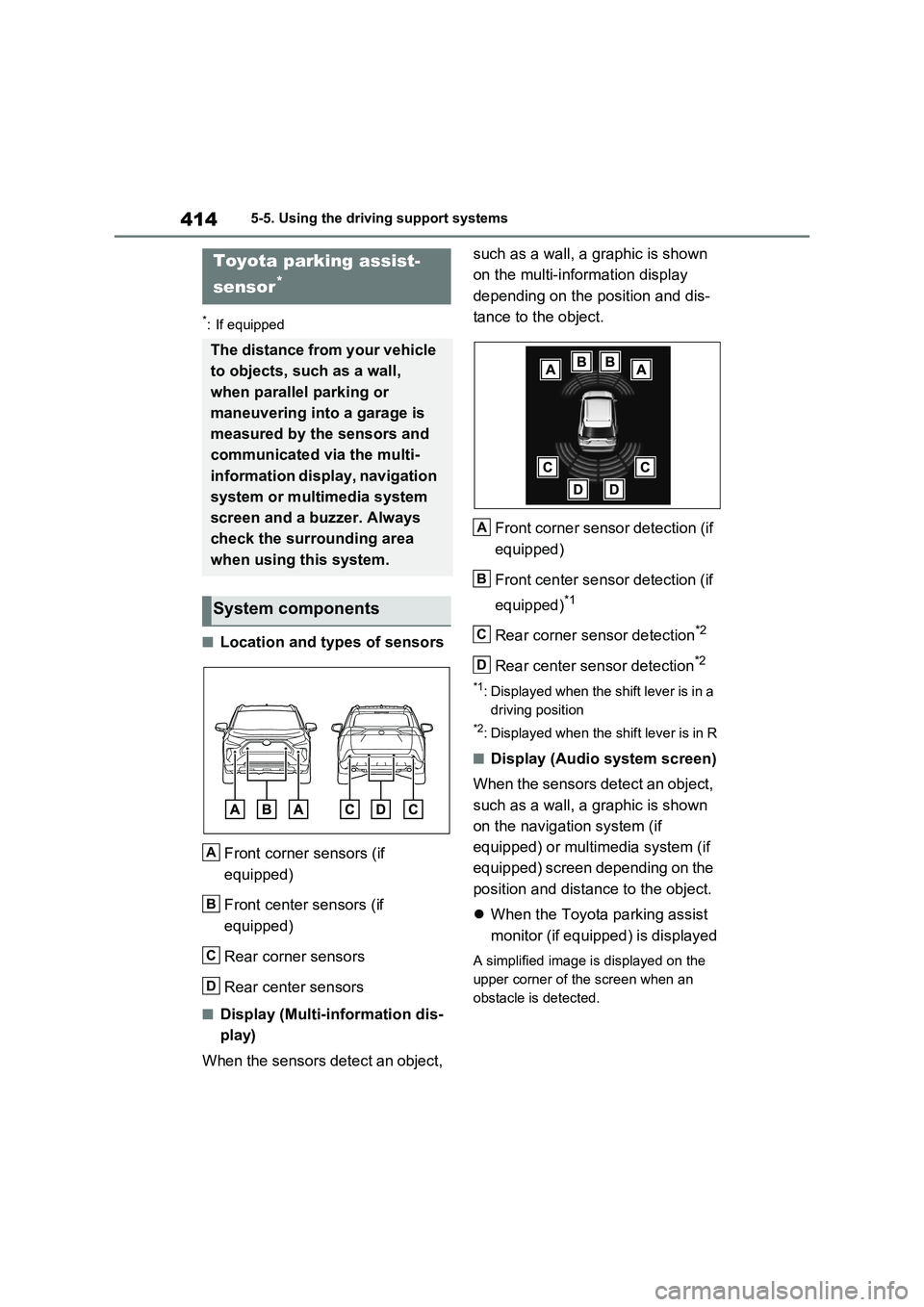
■Location and types of sensors
Front corner sensors (if
equipped)
Front center sensors (if
equipped)
Rear corner sensors
Rear center sensors
■Display (Multi-information dis-
play)
When the sensors detect an object, such as a wall, a graphic is shown
on the multi-information display
depending on the position and dis-
tance to the object.
Front corner sensor detection (if
equipped)
Front center sensor detection (if
equipped)
*1
Rear corner sensor detection*2
Rear center sensor detection*2
*1: Displayed when the shift lever is in a
driving position
*2: Displayed when the shift lever is in R
■Display (Audio system screen)
When the sensors detect an object,
such as a wall, a graphic is shown
on the navigation system (if
equipped) or multimedia system (if
equipped) screen depending on the
position and distance to the object.
When the Toyota parking assist
monitor (if equipped) is displayed
A simplified image is displayed on the
upper corner of the screen when an
obstacle is detected.
Toyota parking assist-
sensor
*
The distance from your vehicle
to objects, such as a wall,
when parallel parking or
maneuvering into a garage is
measured by the sensors and
communicated via the multi-
information display, navigation
system or multimedia system
screen and a buzzer. Always
check the surrounding area
when using this system.
System components
A
B
C
D
A
B
C
D
Page 415 of 664
415
5
5-5. Using the driving support systems
Driving
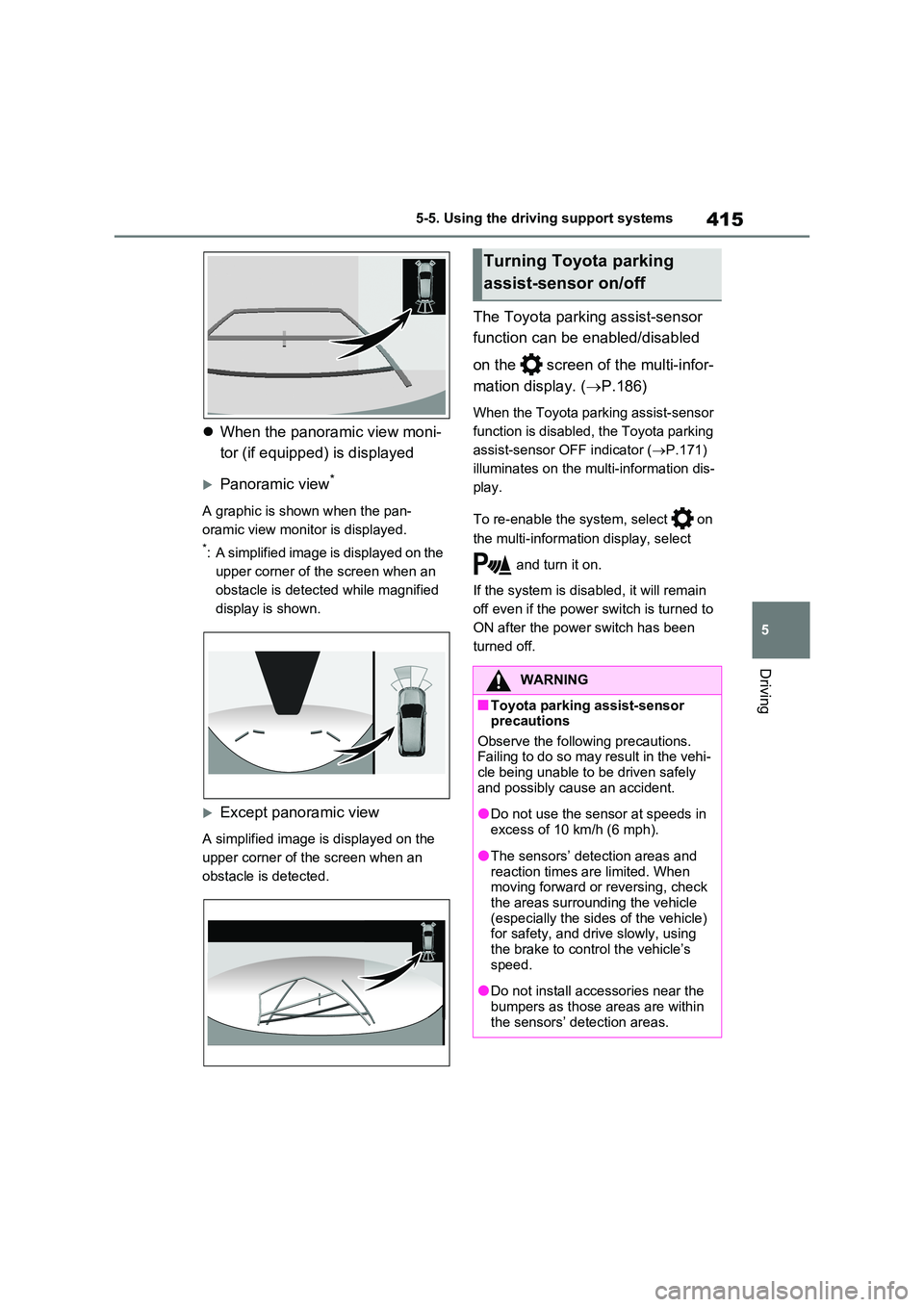
When the panoramic view moni-
tor (if equipped) is displayed
Panoramic view*
A graphic is shown when the pan-
oramic view monitor is displayed.
*: A simplified image is displayed on the
upper corner of the screen when an
obstacle is detected while magnified
display is shown.
Except panoramic view
A simplified image is displayed on the
upper corner of the screen when an
obstacle is detected.
The Toyota parking assist-sensor
function can be enabled/disabled
on the screen of the multi-infor-
mation display. ( P.186)
When the Toyota parking assist-sensor
function is disabled, the Toyota parking
assist-sensor OFF indicator ( P.171)
illuminates on the multi-information dis-
play.
To re-enable the system, select on
the multi-information display, select
and turn it on.
If the system is disabled, it will remain
off even if the power switch is turned to
ON after the power switch has been
turned off.
Turning Toyota parking
assist-sensor on/off
WARNING
■Toyota parking assist-sensor precautions
Observe the following precautions. Failing to do so may result in the vehi-cle being unable to be driven safely
and possibly cause an accident.
●Do not use the sensor at speeds in
excess of 10 km/h (6 mph).
●The sensors’ detection areas and
reaction times are limited. When moving forward or reversing, check the areas surrounding the vehicle
(especially the sides of the vehicle) for safety, and drive slowly, using the brake to control the vehicle’s
speed.
●Do not install accessories near the
bumpers as those areas are within the sensors’ detection areas.
Page 416 of 664
4165-5. Using the driving support systems
■The system can be operated when
●The power switch is in ON.
●Toyota parking assist-sensor function is on.
●The vehicle speed is less than about 10 km/h (6 mph).
●The shift lever is in other than P.
■If “Clean Parking Assist Sensor” is displayed on the multi-information
display
A sensor may be covered with ice,
snow, dirt, etc. Remove the ice, snow, dirt, etc., from the sensor to return the system to normal.
Also, due to ice forming on a sensor at low temperatures, a warning message may be displayed or the sensor may not
be able to detect an object. Once the ice melts, the system will return to normal.
If a warning message is displayed even
if the sensor is clean, there may be a sensor malfunction. Have the vehicle inspected by any authorized Toyota
retailer or Toyota authorized repairer, or any reliable repairer.
WARNING
●The area directly under the bum-pers is not detected.
Thin posts or objects lower than the sensor may not be detected when approached, even if they have been
detected once.
■When to disable the function
In the following situations, disable the function as it may operate even though there is no possibility of a colli-
sion.
●The vehicle is equipped with a com- mercial fender pole, wireless
antenna or fog lights.
●The front or rear bumper or a sen-
sor receives a strong impact.
●A non-genuine Toyota suspension
(lowered suspension, etc.) is installed.
●Towing eyelets are installed.
●A backlit license plate is installed.
●When using an automatic car wash
■When using the Toyota parking assist-sensor
In the following situations, the system
may not function correctly due to a sensor malfunction, etc. Have the vehicle checked by any authorized
Toyota retailer or Toyota authorized repairer, or any reliable repairer.
●The Toyota parking assist-sensor operation display flashes or shows continuously, and a beep sounds
when no objects are detected.
●If the area around a sensor collides
with something, or is subjected to strong impact.
●If the bumper or grille collides with something.
●If the display flashes or is displayed continuously and a buzzer does not sound, except when the mute func-
tion has been turned on.
■Notes when washing the vehicle
Do not apply intensive bursts of water or steam to the sensor area.
Doing so may result in the sensor
malfunctioning.
●When using a high pressure
washer to wash the vehicle, do not spray the sensors directly, as doing so may cause a sensor to malfunc-
tion.
●When using steam to clean the
vehicle, do not direct steam too close to the sensors as doing so may cause a sensor to malfunction.