steering TOYOTA YARIS 2021 Repair Manual
[x] Cancel search | Manufacturer: TOYOTA, Model Year: 2021, Model line: YARIS, Model: TOYOTA YARIS 2021Pages: 568, PDF Size: 110.34 MB
Page 289 of 568
289
5
YARIS(HB) Owner's Manual_Europe_MK0001_en
5-1. Using the air conditioning system and defogger
Interior features
*: If equipped
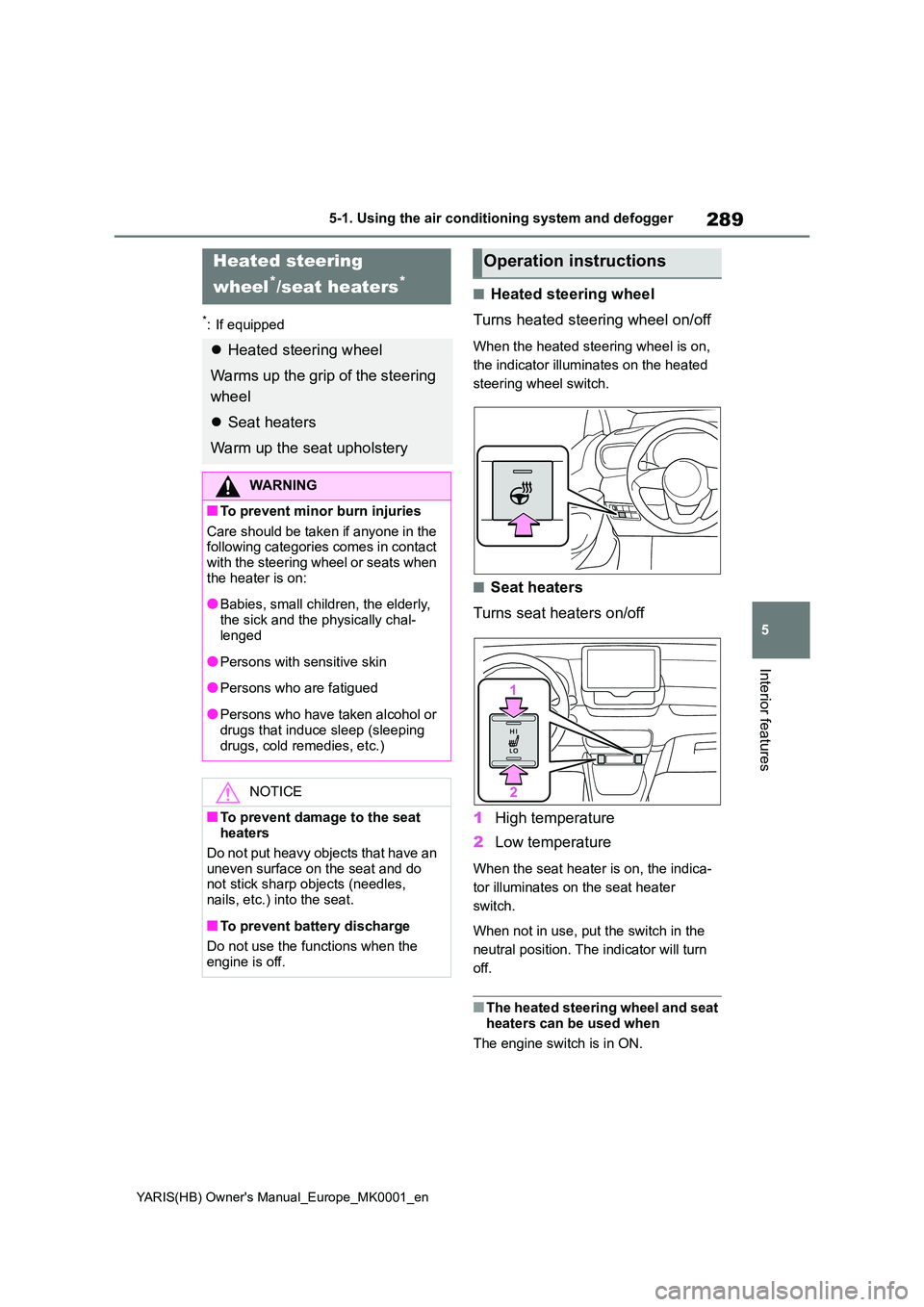
■Heated steering wheel
Turns heated steering wheel on/off
When the heated steering wheel is on,
the indicator illuminates on the heated
steering wheel switch.
■Seat heaters
Turns seat heaters on/off
1 High temperature
2 Low temperature
When the seat heater is on, the indica-
tor illuminates on the seat heater
switch.
When not in use, put the switch in the
neutral position. The indicator will turn
off.
■The heated steering wheel and seat heaters can be used when
The engine switch is in ON.
Heated steering
wheel*/seat heaters*
z Heated steering wheel
Warms up the grip of the steering
wheel
z Seat heaters
Warm up the seat upholstery
WARNING
■To prevent minor burn injuries
Care should be taken if anyone in the following categories comes in contact with the steering wheel or seats when
the heater is on:
●Babies, small children, the elderly,
the sick and the physically chal- lenged
●Persons with sensitive skin
●Persons who are fatigued
●Persons who have taken alcohol or
drugs that induce sleep (sleeping drugs, cold remedies, etc.)
NOTICE
■To prevent damage to the seat heaters
Do not put heavy objects that have an
uneven surface on the seat and do not stick sharp objects (needles, nails, etc.) into the seat.
■To prevent battery discharge
Do not use the functions when the
engine is off.
Operation instructions
Page 310 of 568
310
YARIS(HB) Owner's Manual_Europe_MK0001_en
6-1. Maintenance and care
NOTICE
●To prevent the wheels from corrod- ing, remove any dirt and store in a
place with low humidity when stor- ing the wheels.
■Cleaning the exterior lights
●Wash carefully. Do not use organic substances or scrub with a hard
brush. This may damage the surfaces of the lights.
●Do not apply wax to the surfaces of the lights.
Wax may cause damage to the lenses.
■To prevent damage to the wind-shield wiper arms
When lifting the wiper arms away
from the windshield, pull the driver side wiper arm upward first, and repeat for the passenger side. When
returning the wipers to their original position, do so from the passenger side first.
■When using an automatic car wash (vehicles with rain-sensing
windshield wipers)
Set the wiper switch to the off posi- tion. If the wiper switch is in “AUTO”,
the wipers may operate and the wiper blades may be damaged.
■When using a high pressure car wash
●Vehicles with rear view monitor sys-
tem: When washing the vehicle, do not spray the camera or its sur-rounding area directly with a high
pressure washer. Shock applied from high pressure water may cause the device to not operate
normally.
●Do not spray water directly on the
radar which is equipped behind the emblem. Otherwise it may cause the device to be damaged.
●Do not bring the nozzle tip close to boots (rubber or resin manufac-tured cover), connectors or the fol-
lowing parts. The parts may be damaged if they come into contact with high-pressure water.
• Traction related parts
• Steering parts
• Suspension parts
• Brake parts
●Keep the cleaning nozzle at least 30 cm (11.9 in.) away from the vehi-cles body. Otherwise resin section,
such as moldings and bumpers, may be deformed and damaged. Also, do not continuously hold the
nozzle in the same place.
●Do not spray the lower part of the
windshield continuously. If water enters the air conditioning system intake located near the lower part of
the windshield, the air conditioning system may not operate correctly.
Page 354 of 568
354
YARIS(HB) Owner's Manual_Europe_MK0001_en
6-3. Do-it-yourself maintenance
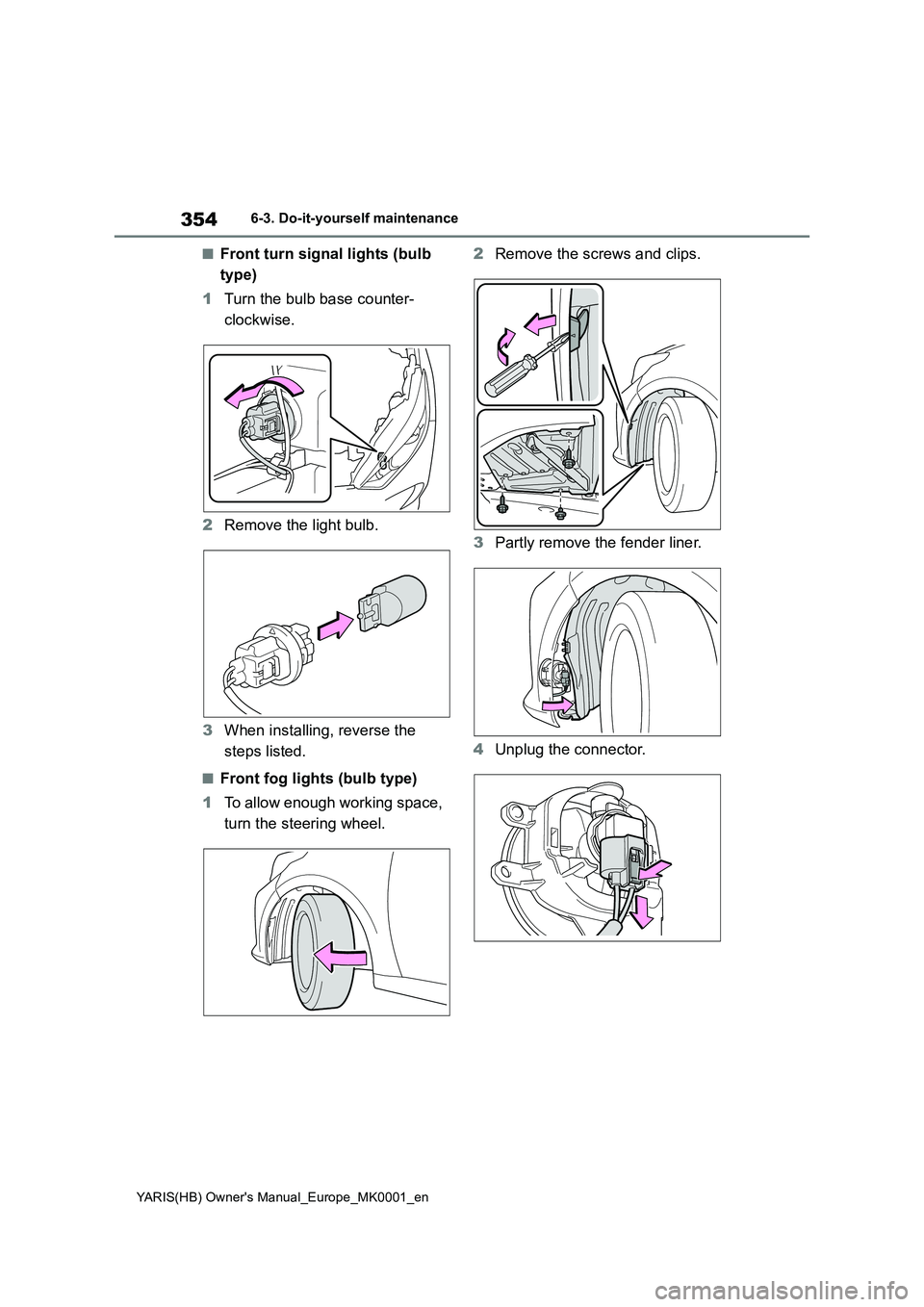
■Front turn signal lights (bulb
type)
1 Turn the bulb base counter-
clockwise.
2 Remove the light bulb.
3 When installing, reverse the
steps listed.
■Front fog lights (bulb type)
1 To allow enough working space,
turn the steering wheel.
2 Remove the screws and clips.
3 Partly remove the fender liner.
4 Unplug the connector.
Page 361 of 568
361
7
YARIS(HB) Owner's Manual_Europe_MK0001_en
7-1. Essential information
When trouble arises
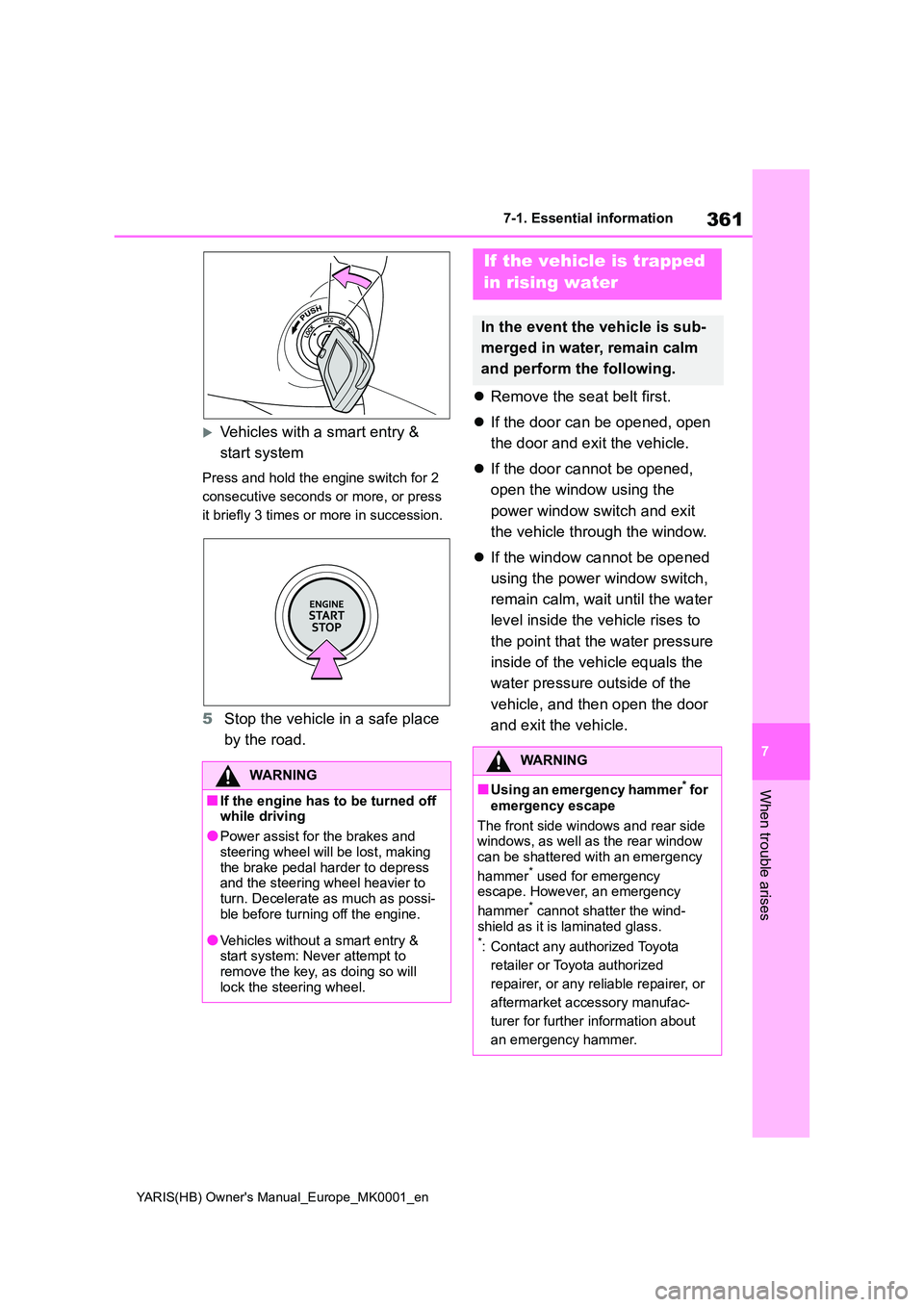
Vehicles with a smart entry &
start system
Press and hold the engine switch for 2
consecutive seconds or more, or press
it briefly 3 times or more in succession.
5 Stop the vehicle in a safe place
by the road.
z Remove the seat belt first.
z If the door can be opened, open
the door and exit the vehicle.
z If the door cannot be opened,
open the window using the
power window switch and exit
the vehicle through the window.
z If the window cannot be opened
using the power window switch,
remain calm, wait until the water
level inside the vehicle rises to
the point that the water pressure
inside of the vehicle equals the
water pressure outside of the
vehicle, and then open the door
and exit the vehicle.
WARNING
■If the engine has to be turned off while driving
●Power assist for the brakes and
steering wheel will be lost, making the brake pedal harder to depress and the steering wheel heavier to
turn. Decelerate as much as possi- ble before turning off the engine.
●Vehicles without a smart entry & start system: Never attempt to remove the key, as doing so will
lock the steering wheel.
If the vehicle is trapped
in rising water
In the event the vehicle is sub-
merged in water, remain calm
and perform the following.
WARNING
■Using an emergency hammer* for
emergency escape
The front side windows and rear side windows, as well as the rear window
can be shattered with an emergency
hammer* used for emergency escape. However, an emergency
hammer* cannot shatter the wind- shield as it is laminated glass.*: Contact any authorized Toyota
retailer or Toyota authorized
repairer, or any reliable repairer, or
aftermarket accessory manufac-
turer for further information about
an emergency hammer.
Page 363 of 568
363
7
YARIS(HB) Owner's Manual_Europe_MK0001_en
7-2. Steps to take in an emergency
When trouble arises
7-2.Ste ps to take in an emerg ency
If your vehicle needs to
be towed
If towing is necessary, we rec-
ommend having your vehicle
towed by any authorized
Toyota retailer or Toyota autho-
rized repairer, or any reliable
repairer or commercial towing
service, using a wheel-lift type
truck or flatbed truck.
Use a safety chain system for
all towing, and abide by all
state/provincial and local laws.
WARNING
Observe the following precautions. Failure to do so may result in death or serious injury.
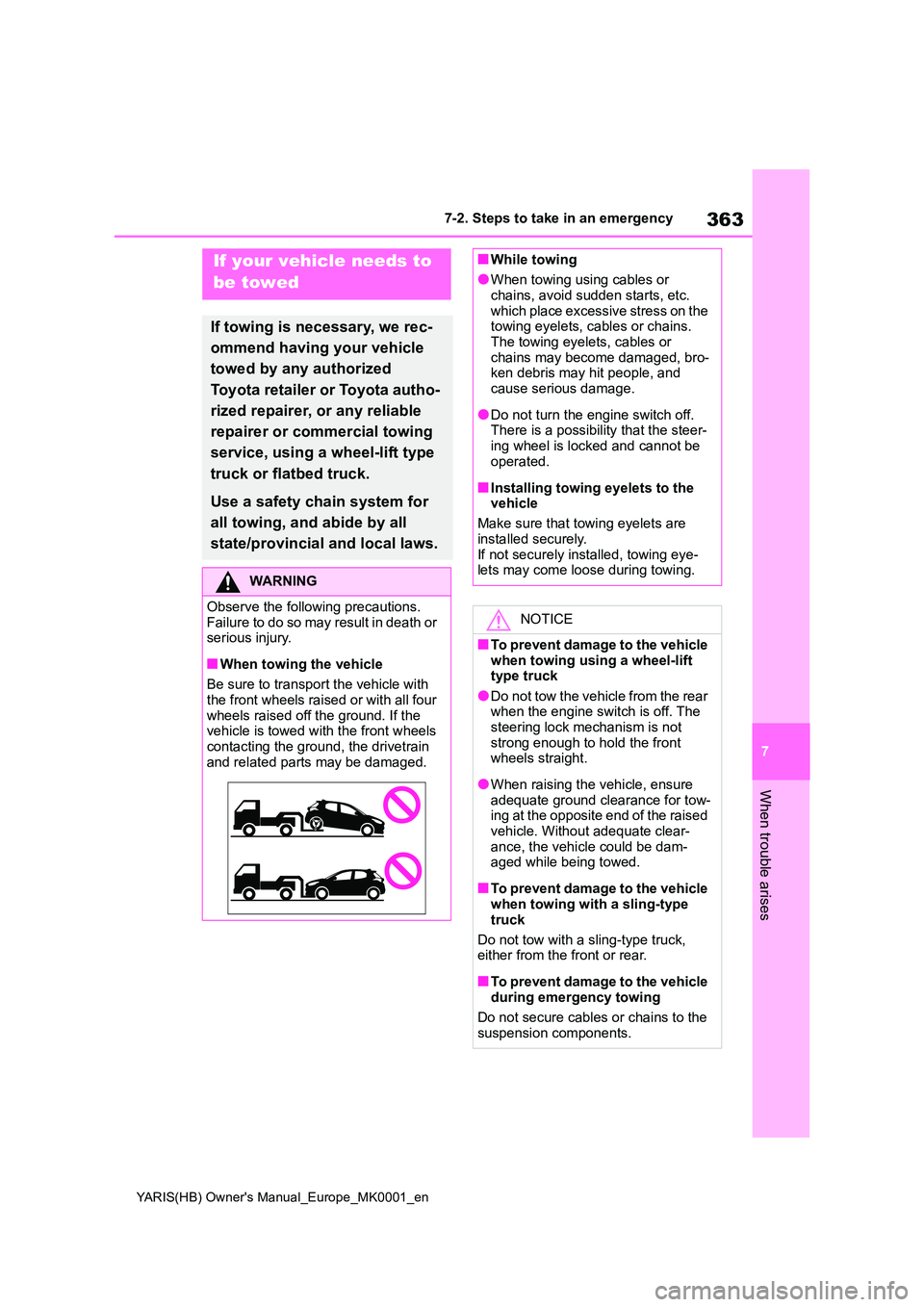
■When towing the vehicle
Be sure to transport the vehicle with
the front wheels raised or with all four wheels raised off the ground. If the vehicle is towed with the front wheels
contacting the ground, the drivetrain and related parts may be damaged.
■While towing
●When towing using cables or chains, avoid sudden starts, etc.
which place excessive stress on the towing eyelets, cables or chains. The towing eyelets, cables or
chains may become damaged, bro- ken debris may hit people, and cause serious damage.
●Do not turn the engine switch off.There is a possibility that the steer-
ing wheel is locked and cannot be operated.
■Installing towing eyelets to the vehicle
Make sure that towing eyelets are
installed securely. If not securely installed, towing eye-lets may come loose during towing.
NOTICE
■To prevent damage to the vehicle when towing using a wheel-lift type truck
●Do not tow the vehicle from the rear when the engine switch is off. The steering lock mechanism is not
strong enough to hold the front wheels straight.
●When raising the vehicle, ensure adequate ground clearance for tow-ing at the opposite end of the raised
vehicle. Without adequate clear- ance, the vehicle could be dam-aged while being towed.
■To prevent damage to the vehicle when towing with a sling-type
truck
Do not tow with a sling-type truck, either from the front or rear.
■To prevent damage to the vehicle during emergency towing
Do not secure cables or chains to the suspension components.
Page 365 of 568
365
7
YARIS(HB) Owner's Manual_Europe_MK0001_en
7-2. Steps to take in an emergency
When trouble arises
If a tow truck is not available in an
emergency, your vehicle may be
temporarily towed using cables or
chains secured to the emergency
towing eyelets. This should only be
attempted on hard surfaced roads
for at most 80 km (50 miles) at
under 30 km/h (18 mph).
A driver must be in the vehicle to
steer and operate the brakes. The
vehicle’s wheels, drive train, axles,
steering and brakes must be in
good condition.
For vehicles with a Multidrive, only
the front towing eyelets may be
used.
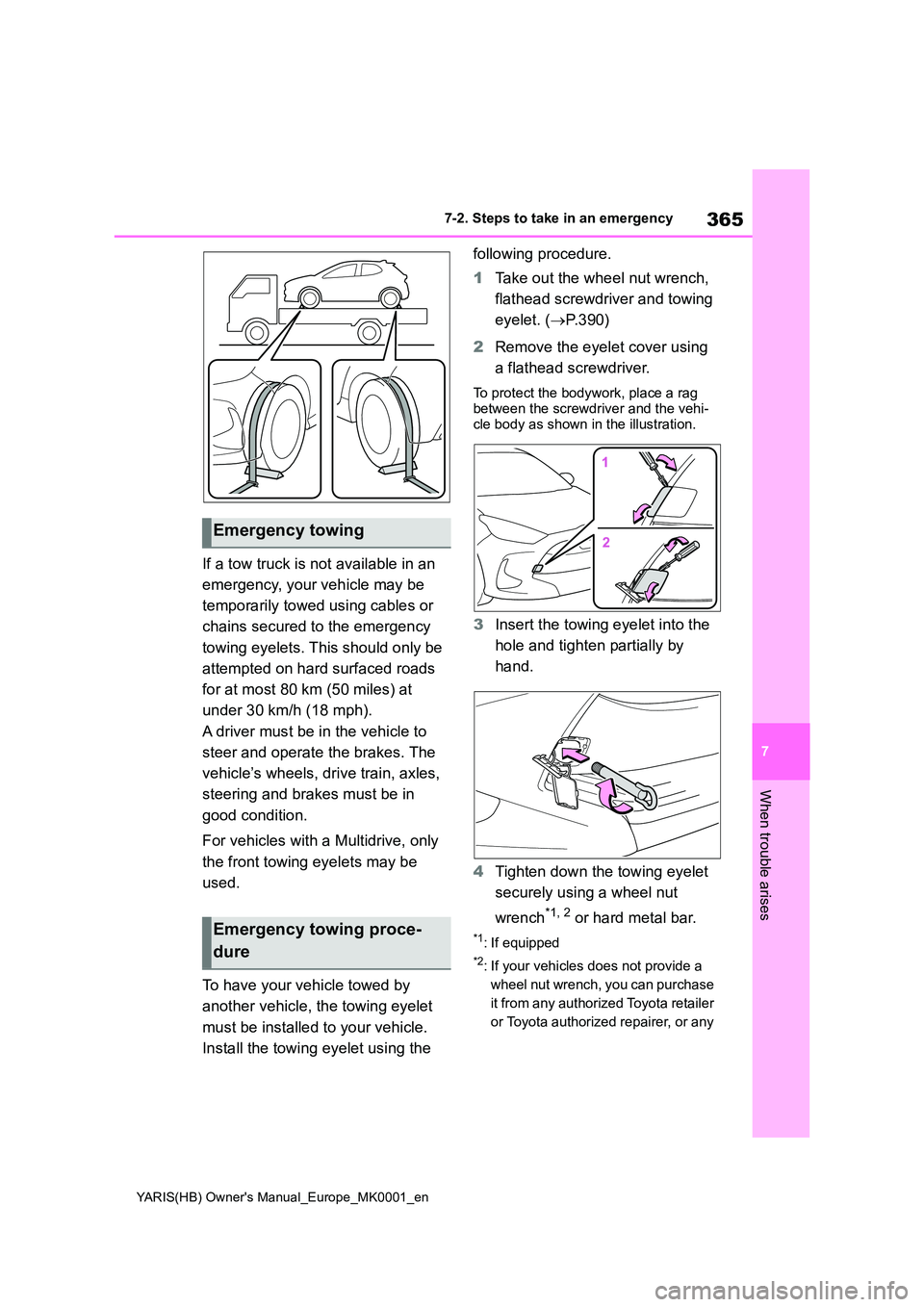
To have your vehicle towed by
another vehicle, the towing eyelet
must be installed to your vehicle.
Install the towing eyelet using the
following procedure.
1 Take out the wheel nut wrench,
flathead screwdriver and towing
eyelet. ( →P.390)
2 Remove the eyelet cover using
a flathead screwdriver.
To protect the bodywork, place a rag
between the screwdriver and the vehi- cle body as shown in the illustration.
3 Insert the towing eyelet into the
hole and tighten partially by
hand.
4 Tighten down the towing eyelet
securely using a wheel nut
wrench*1, 2 or hard metal bar.
*1: If equipped
*2: If your vehicles does not provide a
wheel nut wrench, you can purchase
it from any authorized Toyota retailer
or Toyota authorized repairer, or any
Emergency towing
Emergency towing proce-
dure
Page 366 of 568
366
YARIS(HB) Owner's Manual_Europe_MK0001_en
7-2. Steps to take in an emergency
reliable repairer.
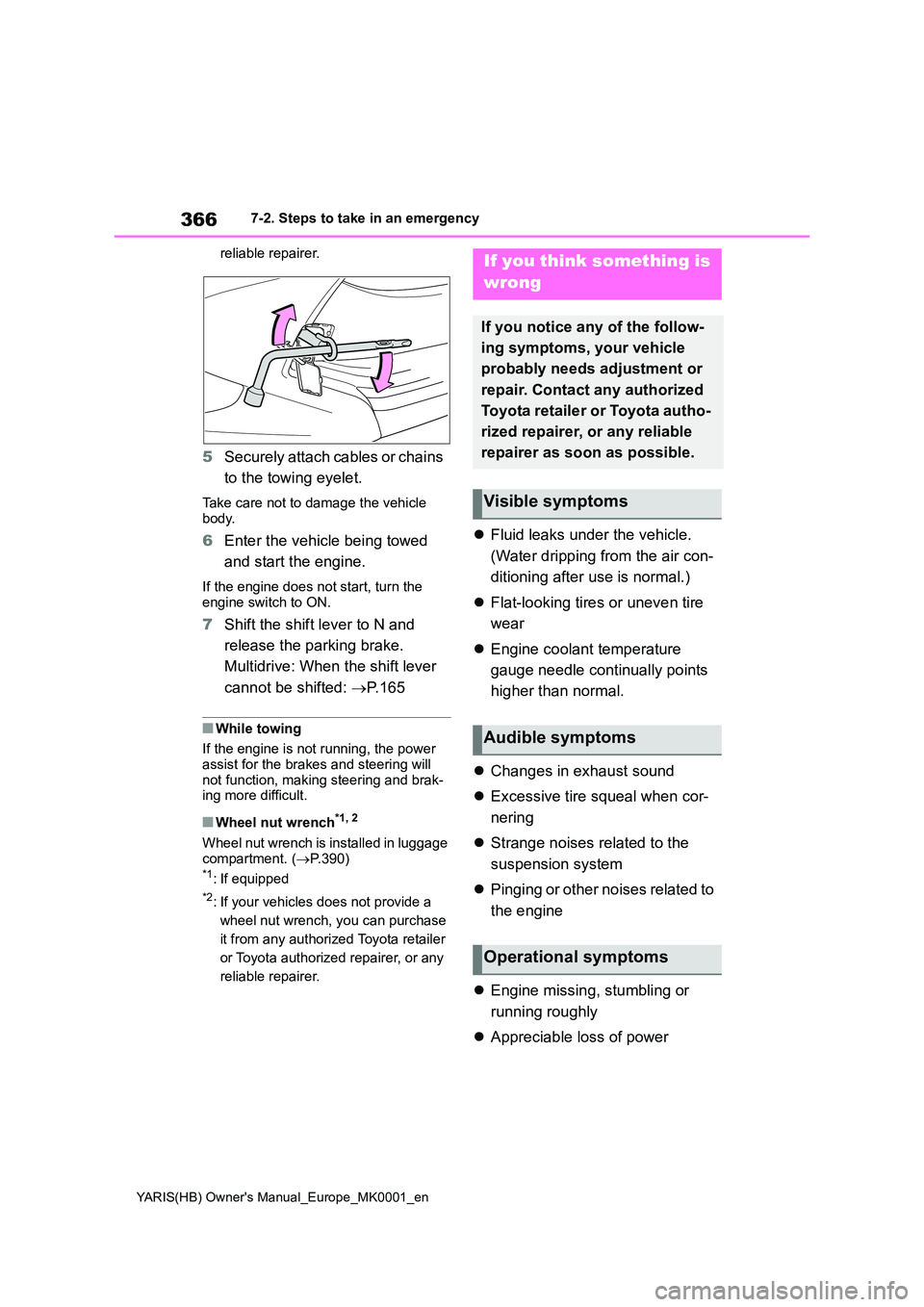
5 Securely attach cables or chains
to the towing eyelet.
Take care not to damage the vehicle body.
6 Enter the vehicle being towed
and start the engine.
If the engine does not start, turn the engine switch to ON.
7 Shift the shift lever to N and
release the parking brake.
Multidrive: When the shift lever
cannot be shifted: →P. 1 6 5
■While towing
If the engine is not running, the power
assist for the brakes and steering will not function, making steering and brak-ing more difficult.
■Wheel nut wrench*1, 2
Wheel nut wrench is installed in luggage
compartment. ( →P.390)*1: If equipped
*2: If your vehicles does not provide a
wheel nut wrench, you can purchase
it from any authorized Toyota retailer
or Toyota authorized repairer, or any
reliable repairer.
z Fluid leaks under the vehicle.
(Water dripping from the air con-
ditioning after use is normal.)
z Flat-looking tires or uneven tire
wear
z Engine coolant temperature
gauge needle continually points
higher than normal.
z Changes in exhaust sound
z Excessive tire squeal when cor-
nering
z Strange noises related to the
suspension system
z Pinging or other noises related to
the engine
z Engine missing, stumbling or
running roughly
z Appreciable loss of power
If you think something is
wrong
If you notice any of the follow-
ing symptoms, your vehicle
probably needs adjustment or
repair. Contact any authorized
Toyota retailer or Toyota autho-
rized repairer, or any reliable
repairer as soon as possible.
Visible symptoms
Audible symptoms
Operational symptoms
Page 370 of 568
370
YARIS(HB) Owner's Manual_Europe_MK0001_en
7-2. Steps to take in an emergency
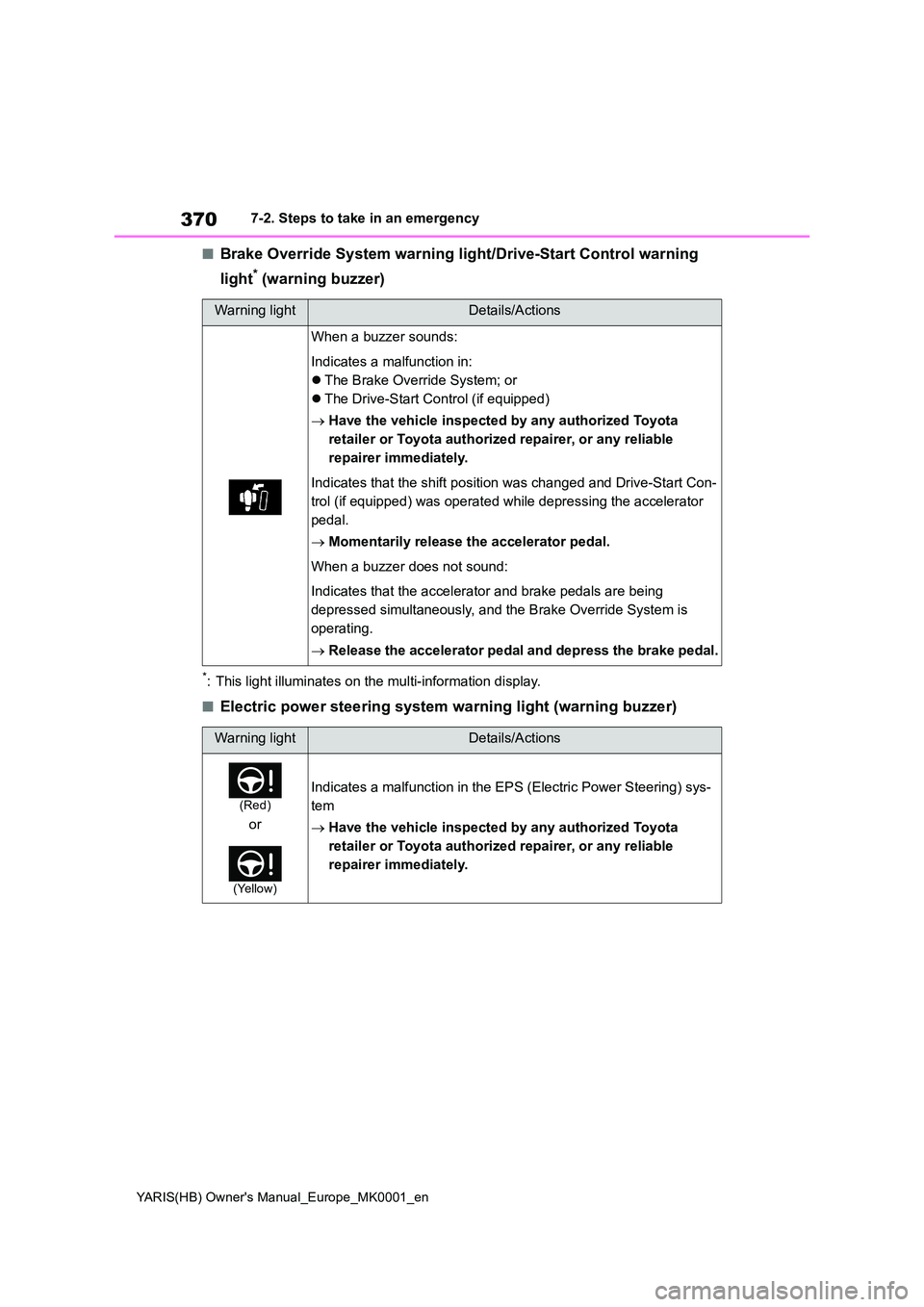
■Brake Override System warning light/Drive-Start Control warning
light* (warning buzzer)
*: This light illuminates on the multi-information display.
■Electric power steering system warning light (warning buzzer)
Warning lightDetails/Actions
When a buzzer sounds:
Indicates a malfunction in:
z The Brake Override System; or
z The Drive-Start Control (if equipped)
→ Have the vehicle inspected by any authorized Toyota
retailer or Toyota authorized repairer, or any reliable
repairer immediately.
Indicates that the shift position was changed and Drive-Start Con-
trol (if equipped) was operated while depressing the accelerator
pedal.
→ Momentarily release the accelerator pedal.
When a buzzer does not sound:
Indicates that the accelerator and brake pedals are being
depressed simultaneously, and the Brake Override System is
operating.
→ Release the accelerator pedal and depress the brake pedal.
Warning lightDetails/Actions
(Red)
or
(Yellow)
Indicates a malfunction in the EPS (Electric Power Steering) sys-
tem
→ Have the vehicle inspected by any authorized Toyota
retailer or Toyota authorized repairer, or any reliable
repairer immediately.
Page 375 of 568
375
7
YARIS(HB) Owner's Manual_Europe_MK0001_en
7-2. Steps to take in an emergency
When trouble arises
ble.
■Electric power steering system
warning light (warning buzzer)
When the battery charge becomes insufficient or the voltage temporarily
drops, the electric power steering sys- tem warning light may come on and the warning buzzer may sound.
■When the tire pressure warning
light comes on
Inspect the tires to check if a tire is punctured.
If a tire is punctured: →P.379, 389
If none of the tires are punctured: Turn the engine switch off then turn it to
ON. Check if the tire pressure warning light comes on or blinks.
If the tire pressure warning light blinks
for approximately 1 minute then stays on
There may be a malfunction in the tire
pressure warning system. Have the vehicle inspected by any authorized Toyota retailer or Toyota authorized
repairer, or any reliable repairer immedi- ately.
If the tire pressure warning light
comes on
1 After the temperature of the tires has lowered sufficiently, check the infla-tion pressure of each tire and adjust
them to the specified level.
2 If the warning light does not turn off even after several minutes have elapsed, check that the inflation
pressure of each tire is at the speci- fied level and perform initialization. ( →P.334)
■The tire pressure warning light may
come on due to natural causes
The tire pressure warning light may come on due to natural causes such as
natural air leaks and tire inflation pres- sure changes caused by temperature. In this case, adjusting the tire inflation
pressure will turn off the warning light (after a few minutes).
■When a tire is replaced with a spare
tire
Vehicles with a compact spare tire: The compact spare tire is not equipped with
a tire pressure warning valve and trans- mitter. If a tire goes flat, the tire pressure warning light will not turn off even
though the flat tire has been replaced with the spare tire. Replace the spare tire with the repaired tire and adjust the
tire inflation pressure. The tire pressure warning light will go off after a few min-utes.
Vehicles with a full-size spare tire: The spare tire is also equipped with a tire pressure warning valve and transmitter.
The tire pressure warning light will turn on if the tire inflation pressure of the spare tire is low. If a tire goes flat, the
tire pressure warning light will not turn off even though the flat tire has been replaced with the spare tire. Replace the
spare tire with the repaired tire and adjust the tire inflation pressure. The tire pressure warning light will go off after a
few minutes.
■Conditions that the tire pressure warning system may not function properly
→ P. 3 3 3
WARNING
■If both the ABS and the brake system warning lights remain on
Stop your vehicle in a safe place immediately and contact any autho-rized Toyota retailer or Toyota autho-
rized repairer, or any reliable repairer. The vehicle will become extremely unstable during braking, and the ABS
system may fail, which could cause an accident resulting in death or seri-ous injury.
Page 376 of 568
376
YARIS(HB) Owner's Manual_Europe_MK0001_en
7-2. Steps to take in an emergency
WARNING
■When the electric power steer- ing system warning light comes
on
When the light comes on yellow, the assist to the power steering is
restricted. When the light comes on red, the assist to the power steering is lost and handling operations of the
steering wheel become extremely heavy.When steering wheel operations are
heavier than usual, grip the steering wheel firmly and operate it using more force than usual.
■If the tire pressure warning light comes on
Be sure to observe the following pre- cautions.Failure to do so could cause a loss of
vehicle control and result in death or serious injury.
●Stop your vehicle in a safe place as soon as possible. Adjust the tire inflation pressure immediately.
●Vehicles with a compact spare tire and full-size spare tire: If the tire
pressure warning light comes on even after tire inflation pressure adjustment, it is probable that you
have a flat tire. Check the tires. If a tire is flat, change it with the spare tire and have the flat tire repaired
by the nearest any authorized Toyota retailer or Toyota authorized repairer, or any reliable repairer.
●Vehicles with emergency tire punc-ture repair kit: If the tire pressure
warning light comes on even after tire inflation pressure adjustment, it is probable that you have a flat tire.
Check the tires. If a tire is flat, repair the flat tire by using emergency tire puncture repair kit.
●Avoid abrupt maneuvering and braking.If the vehicle tires deteriorate, you
could lose control of the steering wheel or the brakes.
■If a blowout or sudden air leak-age should occur
The tire pressure warning system
may not activate immediately.
NOTICE
■To ensure the tire pressure warn- ing system operates properly
Do not install tires with different speci- fications or makers, as the tire pres-sure warning system may not operate
properly.