steering wheel TOYOTA YARIS CROSS 2022 User Guide
[x] Cancel search | Manufacturer: TOYOTA, Model Year: 2022, Model line: YARIS CROSS, Model: TOYOTA YARIS CROSS 2022Pages: 618, PDF Size: 130.77 MB
Page 111 of 618
109
2
CV Owner's Manual_Europe_M52N20_en
2-1. Instrument cluster
Vehicle status information and indicators
ing state of a relevant system.
PCS (Pre-Collision System) (if
equipped) ( P.217)
LTA (Lane Tracing Assist) (if
equipped) ( P.228)
PKSB (Parking Support Brake)
(if equipped) ( P.289)
Brake Override System
( P.160)
Drive-Start Control (if equipped)
( P.165)
Details of content displayed on the
head-up display may differ from that
displayed on the multi-information dis-
play. For details, refer to the explana-
tion of each system.
■ icon
Displayed when a warning mes-
sage is displayed on the multi-infor-
mation display. ( P.413)
■Warning message
Some warning messages are dis-
played when necessary, according
to certain conditions.
Details of content displayed on the
head-up display may differ from that
displayed on the multi-information dis-
play.
■Audio system operation status
(if equipped)
Displayed when an audio remote
control switch on the steering wheel
is operated.
■Hands-free system status (if
equipped)
Displayed when the hands-free
system is operated.
■When a pop-up display is displayed
When a pop-up display is displayed, a current display may no longer be dis-played. In this case, the display will
return after the pop-up display disap- pears.
■Tachometer
Displays the engine speed in revo-
lutions per minute.
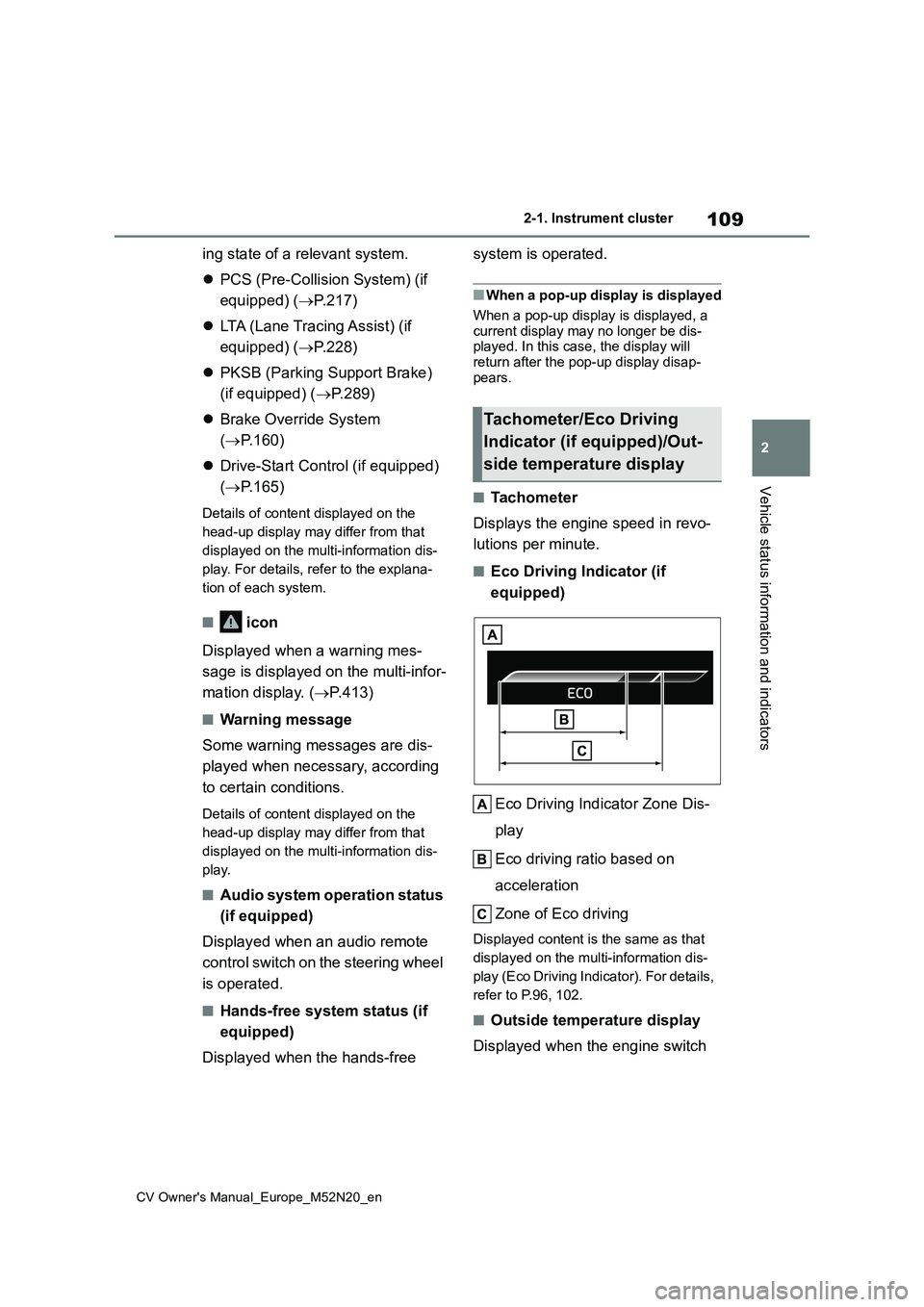
■Eco Driving Indicator (if
equipped)
Eco Driving Indicator Zone Dis-
play
Eco driving ratio based on
acceleration
Zone of Eco driving
Displayed content is the same as that
displayed on the multi-information dis-
play (Eco Driving Indicator). For details,
refer to P.96, 102.
■Outside temperature display
Displayed when the engine switch
Tachometer/Eco Driving
Indicator (if equipped)/Out-
side temperature display
Page 115 of 618
3
113
CV Owner's Manual_Europe_M52N20_en
3
Before driving
Before driving
3-1. Key information
Keys.................................. 114
3-2. Opening, closing and locking
the doors
Side doors ........................ 119
Back door ......................... 123
Smart entry & start system 136
3-3. Adjusting the seats
Front seats........................ 141
Rear seats ........................ 142
Head restraints ................. 144
3-4. Adjusting the steering wheel
and mirrors
Steering wheel .................. 148
Inside rear view mirror ...... 149
Outside rear view mirrors . 150
3-5. Opening and closing the win-
dows
Power windows................. 153
Page 150 of 618
148
CV Owner's Manual_Europe_M52N20_en
3-4. Adjusting the steering wheel and mirrors
3-4.Adjusting the steering whe el an d mirrors
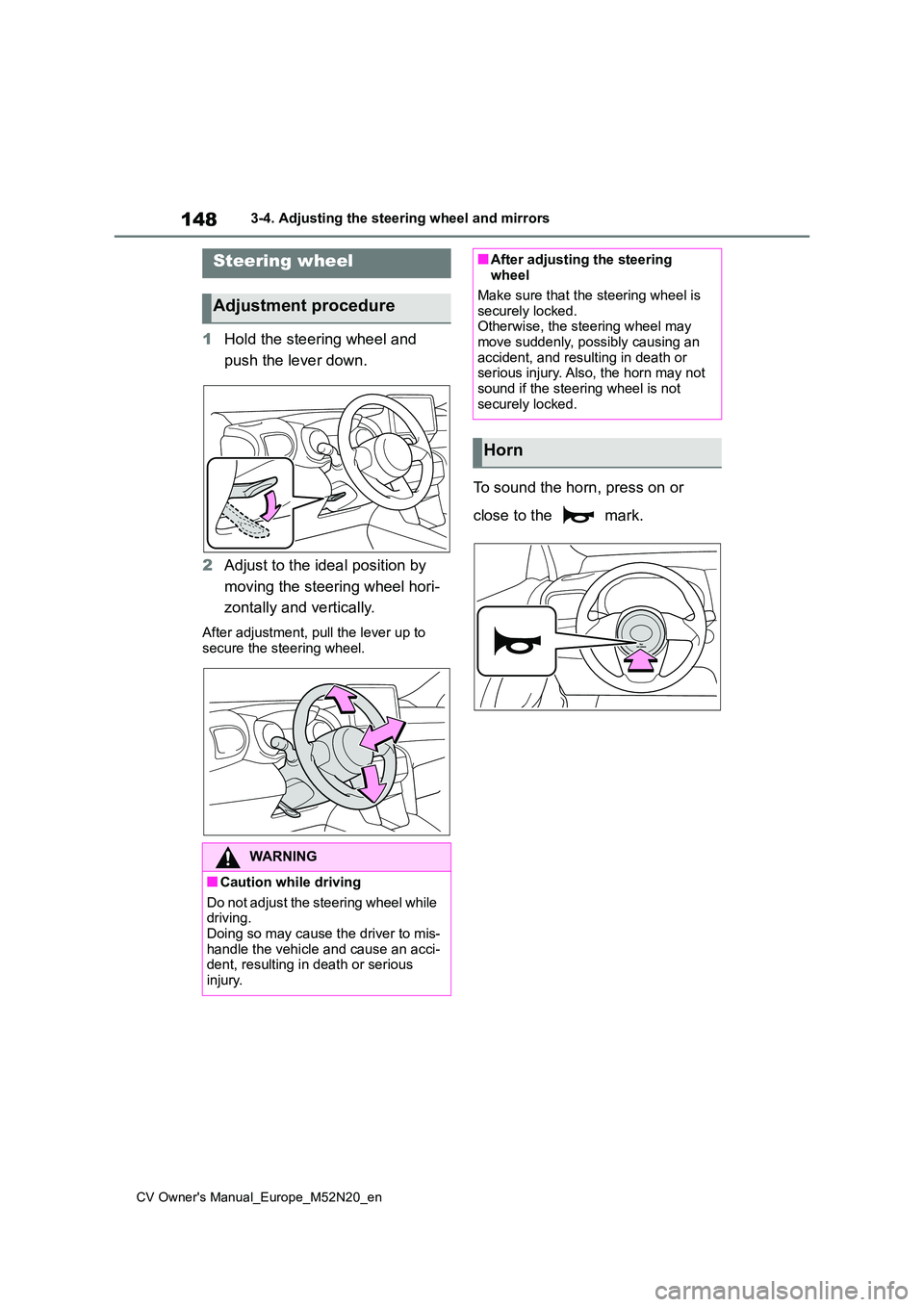
1Hold the steering wheel and
push the lever down.
2 Adjust to the ideal position by
moving the steering wheel hori-
zontally and vertically.
After adjustment, pull the lever up to
secure the steering wheel.
To sound the horn, press on or
close to the mark.
Steering wheel
Adjustment procedure
WARNING
■Caution while driving
Do not adjust the steering wheel while driving.Doing so may cause the driver to mis-
handle the vehicle and cause an acci- dent, resulting in death or serious injury.
■After adjusting the steering wheel
Make sure that the steering wheel is
securely locked. Otherwise, the steering wheel may move suddenly, possibly causing an
accident, and resulting in death or serious injury. Also, the horn may not sound if the steering wheel is not
securely locked.
Horn
Page 151 of 618
149
3
CV Owner's Manual_Europe_M52N20_en
3-4. Adjusting the steering wheel and mirrors
Before driving
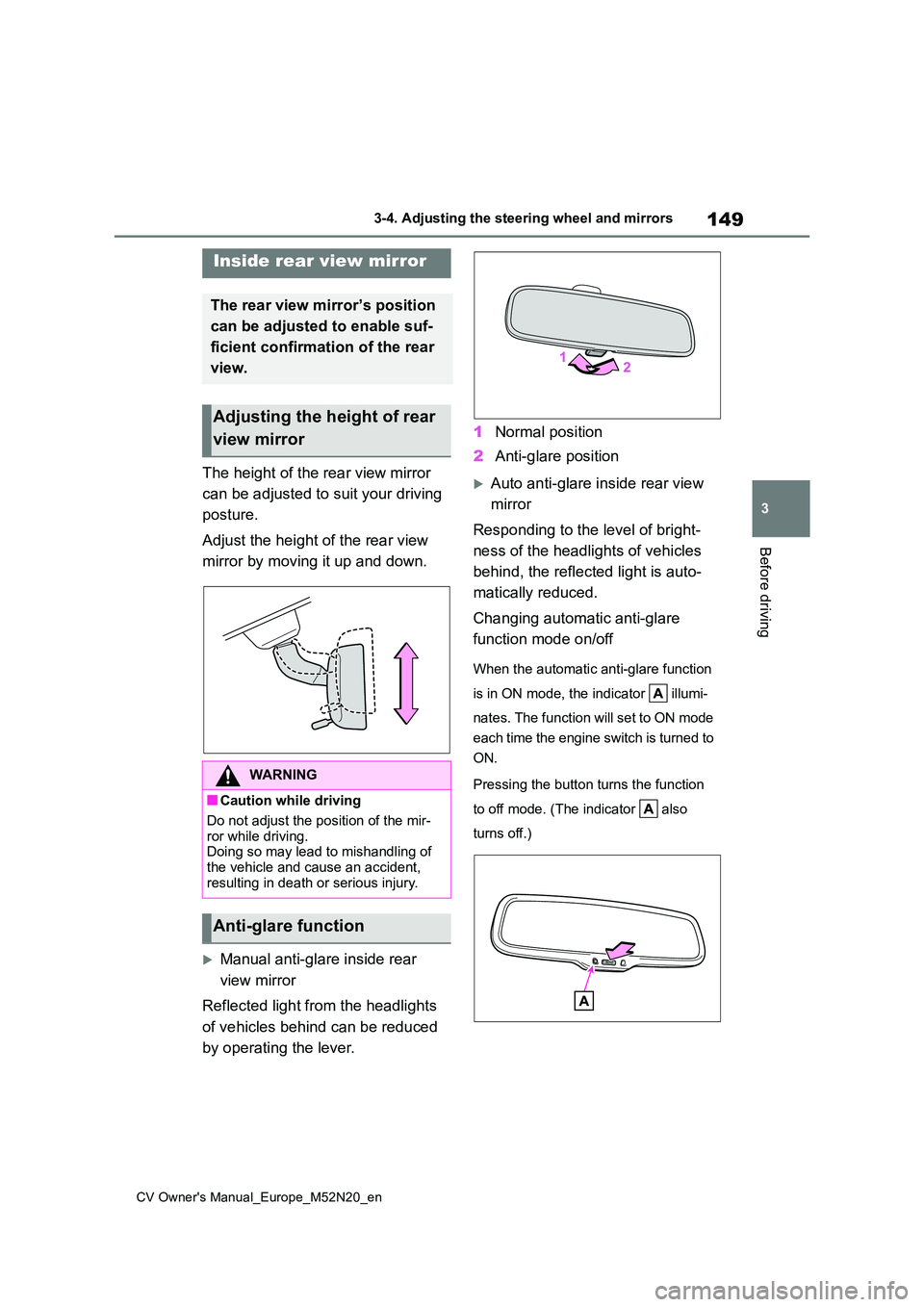
The height of the rear view mirror
can be adjusted to suit your driving
posture.
Adjust the height of the rear view
mirror by moving it up and down.
Manual anti-glare inside rear
view mirror
Reflected light from the headlights
of vehicles behind can be reduced
by operating the lever.
1 Normal position
2 Anti-glare position
Auto anti-glare inside rear view
mirror
Responding to the level of bright-
ness of the headlights of vehicles
behind, the reflected light is auto-
matically reduced.
Changing automatic anti-glare
function mode on/off
When the automatic anti-glare function
is in ON mode, the indicator illumi-
nates. The function will set to ON mode
each time the engine switch is turned to
ON.
Pressing the button turns the function
to off mode. (The indicator also
turns off.)
Inside rear view mirror
The rear view mirror’s position
can be adjusted to enable suf-
ficient confirmation of the rear
view.
Adjusting the height of rear
view mirror
WARNING
■Caution while driving
Do not adjust the position of the mir-
ror while driving. Doing so may lead to mishandling of the vehicle and cause an accident,
resulting in death or serious injury.
Anti-glare function
Page 152 of 618
150
CV Owner's Manual_Europe_M52N20_en
3-4. Adjusting the steering wheel and mirrors
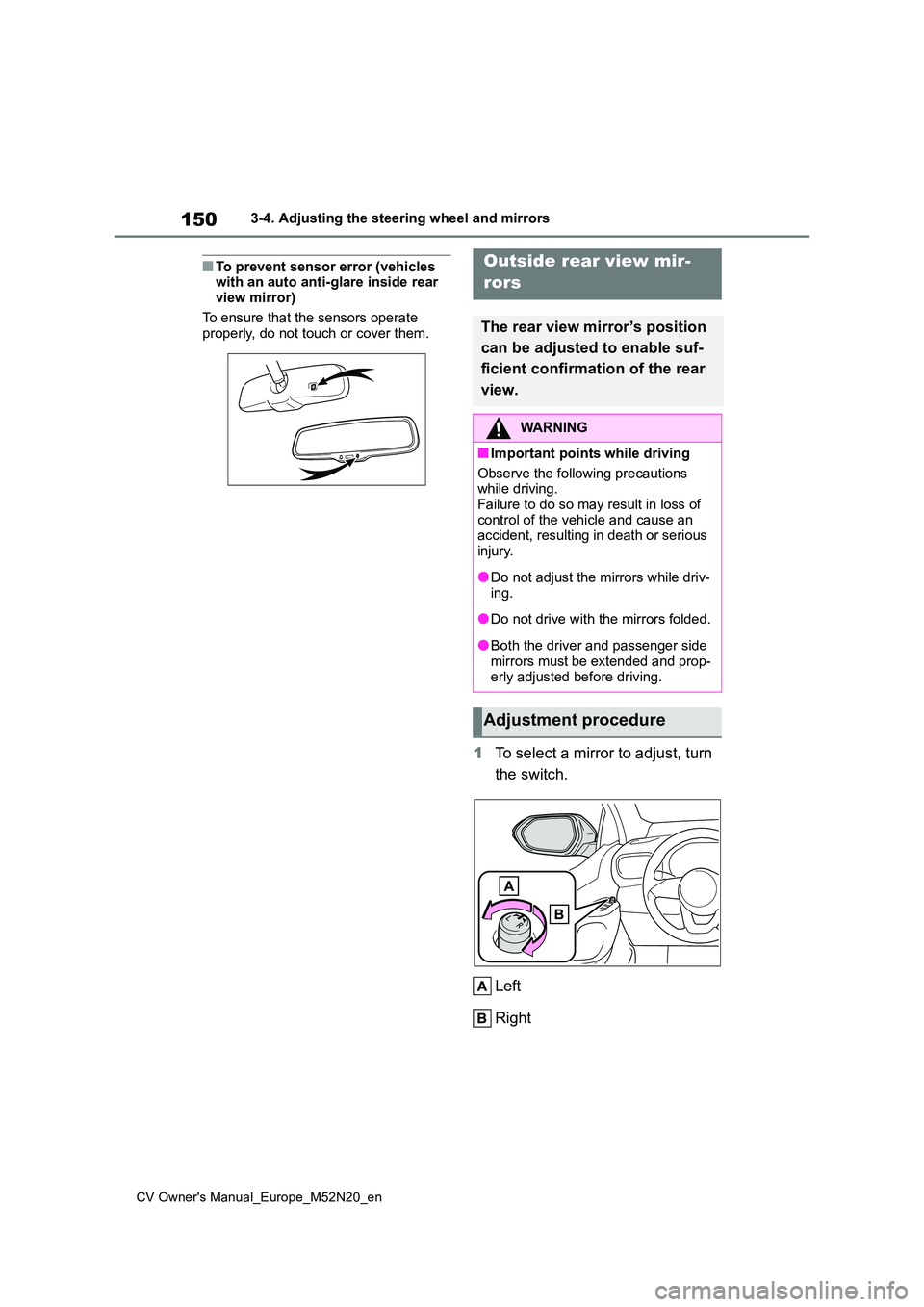
■To prevent sensor error (vehicles with an auto anti-glare inside rear
view mirror)
To ensure that the sensors operate properly, do not touch or cover them.
1 To select a mirror to adjust, turn
the switch.
Left
Right
Outside rear view mir-
rors
The rear view mirror’s position
can be adjusted to enable suf-
ficient confirmation of the rear
view.
WARNING
■Important points while driving
Observe the following precautions while driving.
Failure to do so may result in loss of control of the vehicle and cause an accident, resulting in death or serious
injury.
●Do not adjust the mirrors while driv-
ing.
●Do not drive with the mirrors folded.
●Both the driver and passenger side mirrors must be extended and prop-
erly adjusted before driving.
Adjustment procedure
Page 153 of 618
151
3
CV Owner's Manual_Europe_M52N20_en
3-4. Adjusting the steering wheel and mirrors
Before driving
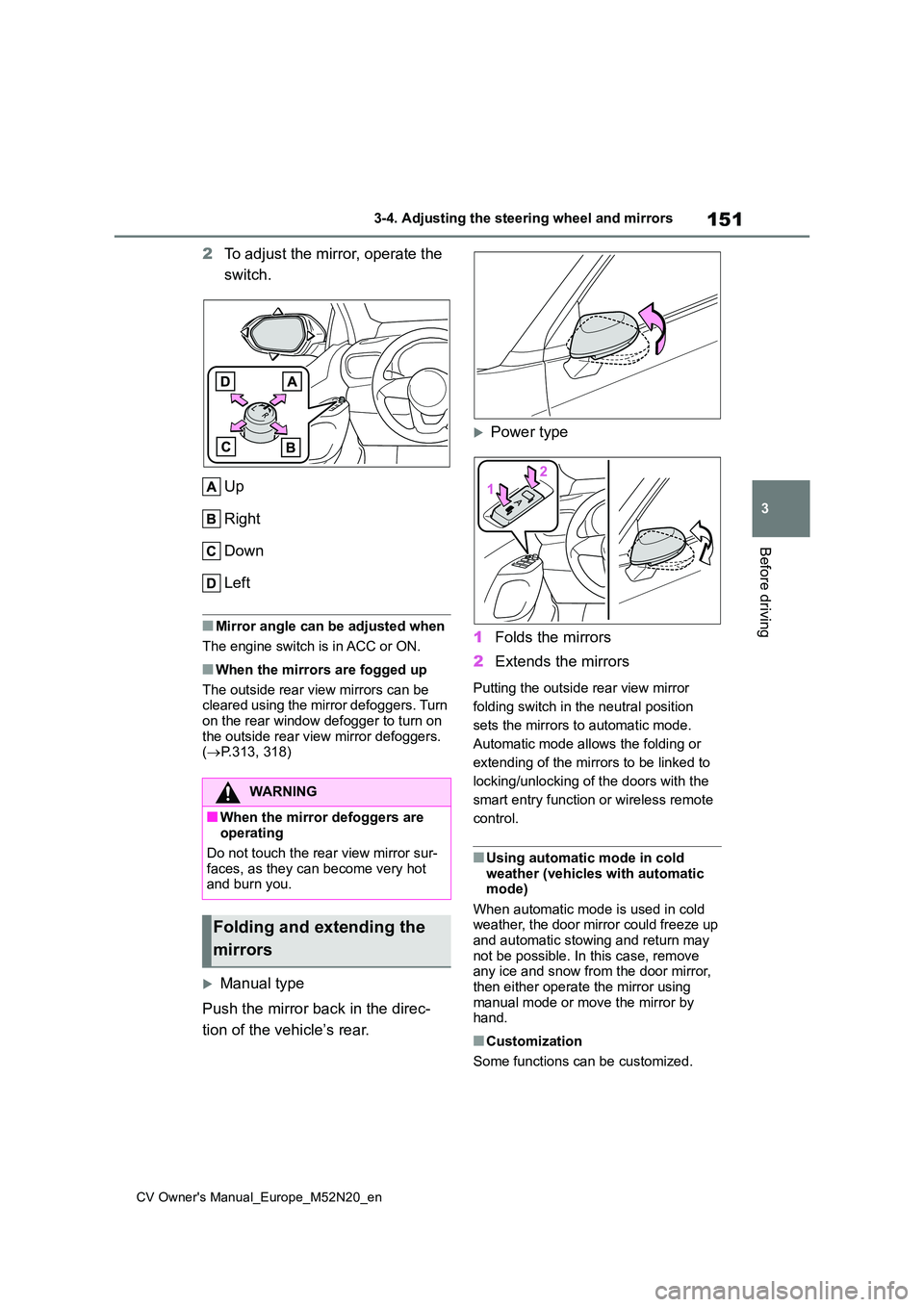
2To adjust the mirror, operate the
switch.
Up
Right
Down
Left
■Mirror angle can be adjusted when
The engine switch is in ACC or ON.
■When the mirrors are fogged up
The outside rear view mirrors can be cleared using the mirror defoggers. Turn
on the rear window defogger to turn on the outside rear view mirror defoggers. ( P.313, 318)
Manual type
Push the mirror back in the direc-
tion of the vehicle’s rear.
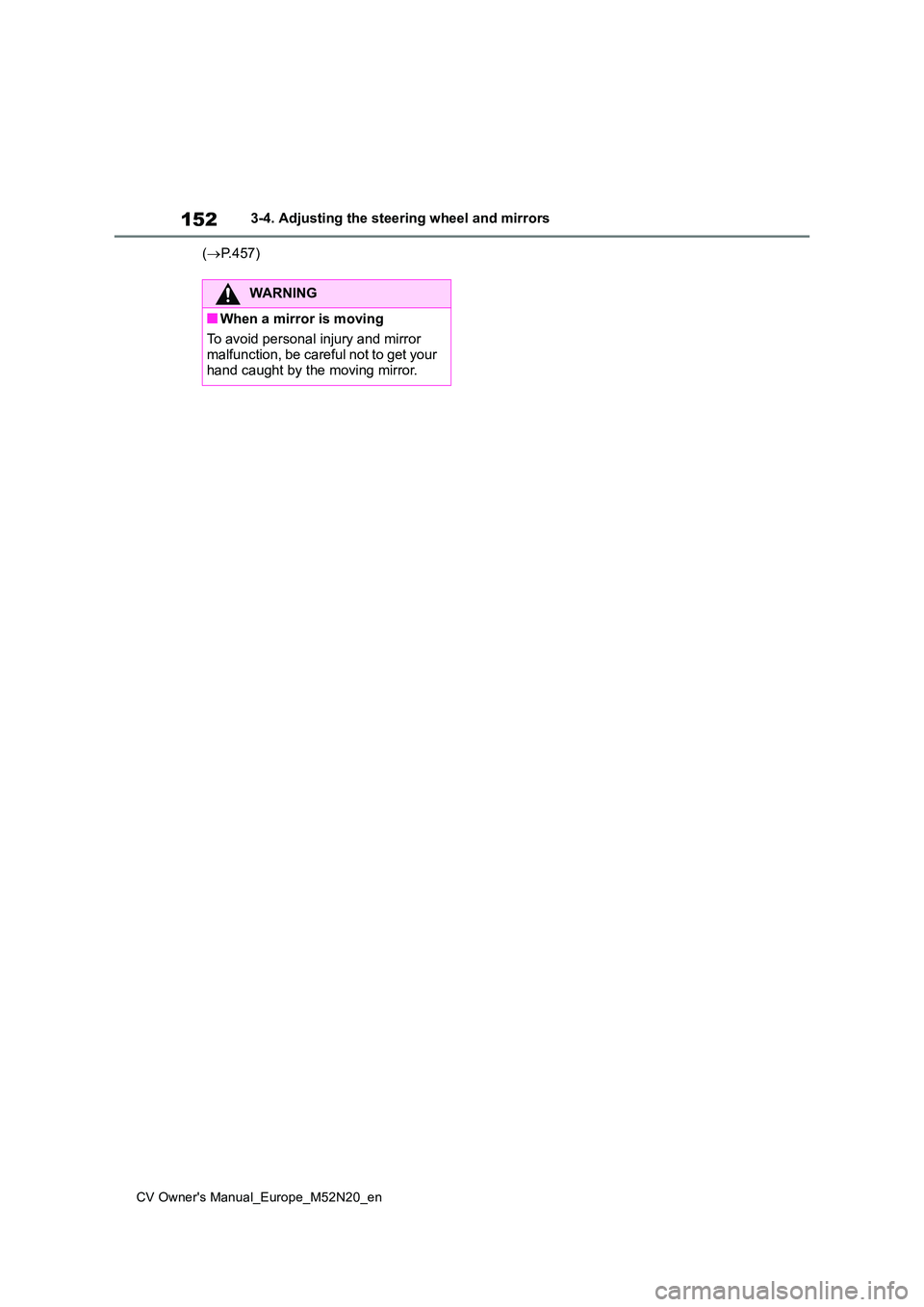
Power type
1 Folds the mirrors
2 Extends the mirrors
Putting the outside rear view mirror
folding switch in the neutral position
sets the mirrors to automatic mode.
Automatic mode allows the folding or
extending of the mirrors to be linked to
locking/unlocking of the doors with the
smart entry function or wireless remote
control.
■Using automatic mode in cold weather (vehicles with automatic mode)
When automatic mode is used in cold weather, the door mirror could freeze up and automatic stowing and return may
not be possible. In this case, remove any ice and snow from the door mirror, then either operate the mirror using
manual mode or move the mirror by hand.
■Customization
Some functions can be customized.
WARNING
■When the mirror defoggers are operating
Do not touch the rear view mirror sur-
faces, as they can become very hot and burn you.
Folding and extending the
mirrors
Page 154 of 618
152
CV Owner's Manual_Europe_M52N20_en
3-4. Adjusting the steering wheel and mirrors
( P.457)
WARNING
■When a mirror is moving
To avoid personal injury and mirror malfunction, be careful not to get your
hand caught by the moving mirror.
Page 161 of 618
159
4
CV Owner's Manual_Europe_M52N20_en
4-1. Before driving
Driving
3Turn the engine switch to OFF
to stop the engine.
4 Slowly release the brake pedal.
5 Lock the door, making sure that
you have the key on your per-
son.
If parking on a hill, block the wheels as needed.
Manual transmission
1 While depressing the clutch
pedal, depress the brake pedal.
2 Set the parking brake. (P.186)
Check that the parking brake indicator is illuminated.
3 Shift the shift lever to N.
( P.183)
If parking on a hill, shift the shift lever to 1 or R and block the wheels as needed.
4 Turn the engine switch to OFF
to stop the engine.
5 Slowly release the brake pedal.
6 Lock the door, making sure that
you have the key on your per-
son.
■Starting off on a steep uphill
Multidrive
1 With the brake pedal depressed,
shift the shift lever to D.
2 Pull the parking brake switch
and parking brake is set manu-
ally. ( P.186)
3 Release the brake pedal and
gently depress the accelerator
pedal to accelerate the vehicle.
4 Press the parking brake switch
and parking brake is released
manually. ( P. 1 8 6 )
Parking brake automatic release func- tion. ( P.188)
Manual transmission
1 With the brake pedal depressed,
shift the shift lever to 1.
2 Pull the parking brake switch
and parking brake is set manu-
ally. ( P.186)
3 Lightly depress the accelerator
pedal at the same time as grad-
ually releasing the clutch pedal.
4 Press the parking brake switch
and parking brake is released
manually. ( P. 1 8 6 )
Parking brake automatic release func-
tion. ( P.188)
■Driving in the rain
●Drive carefully when it is raining,
because visibility will be reduced, the windows may become fogged-up, and the road will be slippery.
●Drive carefully when it starts to rain, because the road surface will be
especially slippery.
●Refrain from high speeds when driv-
ing on an expressway in the rain, because there may be a layer of water between the tires and the road sur-
face, preventing the steering and brakes from operating properly.
■Engine speed while driving (vehi-cles with a Multidrive)
In the following conditions, the engine speed may become high while driving. This is due to automatic up-shifting con-
trol or down-shifting implementation to meet driving conditions. It does not indi-cate sudden acceleration.
Page 163 of 618
161
4
CV Owner's Manual_Europe_M52N20_en
4-1. Before driving
Driving
WARNING
●During normal driving, do not turn off the engine. Turning the engine
off while driving will not cause loss of steering or braking control, but the power assist to these systems
will be lost. This will make it more difficult to steer and brake, so you should pull over and stop the vehi-
cle as soon as it is safe to do so. However, in the event of an emer-gency, such as if it becomes impos-
sible to stop the vehicle in the normal way: P. 3 9 4
●Use engine braking (downshift) to maintain a safe speed when driving down a steep hill.
Using the brakes continuously may cause the brakes to overheat and lose effectiveness. ( P.179, 183)
●Do not adjust the positions of the steering wheel, the seat, or the
inside or outside rear view mirrors while driving.Doing so may result in a loss of
vehicle control.
●Always check that all passengers’
arms, heads or other parts of their body are not outside the vehicle.
■When driving on slippery road surfaces
●Sudden braking, acceleration and
steering may cause tire slippage and reduce your ability to control the vehicle.
●Sudden acceleration, engine brak-ing due to shifting, or changes in
engine speed could cause the vehi- cle to skid.
●After driving through a puddle, lightly depress the brake pedal to make sure that the brakes are func-
tioning properly. Wet brake pads may prevent the brakes from func-tioning properly. If the brakes on
only one side are wet and not func- tioning properly, steering control may be affected.
■When shifting the shift lever
●Vehicles with a Multidrive: Do not
let the vehicle roll backward while a forward driving position is selected, or roll forward while the shift lever is
in R. Doing so may cause the engine to stall or lead to poor brake and
steering performance, resulting in an accident or damage to the vehi-cle.
●Vehicles with a Multidrive: Do not shift the shift lever to P while the
vehicle is moving. Doing so can damage the transmis-sion and may result in a loss of
vehicle control.
●Do not shift the shift lever to R while
the vehicle is moving forward. Doing so can damage the transmis-sion and may result in a loss of
vehicle control.
●Do not shift the shift lever to a driv-
ing position while the vehicle is moving backward.Doing so can damage the transmis-
sion and may result in a loss of vehicle control.
●Moving the shift lever to N while the vehicle is moving will disengage the engine from the transmission.
Engine braking is not available when N is selected.
Page 166 of 618
164
CV Owner's Manual_Europe_M52N20_en
4-1. Before driving
NOTICE
●Observe the following precautions. Failure to do so may cause exces-
sive premature wear or damage to the clutch, eventually making it diffi-cult to accelerate and start off from
a stop. Have the vehicle inspected by any authorized Toyota retailer or Toyota authorized repairer, or any
reliable repairer.
• Do not rest your foot on the clutch
pedal or depress it any time other than when shifting.Doing so may cause clutch trouble.
• Do not use any gear other than the 1st gear when starting off and mov-
ing forward. Doing so may damage the clutch.
• Do not use the clutch pedal to adjust vehicle speed. When stop-ping the vehicle with the shift lever
in a position other then N, make sure to fully depress the clutch pedal and stop the vehicle using the
brake. Doing so may damage the clutch.
• When stopping the vehicle with the shift lever in a position other than N, make sure to fully depress the
clutch pedal and stop the vehicle using the brakes.
●Do not shift the shift lever to R with-out the vehicle completely stopped.Doing so may damage the clutch,
transmission and gears.
■When parking the vehicle (vehi-
cles with a Multidrive)
Always set the parking brake and shift the shift lever to P. Failure to do so
may cause the vehicle to move or the vehicle may accelerate suddenly if the accelerator pedal is accidentally
depressed.
■Avoiding damage to vehicle parts
●Do not turn the steering wheel fully in either direction and hold it there
for an extended period of time. Doing so may damage the power steering motor.
●When driving over bumps in the road, drive as slowly as possible to
avoid damaging the wheels, under- side of the vehicle, etc.
■If you get a flat tire while driving
A flat or damaged tire may cause the following situations. Hold the steering
wheel firmly and gradually depress the brake pedal to slow down the vehicle.
●It may be difficult to control your vehicle.
●The vehicle will make abnormal sounds or vibrations.
●The vehicle will lean abnormally.
Information on what to do in case of a
flat tire ( P.415, 426)
■When encountering flooded
roads
Do not drive on a road that has flooded after heavy rain, etc. Doing so
may cause the following serious dam- age to the vehicle:
●Engine stalling
●Short in electrical components
●Engine damage caused by water immersion
In the event that you drive on a flooded road and the vehicle becomes flooded or stuck in mud or
sand, be sure to have any authorized Toyota retailer or Toyota authorized repairer, or any reliable repairer check
the following:
●Brake function