technical specifications VOLKSWAGEN CORRADO 1990 Repair Manual
[x] Cancel search | Manufacturer: VOLKSWAGEN, Model Year: 1990, Model line: CORRADO, Model: VOLKSWAGEN CORRADO 1990Pages: 906, PDF Size: 6.56 MB
Page 320 of 906

A/C COMPRESSOR OIL CHECKING
Article Text (p. 2)
1990 Volkswagen Corrado
For Volkswagen Technical Site: http://vw.belcom.ru
Copyright © 1998 Mitchell Repair Information Company, LLC
Thursday, March 23, 2000 09:41PM
DISCONNECTING LINES & FITTINGS TEST
After system is discharged, carefully clean area around all
fittings to be opened. Always use 2 wrenches when tightening or
loosening fittings to avoid twisting or distorting lines. Cap or plug
all openings as soon as lines are removed. DO NOT remove caps until
immediately before connections are made. This will keep entry of air
and moisture to a minimum.
CONNECTING LINES AND FITTINGS
A new gasket or "O" ring should be used in all instances when
connecting lines or fittings. Dip "O" ring in new refrigerant oil and
ensure it is not twisted during installation. Always use 2 wrenches to
prevent damage to lines and fittings.
PLACING SYSTEM IN OPERATION
After component service or replacement has been completed and
all connections have been made, evacuate system thoroughly with a
vacuum pump. Charge system with proper amount of refrigerant and
perform a leak test. See REFRIGERANT OIL & R-12 SPECIFICATIONS chart
in this section for system capacities. Be sure to check all fittings
that have been opened. After system has been leak tested, make a
system performance check.
NOTE: Air conditioning systems will not normally need addition of
refrigerant oil unless definite oil loss has occurred due to
ruptured lines, leaking compressor seals, compressor
overhaul or component replacement.
ATSUGI ROTARY VANE DRAIN & REFILL
1) Before checking and adjusting oil level, operate
compressor at engine idling speed, with controls set for maximum
cooling and high blower speed, for 20 to 30 minutes to return oil to
compressor.
2) Stop engine, discharge refrigerant and remove compressor
from vehicle. See SERVICING PRECAUTIONS at beginning of article. Drain
compressor oil from compressor discharge port and measure the amount.
Oil is sometimes hard to drain when compressor is cool. Remove oil
while compressor is warm.
3) If the amount drained is less than 3 ounces, conduct leak
tests at system connections, and if necessary, repair or replace
faulty parts. Check purity of oil and adjust oil level as follows.
4) If amount drained was above 3 ounces, oil level is right.
Pour in same amount as was drained. If amount drained was below 3
ounces, pour in 3 ounces of new refrigerant oil.
Page 328 of 906

A/C COMPRESSOR SERVICING
Article Text (p. 2)
1990 Volkswagen Corrado
For Volkswagen Technical Site: http://vw.belcom.ru
Copyright © 1998 Mitchell Repair Information Company, LLC
Thursday, March 23, 2000 09:41PM
recovery/recycling equipment before loosening any fittings.
DISCONNECTING LINES & FITTINGS TEST
After system is discharged, carefully clean area around all
fittings to be opened. Always use 2 wrenches when tightening or
loosening fittings to avoid twisting or distorting lines. Cap or plug
all openings as soon as lines are removed. Do not remove caps until
immediately before connections are made. This will keep entry of air
and moisture to a minimum.
CONNECTING LINES AND FITTINGS
A new gasket or "O" ring should be used in all instances when
connecting lines or fittings. Dip "O" ring in new refrigerant oil and
ensure it is not twisted during installation. Always use 2 wrenches to
prevent damage to lines and fittings.
PLACING SYSTEM IN OPERATION
After component service or replacement has been completed and
all connections have been made, evacuate system thoroughly with a
vacuum pump. Charge system with proper amount of refrigerant and
perform a leak test. See REFRIGERANT OIL & R-12 SPECIFICATIONS chart
in this section for system capacities. Be sure to check all fittings
that have been opened. After system has been leak tested, make a
system performance check.
NOTE: Air conditioning systems will not normally need addition of
refrigerant oil unless definite oil loss has occurred due to
ruptured lines, leaking compressor seals, compressor
overhaul or component replacement.
ATSUGI ROTARY VANE CLUTCH R & I
Removal
When replacing compressor clutch, be careful not to scratch
shaft or bend pulley. When removing center bolt, hold clutch disc with
Clutch Holder (KV99231010). Using Hub Puller (KV998VR001 &
KV99231010), remove clutch disc. When removing pulley, remove lock nut
with Hub Socket (KV99235160).
Installation
Wipe oil off clutch surface. Adjust disc pulley clearance to
.012-.024" (.3-.6 mm). Tighten center bolt to 80-104 INCH lbs. (9.1-
11.8 N.m). Tighten clutch lock nut to 22-29 ft. lbs. (29-39 N.m). See
Fig. 1.
Page 340 of 906
A/C COMPRESSOR SERVICING
Article Text (p. 14)
1990 Volkswagen Corrado
For Volkswagen Technical Site: http://vw.belcom.ru
Copyright © 1998 Mitchell Repair Information Company, LLC
Thursday, March 23, 2000 09:41PM
ring and carbon seal contact surface of shaft seal seat for damage.
Make sure that "O" ring contact surface on front cover is not damaged.
Make sure refrigerant oil is applied to oil seal in shaft seal seat.
Installation
1) To install, reverse removal procedure. Ensure shaft seal
contact surface is free of dirt. Lubricate with refrigerant oil. Cap
end of compressor shaft.
2) Using Guard (KV994C1143), insert shaft seal. Be sure shaft
seal case is aligned with shaft. Apply force to turn seal to left and
right. Ensure shaft seal seats properly in shaft cut-out.
3) Fit "O" ring to outside groove of shaft seal seat. Ensure
"O" ring seats properly. Apply refrigerant oil on contact surfaces and
around shaft seal seat. Lightly coat surface of shaft with refrigerant
oil.
4) Install key on compressor shaft. Using snap ring pliers,
compress retainer ring and fit retainer ring into front cover. Seat
retainer ring firmly in groove. Thoroughly wipe grease or oil from
shaft surface.
5) Connect Installer (KV99412329) to shaft of compressor, and
turn shaft 5 or 6 times in a clockwise direction to seat seal. See
REFRIGERANT OIL & R-12 SPECIFICATIONS chart in this section for system
capacities.
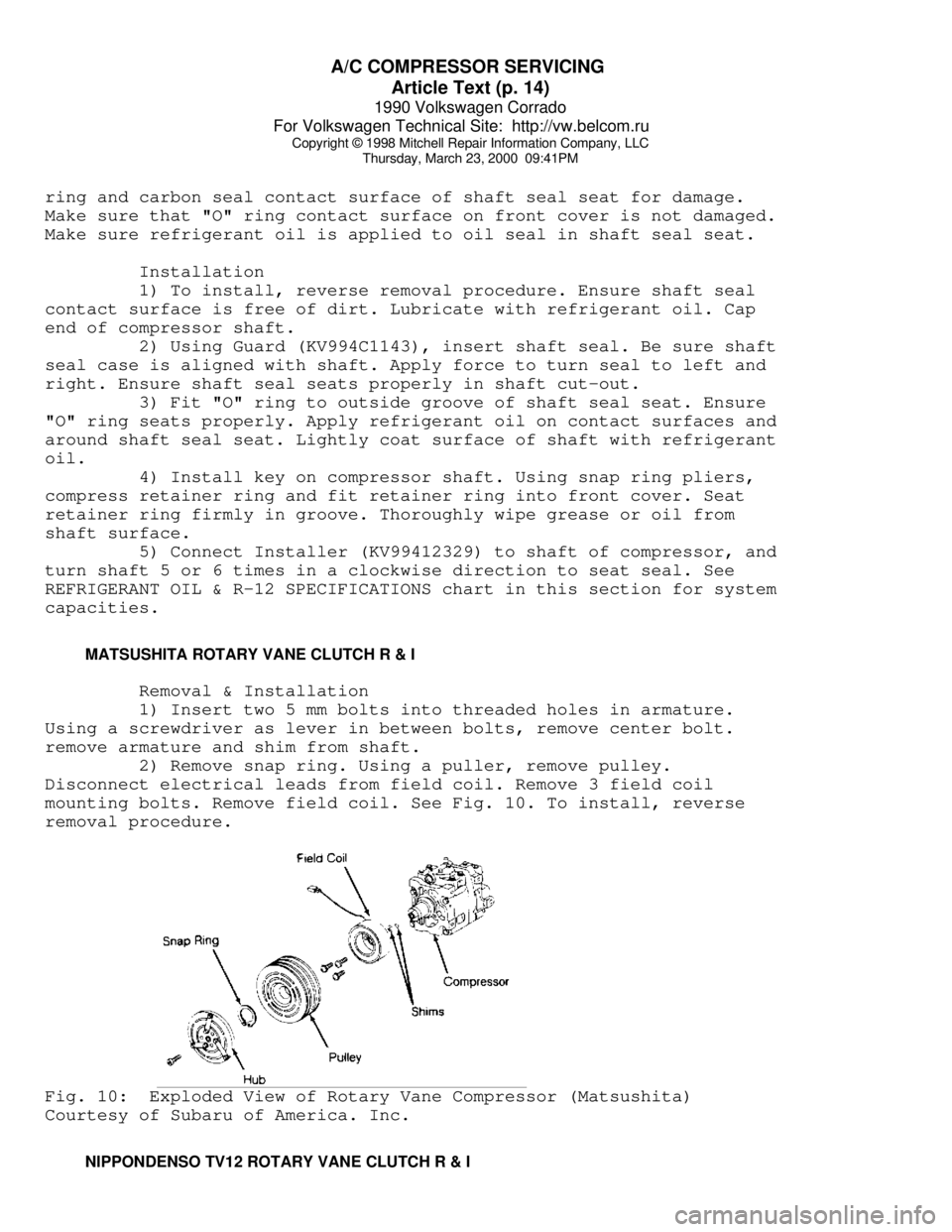
MATSUSHITA ROTARY VANE CLUTCH R & I
Removal & Installation
1) Insert two 5 mm bolts into threaded holes in armature.
Using a screwdriver as lever in between bolts, remove center bolt.
remove armature and shim from shaft.
2) Remove snap ring. Using a puller, remove pulley.
Disconnect electrical leads from field coil. Remove 3 field coil
mounting bolts. Remove field coil. See Fig. 10. To install, reverse
removal procedure.Fig. 10: Exploded View of Rotary Vane Compressor (Matsushita)
Courtesy of Subaru of America. Inc.
NIPPONDENSO TV12 ROTARY VANE CLUTCH R & I
Page 364 of 906
A/C-HEATER SYSTEM - MANUAL
Article Text (p. 7)
1990 Volkswagen Corrado
For Volkswagen Technical Site: http://vw.belcom.ru
Copyright © 1998 Mitchell Repair Information Company, LLC
Thursday, March 23, 2000 09:41PM
3) Check for cool air from left duct. Low-pressure gauge
should read more than 16 psi (1.1 kg/cmý). If low-pressure gauge is
incorrect, hold hands around expansion valve to warm valve. If
pressure rises, moisture is present in system. Discharge using
approved refrigerant recovery/recycling equipment. Evacuate and
recharge system. If pressure does not rise, go to next step.
4) Check temperature on thermometer when thermostatic switch
turns compressor off. If temperature is 39
øF (4øC), system is okay. If
lower than 39
øF (4øC), ensure capillary tube installed length is 7"
(178 mm). If installation is correct, replace thermostatic switch.
REMOVAL & INSTALLATION
NOTE: Removal and installation procedures on other models or
components are not available from manufacturer.
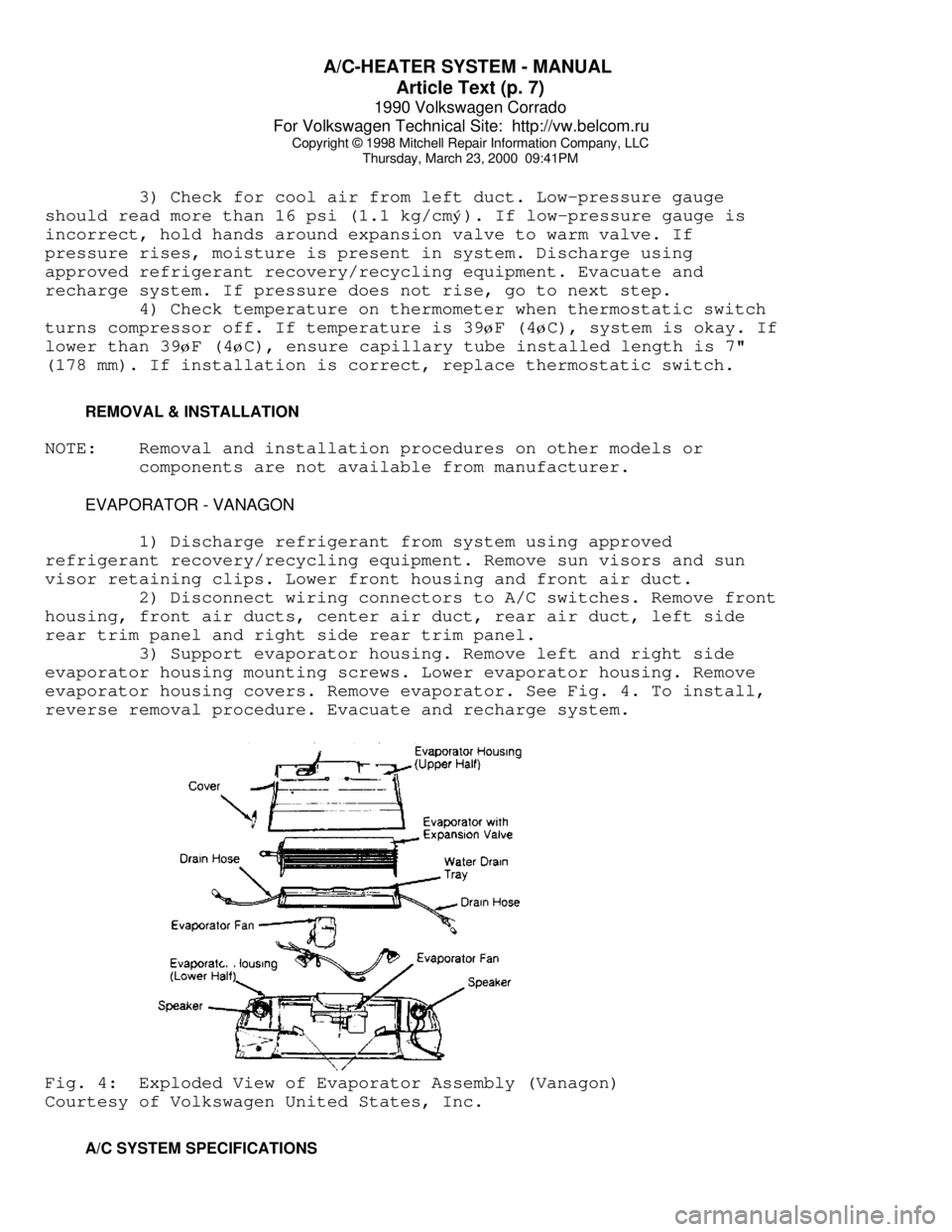
EVAPORATOR - VANAGON
1) Discharge refrigerant from system using approved
refrigerant recovery/recycling equipment. Remove sun visors and sun
visor retaining clips. Lower front housing and front air duct.
2) Disconnect wiring connectors to A/C switches. Remove front
housing, front air ducts, center air duct, rear air duct, left side
rear trim panel and right side rear trim panel.
3) Support evaporator housing. Remove left and right side
evaporator housing mounting screws. Lower evaporator housing. Remove
evaporator housing covers. Remove evaporator. See Fig. 4. To install,
reverse removal procedure. Evacuate and recharge system.Fig. 4: Exploded View of Evaporator Assembly (Vanagon)
Courtesy of Volkswagen United States, Inc.
A/C SYSTEM SPECIFICATIONS
Page 365 of 906

A/C-HEATER SYSTEM - MANUAL
Article Text (p. 8)
1990 Volkswagen Corrado
For Volkswagen Technical Site: http://vw.belcom.ru
Copyright © 1998 Mitchell Repair Information Company, LLC
Thursday, March 23, 2000 09:41PM
A/C SYSTEM SPECIFICATIONS TABLEÄÄÄÄÄÄÄÄÄÄÄÄÄÄÄÄÄÄÄÄÄÄÄÄÄÄÄÄÄÄÄÄÄÄÄÄÄÄÄÄÄÄÄÄÄÄÄÄÄÄÄÄÄÄÄÄÄÄÄÄApplication Specification
System Type ............................... Cycling Clutch
Compressor Type ........................ Sanden 5-Cylinder
Compressor Oil Capacity
Cabriolet ...................................... 6.0 oz.
Fox ............................................ 1.4 oz.
Compressor Belt Deflection
All Models .......................... (1) 3/16" (4.8 mm)
System Oil Capacity
Vanagon ........................................ 5.0 oz.
All Others ..................................... 4.6 oz.
Refrigerant (R-12) Capacity
Corrado ...................................... 37-40 oz.
Vanagon ......................................... 50 oz.
All Other Models ............................. 38-40 oz.
System Operating Pressures
Low Side ........................ 26-40 psi (1-2 kg/cm
ý)
High Side ................. 150-210 psi (10.5-19 kg/cm
ý)
(1) - Deflection is measured at center of belt, between
A/C compressor pulley and crankshaft pulley.
ÄÄÄÄÄÄÄÄÄÄÄÄÄÄÄÄÄÄÄÄÄÄÄÄÄÄÄÄÄÄÄÄÄÄÄÄÄÄÄÄÄÄÄÄÄÄÄÄÄÄÄÄÄÄÄ WIRING DIAGRAMS
Page 372 of 906

AA - USING THIS SECTION (GENERAL HELP INFORMATION)
Article Text
1990 Volkswagen Corrado
For Volkswagen Technical Site: http://vw.belcom.ru
Copyright © 1998 Mitchell Repair Information Company, LLC
Thursday, March 23, 2000 09:41PM
ARTICLE BEGINNING
ENGINE PERFORMANCE
How To Use This Section
INTRODUCTION
NOTE: Because there are so many possible combinations of
articles for the different manufacturers and models,
the new hyper-text capabilities built into this product
DO NOT apply to this article.
It is the purpose of this repair information system to help
professional automotive technicians maintain top vehicle performance
and correct driveability problems related to today's high tech
vehicles.
Because of the limited amount of space allowable for the this
product, our titles have been condensed to fit into the menus. An
alphabetical designation has been added to the front of each title to
allow the titles to be displayed in a way that reflects their
respective order of use. References to the titles in some of the
diagnostic flow charts sometimes will not correlate with the titles in
the this product menu. If not, refer to the MENU CROSS-REFERENCE table
below.
MENU CROSS-REFERENCE TABLEÄÄÄÄÄÄÄÄÄÄÄÄÄÄÄÄÄÄÄÄÄÄÄÄÄÄÄÄÄÄÄÄÄÄÄÄÄÄÄÄÄÄÄÄÄÄÄÄÄÄÄÄÄÄÄÄÄÄÄÄÄÄÄÄÄÄÄÄÄÄTitle Associate Print (Book) Title:
A - ENGINE/VIN I D .................................... Introduction
B - EMISSION APPLICATION ..................... Emission Applications
C - TUNE-UP SPECS .............. Service & Adjustment Specifications
C - SPECIFICATIONS ............. Service & Adjustment Specifications
D - ADJUSTMENTS ............................. On-Vehicle Adjustments
E - THEORY/OPERATION ............................ Theory & Operation
F - BASIC TESTING ...................... Basic Diagnostic Procedures
G - TESTS W/ CODES ................................ Self-Diagnostics
H - TESTS W/O CODES .................... Trouble Shooting - No Codes
I - SYS/COMP TESTS ..................... Systems & Component Testing
J - PIN VOLTAGE CHARTS .......................... Pin Voltage Charts
K - SENSOR RANGE CHARTS .............. Sensor Operating Range Charts
L - WIRING DIAGRAMS ................................ Wiring Diagrams
M - VACUUM DIAGRAMS ................................ Vacuum Diagrams
N - REMOVE/INSTALL/OHAUL .......... Removal, Overhaul & Installation
ÄÄÄÄÄÄÄÄÄÄÄÄÄÄÄÄÄÄÄÄÄÄÄÄÄÄÄÄÄÄÄÄÄÄÄÄÄÄÄÄÄÄÄÄÄÄÄÄÄÄÄÄÄÄÄÄÄÄÄÄÄÄÄÄÄÄÄÄÄÄ Because of this we recommend that you read the rest of these
INTRODUCTION paragraphs to better understand why the information is
presented in this new format.
The A - ENGINE/VIN I D article will help you identify the
vehicle and its systems. It will also explain the VIN code and in many
cases, show its location.
Page 373 of 906

AA - USING THIS SECTION (GENERAL HELP INFORMATION)
Article Text (p. 2)
1990 Volkswagen Corrado
For Volkswagen Technical Site: http://vw.belcom.ru
Copyright © 1998 Mitchell Repair Information Company, LLC
Thursday, March 23, 2000 09:41PM
If you want "TUNE-UP" type information, see D - ADJUSTMENTS
for the adjustment procedures. If you are familiar with the
procedures, but need a quick way to find the specification, go to C -
TUNE-UP SPECS or C - SPECIFICATIONS for the specifications pertaining
to the vehicle.
When diagnosing driveability problems, first go to F - BASIC
TESTING. This article is here to help eliminate wasted diagnostic
time. If the basic systems are working properly, go to G - TESTS W/
CODES.
If the vehicle still is having a driveability problem or if
the vehicle has no self-diagnostic system, go to H - TESTS W/O CODES.
This article will help you diagnose the problem by symptom, locate the
symptom exhibited by the vehicle, and inspect or test the items which
may be causing the problem.
After finding which specific system or component requires
testing, use the I - SYS/COMP TESTS article to tests the systems and
components. We have also included (when available) pin voltage charts
and sensor range charts. These can be found in J - PIN VOLTAGE CHARTS
and K - SENSOR RANGE CHARTS.
Also included in this section are wiring diagrams and vacuum
diagrams. These can be found in L - WIRING DIAGRAMS and M - VACUUM
DIAGRAMS.
When all diagnostic tests have been performed and the problem
has been discovered, it may be necessary to replace or overhaul the
defective part. This information can be found in
N - REMOVE/INSTALL/OHAUL.
The content of each of these articles is outlined below. As a
summary of the driveability diagnosis, see ROUTINE OUTLINE in this
article.
A - ENGINE/VIN ID
This article shows how to identify the model and engine by
its Vehicle Identification Number (VIN). A model coverage chart shows
each model and engine, the fuel system, ignition system and engine
code. The engine serial number locations are also included in this
article.
B - EMISSION APPLICATION
These charts identify the emission systems and sub-systems
applicable to each model and engine combination.
C - TUNE-UP SPECS
This is a collection of quick-reference type specifications.
This article is helpful when you are familiar with proper adjustment
procedures and only need specifications. Included in this section are:
* Battery specifications.
* Fluid capacities.
Page 374 of 906

AA - USING THIS SECTION (GENERAL HELP INFORMATION)
Article Text (p. 3)
1990 Volkswagen Corrado
For Volkswagen Technical Site: http://vw.belcom.ru
Copyright © 1998 Mitchell Repair Information Company, LLC
Thursday, March 23, 2000 09:41PM
* Replacement intervals.
* Belt adjustment.
* Engine Compression.
* Valve clearance.
* Valve Arrangement.
* Ignition coil specifications.
* High tension wire resistance.
* Spark plug type and gap.
* Firing order.
* Ignition timing.
* Fuel pump performance and injector resistance specifications
* Slow and fast idle speed and mixture specifications.
* Carbon monoxide (CO) level specifications.
* Throttle position sensor/switch specifications.
C - SPECIFICATIONS
This is a collection of quick-reference type specifications.
This article is helpful when you are familiar with proper adjustment
procedures and only need specifications. Included in this section are:
* Battery specifications.
* Fluid capacities.
* Replacement intervals.
* Belt adjustment.
* Engine Compression.
* Valve clearance.
* Valve Arrangement.
* Ignition coil specifications.
* High tension wire resistance.
* Spark plug type and gap.
* Firing order.
* Ignition timing.
* Fuel pump performance and injector resistance specifications
* Slow and fast idle speed and mixture specifications.
* Carbon monoxide (CO) level specifications.
* Throttle position sensor/switch specifications.
D - ADJUSTMENTS
This article contains the information that use to be included
in the TUNE-UP section. Checking and adjusting valves, spark plugs,
spark plug wires, base ignition timing and idle speed are found in
this section. Use this article for routine maintenance. Also, if you
have a driveability problem, ensure all on-vehicle adjustments are
correct before proceeding with any diagnosis.
E - THEORY/OPERATION
Page 376 of 906

AA - USING THIS SECTION (GENERAL HELP INFORMATION)
Article Text (p. 5)
1990 Volkswagen Corrado
For Volkswagen Technical Site: http://vw.belcom.ru
Copyright © 1998 Mitchell Repair Information Company, LLC
Thursday, March 23, 2000 09:41PM
sensor is out of calibration. A sensor that is out of calibration may
not set a trouble code, but it will cause driveability problems.
L - WIRING DIAGRAMS
Use these WIRING DIAGRAMS to identify and trace component
circuits, locate shorts and opens in circuits, and understand how
individual circuits function as part of a system. The diagrams in this
article are only for fuel, ignition and emission systems
M - VACUUM DIAGRAMS
The VACUUM DIAGRAMS will assist you in finding incorrectly
routed vacuum hoses which may cause driveability problems or computer
indicated malfunctions.
N - REMOVE/INSTALL/OHAUL
N - REMOVE/INSTALL/OHAUL contains information found in the
sub-headings of REMOVAL, OVERHAUL & INSTALLATION. These are procedures
and specifications required to remove, overhaul (if possible) and
install components related to engine performance.
WHERE TO START
PERFORM BASIC INSPECTION
1) Verify customer complaint.
2) Perform visual inspection. See F - BASIC TESTING.
3) Test engine sub-system to determine that the following
systems are functioning properly. See F- BASIC TESTING.
* Mechanical conditions (compression)
* Ignition output
* Fuel Delivery
4) Check air induction system for leaks.
5) Check & adjust basic engine settings listed below to
ensure they are to specification. See D - ADJUSTMENTS.
* Ignition timing
* Idle speed
CHECK FOR TROUBLE CODES
1) If equipped with self-diagnostics, check for trouble
codes. Refer to G - TESTS W/ CODES.
2) Repair causes of trouble code(s).
3) Clear control unit memory.
SYMPTOM DIAGNOSIS
Page 377 of 906

AA - USING THIS SECTION (GENERAL HELP INFORMATION)
Article Text (p. 6)
1990 Volkswagen Corrado
For Volkswagen Technical Site: http://vw.belcom.ru
Copyright © 1998 Mitchell Repair Information Company, LLC
Thursday, March 23, 2000 09:41PM
1) If no self-diagnostics available, or no trouble codes
present, identify symptom.
2) See trouble shooting procedure to repair complaint. See H
- TESTS W/O CODES
TEST SYSTEM
1) Perform necessary systems and component tests. See I -
SYS/COMP TESTS.
2) Verify that complaint is repaired.
SAFETY PRECAUTIONS
* Always refer to Engine Tune-Up Decal in engine compartment before
performing tune-up. If manual and decal differ, always use decal
specifications.
* DO NOT allow or create a condition of misfire in more than one
cylinder for an extended period of time. Damage to converter may
occur due to loading converter with unburned air/fuel mixture.
* Always turn ignition off and disconnect negative battery cable
BEFORE disconnecting or connecting computer or other electrical
components.
* DO NOT drop or shock electrical components such as computer,
airflow meter, etc.
* DO NOT use fuel system cleaning compounds that are not
recommended by the manufacturer. Damage to gaskets, diaphragm
materials and catalytic converter may result.
* Before performing a compression test or cranking engine using a
remote starter switch, disconnect coil wire from distributor and
secure it to a good engine ground, or disable ignition.
* Before disconnecting any fuel system component, ensure fuel
system pressure is released.
* Use a shop towel to absorb any spilled fuel to prevent fire.
* DO NOT create sparks or have an open flame near battery.
* If any EFI components such as hoses or clamps are replaces,
ensure they are replaced with components designed for EFI use.
* Always reassemble throttle body components with new gaskets, "O"
rings and seals.
* If equipped with an inertia switch, DO NOT reset switch until
fuel system has been inspected for leaks.
* Wear safety goggles when drilling or grinding.
* Wear proper clothing which protects against chemicals and other
hazards.
END OF ARTICLE