sensor VOLKSWAGEN CORRADO 1993 Manual PDF
[x] Cancel search | Manufacturer: VOLKSWAGEN, Model Year: 1993, Model line: CORRADO, Model: VOLKSWAGEN CORRADO 1993Pages: 920, PDF Size: 6.92 MB
Page 511 of 920

E - THEORY/OPERATION
Article Text (p. 6)
1993 Volkswagen Corrado
For Volkswagen Technical Site: http://vw.belcom.ru
Copyright © 1998 Mitchell Repair Information Company, LLC
Wednesday, March 22, 2000 09:09PM
EMISSION SYSTEMS
AIR INJECTION SYSTEM
The air injection system consists of electrically operated
air pump, inlet valve, shut-off valve (mounted between intake ports
for cylinders No. 2 and 4), and air pump control relay.
The Electronic Control Module (ECM) control operation of air
injection system air pump by completing the ground circuit of the air
pump control relay (located above brake master cylinder). In addition,
the relay operates the secondary air injection inlet valve.
EXHAUST GAS RECIRCULATION (EGR) SYSTEM
The EGR system consist of EGR valve, EGR frequency valve, and
EGR temperature sensor. All Corrado SLC models are equipped with the
EGR system. The EGR system is switched on when engine coolant
temperature reaches 122øF (50øC). The system recirculates a small
portion of exhaust gas into the intake air/fuel mixture to reduce
nitrous oxide emissions (NOx).
EGR Frequency Valve
The EGR frequency valve is mounted on back of intake
manifold. The frequency valve controls the amount of vacuum supplied
to the EGR valve. The ECM, depending on engine speed and load,
controls the frequency valve's ground circuit. In doing so, the ECM
controls the amount of recirculated exhaust gas entering the engine.
EGR Temperature Sensor
Sensor is located in EGR valve exhaust gas recirculation
channel. The EGR temperature sensor measures exhaust gas temperature.
The electrical resistance of the sensor decreases as the temperature
of the exhaust gas increases. The signal generated by the EGR
temperature sensor is ONLY used for diagnosis of the EGR system.
FUEL EVAPORATIVE EMISSIONS SYSTEM
Fuel Evaporative (Frequency) Valve
The ECM determines the duty cycle of the frequency valve to
regulate the flow of fuel vapors from fuel evaporative (carbon)
canister into engine. When no current is supplied to valve, it remains
in the open position. The valve is closed (100% duty cycle) when the
engine is started cold. A spring operated check valve inside the
frequency valve closes when the engine is off. This prevents fuel
vapors from entering intake manifold and causing a rich mixture during
engine restart.
Fuel Tank Venting
The engine speed, engine load, engine coolant temperature,
and throttle valve potentiometer input signals are used by the ECM to
control fuel tank venting. Fuel vapors from fuel tank are vented to
fuel evaporative (carbon) canister. When engine is warm and above idle
Page 512 of 920

E - THEORY/OPERATION
Article Text (p. 7)
1993 Volkswagen Corrado
For Volkswagen Technical Site: http://vw.belcom.ru
Copyright © 1998 Mitchell Repair Information Company, LLC
Wednesday, March 22, 2000 09:09PM
speed, the vapors will be drawn into intake manifold. Depending on
engine load and oxygen sensor signal, the fuel evaporative (frequency)
valve will regulate the amount of vapors entering the intake manifold.
SELF-DIAGNOSTIC SYSTEM
The Electronic Control Module (ECM) recognizes faults (open
circuits, short circuits, missing signals, or a continuously applied
signal voltage) in the following circuits/components.
* EGR Frequency Valve
* EGR Temperature Sensor
* Engine Coolant Temperature Sensor
* Engine Speed (RPM)/Reference Sensor
* Fuel Evaporative (Frequency) Valve
* Hall Effect Sensor
* Idle Air Control/Stabilizer Valve
* Intake Air Temperature Sensor
* Knock Sensor(s)
* Throttle Valve Potentiometer
* Oxygen Sensor
MALFUNCTION INDICATOR (CHECK ENGINE) LIGHT
All California models are equipped with a malfunction
indicator (CHECK ENGINE) light. If CHECK ENGINE light comes on and
remains on during vehicle operation, cause of malfunction must be
determined. See the G - TESTS W/CODES article.
END OF ARTICLE
Page 523 of 920
EMISSION CONTROL VISUAL INSPECTION PROCEDURES
Article Text (p. 9)
1993 Volkswagen Corrado
For Volkswagen Technical Site: http://vw.belcom.ru
Copyright © 1998 Mitchell Repair Information Company, LLC
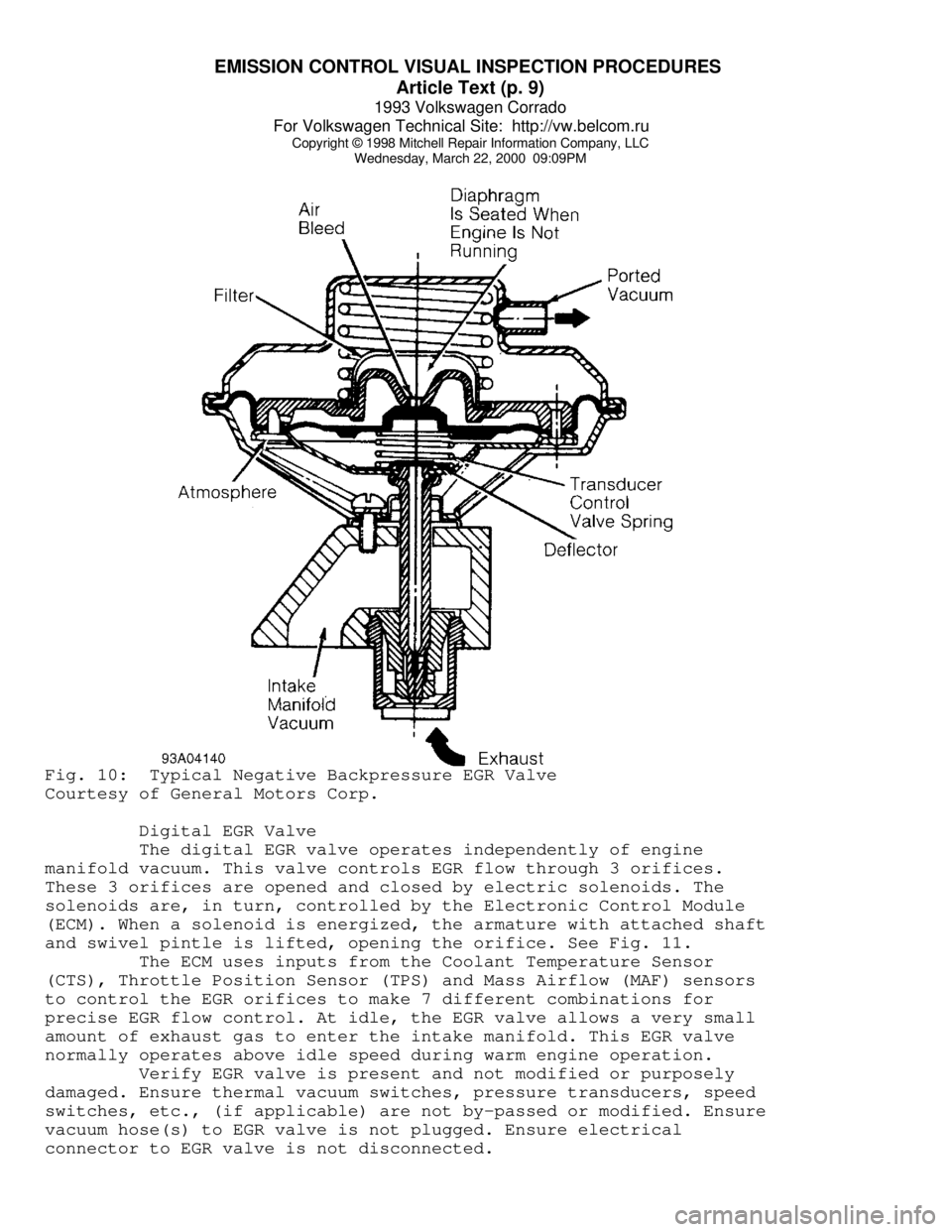
Wednesday, March 22, 2000 09:09PMFig. 10: Typical Negative Backpressure EGR Valve
Courtesy of General Motors Corp.
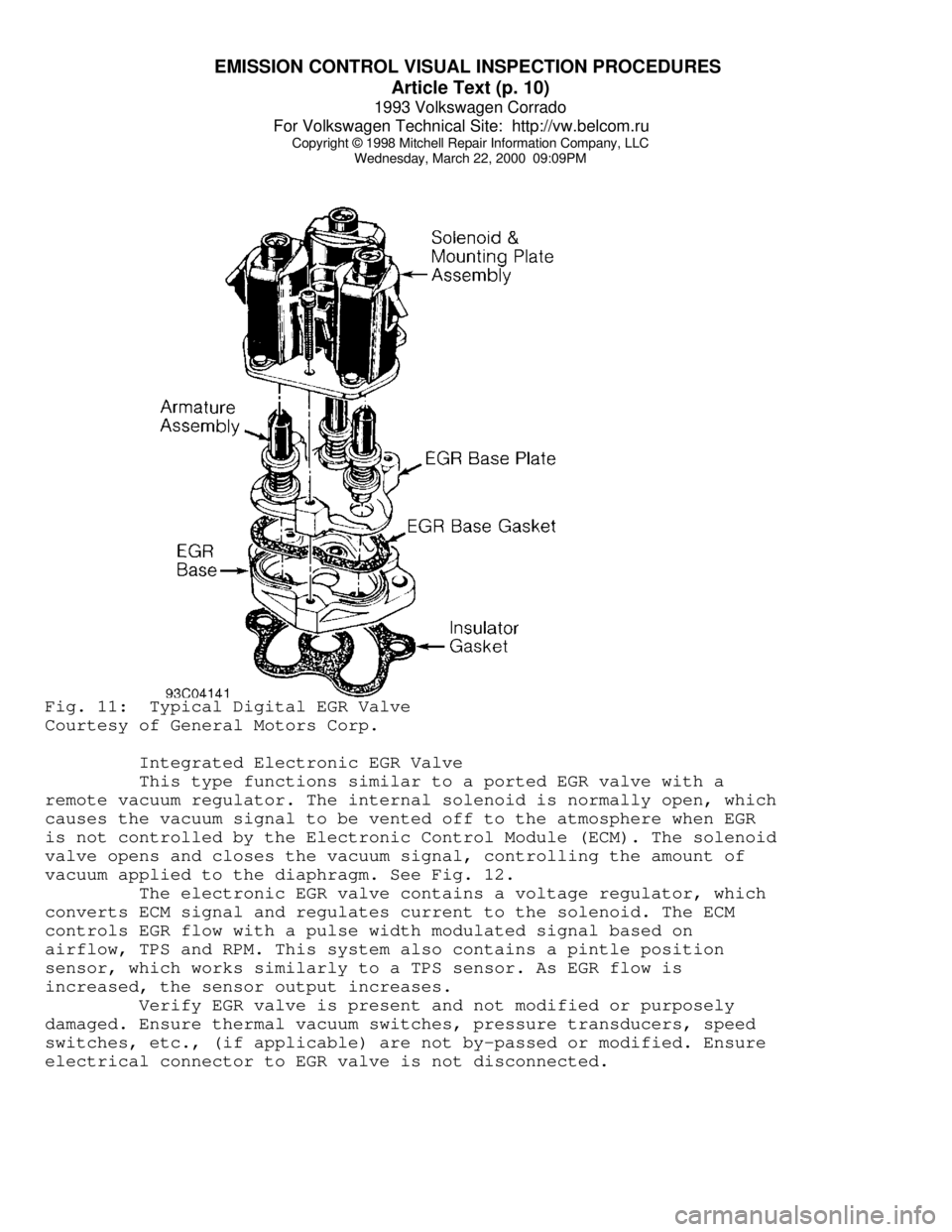
Digital EGR Valve
The digital EGR valve operates independently of engine
manifold vacuum. This valve controls EGR flow through 3 orifices.
These 3 orifices are opened and closed by electric solenoids. The
solenoids are, in turn, controlled by the Electronic Control Module
(ECM). When a solenoid is energized, the armature with attached shaft
and swivel pintle is lifted, opening the orifice. See Fig. 11.
The ECM uses inputs from the Coolant Temperature Sensor
(CTS), Throttle Position Sensor (TPS) and Mass Airflow (MAF) sensors
to control the EGR orifices to make 7 different combinations for
precise EGR flow control. At idle, the EGR valve allows a very small
amount of exhaust gas to enter the intake manifold. This EGR valve
normally operates above idle speed during warm engine operation.
Verify EGR valve is present and not modified or purposely
damaged. Ensure thermal vacuum switches, pressure transducers, speed
switches, etc., (if applicable) are not by-passed or modified. Ensure
vacuum hose(s) to EGR valve is not plugged. Ensure electrical
connector to EGR valve is not disconnected.
Page 524 of 920
EMISSION CONTROL VISUAL INSPECTION PROCEDURES
Article Text (p. 10)
1993 Volkswagen Corrado
For Volkswagen Technical Site: http://vw.belcom.ru
Copyright © 1998 Mitchell Repair Information Company, LLC
Wednesday, March 22, 2000 09:09PMFig. 11: Typical Digital EGR Valve
Courtesy of General Motors Corp.
Integrated Electronic EGR Valve
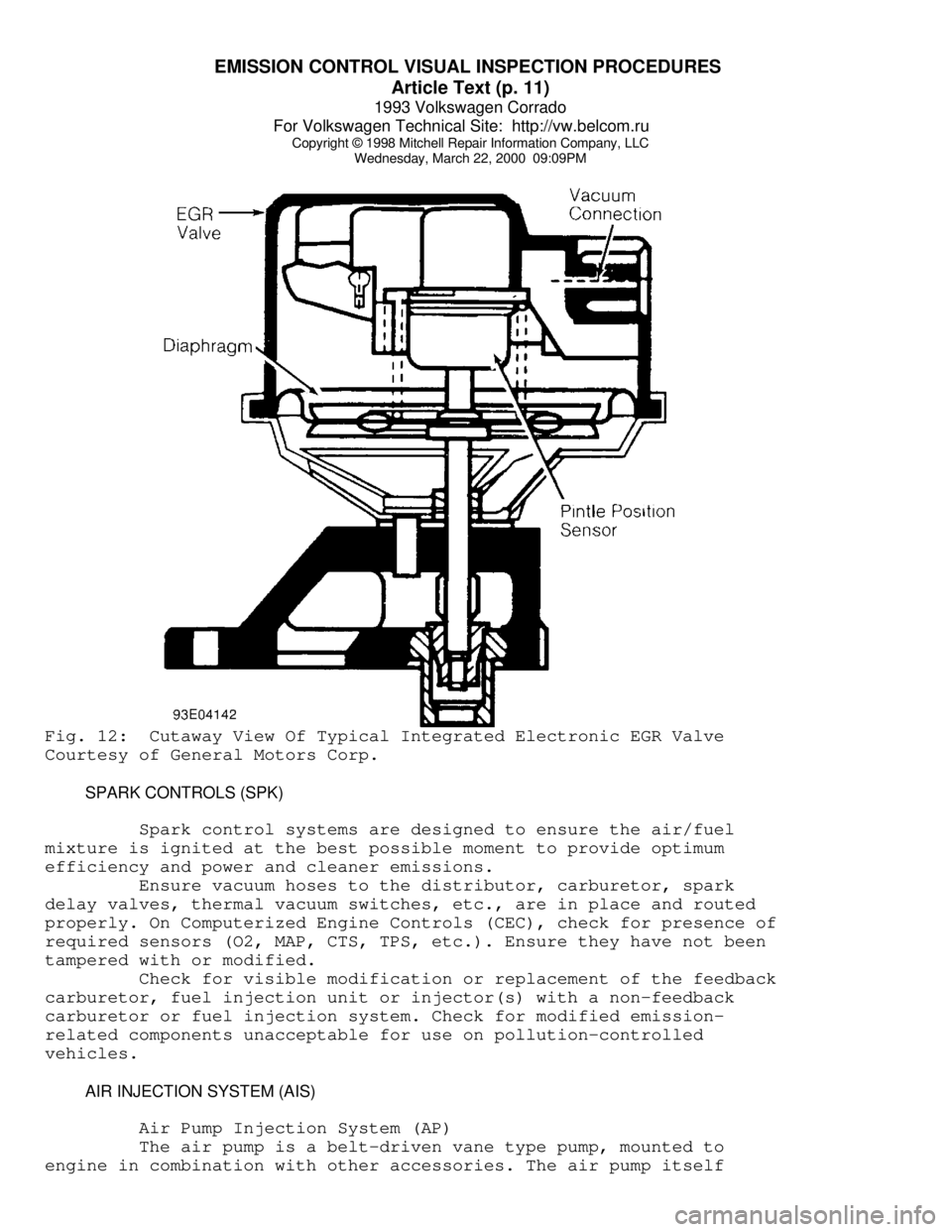
This type functions similar to a ported EGR valve with a
remote vacuum regulator. The internal solenoid is normally open, which
causes the vacuum signal to be vented off to the atmosphere when EGR
is not controlled by the Electronic Control Module (ECM). The solenoid
valve opens and closes the vacuum signal, controlling the amount of
vacuum applied to the diaphragm. See Fig. 12.
The electronic EGR valve contains a voltage regulator, which
converts ECM signal and regulates current to the solenoid. The ECM
controls EGR flow with a pulse width modulated signal based on
airflow, TPS and RPM. This system also contains a pintle position
sensor, which works similarly to a TPS sensor. As EGR flow is
increased, the sensor output increases.
Verify EGR valve is present and not modified or purposely
damaged. Ensure thermal vacuum switches, pressure transducers, speed
switches, etc., (if applicable) are not by-passed or modified. Ensure
electrical connector to EGR valve is not disconnected.
Page 525 of 920
EMISSION CONTROL VISUAL INSPECTION PROCEDURES
Article Text (p. 11)
1993 Volkswagen Corrado
For Volkswagen Technical Site: http://vw.belcom.ru
Copyright © 1998 Mitchell Repair Information Company, LLC
Wednesday, March 22, 2000 09:09PMFig. 12: Cutaway View Of Typical Integrated Electronic EGR Valve
Courtesy of General Motors Corp.
SPARK CONTROLS (SPK)
Spark control systems are designed to ensure the air/fuel
mixture is ignited at the best possible moment to provide optimum
efficiency and power and cleaner emissions.
Ensure vacuum hoses to the distributor, carburetor, spark
delay valves, thermal vacuum switches, etc., are in place and routed
properly. On Computerized Engine Controls (CEC), check for presence of
required sensors (O2, MAP, CTS, TPS, etc.). Ensure they have not been
tampered with or modified.
Check for visible modification or replacement of the feedback
carburetor, fuel injection unit or injector(s) with a non-feedback
carburetor or fuel injection system. Check for modified emission-
related components unacceptable for use on pollution-controlled
vehicles.
AIR INJECTION SYSTEM (AIS)
Air Pump Injection System (AP)
The air pump is a belt-driven vane type pump, mounted to
engine in combination with other accessories. The air pump itself
Page 527 of 920

EMISSION CONTROL VISUAL INSPECTION PROCEDURES
Article Text (p. 13)
1993 Volkswagen Corrado
For Volkswagen Technical Site: http://vw.belcom.ru
Copyright © 1998 Mitchell Repair Information Company, LLC
Wednesday, March 22, 2000 09:09PM
OXYGEN SENSOR (O2)
The O2 sensor is mounted in the exhaust system where it
monitors oxygen content of exhaust gases. Some vehicles may use 2 O2
sensors. The O2 sensor produces a voltage signal which is proportional
to exhaust gas oxygen concentration (0-3%) compared to outside oxygen
(20-21%). This voltage signal is low (about .1 volt) when a lean
mixture is present and high (1.0 volt) when a rich mixture is present.
As ECM compensates for a lean or rich condition, this
voltage signal constantly fluctuates between high and low, crossing a
reference voltage supplied by the ECM on the O2 signal line. This is
referred to as cross counts. A problem in the O2 sensor circuit should
set a related trouble code.
COMPUTERIZED ENGINE CONTROLS (CEC)
The CEC system monitors and controls a variety of
engine/vehicle functions. The CEC system is primarily an emission
control system designed to maintain a 14.7:1 air/fuel ratio under most
operating conditions. When the ideal air/fuel ratio is maintained, the
catalytic converter can control oxides of nitrogen (NOx), hydrocarbon
(HC) and carbon monoxide (CO) emissions.
The CEC system consists of the following sub-systems:
Electronic Control Module (ECM), input devices (sensors and switches)
and output signals.
EARLY FUEL EVAPORATION (EFE)
The EFE valve is actuated by either a vacuum actuator or a
bimetal spring (heat-riser type). The EFE valve is closed when engine
is cold. The closed valve restricts exhaust gas flow from the exhaust
manifold. This forces part of the exhaust gas to flow up through a
passage below the carburetor. As the exhaust gas quickly warms the
intake mixture, distribution is improved. This results in better cold
engine driveability, shorter choke periods and lower emissions.
Ensure EFE valve in exhaust manifold is not frozen or rusted
in a fixed position. On vacuum-actuated EFE system, check EFE thermal
vacuum valve and check valve(s). Also check for proper vacuum hose
routing. See Fig. 15.
Page 567 of 920

F - BASIC TESTING
Article Text (p. 2)
1993 Volkswagen Corrado
For Volkswagen Technical Site: http://vw.belcom.ru
Copyright © 1998 Mitchell Repair Information Company, LLC
Wednesday, March 22, 2000 09:10PMÄÄÄÄÄÄÄÄÄÄÄÄÄÄÄÄÄÄÄÄÄÄÄÄÄÄÄÄÄÄÄÄÄÄÄÄÄÄÄÄÄÄÄÄÄÄÄÄÄÄÄÄÄÄÄÄÄÄÄÄÄÄÄÄÄ Compression
Pressure Compression
Application psi (kg/cm
ý) Ratio
Cabriolet ............. 131-174 (9.2-12.2) ........... 10.0:1
Corrado SLC ........... 157-186 (11.0-13.0) .......... 10.0:1
EuroVan ............... 128-170 (9.0-12.0) ........... 8.5:1
Fox ................... 128-170 (9.0-12.0) ............ 9.0:1
Golf & GTI ............ 142-186 (10.0-13.0) .......... 10.0:1
Jetta ................. 142-186 (10.0-13.0) .......... 10.0:1
Passat GL (2.0L) ...... 142-186 (10.0-13.0) .......... 10.8:1
Passat GLX (2.8L) ..... 142-186 (10.0-13.0) .......... 10.0:1
ÄÄÄÄÄÄÄÄÄÄÄÄÄÄÄÄÄÄÄÄÄÄÄÄÄÄÄÄÄÄÄÄÄÄÄÄÄÄÄÄÄÄÄÄÄÄÄÄÄÄÄÄÄÄÄÄÄÄÄÄÄÄÄÄÄ Exhaust System Backpressure
The exhaust system can be checked with a vacuum or pressure
gauge. Remove O2 sensor or air injection check valve (if equipped).
Connect a 0-5 psi pressure gauge and operate engine at 2500 RPM. If
exhaust system backpressure is greater than 2 psi, exhaust system or
catalytic converter is plugged.
If a vacuum gauge is used, connect vacuum gauge hose to
intake manifold vacuum port and start engine. Observe vacuum gauge.
Open throttle part way and hold steady. If vacuum gauge reading slowly
drops after stabilizing, check exhaust system for restriction.
FUEL SYSTEM
FUEL SYSTEM APPLICATION
FUEL SYSTEM APPLICATION TABLE
ÚÄÄÄÄÄÄÄÄÄÄÄÄÄÂÄÄÄÄÄÄÄÄÄÂÄÄÄÄÄÄÂÄÄÄÄÄÄÄÄÄÄÄÄÄÄÄÄÄ¿
³
³ ³Engine³ ³
³ Model
³ Engine ³ ID ³ Fuel System ³
ÃÄÄÄÄÄÄÄÄÄÄÄÄÄÅÄÄÄÄÄÄÄÄÄÅÄÄÄÄÄÄÅÄÄÄÄÄÄÄÄÄÄÄÄÄÄÄÄÄ´
³ Cabriolet
³ 1.8L ³ 2H ³ Digifant II MFI ³
³
³ 8-Valve ³ ³ (1) ³
ÃÄÄÄÄÄÄÄÄÄÄÄÄÄÅÄÄÄÄÄÄÄÄÄÅÄÄÄÄÄÄÅÄÄÄÄÄÄÄÄÄÄÄÄÄÄÄÄÄ´
³ Corrado SLC
³ 2.8L VR6³ AAA ³ Motronic MFI (2)³
ÃÄÄÄÄÄÄÄÄÄÄÄÄÄÅÄÄÄÄÄÄÄÄÄÅÄÄÄÄÄÄÅÄÄÄÄÄÄÄÄÄÄÄÄÄÄÄÄÄ´
³ EuroVan
³ 2.5L ³ AAF ³ Digifant MFI ³
³
³10-Valve ³ ³ ³
ÃÄÄÄÄÄÄÄÄÄÄÄÄÄÅÄÄÄÄÄÄÄÄÄÅÄÄÄÄÄÄÅÄÄÄÄÄÄÄÄÄÄÄÄÄÄÄÄÄ´
³ Fox
³ 1.8L ³ ABG ³ Digifant II MFI ³
³
³ 8-Valve ³ ³ (1) ³
ÃÄÄÄÄÄÄÄÄÄÄÄÄÄÅÄÄÄÄÄÄÄÄÄÅÄÄÄÄÄÄÅÄÄÄÄÄÄÄÄÄÄÄÄÄÄÄÄÄ´
³ Golf
³ 2.0L ³ ABA ³ Motronic MFI (2)³
³
³ 8-Valve ³ ³ ³
ÃÄÄÄÄÄÄÄÄÄÄÄÄÄÅÄÄÄÄÄÄÄÄÄÅÄÄÄÄÄÄÅÄÄÄÄÄÄÄÄÄÄÄÄÄÄÄÄÄ´
³ GTI
³ 2.0L ³ ABA ³ Motronic MFI (2)³
³
³ 8-Valve ³ ³ ³
ÃÄÄÄÄÄÄÄÄÄÄÄÄÄÅÄÄÄÄÄÄÄÄÄÅÄÄÄÄÄÄÅÄÄÄÄÄÄÄÄÄÄÄÄÄÄÄÄÄ´
Page 568 of 920

F - BASIC TESTING
Article Text (p. 3)
1993 Volkswagen Corrado
For Volkswagen Technical Site: http://vw.belcom.ru
Copyright © 1998 Mitchell Repair Information Company, LLC
Wednesday, March 22, 2000 09:10PM³ Jetta ³ 2.0L ³ ABA ³ Motronic MFI (2)³
³
³ 8-Valve ³ ³ ³
ÃÄÄÄÄÄÄÄÄÄÄÄÄÄÅÄÄÄÄÄÄÄÄÄÅÄÄÄÄÄÄÅÄÄÄÄÄÄÄÄÄÄÄÄÄÄÄÄÄ´
³ Passat GL
³ 2.0L ³ 9A ³ CIS-E Motronic ³
³
³16-Valve ³ ³ MFI (2) ³
ÃÄÄÄÄÄÄÄÄÄÄÄÄÄÅÄÄÄÄÄÄÄÄÄÅÄÄÄÄÄÄÅÄÄÄÄÄÄÄÄÄÄÄÄÄÄÄÄÄ´
³ Passat GLX
³ 2.8L VR6³ AAA ³ Motronic MFI (2)³
ÃÄÄÄÄÄÄÄÄÄÄÄÄÄÁÄÄÄÄÄÄÄÄÄÁÄÄÄÄÄÄÁÄÄÄÄÄÄÄÄÄÄÄÄÄÄÄÄÄ´
³(1) - California vehicles are equipped with
³
³ Digifant I.
³
³(2) - Sequential Multiport Fuel Injection.
³
ÀÄÄÄÄÄÄÄÄÄÄÄÄÄÄÄÄÄÄÄÄÄÄÄÄÄÄÄÄÄÄÄÄÄÄÄÄÄÄÄÄÄÄÄÄÄÄÄÄÙ FUEL PRESSURE
Basic diagnosis of fuel system should begin with determining
fuel system pressure.
WARNING: ALWAYS relieve fuel pressure before disconnecting any fuel
injection-related component. DO NOT allow fuel to contact
engine or electrical components.
CIS-E Motronic
1) Ensure ignition is off. Wrap a cloth around fuel
distributor port near cold start valve. Slowly loosen distributor port
near cold start valve to release fuel pressure. Connect fuel pressure
gauge between fuel distributor port and end of fuel line to cold start
valve. Disconnect differential pressure regulator harness connector.
2) Start engine and let it run. System fuel pressure should
89-96 psi (6.3-6.7 kg/cm
ý). If system fuel pressure is lower than
specification, perform fuel volume check. If fuel volume is okay,
replace fuel pressure regulator.
3) If fuel pressure is greater than specification, remove
return hose from pressure regulator and place in a container. Repeat
test. If system pressure is okay, check for restricted fuel return
line. If pressure is incorrect, replace fuel pressure regulator.
4) Turn ignition off. After 10 minutes, residual pressure
should be 48 psi (3.4 kg/cm
ý). After 20 minutes, residual pressure
should be 46 psi (3.2 kg/cm
ý). If system fuel pressure is low, check
fuel pump check valve, sensor plate free play, fuel distributor "O"
rings and seats. Replace if necessary. If these components are okay,
replace fuel pressure regulator.
Digifant
1) Ensure ignition is off. Wrap a cloth around service port
on fuel plenum. Slowly loosen service port on fuel plenum to release
fuel pressure. Install fuel pressure gauge at service port on fuel
plenum. Fuel pressure gauge must have reading range of 0-50 psi. Start
engine and allow it to idle. System fuel pressure should be
approximately 36 psi (2.5 kg/cm
ý).
2) Disconnect vacuum hose from top of fuel pressure
regulator. Fuel pressure should increase to approximately 44 psi (3
Page 575 of 920

F - BASIC TESTING
Article Text (p. 10)
1993 Volkswagen Corrado
For Volkswagen Technical Site: http://vw.belcom.ru
Copyright © 1998 Mitchell Repair Information Company, LLC
Wednesday, March 22, 2000 09:10PM
to specification. If necessary, see the appropriate D - ADJUSTMENTS
article in this section. Refer to the following menu:
NOTE: For the appropriate D - ADJUSTMENTS article, go to:
* For Cabriolet, see: D - ADJUSTMENTS
* For Corrado SLC, see: D - ADJUSTMENTS
* For EuroVan, see: D - ADJUSTMENTS
* For Fox, see: D - ADJUSTMENTS
* For Golf, GTI, Jetta, see: D - ADJUSTMENTS
* For Passat GL 2.0L 4-Cylinder, see: D - ADJUSTMENTS - 4-CYL
* For Passat GLX 2.8L VR6, see: D - ADJUSTMENTS - VR6
IDLE SPEED & CO LEVELÄÄÄÄÄÄÄÄÄÄÄÄÄÄÄÄÄÄÄÄÄÄÄÄÄÄÄÄÄÄÄÄÄÄÄÄÄÄÄÄÄÄÄÄÄÄÄÄÄÄÄÄÄÄÄApplication Idle RPM CO Level %
Cabriolet (1)
Digifant I ............. 750-850 ......... 0.3-1.2
Digifant II ............ 750-850 ......... 0.3-1.1
Corrado SLC (2) ......... 650-750 ......... 0.3-1.5
Fox ................... (3) 875-925 ....... 0.3-1.2
Golf, Jetta & GTI (2)
800-880
0.3-1.2
Passat GL ............ (4) 800-1000 ....... 0.2-1.2
Passat GLX (2) .......... 650-750 ......... 0.3-1.5
(1) - With engine running, after reconnecting Blue coolant
temperature sensor. See the D - ADJUSTMENTS article
in this section for more information. See menu above.
(2) - Idle speed and fuel mixture (CO level) are not
adjustable.
(3) - If A/C equipped, disconnect idle speed boost valve
harness connector when checking idle speed. Clamp
crankcase breather hose near emission control valve
when checking CO level.
(4) - Idle speed is not adjustable.
ÄÄÄÄÄÄÄÄÄÄÄÄÄÄÄÄÄÄÄÄÄÄÄÄÄÄÄÄÄÄÄÄÄÄÄÄÄÄÄÄÄÄÄÄÄÄÄÄÄÄÄÄÄÄÄIGNITION TIMING (Degrees BTDC @ RPM)
ÄÄÄÄÄÄÄÄÄÄÄÄÄÄÄÄÄÄÄÄÄÄÄÄÄÄÄÄÄÄÄÄÄÄÄÄÄÄÄÄÄÄÄÄÄÄÄÄÄÄÄÄÄÄÄÄÄÄÄÄApplication Checking Adjusting
Cabriolet (1) ....... 4-8 @ 2000-2500 .. 5-7 @ 2000-2500
Corrado SLC ............... (2) .................... (2)
Fox (1) ............. 4-8 @ 2000-2500 .. 5-7 @ 2000-2500
Golf, GTI & Jetta ... (3) 12 @ 800-880 ............ .....
Passat GL ........... 4-8 @ 800-1000 .... 5-7 @ 800-1000
Passat GLX ................ (2) .................... (2)
(1) - On Digifant I systems, ensure engine oil temperature
Page 576 of 920

F - BASIC TESTING
Article Text (p. 11)
1993 Volkswagen Corrado
For Volkswagen Technical Site: http://vw.belcom.ru
Copyright © 1998 Mitchell Repair Information Company, LLC
Wednesday, March 22, 2000 09:10PM
is 176øF (80øC) and Blue engine coolant temperature
sensor is disconnected.
(2) - Ignition timing is computer controlled. Information
is not available from manufacturer.
(3) - Using Scan Tester (VAG 1551) in START BASIC SETTING
mode. Ignition timing is not adjustable.
ÄÄÄÄÄÄÄÄÄÄÄÄÄÄÄÄÄÄÄÄÄÄÄÄÄÄÄÄÄÄÄÄÄÄÄÄÄÄÄÄÄÄÄÄÄÄÄÄÄÄÄÄÄÄÄÄÄÄÄÄIGNITION TIMING ADVANCE (Degrees BTDC @ RPM)
ÄÄÄÄÄÄÄÄÄÄÄÄÄÄÄÄÄÄÄÄÄÄÄÄÄÄÄÄÄÄÄÄÄÄÄÄÄÄÄÄÄÄÄÄÄÄÄÄÄÄÄÄÄÄÄApplication Specification
Cabriolet
Digifant I (California) .......... (1) 27-33 @ 4500
Digifant II (Other 49 States) .... (1) 20-30 @ 2300
Fox
Digifant I (California) .......... (1) 27-33 @ 4500
Digifant II (Other 49 States) .... (1) 20-30 @ 2300
All Other Models ................................ (2)
(1) - With Blue engine coolant temperature sensor
connected. Specification is in addition to the
initial setting.
(2) - Ignition timing advance is computer controlled.
Information is not available from manufacturer.
ÄÄÄÄÄÄÄÄÄÄÄÄÄÄÄÄÄÄÄÄÄÄÄÄÄÄÄÄÄÄÄÄÄÄÄÄÄÄÄÄÄÄÄÄÄÄÄÄÄÄÄÄÄÄÄ SUMMARY
If no faults were found while performing the tests in this
article, see H - TESTS W/O CODES article in this section for diagnosis
by symptom (i.e., ROUGH IDLE, NO START, etc.) or intermittent
diagnostic procedures.
END OF ARTICLE