ESP VOLKSWAGEN GOLF PLUS 2004 User Guide
[x] Cancel search | Manufacturer: VOLKSWAGEN, Model Year: 2004, Model line: GOLF PLUS, Model: VOLKSWAGEN GOLF PLUS 2004Pages: 541, PDF Size: 98.86 MB
Page 47 of 541
Warning
Please fir st r ead and note th e introductory in rormatio n and heed the o n page 45.
Lights
Possible cause
u p
the ignition is sw itch ed on, several warning and indica to r ligh ts come o n brierly ror a ru nctio n
c h ec k. They go out a
the rear h a tc h is not clo se d prope rly . wa rnin g light in the i nstrumen t clu ste r o r the hicl e symbol in th e MFD comes o n showin g the ope n r ear hat ch .
D ep en d in g o n the ve hi
cle opti ons, a symbol m ay
b e di splayed in th e in strument clu ster in ste ad or
t h e warnin g lig h t. The ligh t o r symbol
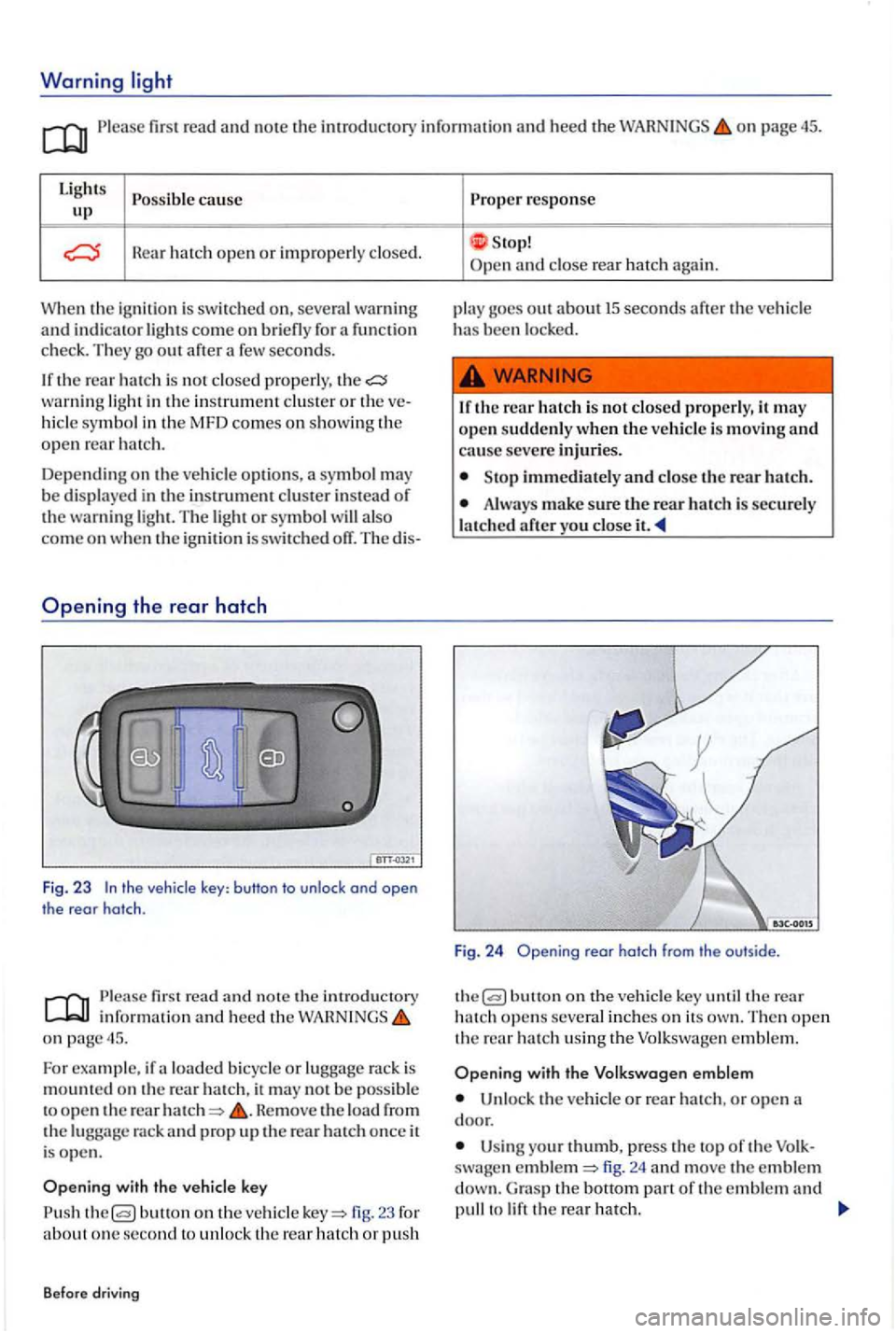
the vehicle key: button to unlock ond open
the rear hatch .
first read a nd n ote th e introducto ry inrorm atio n and heed t he o n page 45.
Fo r example, ir a lo ad ed b icy cle or lu gg age rac k is
m oun te d on the rear ha tc h , it m ay no t b e poss ible
t o o pe n th e rear He move the load rrom the rack and prop u p the rear ha tc h once it
i s ope n .
butto n on th e ve hicle 23 ror about o ne se cond to unl o ck th e re ar hatch or p ush
B efore dr
iving
Prope r response
S top! and close rea r hatc h again.
p la y goes o
ut ab o ut 15 seconds arte r the ve hicl e has been l ocke d.
1 r th e r
ear hatch i s not closed p ro perly, it m ay
o pe n sudde nly w hen the vehicle is movin g and cause seve re injuri es .
Sto p immedi ately and close t h e rear h atc h .
Alwa ys make sure the rear h atc h is sec u re ly
l a tc h ed
butt o n on the ve hicl e key th e rear hatch open s several in ch e s o n its The n open th e rear h a tc h usin g th e Volkswa gen e m ble m .
with the V olk swagen emblem
Un loc k th e ve h icl e or rear hatch , o r o pen
U sin g your thumb, p ress the to p or th e swa gen fig. 24 and move the e mble m G ra s p the bott o m part or th e e mble m and to
Page 48 of 541
Improper and unsuperv ised unl ockin g or openin g of the rear h atc h ca n cause severe ries.
bicycle or luggage rack is ins talle d on the rear hatc h , it may be h ard to se c that th e rear hatch I s unl atc h ed. An unlatch ed rear hatc h may
s ud whe n th e ve hicle Is
first read and note the introdu ctory informa tion and heed the WARNINGS on page 45.
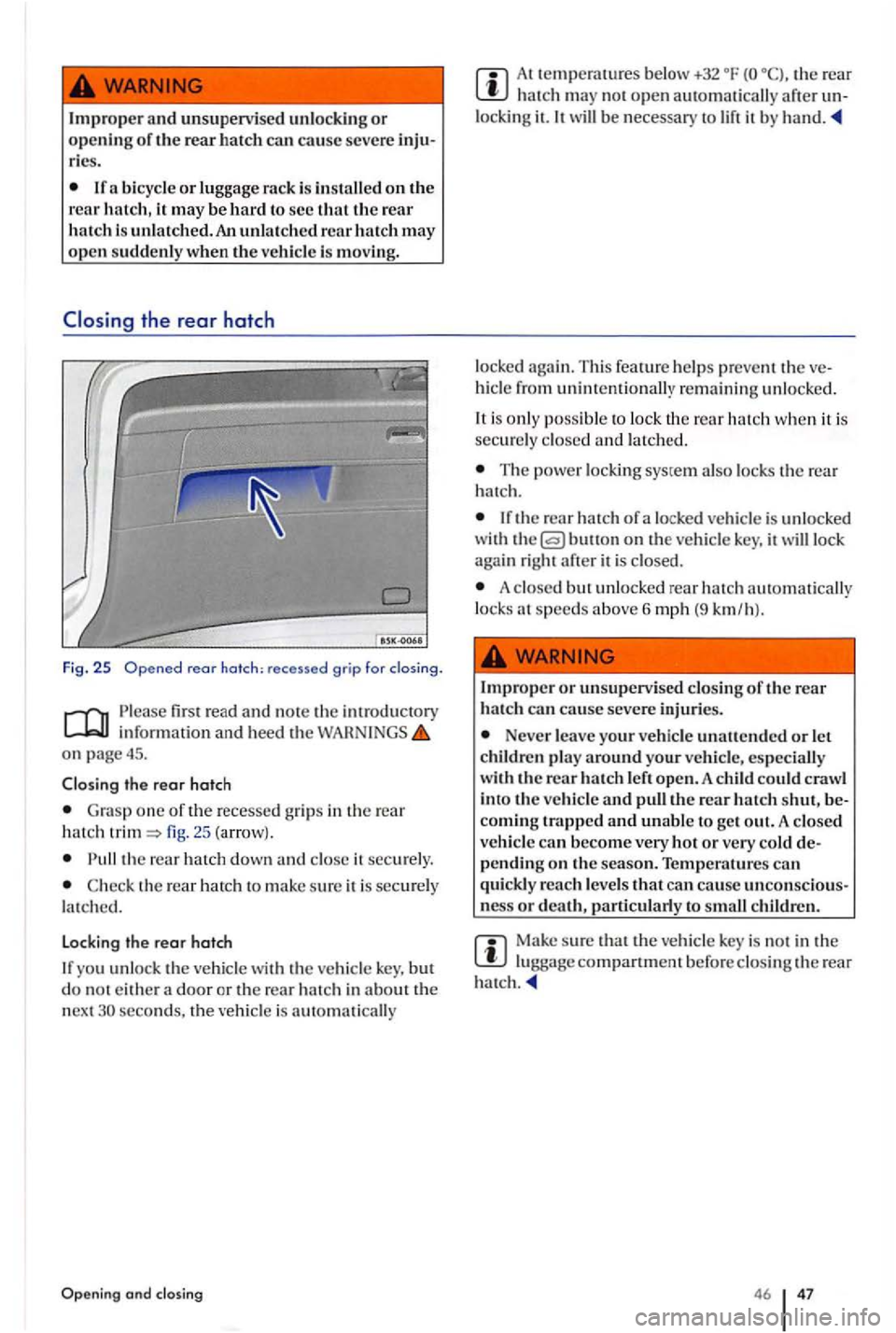
Closin g t he rear hatc h
Grasp one of th e recessed grips in the rear h atc h fig. 25 (a rrow}.
th e rear hatch down and close it securely.
second s, the vehicle is au tomatically
and closing
At t emperatu res below +32 the rear hatch no t o pen automatically after
locked again. Thi s feature helps prevent the hicle from unintentionally re m ain ing unlocke d.
It is onl y poss ible to lock th e rea r hatc h when it is
secur ely closed and latche d.
The power locking system also locks the rear
h atc h.
If th e rear hatch of a locked vehicle is unlocked
w ith button on th e veh icle key, it will lock
agai n right after it is clo sed.
A closed b ut unlocked rear hatch automatically
l ocks at speed s above 6mph (9 k m lh}.
Impro pe r o r unsupervi sed clos ing o f th e rear
h a tc h ca n ca use seve re injuri es.
Never leave your ve hicle unan ended or l et
c h ildren pl ay around your ve hicle, especially
w ilh the re ar ha tc h l eft open. A child could crawl into the ve hicl e and pull the rear h atc h shut,
pending o n the season. Tempe ra tu res can
quickl y re ac h l evels that can ca use unco nscious-ness or death, to sm all child ren.
Make sure tha t compartment b e for e clo sing the rear
46 47
Page 49 of 541
Power windows
In thi s sec tion find lowi ng:
Opening and
windows-functions .. ................. .
Power window pinch protection
More information:
page 21
49
49
so
lockin g and clo sing page 38
Improper use of power windows can resuh in
Neve r let anyone get in the way of a pow er window when clo sing il.
B e for e dri ving
When locking the vehicle from th e outside, make sure that no one, especially children , main s in the ve hicle. The windows will not open in case of an emergency .
Always take the key with you when you l eave
th e vehicle. can still use the power windows
for severa l minutes after the ignition is switched
off as long as the driver or front passe nger d oor has not been opened.
When children are in the back seat, alway s
use th e
Page 50 of 541
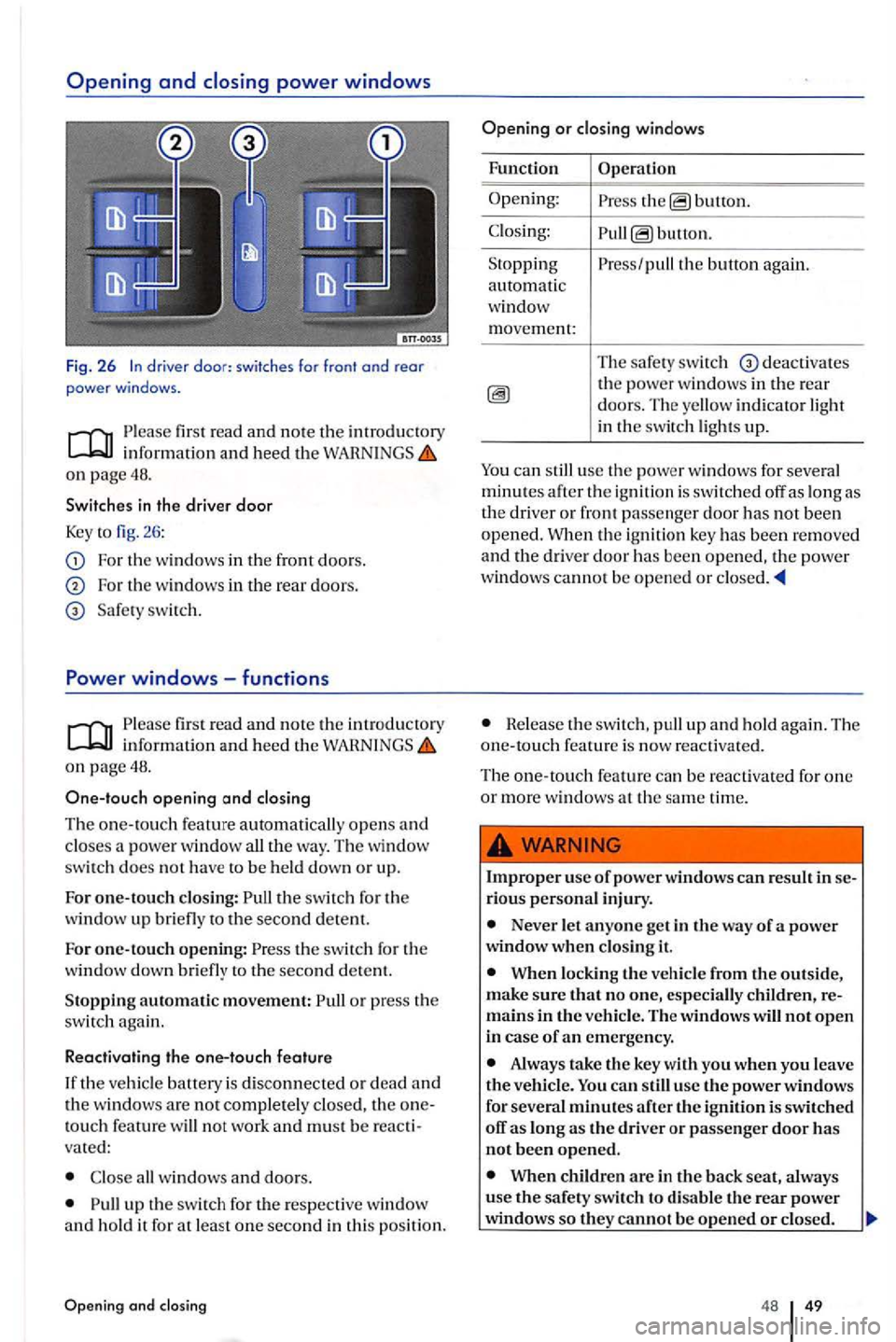
driver door: sw itches for front o nd rear power windows.
first r ea d and not e the introduc tory in formation and heed th e on page 48.
Switches
in the driver door
Key t o fig. 26 :
For th e windows in the fr o n t doors.
For the windows in the rear doors.
windows -functions
fir st r ead and note the introdu ctory information and heed th e on page 48.
One-touch
opening and
th e switch for the
window up to the second detent.
For one-touch ope nin g: the swit ch f or th e
w indow down bri efly to th e seco nd dete nt.
Stopping automatic movement: or press the switch again.
Reactivating the one-touch
feature
If t he ve hicl e ballery is di sconnecte d or d ea d and
th e win dows are not completely closed, the onetouch feature will not work and must be re acti
vat ed:
up th e sw itch for the re spectiv e w indow and hold it for at least one second in thi s po sition .
Opening and closing
buuon.
button.
the button again.
Th e
safe ty switc h deact ivates the power windows in th e rear doors. T he yellow indi cator ligh t
in the switch lig ht s up.
You can still use th e power w in dows for seve ral minutes aft er th e ign itio n is switc h ed off as long as
the driver or front passe nger doo r has not been opened. When the ignitio n key has bee n re moved and th e dri ver door ha s been open ed , the powe r
w ind ows cannot be ope ned or
He lease th e swit ch , pull up and hol d aga in. Th e one-to uch fea tu re is now react iva te d.
The one-touch feature ca n be reactiva ted for one or more window s at the same tim e.
Imprope r use of power windows can result
N ever let anyone get in the way of a power when clo si.ng
When lo cking the vehicl e from the outside, make sure that no one, especially c hildren, remains in the vehicl e. Th e w indows will not open in case of an emergency.
Always take the key with you when you leave the vehicl e. You ca n still use the power windows
for several minutes after the
When children are in the back seat, always
u se the safety switch to disable the rear power windows so they cannot be opened or closed .
48 49
Page 56 of 541
Deleting programming for
pro gramming for th e or turning it ove r to people you do not know.
the s te p s for getting ready to pro
gram as describ ed p age 5 4.
Operating the garage door opener
fir st re ad and note the introductory information on page 53.
The vehicl e must be in the operating range of th e garage or outer ga te drive.
W ith ig nit ion on or engin e running, press the appropriate button in th e sun
an d h old at the same tim e, for about seco nds. When the indicator
light abov e b egi ns to
immediately re lease both buttons. Thi s step dele tes
page 55, door
The rang e of th e 1-lomeLink® Trans
m itt er roughly
corresponds to th e range of the orig inal re mot e control of the device or th e e lec
tri ca l drive. Jfthe garage door or the e lec trical drive
does not work, this coul d be fo r o ne o f the fol
lo wing reasons:
re medy
Batteri es in th e remote con-batteries.
tr ol are dead.
Dis ta nce
or tr ansmission
G arag e door or e lectrica l
angl e too great.
dri ve does not work. Garage door or electrical
drive no t compatible.
In co rre ct programmin g.
usc th e HomcLink ® Trans
mi tter when you arc within range and no one is
th e way.
Note
The wro n g batteries can damage the remote control. Rep lace a discharge d battery wi th one that has th e sam e vo ltage , size , and specifications.
Opening and closin g
Try differe nt dista nces and angles to there-ce iver.
May not co mpl y with legal requirements and may have to be r e placed .
Re-program garage d
oor opener.
di spose of old batteries properly and in a n envir onmentally respon sibl e manner.
clas sified Material. S pec ial handling m ay apply. Se c wwlv.cltsc.ca .gov/ haza rdou swaste/perchlorate . lega l requir ements rega rdin g proper
54 5 5
Page 57 of 541
Sitting properly and safely
Adjusting the seating position
Introduction
In thi s sect io n you'll find information on th e lowing:
Examples of improper sealing positions . . . . . . . . . 57
Proper seating position . . . . . . . . . . . . . . . . . . . . . . . 58
Manual controls on the driv er and passenger
. . 62
Ad jus ting the s teeri ng wheel positio n . . . . . . . . . . . 63
Center a rmrest . . . . . . . . . . . . . . . . . . . . . . . . . . . . . 64
Number o f
Th e ve hicl e has total of five seating positio ns: in fron t and three in the re ar. Each sea tin g sition saf ety be ll.
More information:
pag e 65
page 67
Airbag page
sa fe ty and child page
Improper se atin g pos itions increase th e risk of severe or fata l injurie s in a cras h or other dent, especially w hen th e a irbag deploys.
All occupants mus t b e properly seate d and properly restra ined at all tim es.
Never lett h e number of people in the veh icle
excee d the number of availabl e seatin g tions with sa fe ty belt s.
Alw ays secure childr en in the ve hicl e with an approve d and suitable restraint system cord ing to t heir he igh t and weight
All vehi cle occupants shou ld alway s keep
th eir fee t in their r espective footwell s. Neve r
a llow veh icle occ upants to place their feet on the scat, in strume nt panel, out of th e w ind ow, etc. The and eve n in crease the risk of inju ry in a cras h.
B efore driving
Always adjust scat, sa fcry belts and head straints properly befo re drivin g and m ake sure that passe nge rs are prope rl y restrai ne d.
the front passenger sc at as
inch es (25 e m) between th e front passenge r's breastbone and the instrument panel.
Alway s adjus t the driver's scat and th e
s teeri ng wheel so that there arc at least
em).
or an authorized Volkswagen Facilit y to sec w hether adaptive equipment is availabl e.
Alwa ys hold the steerin g wheel on the side of th e steering wheel rim with your hand s at the 9 o'clock and 3 o'clock positi ons to help reduce the risk of p ersonal inju ry if th e dri ver's
a ir bag inflates.
Neve r hold the stee ring whee l at the 12 o'clo ck
po siti on or with your hand s at o th er places insid e
the stee ring wheel rim or o n th e stee rin g w hee l hub. the steering w heel the wrong way
ca n ca use serio us in juries to the hands, arms,
and h ea d if th e driver 's airbag inflates.
t h e s teeri ng whee l toward your face
d ec reases the abiliry of the driver's airbag to
h elp prot ect yo u in a co llisio n.
Never drive with backre sts reclin ed or tilt ed
far back . T he farther th e backr ests arc tilted back, the g reater th e r is k of injury caused by
in correc t positioning of th e safet y belt s and
improper seati ng position.
Never drive with a front seat backres t tilted
forward. If the front airbag deploy s, th e front
backres t ca n b e forced backward and injure
p asse ngers on th e rear scat.
far back as possibl e from the s tee ring
whee l a n d the in strument panel.
Page 58 of 541
Always upright your back agains t the backrest with the front seats properly adjusted.
Never lean agains t or pla ce any part of you r
body too close to the area where the airb ags are
l oca ted.
Rear seat passengers who are not properly
seated and restrained are more lik ely to be seri
ously injured in a crash.
of improper seating positions
first r ead and not e th e introdu ctory inf ormation and hee d th e on pa ge 56.
Not w earin g or improperly fastening safety belts
i n c reases the risk of se ver e or fata l injuri es. Safe ty
b elt s can work onl y when they are prop erly po sitioned on th e bo dy. A n improp er se atin g pos ition
s ig nifi cantly impai rs the protection provided by
safety belt s. Thi s can cause se ve re or ev en fa ta l in
j uries. T he risk of se rious injur y and d eath is pa r
ti cularly hi gh wh en an airbag depl oys and strik es
an occupant who is not in the prop er seatin g pos i
ti o n. Th e driver is respons ibl e fo r pa ssen ge rs
a nd especi ally childr en riding th e vehicl e.
Th e
and dea th.
Therefore, whenever the vehicle
is moving :
Never stand up in the v ehicle .
Never stand on the seats.
Never kneel o n th e se ats.
Neve r rid e w ith the seat back re clin ed .
Neve r lea n up again st t he in strum ent pa nel.
Neve r lie dow n on the rear seat.
Neve r sit on th e edge of th e se at.
Sitting properly and safely
Improper adjustment of the seats can cause ac
cidents and severe injuries.
Never adjust the seats while the veh icle is
moving. seat may move unexpec tedly and
yo u could lose contro l of the vehicle. In addi
tion, the result of the adjustment will lead to an incorrect seating position.
Adjust the front seat height, angle and longi
tudinal position only if the seat adjustment area is clear.
The adjustment area of the front seats must not be restricted by ob jects
Nev er sit side ways.
N ever lean out the w indow.
Neve r put your feet o ut the window.
Never put feet on th e instrum ent panel.
Neve r rest your feet on the s eat cushion or b ac k of the seat.
Never rid e in the foo t well.
Neve r sit on th e front o r rea r ce nter armrest.
Neve r rid e withou t your belt prop erl y faste ned.
N ev er ride in th e lu gg age compartment.
Each
and incorrec t seating position in
creases the risk of seri o us or fatal during sudden driving and brakin g manoevers and cras hes.
Always make sure that all vehicle occupants
stay in a proper seat ing position and are prop
erly restrained whenever the vehicle is moving.
incorrec tly, not wearing a safety belt and sittin g too close to the airbag increas e the risk of receiving life-threatening or fatal inju
r ies, especially if the airbag deploys and strikes the person who is seated improperly
56 57
Page 63 of 541
Removing and head restraints
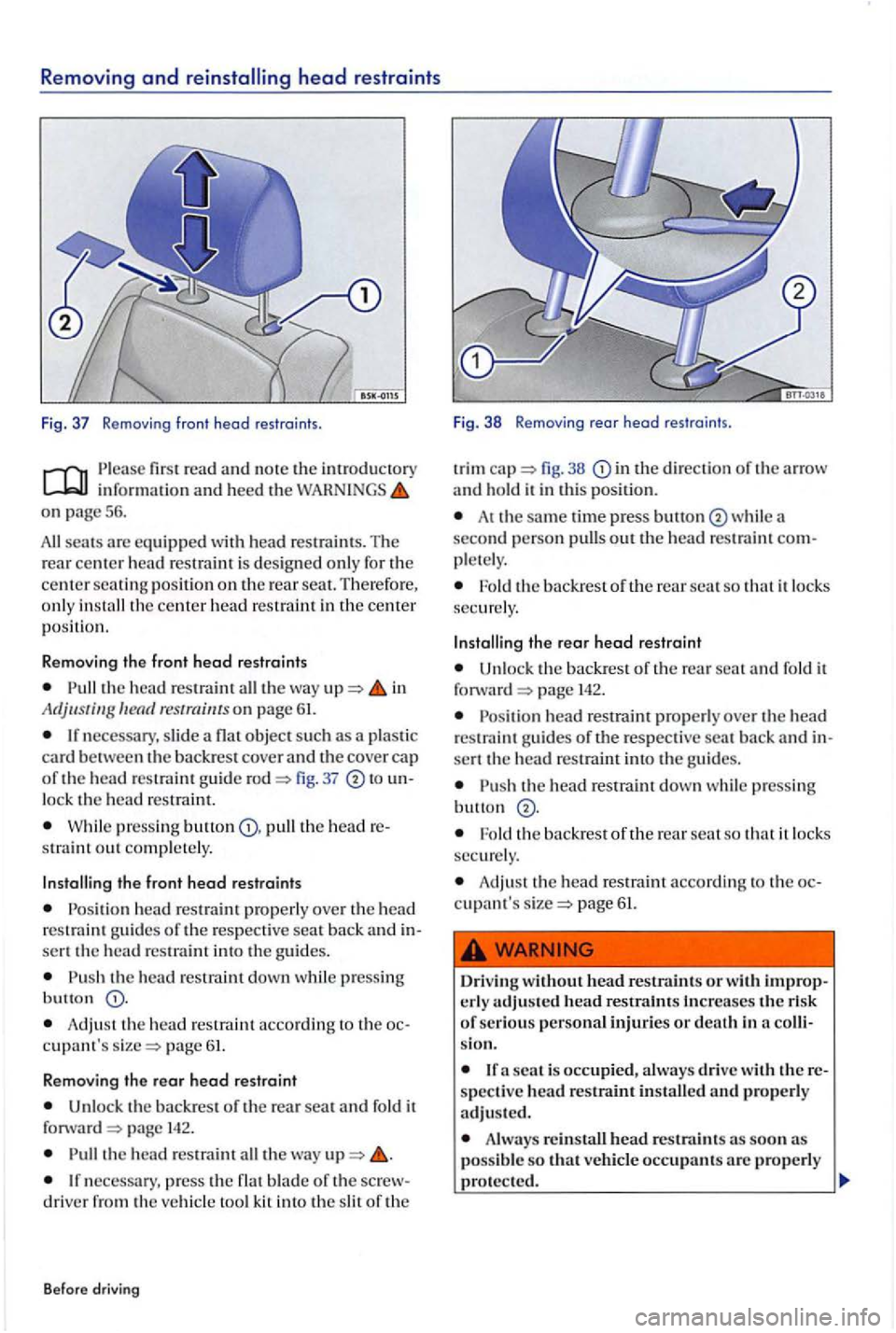
Fig. 37 Removi ng fro nt head restr aints.
read and note the introduc tory informat ion and heed the on page 56 .
scats arc equipped with head restrain ts . The rear c e nt er h ead restrai nt is des igned onl y fo r the ce nter seat ing positi on on th e rear sea t. Th erefo re ,
o nl y
the head re straint the wa y in Adjustin g res traints on page 61.
necessary , slide object su ch a s a pla sti c
ca rd be tween the backre st cover and the co ver cap
of the head restraint g uid e 37
W hil e pres sing pull the head straint out compl ete ly .
the front head restraints
P o sition head restrain t prop erly ove r th e head
r e s tr ain t gu ides of th e respective seat back and sert the head rc s trai m into th e g uid es.
the hea d restraim down whil e pressin g
but to n
Adjust the h ead re strai nt acco rding to the c upant's page 61.
Removing the rear head restraint
Unlock the backrest o f th e re a r seat and fold it
f orward p age
th e head re straint th e wa y
necess ary, pre s s th e flat blade of th e drive r from th e ve hicle too l kit into the s lit of th e
B efore driving Fig
. 38 Remov ing r
ear hea d restra in ts .
trim in the direction o f th e arrow and hold it in thi s posit ion.
At th e same time press bullon second person pull s out th e head restraint
th e backrest of th e rear scat so that it lock s
secure ly.
the rear head restraint
Un lock the backrest of the re a r scat fo ld it
f o rward page 14 2.
h ead restraint prop erly ove r th e head restra int guides of th e re spective sca t back and sert the head restraint into the g uide s.
the head res traint down whil e p ressin g
Fold the backres t of the rear seat so that it lo cks secure ly.
Adju st th e head re straint a ccord in g to the page 61.
Driving without head restraints or wit.h crly adjusted head restra .lnts Increases the ri sk of seriou s personal injuries or death in co
scat is occupied, always drive with
Always reinstall head r estraints as soon possib le so that veh icle occupan ts properl y
Page 65 of 541
Please fir st read and note the in tro ductory
on page 56.
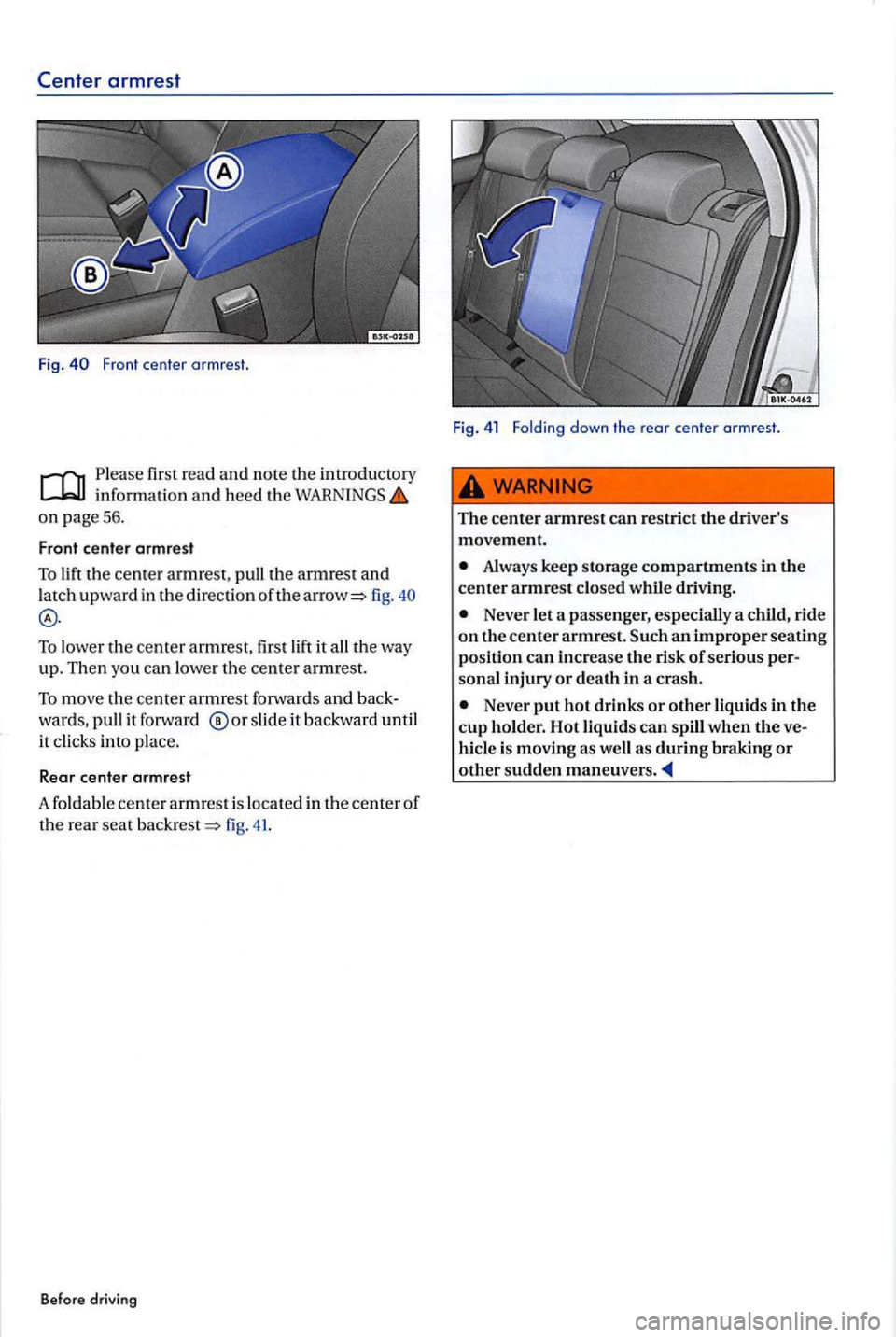
Front center armrest
To lift the cente r a rm rest, pull the armrest and
l atc h upward in th e direction of the fig.
To lowe r th e center armre st, first lift it all the way up. Then you ca n lowe r the center armre st.
To move the center armrest forwards and back
wa rds, pull it forwa rd slid e it backward until
it click s into place.
Rear center armrest
A foldabl e ce nter armrest i s loca te d in the center of the rear sea t fig. 41.
Before drivi ng Fig
.
41 Folding d own th e rear center armrest.
The center armrest can restrict the driver 's
movement.
Always keep storage compartments in the center armrest closed whil e driving .
Never let a pas se nger, esp ecially a child , ride on thecenterarmrest. an improper seating position can increas e the risk of se rious personal injury or death in a cras h.
Never put hot drinks or other liquids in the cup h old er. Hot liquid s can spill wh en the ve
hicl e is moving as well as during braking or other sudden maneuvers.
Page 69 of 541
Damage to safety belt s reduces their ef
fectiven ess increase s the ris k of seriou s perinjury is
b ein g used.
Neve r safety belt s beco me damage d by
b ei ng caught in the door or seat hardware.
Torn or frayed safety te ar, and dam
aged safety hardware break in accident.
Warn ing
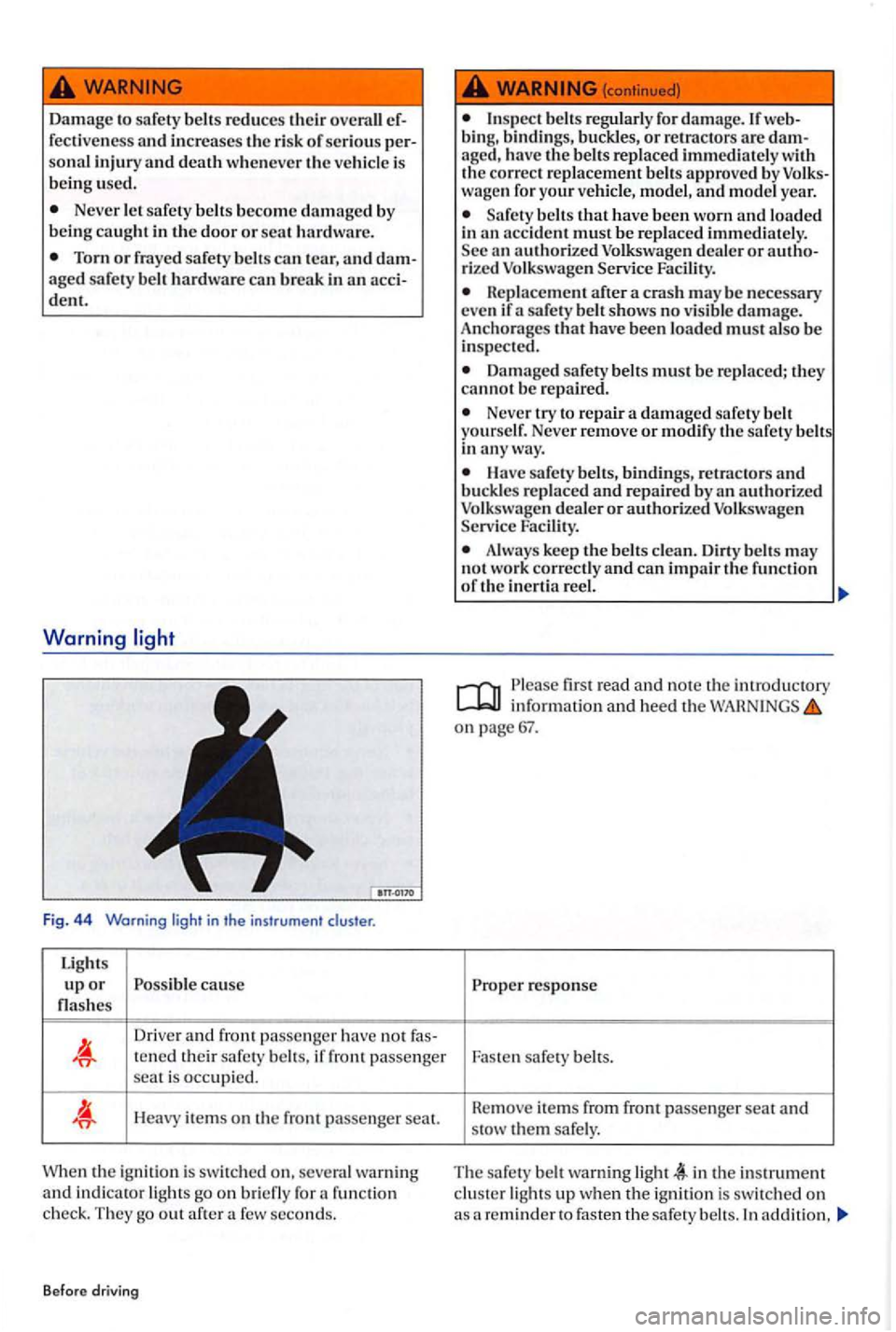
Fig. 44 Warning
Light s
u p o r cause
Driver and fron t pa sse nger have not fas-te n ed their safety if fron t passenger
sea t is occupied.
H eavy items on the front passenger seal.
the ignition is switched on. warning and in dica tor go on fun ction c he ck. They out after few seconds.
Before driving
for damage. If web
bin g, bindings, or re tra cto rs are damaged, have the approve d by wage n for your and year .
Safety that have bee n worn and in an accide nt must be
after a cras h may be nece ssary
eve n if safety sho ws no damage.
Anchorages that have been must
Damage d safety the y canno t b e re p air ed.
Neve r try to re pair a damage d sa fety Never remove or m odify th e safety
Have sa fety belts, binding s, retractor s and
or authorized Serv ice
k ee p the may
n ot work correct ly and ca n impair the function
o f th e in erti a
firs t rea d and note the introductory information and heed the on page 67.
Proper respo nse
Faste n safe ty
T he safety warning in the instrument
In add ition,