ESP VOLKSWAGEN GOLF PLUS 2004 Service Manual
[x] Cancel search | Manufacturer: VOLKSWAGEN, Model Year: 2004, Model line: GOLF PLUS, Model: VOLKSWAGEN GOLF PLUS 2004Pages: 541, PDF Size: 98.86 MB
Page 157 of 541
Driving with a
Please fir st read and note the introductory
o n page 152.
Headlight settings
Towing a tra
ile r can ra ise the fron t end of th e ve
hicle enough fo r the low beam s to blind other road u sers. the headlight ra nge adjustment feature
to lower the light cones as req uired . your vehicle does not have headlight range adjustment, have
the headli gh ts adjusted by an authorized Volkswage n dealer or au th orized Volkswagen Serv ice Facility . Vehicles with gas-d ischa rge lamps self-adjus t to vehicle load an d do not need manual adjustme nt.
Special towing
considerations
Due to th e combined towing weig h t includin g the hi gh er gross vehicle weight, the stopping distance is longer .
Before driving downhill , especially on hills that
a re long or steep, shift in to a lower gea r (m anual
t ransmi ssion) or a lower drive position (automatic
t ra n smi ssion) so that the eng in e helps to brake th e vehicl e. Otherwise, the b rake system could ove rheat and might fail.
The ve hicle's center of grav ity and, i n
Weigh t dis tr ibutio n i s especially bad if the
tow ing veh icle is e mpty and the traile r i s loaded. If
you absolutely must d rive with this combination , drive with extra care an d at a reduced speed.
Starting off with a trail er on hills
Depend ing o n how steep the h ill is and the combined tow ing weig ht, a parked vehicle wi th trailer can roll backwards when yo u firs t sta rt mov ing.
When sta rti
ng off with a trailer on a hill :
Depress and ho ld the brake pedal.
Befo re driv ing
Ma nual transmiss io n : d epress th e clutch fully.
Shift into fir s t gear or drive posi t ion D page 179,
Unlock the par ki ng brake and release it
w hil e ho ld ing th e unl ock butto n.
page assistance systems.
Do not re lease th e parkin g bra ke leve r until the engine sta rt s to move th e vehicle fonvard. your veh icle has an automatic t ransmissio n, yo u can
also depress a nd ho ld the brake pedal for added b raking and then letup on th e brake pedal w hen
you feel th a t the vehicle to move fo rward.
Drive ahead slowly at first.
A lways watch what i s happening up a head
and a round you. Brake earlier than you would if yo u were not to wing a trailer.
Drive especially care full y and accel erate gently. Always avoid sudde n m an euvers and h ard braking.
Be especiall y care ful when p ass ing other hicles. Reduce speed immediate ly if t he trailer
s hows the s lightes t sig n of swayin g. Reduce speed immediatel y if the t ra ile r shows even the
slightest sig n of sway ing.
Neve r try to sto p th e swayin g by accelerating.
Page 163 of 541
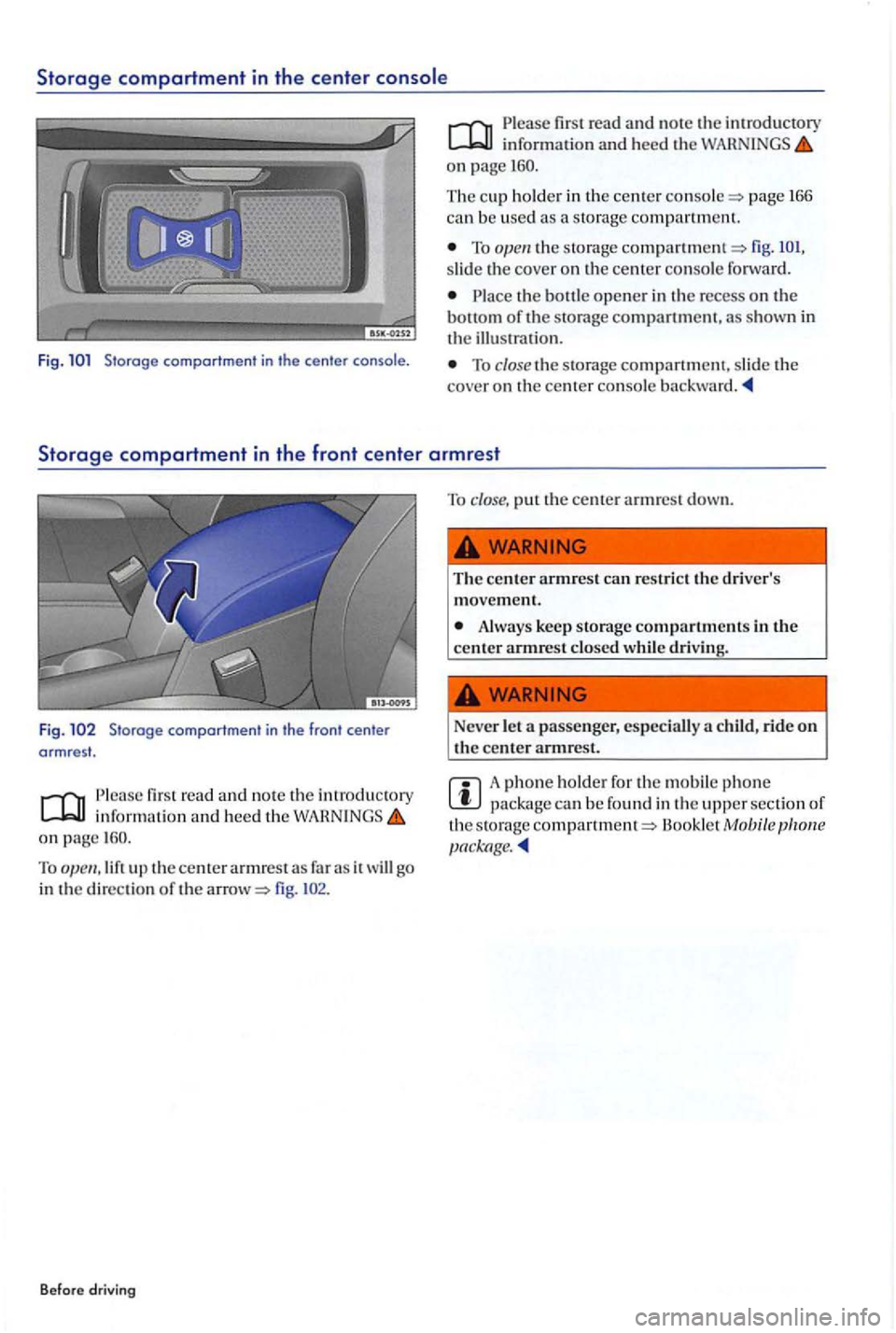
Storage compartment in the center
Fig . Storoge comportment in the cente r console .
first read and no te th e information and heed the on page
Th e c up ho lder in the center page 166
can be use d as a storage
To th e s torage fig. ce nter co nsole forwar d.
th e boule opener in th e recess on the bouom of the storage as shown in
th e illu stration.
To close th e s torage slid e the
cove r o n the cent er co nsole backwar d.
Storage com portment in the front center
armrest .
information and heed the on pa ge
lift up the center armre st far as it will go
in th e d irection of the fig.
Before driving
To close, put th e armrest down.
Th e
center armrest can restrict the driv er' s
Always keep storage compartments in the center armrest clo sed while driving.
Neve r let a passenger, especially a ch ild, ride on the center armres t.
A ph one ho lder for the mobile phone package can be found in th e uppe r section of the storage Mobile
Page 180 of 541
Shifting
Introduction
In this section you'll find information on
. . . . . . . .
Pedals . . . . . . . . . . . . . . . . . . . . . . . . . . . . . . . . . . . . . . 181
Manual transmi ssion: Gearshift lever . . . . . . . . . . . . 182
Automa tic transmission: Selector lever . . . . . . . . . . . 182
with Tiptronic . . . . . . . . . . . . . . . . . . . . . . . . . 185
Driving with automatic transmission . . . . . . . . . . . . . 186
E xplanatory no tes in thi s chapter also apply rect Gearbox.
When the ignition is switched on and th e
T he backup light comes on.
Th e air co nd itionin g sys te m sw itch es ically r ecirculat ing air verse.
The rear window wiper swi tches on when
sis t sys te m , a nd camera For
Instrum em s
Brak ing, and
D is tance
H everse driving assista nl (Rea r Assist)
Clima te comrol
Eng in e contro l and emission cont rol sys tem
Eme rgen cy closi ng and page 322
accelera tion can cause skidding and loss of t ract ion, especially on slipp ery roads, sulling in loss of vehicl e control , collision s,
and seriou s personal injury.
kick -d own feature or fast ti on onl y if vis ibility, weather, road , and traffi c
co nditi ons permit.
Neve r
or apply the p edal often or lo ng. Constant brakin g ca uses the brakes to over hea t. This subs ta nti ally duce performance, increase stop1> ing
d is tance, and cau se complete failure of th e
Note
Neve r the brakes by keeping your foot
o n brake ped al when you do not want to brake.
Thi s
Before driving downhill , es peci all y on that are lon g or steep, alw ays reduce speed an d into lower gear (manual or auto mati c mission) so that th e engin e help s to brake hi cle. Otherwi se, th e brake system could over hea t and possibl y fail. use th e when yo u
n eed them slow v ehicl e dow n more or
Page 184 of 541
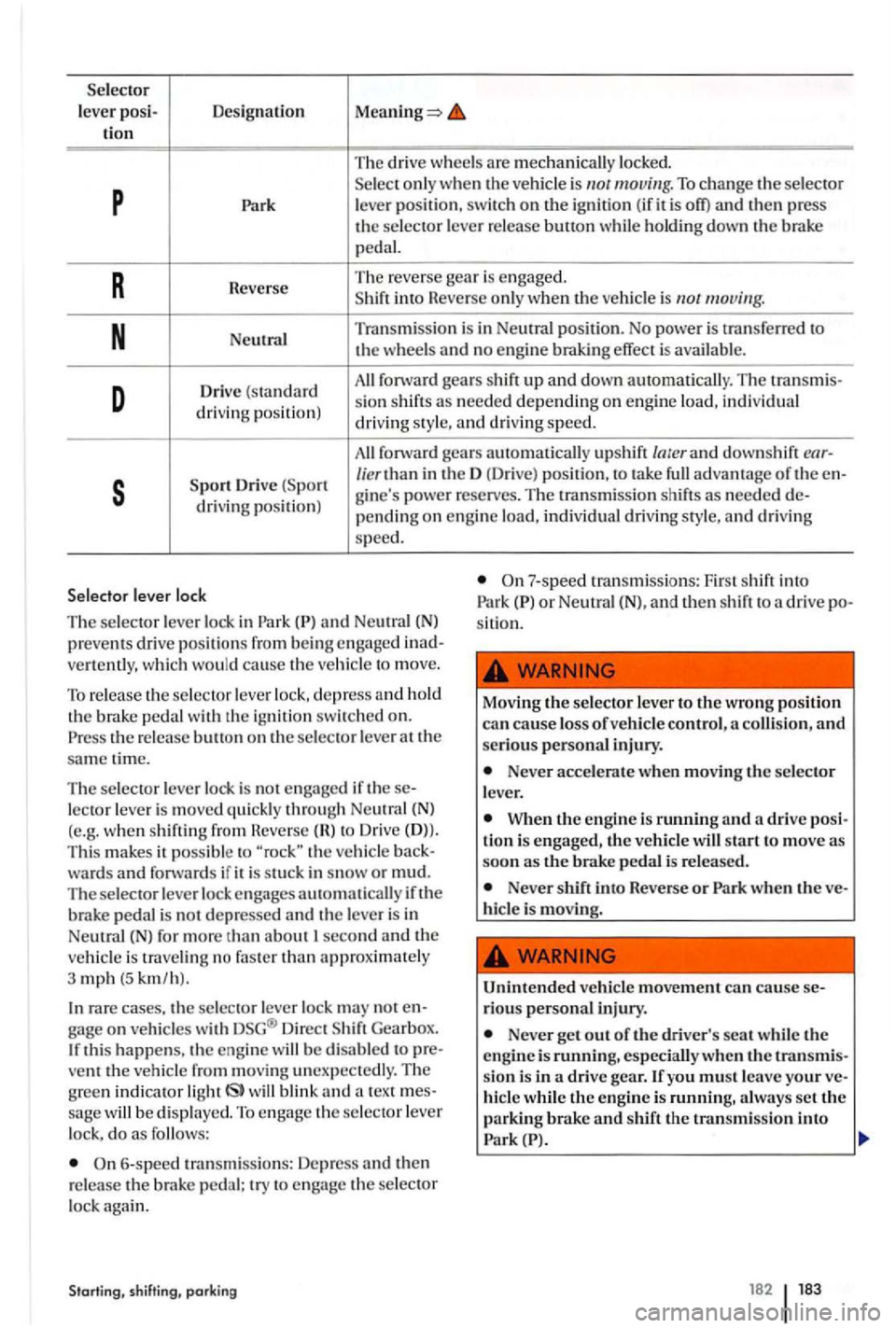
Selector lever posi- Designation tion
The drive wheels are mecha nica lly locked.
p Se le c t only when the ve hicle is
N Neutral Tran
smissio n i s in Ne utral positi on. No power is tra nsferre d to
th e wheels and no e ng in e brakin g effect is available.
D Driv e (standard All forwa rd gears shift up and d ow n automatically. The tran smi s-
dri vin g pos ition) s
ion shift s as nee ded dep endin g on engin e load , indiv idual dri vin g sty le, and dri ving speed.
A
ll f orwa rd gea rs aut omatically up shift/aterand dow nshift ear-
s Sport Dri ve
leve r lock
Th e
selector leve r lo ck in
the re le ase button on th e selec tor leve r a t th e sam e time .
Th e se lec to r leve r l
ock is no t e ngaged if these
(R) to Dri ve (D)).
T hi s makes it possibl e to
second and th e
ve hicl e is tra velin g no faste r than approx imate ly
3 mph (5 km /h).
ra re cases. the Dir ect Gea rbox. thi s ha ppens, th e eng ine w ill be disab led to pre
ve nt the vehicle from m oving unexpec te dly. Th e
gree n ind ica tor light will blink and text mes
sage will be di sp layed. To e n gage th e selec tor lever lock, do as follows:
6-speed trans missions: Depress and then re le a se the brak e pedal; try to e ngage th e se lector l oc k again.
Starting, shifting, parking
Never accelerate when m ovi ng the selector lever.
Whe n the en gin e is running and a drive positio n is engaged, the ve hicle will start to move as soon as the brake pedal is re leased.
Never shift into Reverse or
Never get out of the driver's seat whil e the engine is running, especially when the tra nsmi s
s ion is in a drive gear. lfyou m ust leave your ve
hicl e while the engi ne is running, alwa ys set the
p a rkin g brake and shift the transmi ssio n into (P).
182
Page 187 of 541
Driving with automatic transmission
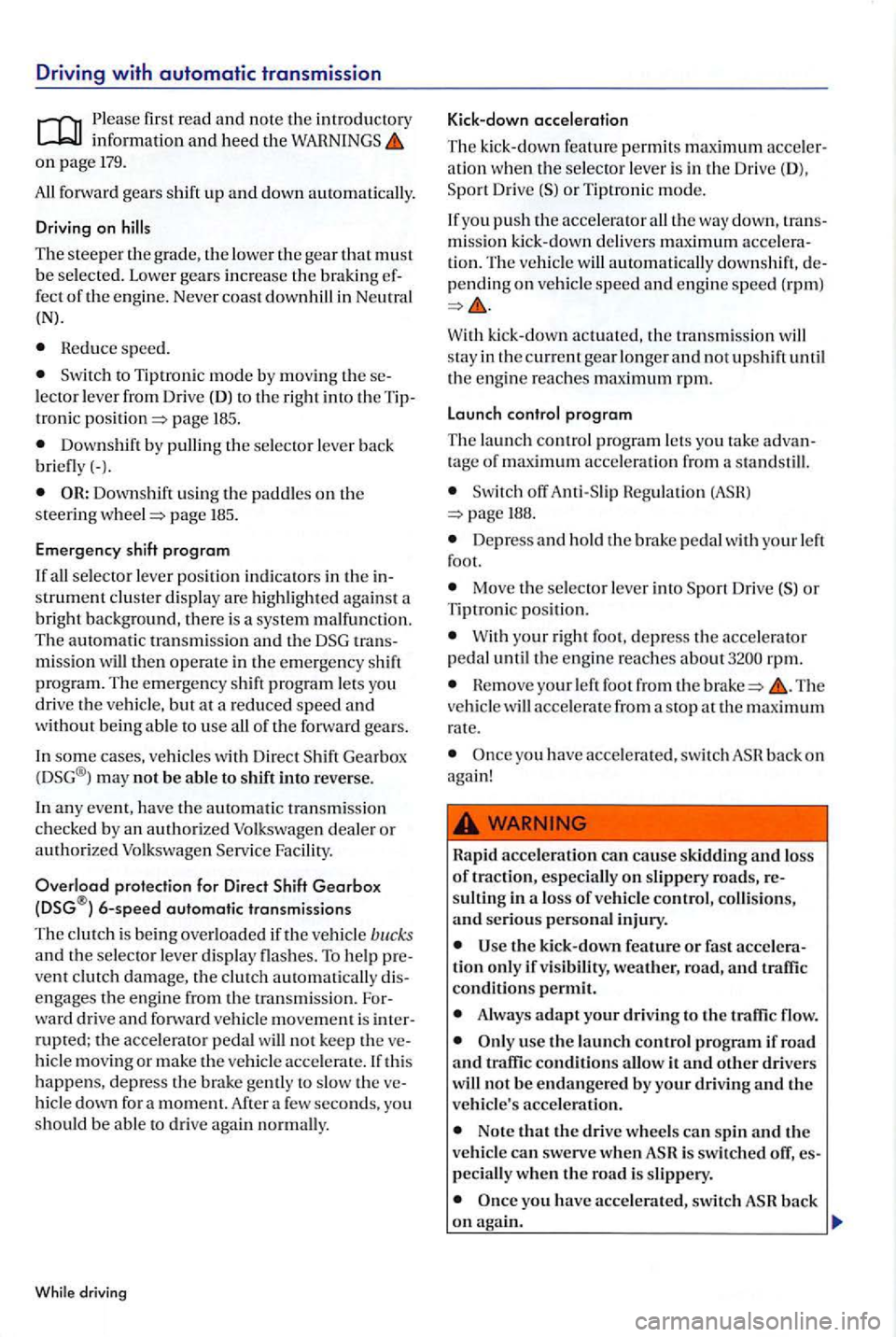
Please fir st read and n ote the int rod uctory informatio n and heed th e WARN INGS on page 179.
All forwa rd gea rs shift up and down automatically.
Driving on
Th e steeper grade, lower the gea r that must be selec te d. Lowe r gea rs in crease the b raking ef
fect o f th e e ng ine. Neve r coast downhill in (N).
Heduce sp eed.
Switch to Tiptron ic mod e by m oving theselecto r l eve r fro m Drive (D) t o the rig ht into the Tipp age 185.
Dow nshift by pullin g th e selec to r l ever back briefly(-).
page 185.
Emergency shift
program
trans
m issio n will th en operate in th e em ergency shif t
p rogram. The emergency shift progra m lets you drive th e ve hicle, bu t at a re duced speed and w ithout bein g able to use all of th e forwa rd gears.
I n
som e cases, vehicles with Direct Gearbox (DSG® ) may not be able to shift into reverse.
I n
any event, have the automatic tra nsm iss ion checke d by an authorized Volkswage n dealer or authorized Volkswage n Service Facility.
O verload prot ection for Direct
Drive
With k ick-down actu ate d , t he tran sm iss io n will stay in th e current gear lo nge r an d not ups hift un til
t h e e ng ine reaches m aximum rpm.
Launch control
program
The launch control p rogra m lets you ta ke ad van
t age of maximum acce lera tion from a standstill.
Switc h off Anti -Sli p H egulation 188.
De press and ho ld th e bra ke pedal with your le ft
foot.
Move th e selector leve r in to Dr ive
W ith your rig ht foot, depress the accelerator
pedal un til the engine reaches rpm.
Hemove you r left foo t from the stop at the m aximum rate.
y o u h ave acce le rated, swit ch back on aga in!
H apid
accele rati on ca n cause skidding and loss of trac ti o n, esp eciall y on slippery roa ds, re
s ultin g in loss of ve hicl e co ntrol , co llisio ns,
and se rious pe rso na l injury .
Use th e kic k-down feature or fa st acceleration only if vis ibilit y, weather, road , and traffic conditions permit.
A lways adapt your dri vin g to th e tr affi c flow.
use the launc h contro l progra m if road and traffic co nditi ons a llow it and oth er dri ve rs
w ill no t b e endangered by your drivin g and th e
ve hicle's accele rati on .
Note tha t th e drive whee ls ca n spin and the
ve hicle can swerve when
back
Page 188 of 541
Note
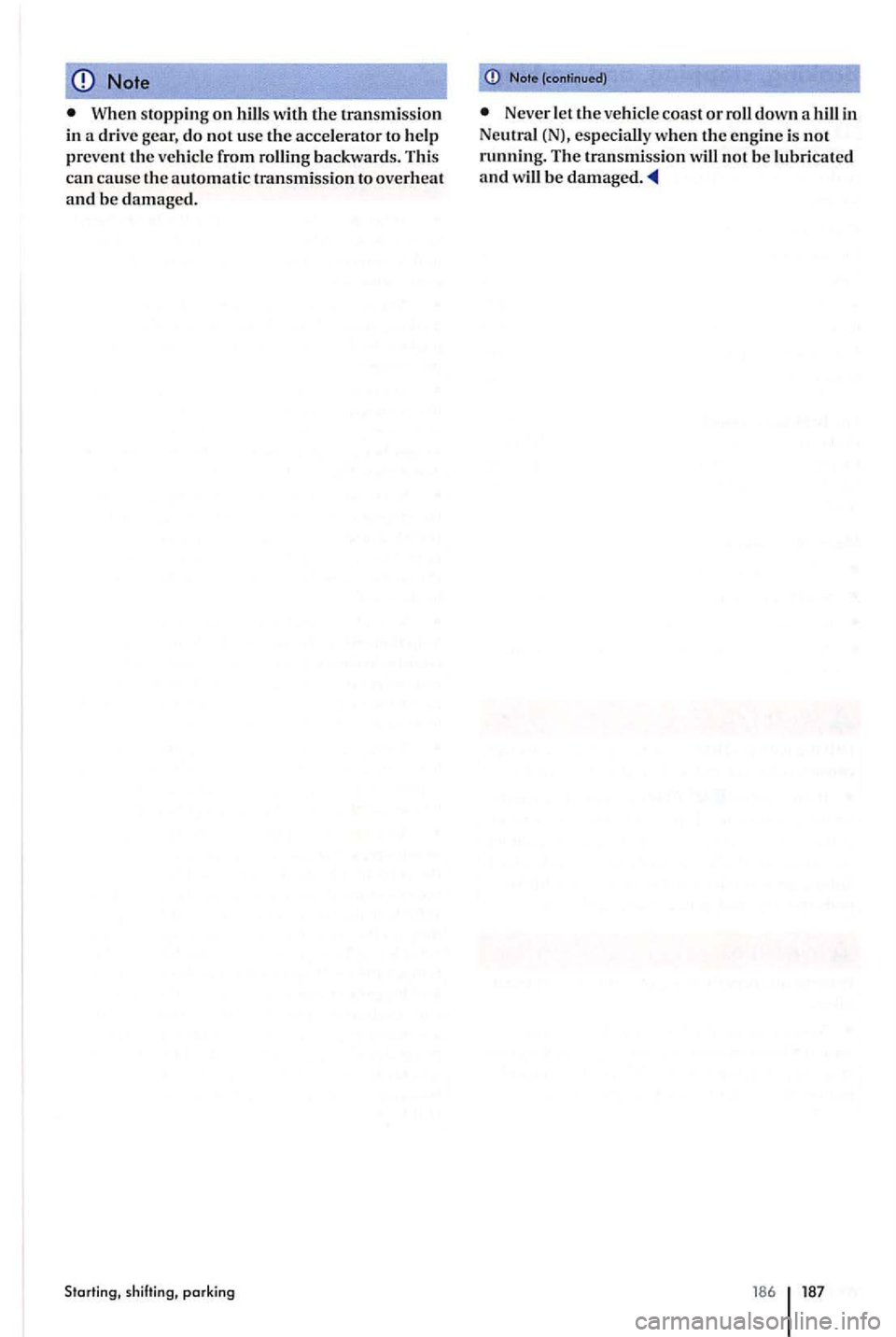
When stopping on hills with the transmission in a drive gear, do not use the accelerator to help prev ent the vehicle from rolling backward s. This can cause the automatic transmission to overhea t and be damaged.
Starting, shifting, parking
Note (continued)
Never let the vehicle coast or roll down a hill in Neutra l (N), especial ly when the engine is not running. The transmission not be lubricated and be
186 187
Page 191 of 541
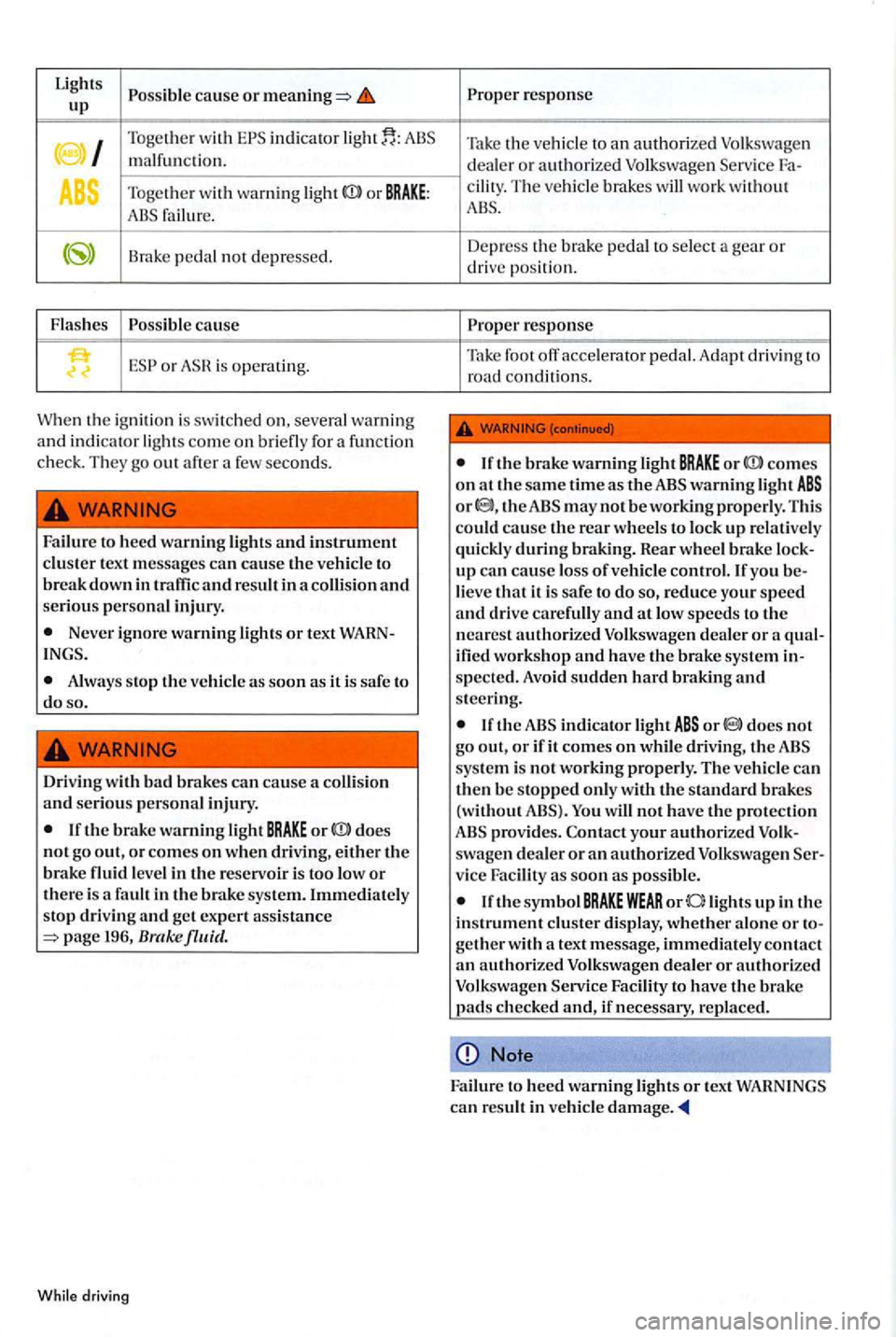
Lights cause or up
I
Together w ith indicator
m alfun ction.
T oge th
er with warning light
cause
or is opera ting.
W hen the ig nition
is sw itched on,
light s and instrument cluster text messages can cause the vehicl e to
break down in traffic and result in a collision and serious personal injury.
Never ignore warning light s or text WARN
Always stop the vehicl e as soon as it is safe to
do so.
Driving
with bad brake s can cause a collision and serious p ersonal injury .
does
not go out, or co mes on w hen driving, either the brak e fluid leve l in the reservoir is too low or there is a fault in the brake sys tem. Immediately
s top driving and get expert assista nce
response
Take the veh icle to an authori zed Volkswage n
d ealer or authori zed Volkswagen Service Fa-The ve hicl e brake s will work without
response
foot off accelerator pedal. Adapt driving to road conditi ons.
If the brake warnin g light BRAKE or co mes on at the same time as the warning light or th eABS may not be working properly. Thi s
could cause th e rear whee ls to lock up re latively
quickly during braking. Rear wheel brake lock
u p can cause loss of veh icle control. If yo u be
lieve that it is safe to do so, reduce your speed and d ri ve carefully and at low speeds to the neares t authorized Volkswagen dealer or a qual
the indicator light or does not go out , or if it comes on driving, the sys tem is not workin g properly. The vehicle can th en be stopped onl y with the standard brake s
(wi thout ABS). w ill not have the protection provides. Contact your authorized Volk
swage n dealer or an authorized Volkswagen vice Facility as soon as possib le.
lights up in the
in strument cluster display, whether alo ne or to gether with a te xt message, immediately contact an authorized Volkswagen dealer or authorized Volkswage n Facility to have the brake pad s ch ecked and, if necessary, replaced.
Note
Failure to heed warning lights or text WARNINGS can re sult in vehicle damage
Page 192 of 541
first read and note the imrod uctory
on pag e 188.
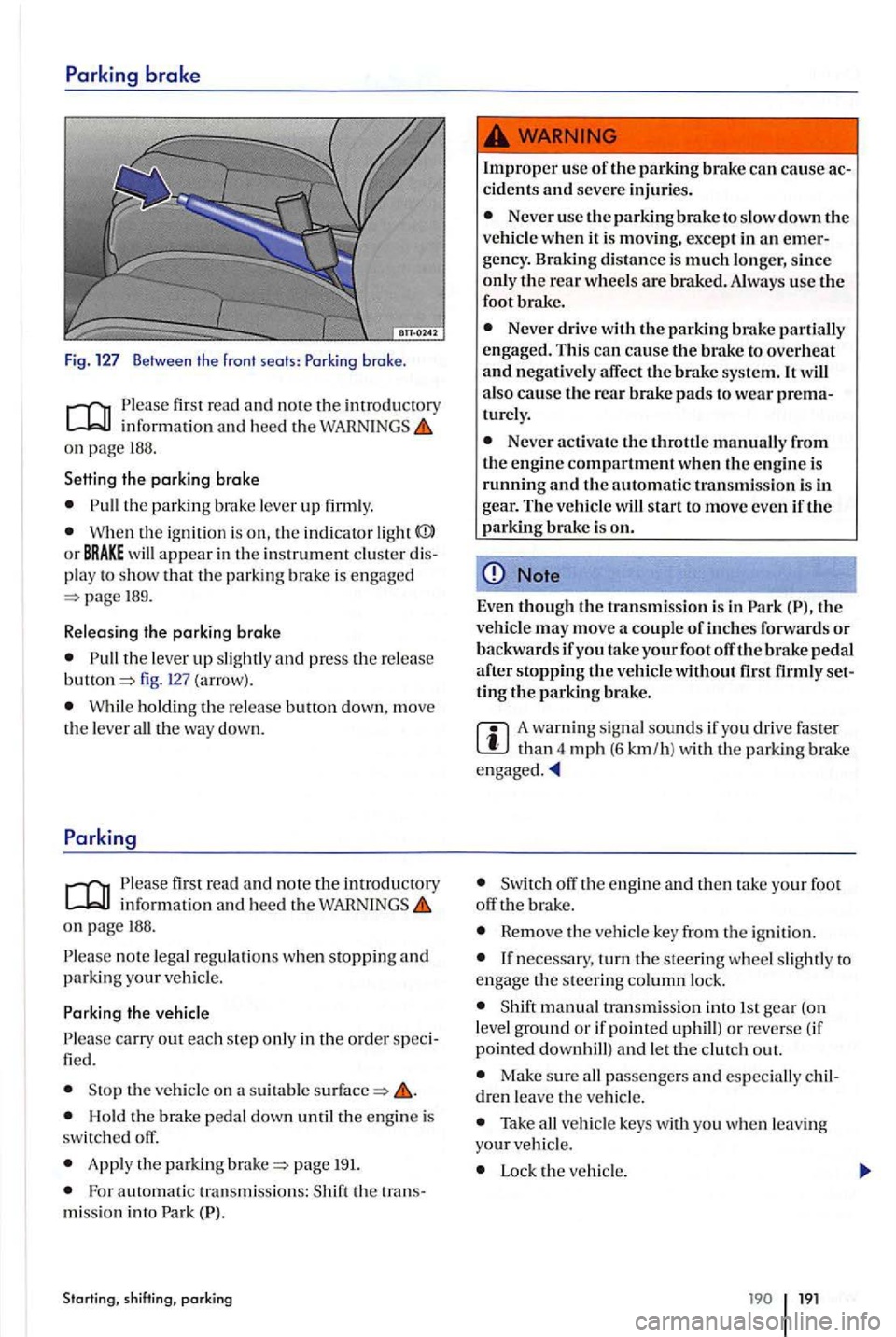
Setting the parking brake
the parkin g br ake lever up firml y.
Wh en th e ignitio n is on, the in dicator light
189.
R e leasing the parking
brake
the lever up slightl y and press the release fig. (arrow).
W hil e ho ldin g th e re lease butt on down, move
t h e leve r all th e way down.
info rmatio n and hee d th e on page 188.
n o te lega l regulations when stopping and parking your veh icle.
th e vehicle on a suitabl e
Hold th e brak e pedal dow n until the engin e is
switc h ed off.
App ly the parking page 191.
Fo r a utomatic tra nsmiss ions: th e tra ns
mi ssio n in to Park
Starting, shift ing, parking
Improper use of the parking brake ca n cause ac cidents and seve re injurie s.
Never use the pa rkin g brake to slow down the ve hicl e when it is moving , except in an emer
gency . Braking distance is much longe r, since only the rear wheels are brak ed. Always use the
foot brake.
Never drive with the parking brake partiall y
engage d. Thi s can cause the brake to overheat and negatively affect the brake syste m. It also cause the rea r brake pads to wea r prematurely.
Never acti va te t he throttl e manually from
th e e ngin e compartment when th e engine is running and the automatic tra n smissio n is in gear. The ve h icl e w ill start to move eve n iftl1 e parking brake is on.
Note
Even t11ough the transmi ssio n is in th e
ve hicl e may move a couple of inches forward s or backwar ds if you take your foot off the brake pedal after s toppin g the vehicle without set
ting tl1e parking brake.
A wa rning sig nal sounds if yo u driv e faste r th an 4 mph (6 km/h ) w ith th e parking brake
off the engin e and th en tak e yo ur foot
off brak e.
Rem ove the veh icle ke y from th e ign ition .
manual transm iss ion in to 1 st gea r (on
l evel ground or if pointed uphill) o r re ve rse (if
point ed
Make sure all passengers and esp ecially children leave th e ve hicle.
Take all ve h icle keys with you w he n le a vin g your ve hicl e.
Lock the ve hicl e.
19 1
Page 194 of 541
Brake booster
Th e brak e boo ste r w ork s o
nly wh en the engi ne is
running . It increa se s th e forc e on the brake s above and beyond the pre ssure put on th e brake pedal by
the driver.
If the brake booster is not working, or if th e ve hicl e
ha s to be towed, you have to push th e brak e
p ed a l hard er to make up for the lack of booster
New brake pads do not provide maximum braking performance.
New brake pads do not have the best ping power for the first km) and must be You can compensate for the slightl y reduced braking force by putting more pressure on the brake pedal.
Drive with
Never follow otl1er vehicles too closely or put yourself into other sit uation s that might require sudden, hard braking ,especially when the brake pads have not been broken
Overheated brakes
When driving downhill , the brakes have to
work es pecially hard and heat up quickly.
Before driving downhill, es peciall y on th at are long or steep, alwa ys reduce s peed and shift into lower gear (manual or automatic
transmission) so that the engine he lp s to brake
the vehicl e. Othenvise, the brake system cou ld
ov erheat and pos sibly u se the brakes
w hen yo u need them to slow the v ehicl e down
m ore or to stop.
A damaged front spoiler or a non- standard spoiler can reduce airflow to the brakes and
Starting, shifting, parking
Wet brakes or brakes witl1 icc or road salt
react slow er and n eed lo n ger stoppin g tances.
Ca refully apply the brakes to test th em.
Always dry brak es and clean off ice and salt
coat ings with a few cautious
tions permit.
Driving when the booster is no t working
in creases stopping distances and can cause dent s and seriou s personal injuries.
Never le t the vehicl e coast when the en gine is
switc hed off.
If the brake booster is not working (such as
w he n the vehicle is bein g towed), a lot more pedal force is needed to slow down and stop.
Note
Neve r the by keeping your foot on the to brak e.
Constant pressure on the brake pedal can make th e brakes overheat. This sub stantially reduce
braking performance, increase stopping di stan ce, and can cause co mpl ete failure of th e brake
s y stem.
Before driving downhill, especially on that are long or steep, always reduce speed and shift into lower gear (manua l or automati c
When th e front brake s are serviced , you should have the rea r brake pads inspected
rized Volksw agen deal er or au th orize d Volkswa gen
Service Facility vis uall y insp ec t th e pads through
th e o pe nin gs in the wh eel rim s or from nea th tl1e ve hicle. If n ecess ary, the wheels ca n be
t ake n off for a mor e thorou gh
192 193
Page 201 of 541
Fuel-efficient driving
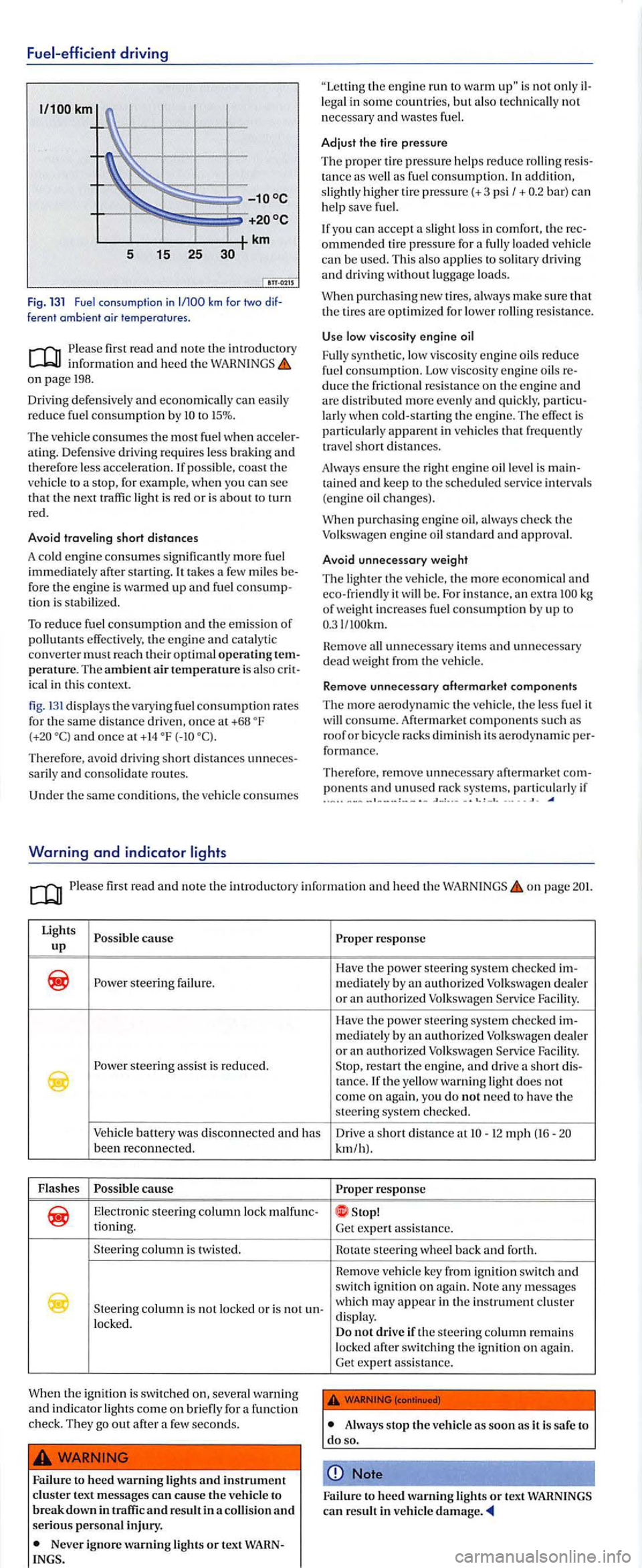
Fig. 131 Fuel consumption in ferent ambient air temperatures .
info rmation and heed the on page 198.
Dri vin g defensive ly and economically can easily
r educe fuel con sumption by to 15 % .
The ve hicle consu mes the most fu el w he n atin g. D efe nsive dri vin g require s less brakin g and therefore less accelerat ion. If possib le, coast the ve hicle to a sto p, for exa mple, when yo u ca n see th a t th e next traffic ligh t is red or is about to turn
red.
Avoid traveling short distanc
es
A cold engine consumes sig nificantl y more fuel
imm ediately after sta rtin g. It take s a few miles fore the engi ne is warm ed up and fuel tion i s stabili zed.
To reduce fuel consumptio n and the emission of pollutants effect ive ly, the e ng in e and ca talytic
conve rter must reach th eir optimal operating
ica l in thi s context.
fig. 13 1 displays the v a ry ing fuel consumption rates
for the same d istance dri ven, once at +68 and once at + 14
th e e ngin e run to warm is not o nl y lega l in some co untries, but also technicall y not
n ecessary and wastes fu el.
Adjust the tire pres sure
T he prop er tir e
pressure help s reduce rollin g tance as well as fue l co nsumption. In additi on ,
slig htl y higher tire pressure(+ 3 psi I+ bar) ca n
h e lp save fuel.
If you ca n a ccept a slight los s in comfort, the ommend ed tir e pressure for a fully loade d ve hicl e
ca n be used. This als o applies to so litary dri vin g and driv ing withou t lu ggage loa ds.
When purchasing new t ires, alway s ma ke sure th at
th e tires are optimi zed for lower rollin g resis tance.
Us e low viscosity engine oil
F ull y sy nth e
tic, low viscosity e ngine oils reduce
fuel consumption. Low viscosity e ngin e oils duce the fric tional res istance on th e engine and are dis tributed m ore evenly and qui ckly, larly w hen co ld -s tarting the engine. The effect is parti c ularl y apparent in vehicles th at frequentl y
tra vel s hort dis tan ces.
A lways ens
ure th e righ t e n g in e oil leve l is ta in ed and keep to the sc h edul ed serv ice interva ls
(e ng ine oil ch an ges).
W
hen purch asing e ngine oil, always ch eck th e Volksw agen en gine oil standard and approval.
Avoid unnecessary weight
The lighter th e ve hicl e, th e more economica l and ceo-friend ly it w ill be. For in stance, an extra
H e m ove
consum e. Aftermark et co mponents s uch as
ro of or b icycle racks dimin is h its aerod yn a m ic fonnan ce.
Th erefo re, re
mov e un necessary aftermark e t ponents and unused rac k systems, parti cul arly if ....... -
fir st read and note th e introductory informa tion and h ee d th e WAHNINGS page
response
Ha ve the power stee rin g sys te m ch ec ked ste eri ng failure. mediatel y by an authori zed Volk swag en deale r
o r a n authorized Volk swagen
Fac ility. steeri ng ass is t i s reduced. re start the e n gine, and dri ve a sh ort tan ce. If th e yello w warning light does not
c o m e on again, you do not need to have th e
s te ering syste m ch ec ke d .
Vehicle battery was di sconnected and has Drive a short distan ce at 12 mph been reconnec te d . km/h).
F lashes re sponse
Elec troni c steering column lo ck malfunc -
which m ay appea r in the in strument clu ste r
di sp lay. loc ke d.
W
hen the i g nit ion is switc h ed on, seve ra l wa rnin g and indicator lights come on bri efly for a f un ction ch e ck . T hey go out after a few seconds.
Failure to
heed warning light s and in strument cluster text m essages can cause th e vehicl e to break down in t raffic and result in a collisio n and seriou s personal injury.
Neve r igno re warning lights or tex t
Do not dri ve if th e s teerin g co lumn remains
l ocke d switch in g th e ig niti on on aga in.
Ge t expert assis ta nce.
Alwa ys sto p the vehicl e as soon as it is safe to do so .
Note
Failur e to heed warning lights or tex t WARNINGS can res ult in vehicl e damage