belt VOLKSWAGEN POLO 2015 Owner´s Manual
[x] Cancel search | Manufacturer: VOLKSWAGEN, Model Year: 2015, Model line: POLO, Model: VOLKSWAGEN POLO 2015Pages: 100, PDF Size: 4.14 MB
Page 14 of 100
Downloaded from www.Manualslib.com manuals search engine 12/29/2015Bedienungsanleitung < Service & Zubehör < Volkswagen Deutschland
11/32
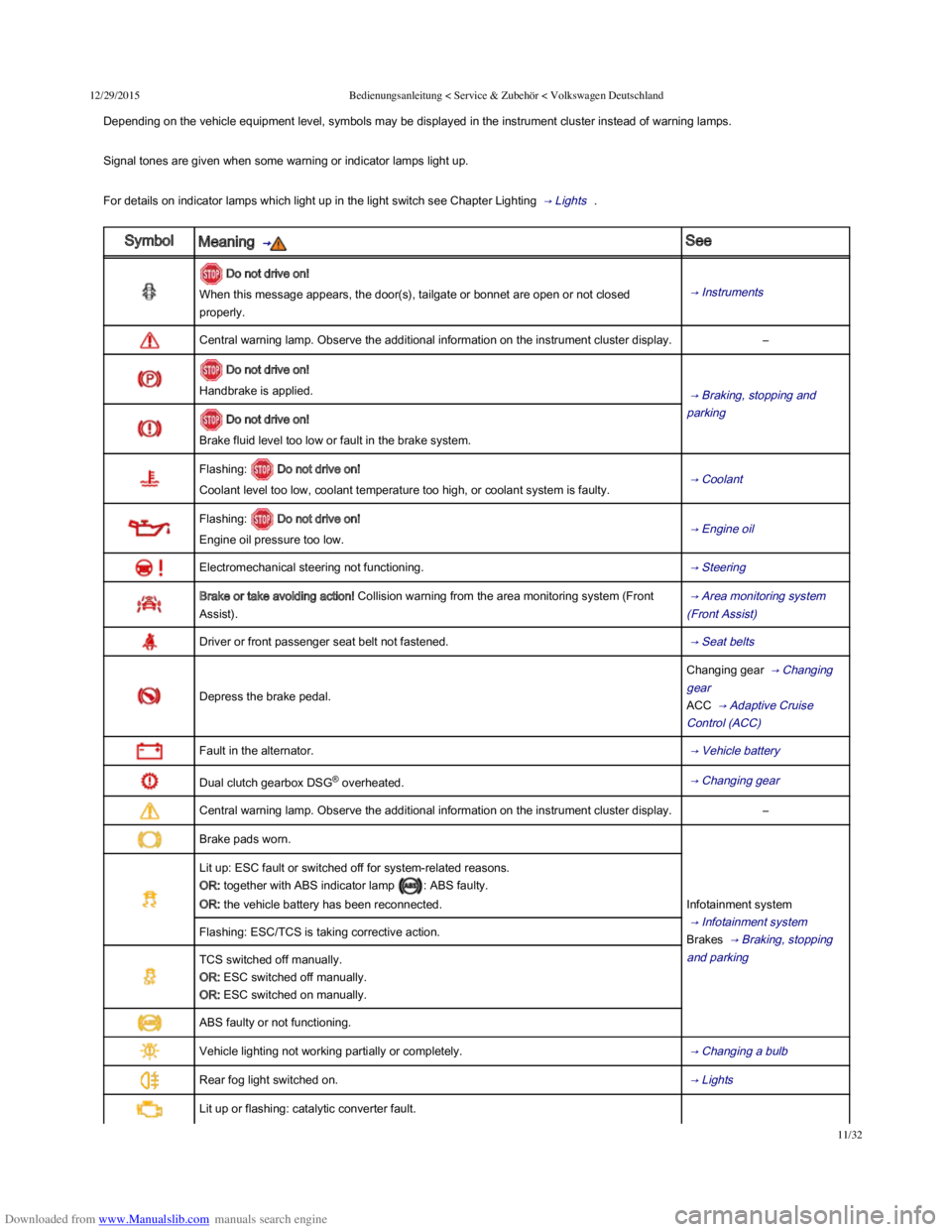
Depending on the vehicle equipment level, symbols may be displayed in the instrument cluster instead of warning lamps.
Signal tones are given when some warning or indicator lamps light up.
For details on indicator lamps which light up in the light switch see Chapter Lighting → Lights .
SymbolMeaning → See
Do not drive on!
When this message appears, the door(s), tailgate or bonnet are open or not closed
properly.
→ Instruments
Central warning lamp. Observe the additional information on the instrument cluster display.–
Do not drive on!
Handbrake is applied. → Braking, stopping and
parking Do not drive on!
Brake fluid level too low or fault in the brake system.
Flashing: Do not drive on!
Coolant level too low, coolant temperature too high, or coolant system is faulty. → Coolant
Flashing: Do not drive on!
Engine oil pressure too low. → Engine oil
Electromechanical steering not functioning. → Steering
Brake or take avoiding action! Collision warning from the area monitoring system (Front
Assist).
→ Area monitoring system
(Front Assist)
Driver or front passenger seat belt not fastened. → Seat belts
Depress the brake pedal.
Changing gear → Changing
gear
ACC → Adaptive Cruise
Control (ACC)
Fault in the alternator. → Vehicle battery
Dual clutch gearbox DSG® overheated. → Changing gear
Central warning lamp. Observe the additional information on the instrument cluster display.–
Brake pads worn.
Infotainment system
→ Infotainment system
Brakes → Braking, stopping
and parking
Lit up: ESC fault or switched off for system-related reasons.
OR: together with ABS indicator lamp : ABS faulty.
OR: the vehicle battery has been reconnected.
Flashing: ESC/TCS is taking corrective action.
TCS switched off manually.
OR: ESC switched off manually.
OR: ESC switched on manually.
ABS faulty or not functioning.
Vehicle lighting not working partially or completely. → Changing a bulb
Rear fog light switched on. → Lights
Lit up or flashing: catalytic converter fault.
Starting the engine → Starting
Page 15 of 100
Downloaded from www.Manualslib.com manuals search engine 12/29/2015Bedienungsanleitung < Service & Zubehör < Volkswagen Deutschland
12/32
Starting the engine → Starting
and stopping the engine
Engine management, exhaust
gas purification → Engine
management system and
exhaust purification system
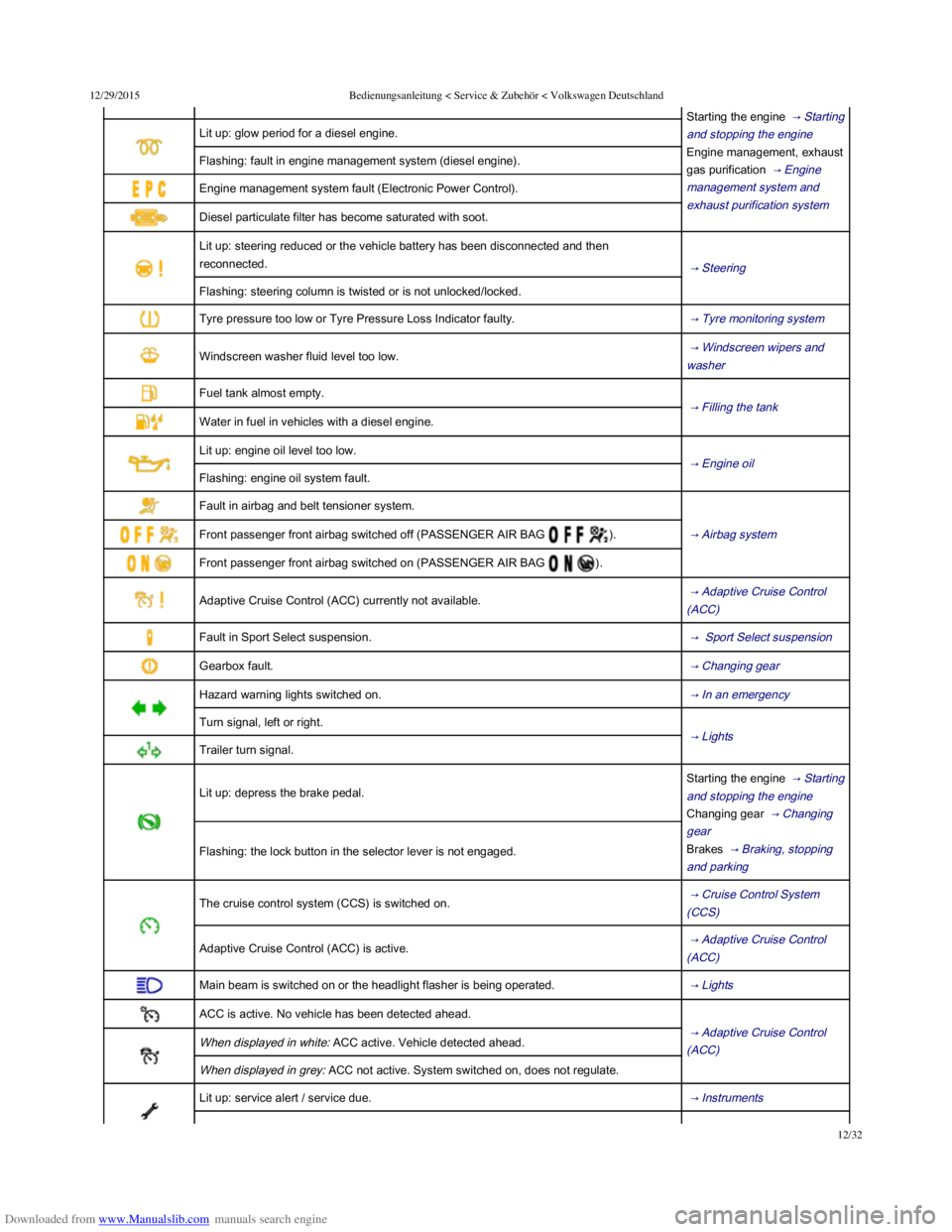
Lit up: glow period for a diesel engine.
Flashing: fault in engine management system (diesel engine).
Engine management system fault (Electronic Power Control).
Diesel particulate filter has become saturated with soot.
Lit up: steering reduced or the vehicle battery has been disconnected and then
reconnected. → Steering
Flashing: steering column is twisted or is not unlocked/locked.
Tyre pressure too low or Tyre Pressure Loss Indicator faulty. → Tyre monitoring system
Windscreen washer fluid level too low. → Windscreen wipers and
washer
Fuel tank almost empty.
→ Filling the tank
Water in fuel in vehicles with a diesel engine.
Lit up: engine oil level too low.
→ Engine oil
Flashing: engine oil system fault.
Fault in airbag and belt tensioner system.
→ Airbag system Front passenger front airbag switched off (PASSENGER AIR BAG ).
Front passenger front airbag switched on (PASSENGER AIR BAG ).
Adaptive Cruise Control (ACC) currently not available. → Adaptive Cruise Control
(ACC)
Fault in Sport Select suspension. → Sport Select suspension
Gearbox fault. → Changing gear
Hazard warning lights switched on. → In an emergency
Turn signal, left or right.
→ Lights
Trailer turn signal.
Lit up: depress the brake pedal.
Starting the engine → Starting
and stopping the engine
Changing gear → Changing
gear
Brakes → Braking, stopping
and parking
Flashing: the lock button in the selector lever is not engaged.
The cruise control system (CCS) is switched on. → Cruise Control System
(CCS)
Adaptive Cruise Control (ACC) is active. → Adaptive Cruise Control
(ACC)
Main beam is switched on or the headlight flasher is being operated. → Lights
ACC is active. No vehicle has been detected ahead.
→ Adaptive Cruise Control
(ACC) When displayed in white: ACC active. Vehicle detected ahead.
When displayed in grey: ACC not active. System switched on, does not regulate.
Lit up: service alert / service due. → Instruments
→ Changing gear
Page 37 of 100
Downloaded from www.Manualslib.com manuals search engine 12/29/2015Bedienungsanleitung < Service & Zubehör < Volkswagen Deutschland
2/136
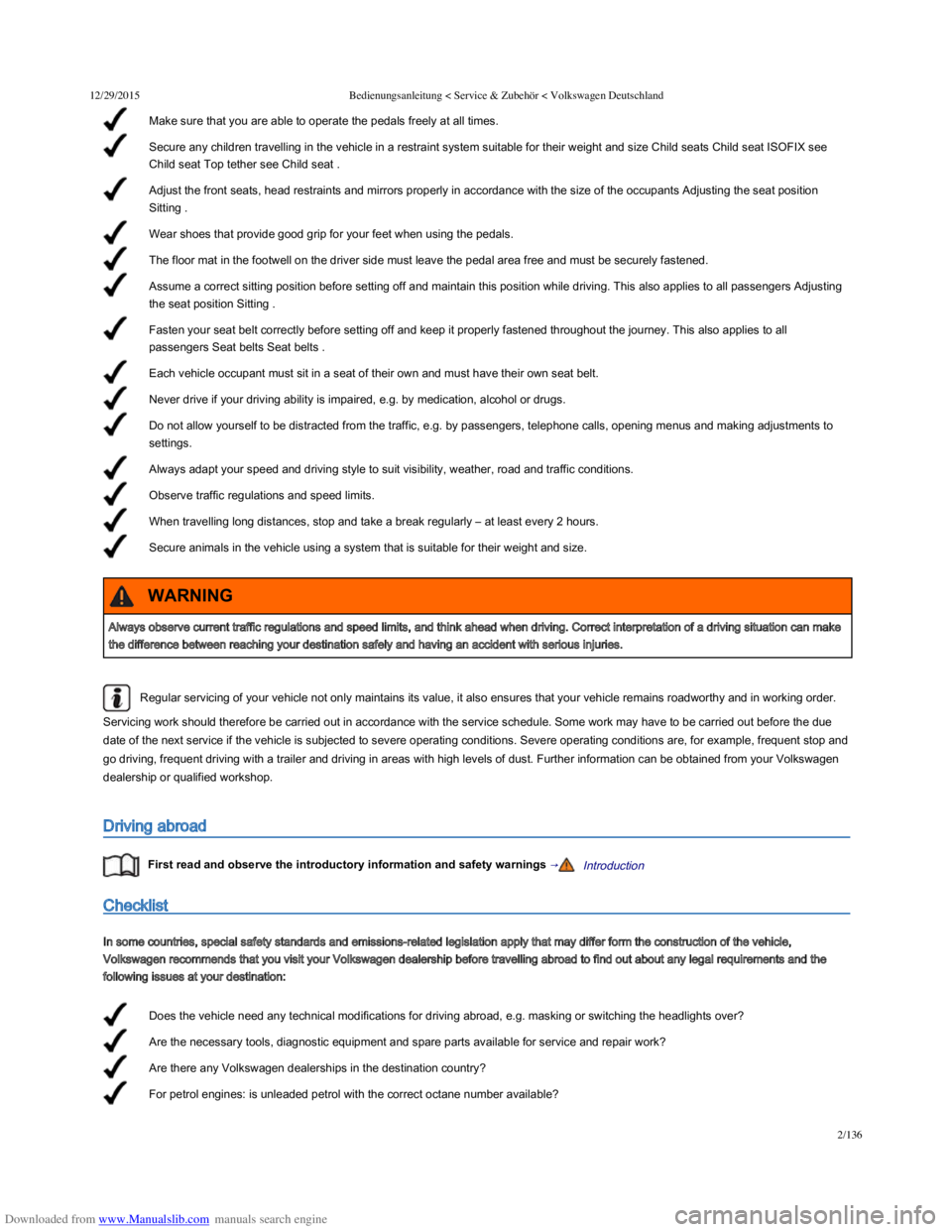
Make sure that you are able to operate the pedals freely at all times.
Secure any children travelling in the vehicle in a restraint system suitable for their weight and size Child seats Child seat ISOFIX see
Child seat Top tether see Child seat .
Adjust the front seats, head restraints and mirrors properly in accordance with the size of the occupants Adjusting the seat position
Sitting .
Wear shoes that provide good grip for your feet when using the pedals.
The floor mat in the footwell on the driver side must leave the pedal area free and must be securely fastened.
Assume a correct sitting position before setting off and maintain this position while driving. This also applies to all passengers Adjusting
the seat position Sitting .
Fasten your seat belt correctly before setting off and keep it properly fastened throughout the journey. This also applies to all
passengers Seat belts Seat belts .
Each vehicle occupant must sit in a seat of their own and must have their own seat belt.
Never drive if your driving ability is impaired, e.g. by medication, alcohol or drugs.
Do not allow yourself to be distracted from the traffic, e.g. by passengers, telephone calls, opening menus and making adjustments to
settings.
Always adapt your speed and driving style to suit visibility, weather, road and traffic conditions.
Observe traffic regulations and speed limits.
When travelling long distances, stop and take a break regularly – at least every 2 hours.
Secure animals in the vehicle using a system that is suitable for their weight and size.
Does the vehicle need any technical modifications for driving abroad, e.g. masking or switching the headlights over?
Are the necessary tools, diagnostic equipment and spare parts available for service and repair work?
Are there any Volkswagen dealerships in the destination country?
For petrol engines: is unleaded petrol with the correct octane number available?
Regular servicing of your vehicle not only maintains its value, it also ensures that your vehicle remains roadworthy and in working order.
Servicing work should therefore be carried out in accordance with the service schedule. Some work may have to be carried out before the due
date of the next service if the vehicle is subjected to severe operating conditions. Severe operating conditions are, for example, frequent stop and
go driving, frequent driving with a trailer and driving in areas with high levels of dust. Further information can be obtained from your Volkswagen
dealership or qualified workshop.
Driving abroad
First read and observe the introductory information and safety warnings →Introduction
Checklist
In some countries, special safety standards and emissions-related legislation apply that may differ form the construction of the vehicle,
Volkswagen recommends that you visit your Volkswagen dealership before travelling abroad to find out about any legal requirements and the
following issues at your destination:
Always observe current traffic regulations and speed limits, and think ahead when driving. Correct interpretation of a driving situation can make
the difference between reaching your destination safely and having an accident with serious injuries.
WARNING
Page 68 of 100
Downloaded from www.Manualslib.com manuals search engine 12/29/2015Bedienungsanleitung < Service & Zubehör < Volkswagen Deutschland
33/136
→ Convenience opening and closing .
Introduction
This chapter contains information on the following subjects:
→ The dangers of assuming an incorrect sitting position
→ Correct sitting position
→ Mechanical controls on the front seats
→ Adjusting the head restraints
→ Removing and fitting head restraints
→ Adjusting the steering wheel position
→ Centre armrest
Number of seats
The vehicle has a total of 5 seats: 2 at the front and 3 at the rear. Each seat is equipped with a seat belt.
Additional information and warnings:
Seat functions → Seat functions
Seat belts → Seat belts
Airbag system → Airbag system
Child seats → Child seats
Cleaning and caring for the interior → Cleaning and caring for the interior
Sitting correctly and safely
Adjusting the seat position
Assuming an incorrect sitting position in the vehicle can increase the risk of severe or fatal injuries during a sudden driving or braking
manoeuvre, in the event of a collision or accident, or if the airbags are triggered.
All vehicle occupants must assume a correct sitting position before setting off and maintain this position throughout the trip. This also applies
to the fastening of seat belts.
The number of vehicle occupants must never exceed the number of seats with seat belts in the vehicle.
Always secure children in the vehicle in an authorised restraint system which is suitable for their height and weight → Airbag system ,
→ Child seats .
Always keep your feet in the footwell while the vehicle is in motion. Never place your feet on the seat or dash panel, for example, and never
ride with your feet out the window. When you are sat like this, the airbag and seat belt cannot provide optimal protection and could actually
increase the risk of injury during an accident.
WARNING
Page 69 of 100
Downloaded from www.Manualslib.com manuals search engine 12/29/2015Bedienungsanleitung < Service & Zubehör < Volkswagen Deutschland
34/136
The dangers of assuming an incorrect sitting position
First read and observe the introductory information and safety warnings →Introduction
If the seat belts are not worn or are worn incorrectly, the risk of severe or fatal injuries increases. Seat belts can only provide optimal protection if
the seat belt routing is correct. Assuming an incorrect sitting position considerably impairs the level of protection provided by a seat belt. This
could lead to severe or even fatal injuries. The risk of severe or fatal injuries is especially increased when a deploying airbag strikes a vehicle
occupant who has assumed an incorrect sitting position. The driver is responsible for all occupants transported in the vehicle, especially children.
The following list contains examples of sitting positions that can be dangerous for all vehicle occupants.
Always adjust seats, seat belts and head restraints to their correct position before any journey and ensure that all passengers have fastened
their seat belt.
Push the front passenger seat as far back as possible.
Adjust the driver seat so that there is at least 25 cm between your breastbone and the hub of the steering wheel. If your physical build
makes it impossible to fulfil this requirement, you must contact a qualified workshop so they can make any necessary modifications.
Never travel with the backrest tilted far back. The further back the backrest is tilted, the greater the risk of injury caused by incorrect seat belt
routing or an incorrect sitting position.
Never travel with the backrest tilted far forwards. When a front airbag is triggered it could force the seat backrest backwards and injure
vehicle occupants on the back seats.
Adopt and maintain the greatest possible distance from the steering wheel and dash panel.
You should always sit upright with your back against the seat backrest with the front seats properly adjusted. Do not position any body part
too close where the airbags are fitted.
The risk of serious injury is increased for passengers on the rear seat if they are not sitting upright because the seat belts are incorrectly
positioned.
WARNING
Incorrect adjustment of the seats can cause accidents and serious injuries.
The seats may only be adjusted when the vehicle is stationary, or else the seat could change position unexpectedly while the vehicle is in
motion, leading to a loss of control of the vehicle. Furthermore, an incorrect seating position is adopted while adjusting the seat.
Only adjust the height and tilt of the seat or move it forwards and backwards when the area around the seat is clear.
There should be no objects in the adjustment area of the front seats.
WARNING
Cigarette lighters in the vehicle could be damaged or accidentally lit. This could lead to serious burns and other injuries.
Before adjusting the seats always make sure that there is no lighter on or near the moveable parts of the seat.
Before closing stowage areas or compartments always make sure that there is no lighter in the way.
Never stow lighters in stowage areas or compartments or on other surfaces in the vehicle. Cigarette lighters may self-ignite on high-
temperature surfaces, especially in summer.
WARNING
Page 70 of 100

Downloaded from www.Manualslib.com manuals search engine 12/29/2015Bedienungsanleitung < Service & Zubehör < Volkswagen Deutschland
35/136
Whenever the vehicle is in motion:
Never stand in the vehicle.
Never stand on the seats.
Never kneel on the seats.
Never tilt the backrest too far to the rear.
Never lean against the dash panel.
Never lie on the rear bench seat.
Never sit on the front edge of a seat.
Never sit sideways.
Never lean out of a window.
Never put your feet out of a window.
Never put your feet on the dash panel.
Never place your feet on the seat cushion or seat backrest.
Never travel in a footwell.
Never sit on the front armrest.
Never travel on a seat without wearing the seat belt.
Never travel in the luggage compartment.
Correct sitting position
Fig. 39 There must be a distance of at least 25 cm between the driver and the steering wheel
Every incorrect sitting position in the vehicle increases the risk of severe or fatal injuries in the event of an accident or sudden driving or braking
manoeuvre.
All vehicle occupants must maintain a correct sitting position and wear their seat belt properly while the vehicle is in motion.
Sitting in an incorrect position, not fastening the seat belt, or being too close to the airbag exposes the occupants to the risk of sustaining
critical or fatal injuries, especially if the airbags are triggered and strike an occupant who has assumed an incorrect sitting position.
WARNING
Page 71 of 100
Downloaded from www.Manualslib.com manuals search engine 12/29/2015Bedienungsanleitung < Service & Zubehör < Volkswagen Deutschland
36/136
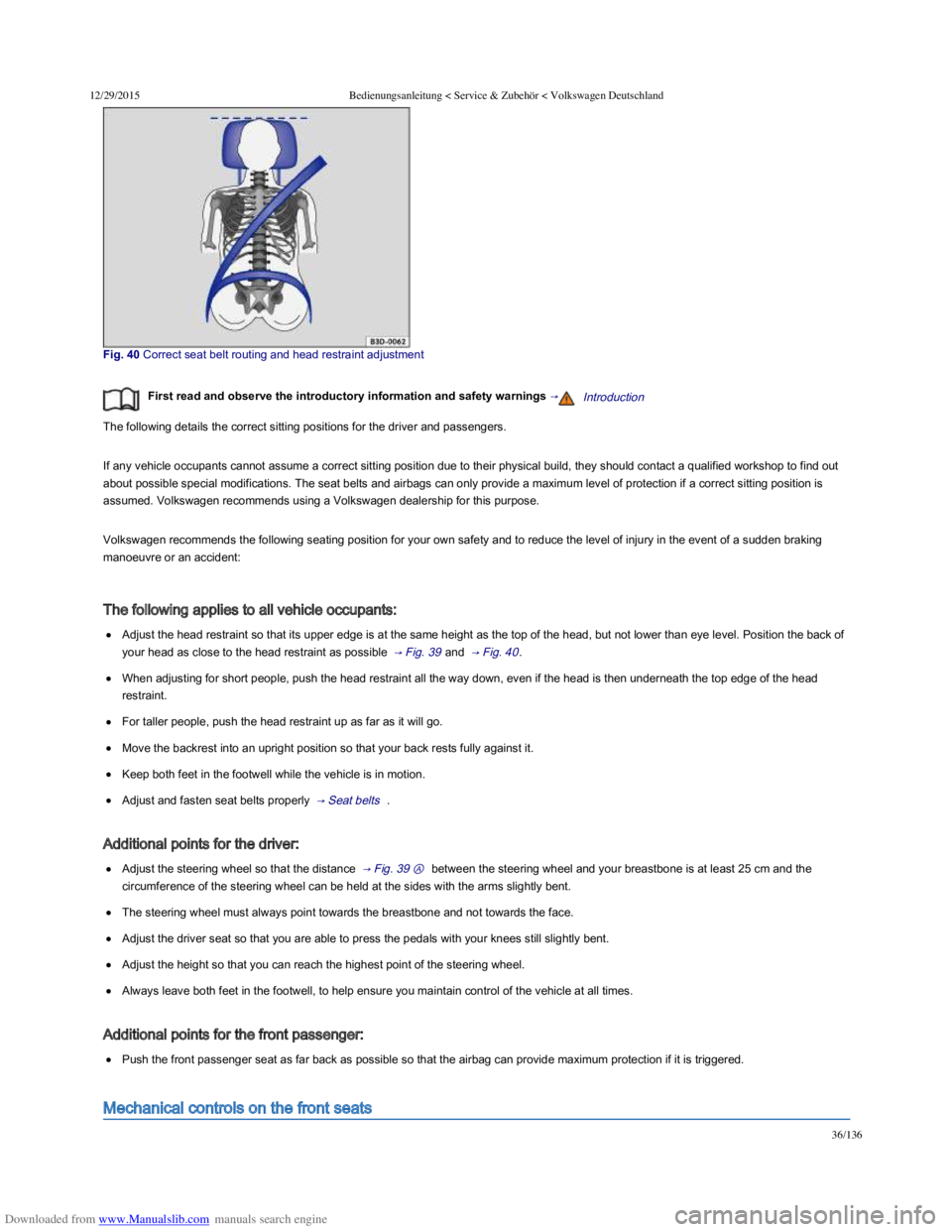
Fig. 40 Correct seat belt routing and head restraint adjustment
First read and observe the introductory information and safety warnings →Introduction
The following details the correct sitting positions for the driver and passengers.
If any vehicle occupants cannot assume a correct sitting position due to their physical build, they should contact a qualified workshop to find out
about possible special modifications. The seat belts and airbags can only provide a maximum level of protection if a correct sitting position is
assumed. Volkswagen recommends using a Volkswagen dealership for this purpose.
Volkswagen recommends the following seating position for your own safety and to reduce the level of injury in the event of a sudden braking
manoeuvre or an accident:
The following applies to all vehicle occupants:
Adjust the head restraint so that its upper edge is at the same height as the top of the head, but not lower than eye level. Position the back of
your head as close to the head restraint as possible → Fig. 39 and → Fig. 40 .
When adjusting for short people, push the head restraint all the way down, even if the head is then underneath the top edge of the head
restraint.
For taller people, push the head restraint up as far as it will go.
Move the backrest into an upright position so that your back rests fully against it.
Keep both feet in the footwell while the vehicle is in motion.
Adjust and fasten seat belts properly → Seat belts .
Additional points for the driver:
Adjust the steering wheel so that the distance → Fig. 39 Ⓐ between the steering wheel and your breastbone is at least 25 cm and the
circumference of the steering wheel can be held at the sides with the arms slightly bent.
The steering wheel must always point towards the breastbone and not towards the face.
Adjust the driver seat so that you are able to press the pedals with your knees still slightly bent.
Adjust the height so that you can reach the highest point of the steering wheel.
Always leave both feet in the footwell, to help ensure you maintain control of the vehicle at all times.
Additional points for the front passenger:
Push the front passenger seat as far back as possible so that the airbag can provide maximum protection if it is triggered.
Mechanical controls on the front seats
Page 77 of 100
Downloaded from www.Manualslib.com manuals search engine 12/29/2015Bedienungsanleitung < Service & Zubehör < Volkswagen Deutschland
42/136
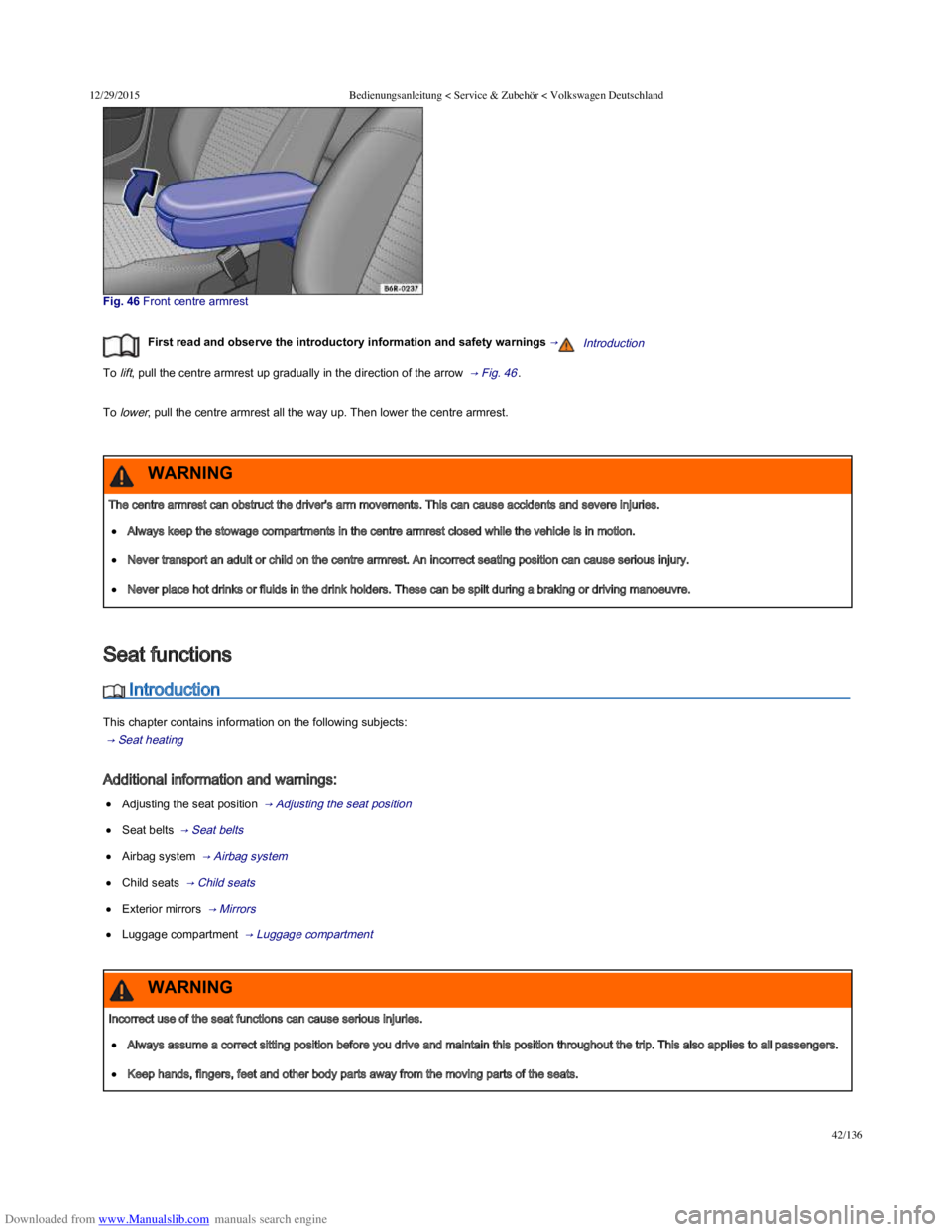
Fig. 46 Front centre armrest
First read and observe the introductory information and safety warnings →Introduction
To lift, pull the centre armrest up gradually in the direction of the arrow → Fig. 46 .
To lower, pull the centre armrest all the way up. Then lower the centre armrest.
Introduction
This chapter contains information on the following subjects:
→ Seat heating
Additional information and warnings:
Adjusting the seat position → Adjusting the seat position
Seat belts → Seat belts
Airbag system → Airbag system
Child seats → Child seats
Exterior mirrors → Mirrors
Luggage compartment → Luggage compartment
Seat heating
The centre armrest can obstruct the driver's arm movements. This can cause accidents and severe injuries.
Always keep the stowage compartments in the centre armrest closed while the vehicle is in motion.
Never transport an adult or child on the centre armrest. An incorrect seating position can cause serious injury.
Never place hot drinks or fluids in the drink holders. These can be spilt during a braking or driving manoeuvre.
WARNING
Seat functions
Incorrect use of the seat functions can cause serious injuries.
Always assume a correct sitting position before you drive and maintain this position throughout the trip. This also applies to all passengers.
Keep hands, fingers, feet and other body parts away from the moving parts of the seats.
WARNING
Page 79 of 100
Downloaded from www.Manualslib.com manuals search engine 12/29/2015Bedienungsanleitung < Service & Zubehör < Volkswagen Deutschland
44/136
The seat heating should be switched off as soon as it is no longer needed. Fuel is otherwise wasted.
Introduction
This chapter contains information on the following subjects:
→ Warning lamp
→ Frontal collisions and the laws of physics
→ What happens to vehicle occupants who have not fastened their seat belts
→ Seat belt protection
→ Using seat belts
→ Fastening and unfastening seat belts
→ Seat belt routing
→ Belt height adjuster
→ Automatic belt retractor, belt tensioner, belt tension limiter
→ Service and disposal of belt tensioners
Check the condition of all seat belts regularly. If the belt webbing, belt connections, belt retractor or seat belt buckle become damaged, the seat
belt in question should be replaced immediately by a qualified workshop → . The qualified workshop must use correct spare parts that are
compatible with the vehicle, equipment level and model year. Volkswagen recommends using a Volkswagen dealership for this purpose.
Additional information and warnings:
Adjusting the seat position → Adjusting the seat position
Airbag system → Airbag system
Child seats → Child seats
Stowage → Stowage areas
Cleaning and caring for the interior → Cleaning and caring for the interior
Accessories, modifications, repairs and renewal of parts → Accessories, modifications, repairs and renewal of parts
Wet upholstery can cause a fault in the seat heating and increase the risk of burns.
Make sure that the seat cushion is dry before using the seat heating.
Do not sit on the seat when wearing damp or wet clothing.
Do not set any damp or wet objects or items of clothing on the seat.
Do not spill any liquids on the seat.
WARNING
To avoid damaging the heating elements, do not kneel on the seat or apply sharp pressure at a single point on the seat cushion and
backrest.
Liquids, sharp objects and insulating materials such as a protective cover or child seat on the seat could damage the seat heating.
If the system starts to emit a smell, switch the seat heating off immediately and have it checked by a qualified workshop.
NOTICE
Seat belts
Page 80 of 100
Downloaded from www.Manualslib.com manuals search engine 12/29/2015Bedienungsanleitung < Service & Zubehör < Volkswagen Deutschland
45/136
Warning lamp
Incorrectly fastened or unfastened seat belts increase the risk of severe or fatal injuries. Seat belts will only offer the optimum level of protection
when they are fastened and used properly.
Seat belts are the most effective means of reducing the risk of serious and fatal injuries in the event of an accident. Seat belts must always
be fastened properly when the vehicle is in motion to protect the driver and all vehicle occupants.
Before every trip, each vehicle occupant must adopt the correct sitting position, correctly fasten the seat belt belonging to their seat and
keep it fastened properly throughout the trip. This applies to all vehicle occupants and also in urban traffic.
While the vehicle is in motion, secure all children travelling in the vehicle in a restraint system suitable for their weight and height. They must
also wear correctly fastened seat belts → Child seats .
Only start driving when all passengers have correctly fastened their seat belts.
Only ever insert the latch plate into the buckle of the associated seat, and always ensure that it engages properly. Using a buckle that does
not belong to the seat that you are occupying reduces the level of protection and can lead to severe injuries.
Avoid allowing foreign bodies or liquids to enter the slot for the seat belt buckle. This could prevent the belt buckle and seat belt from
working properly.
Never unfasten the seat belt while the vehicle is in motion.
Never allow more than one person to share the same seat belt.
Never travel when children or babies are being carried on somebody's lap and fastened with the same belt.
Never travel wearing loose, bulky clothing (such as an overcoat over a jacket). This could prevent the seat belts from fitting and functioning
properly.
WARNING
Damaged seat belts are very dangerous and can cause severe or fatal injuries.
Never damage the belt by trapping it in the door or in the seat mechanism.
If the belt webbing or any other part of the seat belt becomes damaged, the seat belt may tear during an accident or sudden braking
manoeuvre.
Have damaged seat belts immediately replaced by new seat belts that have been approved by Volkswagen for the vehicle. Seat belts
subjected to stress and stretched during an accident must be replaced by a qualified workshop. Renewal may be necessary even if there is
no apparent damage. The belt anchorage should also be checked.
Never try to repair, modify or remove the seat belts yourself. All repairs to the seat belts, belt retractors and buckles must be carried out by a
qualified workshop.
WARNING