fluid VOLKSWAGEN T-ROC 2021 Owner´s Manual
[x] Cancel search | Manufacturer: VOLKSWAGEN, Model Year: 2021, Model line: T-ROC, Model: VOLKSWAGEN T-ROC 2021Pages: 502, PDF Size: 9.42 MB
Page 11 of 502
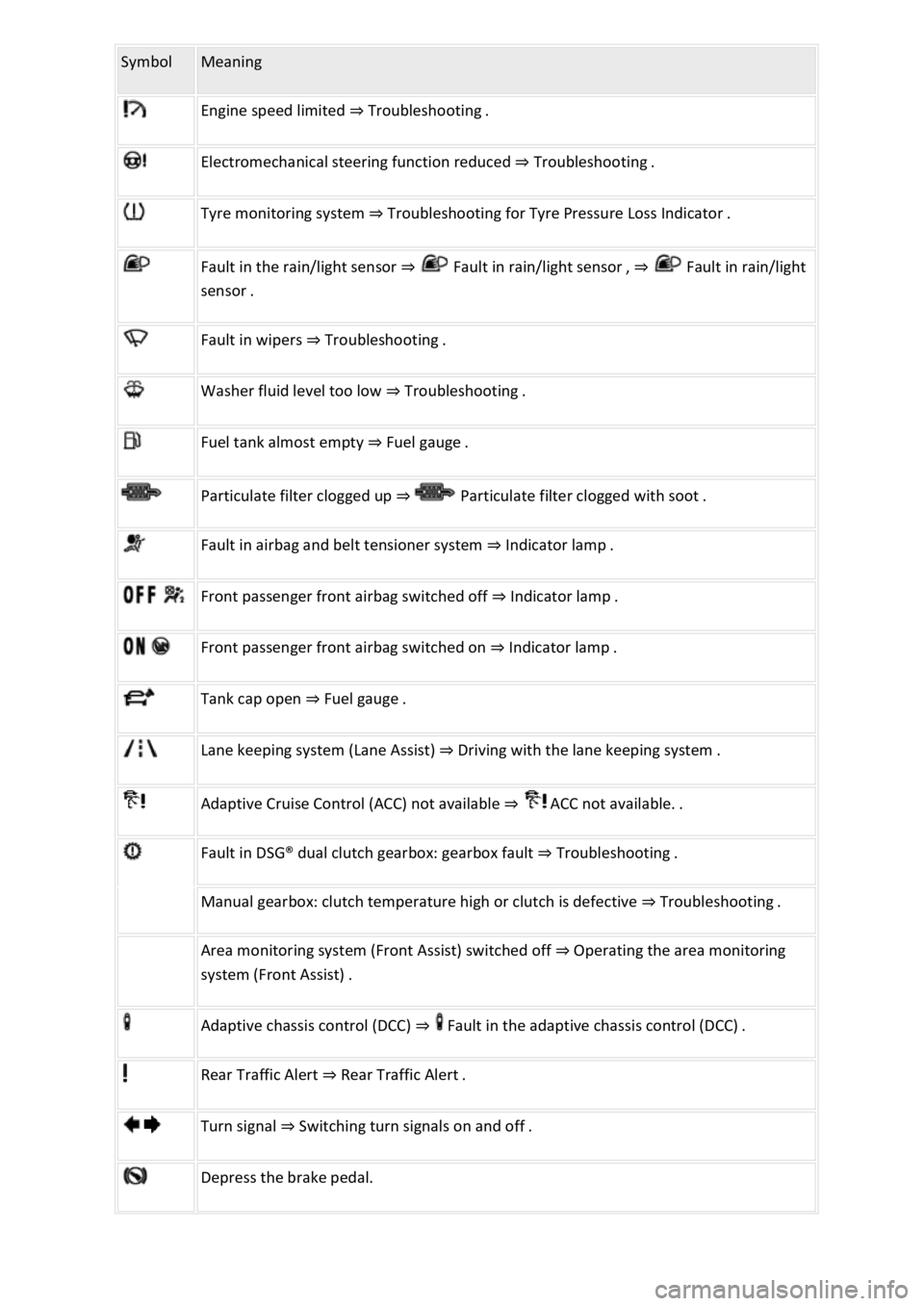
Symbol Meaning
Engine speed limited ⇒ Troubleshooting .
Electromechanical steering function reduced ⇒ Troubleshooting .
Tyre monitoring system ⇒ Troubleshooting for Tyre Pressure Loss Indicator .
Fault in the rain/light sensor ⇒ Fault in rain/light sensor , ⇒ Fault in rain/light
sensor .
Fault in wipers ⇒ Troubleshooting .
Washer fluid level too low ⇒ Troubleshooting .
Fuel tank almost empty ⇒ Fuel gauge .
Particulate filter clogged up ⇒ Particulate filter clogged with soot .
Fault in airbag and belt tensioner system ⇒ Indicator lamp .
Front passenger front airbag switched off ⇒ Indicator lamp .
Front passenger front airbag switched on ⇒ Indicator lamp .
Tank cap open ⇒ Fuel gauge .
Lane keeping system (Lane Assist) ⇒ Driving with the lane keeping system .
Adaptive Cruise Control (ACC) not available ⇒ ACC not available. .
Fault in DSG® dual clutch gearbox: gearbox fault ⇒ Troubleshooting .
Manual gearbox: clutch temperature high or clutch is defective ⇒ Troubleshooting .
Area monitoring system (Front Assist) switched off ⇒ Operating the area monitoring
system (Front Assist) .
Adaptive chassis control (DCC) ⇒ Fault in the adaptive chassis control (DCC) .
Rear Traffic Alert ⇒ Rear Traffic Alert .
Turn signal ⇒ Switching turn signals on and off .
Depress the brake pedal.
Page 24 of 502
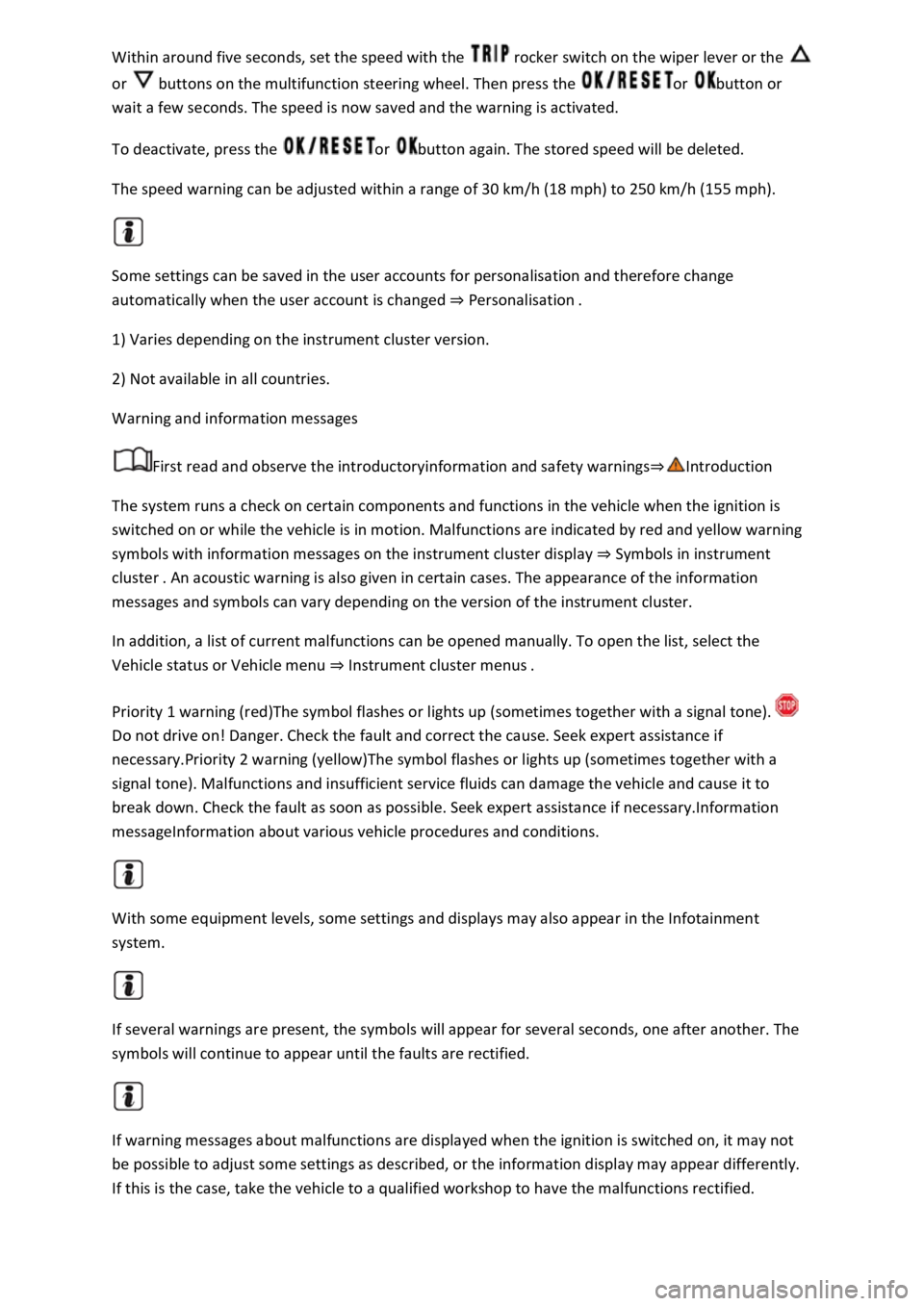
Within around five seconds, set the speed with the rocker switch on the wiper lever or the
or buttons on the multifunction steering wheel. Then press the or button or
wait a few seconds. The speed is now saved and the warning is activated.
To deactivate, press the or button again. The stored speed will be deleted.
The speed warning can be adjusted within a range of 30 km/h (18 mph) to 250 km/h (155 mph).
Some settings can be saved in the user accounts for personalisation and therefore change
automatically when the user account is changed ⇒ Personalisation .
1) Varies depending on the instrument cluster version.
2) Not available in all countries.
Warning and information messages
First read and observe the introductoryinformation and safety warnings⇒Introduction
The system runs a check on certain components and functions in the vehicle when the ignition is
switched on or while the vehicle is in motion. Malfunctions are indicated by red and yellow warning
symbols with information messages on the instrument cluster display ⇒ Symbols in instrument
cluster . An acoustic warning is also given in certain cases. The appearance of the information
messages and symbols can vary depending on the version of the instrument cluster.
In addition, a list of current malfunctions can be opened manually. To open the list, select the
Vehicle status or Vehicle menu ⇒ Instrument cluster menus .
Priority 1 warning (red)The symbol flashes or lights up (sometimes together with a signal tone).
Do not drive on! Danger. Check the fault and correct the cause. Seek expert assistance if
necessary.Priority 2 warning (yellow)The symbol flashes or lights up (sometimes together with a
signal tone). Malfunctions and insufficient service fluids can damage the vehicle and cause it to
break down. Check the fault as soon as possible. Seek expert assistance if necessary.Information
messageInformation about various vehicle procedures and conditions.
With some equipment levels, some settings and displays may also appear in the Infotainment
system.
If several warnings are present, the symbols will appear for several seconds, one after another. The
symbols will continue to appear until the faults are rectified.
If warning messages about malfunctions are displayed when the ignition is switched on, it may not
be possible to adjust some settings as described, or the information display may appear differently.
If this is the case, take the vehicle to a qualified workshop to have the malfunctions rectified.
Page 47 of 502

General notes
Checklist
Observe the following information both before and during every journey to ensure your own safety,
and the safety of all passengers and other road users ⇒ :
Check that all lights and turn signals are working properly.
Check the tyre pressure and fuel level Tyre pressure, Fuel gauge.
Check the washer fluid level Washer fluid.
Make sure that you have a good, clear view through all of the windows Caring for and cleaning the
vehicle exterior.
Secure any objects and luggage in the stowage compartments, the luggage compartment or on the
roof Transporting items.
Ensure that you are able to operate the pedals freely at all times.
Secure any children travelling in the vehicle in a restraint system suitable for their weight and size
Safe transport of children.
Adjust the front seats, head restraints and mirrors properly to match the size of the occupants
Sitting position, Mirrors.
Wear shoes that provide proper support for your feet when using the pedals.
The floor mat in the footwell on the driver side must leave the pedal area free and must be securely
fastened.
Page 49 of 502

Are there any Volkswagen dealerships in the destination country?
Is fuel in the adequate quality available Fuel and emission control?
Are the correct service fluids that comply with Volkswagen specifications available in the destination
country Service fluids and consumables?
Will the navigation function in the factory-fitted Infotainment system work with the available
navigation data in the destination country?
Are special tyres necessary for travelling in the destination country?
Is a fire extinguisher a requirement in your destination country?
Which requirements must be observed regarding high-visibility waistcoats?
Checklist
Do not work on the engine and in the engine compartment unless you are familiar with the task, are
aware of the general safety procedures and have the correct equipment, service fluids and suitable
tools ⇒ In the engine compartment ! The work should be carried out by a qualified workshop if you
are uncertain. Make sure you check the following on a regular basis:
Washer fluid level Washer fluid
Engine oil level Engine oil
Coolant level Coolant
Brake fluid level Brake fluid
Tyre pressure Wheels and tyres
Page 60 of 502

Using seat belts ⇒ :
Regularly check the condition of all seat belts.
Keep the seat belts clean.
Avoid allowing any foreign bodies or fluids to get on to the seat belt or latch plate or into the slot for
the seat belt buckle.
Do not trap or damage the seat belt and latch plate, for example when closing the door.
Never remove, modify or repair the seat belt or belt anchorage elements.
Always fasten the seat belt correctly before any journey and wear it properly while the vehicle is in
motion.
Twisted seat belt
If it is difficult to pull the seat belt out of the belt guide, the seat belt may have become twisted in
the side trim as a result of being retracted too quickly when unfastened:
Take hold of the latch plate, then slowly and carefully pull out the seat belt fully.
Untwist the seat belt and guide it back slowly by hand.
Fasten the seat belt even if you are unable to undo the twist. However, the twist should not be in
part of the seat belt which comes into direct contact with the body. The twist should be corrected
immediately by a qualified workshop.
WARNING
Using seat belts incorrectly increases the risk of severe or fatal injuries.
Regularly check to ensure that the seat belt and its related parts are in perfect condition.
Always keep the seat belt clean.
Do not allow the belt webbing to become jammed, damaged or to rub on any sharp edges.
Always keep the latch plate and slot in the buckle free from foreign bodies and liquids.
Fastening and unfastening seat belts
Page 142 of 502

Wipers switched off.
Interval wipe for the windscreen or rain/light sensor mode. The interval wipe for the
windscreen depends on the speed of the vehicle. The wipers will wipe more frequently as the vehicle
moves faster.
Slow wipe.
Fast wipe.
x Flick wipe – brief wiping. Push down and hold the lever for longer to wipe more quickly.
Pulling the lever activates the wash and wipe system for cleaning the windscreen. Climatronic
will switch to air recirculation mode for approximately 30 seconds to prevent the smell of the
washer fluid from entering the vehicle interior.
Switch for interval settings (vehicles without a rain/light sensor) or adjusting the
sensitivity of the rain/light sensor.
Interval wipe for the rear window. The wiper will wipe the window approximately every
six seconds.
Pushing the lever activates the wash and wipe system for cleaning the rear window.
WARNING
Without an adequate amount of anti-freeze, the washer fluid can freeze on the windscreen and
obscure your view.
In winter temperatures, use the windscreen washer system only when adequate anti-freeze has
been added to the washer fluid.
Never use the windscreen washer system at winter temperatures before the windscreen has been
heated by the ventilation system. The anti-freeze mixture may otherwise freeze on the windscreen
and restrict vision.
WARNING
Worn or dirty wiper blades reduce visibility and increase the risk of accidents and serious injuries.
Always change wiper blades if they are damaged or worn and no longer clean the windows properly
⇒ Wiper blades .
NOTICE
Page 143 of 502
Before setting off and before switching on the ignition, always check the following to avoid damage
to the windscreen, the wiper blades and the wiper motor:
The wiper lever is located in the basic position.
Snow and ice have been removed from the wiper blades and door windows.
Wiper blades that have become frozen onto the glass have been carefully loosened. Volkswagen
recommends using a de-icer spray for this.
NOTICE
Do not switch on the wipers when the window is dry. Using the wipers when the window is dry can
damage the glass.
When switched on, the wipers will temporarily be switched to the next setting down when the
vehicle is stationary.
When parking the vehicle in cold weather, it may be helpful to leave the front windscreen wipers in
the service position to make it easier to loosen the wiper blades ⇒ Wiper blades .
Wiper function
Automatic activation of the rear window wiper
The rear window wiper is switched on automatically if the windscreen wipers are switched on and
reverse gear is engaged. Automatic switch-on when reverse gear is selected can be activated and
deactivated in the Infotainment system in the Vehicle settings menu ⇒ Infotainment system controls
and displays .
Heated washer jets
The heating defrosts frozen washer jets. The heating output is automatically regulated depending on
the ambient temperature when the ignition is switched on. Only the jets are heated, not the hoses
that the washer fluid flows through.
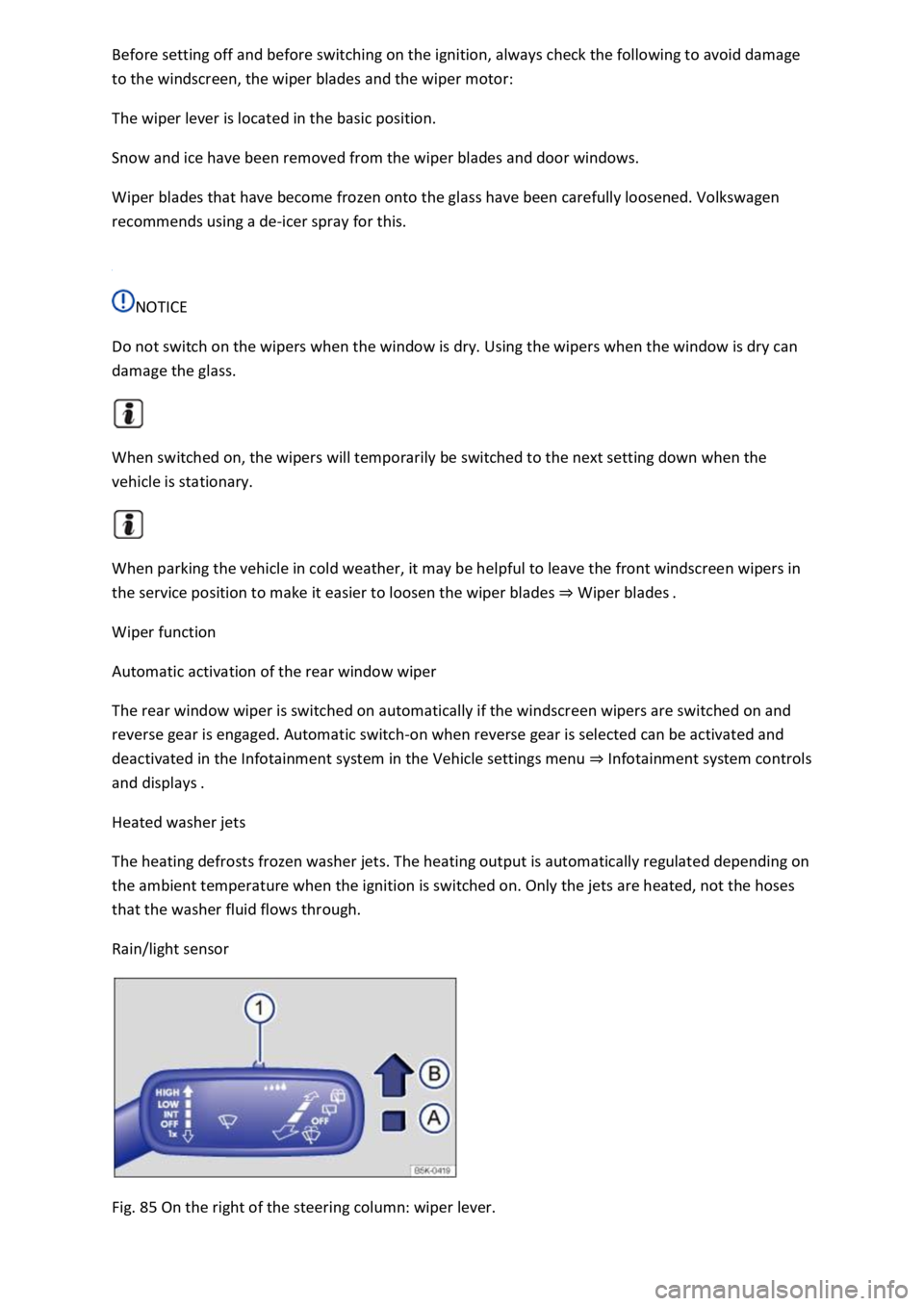
Rain/light sensor
Fig. 85 On the right of the steering column: wiper lever.
Page 144 of 502
When the rain/light sensor is activated, it automatically controls the frequency of the wiper intervals
depending on the intensity of the rain.
Activating and deactivating the rain/light sensor
Position Ⓐ - the rain/light sensor is deactivated.
Position Ⓑ - the rain/light sensor is activated, automatic wipe when necessary.
The automatic wipe function can be activated and deactivated in the Infotainment system in
the Vehicle settings menu ⇒ Infotainment system controls and displays .
If the automatic wipe function is deactivated in the Infotainment system, the intervals are set at
fixed levels.
Adjusting the sensitivity of the rain/light sensor
The sensitivity of the rain/light sensor can be adjusted manually using the switch in the wiper lever
⇒ Fig. 85 ① ⇒ .
Switch to the right – high sensitivity.
Switch to the left – low sensitivity.
WARNING
The rain/light sensor cannot always adequately detect all precipitation and activate the wipers
correspondingly.
If necessary, switch on the wipers manually in good time if the water on the windscreen restricts the
field of vision.
Some settings can be stored in the user accounts of the personalisation function and therefore
change automatically when the user account changes ⇒ Personalisation .
Troubleshooting
Washer fluid level too low
The indicator lamp lights up yellow.
Fill up the washer fluid reservoir at the next opportunity ⇒ Washer fluid
Fault in rain/light sensor
The wipers are not switched on automatically if it rains during rain/light sensor operation.
The indicator lamp lights up yellow.
Switch the ignition off and on.
If the problem persists, go to a qualified workshop.
Page 146 of 502

For safety reasons, it is important that the driver positions the exterior and interior mirrors correctly
before starting a journey ⇒ .
Looking in the exterior mirrors and the interior mirror does not allow the driver to see the entire
side and rear area around the vehicle. The area that cannot be seen is known as the blind spot.
There may be objects and other road users in the blind spot.
WARNING
Adjusting the exterior and interior mirrors while the vehicle is moving may cause the driver to
become distracted. This could lead to accidents and serious injuries.
Exterior and interior mirrors should be adjusted only when the vehicle is at a standstill.
When parking, changing lane, or performing an overtaking or turning manoeuvre, always pay careful
attention to the area around the vehicle as objects and other road users may be located in the blind
spot.
Always ensure that the mirrors are positioned correctly and that the rear view is not restricted by
ice, snow, condensation or any other objects.
WARNING
If you estimate the distance from traffic behind you incorrectly, you can cause accidents and serious
injuries.
Curved mirrors (convex or aspheric) enlarge the field of vision and can make objects in the mirror
seem smaller and further away than they actually are.
Using curved mirrors to estimate the distance from other vehicles behind you when changing lanes
can provide inaccurate results and can lead to accidents and serious injuries.
Whenever possible, use the interior mirror to check the exact distance between your vehicle and
following traffic or other objects.
Ensure that you have a good view to the rear of the vehicle.
WARNING
Automatic anti-dazzle mirrors contain an electrolyte fluid which could leak if the mirror is broken.
The leaking electrolyte fluid can cause irritation to the skin, eyes and respiratory organs, especially in
people who suffer from asthma or similar illnesses. Immediately ensure that there is a sufficient
supply of fresh air and get out of the vehicle. If this is not possible, open all of the windows and
doors.
If the electrolyte fluid gets into the eyes or onto the skin, immediately wash the area with plenty of
water for at least 15 minutes and consult a doctor.
Page 147 of 502
If the electrolyte fluid gets onto shoes or clothing, wash immediately with plenty of water for at least
15 minutes. Clean shoes and clothes thoroughly before wearing them again.
If the electrolyte fluid is swallowed, immediately rinse the mouth with plenty of water for at least
15 minutes. Do not induce vomiting unless instructed to do so by a doctor. Seek medical assistance
immediately.
NOTICE
If the glass of an automatic anti-dazzle mirror is broken, electrolyte fluid can leak from the mirror.
This fluid corrodes plastic surfaces. Remove the fluid as soon as possible, e.g. using a wet sponge.
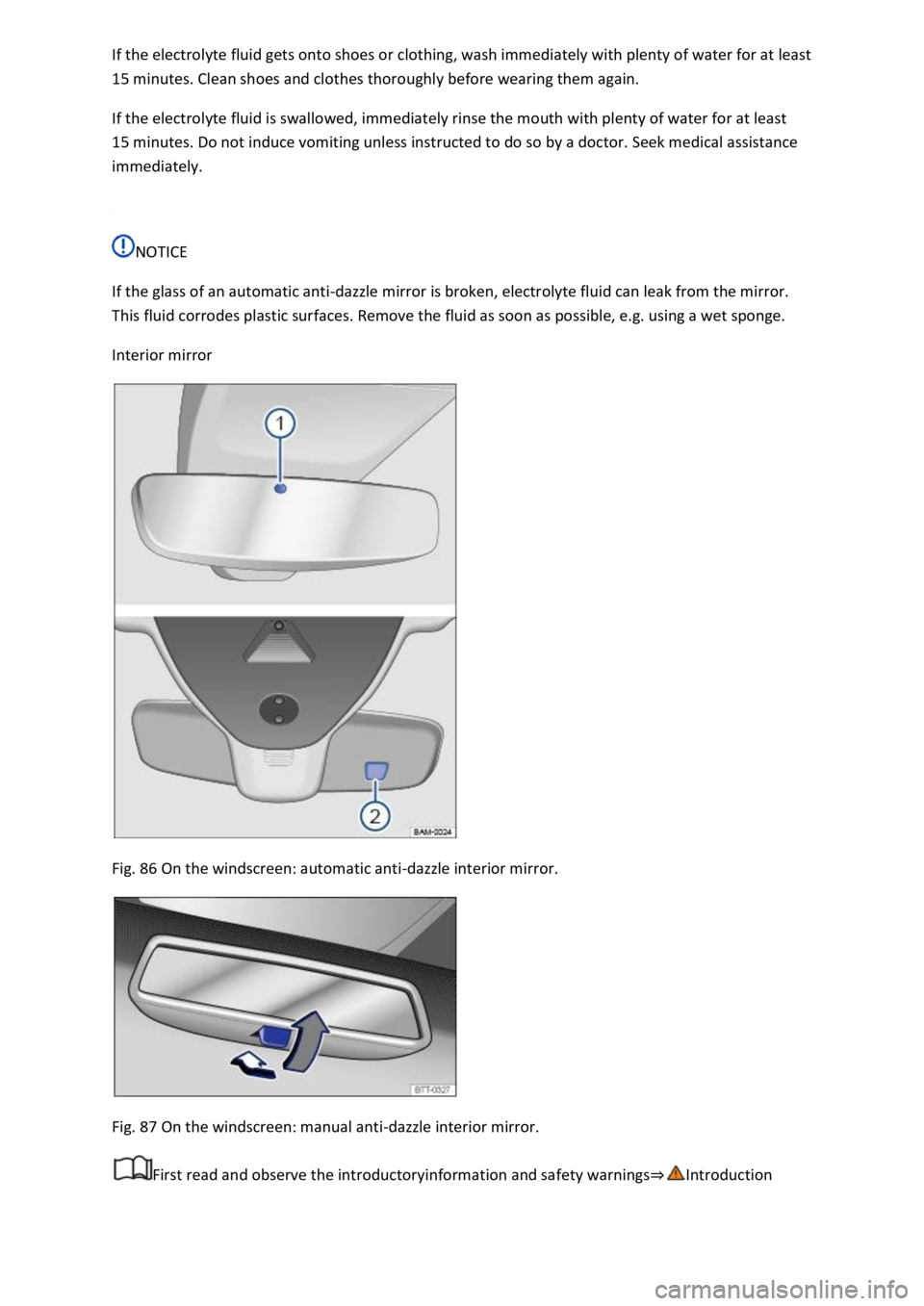
Interior mirror
Fig. 86 On the windscreen: automatic anti-dazzle interior mirror.
Fig. 87 On the windscreen: manual anti-dazzle interior mirror.
First read and observe the introductoryinformation and safety warnings⇒Introduction