ESP VOLKSWAGEN TIGUAN 2017 Owner´s Manual
[x] Cancel search | Manufacturer: VOLKSWAGEN, Model Year: 2017, Model line: TIGUAN, Model: VOLKSWAGEN TIGUAN 2017Pages: 341, PDF Size: 9.14 MB
Page 77 of 341
Display
First read and observe the introductoryinformation and safety warnings⇒
Introduction
A symbol in the instrument cluster display ⇒ Driver information indicates if one or more doors are
not closed properly. Do not drive on! Open the relevant door and then close it again.
This symbol is also visible when the ignition is switched off and will go out a few seconds after the
vehicle has been locked when all doors are closed.
The symbol can differ depending on the version of the instrument cluster.
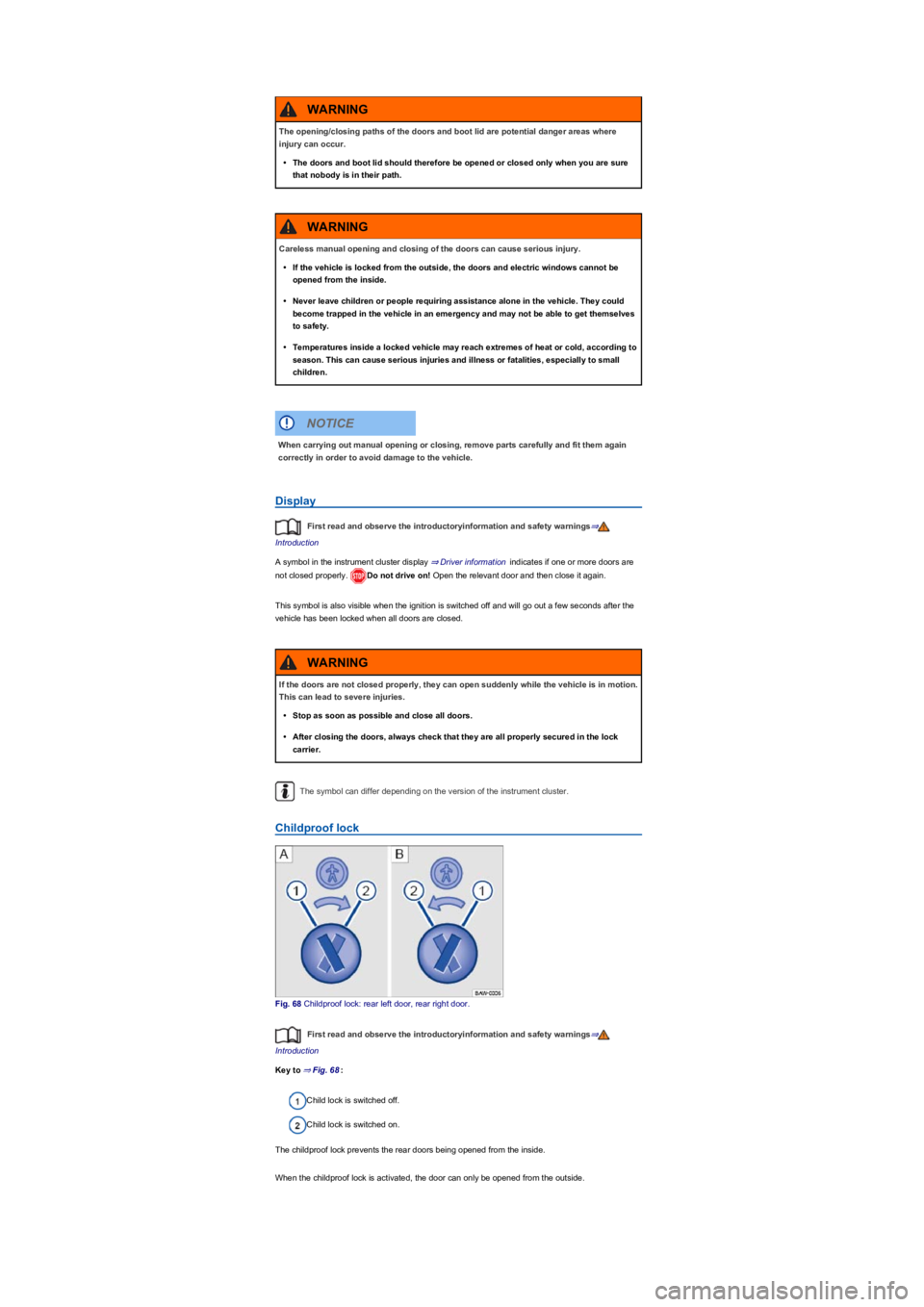
Childproof lock
Fig. 68 Childproof lock: rear left door, rear right door.
First read and observe the introductoryinformation and safety warnings⇒
Introduction
Key to ⇒ Fig. 68:
Child lock is switched off.
Child lock is switched on.
The childproof lock prevents the rear doors being opened from the inside.
When the childproof lock is activated, the door can only be opened from the outside.
The opening/closing paths of the doors and boot lid are potential danger areas where
injury can occur.
•The doors and boot lid should therefore be opened or closed only when you are sure
that nobody is in their path.
WARNING
Careless manual opening and closing of the doors can cause serious injury.
•If the vehicle is locked from the outside, the doors and electric windows cannot be
opened from the inside.
•Never leave children or people requiring assistance alone in the vehicle. They could
become trapped in the vehicle in an emergency and may not be able to get themselves
to safety.
•Temperatures inside a locked vehicle may reach extremes of heat or cold, according to
season. This can cause serious injuries and illness or fatalities, especially to small
children.
WARNING
When carrying out manual opening or closing, remove parts carefully and fit them again
correctly in order to avoid damage to the vehicle.
NOTICE
If the doors are not closed properly, they can open suddenly while the vehicle is in motion.
This can lead to severe injuries.
•Stop as soon as possible and close all doors.
•After closing the doors, always check that they are all properly secured in the lock
carrier.
WARNING
Page 78 of 341
Switching the child lock on and off
•Unlock the vehicle and open the appropriate rear door.
•Move the slot to the corresponding position.
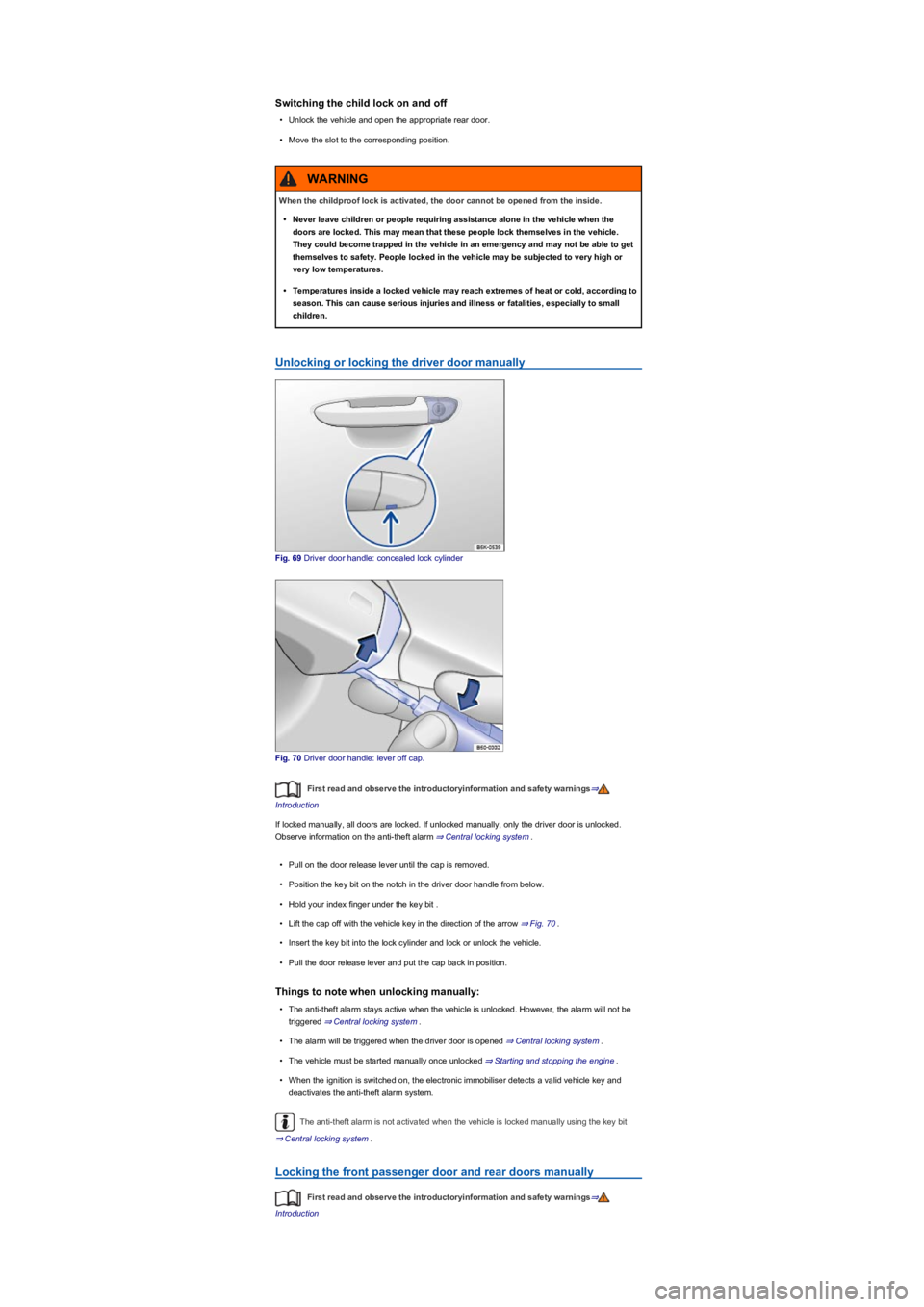
Unlocking or locking the driver door manually
Fig. 69 Driver door handle: concealed lock cylinder
Fig. 70 Driver door handle: lever off cap.
First read and observe the introductoryinformation and safety warnings⇒
Introduction
If locked manually, all doors are locked. If unlocked manually, only the driver door is unlocked.
Observe information on the anti-theft alarm ⇒ Central locking system.
•Pull on the door release lever until the cap is removed.
•Position the key bit on the notch in the driver door handle from below.
•Hold your index finger under the key bit .
•Lift the cap off with the vehicle key in the direction of the arrow ⇒ Fig. 70.
•Insert the key bit into the lock cylinder and lock or unlock the vehicle.
•Pull the door release lever and put the cap back in position.
Things to note when unlocking manually:
•The anti-theft alarm stays active when the vehicle is unlocked. However, the alarm will not be
triggered ⇒ Central locking system.
•The alarm will be triggered when the driver door is opened ⇒ Central locking system.
•The vehicle must be started manually once unlocked ⇒ Starting and stopping the engine.
•When the ignition is switched on, the electronic immobiliser detects a valid vehicle key and
deactivates the anti-theft alarm system.
The anti-theft alarm is not activated when the vehicle is locked manually using the key bit
⇒ Central locking system.
Locking the front passenger door and rear doors manually
First read and observe the introductoryinformation and safety warnings⇒
Introduction
When the childproof lock is activated, the door cannot be opened from the inside.
•Never leave children or people requiring assistance alone in the vehicle when the
doors are locked. This may mean that these people lock themselves in the vehicle.
They could become trapped in the vehicle in an emergency and may not be able to get
themselves to safety. People locked in the vehicle may be subjected to very high or
very low temperatures.
•Temperatures inside a locked vehicle may reach extremes of heat or cold, according to
season. This can cause serious injuries and illness or fatalities, especially to small
children.
WARNING
Page 79 of 341
The front passenger door and the rear doors can be locked manually. This does not activate the
anti-theft alarm.
•Open the door.
•Remove the rubber seal from the end face of the door.
•Insert the key bit into the slot and turn.
•Secure the rubber seal again.
•Ensure that the door is locked.
•The vehicle should be checked by a qualified workshop as soon as possible.
The manually locked door is unlocked again when the vehicle is unlocked or the door is opened
from the inside.
The doors can be unlocked and opened from the inside by pulling the door release handle.
Boot lid
Introduction
This chapter contains information on the followingsubjects:
⇒ Opening and closing the boot lid
⇒ Electrically opening and closing the boot lid
⇒ Boot lid with movement sensor ()
⇒ Automatically closing the boot lid ()
⇒ Unlocking the boot lid manually
⇒ Troubleshooting
The boot lid is unlocked and locked together with the doors.
On vehicles with the keyless locking and starting system Keyless Access, the boot lid is unlocked
automatically when it is opened ⇒ Locking and unlocking the vehicle with keyless access.
Incorrect and unsupervised unlocking, opening or closing of the boot lid can cause
accidents and serious injuries.
•The boot lid should only be opened or closed when you are sure that nobody is in its
path.
•Always check that the boot lid is properly closed after closing it. The closed boot lid
must be flush with the surrounding body panels.
•Always keep the boot lid closed while the vehicle is in motion.
•Never open the boot lid when loads, e.g. bicycles, are attached to it. The boot lid may
close under its own weight due to the additional load. Support the boot lid as
necessary or remove the load before opening.
•Close and lock the boot lid and all vehicle doors when the vehicle is not in use. Ensure
that no one remains in the vehicle.
•Never leave children playing unattended in or around the vehicle, especially when the
boot lid is open. Children could climb into the luggage compartment and shut the boot
lid, thereby trapping themselves inside. Temperatures inside a locked vehicle may
reach extremes of heat or cold, according to season. This can cause serious injuries
and illness or fatalities, especially to small children.
WARNING
Serious injuries could occur if the boot lid is unlocked or opened incorrectly or without
due care and attention.
•The boot lid may not always be detected as being unlocked if there is a carrier and
items attached to it. The boot lid may open suddenly while the vehicle is in motion if it
is unlocked.
WARNING
If there is a large amount of snow or a heavy load on the boot lid, the boot lid may lower
by itself and cause serious injuries due to the additional weight.
•Never open the boot lid if it is covered by a large amount of snow or a load is attached
to it, e.g. a rack or luggage carrier.
•Remove the snow or luggage before opening the boot lid.
WARNING
Page 84 of 341
One-touch opening and closing
One-touch opening and closing makes it possible to fully open and close the windows. The
individual buttons do not have to be held down to do this.
One-touch closing: pull the button for the appropriate window up briefly into the second position.
One-touch opening: press the button for the appropriate window down briefly into the second
position.
Stopping the one-touch function: press or pull the button for the appropriate window again.
Convenience opening and closing
The windows can be opened and closed from outside the vehicle using the vehicle key when the
ignition is switched off:
•Press and hold the locking or unlocking button on the vehicle key.
•Vehicles with the keyless locking and starting system Keyless Access: place your finger on the
locking sensor in the door handle for a few seconds until the windows are closed ⇒ Central
locking system. The vehicle key must also be within the operating range.
•To interrupt the function, release the unlocking or locking button OR take your finger off the
sensor surface.
A valid vehicle key must be located in the operating range. All turn signals will flash once as
confirmation that all the windows have been closed.
Adjust the settings for convenience opening using the Infotainment system ⇒ Operation and display
in the Infotainment system.
One-touch opening and closing and the roll-back function will not work if there is a
malfunction in the electric windows. Go to a qualified workshop.
Convenience opening and closing works only when one-touch opening and closing is
activated for all electric windows.
Electric window roll-back function
First read and observe the introductoryinformation and safety warnings⇒
Introduction
The roll-back function for the electric windows can reduce the risk of crush injuries when the
windows are closing.
If the window is not able to close because it is stiff or because of an obstruction, the window will
immediately open again ⇒.
•Check to see why the window has not closed.
•Try to close the window again.
•If the window closing process is interrupted again, the roll-back function will be disabled for a
few seconds.
•If the window still cannot be closed, it will stop at the corresponding position. To close the
window without the roll-back function, press the button again within a few seconds ⇒.
Careless or unsupervised use of the electric windows can cause serious injuries.
•The electric windows should be opened or closed only when you are sure that nobody
is in their operating area.
•Never leave children or people requiring assistance alone in the vehicle when the
vehicle is locked. The windows can no longer be opened in an emergency.
•Always take all vehicle keys with you every time you leave the vehicle. The windows
can still be operated using the buttons in the doors for a short time after the ignition
has been switched off, provided that the driver door and front passenger door are not
opened.
•When transporting children on the rear bench seat, the rear electric windows should
always be deactivated using the safety button so that they cannot be opened or closed.
WARNING
Page 85 of 341
The roll-back function is also activated if the windows are closed using the vehicle key for
convenience closing.
Troubleshooting
First read and observe the introductoryinformation and safety warnings⇒
Introduction
Restoring one-touch opening and closing
One-touch opening and closing is deactivated if the 12-volt vehicle battery has been disconnected
or discharged while the windows were not fully closed. The function will have to be reset.
•Switch on the ignition.
•Close all windows and doors.
•Pull up the button for the window and hold it in this position for a few seconds.
•Let go of the button then pull it up again and hold it in this position. One-touch opening and
closing is now ready for operation.
The one-touch function can be restored for individual windows or for several windows at the same
time.
Closing the window without the roll-back function
•Try to close the window again within a few seconds by holding the button. The roll-back
function will be deactivated for a small section of the path of the closing window.
•If the closing procedure takes longer than several seconds, the roll-back function will be
reactivated. If it is still stiff or obstructed, the window will stop and will open itself automatically
again.
•Please go to a qualified workshop if the window still cannot be closed.
Glass roof
Introduction
This chapter contains information on the followingsubjects:
⇒ Opening and closing the glass roof
⇒ Glass roof roll-back function
⇒ Troubleshooting
The term glass roof is used for the tilting and sliding panoramic sunroof.
The glass roof is a roof opening system featuring two glass elements. The rear glass element is
fixed and cannot be opened.
Closing the electric windows without the roll-back function can lead to severe injuries.
•Always close the window carefully.
•Ensure that nobody obstructs the path of the window, especially if a window is being
closed when the roll-back function is not active.
•The roll-back function does not prevent fingers or other body parts from being pressed
against the window frame and sustaining injury.
WARNING
Page 86 of 341
Remove leaves and other loose items from the glass roof guide rails at regular intervals
using a vacuum cleaner, or by hand.
The roll-back function will not work properly if there is a malfunction with the glass roof. Go to
a qualified workshop.
Opening and closing the glass roof
Fig. 76 In the roof: button for the glass roof.
First read and observe the introductoryinformation and safety warnings⇒
Introduction
The sun blind automatically opens at the same time as the glass roof when closed. The sun blind
can be closed completely only once the glass roof has been closed.
The button has 2 positions. 1st stage: fully or partially tilt, open or close the roof.
2nd stage: automatically move the roof to the respective limit position. Press the button again to
stop the one-touch function.
•Tilting the glass roof: push the button ⇒ Fig. 76Ⓑ to position 1. One-touch function: push button
Ⓑ to position 2.
•Closing the tilted glass roof: push the button Ⓐ to position 1. One-touch function: push button Ⓐ
to position 2.
•Stopping one-stop function of the opening or closing procedure: Push button Ⓐ or Ⓑ again.
•Opening the glass roof: push the button Ⓒ to position 1. One-touch function up to convenience
position: push button Ⓒ to position 2.
•Closing the glass roof: push the button Ⓓ to position 1. One-touch function: push button Ⓓ to
position 2.
•Stopping one-stop function of the opening or closing procedure: Push button Ⓒ or Ⓓ again.
Glass roof roll-back function
First read and observe the introductoryinformation and safety warnings⇒
Introduction
The roll-back function reduces the risk of crush injuries ⇒. If the tilting and sliding panoramic
sunroof is impaired during the closing process, it will open again immediately.
•Check to see why the glass roof has not closed.
•Try to close the glass roof again.
•If the glass roof still cannot be closed, close it without the roll-back function.
Careless or unsupervised use of the glass roof can cause serious injuries.
•Open and close the glass roof only when you are sure that nobody is in the operating
area.
•Always take all vehicle keys with you every time you leave the vehicle.
•Never leave children or people requiring assistance alone in the car, particularly if they
have access to the vehicle key. Unsupervised use of the vehicle key can lock the
vehicle, start the engine, switch on the ignition and operate the glass roof.
•The glass roof can still be opened or closed for a short time after the ignition has been
switched off, provided the driver door or front passenger door are not opened.
WARNING
•To avoid damage during cold weather, clear any ice and snow off the vehicle roof
before opening or tilting the glass roof.
•Always close the glass roof when you leave the vehicle or if it starts to rain. Any rain
entering the vehicle when the glass roof is open or tilted could cause significant
damage to the electrical system. This can result in further damage to the vehicle.
NOTICE
Page 87 of 341
Closing the glass roof without the roll-back function
•Press the button to the 2nd position Ⓓ until the glass roof has fully closed.
•The glass roof will now close without the roll-back function.
•Please go to a qualified workshop if the glass roof still cannot be closed.
If you let go of the switch during the closing procedure, the glass roof will open automatically.
Troubleshooting
First read and observe the introductoryinformation and safety warnings⇒
Introduction
Glass roof will not close
•The glass roof only works when the ignition is switched on. The glass roof can still be opened or
closed for a short time after the ignition has been switched off, provided the driver door or front
passenger door are not opened.
Steering wheel
Adjusting the steering wheel position
Fig. 77 Below the steering wheel in the steering column trim: lever for mechanical adjustment of the
steering wheel position.
Fig. 78 On the steering wheel: 9 o'clock and 3 o'clock position.
Adjust the steering wheel position before setting off and only when the vehicle is stationary ⇒.
•Push down the lever ⇒ Fig. 77①.
•Adjust the steering wheel so that you can hold it with both hands at its circumference at the 9
o'clock and 3 o'clock positions with your arms slightly bent ⇒ Fig. 78.
•Push the lever up firmly until it is flush with the steering column trim ⇒.
Closing the glass roof without the roll-back function can cause serious injuries.
•Always close the glass roof carefully.
•Ensure that nobody obstructs the path of the glass roof, especially if the roll-back
function is not active.
•The roll-back function does not prevent fingers or other body parts from being pressed
against the roof frame and sustaining injury.
WARNING
Page 89 of 341
Mechanically adjusting the front seat
Always adjust the front seats to their correct position before any journey and ensure that
any passenger has fastened their seat belt.
•Push the front passenger seat as far back as possible.
•Adjust the driver seat so that there is at least 25 cm between your breastbone and the
hub of the steering wheel. Adjust the driver seat by moving it forwards or backwards
so that you are able to press the pedals to the floor with your knees still slightly bent
and so that the distance from the dash panel to your knees is at least 10 cm. If your
build makes it impossible to fulfil this requirement then you must contact a qualified
workshop so they can make any necessary modifications.
•Never travel with the backrest tilted far back. The further back the backrest is tilted, the
greater the risk of injury caused by incorrect seat belt routing or an incorrect sitting
position.
•Never travel with the backrest tilted far forwards. When a front airbag is triggered it
could force the seat backrest backwards and injure vehicle occupants on the back
seats.
•Adopt and maintain the greatest possible distance from the steering wheel and dash
panel.
•You should always sit upright with your back against the seat backrest with the front
seats properly adjusted. Do not position any body part too close where the airbags are
fitted.
•The risk of serious injury is increased for passengers on the rear seat if they are not
sitting upright because the seat belts are incorrectly positioned.
WARNING
Incorrect adjustment of the seats can cause accidents and serious injuries.
•Only adjust the seats when the vehicle is stationary. The seats could change position
unexpectedly if you attempt to reposition them while the vehicle is in motion, leading
to a loss of control of the vehicle. Furthermore, an incorrect seating position is
adopted while adjusting the seat.
•Only adjust the height and tilt of the seat or move it forwards and backwards when the
area around the seat is clear.
•To be able to make adjustments to the seats, the area around them must not be
restricted by any items.
•Only adjust the height of the rear seat or move it forwards and backwards when the
area around the seat is clear.
•The areas for adjusting and locking the seats must not be soiled.
WARNING
Improper use of seat covers or protective covers may lead to the electrical seat controls
being operated accidentally and the front seats moving unexpectedly while the vehicle is
moving. You could lose control over the vehicle. This could result in serious injury and
accidents. Furthermore, this may result in damage to the electrical components in the
front seats.
•Never attach or secure seat covers or protective covers to the electrical controls.
•Do not fit seat covers or protective covers over the seats unless they have been
expressly approved for use in the vehicle.
WARNING
Cigarette lighters in the vehicle could be damaged or accidentally lit. This could lead to
serious burns and other injuries.
•Before adjusting the seats always ensure that there is no lighter on or near the
moveable parts of the seat.
•Before closing stowage areas or compartments always ensure that there is no lighter
in the way.
•Never stow lighters in stowage areas, compartments or on other surfaces in the
vehicle. High surface temperatures, especially in summer, may cause cigarette lighters
to self-ignite.
WARNING
Page 91 of 341
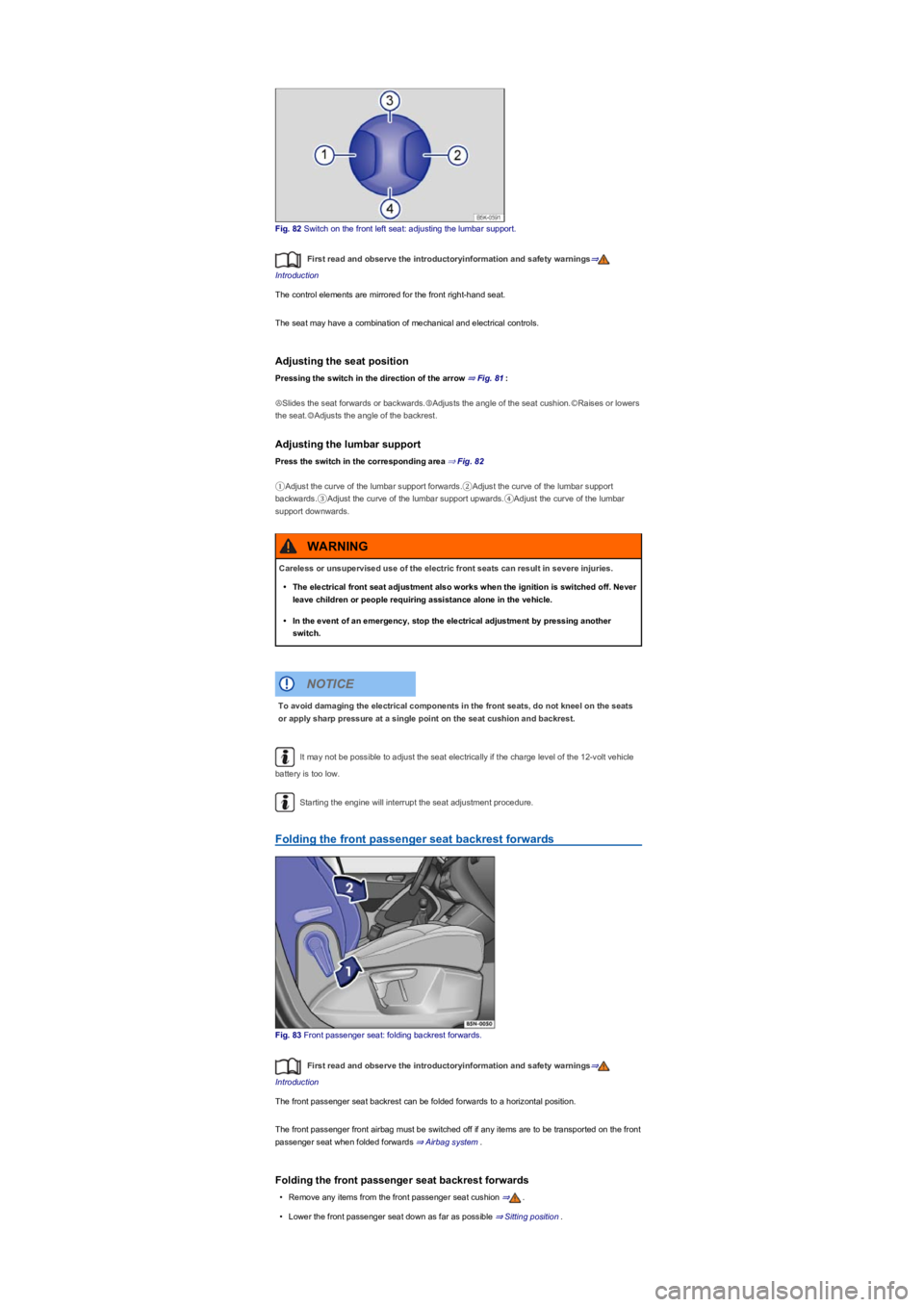
Fig. 82 Switch on the front left seat: adjusting the lumbar support.
First read and observe the introductoryinformation and safety warnings⇒
Introduction
The control elements are mirrored for the front right-hand seat.
The seat may have a combination of mechanical and electrical controls.
Adjusting the seat position
Pressing the switch in the direction of the arrow ⇒ Fig. 81:
ⒶSlides the seat forwards or backwards.ⒷAdjusts the angle of the seat cushion.ⒸRaises or lowers
the seat.ⒹAdjusts the angle of the backrest.
Adjusting the lumbar support
Press the switch in the corresponding area ⇒ Fig. 82
①Adjust the curve of the lumbar support forwards.②Adjust the curve of the lumbar support
backwards.③Adjust the curve of the lumbar support upwards.④Adjust the curve of the lumbar
support downwards.
It may not be possible to adjust the seat electrically if the charge level of the 12-volt vehicle
battery is too low.
Starting the engine will interrupt the seat adjustment procedure.
Folding the front passenger seat backrest forwards
Fig. 83 Front passenger seat: folding backrest forwards.
First read and observe the introductoryinformation and safety warnings⇒
Introduction
The front passenger seat backrest can be folded forwards to a horizontal position.
The front passenger front airbag must be switched off if any items are to be transported on the front
passenger seat when folded forwards ⇒ Airbag system.
Folding the front passenger seat backrest forwards
•Remove any items from the front passenger seat cushion ⇒.
•Lower the front passenger seat down as far as possible ⇒ Sitting position.
Careless or unsupervised use of the electric front seats can result in severe injuries.
•The electrical front seat adjustment also works when the ignition is switched off. Never
leave children or people requiring assistance alone in the vehicle.
•In the event of an emergency, stop the electrical adjustment by pressing another
switch.
WARNING
To avoid damaging the electrical components in the front seats, do not kneel on the seats
or apply sharp pressure at a single point on the seat cushion and backrest.
NOTICE
Page 93 of 341
Adjusting the rear bench seat
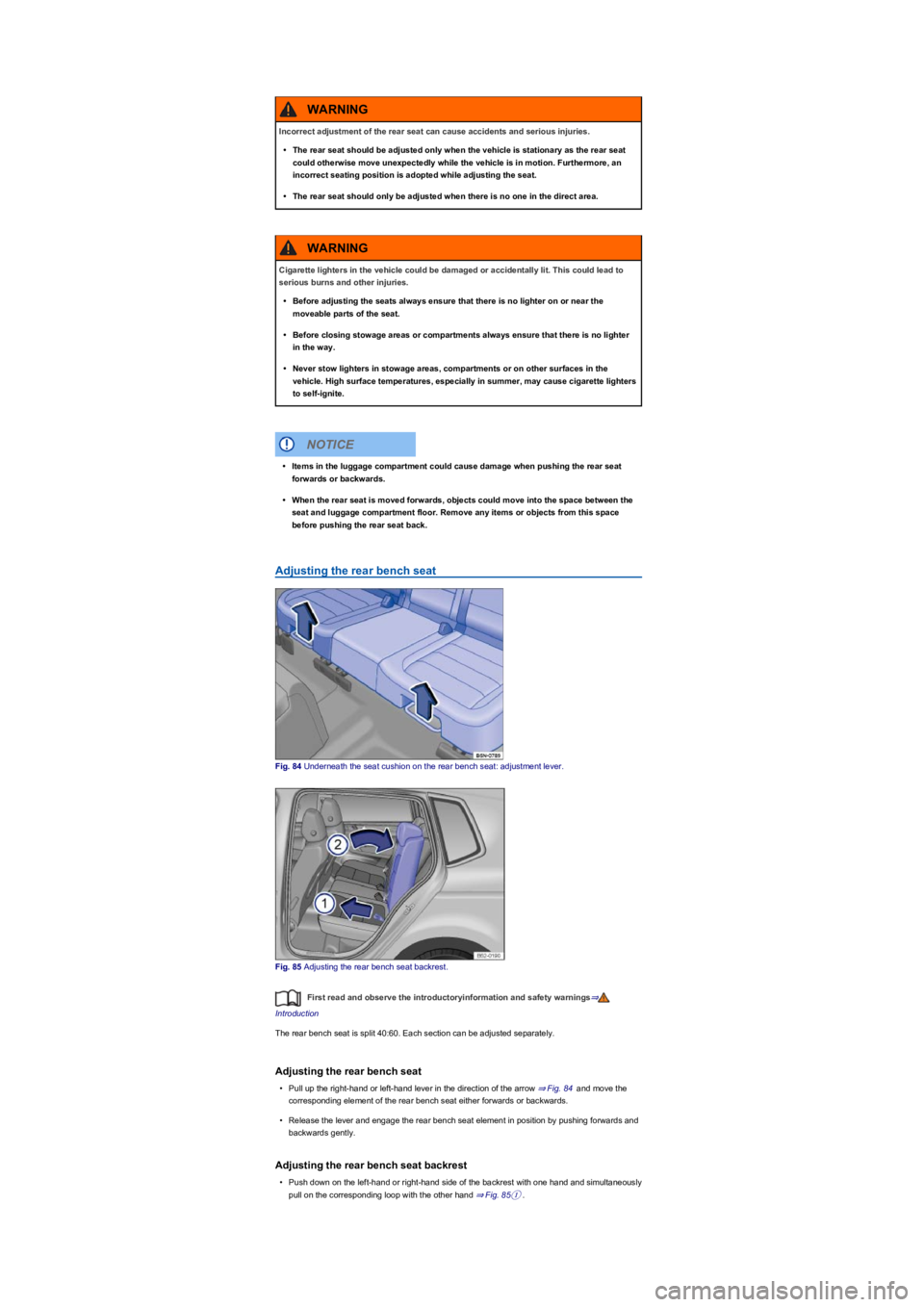
Fig. 84 Underneath the seat cushion on the rear bench seat: adjustment lever.
Fig. 85 Adjusting the rear bench seat backrest.
First read and observe the introductoryinformation and safety warnings⇒
Introduction
The rear bench seat is split 40:60. Each section can be adjusted separately.
Adjusting the rear bench seat
•Pull up the right-hand or left-hand lever in the direction of the arrow ⇒ Fig. 84 and move the
corresponding element of the rear bench seat either forwards or backwards.
•Release the lever and engage the rear bench seat element in position by pushing forwards and
backwards gently.
Adjusting the rear bench seat backrest
•Push down on the left-hand or right-hand side of the backrest with one hand and simultaneously
pull on the corresponding loop with the other hand ⇒ Fig. 85①.
Incorrect adjustment of the rear seat can cause accidents and serious injuries.
•The rear seat should be adjusted only when the vehicle is stationary as the rear seat
could otherwise move unexpectedly while the vehicle is in motion. Furthermore, an
incorrect seating position is adopted while adjusting the seat.
•The rear seat should only be adjusted when there is no one in the direct area.
WARNING
Cigarette lighters in the vehicle could be damaged or accidentally lit. This could lead to
serious burns and other injuries.
•Before adjusting the seats always ensure that there is no lighter on or near the
moveable parts of the seat.
•Before closing stowage areas or compartments always ensure that there is no lighter
in the way.
•Never stow lighters in stowage areas, compartments or on other surfaces in the
vehicle. High surface temperatures, especially in summer, may cause cigarette lighters
to self-ignite.
WARNING
•Items in the luggage compartment could cause damage when pushing the rear seat
forwards or backwards.
•When the rear seat is moved forwards, objects could move into the space between the
seat and luggage compartment floor. Remove any items or objects from this space
before pushing the rear seat back.
NOTICE