ESP VOLKSWAGEN TIGUAN 2017 Owner´s Manual
[x] Cancel search | Manufacturer: VOLKSWAGEN, Model Year: 2017, Model line: TIGUAN, Model: VOLKSWAGEN TIGUAN 2017Pages: 341, PDF Size: 9.14 MB
Page 37 of 341
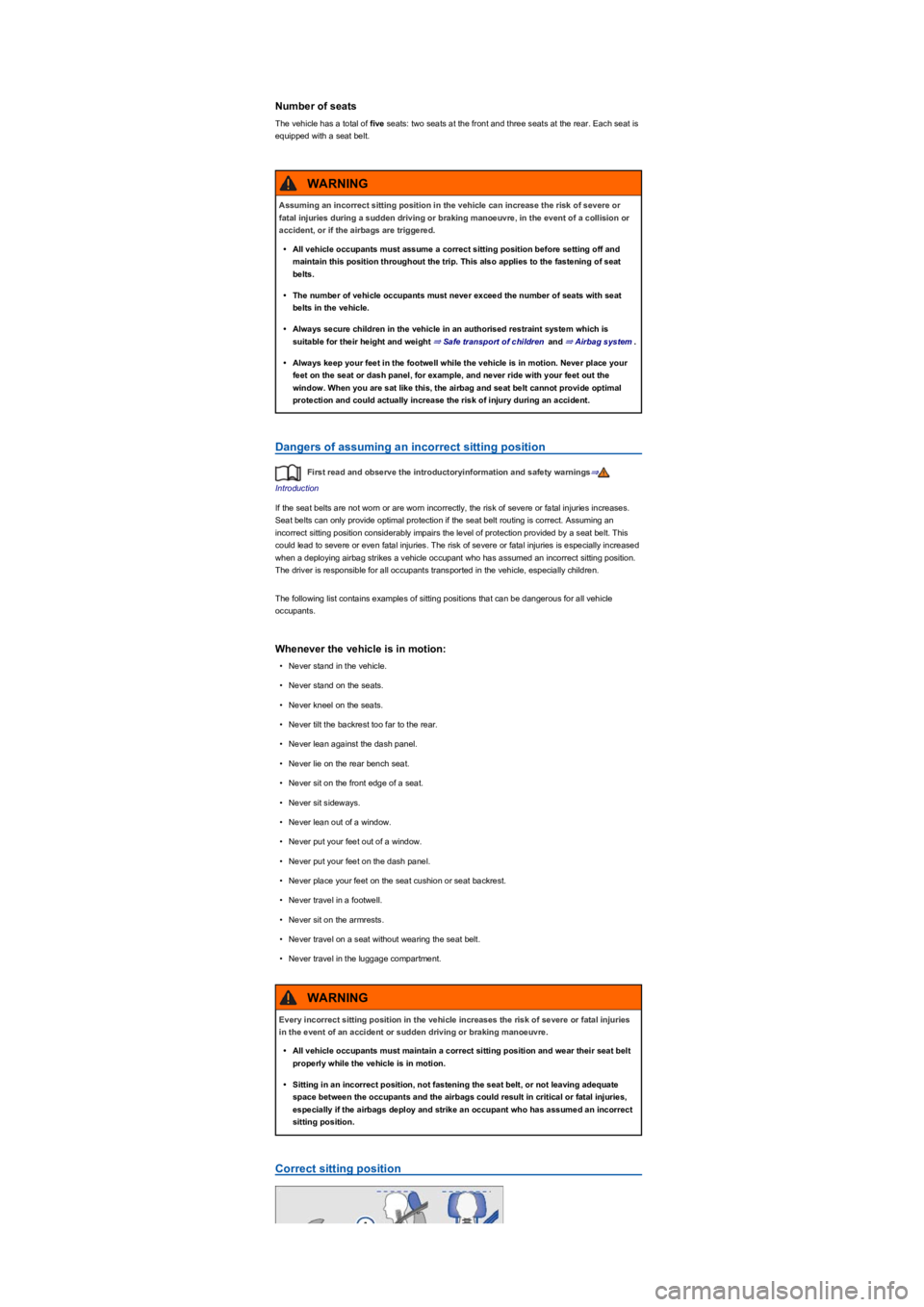
Number of seats
The vehicle has a total of five seats: two seats at the front and three seats at the rear. Each seat is
equipped with a seat belt.
Dangers of assuming an incorrect sitting position
First read and observe the introductoryinformation and safety warnings⇒
Introduction
If the seat belts are not worn or are worn incorrectly, the risk of severe or fatal injuries increases.
Seat belts can only provide optimal protection if the seat belt routing is correct. Assuming an
incorrect sitting position considerably impairs the level of protection provided by a seat belt. This
could lead to severe or even fatal injuries. The risk of severe or fatal injuries is especially increased
when a deploying airbag strikes a vehicle occupant who has assumed an incorrect sitting position.
The driver is responsible for all occupants transported in the vehicle, especially children.
The following list contains examples of sitting positions that can be dangerous for all vehicle
occupants.
Whenever the vehicle is in motion:
•Never stand in the vehicle.
•Never stand on the seats.
•Never kneel on the seats.
•Never tilt the backrest too far to the rear.
•Never lean against the dash panel.
•Never lie on the rear bench seat.
•Never sit on the front edge of a seat.
•Never sit sideways.
•Never lean out of a window.
•Never put your feet out of a window.
•Never put your feet on the dash panel.
•Never place your feet on the seat cushion or seat backrest.
•Never travel in a footwell.
•Never sit on the armrests.
•Never travel on a seat without wearing the seat belt.
•Never travel in the luggage compartment.
Correct sitting position
Assuming an incorrect sitting position in the vehicle can increase the risk of severe or
fatal injuries during a sudden driving or braking manoeuvre, in the event of a collision or
accident, or if the airbags are triggered.
•All vehicle occupants must assume a correct sitting position before setting off and
maintain this position throughout the trip. This also applies to the fastening of seat
belts.
•The number of vehicle occupants must never exceed the number of seats with seat
belts in the vehicle.
•Always secure children in the vehicle in an authorised restraint system which is
suitable for their height and weight ⇒ Safe transport of children and ⇒ Airbag system.
•Always keep your feet in the footwell while the vehicle is in motion. Never place your
feet on the seat or dash panel, for example, and never ride with your feet out the
window. When you are sat like this, the airbag and seat belt cannot provide optimal
protection and could actually increase the risk of injury during an accident.
WARNING
Every incorrect sitting position in the vehicle increases the risk of severe or fatal injuries
in the event of an accident or sudden driving or braking manoeuvre.
•All vehicle occupants must maintain a correct sitting position and wear their seat belt
properly while the vehicle is in motion.
•Sitting in an incorrect position, not fastening the seat belt, or not leaving adequate
space between the occupants and the airbags could result in critical or fatal injuries,
especially if the airbags deploy and strike an occupant who has assumed an incorrect
sitting position.
WARNING
Page 46 of 341
The airbag modules and belt tensioners may contain perchlorate. Please comply with
legislation regarding disposal.
Proactive occupant protection system
First read and observe the introductoryinformation and safety warnings⇒
Introduction
The proactive occupant protection system is an assistance system that initiates action to protect
vehicle occupants in dangerous situations. However, the system cannot prevent a collision.
The full range of functions of the proactive occupant protection system will be available only if the
function has been activated in the Infotainment system, no special driving profile has been selected
and there are no malfunctions ⇒ Driving profile selection and 4MOTION Active Control, ⇒ Function
limitations.
Basic functions
Depending on country-specific legal requirements and also on the vehicle equipment, the following
functions may be initiated, either individually or jointly, in critical situations (e.g. emergency braking
or in the case of oversteering or understeering) as of a speed of approximately 30 km/h (19 mph):
•Temporary tensioning of the fastened front seat belts.
•Automatic closing of the glass roof and side windows down to a gap, depending on the vehicle
equipment.
The belts may be tensioned individually or together depending on the respective critical driving
situations.
Additional information for vehicles with an area monitoring system (Front
Assist)
In vehicles fitted with the area monitoring system (Front Assist) ⇒ Area monitoring system (Front
Assist), the probability of a collision with the vehicle ahead is also calculated within the system
limits. The system can trigger the proactive occupant protection system if it detects a probable
collision or initiates strong braking.
Settings in the Infotainment system
The full range of functions of the proactive occupant protection system can be activated and
deactivated in the Infotainment system ⇒ Operation and display in the Infotainment system.
The proactive occupant protection system will be reactivated every time the ignition is switched on.
It may not be possible to operate the setting function if the proactive occupant protection system
has already been adapted to the specific vehicle setup.
Setting in driving profile selection
In vehicles with driving profile selection, the proactive occupant protection system is adapted to the
special vehicle setup of the respective driving profile ⇒ Driving profile selection and 4MOTION
Active Control.
Function limitations
The proactive occupant protection system will not be available, or will only be available to a limited
extent, in the following situations:
•If there is a fault in the ESC, belt tensioner or in the airbag control unit ⇒ Seat belts or ⇒ Airbag
system.
•When the TCS or ESC are switched off, and when the vehicle is reversing ⇒ Brake support
systems.
•The temporary tensioning for the front passenger seat is switched off if the front passenger front
airbag is deactivated.
•If there is a system fault in the area monitoring system (Front Assist) ⇒ Area monitoring system
(Front Assist).
The risk of severe or fatal injuries may be increased if the seat belts, automatic belt
retractors and belt tensioners are not used correctly, or if they are repaired by a non-
professional. As a result, the belt tensioners may not be triggered when they should, or
they may be triggered unexpectedly.
•Any repairs, adjustments or removal and refitting of parts in the belt tensioners or seat
belts should always be carried out by a qualified workshop and never by yourself
⇒ Accessories, modifications, repairs and renewal of parts.
•Belt tensioners and automatic belt retractors cannot be repaired. They must be
replaced.
WARNING
Page 48 of 341
Types of front passenger front airbag system
First read and observe the introductoryinformation and safety warnings⇒
Introduction
Never rely solely on the airbag system for your protection.
•Even if an airbag is triggered, it only offers auxiliary protection.
•The airbag system offers the best level of protection, and reduces the risk of injury,
when seat belts are properly worn ⇒ Seat belts.
•Before every trip, each vehicle occupant must adopt the correct sitting position,
correctly fasten the seat belt belonging to their seat and keep it fastened properly
throughout the trip. This applies to all vehicle occupants and also in urban traffic.
WARNING
The risk of injury increases if there are any objects between the vehicle occupants and the
deployment area of the airbag when it is triggered. This will alter the deployment zone of
the airbag, or the objects will be flung against the body.
•Never hold any objects in your hand or on your lap while the vehicle is in motion.
•Never transport any objects on the front passenger seat. The objects could enter the
deployment zone of the airbag during sudden braking or driving manoeuvres and then
be flung dangerously through the vehicle interior if the airbag is activated.
•Vehicle occupants sitting on the front seats and rear outer seats must never carry any
people, pets or objects in the deployment zone between themselves and the airbags.
Ensure that children and passengers keep to this rule.
WARNING
The airbag system can only be triggered once. The system will have to be replaced if the
airbags have been triggered.
•Airbags that have been triggered, and any affected system parts, must immediately be
replaced with new parts that are approved by Volkswagen for the vehicle.
•Repairs and modifications to your vehicle should only be carried out by a qualified
workshop. Qualified workshops have the necessary tools, diagnostic equipment, repair
information and qualified personnel.
•Never use recycled airbag components or components that have been taken from end-
of-life vehicles in your vehicle.
•Never alter any components of the airbag system.
WARNING
Fine dust particles or steam may be released when the airbags are triggered. This is
normal and does not mean that there is a fire in the vehicle.
•The fine dust can cause irritation to the skin and eye membranes and cause breathing
difficulties, particularly for people suffering from asthma or people who have (had)
other respiratory problems. To help reduce breathing difficulties, get out of the vehicle
or open the windows or doors for more fresh air.
•If you come into contact with the dust, you should wash your hands and face with a
mild soap and water before eating.
•Do not let the dust get into your eyes or into open wounds.
•If dust has entered your eyes, rinse them with water.
WARNING
Cleaning agents that contain solvents cause the surface of the airbag modules to become
porous. In an accident that triggers the airbag, loose plastic parts can cause serious
injury.
•Never clean the dash panel or the airbag covers with cleansers that contain solvents.
WARNING
Page 53 of 341
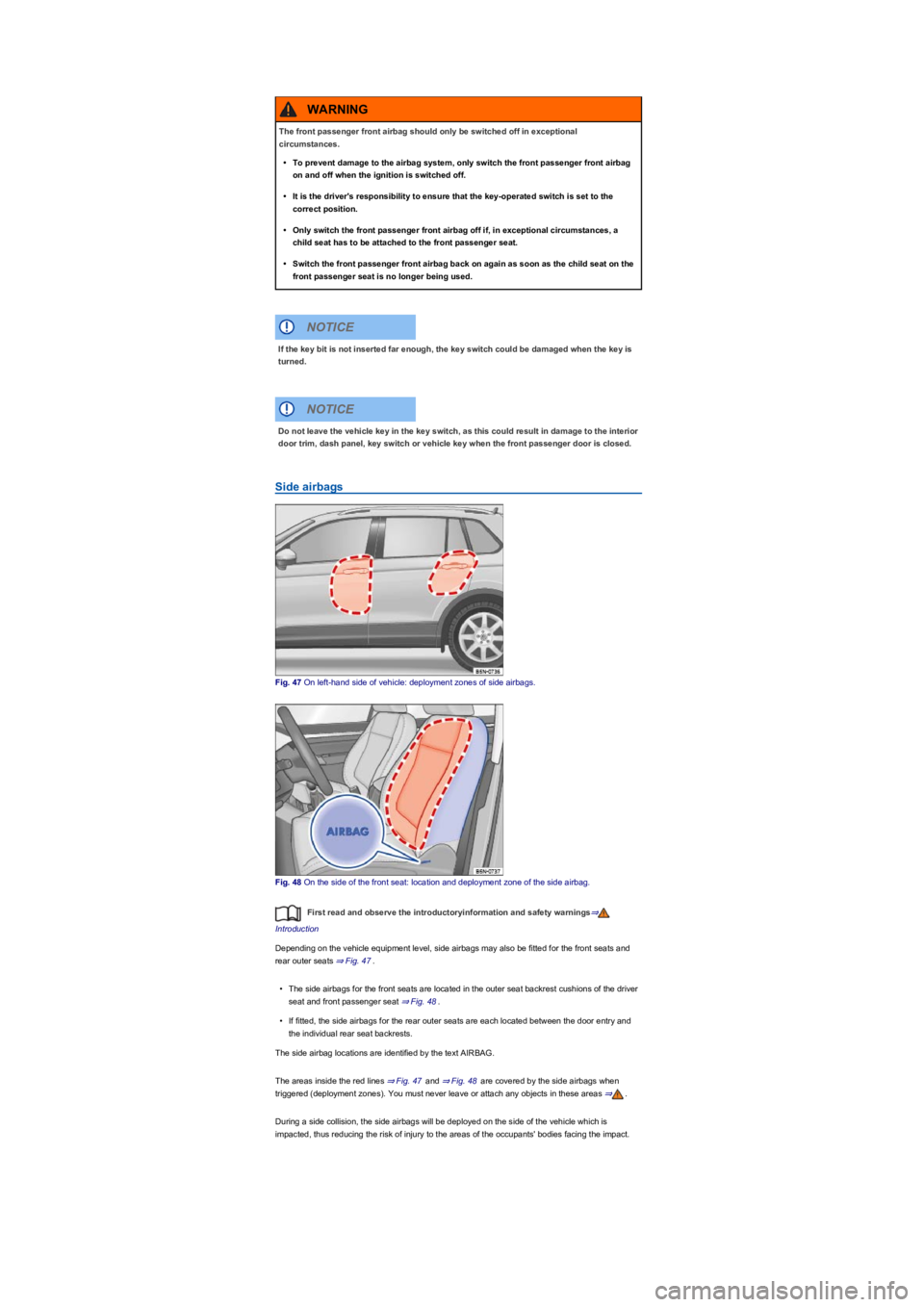
Side airbags
Fig. 47 On left-hand side of vehicle: deployment zones of side airbags.
Fig. 48 On the side of the front seat: location and deployment zone of the side airbag.
First read and observe the introductoryinformation and safety warnings⇒
Introduction
Depending on the vehicle equipment level, side airbags may also be fitted for the front seats and
rear outer seats ⇒ Fig. 47.
•The side airbags for the front seats are located in the outer seat backrest cushions of the driver
seat and front passenger seat ⇒ Fig. 48.
•If fitted, the side airbags for the rear outer seats are each located between the door entry and
the individual rear seat backrests.
The side airbag locations are identified by the text AIRBAG.
The areas inside the red lines ⇒ Fig. 47 and ⇒ Fig. 48 are covered by the side airbags when
triggered (deployment zones). You must never leave or attach any objects in these areas ⇒.
During a side collision, the side airbags will be deployed on the side of the vehicle which is
impacted, thus reducing the risk of injury to the areas of the occupants' bodies facing the impact.
The front passenger front airbag should only be switched off in exceptional
circumstances.
•To prevent damage to the airbag system, only switch the front passenger front airbag
on and off when the ignition is switched off.
•It is the driver's responsibility to ensure that the key-operated switch is set to the
correct position.
•Only switch the front passenger front airbag off if, in exceptional circumstances, a
child seat has to be attached to the front passenger seat.
•Switch the front passenger front airbag back on again as soon as the child seat on the
front passenger seat is no longer being used.
WARNING
If the key bit is not inserted far enough, the key switch could be damaged when the key is
turned.
NOTICE
Do not leave the vehicle key in the key switch, as this could result in damage to the interior
door trim, dash panel, key switch or vehicle key when the front passenger door is closed.
NOTICE
Page 60 of 341
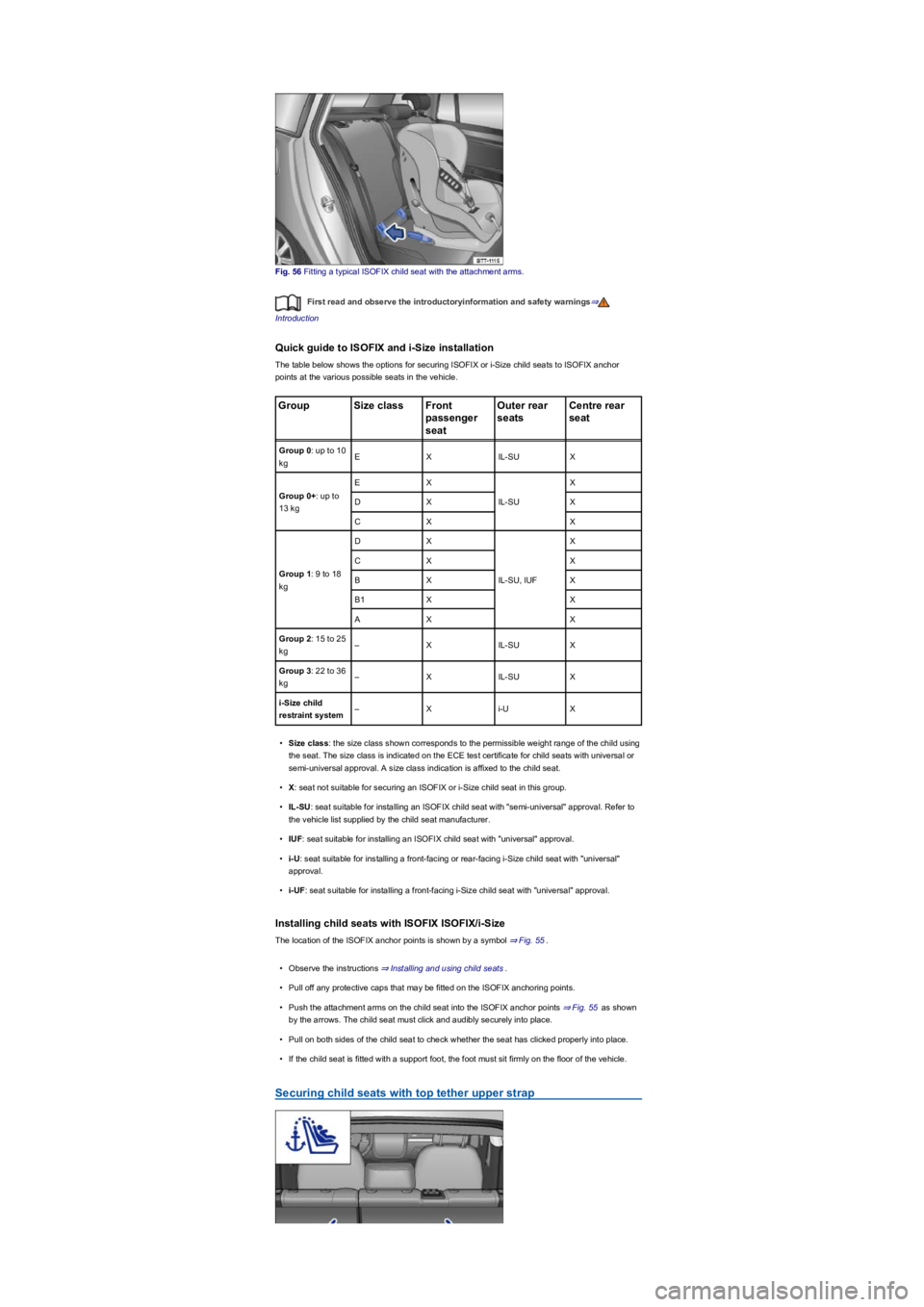
Fig. 56 Fitting a typical ISOFIX child seat with the attachment arms.
First read and observe the introductoryinformation and safety warnings⇒
Introduction
Quick guide to ISOFIX and i-Size installation
The table below shows the options for securing ISOFIX or i-Size child seats to ISOFIX anchor
points at the various possible seats in the vehicle.
GroupSize classFront
passenger
seat
Outer rear
seats
Centre rear
seat
Group 0: up to 10
kgEXIL-SUX
Group 0+: up to
13 kg
EX
IL-SU
X
DXX
CXX
Group 1: 9 to 18
kg
DX
IL-SU, IUF
X
CXX
BXX
B1XX
AXX
Group 2: 15 to 25
kg–XIL-SUX
Group 3: 22 to 36
kg–XIL-SUX
i-Size child
restraint system–Xi-UX
•Size class: the size class shown corresponds to the permissible weight range of the child using
the seat. The size class is indicated on the ECE test certificate for child seats with universal or
semi-universal approval. A size class indication is affixed to the child seat.
•X: seat not suitable for securing an ISOFIX or i-Size child seat in this group.
•IL-SU: seat suitable for installing an ISOFIX child seat with "semi-universal" approval. Refer to
the vehicle list supplied by the child seat manufacturer.
•IUF: seat suitable for installing an ISOFIX child seat with "universal" approval.
•i-U: seat suitable for installing a front-facing or rear-facing i-Size child seat with "universal"
approval.
•i-UF: seat suitable for installing a front-facing i-Size child seat with "universal" approval.
Installing child seats with ISOFIX ISOFIX/i-Size
The location of the ISOFIX anchor points is shown by a symbol ⇒ Fig. 55.
•Observe the instructions ⇒ Installing and using child seats.
•Pull off any protective caps that may be fitted on the ISOFIX anchoring points.
•Push the attachment arms on the child seat into the ISOFIX anchor points ⇒ Fig. 55 as shown
by the arrows. The child seat must click and audibly securely into place.
•Pull on both sides of the child seat to check whether the seat has clicked properly into place.
•If the child seat is fitted with a support foot, the foot must sit firmly on the floor of the vehicle.
Securing child seats with top tether upper strap
Page 61 of 341
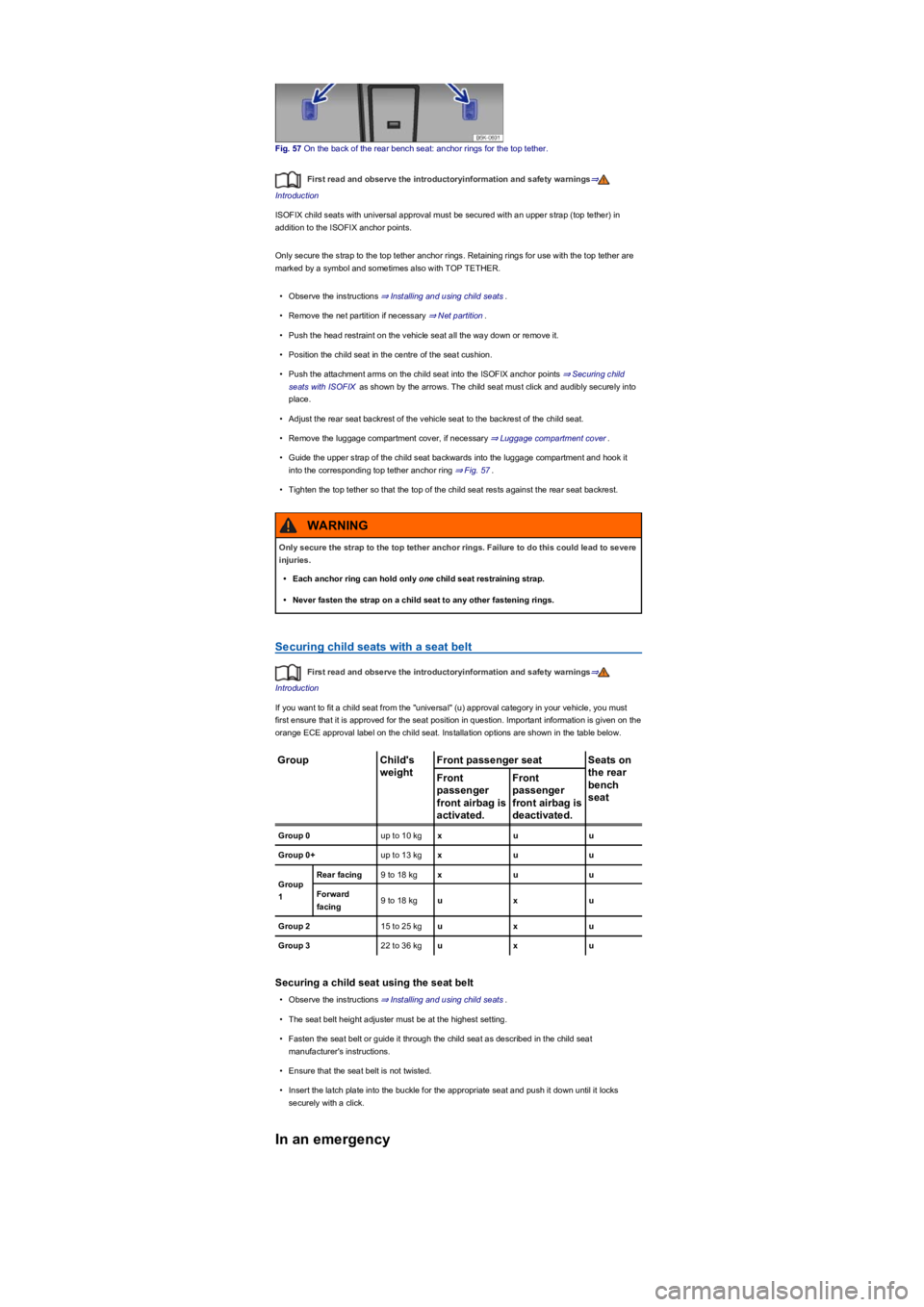
Fig. 57 On the back of the rear bench seat: anchor rings for the top tether.
First read and observe the introductoryinformation and safety warnings⇒
Introduction
ISOFIX child seats with universal approval must be secured with an upper strap (top tether) in
addition to the ISOFIX anchor points.
Only secure the strap to the top tether anchor rings. Retaining rings for use with the top tether are
marked by a symbol and sometimes also with TOP TETHER.
•Observe the instructions ⇒ Installing and using child seats.
•Remove the net partition if necessary ⇒ Net partition.
•Push the head restraint on the vehicle seat all the way down or remove it.
•Position the child seat in the centre of the seat cushion.
•Push the attachment arms on the child seat into the ISOFIX anchor points ⇒ Securing child
seats with ISOFIX as shown by the arrows. The child seat must click and audibly securely into
place.
•Adjust the rear seat backrest of the vehicle seat to the backrest of the child seat.
•Remove the luggage compartment cover, if necessary ⇒ Luggage compartment cover.
•Guide the upper strap of the child seat backwards into the luggage compartment and hook it
into the corresponding top tether anchor ring ⇒ Fig. 57.
•Tighten the top tether so that the top of the child seat rests against the rear seat backrest.
Securing child seats with a seat belt
First read and observe the introductoryinformation and safety warnings⇒
Introduction
If you want to fit a child seat from the "universal" (u) approval category in your vehicle, you must
first ensure that it is approved for the seat position in question. Important information is given on the
orange ECE approval label on the child seat. Installation options are shown in the table below.
GroupChild's
weight
Front passenger seatSeats on
the rear
bench
seat
Front
passenger
front airbag is
activated.
Front
passenger
front airbag is
deactivated.
Group 0up to 10 kgxuu
Group 0+up to 13 kgxuu
Group
1
Rear facing9 to 18 kgxuu
Forward
facing9 to 18 kguxu
Group 215 to 25 kguxu
Group 322 to 36 kguxu
Securing a child seat using the seat belt
•Observe the instructions ⇒ Installing and using child seats.
•The seat belt height adjuster must be at the highest setting.
•Fasten the seat belt or guide it through the child seat as described in the child seat
manufacturer's instructions.
•Ensure that the seat belt is not twisted.
•Insert the latch plate into the buckle for the appropriate seat and push it down until it locks
securely with a click.
In an emergency
Only secure the strap to the top tether anchor rings. Failure to do this could lead to severe
injuries.
•Each anchor ring can hold only one child seat restraining strap.
•Never fasten the strap on a child seat to any other fastening rings.
WARNING
Page 67 of 341
Vehicle key
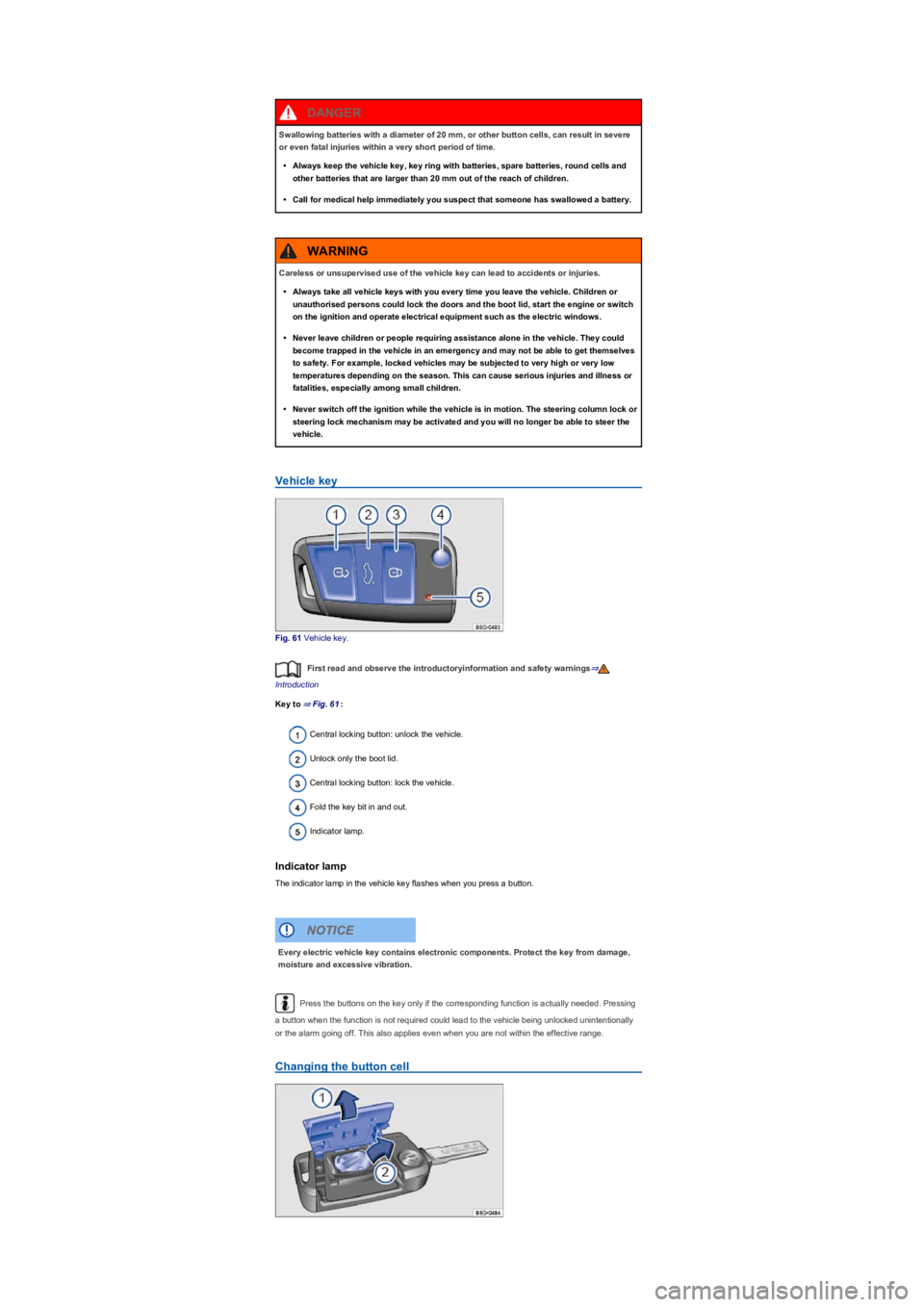
Fig. 61 Vehicle key.
First read and observe the introductoryinformation and safety warnings⇒
Introduction
Key to ⇒ Fig. 61:
Central locking button: unlock the vehicle.
Unlock only the boot lid.
Central locking button: lock the vehicle.
Fold the key bit in and out.
Indicator lamp.
Indicator lamp
The indicator lamp in the vehicle key flashes when you press a button.
Press the buttons on the key only if the corresponding function is actually needed. Pressing
a button when the function is not required could lead to the vehicle being unlocked unintentionally
or the alarm going off. This also applies even when you are not within the effective range.
Changing the button cell
Swallowing batteries with a diameter of 20 mm, or other button cells, can result in severe
or even fatal injuries within a very short period of time.
•Always keep the vehicle key, key ring with batteries, spare batteries, round cells and
other batteries that are larger than 20 mm out of the reach of children.
•Call for medical help immediately you suspect that someone has swallowed a battery.
DANGER
Careless or unsupervised use of the vehicle key can lead to accidents or injuries.
•Always take all vehicle keys with you every time you leave the vehicle. Children or
unauthorised persons could lock the doors and the boot lid, start the engine or switch
on the ignition and operate electrical equipment such as the electric windows.
•Never leave children or people requiring assistance alone in the vehicle. They could
become trapped in the vehicle in an emergency and may not be able to get themselves
to safety. For example, locked vehicles may be subjected to very high or very low
temperatures depending on the season. This can cause serious injuries and illness or
fatalities, especially among small children.
•Never switch off the ignition while the vehicle is in motion. The steering column lock or
steering lock mechanism may be activated and you will no longer be able to steer the
vehicle.
WARNING
Every electric vehicle key contains electronic components. Protect the key from damage,
moisture and excessive vibration.
NOTICE
Page 69 of 341
Central and manual locking
Introduction
This chapter contains information on the followingsubjects:
⇒ Indicator lamp
⇒ Central locking system
⇒ Locking and unlocking the vehicle from the outside
⇒ Locking and unlocking the vehicle from the inside
⇒ Locking and unlocking the vehicle with
⇒ SAFELOCK
⇒ Anti-theft alarm
⇒ Interior monitoring system and anti-tow alarm
⇒ Locking the vehicle after the airbag has been triggered
⇒ Troubleshooting
The central locking system locks all doors and the boot lid of the vehicle. The vehicle cannot be
locked if the driver door is open.
The vehicle can only be locked if the ignition has been switched off or the driver has switched off
the engine before leaving the vehicle.
Automatic locking (anti-theft protection)
The vehicle will lock itself again automatically after around 45 seconds if one of the following
conditions applies:
•The vehicle was unlocked but not opened.
•The ignition was not switched on.
•The boot lid was not opened.
•The vehicle has been unlocked using the lock cylinder.
•The vehicle was locked with the central locking button in the vehicle interior.
Indicator lamp
First read and observe the introductoryinformation and safety warnings⇒
Introduction
The central locking indicator lamp is located in the driver door ⇒ Driver door.
Vehicle locked: red LED flashes at short intervals for approximately two seconds, and then more
slowly. The indicator lamp does not flash if the vehicle was locked with the central locking button in
the driver door ⇒ Locking and unlocking the vehicle from the inside.
Central locking system
First read and observe the introductoryinformation and safety warnings⇒
Introduction
The central locking system enables you to lock or unlock all the doors, the boot lid and the tank flap
from one point.
Settings for the central locking system can be adjusted in the Infotainment system ⇒ Operation and
display in the Infotainment system.
Automatic locking (Auto Lock)
The vehicle may lock itself automatically at speeds of approximately 15 km/h (9 mph) and above
⇒ Operation and display in the Infotainment system. The indicator lamp in the central locking
button will light up yellow when the vehicle is locked.
Improper use of the central locking system could lead to serious injury.
•The central locking system locks all doors. Locking the vehicle from the inside can
prevent accidental opening of the doors and unauthorised persons from entering the
vehicle. However, locked doors can delay assistance to passengers inside the vehicle
in the event of an accident or emergency.
•Never leave children or people requiring assistance alone in the vehicle. All doors can
be locked from the inside using the central locking button. This may mean that people
lock themselves in the vehicle. People locked in the vehicle may be subjected to very
high or very low temperatures.
•Temperatures inside a locked vehicle may reach extremes of heat or cold, according to
season. This can cause serious injuries and illness or fatalities, especially to small
children.
•Never leave anyone inside a locked vehicle. People in the vehicle could become
trapped in an emergency and may not be able to get themselves to safety.
•Doors and the boot lid should therefore be opened or closed only when you are sure
that nobody is in their path.
WARNING
Page 73 of 341
Depending on the mirror function set in the Infotainment system, the exterior mirrors fold out
when the vehicle is unlocked using the sensor on the door handle of the driver of passenger door
and surround lighting is switched on.
If there is no valid vehicle key in the vehicle or if it is not detected, a corresponding display
will be shown on the instrument cluster display. This may occur if the vehicle key is obstructed by
another radio signal or is covered by another item, e.g. a mobile telephone accessory or an
aluminium suitcase ⇒ Starting and stopping the engine.
The sensors may have limited functionality if they become very dirty.
If the vehicle has a DSG dual clutch gearbox, it can be locked only if the selector lever is in
position P.
The entire vehicle will be unlocked if the sensor is touched twice, even if a single door has
already been unlocked.
SAFELOCK
First read and observe the introductoryinformation and safety warnings⇒
Introduction
Depending on the vehicle equipment, the vehicle may have an anti-theft alarm and SAFELOCK
⇒ Anti-theft alarm.
The SAFELOCK deactivates the door release levers if the vehicle has been locked. This makes it
more difficult to break into the vehicle. The doors can no longer be opened from the inside ⇒.
•Press the button on the vehicle key once⇒ Central locking system.
•Press the button on the vehicle key twice in quick succession ⇒ Central locking system.
•Vehicles with the keyless locking and starting system Keyless Access: touch the sensor on the
outside of the door handle twice⇒ Locking and unlocking the vehicle with keyless access.
•Press the central locking button in the driver door once ⇒ Central locking system.
Depending on the vehicle equipment level, there may be an indication of the activated SAFELOCK
in the display of the instrument cluster (Check SAFELOCK! or SAFELOCK).
Deactivating SAFELOCK
The SAFELOCK can be deactivated in one of the following ways:
•Switch on the ignition.
•OR: deactivate interior monitoring and the anti-tow alarm.
Depending on the vehicle equipment, temporarily deactivate interior monitoring and the anti-tow
alarm using the Infotainment system ⇒ Operation and display in the Infotainment system before
locking the vehicle.
The following applies when SAFELOCK is deactivated:
•The vehicle can be unlocked and opened from the inside using the door release lever.
•The anti-theft alarm ⇒ Anti-theft alarm is active.
Depending on the equipment, the interior monitoring and anti-tow alarm will be activated or
deactivated via the Infotainment system ⇒ Operation and display in the Infotainment system.
Anti-theft alarm
First read and observe the introductoryinformation and safety warnings⇒
Introduction
Depending on the vehicle equipment level, the vehicle may have an anti-theft alarm and
SAFELOCK ⇒ SAFELOCK.
Always take care when using the SAFELOCK as you could cause serious injuries.
•Never leave anybody in the vehicle if the vehicle has been locked using the vehicle key.
The doors can no longer be opened from the inside once the SAFELOCK is activated.
•Locked doors make it more difficult for emergency service personnel to gain access to
the vehicle and provide assistance when needed. In an emergency, people locked
inside the vehicle would not be able to leave the vehicle by unlocking the doors.
WARNING
Page 76 of 341
The doors and the boot lid can be locked or unlocked manually if the vehicle key or central locking
fails ⇒ Unlocking or locking the driver door manually⇒ Unlocking the boot lid manually.
If the turn signals do not flash as confirmation when you lock the vehicle:
•At least one of the doors or the boot lid is not closed.
•OR: convenience closing is in progress and not all windows have been closed.
Response when locking the vehicle with a second vehicle key
Keyless locking and starting system Keyless Access: Any vehicle key located inside the vehicle will
be blocked from starting the engine if the vehicle has been locked from the outside using a second
vehicle key. Press the button on the vehicle key in the vehicle interior to enable it to start the
engine ⇒ Starting and stopping the engine.
Automatic switch-off of the sensor surfaces
•The vehicle is not unlocked or locked for an extended period.
•A sensor has been triggered an excessive number of times.
Activating sensors again:
•Wait for a short period of time.
•OR: unlock the vehicle with the button on the vehicle key.
•OR: the boot lid is opened.
•OR: unlock the vehicle with the vehicle key ⇒ Doors.
It may not be possible to lock or unlock the vehicle using keyless access if the 12-volt vehicle
battery or button cell in the vehicle key is weak or discharged. The vehicle can be locked or
unlocked manually ⇒.
If there is no valid vehicle key in the vehicle or if it is not detected, a corresponding display
will be shown on the instrument cluster display. This may occur if the vehicle key is obstructed by
another radio signal or is covered by another item, e.g. a mobile telephone accessory or an
aluminium suitcase ⇒ Starting and stopping the engine.
The sensors may have limited functionality if they become very dirty.
Doors
Introduction
This chapter contains information on the followingsubjects:
⇒ Display
⇒ Childproof lock
⇒ Unlocking or locking the driver door manually
⇒ Locking the front passenger door and rear doors manually
If, for example, the vehicle key or central locking fails, the doors, boot lid and tilting and sliding
panoramic sunroof can be locked and, with some exceptions, unlocked manually.
Please note that the sensors in the door handles can be activated by a powerful jet of
water or steam if a valid vehicle key is simultaneously within its operating range. If at least
one window is open and the sensors in a door handle are continuously activated, all
windows will close. It is possible that all windows will open if the jet of water or steam is
moved away from the door handle sensors briefly and then moved back onto them
⇒ Locking and unlocking the vehicle with keyless access.
NOTICE
Any door that is not properly closed could open suddenly while the vehicle is in motion.
This could lead to severe injuries.
•Stop as soon as possible and close the door.
•Ensure that the door is closed properly and that the lock has engaged. The closed door
must be flush with the surrounding body panels.
•Doors should only be opened or closed when you are sure there is no-one in their path.
WARNING
Any door being held open by the door arrester could close unexpectedly in strong winds
or if the vehicle is on a slope. This could lead to injuries.
•Always keep a good grip on the handle when opening and closing doors.
WARNING