ESP VOLKSWAGEN TIGUAN 2017 Owner´s Manual
[x] Cancel search | Manufacturer: VOLKSWAGEN, Model Year: 2017, Model line: TIGUAN, Model: VOLKSWAGEN TIGUAN 2017Pages: 341, PDF Size: 9.14 MB
Page 141 of 341
First read and observe the introductoryinformation and safety warnings⇒
Introduction
Warning and indicator lamps in the instrument cluster
Warning and indicator lamps light up
Fault in engine management system. The engine should be checked by a qualified workshop
as soon as possible.Risk of engine overheating. The engine speed will be automatically
restricted. The engine speed is shown on the instrument cluster display. The engine speed control
is lifted when the engine is no longer in a critical temperature range and the foot is taken off the
accelerator. and Engine speed limitation is initiated due to a fault in the engine
management system. Make sure that you do not exceed the displayed engine speed. The engine
should be checked by a qualified workshop as soon as possible.Exhaust system fault. Have
the engine checked by a qualified workshop.Particulate filter has become saturated with
soot. Drive in fourth gear (manual gearbox) or in selector lever position D (DSG dual clutch
gearbox) at a speed of at least 70 km/h (44 mph) for approximately 15 minutes. Observe the valid
speed limits. Go to the nearest qualified workshop if the indicator lamp still does not go out.
m/k/a997MKVehicles with diesel engine
Indicator lamps flash.
Fault in engine management system. The engine should be checked by a qualified workshop
as soon as possible.Engine management system has detected misfiring, which damages the
catalytic converter. Reduce speed immediately and drive carefully to the nearest qualified
workshop. Have the engine checked.
Unauthorised vehicle keys
If a non-authorised vehicle key has been inserted in the ignition lock it can be removed as follows:
•m/k/a995MKVehicles with a DSG dual clutch gearbox: press the lock button in the
selector lever and release. Pull the vehicle key out of the ignition lock.
•m/k/a995MKVehicles with a manual gearbox: remove the vehicle key from the ignition
lock.
Emergency start function
Use the emergency start function if no valid vehicle key is detected in the vehicle interior. A
corresponding display will appear in the instrument cluster. This could be the case, for example, if
the button cell in the vehicle key is weak or discharged:
•Depress and hold the brake pedal.
•Hold the vehicle key to the right of the steering column trim directly after pressing the starter
button ⇒ Fig. 120.
•The ignition is switched on automatically, and in some cases the engine is started.
Emergency deactivation
If the engine cannot be switched off by pressing the starter button briefly, an emergency switch-off
procedure is required:
•Press the starter button twice within a few seconds or press and hold once.
•The engine switches off automatically ⇒.
Immobiliser malfunction
A message will be displayed in the instrument cluster if an unauthorised vehicle key is used or there
is a fault in the system. The engine cannot be started. Use an authorised vehicle key or seek expert
assistance.
Start/stop system
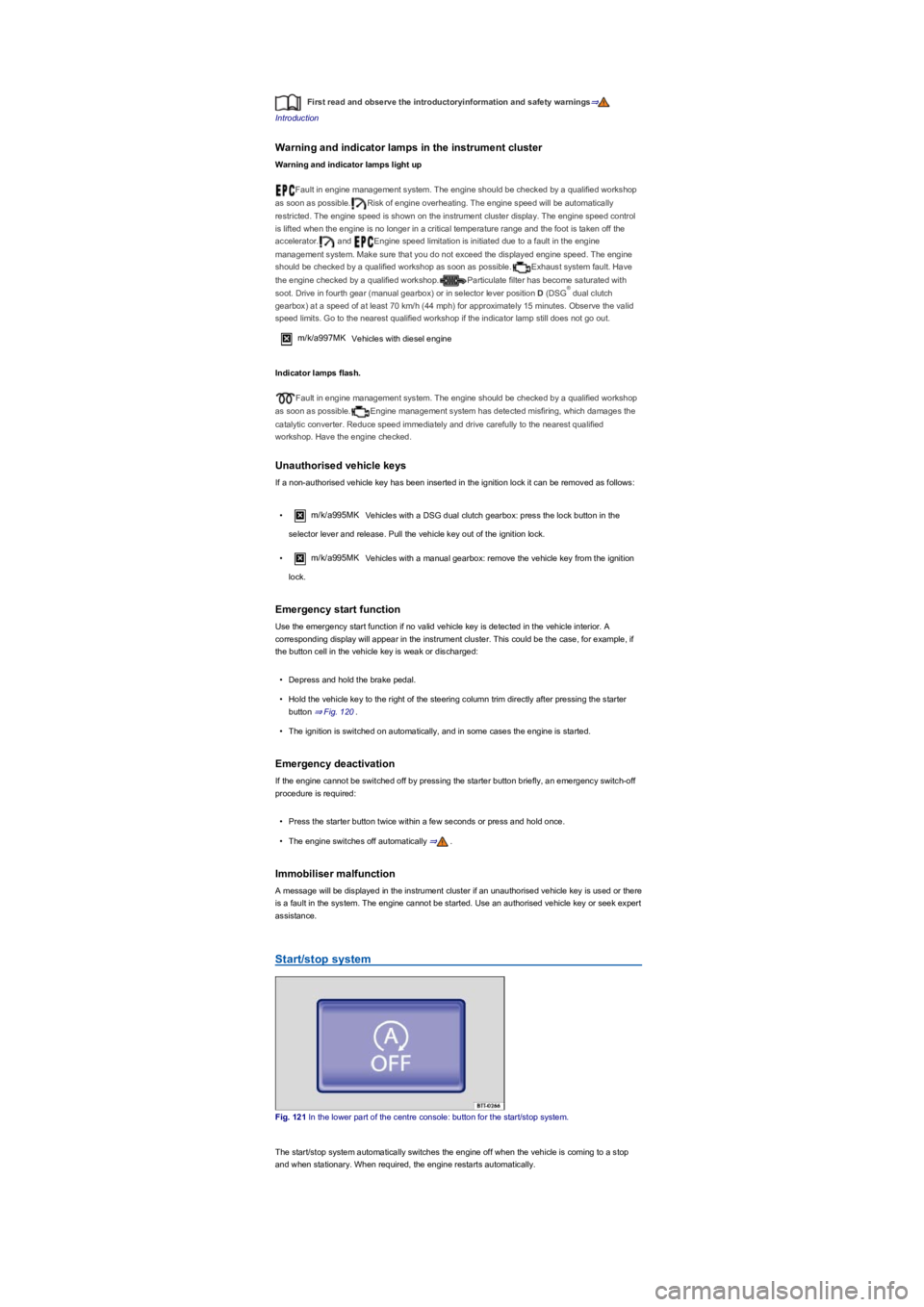
Fig. 121 In the lower part of the centre console: button for the start/stop system.
The start/stop system automatically switches the engine off when the vehicle is coming to a stop
and when stationary. When required, the engine restarts automatically.
®
Page 143 of 341
Conditions that require a manual engine start
The engine must be started manually under the following conditions:
•If the driver door is opened.
•If the bonnet is opened.
Activating and deactivating the start/stop system manually
•Press the button in the centre console ⇒ Fig. 121 to deactivate the system. If the
start/stop system has been deactivated, the indicator lamp in the button lights up.
•Press the button in the centre console again ⇒ Fig. 121 to reactivate the system.
The instrument cluster shows the status of the start/stop system every time the button is
pressed.
If the start/stop system has switched the engine off, it will start again as soon as the system has
been deactivated manually with the button.
Always deactivate the start/stop system manually when driving through water.
Start/stop mode when Adaptive Cruise Control (ACC) is active
The engine will be switched off after the Adaptive Cruise Control (ACC) has brought the vehicle to a
standstill via an active braking intervention ⇒ Adaptive Cruise Control (ACC).
m/k/a995MKVehicles with DSG dual clutch gearbox: when the Adaptive Cruise Control
(ACC) is active, the DSG dual clutch gearbox can shift into coasting mode and the engine can be
switched off with the engine-off coasting function.
In the following instances, the engine will restart when the Adaptive Cruise Control (ACC) is active:
•If the accelerator is depressed.
•When the Adaptive Cruise Control (ACC) has resumed speed and automatic distance control.
•If the vehicle ahead has moved on.
•If the Adaptive Cruise Control (ACC) is deactivated and the vehicle driving in front moved away.
Troubleshooting
The engine stop function may be deactivated if the temperature is above around 38°C (100°F).
In some cases, it may be necessary to restart the engine manually. Follow any
corresponding messages on the instrument cluster display.
The start/stop function is activated automatically if the Eco driving profile is selected on
vehicles with driving profile selection ⇒ Driving profile selection and 4MOTION Active Control.
Always deactivate the start/stop system manually when driving through water.
Manual gearbox: selecting a gear
®
Never switch off the engine or the ignition while the vehicle is in motion. This can lead to a
loss of vehicle control, accidents and serious injuries.
•The airbags and belt tensioners will not work if the ignition is switched off.
•The brake servo will not work when the engine is switched off. That is why more
pressure on the brake pedal is needed to brake the vehicle when the engine is
switched off.
•The power steering will not work when the engine is not running. More power is
needed to steer the vehicle when the engine is switched off.
•When the ignition is switched off, the steering lock may activate and you will no longer
be able to steer the vehicle.
•The start/stop system must be deactivated if work is to be carried out in the engine
compartment.
WARNING
If the start/stop system is used in very high outside temperatures over a long period, the
12-volt vehicle battery can be damaged.
NOTICE
Page 147 of 341
If the selector lever is moved accidentally to N when driving, take your foot off the
accelerator. Wait for the engine revs in the neutral position before selecting a position again.
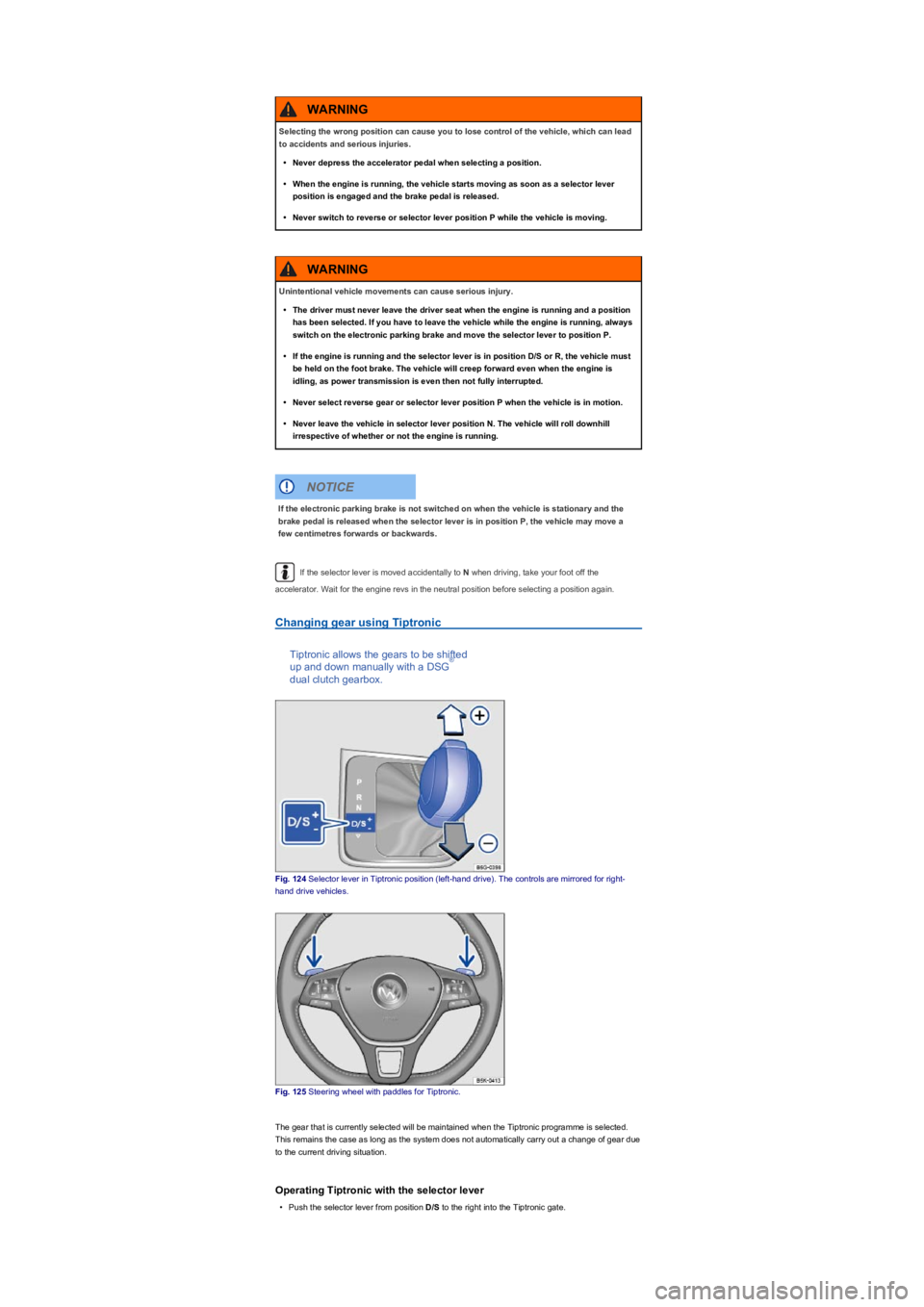
Changing gear using Tiptronic
Tiptronic allows the gears to be shifted
up and down manually with a DSG
dual clutch gearbox.
Fig. 124 Selector lever in Tiptronic position (left-hand drive). The controls are mirrored for right-
hand drive vehicles.
Fig. 125 Steering wheel with paddles for Tiptronic.
The gear that is currently selected will be maintained when the Tiptronic programme is selected.
This remains the case as long as the system does not automatically carry out a change of gear due
to the current driving situation.
Operating Tiptronic with the selector lever
•Push the selector lever from position D/S to the right into the Tiptronic gate.
Selecting the wrong position can cause you to lose control of the vehicle, which can lead
to accidents and serious injuries.
•Never depress the accelerator pedal when selecting a position.
•When the engine is running, the vehicle starts moving as soon as a selector lever
position is engaged and the brake pedal is released.
•Never switch to reverse or selector lever position P while the vehicle is moving.
WARNING
Unintentional vehicle movements can cause serious injury.
•The driver must never leave the driver seat when the engine is running and a position
has been selected. If you have to leave the vehicle while the engine is running, always
switch on the electronic parking brake and move the selector lever to position P.
•If the engine is running and the selector lever is in position D/S or R, the vehicle must
be held on the foot brake. The vehicle will creep forward even when the engine is
idling, as power transmission is even then not fully interrupted.
•Never select reverse gear or selector lever position P when the vehicle is in motion.
•Never leave the vehicle in selector lever position N. The vehicle will roll downhill
irrespective of whether or not the engine is running.
WARNING
If the electronic parking brake is not switched on when the vehicle is stationary and the
brake pedal is released when the selector lever is in position P, the vehicle may move a
few centimetres forwards or backwards.
NOTICE
®
Page 149 of 341
If the accelerator pedal is depressed fully, the gearbox will automatically shift to a lower gear,
depending on the speed and engine revs. This will make use of the full vehicle acceleration.
The gearbox does not shift up to the next gear until the engine reaches the maximum engine speed
for the gear.
When the Eco driving profile is selected in vehicles with driving profile selection ⇒ Driving profile
selection and 4MOTION Active Control and the accelerator is depressed fully beyond the pressure
point, the engine output is automatically regulated to ensure maximum vehicle acceleration.
Launch Control Programme
The Launch Control programme gives the vehicle maximum acceleration from a standing start in
vehicles with a DSG dual clutch gearbox.
•Switch off TCS ⇒ Brake support systems.
•Depress and hold the brake pedal with your left foot.
•In selector lever position D/S, select position S. Alternatively, select the Tiptronic position or in
vehicles with driving profile selection select the Sport driving profile ⇒ Driving profile selection
and 4MOTION Active Control.
•With your right foot, depress the accelerator until the engines speed reaches approximately
3,200 rpm.
•Take your left foot off the brake ⇒. The vehicle will start with maximum acceleration.
•Switch the TCS back on after acceleration.
Troubleshooting
®
Rapid acceleration can cause loss of traction and skidding, particularly on slippery roads.
This can cause you to lose control of the vehicle, which can lead to accidents and serious
injuries.
•Always adjust your driving style in accordance with the flow of traffic.
•Only use kickdown or fast acceleration if visibility, weather, road and traffic conditions
permit, and other road users are not put at risk due to the acceleration and the driving
style.
•Please note that the driven wheels could start to spin and the vehicle could skid if the
traction control system (TCS) is switched off, especially if the road is slippery.
•Switch the traction control system (TCS) back on after acceleration.
•Only use the launch control programme, if the road and traffic conditions allow for it.
•You should never endanger other road users through the acceleration of your vehicle
or through your driving style.
WARNING
Never ride the brake pedal. Do not overuse the brake pedal. Constant braking will cause
the brakes to overheat. This can considerably reduce the brake effect, increase the
braking distance and, in certain circumstances, cause the brake system to fail completely.
WARNING
•If you stop the vehicle on an incline, do not attempt to stop it from rolling back by
depressing the accelerator while a position is still selected. The dual clutch gearbox
DSG could overheat and be damaged.
•Never allow the vehicle to roll in position N, particularly if the ignition is switched off.
The DSG dual clutch gearbox will not be lubricated and could be damaged.
•m/k/a995MK Vehicles with Launch Control Programme: accelerating with the
Launch Control programme places heavy strain on all vehicle components. This can
lead to higher rates of wear.
NOTICE
®
®
•Never let the brakes rub by applying light pressure to the brake when it is not
necessary to brake. This will increase levels of wear.
•Before driving down a long, steep gradient, reduce your speed and select a suitable
recuperation level. This will make use of the electric drive braking effect and relieve the
load on the brakes. The brakes could otherwise overheat and possibly fail. The brakes
should only be used to slow or stop the vehicle.
NOTICE
Page 152 of 341
•In addition, if the cruise control system or Adaptive Cruise Control (ACC) is switched off:
if the vehicle speed is less than approximately 80 km/h (50 mph) or the brake pedal is
depressed.
•In addition, if the cruise control system or Adaptive Cruise Control (ACC) is active: if the
stored speed is exceeded.
Deactivating downhill speed control automatically:
•If the downhill gradient becomes less steep.
•OR: if the gearbox shifts up a gear because the engine speed is higher than approximately
4,500 rpm.
•Or in addition if the cruise control system or Adaptive Cruise Control (ACC) is active: if
the stored speed can be maintained.
Hill Descent Control
When Hill Descent Control is active, the indicator lamp lights up white.
When Hill Descent Control is not active, the indicator lamp lights up grey. The system is
switched on, but is not regulating.
The Hill Descent Control system automatically brakes all four wheels to limit the speed when driving
forwards and reversing on steep downhill gradients. The wheels will not lock as the anti-lock brake
system remains active. In vehicles with a manual gearbox, Hill Descent Control adjusts the target
speed so that the engine speed does not drop below the idling speed.
If you enter a downhill slope travelling at a speed under 30 km/h (18 mph), the vehicle speed will be
limited to a speed between min. 2 km/h (1 mph) and max. 30 km/h (18 mph). The driver can use the
accelerator pedal and the brakes to alter the speed in this range. The control speed will be set
again as soon as the driver takes their foot off the accelerator or brake pedal.
However, this can work only if the tyres have sufficient grip on the road. Hill Descent Control
cannot work on an icy or slippery slope, for example.
Hill Descent Control is automatically activated if the following conditions are met:
•The engine is running.
•The Off-road driving profile is selected ⇒ Driving profile selection and 4MOTION Active
Control.
•The speed is under 30 km/h (18 mph) (the function display is visible on the instrument
cluster display).
•The downhill gradient is at least 10 %.
•You do not brake or accelerate.
The Hill Descent Control function will be deactivated when the downhill gradient is less than 5 %.
The intelligent downhill speed control technology cannot overcome the laws of physics,
and functions only within the limits of the system. Never allow the extra convenience
afforded by pull-away assist systems to tempt you into taking any risks when driving.
•Unintentional vehicle movements can cause serious injury.
•The downhill speed control cannot replace the full concentration of the driver.
•Always adapt your speed and driving style to suit visibility, weather, road and traffic
conditions.
•Downhill speed control cannot hold the vehicle in all hill start situations or brake it
sufficiently on all slopes going downhill (e.g. if the ground is slippery or icy).
WARNING
Always be prepared to brake the vehicle. Accidents and injuries could occur if this is not
ensured.
•The downhill speed control is only a support function and may not be able to brake the
vehicle sufficiently in all situations when driving downhill.
•The vehicle may become faster despite the downhill speed control being in operation.
WARNING
Page 153 of 341
Steering
Information on steering
The steering should be locked every time you leave the vehicle to make it more difficult for the
vehicle to be stolen.
Steering
The power steering is not hydraulic. It is an electromechanical system. The advantage of this
steering system is that no hydraulic hoses, hydraulic oil, pumps, filter or other parts are required.
The electromechanical system reduces fuel consumption. A hydraulic system requires constant oil
pressure in the system, whereas an electromechanical steering system only needs an energy
supply while steering.
In vehicles with driving profile selection, the selected driving profile can affect the behaviour of the
power steering ⇒ Driving profile selection and 4MOTION Active Control.
Electronic steering column lock in vehicles with starter button
The steering column will be locked if the driver door is opened and the ignition is switched off. For
this, the vehicle should be stationary and, if necessary, the gear selector lever should be in position
P.
If the ignition is not switched off until after the driver door is opened, the electronic steering column
will only be locked when the vehicle is locked using the vehicle key or the sensor in the door
handle.
Mechanical steering column lock (steering lock) in vehicles with an
ignition lock
The steering column is locked if the vehicle key is removed from the ignition lock when the vehicle
is stationary. Turn the steering wheel slightly until the steering lock clicks into place.
Insert the vehicle key into the ignition lock to unlock the steering lock. Turn the steering wheel
slightly to take the load off the steering lock mechanism. Hold the steering wheel in this position and
turn the ignition on.
Electromechanical steering
The power steering provided by the electromechanical steering system automatically adjusts to the
vehicle speed, steering wheel torque and steering wheel angle. The electromechanical steering
only functions when the engine is running.
You will need considerably more strength than normal to steer the vehicle if the power steering is
reduced or has failed completely.
Counter steering assistance
Counter steering assistance provides the driver with power steering in critical driving situations.
Additional steering power helps the driver when counter steering ⇒.
The intelligent Hill Descent Control technology cannot overcome the laws of physics, and
functions only within the limits of the system. Never allow the extra convenience afforded
by pull-away assist systems to tempt you into taking any risks when driving.
•Unintentional vehicle movements can cause serious injury.
•The Hill Descent Control cannot replace the full concentration of the driver.
•Always adapt your speed and driving style to suit visibility, weather, road and traffic
conditions.
•A Hill Descent Control System may not be able to always hold the vehicle on uphill
gradients or brake it sufficiently on all slopes going downhill (e.g. if the ground is
slippery or icy).
WARNING
Always be prepared to brake the vehicle. Accidents and injuries could occur if this is not
ensured.
•The Hill Descent Control system is only a support function and may not be able to
brake the vehicle sufficiently in all situations when driving downhill.
•The vehicle may accelerate despite the Hill Descent Control system.
WARNING
Page 154 of 341
Progressive steering
Depending on the vehicle equipment level, progressive steering can adjust the force of the steering
movement in a driving situation. Progressive steering only functions when the engine is running.
In urban driving, smaller steering movements are required when parking, manoeuvring, or turning
sharply.
When driving on country roads or on the motorway, the progressive steering provides a more
sporty, direct steering response, and a dynamic feel.
Troubleshooting
Warning and indicator lamps in the instrument cluster
The indicator lamps light up.
Do not drive on! Electromechanical steering not functioning. The steering must be
checked by a qualified workshop as soon as possible.Electromechanical steering function
reduced. The steering must be checked by a qualified workshop as soon as possible. If the yellow
warning lamp remains off after the engine has been restarted and you have driven a short distance,
you do not need to consult a qualified workshop.The 12-volt battery has been disconnected
and reconnected. Drive a short distance at a speed of 15 – 20 km/h (9 – 12 mph).
The indicator lamps flash.
Steering column twisted. Turn the steering wheel back and forth.Steering column not
locked or unlocked. Remove the vehicle key from the ignition lock and switch the ignition back on
again. Follow any messages that are on the instrument cluster display. Do not continue your
journey if the steering column remains locked when the ignition is switched on. Seek expert
assistance.
Driving profile selection and 4MOTION Active
Control
Introduction
This chapter contains information on the followingsubjects:
⇒ Selecting a driving profile (ONROAD)
⇒ Selecting a driving profile (4MOTION Action Control)
⇒ Adjusting the driving profile to suit your requirements
⇒ Troubleshooting
The driving profile selection contains
factory-defined driving profiles which
have different effects on the vehicle
setup. You can also set your own
vehicle setup by means of an individual
driving profile.
Different driving profiles can be selected depending on the vehicle equipment level. The effect on
the vehicle setup in the individual driving profiles depends on the vehicle equipment.
The settings available depend on the type of drive. Vehicles with a front-wheel drive come with
ONROAD driving profiles ⇒ Selecting a driving profile (ONROAD), while vehicles with all-wheel
If the power steering is not working, the steering wheel is difficult to turn, which makes it
difficult to steer the vehicle.
•The power steering only functions when the engine is running.
•Never allow the vehicle to roll if the engine is switched off.
•Never remove the vehicle key from the ignition lock when the vehicle is in motion. The
steering column lock may be activated and it will no longer be possible to steer the
vehicle.
WARNING
In conjunction with the ESC, counter steering assistance provides the driver with
assistance when steering in critical driving situations. The driver must steer the vehicle at
all times. Counter steering assistance does not steer the vehicle.
WARNING
The ignition of the vehicle being towed must be switched on to prevent the steering wheel
from locking, and so that the turn signals, horn, wipers and window washer system can be
used.
NOTICE
Page 156 of 341
•Proactive occupant protection system
In vehicles with a DSG dual clutch gearbox, the system automatically changes to gear
position S when the Sport driving profile is selected. The system automatically switches to gear
position D when the Eco driving profile is selected. Since coasting is active in the Eco driving
profile, the gearbox programme E is additionally displayed on the instrument cluster display.
The driver can adjust certain vehicle functions irrespective of the selected driving profile. For
example, the driver can switch to gear position S when the Eco driving profile is selected.
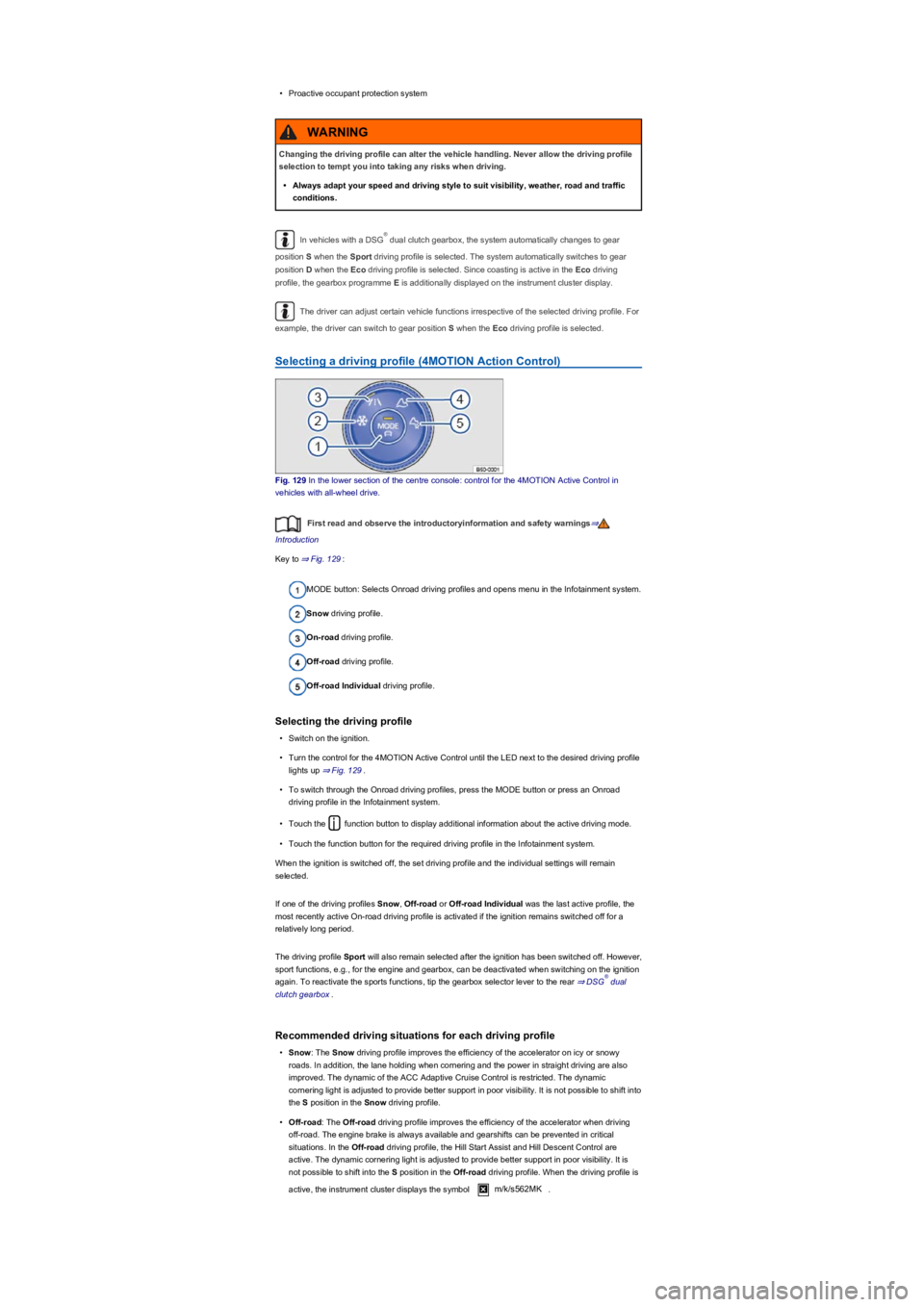
Selecting a driving profile (4MOTION Action Control)
Fig. 129 In the lower section of the centre console: control for the 4MOTION Active Control in
vehicles with all-wheel drive.
First read and observe the introductoryinformation and safety warnings⇒
Introduction
Key to ⇒ Fig. 129:
MODE button: Selects Onroad driving profiles and opens menu in the Infotainment system.
Snow driving profile.
On-road driving profile.
Off-road driving profile.
Off-road Individual driving profile.
Selecting the driving profile
•Switch on the ignition.
•Turn the control for the 4MOTION Active Control until the LED next to the desired driving profile
lights up ⇒ Fig. 129.
•To switch through the Onroad driving profiles, press the MODE button or press an Onroad
driving profile in the Infotainment system.
•Touch the function button to display additional information about the active driving mode.
•Touch the function button for the required driving profile in the Infotainment system.
When the ignition is switched off, the set driving profile and the individual settings will remain
selected.
If one of the driving profiles Snow, Off-road or Off-road Individual was the last active profile, the
most recently active On-road driving profile is activated if the ignition remains switched off for a
relatively long period.
The driving profile Sport will also remain selected after the ignition has been switched off. However,
sport functions, e.g., for the engine and gearbox, can be deactivated when switching on the ignition
again. To reactivate the sports functions, tip the gearbox selector lever to the rear ⇒ DSG dual
clutch gearbox.
Recommended driving situations for each driving profile
•Snow: The Snow driving profile improves the efficiency of the accelerator on icy or snowy
roads. In addition, the lane holding when cornering and the power in straight driving are also
improved. The dynamic of the ACC Adaptive Cruise Control is restricted. The dynamic
cornering light is adjusted to provide better support in poor visibility. It is not possible to shift into
the S position in the Snow driving profile.
•Off-road: The Off-road driving profile improves the efficiency of the accelerator when driving
off-road. The engine brake is always available and gearshifts can be prevented in critical
situations. In the Off-road driving profile, the Hill Start Assist and Hill Descent Control are
active. The dynamic cornering light is adjusted to provide better support in poor visibility. It is
not possible to shift into the S position in the Off-road driving profile. When the driving profile is
active, the instrument cluster displays the symbol m/k/s562MK.
Changing the driving profile can alter the vehicle handling. Never allow the driving profile
selection to tempt you into taking any risks when driving.
•Always adapt your speed and driving style to suit visibility, weather, road and traffic
conditions.
WARNING
®
®
Page 158 of 341
•Press the button in the Infotainment system.
•Touch the Vehicle function button.
•Touch the Selection function button.
•Touch the Off-road function button.
Selecting instruments and setting units
The display shows various instruments ⇒ Fig. 130.
To change instruments, swipe vertically over the display.
The units can be adjusted for some instruments in the Infotainment system ⇒ Operation and
display in the Infotainment system.
Instruments in the off-road display (depends on the vehicle's equipment):
•Altitude: The altitude function shows the current height above sea level.
•Steering angle display: the steering angle of the vehicle is displayed in the range between -
49° and 49°. The value is positive for a left steering angle and negative for a right steering
angle.
•Compass: the compass shows the current driving direction.
•Coolant temperature display: the display corresponds to the temperature display on the
instrument cluster ⇒ Coolant temperature display. At high engine loads and with high outside
temperatures, the needle will move clockwise. This is no cause for concern unless the
indicator lamp in the instrument cluster is lit up or flashing.
•Oil temperature display: the needle is in the middle when the engine has reached operating
temperature. If the needle is in the bottom left area, this means that the engine has not yet
reached its operating temperature. At high engine loads and with high outside temperatures, the
needle will move clockwise. This is no cause for concern unless the indicator lamp in
the instrument cluster is lit up or flashing ⇒ Engine oil.
Adapting the display areas to the driving situation
The displayed instruments can be selected depending on the driving situation, the ambient
conditions and the off-road conditions:
•Sandy terrain: oil, steering angle and coolant temperature display
•Inclines: steering angle and coolant temperature display, altimeter
•Alpine terrain: steering angle display, altimeter, compass
Off-road driving situations
Introduction
This chapter contains information on the followingsubjects:
⇒ Safety notes for driving off-road
⇒ Explanation of some technical terms
⇒ Checklist: Before driving off-road
⇒ General rules and driving tips
⇒ Useful accessories for off-road driving
⇒ Changing gear
⇒ Up hill and down dale
⇒ Driving through water
⇒ Off-road driving in snow
⇒ Driving in sand and mud
⇒ Driving in steep terrain
⇒ Traversing a slope
⇒ Driving through ditches
⇒ If your vehicle gets stuck
⇒ After off-road driving
You can also drive four-wheel drive vehicles off-road in addition to normal roads. It is very important
to read the contents of this section before driving off-road.
The vehicle is not built for expeditions.
The examples given in this chapter are an aid for safe off-road driving. However, we cannot predict
whether these guidelines will be valid for all situations that could occur.
The large variety of landscapes and the associated risks and dangers make it impossible to
describe all possible driving situations. The examples are only general guidelines designed to help
you drive off-road safely. It is crucial that you know what to expect when you drive into off-road
terrain you are unfamiliar with. This will enable you to assess potential danger in advance.
Accidents and injuries can occur if the driver is distracted. Operating the Infotainment
system can distract you from the road.
•Always drive carefully and responsibly.
WARNING
Page 159 of 341
The driver can use 4MOTION Active Control to activate a variety of vehicle settings in an all-wheel
drive vehicle as required ⇒ Selecting a driving profile (4MOTION Action Control).
Checklist
Before driving for the first time, take the following steps so you can operate and drive the
vehicle safely off-road:
Observe the basic safety notes Safety notes for driving off-road.
Familiarise yourself with the vehicle controls.
Check and adjust the seat position Sitting position and fasten the seat belts Seat belts.
Check distance to steering wheel and adjust Steering.
Always wear suitable, well-fitting shoes that provide good grip for your feet when using the
pedals.
Safety notes for driving off-road
First read and observe the introductoryinformation and safety warnings⇒
Introduction
The intelligent vehicle technology cannot overcome the laws of physics, and functions
only within the limits of the system. Despite input from the ABS, adverse terrain can cause
instability through locked wheels – e.g. if you brake hard when driving on a loose gravel
road. The ESC system will have difficulty stabilising the vehicle in these circumstances.
WARNING
Driving off-road can be dangerous and could cause accidents, serious injury, damage to
the vehicle and also a vehicle breakdown far from any assistance.
•Never select a dangerous route and never take risks that could endanger you and your
passengers. If you cannot drive on or if you are in any doubt about the safety of the
route, turn round and choose another route.
•Even terrain that looks harmless can be difficult and dangerous, and could get you and
your passengers into difficulties. It is preferable to walk over the terrain before driving
over it.
•You should drive particularly carefully and think ahead when driving off-road. If you
drive too fast or if a driving manoeuvre is unsuccessful this could result in serious
injuries and vehicle damage.
•Never drive faster than the current terrain, road conditions, traffic and weather allow.
•Never drive too fast along embankments, ramps or slopes. This could cause the
vehicle to lose contact with the ground. If this happens, you will be unable to steer and
will lose control of the vehicle.
•If the vehicle does lose contact with the ground, always point the front wheels straight
ahead. If the wheels are not pointing straight ahead when the vehicle lands, it could roll
over.
•Terrain might look harmless, but there could be hidden dangers. Potholes, hollows,
ditches, precipices, obstacles, shallows, soft and boggy surfaces are often not
recognisable as such and can be covered either fully or partly by water or grass or
branches lying on the ground. Inspect terrain on foot.
WARNING
Sporty SUVs are subject to a considerably higher risk of rolling over than normal road
passenger vehicles ⇒ Explanation of some technical terms.
•In the event of an accident, vehicle occupants not wearing seat belts are subjected to a
considerably higher risk of fatal injury than those wearing seat belts.
•The vehicle has a higher centre of gravity and is more prone to rolling over than a
normal on-road vehicle which is unsuited for off-road driving.
•Never drive too fast, especially when driving through bends, or carry out any extreme
driving manoeuvres.
•Always adjust your speed and driving style to the terrain.
•Luggage and other items transported on the roof of the vehicle raise the centre of
gravity and will make the vehicle more likely to roll over.
WARNING