change wheel VOLKSWAGEN TIGUAN 2017 Owner´s Manual
[x] Cancel search | Manufacturer: VOLKSWAGEN, Model Year: 2017, Model line: TIGUAN, Model: VOLKSWAGEN TIGUAN 2017Pages: 341, PDF Size: 9.14 MB
Page 238 of 341
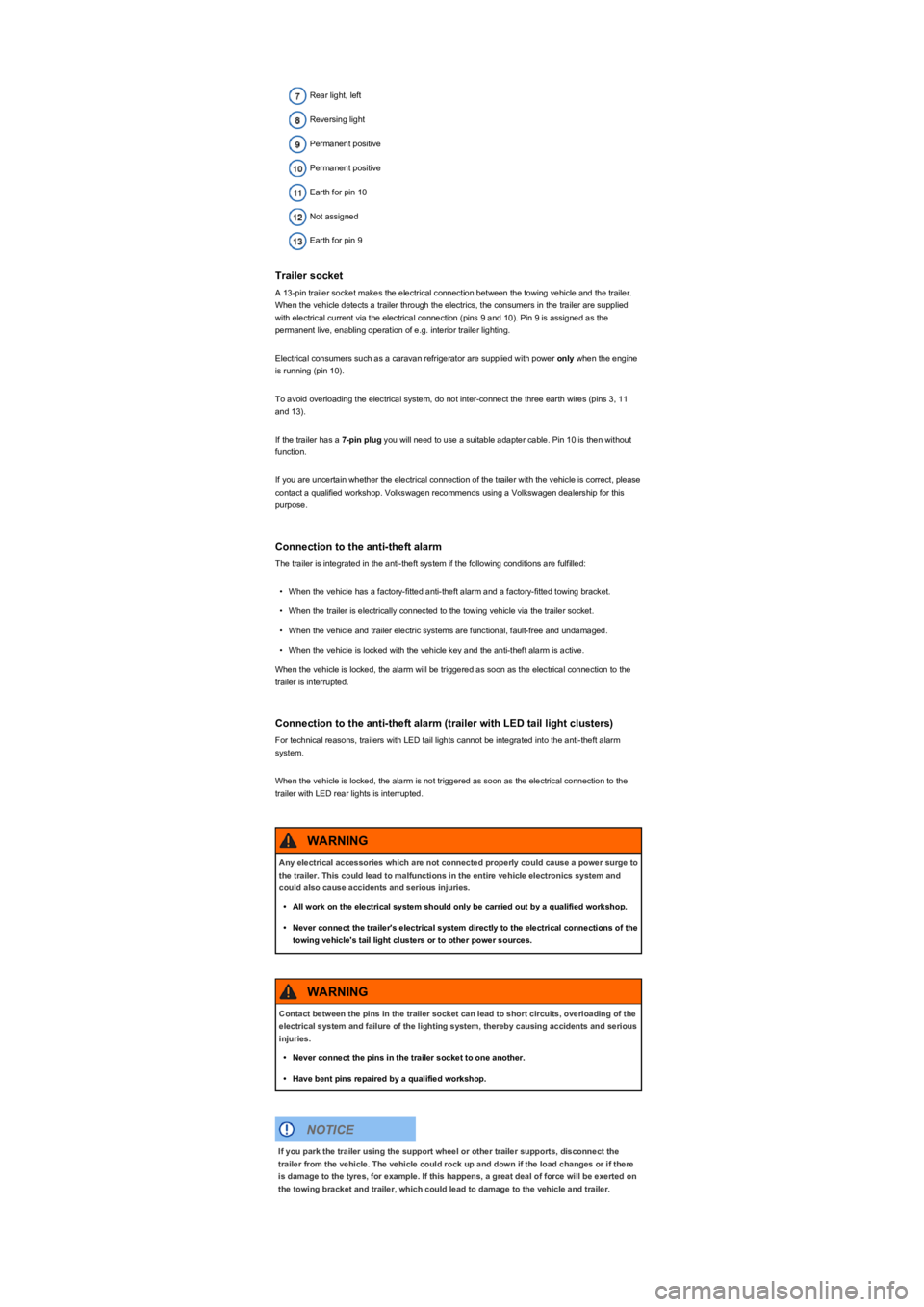
Rear light, left
Reversing light
Permanent positive
Permanent positive
Earth for pin 10
Not assigned
Earth for pin 9
Trailer socket
A 13-pin trailer socket makes the electrical connection between the towing vehicle and the trailer.
When the vehicle detects a trailer through the electrics, the consumers in the trailer are supplied
with electrical current via the electrical connection (pins 9 and 10). Pin 9 is assigned as the
permanent live, enabling operation of e.g. interior trailer lighting.
Electrical consumers such as a caravan refrigerator are supplied with power only when the engine
is running (pin 10).
To avoid overloading the electrical system, do not inter-connect the three earth wires (pins 3, 11
and 13).
If the trailer has a 7-pin plug you will need to use a suitable adapter cable. Pin 10 is then without
function.
If you are uncertain whether the electrical connection of the trailer with the vehicle is correct, please
contact a qualified workshop. Volkswagen recommends using a Volkswagen dealership for this
purpose.
Connection to the anti-theft alarm
The trailer is integrated in the anti-theft system if the following conditions are fulfilled:
•When the vehicle has a factory-fitted anti-theft alarm and a factory-fitted towing bracket.
•When the trailer is electrically connected to the towing vehicle via the trailer socket.
•When the vehicle and trailer electric systems are functional, fault-free and undamaged.
•When the vehicle is locked with the vehicle key and the anti-theft alarm is active.
When the vehicle is locked, the alarm will be triggered as soon as the electrical connection to the
trailer is interrupted.
Connection to the anti-theft alarm (trailer with LED tail light clusters)
For technical reasons, trailers with LED tail lights cannot be integrated into the anti-theft alarm
system.
When the vehicle is locked, the alarm is not triggered as soon as the electrical connection to the
trailer with LED rear lights is interrupted.
Any electrical accessories which are not connected properly could cause a power surge to
the trailer. This could lead to malfunctions in the entire vehicle electronics system and
could also cause accidents and serious injuries.
•All work on the electrical system should only be carried out by a qualified workshop.
•Never connect the trailer's electrical system directly to the electrical connections of the
towing vehicle's tail light clusters or to other power sources.
WARNING
Contact between the pins in the trailer socket can lead to short circuits, overloading of the
electrical system and failure of the lighting system, thereby causing accidents and serious
injuries.
•Never connect the pins in the trailer socket to one another.
•Have bent pins repaired by a qualified workshop.
WARNING
If you park the trailer using the support wheel or other trailer supports, disconnect the
trailer from the vehicle. The vehicle could rock up and down if the load changes or if there
is damage to the tyres, for example. If this happens, a great deal of force will be exerted on
the towing bracket and trailer, which could lead to damage to the vehicle and trailer.
NOTICE
Page 240 of 341
Trailer towing
First read and observe the introductoryinformation and safety warnings⇒
Introduction
Headlight adjustment
Towing a trailer can raise the front end of the vehicle enough for the dipped beam to blind other
road users. Use the headlight range control to lower the light cone as required. Vehicles with
automatic headlight range adjustment are adjusted automatically.
Things to note when driving with a trailer
•If the trailer has an overrun brake, apply the brakes gently at first and then firmly. This will
prevent the jerking that can be caused by the trailer wheels locking.
•The combination weight causes the braking distance to increase.
•Engage a lower gear prior to inclines (manual gearbox or Tiptronic mode of the automatic
gearbox) to additionally make use of engine braking. The brake system could otherwise
overheat and fail.
•The vehicle's centre of gravity and, in turn, the vehicle's handling, will change because of the
trailer load and the increased combined towing weight of the vehicle and trailer.
•The weight distribution of a loaded trailer with an unladen towing vehicle is very unfavourable.
When driving in this situation, drive particularly carefully and slowly.
Pulling off on slopes when towing a trailer
A vehicle towing a trailer is liable to roll back a short distance when moving off on a slope,
depending on the angle of the slope and the total weight of the trailer and vehicle.
When towing a trailer, pull off on slopes as follows:
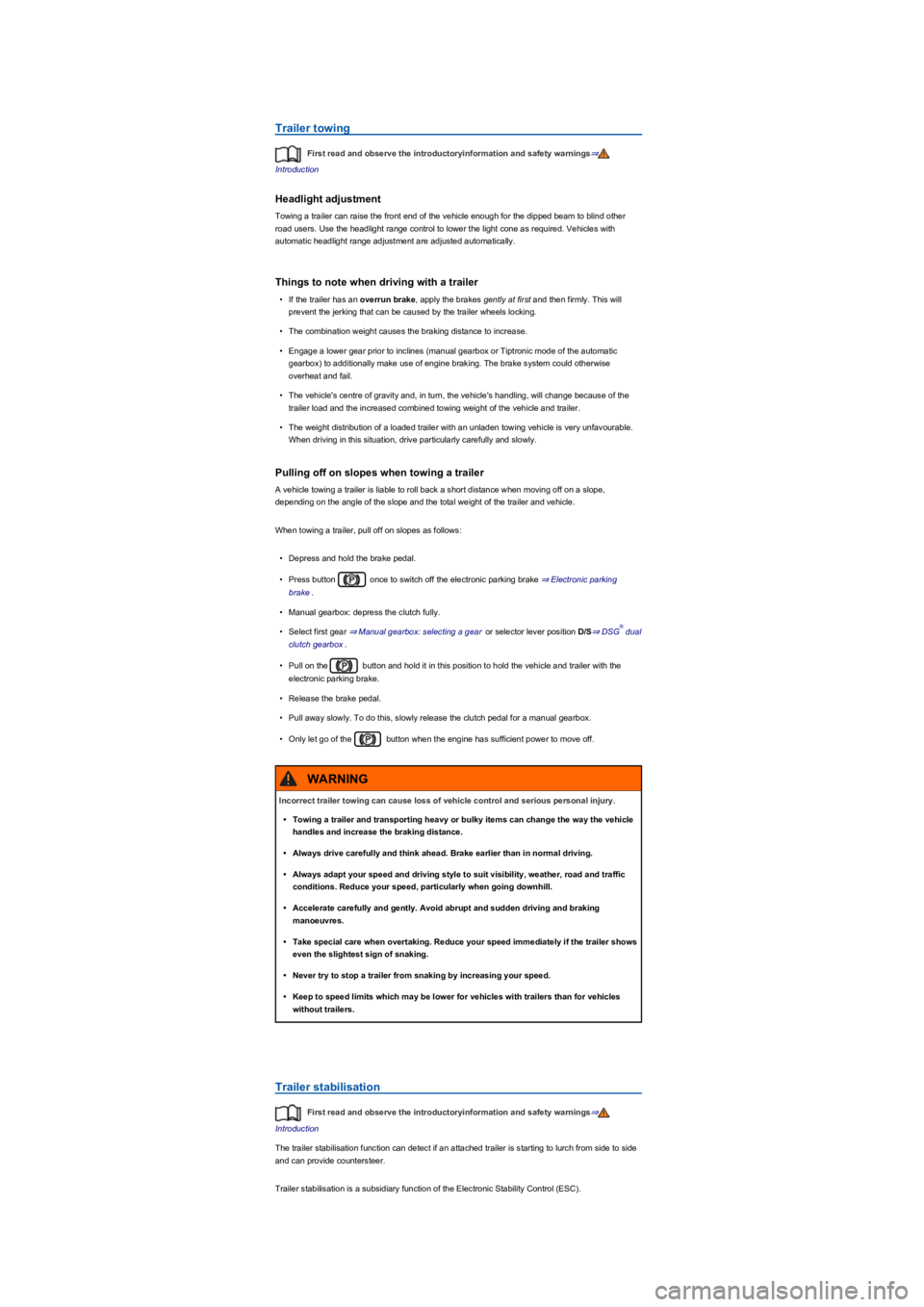
•Depress and hold the brake pedal.
•Press button once to switch off the electronic parking brake ⇒ Electronic parking
brake.
•Manual gearbox: depress the clutch fully.
•Select first gear ⇒ Manual gearbox: selecting a gear or selector lever position D/S⇒ DSG dual
clutch gearbox.
•Pull on the button and hold it in this position to hold the vehicle and trailer with the
electronic parking brake.
•Release the brake pedal.
•Pull away slowly. To do this, slowly release the clutch pedal for a manual gearbox.
•Only let go of the button when the engine has sufficient power to move off.
Trailer stabilisation
First read and observe the introductoryinformation and safety warnings⇒
Introduction
The trailer stabilisation function can detect if an attached trailer is starting to lurch from side to side
and can provide countersteer.
Trailer stabilisation is a subsidiary function of the Electronic Stability Control (ESC).
®
Incorrect trailer towing can cause loss of vehicle control and serious personal injury.
•Towing a trailer and transporting heavy or bulky items can change the way the vehicle
handles and increase the braking distance.
•Always drive carefully and think ahead. Brake earlier than in normal driving.
•Always adapt your speed and driving style to suit visibility, weather, road and traffic
conditions. Reduce your speed, particularly when going downhill.
•Accelerate carefully and gently. Avoid abrupt and sudden driving and braking
manoeuvres.
•Take special care when overtaking. Reduce your speed immediately if the trailer shows
even the slightest sign of snaking.
•Never try to stop a trailer from snaking by increasing your speed.
•Keep to speed limits which may be lower for vehicles with trailers than for vehicles
without trailers.
WARNING
Page 251 of 341
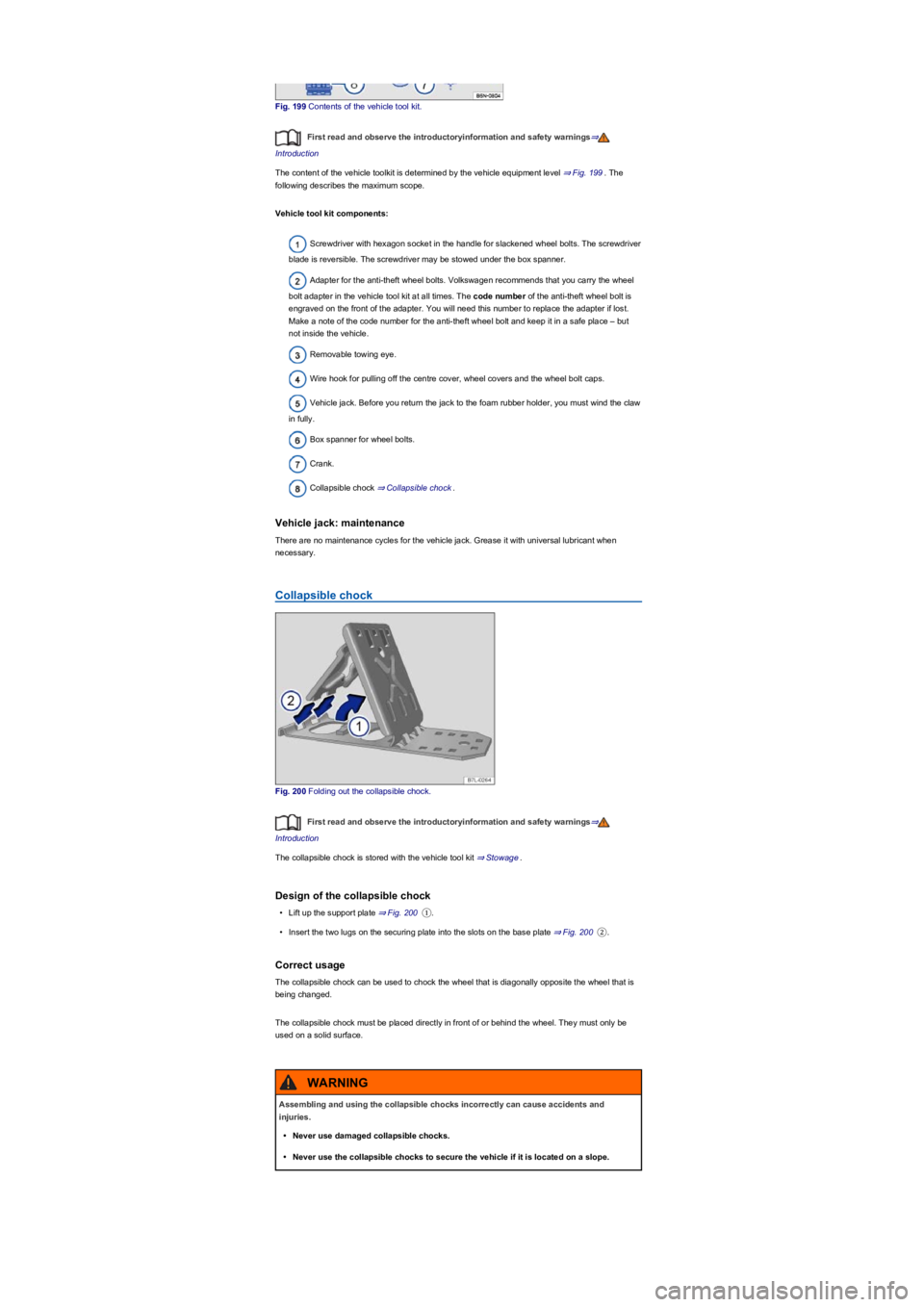
Fig. 199 Contents of the vehicle tool kit.
First read and observe the introductoryinformation and safety warnings⇒
Introduction
The content of the vehicle toolkit is determined by the vehicle equipment level ⇒ Fig. 199. The
following describes the maximum scope.
Vehicle tool kit components:
Screwdriver with hexagon socket in the handle for slackened wheel bolts. The screwdriver
blade is reversible. The screwdriver may be stowed under the box spanner.
Adapter for the anti-theft wheel bolts. Volkswagen recommends that you carry the wheel
bolt adapter in the vehicle tool kit at all times. The code number of the anti-theft wheel bolt is
engraved on the front of the adapter. You will need this number to replace the adapter if lost.
Make a note of the code number for the anti-theft wheel bolt and keep it in a safe place – but
not inside the vehicle.
Removable towing eye.
Wire hook for pulling off the centre cover, wheel covers and the wheel bolt caps.
Vehicle jack. Before you return the jack to the foam rubber holder, you must wind the claw
in fully.
Box spanner for wheel bolts.
Crank.
Collapsible chock ⇒ Collapsible chock.
Vehicle jack: maintenance
There are no maintenance cycles for the vehicle jack. Grease it with universal lubricant when
necessary.
Collapsible chock
Fig. 200 Folding out the collapsible chock.
First read and observe the introductoryinformation and safety warnings⇒
Introduction
The collapsible chock is stored with the vehicle tool kit ⇒ Stowage.
Design of the collapsible chock
•Lift up the support plate ⇒ Fig. 200①.
•Insert the two lugs on the securing plate into the slots on the base plate ⇒ Fig. 200②.
Correct usage
The collapsible chock can be used to chock the wheel that is diagonally opposite the wheel that is
being changed.
The collapsible chock must be placed directly in front of or behind the wheel. They must only be
used on a solid surface.
Assembling and using the collapsible chocks incorrectly can cause accidents and
injuries.
•Never use damaged collapsible chocks.
•Never use the collapsible chocks to secure the vehicle if it is located on a slope.
WARNING
Page 268 of 341
Notes on tow-starting and towing
First read and observe the introductoryinformation and safety warnings⇒
Introduction
Tow rope, tow bar
It is easier and safer to tow a vehicle with a tow bar. Only use a tow rope if you do not have a tow
bar.
The tow rope should be slightly elastic to reduce the strain on both vehicles. It is advisable to use a
tow rope made of synthetic fibre or similarly elastic material.
Only attach the tow rope or tow bar to the specially provided towing eyes or to the towing bracket.
Vehicles with a factory-fitted towing bracket must only use tow bars that are specially designed
to fit a ball head ⇒ Trailer towing.
Tow-starting
Vehicles should not be tow-started wherever possible. Instead have the vehicle jump-started
⇒ Jump starting or collected by a recovery vehicle.
However, if the vehicle still has to be tow-started:
•Engage second or third gear.
•Keep the clutch pressed down.
•Switch on the ignition and the hazard warning lights.
•Once both vehicles are in motion, release the clutch.
•As soon as the engine starts, press the clutch and put the gear into neutral. This helps to
prevent driving into the towing vehicle.
When should your vehicle not be towed?
•The vehicle gearbox is damaged or does not contain any lubricant.
•The 12-volt vehicle battery is discharged. The steering system is still locked and the electronic
parking brake and electronic steering column lock, if applied, cannot be released.
•The distance to be towed is further than 50 km.
Never tow a vehicle that has no power supply.
•Never remove the vehicle key from the ignition or switch off the ignition using the
starter button during towing. This could cause the mechanical steering column lock
(steering lock) or the electronic steering column lock to engage suddenly. You will no
longer be able to steer the vehicle. This can lead to a loss of control of the vehicle,
accidents and serious injuries.
•If the power supply to the towed vehicle is disconnected, stop towing immediately and
seek expert assistance.
WARNING
If a vehicle is being towed, the vehicle handling and braking effect will change
significantly. Please note the following in order to reduce the risk of an accident or serious
injuries:
•Notes for the driver of the towed vehicle:
- You will need to depress the brake pedal more vigorously than normal as the
brake servo is not working. Always be careful not to drive into the vehicle that is
pulling your vehicle.
- You will need to turn the steering wheel more vigorously as the power-assisted
steering function is not working.
•Notes for the driver of the towing vehicle
- Accelerate carefully and gently.
- Avoid sudden braking and driving manoeuvres.
- Brake earlier than normal by pressing lightly on the brake pedal.
WARNING
•Remove and install the cover and the towing eye carefully so as to avoid damage to the
vehicle, e.g. the paintwork.
•Unburnt fuel can enter the catalytic converter and damage it while the vehicle is being
towed.
NOTICE
Page 290 of 341
If the tyre pressure is too low, this will increase fuel consumption and tyre wear.
When new tyres are driven at high speeds for the first time, they can expand slightly and
trigger a one-off pressure warning.
Old tyres should only be replaced by tyres that have been approved by Volkswagen for the
vehicle type.
Do not rely solely on the tyre monitoring system. Check your tyres regularly to ensure that
they are properly inflated and have no signs of damage, such as punctures, cuts, cracks, and
blisters. Remove any objects that become embedded in the tyre tread but have not penetrated into
the body of the tyre itself.
Types of tyre monitoring systems
First read and observe the introductoryinformation and safety warnings⇒
Introduction
There are two different tyre monitoring systems available for this vehicle. Their differing features are
described below:
Tyre Pressure Loss Indicator
•Monitoring of various parameters (for example rolling circumference) of all wheels using ABS
sensors (indirect measurement).
Tyre Pressure Monitoring System
•Monitoring of the tyre pressure by means of pressure sensors on each tyre valve (direct
measurement). Tyre valve made of metal.
Tyre Pressure Loss Indicator
First read and observe the introductoryinformation and safety warnings⇒
Introduction
Functional description
The Tyre Pressure Loss Indicator uses data from the ABS sensors and other functions to check the
speed of rotation and the rolling circumference of the individual wheels.
The rolling circumference can change:
•If the tyre pressure has been changed.
•If the tyre pressure is too low.
•If the tyre has structural damage.
•If the vehicle is loaded more heavily on one side.
•If snow chains have been fitted.
•If a temporary spare wheel has been fitted.
•If one wheel per axle has been changed.
The Tyre Pressure Loss Indicator may react with a delay or not display anything at all in the
event of a sporty driving style, when driving on snow-covered or icy roads or unpaved roads or
when driving with snow chains.
Synchronising the Tyre Pressure Loss Indicator
•Switch on the ignition.
•Press the button or function button, depending on version ⇒ Vehicle settings menu.
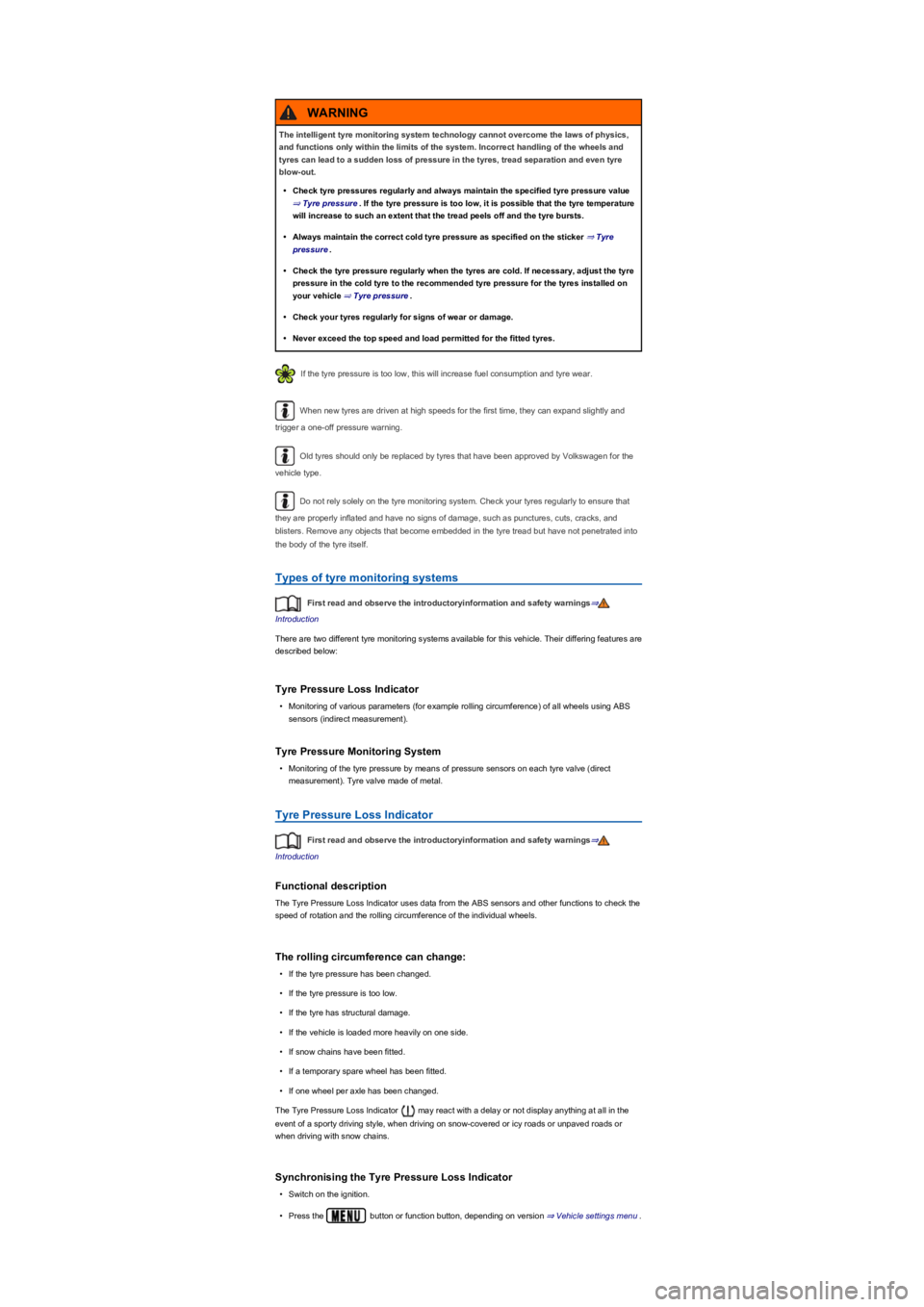
The intelligent tyre monitoring system technology cannot overcome the laws of physics,
and functions only within the limits of the system. Incorrect handling of the wheels and
tyres can lead to a sudden loss of pressure in the tyres, tread separation and even tyre
blow-out.
•Check tyre pressures regularly and always maintain the specified tyre pressure value
⇒ Tyre pressure. If the tyre pressure is too low, it is possible that the tyre temperature
will increase to such an extent that the tread peels off and the tyre bursts.
•Always maintain the correct cold tyre pressure as specified on the sticker ⇒ Tyre
pressure.
•Check the tyre pressure regularly when the tyres are cold. If necessary, adjust the tyre
pressure in the cold tyre to the recommended tyre pressure for the tyres installed on
your vehicle ⇒ Tyre pressure.
•Check your tyres regularly for signs of wear or damage.
•Never exceed the top speed and load permitted for the fitted tyres.
WARNING
Page 291 of 341
•Open the Vehicle settings menu in the Infotainment system.
•Touch the Tyres function button.
•Touch the SET function button.
•When all four tyre pressures correspond to the required values, touch the Confirm function
button.
After an extended driving time with driving at different speeds, the system will automatically learn
the new values and monitor them.
•If the tyre pressures have been changed.
•If one or more wheels have been changed.
•If the wheels have been swapped round, e.g. from front to rear ⇒ Rotating wheels front to rear.
The Tyre Pressure Loss Indicator stops working if there is a fault in the ESC or ABS ⇒ Brake
support systems.
After a warning about the tyre pressure being too low, switch the ignition off and then back
on again. The Tyre Pressure Loss Indicator can only then be re-synchronised.
Tyre Pressure Monitoring System
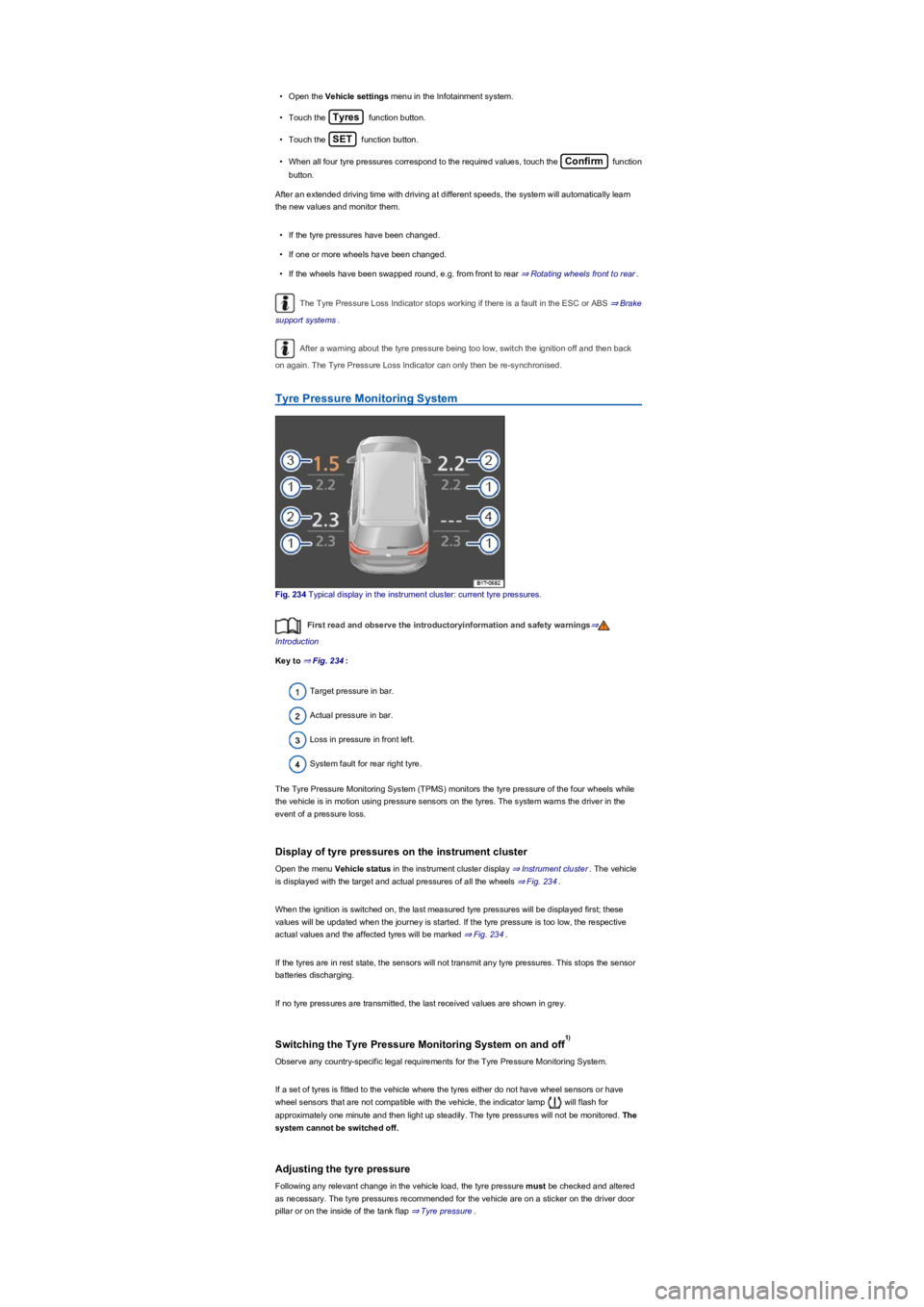
Fig. 234 Typical display in the instrument cluster: current tyre pressures.
First read and observe the introductoryinformation and safety warnings⇒
Introduction
Key to ⇒ Fig. 234:
Target pressure in bar.
Actual pressure in bar.
Loss in pressure in front left.
System fault for rear right tyre.
The Tyre Pressure Monitoring System (TPMS) monitors the tyre pressure of the four wheels while
the vehicle is in motion using pressure sensors on the tyres. The system warns the driver in the
event of a pressure loss.
Display of tyre pressures on the instrument cluster
Open the menu Vehicle status in the instrument cluster display ⇒ Instrument cluster. The vehicle
is displayed with the target and actual pressures of all the wheels ⇒ Fig. 234.
When the ignition is switched on, the last measured tyre pressures will be displayed first; these
values will be updated when the journey is started. If the tyre pressure is too low, the respective
actual values and the affected tyres will be marked ⇒ Fig. 234.
If the tyres are in rest state, the sensors will not transmit any tyre pressures. This stops the sensor
batteries discharging.
If no tyre pressures are transmitted, the last received values are shown in grey.
Switching the Tyre Pressure Monitoring System on and off
Observe any country-specific legal requirements for the Tyre Pressure Monitoring System.
If a set of tyres is fitted to the vehicle where the tyres either do not have wheel sensors or have
wheel sensors that are not compatible with the vehicle, the indicator lamp will flash for
approximately one minute and then light up steadily. The tyre pressures will not be monitored. The
system cannot be switched off.
Adjusting the tyre pressure
Following any relevant change in the vehicle load, the tyre pressure must be checked and altered
as necessary. The tyre pressures recommended for the vehicle are on a sticker on the driver door
pillar or on the inside of the tank flap ⇒ Tyre pressure.
1)
Page 292 of 341
There may be differences between readings on the pressure gauge when filling the tyres and the
values determined by the Tyre Pressure Monitoring System. The Tyre Pressure Monitoring System
is more precise.
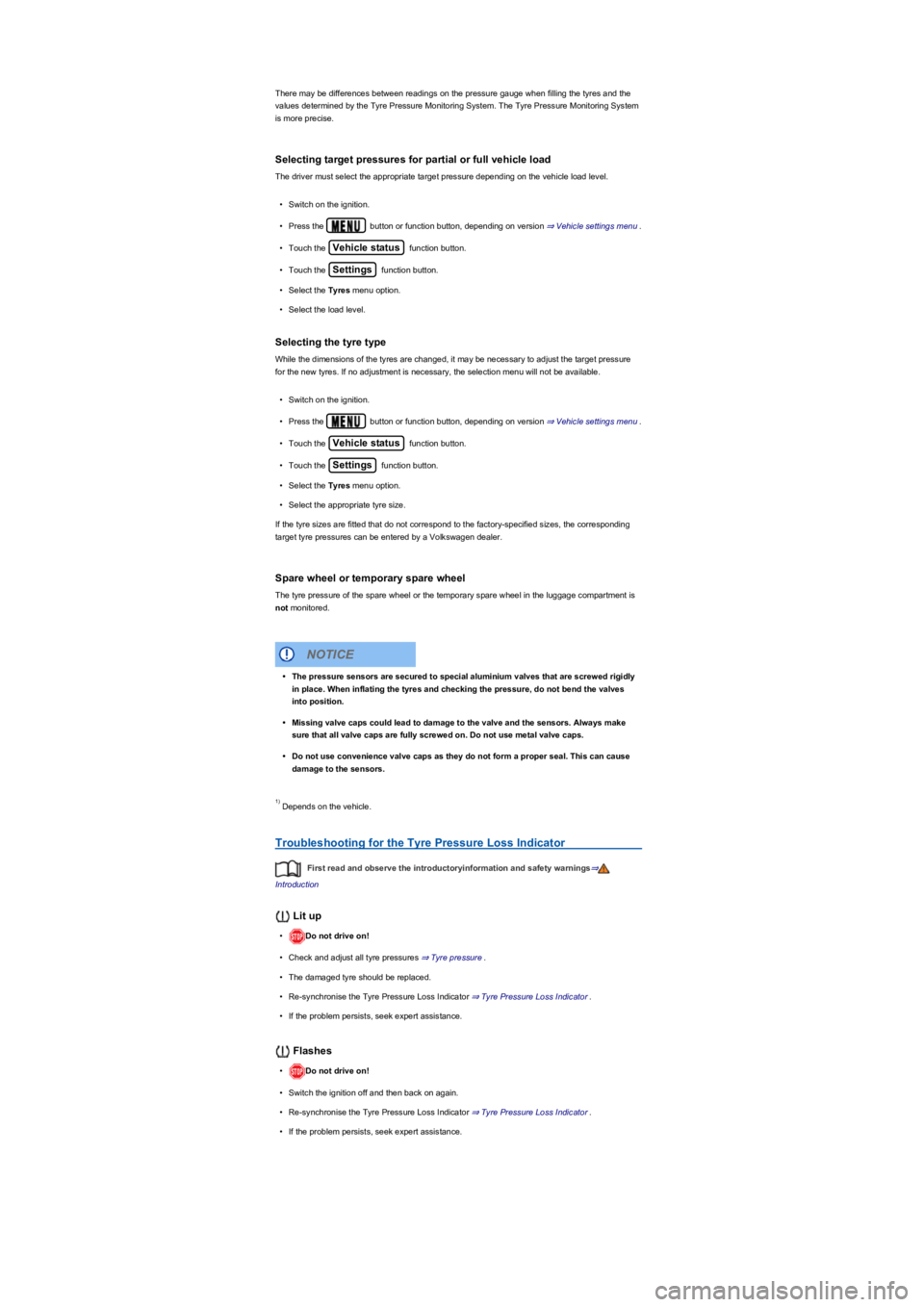
Selecting target pressures for partial or full vehicle load
The driver must select the appropriate target pressure depending on the vehicle load level.
•Switch on the ignition.
•Press the button or function button, depending on version ⇒ Vehicle settings menu.
•Touch the Vehicle status function button.
•Touch the Settings function button.
•Select the Tyres menu option.
•Select the load level.
Selecting the tyre type
While the dimensions of the tyres are changed, it may be necessary to adjust the target pressure
for the new tyres. If no adjustment is necessary, the selection menu will not be available.
•Switch on the ignition.
•Press the button or function button, depending on version ⇒ Vehicle settings menu.
•Touch the Vehicle status function button.
•Touch the Settings function button.
•Select the Tyres menu option.
•Select the appropriate tyre size.
If the tyre sizes are fitted that do not correspond to the factory-specified sizes, the corresponding
target tyre pressures can be entered by a Volkswagen dealer.
Spare wheel or temporary spare wheel
The tyre pressure of the spare wheel or the temporary spare wheel in the luggage compartment is
not monitored.
Depends on the vehicle.
Troubleshooting for the Tyre Pressure Loss Indicator
First read and observe the introductoryinformation and safety warnings⇒
Introduction
Lit up
•Do not drive on!
•Check and adjust all tyre pressures ⇒ Tyre pressure.
•The damaged tyre should be replaced.
•Re-synchronise the Tyre Pressure Loss Indicator ⇒ Tyre Pressure Loss Indicator.
•If the problem persists, seek expert assistance.
Flashes
•Do not drive on!
•Switch the ignition off and then back on again.
•Re-synchronise the Tyre Pressure Loss Indicator ⇒ Tyre Pressure Loss Indicator.
•If the problem persists, seek expert assistance.
•The pressure sensors are secured to special aluminium valves that are screwed rigidly
in place. When inflating the tyres and checking the pressure, do not bend the valves
into position.
•Missing valve caps could lead to damage to the valve and the sensors. Always make
sure that all valve caps are fully screwed on. Do not use metal valve caps.
•Do not use convenience valve caps as they do not form a proper seal. This can cause
damage to the sensors.
NOTICE
1)
Page 293 of 341
Driving on unpaved roads for long periods, or a sporty driving style, can temporarily
deactivate the Tyre Pressure Loss Indicator. The indicator lamp shows the malfunction, but
disappears if the road conditions or driving style change.
Troubleshooting for the Tyre Pressure Monitoring System
First read and observe the introductoryinformation and safety warnings⇒
Introduction
Lit up
•Do not drive on!
•Check all wheels for exterior damage or foreign bodies that have entered the tyres.
•Check the tyre pressure for all tyres ⇒ Tyre pressure.
•Change the wheel or drive at a low speed to the nearest qualified workshop.
•Check and adjust the tyre pressure for all tyres ⇒ Tyre pressure.
•Change the wheel or drive at a low speed to the nearest qualified workshop.
•Avoid long journeys and high speeds as long as the warning is displayed.
•Check ⇒ Tyre pressure and adjust the tyre pressure for all tyres.
Flashes
•Switch off or avoid any disruptive sources, e.g. two-way radios, remote controls or children's
toys.
•Switch the ignition off and then back on again. If the problem persists, seek expert assistance.
Differing tyre pressures or tyre pressures that are too low can cause tyre damage, tyre
failure, loss of vehicle control, accidents, serious injury and death.
•If the indicator lamp lights up, stop the vehicle as soon as possible and check all
the tyres ⇒ Useful information about wheels and tyres.
•Different tyre pressures or tyre pressures that are too low can increase wear on the
tyres, reduce vehicle stability and increase the braking distance.
•Differing tyre pressures or tyre pressures that are too low can cause sudden tyre
failure and lead to a tyre bursting and the loss of control over the vehicle.
•The driver is responsible for the correct tyre pressure of all tyres on the vehicle. The
recommended tyre pressure can be found on a sticker ⇒ Tyre pressure.
•The tyre monitoring system cannot function correctly until all cold tyres have the
correct tyre pressure.
•The pressure in all tyres must always be appropriate to the vehicle load ⇒ Tyre
pressure.
•Always inflate all tyres to the correct tyre pressure before every journey ⇒ Tyre
pressure.
•If the vehicle is driven with insufficient tyre pressure, this results in greater tyre flexing.
This could warm up the tyre to such an extent that the tread may separate and the tyre
could burst. This could cause the driver to lose control of the vehicle.
•High speeds and overloading of the vehicle may cause the tyres to heat up to such an
extent that the tyre bursts, leading you to lose control of the vehicle.
•If the tyre pressure is too low or too high, the tyres will wear prematurely and the
vehicle will not handle well.
•If the tyre is not flat and it is not necessary to change the wheel immediately, drive at
low speed to the nearest qualified workshop and check and correct the tyre pressure
⇒ Useful information about wheels and tyres.
WARNING
Page 294 of 341
Useful information about wheels and tyres
Introduction
This chapter contains information on the followingsubjects:
⇒ Handling wheels and tyres
⇒ Wheel rims and wheel bolts
⇒ Tyre pressure
⇒ Tread depth and wear indicators
⇒ Tyre damage
⇒ Spare wheel or temporary spare wheel
⇒ Tyre lettering and tyre type
⇒ Maximum load and speed range for tyres
⇒ Winter tyres
⇒ Snow chains
The tyres are the most used and most underestimated parts of a vehicle. Tyres are very important
as the narrow tyre surfaces are the only contact between the vehicle and the road.
The service life of tyres is dependent on tyre pressure, driving style, handling and correct fitting.
Differing tyre pressures or tyre pressures that are too low can cause tyre damage, tyre
failure, loss of vehicle control, accidents, serious injury and death.
•If the indicator lamp lights up, stop the vehicle as soon as possible and check all
the tyres ⇒ Useful information about wheels and tyres.
•Different tyre pressures or tyre pressures that are too low can increase wear on the
tyres, reduce vehicle stability and increase the braking distance.
•Differing tyre pressures or tyre pressures that are too low can cause sudden tyre
failure and lead to a tyre bursting and the loss of control over the vehicle.
•The driver is responsible for the correct tyre pressure of all tyres on the vehicle. The
recommended tyre pressure can be found on a sticker ⇒ Tyre pressure.
•The tyre monitoring system cannot function correctly until all cold tyres have the
correct tyre pressure.
•The pressure in all tyres must always be appropriate to the vehicle load ⇒ Tyre
pressure.
•Always inflate all tyres to the correct tyre pressure before every journey ⇒ Tyre
pressure.
•If the vehicle is driven with insufficient tyre pressure, this results in greater tyre flexing.
This could warm up the tyre to such an extent that the tread may separate and the tyre
could burst. This could cause the driver to lose control of the vehicle.
•High speeds and overloading of the vehicle may cause the tyres to heat up to such an
extent that the tyre bursts, leading you to lose control of the vehicle.
•If the tyre pressure is too low or too high, the tyres will wear prematurely and the
vehicle will not handle well.
•If the tyre is not flat and it is not necessary to change the wheel immediately, drive at
low speed to the nearest qualified workshop and check and correct the tyre pressure
⇒ Tyre pressure.
WARNING
Page 295 of 341
Handling wheels and tyres
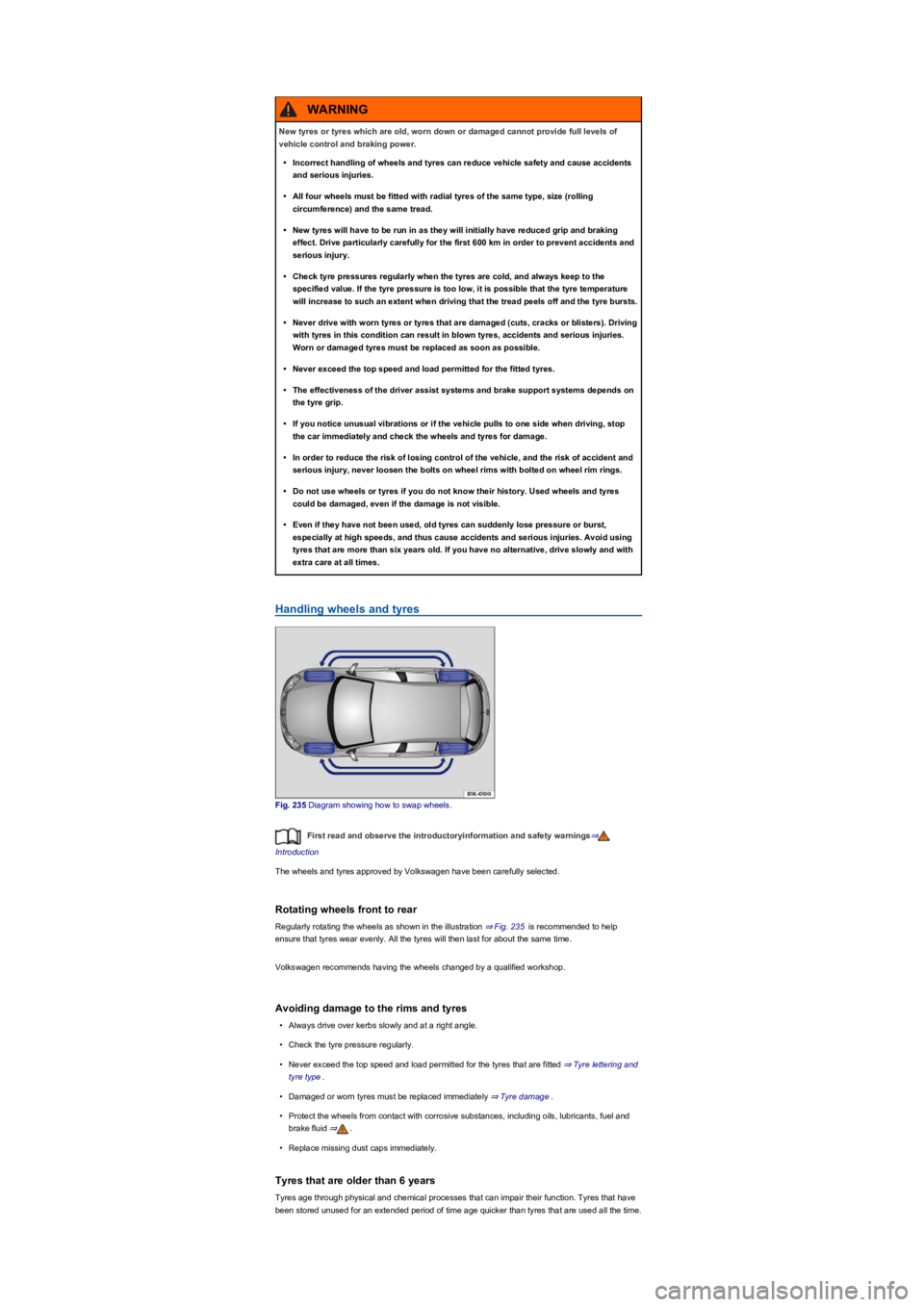
Fig. 235 Diagram showing how to swap wheels.
First read and observe the introductoryinformation and safety warnings⇒
Introduction
The wheels and tyres approved by Volkswagen have been carefully selected.
Rotating wheels front to rear
Regularly rotating the wheels as shown in the illustration ⇒ Fig. 235 is recommended to help
ensure that tyres wear evenly. All the tyres will then last for about the same time.
Volkswagen recommends having the wheels changed by a qualified workshop.
Avoiding damage to the rims and tyres
•Always drive over kerbs slowly and at a right angle.
•Check the tyre pressure regularly.
•Never exceed the top speed and load permitted for the tyres that are fitted ⇒ Tyre lettering and
tyre type.
•Damaged or worn tyres must be replaced immediately ⇒ Tyre damage.
•Protect the wheels from contact with corrosive substances, including oils, lubricants, fuel and
brake fluid ⇒.
•Replace missing dust caps immediately.
Tyres that are older than 6 years
Tyres age through physical and chemical processes that can impair their function. Tyres that have
been stored unused for an extended period of time age quicker than tyres that are used all the time.
New tyres or tyres which are old, worn down or damaged cannot provide full levels of
vehicle control and braking power.
•Incorrect handling of wheels and tyres can reduce vehicle safety and cause accidents
and serious injuries.
•All four wheels must be fitted with radial tyres of the same type, size (rolling
circumference) and the same tread.
•New tyres will have to be run in as they will initially have reduced grip and braking
effect. Drive particularly carefully for the first 600 km in order to prevent accidents and
serious injury.
•Check tyre pressures regularly when the tyres are cold, and always keep to the
specified value. If the tyre pressure is too low, it is possible that the tyre temperature
will increase to such an extent when driving that the tread peels off and the tyre bursts.
•Never drive with worn tyres or tyres that are damaged (cuts, cracks or blisters). Driving
with tyres in this condition can result in blown tyres, accidents and serious injuries.
Worn or damaged tyres must be replaced as soon as possible.
•Never exceed the top speed and load permitted for the fitted tyres.
•The effectiveness of the driver assist systems and brake support systems depends on
the tyre grip.
•If you notice unusual vibrations or if the vehicle pulls to one side when driving, stop
the car immediately and check the wheels and tyres for damage.
•In order to reduce the risk of losing control of the vehicle, and the risk of accident and
serious injury, never loosen the bolts on wheel rims with bolted on wheel rim rings.
•Do not use wheels or tyres if you do not know their history. Used wheels and tyres
could be damaged, even if the damage is not visible.
•Even if they have not been used, old tyres can suddenly lose pressure or burst,
especially at high speeds, and thus cause accidents and serious injuries. Avoid using
tyres that are more than six years old. If you have no alternative, drive slowly and with
extra care at all times.
WARNING