ESP VOLKSWAGEN UP! 2021 Owner´s Manual
[x] Cancel search | Manufacturer: VOLKSWAGEN, Model Year: 2021, Model line: UP!, Model: VOLKSWAGEN UP! 2021Pages: 211, PDF Size: 5.98 MB
Page 126 of 211
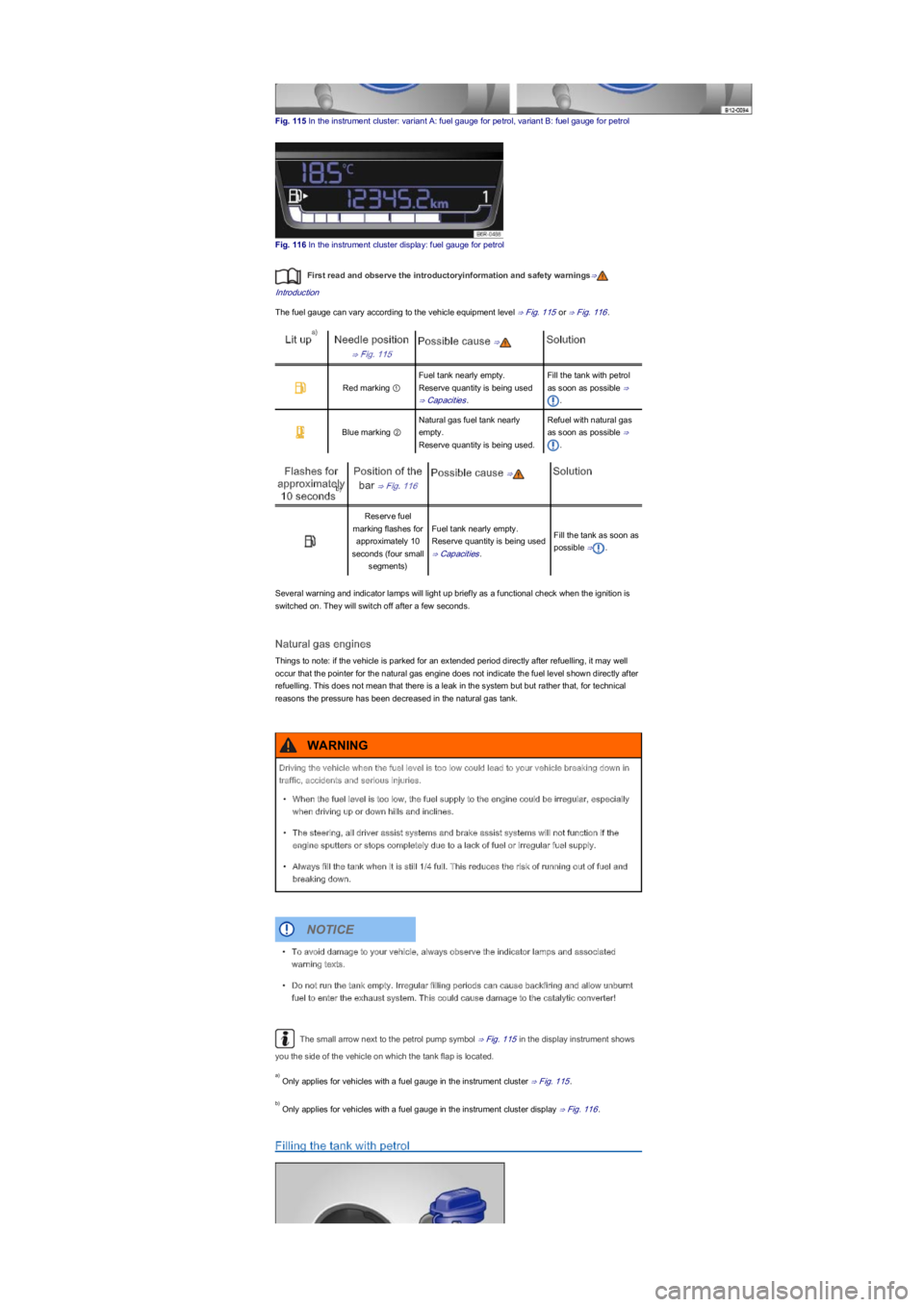
Fig. 115 In the instrument cluster: variant A: fuel gauge for petrol, variant B: fuel gauge for petrol
Fig. 116 In the instrument cluster display: fuel gauge for petrol
First read and observe the introductoryinformation and safety warnings⇒
Introduction
The fuel gauge can vary according to the vehicle equipment level ⇒ Fig. 115 or ⇒ Fig. 116.
Lit upNeedle position
⇒ Fig. 115
Possible cause ⇒Solution
Red marking ①
Fuel tank nearly empty.
Reserve quantity is being used
⇒ Capacities.
Fill the tank with petrol
as soon as possible ⇒
.
Blue marking ②
Natural gas fuel tank nearly
empty.
Reserve quantity is being used.
Refuel with natural gas
as soon as possible ⇒
.
Flashes for
approximately
10 seconds
Position of the
bar ⇒ Fig. 116
Possible cause ⇒Solution
Reserve fuel
marking flashes for
approximately 10
seconds (four small
segments)
Fuel tank nearly empty.
Reserve quantity is being used
⇒ Capacities.
Fill the tank as soon as
possible ⇒.
Several warning and indicator lamps will light up briefly as a functional check when the ignition is
switched on. They will switch off after a few seconds.
Natural gas engines
Things to note: if the vehicle is parked for an extended period directly after refuelling, it may well
occur that the pointer for the natural gas engine does not indicate the fuel level shown directly after
refuelling. This does not mean that there is a leak in the system but but rather that, for technical
reasons the pressure has been decreased in the natural gas tank.
The small arrow next to the petrol pump symbol ⇒ Fig. 115 in the display instrument shows
you the side of the vehicle on which the tank flap is located.
Only applies for vehicles with a fuel gauge in the instrument cluster ⇒ Fig. 115.
Only applies for vehicles with a fuel gauge in the instrument cluster display ⇒ Fig. 116.
Filling the tank with petrol
a)
b)
Driving the vehicle when the fuel level is too low could lead to your vehicle breaking down in
traffic, accidents and serious injuries.
•When the fuel level is too low, the fuel supply to the engine could be irregular, especially
when driving up or down hills and inclines.
•The steering, all driver assist systems and brake assist systems will not function if the
engine sputters or stops completely due to a lack of fuel or irregular fuel supply.
•Always fill the tank when it is still 1/4 full. This reduces the risk of running out of fuel and
breaking down.
WARNING
•To avoid damage to your vehicle, always observe the indicator lamps and associated
warning texts.
•Do not run the tank empty. Irregular filling periods can cause backfiring and allow unburnt
fuel to enter the exhaust system. This could cause damage to the catalytic converter!
NOTICE
a)
b)
Page 130 of 211
than the engine requires. However, this does not provide any advantage in terms of fuel
consumption or engine output.
Volkswagen recommends using fuel with a low sulphur content or sulphur-free fuel for petrol
engines in order to achieve reduced fuel consumption.
Petrol additives
The quality of petrol influences the running properties, performance and service life of the engine.
This is why the vehicle should be refuelled with good quality petrol that has only non-metallic
additives pre-added by the petroleum industry. These petrol additives help to prevent corrosion,
keep the fuel system clean, and prevent the build-up of deposits in the engine.
If good quality petrol containing non-metallic additives is not available, or if engine problems arise,
the necessary petrol additives must be added to the petrol when refuelling ⇒.
Not all petrol additives are effective. The use of unsuitable petrol additives can cause considerable
damage to the engine and catalytic converter. Metallic additives should be avoided at all times.
Petrol additives on sale that are intended to improve knock resistance or increase the octane
number can also contain metallic additives ⇒.
Volkswagen recommends genuine Volkswagen or Audi fuel additives for petrol engines. These
additives and information on how to use them are available from your Volkswagen dealership.
Natural gas engines
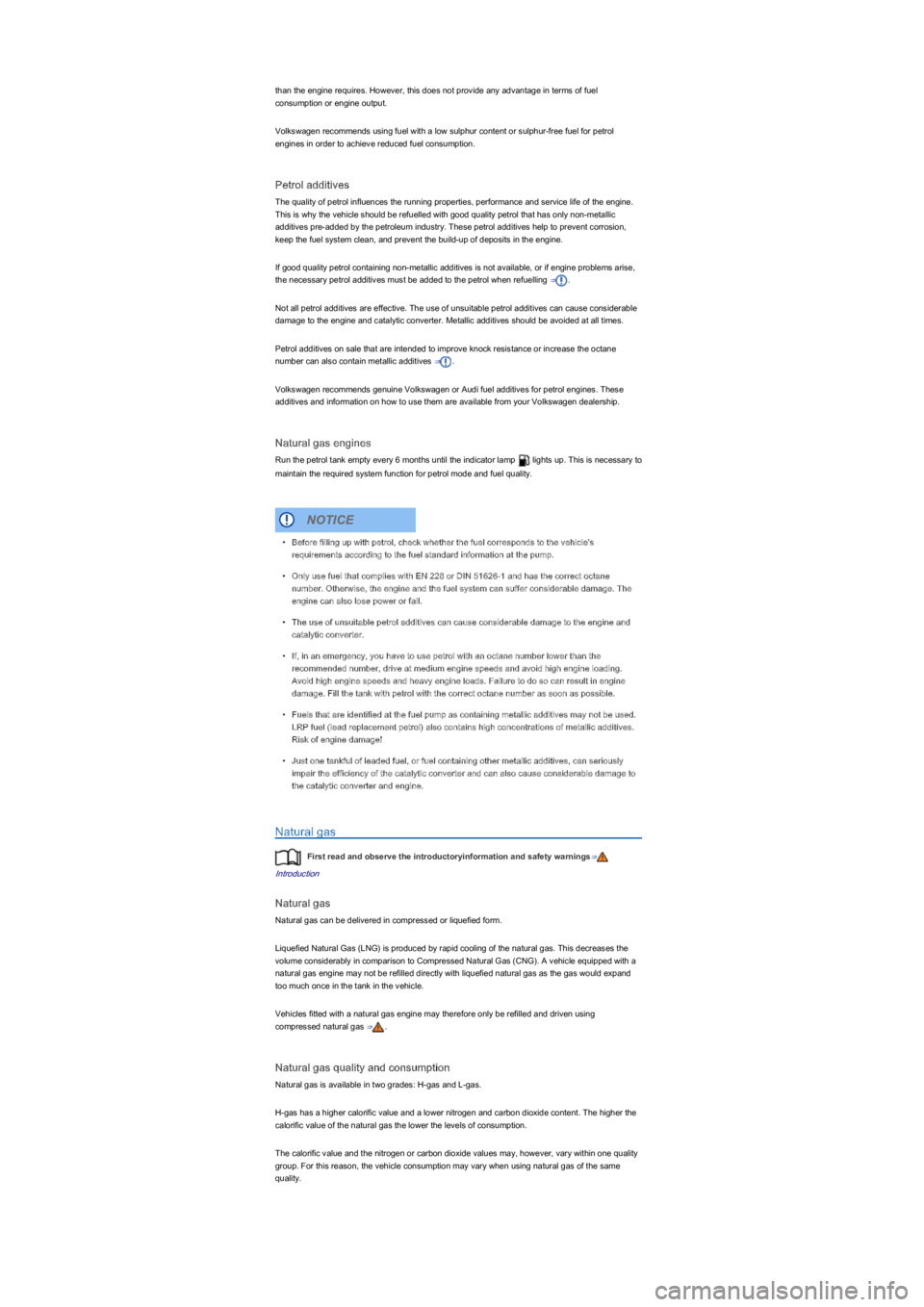
Run the petrol tank empty every 6 months until the indicator lamp lights up. This is necessary to
maintain the required system function for petrol mode and fuel quality.
Natural gas
First read and observe the introductoryinformation and safety warnings⇒
Introduction
Natural gas
Natural gas can be delivered in compressed or liquefied form.
Liquefied Natural Gas (LNG) is produced by rapid cooling of the natural gas. This decreases the
volume considerably in comparison to Compressed Natural Gas (CNG). A vehicle equipped with a
natural gas engine may not be refilled directly with liquefied natural gas as the gas would expand
too much once in the tank in the vehicle.
Vehicles fitted with a natural gas engine may therefore only be refilled and driven using
compressed natural gas ⇒.
Natural gas quality and consumption
Natural gas is available in two grades: H-gas and L-gas.
H-gas has a higher calorific value and a lower nitrogen and carbon dioxide content. The higher the
calorific value of the natural gas the lower the levels of consumption.
The calorific value and the nitrogen or carbon dioxide values may, however, vary within one quality
group. For this reason, the vehicle consumption may vary when using natural gas of the same
quality.
•Before filling up with petrol, check whether the fuel corresponds to the vehicle's
requirements according to the fuel standard information at the pump.
•Only use fuel that complies with EN 228 or DIN 51626-1 and has the correct octane
number. Otherwise, the engine and the fuel system can suffer considerable damage. The
engine can also lose power or fail.
•The use of unsuitable petrol additives can cause considerable damage to the engine and
catalytic converter.
•If, in an emergency, you have to use petrol with an octane number lower than the
recommended number, drive at medium engine speeds and avoid high engine loading.
Avoid high engine speeds and heavy engine loads. Failure to do so can result in engine
damage. Fill the tank with petrol with the correct octane number as soon as possible.
•Fuels that are identified at the fuel pump as containing metallic additives may not be used.
LRP fuel (lead replacement petrol) also contains high concentrations of metallic additives.
Risk of engine damage!
•Just one tankful of leaded fuel, or fuel containing other metallic additives, can seriously
impair the efficiency of the catalytic converter and can also cause considerable damage to
the catalytic converter and engine.
NOTICE
Page 135 of 211
Engine oil
Introduction
This chapter contains information on the followingsubjects:
⇒ Warning and indicator lamps
⇒ Engine oil specification
⇒ Checking the engine oil level and refilling engine oil
⇒ Engine oil consumption
⇒ Changing engine oil
Additional information and warnings:
•⇒BookletService schedule,
•Preparation for working in the engine compartment ⇒ Preparation for working in the engine
compartment
•Accessories, modifications, repairs and renewal of parts ⇒ Accessories, modifications, repairs
and renewal of parts
Leaking or spilt engine oil can pollute the environment. Spilt operating fluids must be
collected and disposed of properly and with respect for the environment.
Warning and indicator lamps
First read and observe the introductoryinformation and safety warnings⇒
Introduction
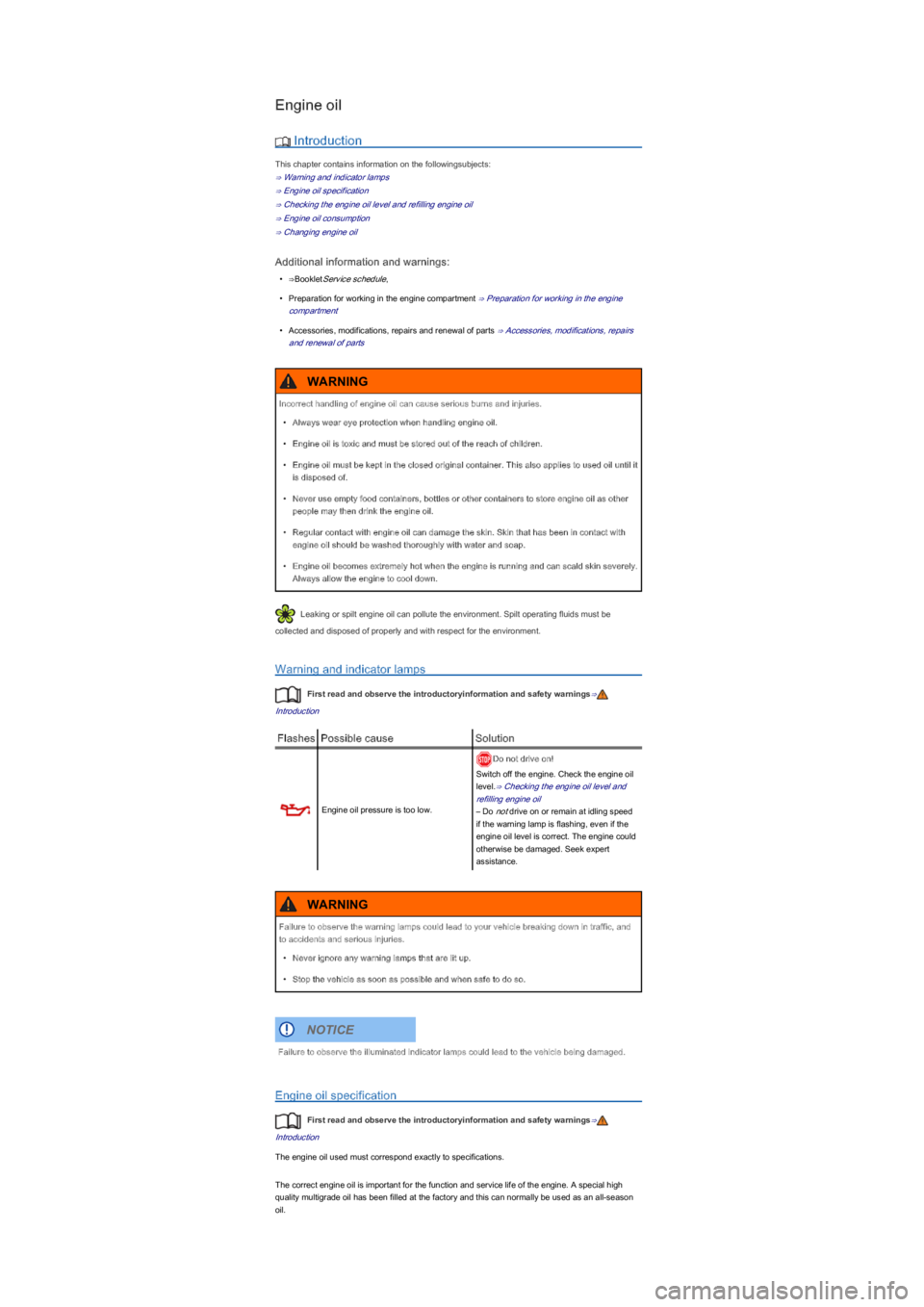
FlashesPossible causeSolution
Engine oil pressure is too low.
Do not drive on!
Switch off the engine. Check the engine oil
level.⇒ Checking the engine oil level and
refilling engine oil
– Do not drive on or remain at idling speed
if the warning lamp is flashing, even if the
engine oil level is correct. The engine could
otherwise be damaged. Seek expert
assistance.
Engine oil specification
First read and observe the introductoryinformation and safety warnings⇒
Introduction
The engine oil used must correspond exactly to specifications.
The correct engine oil is important for the function and service life of the engine. A special high
quality multigrade oil has been filled at the factory and this can normally be used as an all-season
oil.
Incorrect handling of engine oil can cause serious burns and injuries.
•Always wear eye protection when handling engine oil.
•Engine oil is toxic and must be stored out of the reach of children.
•Engine oil must be kept in the closed original container. This also applies to used oil until it
is disposed of.
•Never use empty food containers, bottles or other containers to store engine oil as other
people may then drink the engine oil.
•Regular contact with engine oil can damage the skin. Skin that has been in contact with
engine oil should be washed thoroughly with water and soap.
•Engine oil becomes extremely hot when the engine is running and can scald skin severely.
Always allow the engine to cool down.
WARNING
Failure to observe the warning lamps could lead to your vehicle breaking down in traffic, and
to accidents and serious injuries.
•Never ignore any warning lamps that are lit up.
•Stop the vehicle as soon as possible and when safe to do so.
WARNING
Failure to observe the illuminated indicator lamps could lead to the vehicle being damaged.
NOTICE
Page 137 of 211

With the engine at operating temperature, park the vehicle on a level surface to ensure
that the engine oil reading is correct.
Switch off the engine and wait a few minutes for the engine oil to flow back into the sump.
Open the bonnet .
Identify the engine oil filler cap and oil dipstick. The engine oil filler opening bears the
symbol on the cap and the oil dipstick has a coloured handle. If you cannot find the cap
and dipstick please contact a qualified workshop.
Pull the dipstick out of the guide tube and wipe it off with a clean cloth.
Insert the oil dipstick into the guide tube again as far as it will go. If there is a marking on
the oil dipstick, this marking must fit in the corresponding groove at the top end of the
guide tube when inserting.
After reading the oil level, push the oil dipstick back into the guide tube as far as it will go.
Unscrew the engine oil filler opening cap .
Using only the engine oil approved by Volkswagen expressly for this engine, top up the oil
in small gradual amounts (no more than 0.5 l).
To avoid overfilling, wait for approximately one minute after each pour to allow the engine
oil to flow into the oil sump up to the marking on the engine oil dipstick.
Read the engine oil level from the dipstick again before refilling with a further small
quantity of engine oil. Never overfill engine oil .
After the refilling procedure, the engine oil level should be at least in the centre of area Ⓑ,
but never above area Ⓐ .
After refilling, screw the engine oil filler cap back on correctly.
Reinsert the oil dipstick correctly into the guide tube as far as it will go.
Close the bonnet correctly .
Checklist
Carry out the steps in the specified order ⇒:
Pull the dipstick out again and read the engine oil level on the dipstick as follows: Ⓐ: do not
refill oil . Proceed to step 15. Ⓑ: oil can be refilled (approximately 0.5 l). Proceed to step 8
or 15. Ⓒ: oil must be refilled (approximately 1.0 l). Proceed to step 8.
The engine oil level must never be above area ⇒ Fig. 121Ⓐ. Otherwise oil can be drawn in
through the crankcase breather and escape into the atmosphere via the exhaust system.
Engine oil consumption
First read and observe the introductoryinformation and safety warnings⇒
Introduction
Engine oil consumption can vary from engine to engine and can change during the working life of
an engine.
Depending on how you drive and the conditions in which the car is used, oil consumption can be up
to 1.0 litre/2,000 km – and is likely to be higher for the first 5,000 km for new vehicles. The engine
oil level must therefore be checked at regular intervals, preferably when refuelling and before long
journeys.
When the engine is working hard the oil level must be kept within the area shown in ⇒ Fig. 121Ⓐ,
for instance during long motorway cruising in summer or climbing mountain passes.
Engine oil can ignite if it comes into contact with hot engine components. It can cause fires,
burns and other serious injuries.
•If engine oil is spilt on cold engine parts it can heat up and ignite when the engine is
running.
•Always ensure that the engine oil filler cap is securely tightened after refilling, and that the
dipstick is properly inserted back into the guide tube. This will prevent the engine oil from
draining out on to hot engine components when the engine is running.
WARNING
•Do not start the engine if the engine oil level is above area ⇒ Fig. 121Ⓐ. Seek expert
assistance. The catalytic converter and the engine could otherwise be damaged.
•When refilling or changing operating fluids please ensure that the fluids are in the correct
container. Incorrect operating fluids can cause serious functional problems and engine
damage.
NOTICE
Page 139 of 211
Coolant and coolant additives can pollute the environment. Spilt operating fluids must be
collected and disposed of properly and with respect for the environment.
Warning lamp for coolant
First read and observe the introductoryinformation and safety warnings⇒
Introduction
Several warning and indicator lamps will light up briefly as a functional check when the ignition is
switched on. They will switch off after a few seconds.
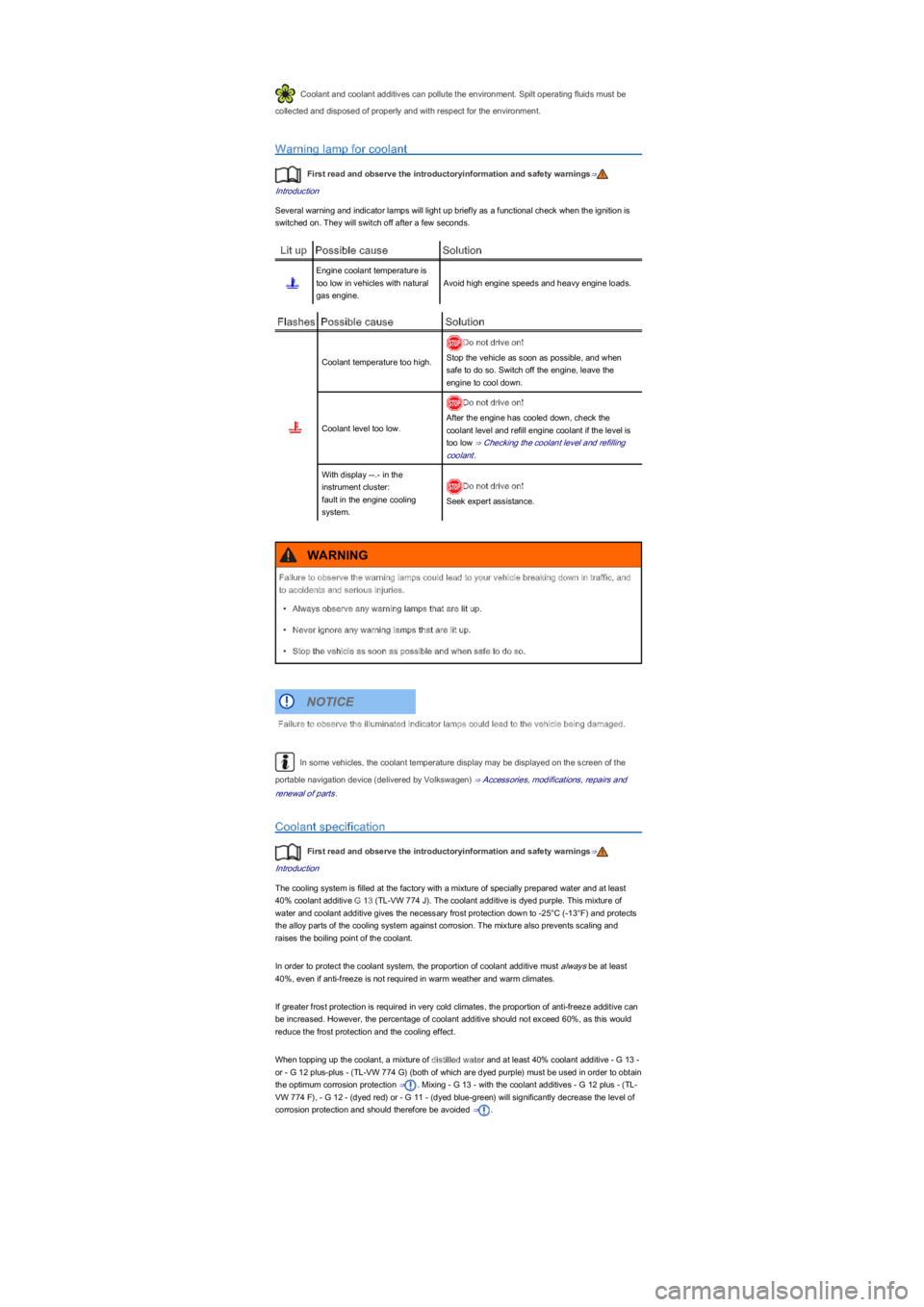
Lit upPossible causeSolution
Engine coolant temperature is
too low in vehicles with natural
gas engine.
Avoid high engine speeds and heavy engine loads.
FlashesPossible causeSolution
Coolant temperature too high.
Do not drive on!
Stop the vehicle as soon as possible, and when
safe to do so. Switch off the engine, leave the
engine to cool down.
Coolant level too low.
Do not drive on!
After the engine has cooled down, check the
coolant level and refill engine coolant if the level is
too low ⇒ Checking the coolant level and refilling
coolant.
With display --.- in the
instrument cluster:
fault in the engine cooling
system.
Do not drive on!
Seek expert assistance.
In some vehicles, the coolant temperature display may be displayed on the screen of the
portable navigation device (delivered by Volkswagen) ⇒ Accessories, modifications, repairs and
renewal of parts.
Coolant specification
First read and observe the introductoryinformation and safety warnings⇒
Introduction
The cooling system is filled at the factory with a mixture of specially prepared water and at least
40% coolant additive G 13 (TL-VW 774 J). The coolant additive is dyed purple. This mixture of
water and coolant additive gives the necessary frost protection down to -25°C (-13°F) and protects
the alloy parts of the cooling system against corrosion. The mixture also prevents scaling and
raises the boiling point of the coolant.
In order to protect the coolant system, the proportion of coolant additive must always be at least
40%, even if anti-freeze is not required in warm weather and warm climates.
If greater frost protection is required in very cold climates, the proportion of anti-freeze additive can
be increased. However, the percentage of coolant additive should not exceed 60%, as this would
reduce the frost protection and the cooling effect.
When topping up the coolant, a mixture of distilled water and at least 40% coolant additive - G 13 -
or - G 12 plus-plus - (TL-VW 774 G) (both of which are dyed purple) must be used in order to obtain
the optimum corrosion protection ⇒. Mixing - G 13 - with the coolant additives - G 12 plus - (TL-
VW 774 F), - G 12 - (dyed red) or - G 11 - (dyed blue-green) will significantly decrease the level of
corrosion protection and should therefore be avoided ⇒.
Failure to observe the warning lamps could lead to your vehicle breaking down in traffic, and
to accidents and serious injuries.
•Always observe any warning lamps that are lit up.
•Never ignore any warning lamps that are lit up.
•Stop the vehicle as soon as possible and when safe to do so.
WARNING
Failure to observe the illuminated indicator lamps could lead to the vehicle being damaged.
NOTICE
Page 140 of 211
Coolant and coolant additives can pollute the environment. Spilt operating fluids must be
collected and disposed of properly and with respect for the environment.
Checking the coolant level and refilling coolant
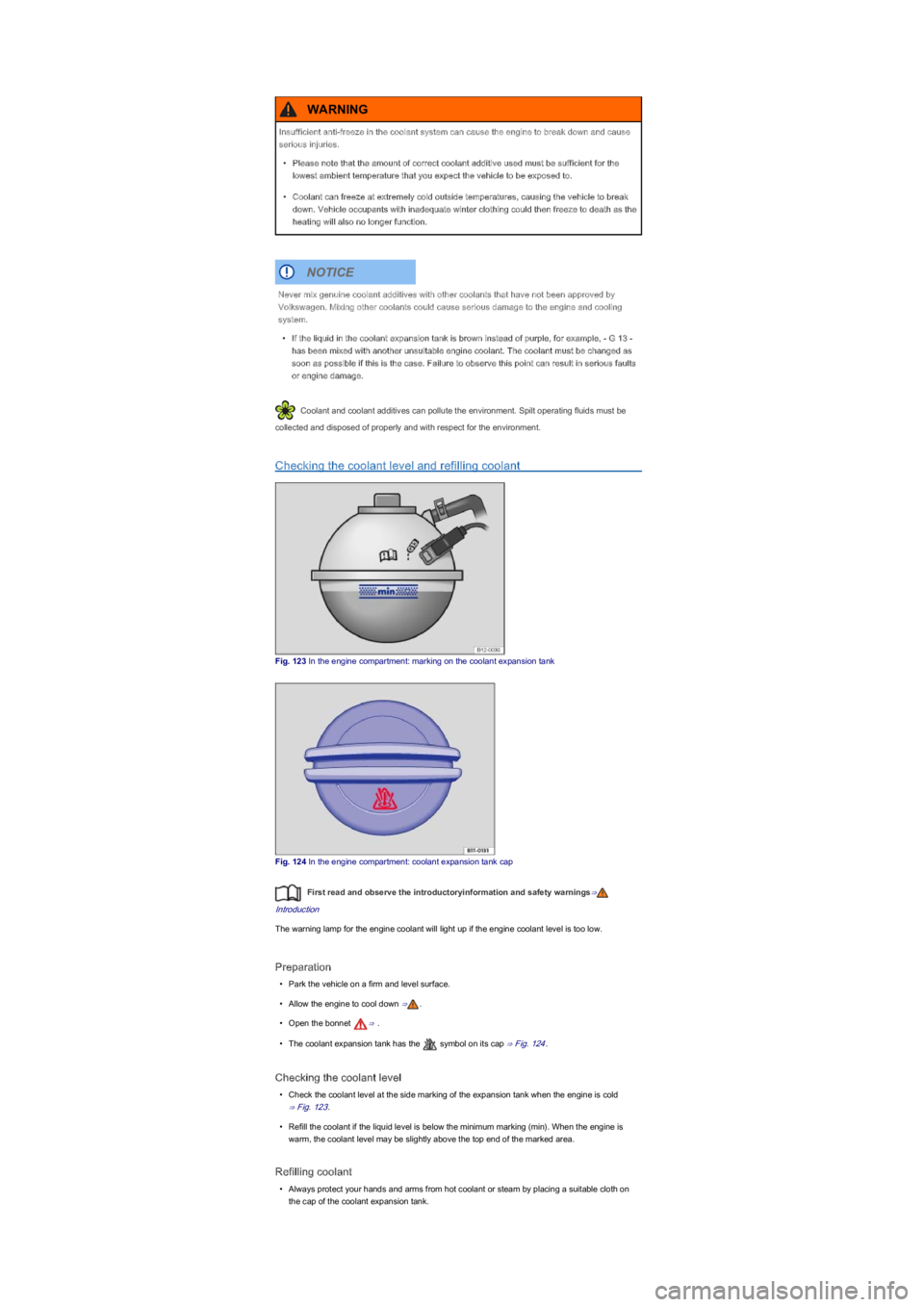
Fig. 123 In the engine compartment: marking on the coolant expansion tank
Fig. 124 In the engine compartment: coolant expansion tank cap
First read and observe the introductoryinformation and safety warnings⇒
Introduction
The warning lamp for the engine coolant will light up if the engine coolant level is too low.
Preparation
•Park the vehicle on a firm and level surface.
•Allow the engine to cool down ⇒.
•Open the bonnet ⇒ .
•The coolant expansion tank has the symbol on its cap ⇒ Fig. 124.
Checking the coolant level
•Check the coolant level at the side marking of the expansion tank when the engine is cold
⇒ Fig. 123.
•Refill the coolant if the liquid level is below the minimum marking (min). When the engine is
warm, the coolant level may be slightly above the top end of the marked area.
Refilling coolant
•Always protect your hands and arms from hot coolant or steam by placing a suitable cloth on
the cap of the coolant expansion tank.
Insufficient anti-freeze in the coolant system can cause the engine to break down and cause
serious injuries.
•Please note that the amount of correct coolant additive used must be sufficient for the
lowest ambient temperature that you expect the vehicle to be exposed to.
•Coolant can freeze at extremely cold outside temperatures, causing the vehicle to break
down. Vehicle occupants with inadequate winter clothing could then freeze to death as the
heating will also no longer function.
WARNING
Never mix genuine coolant additives with other coolants that have not been approved by
Volkswagen. Mixing other coolants could cause serious damage to the engine and cooling
system.
•If the liquid in the coolant expansion tank is brown instead of purple, for example, - G 13 -
has been mixed with another unsuitable engine coolant. The coolant must be changed as
soon as possible if this is the case. Failure to observe this point can result in serious faults
or engine damage.
NOTICE
Page 145 of 211
How the vehicle battery discharges:
•Long periods at a standstill in which the engine is not running, especially if the ignition is
switched on.
•The use of electrical consumers when the engine is switched off.
Dispose of the vehicle battery as required by legislation. Batteries may contain toxic
substances such as sulphuric acid and lead.
Electrolyte can pollute the environment. Clean up any service fluid leakages and dispose of
them properly.
Vehicle care and maintenance
Caring for and cleaning the vehicle exterior
Introduction
This chapter contains information on the followingsubjects:
⇒ Washing the vehicle
⇒ Washing the vehicle with a high-pressure cleaner
⇒ Cleaning windows and exterior mirrors
⇒ Cleaning and changing windscreen wiper blades
⇒ Waxing and polishing the vehicle
⇒ Cleaning and caring for chrome and aluminium trim parts
⇒ Cleaning wheels
⇒ Care of rubber seals
⇒ De-icing the door lock cylinders
⇒ Underseal
⇒ Cleaning the engine compartment
Regular and expert care helps to maintain the value of the vehicle. Proper maintenance may also
be one of the requirements for the approval of warranty claims in the event of corrosion or paint
defects.
Suitable care products are available from Volkswagen dealers.
Additional information and warnings:
•Preparation for working in the engine compartment ⇒ Preparation for working in the engine
compartment
•Cleaning and caring for the interior ⇒ Cleaning and caring for the interior
•Accessories, modifications, repairs and renewal of parts ⇒ Accessories, modifications, repairs
and renewal of parts
Incorrectly attaching the battery and using incorrect vehicle batteries can cause short circuits,
fire and serious injuries.
•Always use maintenance-free and leak-proof batteries that have the same properties,
specifications and dimensions as the factory-fitted vehicle battery.
WARNING
A highly explosive mixture of gases is given off when the vehicle battery is being charged.
•Vehicle batteries should only be charged in well-ventilated spaces.
•Never charge a vehicle battery once it has been frozen. Discharged vehicle batteries can
even freeze at temperatures of around 0°C (+32°F).
•A vehicle battery must be replaced if it has been frozen.
•Incorrectly connected cables can cause a short circuit. First connect the positive cable and
then the negative cable.
WARNING
•Never make or break connections between vehicle batteries if the ignition is switched on or
the engine is running. Never use a vehicle battery that does not correspond with the
vehicle's specifications. The vehicle's electrical system or electronic components could be
damaged, which could lead to electrical faults, for example in the start/stop system.
•Never connect equipment that provides electricity, such as solar panels or a battery
charger, to the 12-volt socket or to the cigarette lighter to charge the vehicle battery. This
can damage the vehicle electrical system.
NOTICE
Page 153 of 211
Before getting into the vehicle, close all Velcro fasteners that could touch the cloth seat
covers and fabric trims. Open Velcro fasteners can cause damage to cloth seat covers and
fabric trims.
Avoid the direct contact of sharp-edged items and accessories to the upholstery and fabric
trims in order to prevent damage. Accessories include zips, studs, rhinestones on clothing
or belts.
Dust and grit in upholstery pores, folds and seams should be removed regularly so that no
permanent damage is caused to the surface of the seats by scratching.
Always check whether garments are colourfast to prevent damage to the upholstery. This
is especially important for light-coloured upholstery.
•Accessories, modifications, repairs and renewal of parts ⇒ Accessories, modifications, repairs
and renewal of parts
Suitable care products are available from a Volkswagen dealership.
Seat covers
First read and observe the introductoryinformation and safety warnings⇒
Introduction
Checklist
Please note the following for the cleaning and maintenance of the seat covers ⇒:
Volkswagen recommends that stained upholstery is cleaned by a specialist company.
Cleaning cloth seat covers, fabric trim and Alcantara upholstery
First read and observe the introductoryinformation and safety warnings⇒
Introduction
Car care products can be toxic and hazardous. Unsuitable care products and incorrect
application of care products can cause accidents, serious injuries, burns or poisoning.
•The care product must be kept in its original sealed container.
•Read the manufacturer's instructions.
•Never store car care products in empty food containers, bottles or any other non-original
containers as people finding these containers may not know that they contain care
products.
•Keep children away from care products.
•The products can give off harmful fumes during use. They should therefore only be used
outside or in well-ventilated spaces.
•Never use fuel, turpentine, engine oil, nail varnish remover or other volatile fluids to wash,
clean or care for your vehicle. These substances are toxic and highly inflammable.
WARNING
Incorrect care and cleaning of vehicle parts can impair the safety features of the vehicle and
cause serious injury.
•Vehicle parts must be cleaned according to the manufacturer's instructions.
•Only use approved or recommended cleaning products.
WARNING
•Cleaning products that contain solvents attack the material and may cause irreparable
damage.
•Stains, dirt and other deposits containing aggressive and solvent-based ingredients attack
the material and may cause irreparable damage, even if only left for a short time.
•Stains, dirt and other deposits should be removed as quickly as possible and not allowed
to dry in.
•To avoid damage, stubborn stains should be removed by a specialist cleaning company.
NOTICE
Ignoring any of the items on this important checklist for maintaining the seat covers can lead
to damage or discolouration of the seat covers and fabric trims.
•Follow the instructions on the checklist.
NOTICE
®
Page 156 of 211
However, slight colour variations will arise in normal use.
Mild soap solution: two tablespoons neutral soap diluted in one litre of water.
Cleaning leatherette upholstery
First read and observe the introductoryinformation and safety warnings⇒
Introduction
Please observe the following notes prior to cleaning the leatherette upholstery ⇒ Cleaning
upholstery on seat cushions with seat heating, electrically adjustable seats, or seats containing
airbag components.
Only use water and neutral detergents to clean the leatherette upholstery.
Cleaning stowage compartments, drink holders and ash trays
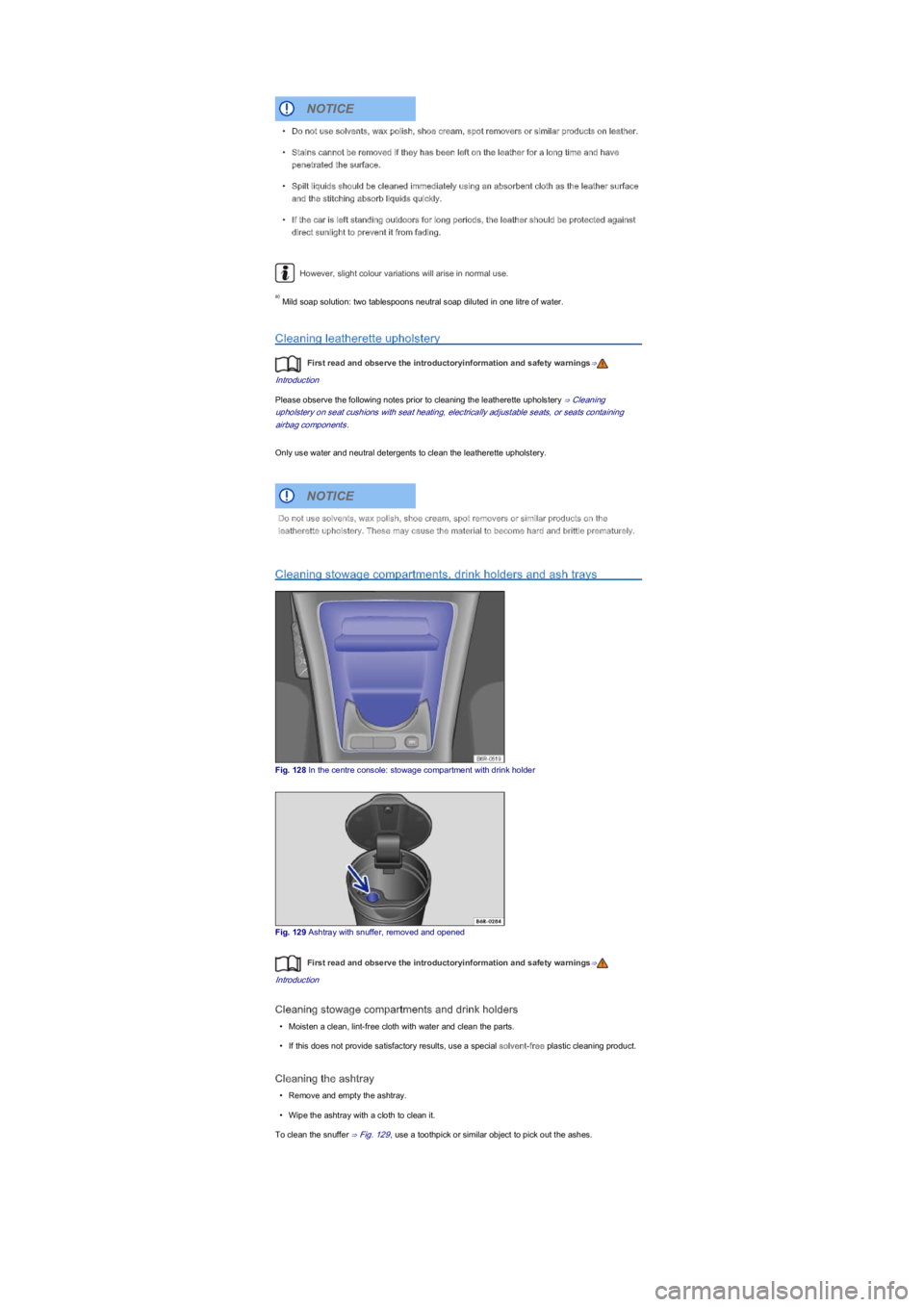
Fig. 128 In the centre console: stowage compartment with drink holder
Fig. 129 Ashtray with snuffer, removed and opened
First read and observe the introductoryinformation and safety warnings⇒
Introduction
Cleaning stowage compartments and drink holders
•Moisten a clean, lint-free cloth with water and clean the parts.
•If this does not provide satisfactory results, use a special solvent-free plastic cleaning product.
Cleaning the ashtray
•Remove and empty the ashtray.
•Wipe the ashtray with a cloth to clean it.
To clean the snuffer ⇒ Fig. 129, use a toothpick or similar object to pick out the ashes.
•Do not use solvents, wax polish, shoe cream, spot removers or similar products on leather.
•Stains cannot be removed if they has been left on the leather for a long time and have
penetrated the surface.
•Spilt liquids should be cleaned immediately using an absorbent cloth as the leather surface
and the stitching absorb liquids quickly.
•If the car is left standing outdoors for long periods, the leather should be protected against
direct sunlight to prevent it from fading.
NOTICE
a)
Do not use solvents, wax polish, shoe cream, spot removers or similar products on the
leatherette upholstery. These may cause the material to become hard and brittle prematurely.
NOTICE
Page 158 of 211
proper facilities for disposing of the old tyres. Volkswagen recommends using a Volkswagen
dealership for this purpose.
Additional information and warnings:
•Transporting ⇒ Driving notes
•Braking, stopping and parking ⇒ Braking, stopping and parking
•Cleaning and caring for the vehicle exterior ⇒ Caring for and cleaning the vehicle exterior
•Consumer information ⇒ Consumer information
•Vehicle toolkit ⇒ Vehicle toolkit
•Hubcaps ⇒ Hubcaps
•Changing a wheel ⇒ Changing a wheel
•Breakdown set ⇒ Breakdown set
For technical reasons, it is not generally possible to use the wheels from other vehicles. This
can also apply to wheels of the same vehicle type. Refer to the vehicle documentation and ask a
Volkswagen dealership if necessary.
Handling wheels and tyres
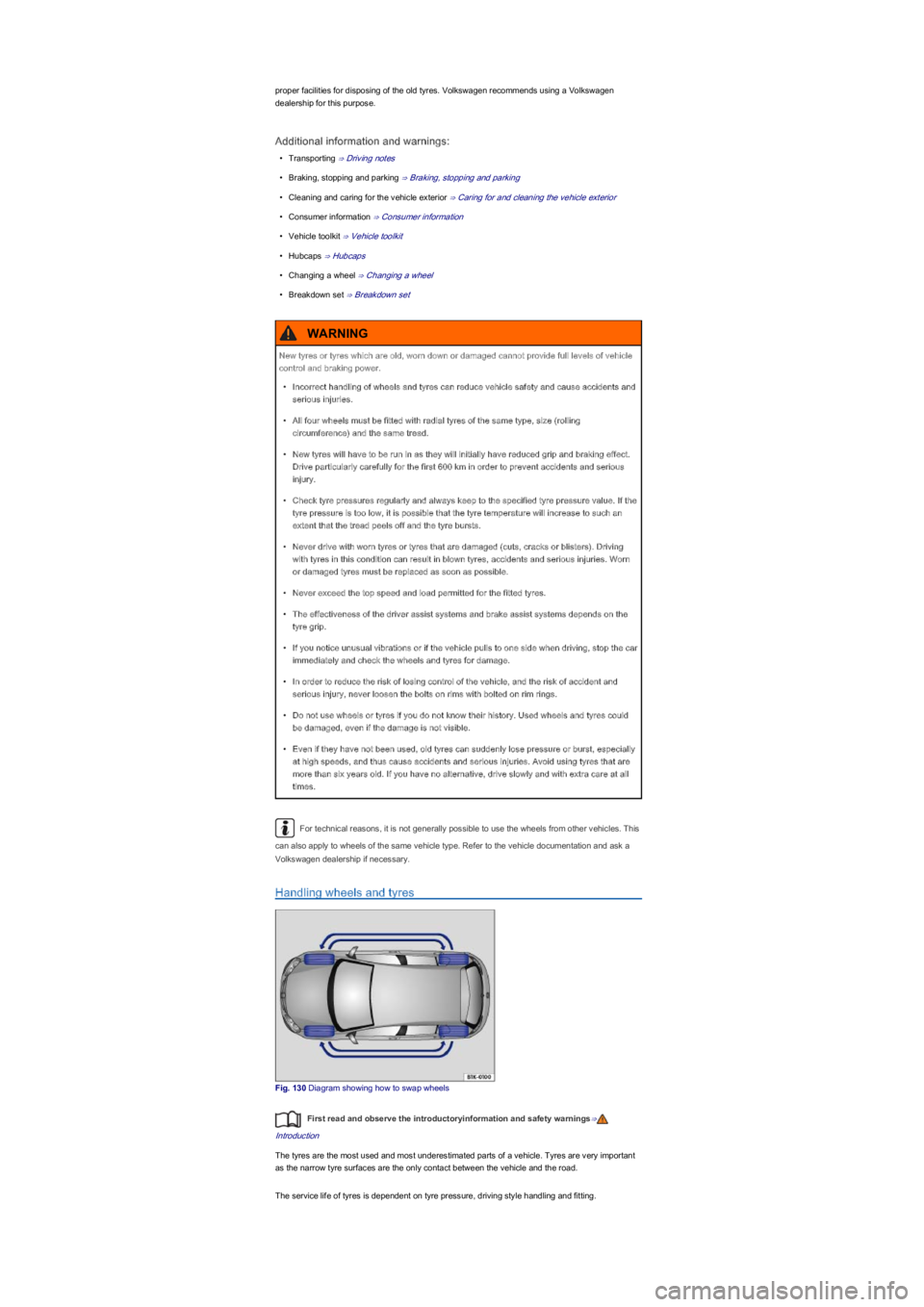
Fig. 130 Diagram showing how to swap wheels
First read and observe the introductoryinformation and safety warnings⇒
Introduction
The tyres are the most used and most underestimated parts of a vehicle. Tyres are very important
as the narrow tyre surfaces are the only contact between the vehicle and the road.
The service life of tyres is dependent on tyre pressure, driving style handling and fitting.
New tyres or tyres which are old, worn down or damaged cannot provide full levels of vehicle
control and braking power.
•Incorrect handling of wheels and tyres can reduce vehicle safety and cause accidents and
serious injuries.
•All four wheels must be fitted with radial tyres of the same type, size (rolling
circumference) and the same tread.
•New tyres will have to be run in as they will initially have reduced grip and braking effect.
Drive particularly carefully for the first 600 km in order to prevent accidents and serious
injury.
•Check tyre pressures regularly and always keep to the specified tyre pressure value. If the
tyre pressure is too low, it is possible that the tyre temperature will increase to such an
extent that the tread peels off and the tyre bursts.
•Never drive with worn tyres or tyres that are damaged (cuts, cracks or blisters). Driving
with tyres in this condition can result in blown tyres, accidents and serious injuries. Worn
or damaged tyres must be replaced as soon as possible.
•Never exceed the top speed and load permitted for the fitted tyres.
•The effectiveness of the driver assist systems and brake assist systems depends on the
tyre grip.
•If you notice unusual vibrations or if the vehicle pulls to one side when driving, stop the car
immediately and check the wheels and tyres for damage.
•In order to reduce the risk of losing control of the vehicle, and the risk of accident and
serious injury, never loosen the bolts on rims with bolted on rim rings.
•Do not use wheels or tyres if you do not know their history. Used wheels and tyres could
be damaged, even if the damage is not visible.
•Even if they have not been used, old tyres can suddenly lose pressure or burst, especially
at high speeds, and thus cause accidents and serious injuries. Avoid using tyres that are
more than six years old. If you have no alternative, drive slowly and with extra care at all
times.
WARNING