ESP VOLKSWAGEN UP! 2021 Owner´s Manual
[x] Cancel search | Manufacturer: VOLKSWAGEN, Model Year: 2021, Model line: UP!, Model: VOLKSWAGEN UP! 2021Pages: 211, PDF Size: 5.98 MB
Page 33 of 211
Roll-back function of the electric panorama sliding/tilting glass roof
First read and observe the introductoryinformation and safety warnings⇒
Introduction
The roll-back function can reduce the risk of injury when the electric panorama sliding/tilting glass
roof is being closed ⇒. If the electric panorama sliding/tilting glass roof is not able to close
because it is stiff or obstructed, it will automatically open again immediately.
•Check why the electric panorama sliding/tilting glass roof has not closed.
•Try to close the electric panorama sliding/tilting glass roof again.
•If the electric panorama sliding/tilting glass roof is still stiff or obstructed, it stops at this point.
Then close the electric panorama sliding/tilting glass roof without the roll-back function
Closing the electric panorama sliding/tilting glass roof without the roll-back
function
•Pull the switch ⇒ Fig. 34⑤ within approximately 5 seconds after the roll-back function has been
triggered and hold it in this position until the electric panorama sliding/tilting glass roof is closed
completely.
•The electric panorama sliding/tilting glass roof will then close without the roll-back function.
•If the electric panorama sliding/tilting glass roof still cannot be closed, go to a qualified
workshop.
If you let go of the switch during the closing procedure, the electric panorama sliding/tilting glass
roof will open automatically.
Sitting correctly and safely
Adjusting the seat position
Introduction
This chapter contains information on the followingsubjects:
⇒ The dangers of assuming an incorrect sitting position
⇒ Correct sitting position
⇒ Controls on the front seats
⇒ Adjusting the rear head restraint
⇒ Removing and installing the rear head restraint
⇒ Adjusting the steering wheel position
Number of seats
The vehicle has a total of 4 seats: 2 at the front and 2 at the rear. Each seat is equipped with a seat
belt.
Additional information and warnings:
•Seat functions ⇒ Seat functions
•Seat belts ⇒ Seat belts
•Airbag system ⇒ Airbag system
•Child seats (accessories) ⇒ Child seats (accessories)
Closing the electric panorama sliding/tilting glass roof without the roll-back function can cause
severe injuries.
•Always be careful when closing the electric panorama sliding/tilting glass roof.
•Ensure that nobody is obstructing the operating area of the electric panorama sliding/tilting
glass roof, especially if the roll-back function is not active.
•The roll-back function does not prevent fingers or other body parts from being pressed
against the roof frame and sustaining injury.
WARNING
Page 34 of 211
The dangers of assuming an incorrect sitting position
First read and observe the introductoryinformation and safety warnings⇒
Introduction
If the seat belts are not worn or are worn incorrectly, the risk of severe or fatal injuries increases.
Seat belts can only provide optimal protection if the seat belt routing is correct. Assuming an
incorrect sitting position considerably impairs the level of protection provided by a seat belt. This
could lead to severe or even fatal injuries. The risk of severe or fatal injuries is especially increased
when a triggering airbag strikes an occupant who has assumed an incorrect sitting position. The
driver is responsible for all vehicle passengers, especially if they are children.
The following list contains examples of sitting positions that could be dangerous for all occupants.
Whenever the vehicle is in motion:
•Never stand in the vehicle.
•Never stand on the seats.
•Never kneel on the seats.
•Never tilt the backrest too far to the rear.
•Never lean against the dash panel.
•Never lie on the rear bench seat.
•Never sit on the front edge of a seat.
Assuming an incorrect sitting position in the vehicle can increase the risk of severe or fatal
injuries during a sudden driving or braking manoeuvre, in the event of a collision or accident,
or if the airbags are triggered.
•All vehicle occupants must assume a correct sitting position before setting off and
maintain this position throughout the trip. This also applies to the fastening of seat belts.
•The number of vehicle occupants must never exceed the number of seats with seat belts
in the vehicle.
•Always secure children in the vehicle in an authorised restraint system suitable for their
height and weight ⇒ Child seats (accessories)⇒ Airbag system.
•Always keep your feet in the footwell while the vehicle is in motion. Never place your feet
on the seat or on the dash panel and never hold your feet out the window. The airbag and
seat belt can otherwise not provide optimal protection and can actually increase the risk of
injury during an accident.
WARNING
Always adjust seats, seat belts and head restraints to their correct position before any journey
and ensure that all passengers have fastened their seat belt.
•Push the front passenger seat as far back as possible.
•Adjust the driver seat in such a way that there is at least 25 cm between your breastbone
and the hub of the steering wheel. Adjust the driver seat by moving it forwards or
backwards so that you are able to press the pedals to the floor with your knees still slightly
angled and the distance to the dash panel in the knee area is at least 10 cm. If your
physical build makes it impossible to fulfil this requirement, you must contact a qualified
workshop so they can make any necessary modifications.
•Never travel with the backrest tilted far back. The further back the backrest is tilted, the
greater the risk of injury caused by incorrect seat belt routing or an incorrect sitting
position.
•Never travel with the backrest tilted far forwards. When an airbag is triggered it could force
the seat backrest backwards and injure vehicle occupants on the back seats.
•Adopt and maintain the greatest possible distance to the steering wheel and dash panel.
•You should always sit upright with your back against the seat backrest with the front seats
properly adjusted. Do not position any body part too close where the airbags are fitted.
•The risk of serious injury is increased for passengers on the rear seat if they are not sitting
upright because the seat belts are incorrectly positioned.
WARNING
Incorrect adjustment of the seats can cause accidents and serious injuries.
•The seats may only be adjusted when the vehicle is stationary as the seat could otherwise
change position unexpectedly while the vehicle is in motion, leading to a loss of control of
the vehicle. Furthermore, an incorrect seating position is adopted while adjusting the seat.
•Only adjust the height and tilt of the seat or move it forwards and backwards when the
area around the seat is clear.
•There should be no objects in the adjustment area of the front seats.
WARNING
Page 35 of 211
•Never sit sideways.
•Never lean out of a window.
•Never put your feet out of a window.
•Never put your feet on the dash panel.
•Never place your feet on the seat cushion or seat backrest.
•Never travel in a footwell.
•Never travel on a seat without wearing the seat belt.
•Never travel in the luggage compartment.
Correct sitting position
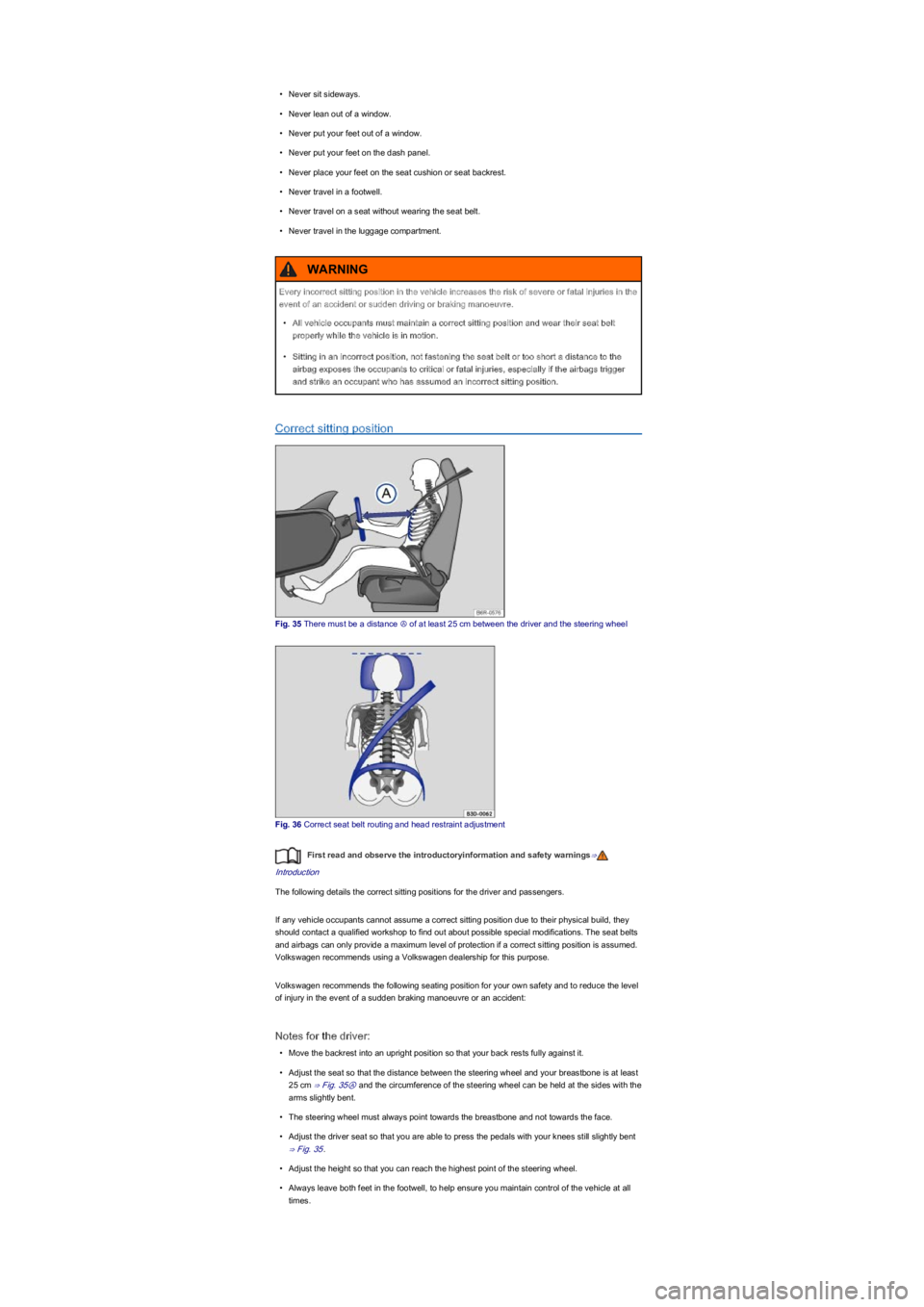
Fig. 35 There must be a distance Ⓐ of at least 25 cm between the driver and the steering wheel
Fig. 36 Correct seat belt routing and head restraint adjustment
First read and observe the introductoryinformation and safety warnings⇒
Introduction
The following details the correct sitting positions for the driver and passengers.
If any vehicle occupants cannot assume a correct sitting position due to their physical build, they
should contact a qualified workshop to find out about possible special modifications. The seat belts
and airbags can only provide a maximum level of protection if a correct sitting position is assumed.
Volkswagen recommends using a Volkswagen dealership for this purpose.
Volkswagen recommends the following seating position for your own safety and to reduce the level
of injury in the event of a sudden braking manoeuvre or an accident:
Notes for the driver:
•Move the backrest into an upright position so that your back rests fully against it.
•Adjust the seat so that the distance between the steering wheel and your breastbone is at least
25 cm ⇒ Fig. 35Ⓐ and the circumference of the steering wheel can be held at the sides with the
arms slightly bent.
•The steering wheel must always point towards the breastbone and not towards the face.
•Adjust the driver seat so that you are able to press the pedals with your knees still slightly bent
⇒ Fig. 35.
•Adjust the height so that you can reach the highest point of the steering wheel.
•Always leave both feet in the footwell, to help ensure you maintain control of the vehicle at all
times.
Every incorrect sitting position in the vehicle increases the risk of severe or fatal injuries in the
event of an accident or sudden driving or braking manoeuvre.
•All vehicle occupants must maintain a correct sitting position and wear their seat belt
properly while the vehicle is in motion.
•Sitting in an incorrect position, not fastening the seat belt or too short a distance to the
airbag exposes the occupants to critical or fatal injuries, especially if the airbags trigger
and strike an occupant who has assumed an incorrect sitting position.
WARNING
Page 38 of 211
Removing and installing the rear head restraint
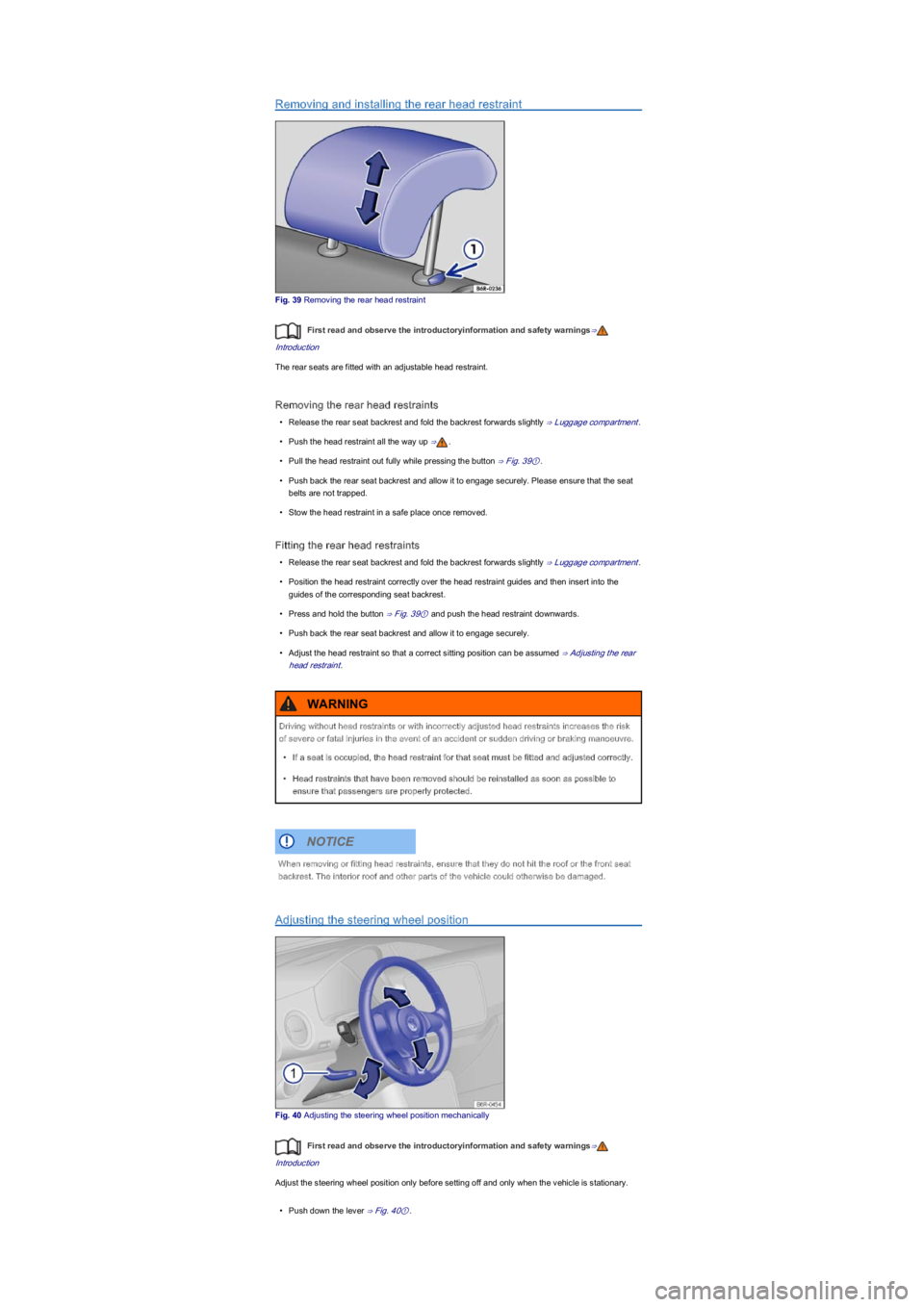
Fig. 39 Removing the rear head restraint
First read and observe the introductoryinformation and safety warnings⇒
Introduction
The rear seats are fitted with an adjustable head restraint.
Removing the rear head restraints
•Release the rear seat backrest and fold the backrest forwards slightly ⇒ Luggage compartment.
•Push the head restraint all the way up ⇒.
•Pull the head restraint out fully while pressing the button ⇒ Fig. 39①.
•Push back the rear seat backrest and allow it to engage securely. Please ensure that the seat
belts are not trapped.
•Stow the head restraint in a safe place once removed.
Fitting the rear head restraints
•Release the rear seat backrest and fold the backrest forwards slightly ⇒ Luggage compartment.
•Position the head restraint correctly over the head restraint guides and then insert into the
guides of the corresponding seat backrest.
•Press and hold the button ⇒ Fig. 39① and push the head restraint downwards.
•Push back the rear seat backrest and allow it to engage securely.
•Adjust the head restraint so that a correct sitting position can be assumed ⇒ Adjusting the rear
head restraint.
Adjusting the steering wheel position
Fig. 40 Adjusting the steering wheel position mechanically
First read and observe the introductoryinformation and safety warnings⇒
Introduction
Adjust the steering wheel position only before setting off and only when the vehicle is stationary.
•Push down the lever ⇒ Fig. 40①.
Driving without head restraints or with incorrectly adjusted head restraints increases the risk
of severe or fatal injuries in the event of an accident or sudden driving or braking manoeuvre.
•If a seat is occupied, the head restraint for that seat must be fitted and adjusted correctly.
•Head restraints that have been removed should be reinstalled as soon as possible to
ensure that passengers are properly protected.
WARNING
When removing or fitting head restraints, ensure that they do not hit the roof or the front seat
backrest. The interior roof and other parts of the vehicle could otherwise be damaged.
NOTICE
Page 48 of 211
Types of front passenger front airbag system
First read and observe the introductoryinformation and safety warnings⇒
Introduction
Never rely solely on the airbag system for your protection.
•Even if an airbag is triggered, it only offers auxiliary protection.
•The airbag system offers the best level of protection, and reduces the risk of injury, when
seat belts are properly worn ⇒ Seat belts.
•Before every trip, each vehicle occupant must adopt the correct sitting position, correctly
fasten the seat belt belonging to their seat and keep it fastened properly throughout the
trip. This applies to all vehicle occupants.
WARNING
The risk of injury increases if there are any objects located between the vehicle occupants
and the deployment area of the airbag when it is triggered. This will alter the deployment zone
of the airbag, or the objects will be flung against the body.
•Never hold any objects in your hand or on your lap while the vehicle is in motion.
•Never transport any objects on the front passenger seat. The objects could enter the
deployment zone of the airbag during sudden braking or driving manoeuvres and then be
flung dangerously through the vehicle interior if the airbag is activated.
•Occupants of the front seats and rear seats must never carry any people, pets or objects
in the deployment space between them and the airbags. Ensure that children and
passengers keep to this rule.
WARNING
The airbag system can only be triggered once. The system will have to be replaced if the
airbags have been triggered.
•Airbags that have been triggered, and any affected system parts, must immediately be
replaced with new parts that are approved by Volkswagen for the vehicle.
•Repairs and modifications to your vehicle should only be carried out by a qualified
workshop. Qualified workshops have the necessary tools, diagnostic equipment, repair
information and qualified personnel.
•Never use recycled airbag components or components that have been taken from end-of-
life vehicles in your vehicle.
•Never alter any components of the airbag system.
WARNING
A fine dust may develop when the airbags trigger. This is normal and does not mean that
there is a fire in the vehicle.
•The fine dust can cause irritation to the skin and eye membranes and cause breathing
difficulties, particularly for people suffering from asthma or people who have (had) other
respiratory problems. To help reduce breathing difficulties, get out of the vehicle or open
the windows or doors for more fresh air.
•If you come into contact with the dust, you should wash your hands and face with a mild
soap and water before eating.
•Do not let the dust get into your eyes or into open wounds.
•If dust has entered your eyes, rinse them with water.
WARNING
Cleaning agents that contain solvents cause the surface of the airbag modules to become
porous. In an accident that triggers the airbag, loose plastic parts can cause serious injury.
•Never clean the dash panel or the airbag covers with cleansers that contain solvents.
WARNING
Page 52 of 211
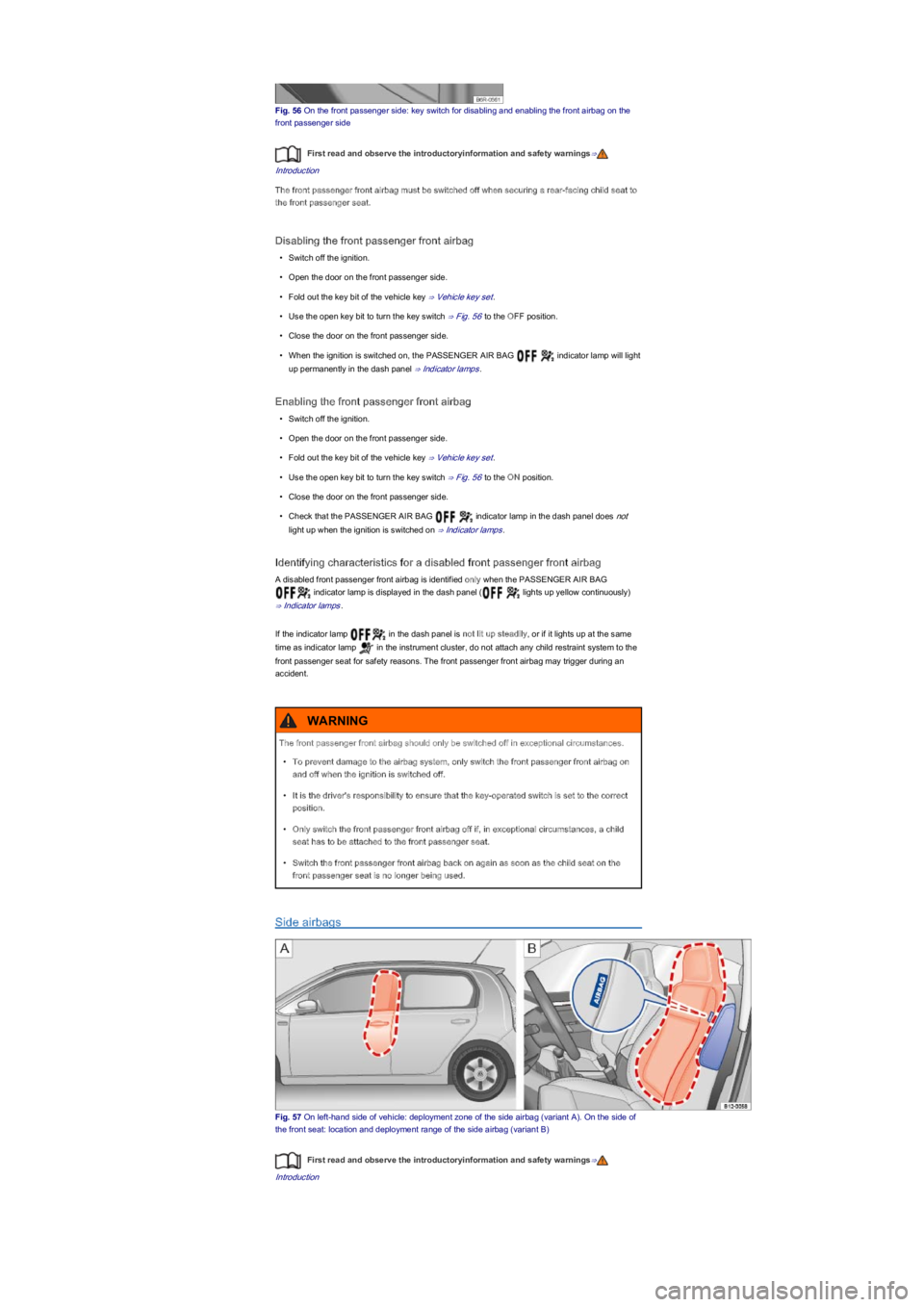
Fig. 56 On the front passenger side: key switch for disabling and enabling the front airbag on the
front passenger side
First read and observe the introductoryinformation and safety warnings⇒
Introduction
The front passenger front airbag must be switched off when securing a rear-facing child seat to
the front passenger seat.
Disabling the front passenger front airbag
•Switch off the ignition.
•Open the door on the front passenger side.
•Fold out the key bit of the vehicle key ⇒ Vehicle key set.
•Use the open key bit to turn the key switch ⇒ Fig. 56 to the OFF position.
•Close the door on the front passenger side.
•When the ignition is switched on, the PASSENGER AIR BAG indicator lamp will light
up permanently in the dash panel ⇒ Indicator lamps.
Enabling the front passenger front airbag
•Switch off the ignition.
•Open the door on the front passenger side.
•Fold out the key bit of the vehicle key ⇒ Vehicle key set.
•Use the open key bit to turn the key switch ⇒ Fig. 56 to the ON position.
•Close the door on the front passenger side.
•Check that the PASSENGER AIR BAG indicator lamp in the dash panel does not
light up when the ignition is switched on ⇒ Indicator lamps.
Identifying characteristics for a disabled front passenger front airbag
A disabled front passenger front airbag is identified only when the PASSENGER AIR BAG
indicator lamp is displayed in the dash panel ( lights up yellow continuously)
⇒ Indicator lamps.
If the indicator lamp in the dash panel is not lit up steadily, or if it lights up at the same
time as indicator lamp in the instrument cluster, do not attach any child restraint system to the
front passenger seat for safety reasons. The front passenger front airbag may trigger during an
accident.
Side airbags
Fig. 57 On left-hand side of vehicle: deployment zone of the side airbag (variant A). On the side of
the front seat: location and deployment range of the side airbag (variant B)
First read and observe the introductoryinformation and safety warnings⇒
Introduction
The front passenger front airbag should only be switched off in exceptional circumstances.
•To prevent damage to the airbag system, only switch the front passenger front airbag on
and off when the ignition is switched off.
•It is the driver's responsibility to ensure that the key-operated switch is set to the correct
position.
•Only switch the front passenger front airbag off if, in exceptional circumstances, a child
seat has to be attached to the front passenger seat.
•Switch the front passenger front airbag back on again as soon as the child seat on the
front passenger seat is no longer being used.
WARNING
Page 55 of 211
Do not leave any toys or other objects loose in the child seat or on the seat while the
vehicle is in motion.
Country-specific standards for child seats (selection)
The child seats must correspond to the standard ECE-R 44. Further information is available from
Volkswagen dealerships or on the Internet at www.volkswagen.com.
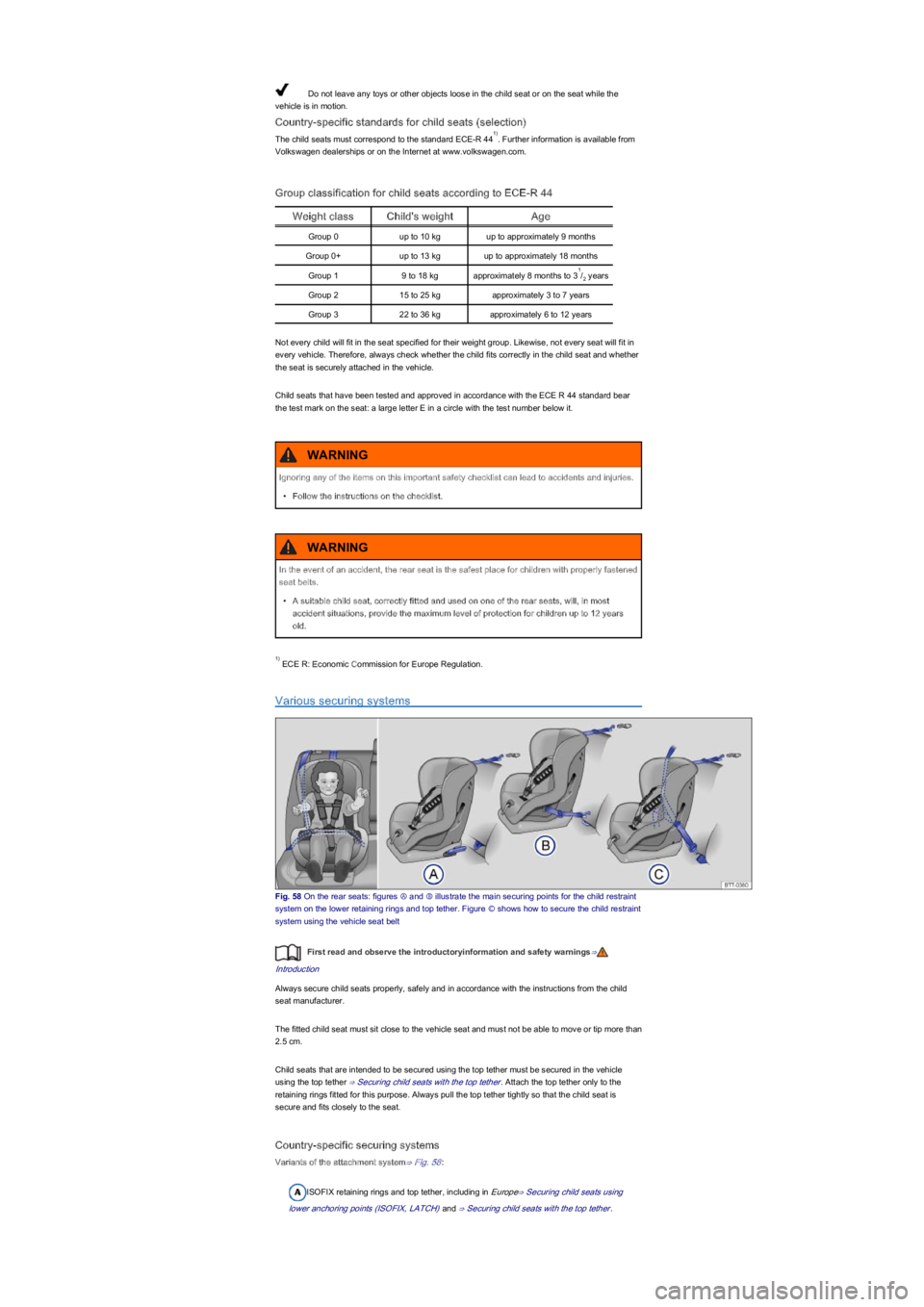
Group classification for child seats according to ECE-R 44
Weight classChild's weightAge
Group 0up to 10 kgup to approximately 9 months
Group 0+up to 13 kgup to approximately 18 months
Group 19 to 18 kgapproximately 8 months to 3/ years
Group 215 to 25 kgapproximately 3 to 7 years
Group 322 to 36 kgapproximately 6 to 12 years
Not every child will fit in the seat specified for their weight group. Likewise, not every seat will fit in
every vehicle. Therefore, always check whether the child fits correctly in the child seat and whether
the seat is securely attached in the vehicle.
Child seats that have been tested and approved in accordance with the ECE R 44 standard bear
the test mark on the seat: a large letter E in a circle with the test number below it.
ECE R: Economic Commission for Europe Regulation.
Various securing systems
Fig. 58 On the rear seats: figures Ⓐ and Ⓑ illustrate the main securing points for the child restraint
system on the lower retaining rings and top tether. Figure Ⓒ shows how to secure the child restraint
system using the vehicle seat belt
First read and observe the introductoryinformation and safety warnings⇒
Introduction
Always secure child seats properly, safely and in accordance with the instructions from the child
seat manufacturer.
The fitted child seat must sit close to the vehicle seat and must not be able to move or tip more than
2.5 cm.
Child seats that are intended to be secured using the top tether must be secured in the vehicle
using the top tether ⇒ Securing child seats with the top tether. Attach the top tether only to the
retaining rings fitted for this purpose. Always pull the top tether tightly so that the child seat is
secure and fits closely to the seat.
Country-specific securing systems
Variants of the attachment system⇒ Fig. 58:
ISOFIX retaining rings and top tether, including in Europe⇒ Securing child seats using
lower anchoring points (ISOFIX, LATCH) and ⇒ Securing child seats with the top tether.
1)
1
2
Ignoring any of the items on this important safety checklist can lead to accidents and injuries.
•Follow the instructions on the checklist.
WARNING
In the event of an accident, the rear seat is the safest place for children with properly fastened
seat belts.
•A suitable child seat, correctly fitted and used on one of the rear seats, will, in most
accident situations, provide the maximum level of protection for children up to 12 years
old.
WARNING
1)
Page 57 of 211
Ensure that the front passenger can still maintain a correct sitting position ⇒ Adjusting the seat
position.
Suitable child seats
The child seat must have been approved by the manufacturer for use on the rear bench seat with
side airbag.
Universal child seats in groups 0, 0+, 1, 2, or 3 as specified in ECE-R 44 can be fitted to the rear
seats.
The seats are suitable for child seats with the ISOFIX system that are specially approved for this
vehicle type by ECE-R 44.
ISOFIX child seats approved for use on rear seats
There are different categories of ISOFIX child seats: universal, semi-universal and vehicle-specific.
•If the ISOFIX child seat has universal approval, the child seat must be fastened with the lower
anchoring points and the top tether.
•If ISOFIX child seats have semi-universal or vehicle-specific approval, a check must be made
prior to use in order to find out whether the child seat has been approved for the vehicle. For
this purpose, the child-seat manufacturer supplies the ISOFIX child seat with a list of vehicles
for which the respective ISOFIX child seat has been approved. If necessary, contact the child
seat manufacturer for an up-to-date list of vehicles.
Securing child seats with a seat belt
First read and observe the introductoryinformation and safety warnings⇒
Introduction
It is permissible to fasten child seats with universal written on the orange label to the seats using
the seat belt, but only on the seats marked in the table with a u.
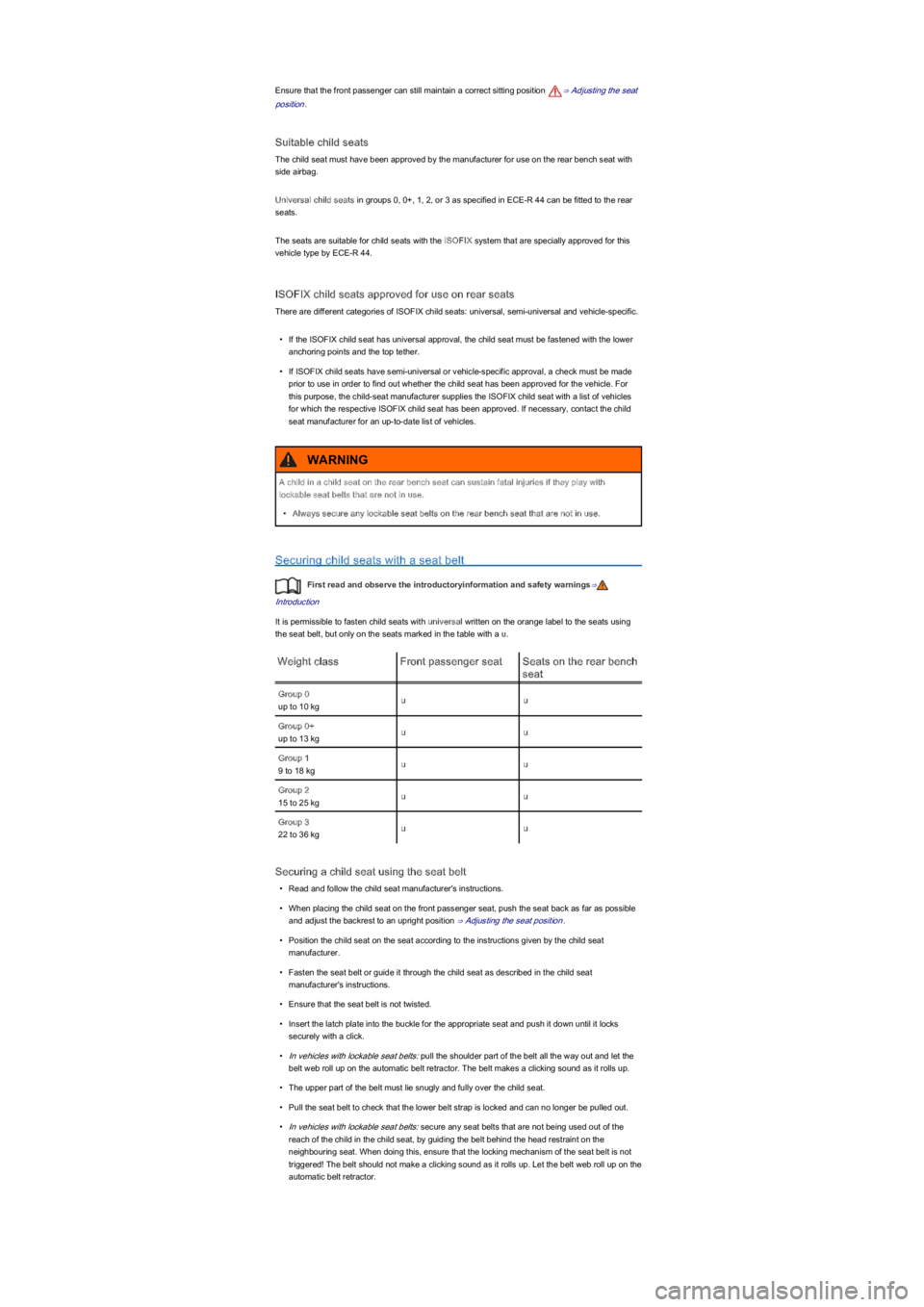
Weight classFront passenger seatSeats on the rear bench
seat
Group 0
up to 10 kguu
Group 0+
up to 13 kguu
Group 1
9 to 18 kguu
Group 2
15 to 25 kguu
Group 3
22 to 36 kguu
Securing a child seat using the seat belt
•Read and follow the child seat manufacturer's instructions.
•When placing the child seat on the front passenger seat, push the seat back as far as possible
and adjust the backrest to an upright position ⇒ Adjusting the seat position.
•Position the child seat on the seat according to the instructions given by the child seat
manufacturer.
•Fasten the seat belt or guide it through the child seat as described in the child seat
manufacturer's instructions.
•Ensure that the seat belt is not twisted.
•Insert the latch plate into the buckle for the appropriate seat and push it down until it locks
securely with a click.
•In vehicles with lockable seat belts: pull the shoulder part of the belt all the way out and let the
belt web roll up on the automatic belt retractor. The belt makes a clicking sound as it rolls up.
•The upper part of the belt must lie snugly and fully over the child seat.
•Pull the seat belt to check that the lower belt strap is locked and can no longer be pulled out.
•In vehicles with lockable seat belts: secure any seat belts that are not being used out of the
reach of the child in the child seat, by guiding the belt behind the head restraint on the
neighbouring seat. When doing this, ensure that the locking mechanism of the seat belt is not
triggered! The belt should not make a clicking sound as it rolls up. Let the belt web roll up on the
automatic belt retractor.
A child in a child seat on the rear bench seat can sustain fatal injuries if they play with
lockable seat belts that are not in use.
•Always secure any lockable seat belts on the rear bench seat that are not in use.
WARNING
Page 60 of 211
Introduction
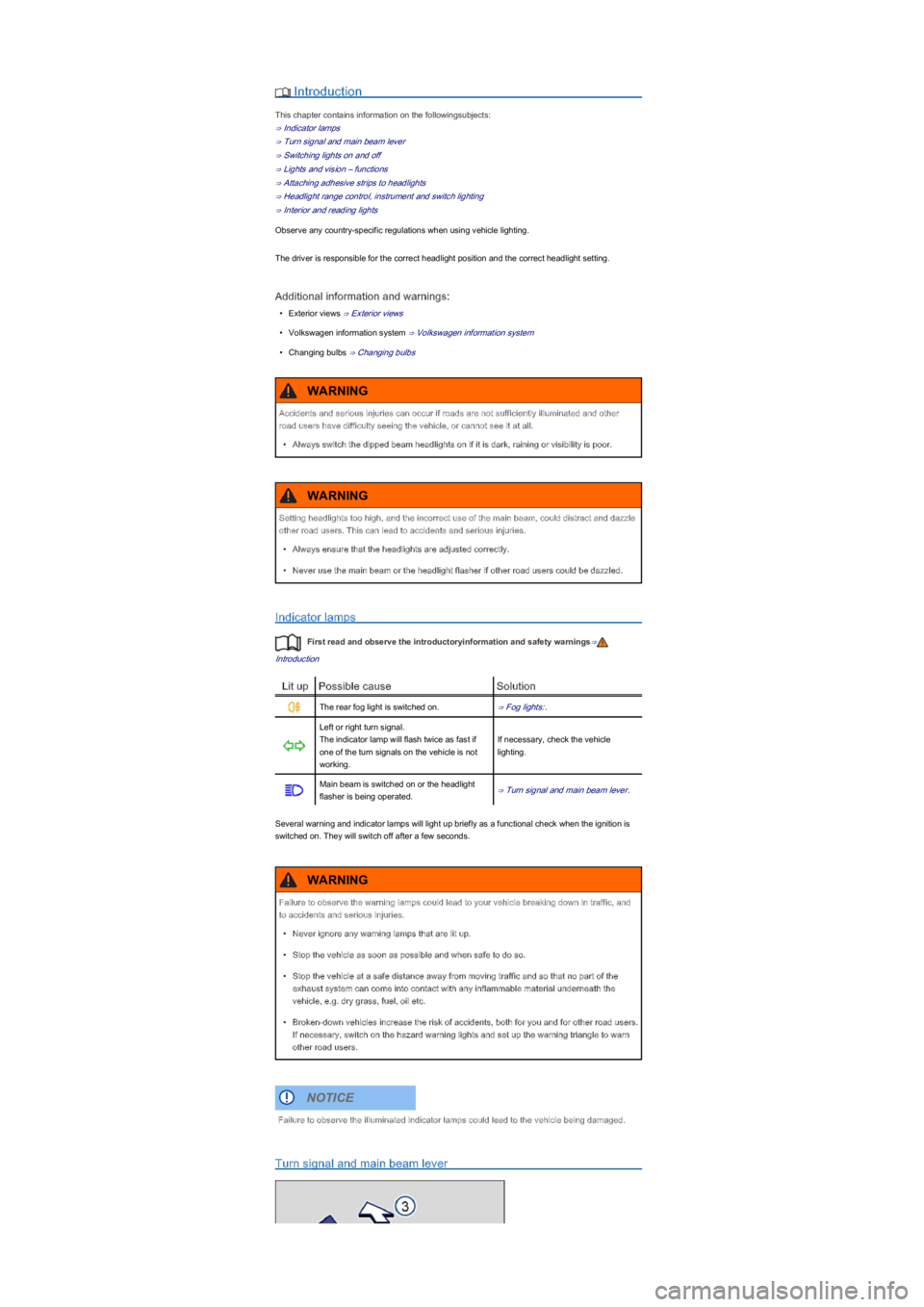
This chapter contains information on the followingsubjects:
⇒ Indicator lamps
⇒ Turn signal and main beam lever
⇒ Switching lights on and off
⇒ Lights and vision – functions
⇒ Attaching adhesive strips to headlights
⇒ Headlight range control, instrument and switch lighting
⇒ Interior and reading lights
Observe any country-specific regulations when using vehicle lighting.
The driver is responsible for the correct headlight position and the correct headlight setting.
Additional information and warnings:
•Exterior views ⇒ Exterior views
•Volkswagen information system ⇒ Volkswagen information system
•Changing bulbs ⇒ Changing bulbs
Indicator lamps
First read and observe the introductoryinformation and safety warnings⇒
Introduction
Lit upPossible causeSolution
The rear fog light is switched on.⇒ Fog lights:.
Left or right turn signal.
The indicator lamp will flash twice as fast if
one of the turn signals on the vehicle is not
working.
If necessary, check the vehicle
lighting.
Main beam is switched on or the headlight
flasher is being operated.⇒ Turn signal and main beam lever.
Several warning and indicator lamps will light up briefly as a functional check when the ignition is
switched on. They will switch off after a few seconds.
Turn signal and main beam lever
Accidents and serious injuries can occur if roads are not sufficiently illuminated and other
road users have difficulty seeing the vehicle, or cannot see it at all.
•Always switch the dipped beam headlights on if it is dark, raining or visibility is poor.
WARNING
Setting headlights too high, and the incorrect use of the main beam, could distract and dazzle
other road users. This can lead to accidents and serious injuries.
•Always ensure that the headlights are adjusted correctly.
•Never use the main beam or the headlight flasher if other road users could be dazzled.
WARNING
Failure to observe the warning lamps could lead to your vehicle breaking down in traffic, and
to accidents and serious injuries.
•Never ignore any warning lamps that are lit up.
•Stop the vehicle as soon as possible and when safe to do so.
•Stop the vehicle at a safe distance away from moving traffic and so that no part of the
exhaust system can come into contact with any inflammable material underneath the
vehicle, e.g. dry grass, fuel, oil etc.
•Broken-down vehicles increase the risk of accidents, both for you and for other road users.
If necessary, switch on the hazard warning lights and set up the warning triangle to warn
other road users.
WARNING
Failure to observe the illuminated indicator lamps could lead to the vehicle being damaged.
NOTICE
Page 66 of 211
The windscreen wipers will only function when the ignition is switched on.
The interval wipe for the windscreen depends on the speed of the vehicle. The wipers will
wipe more frequently as the vehicle moves faster.
The rear window wiper is switched on automatically if the front windscreen wipers are
switched on and reverse gear is engaged.
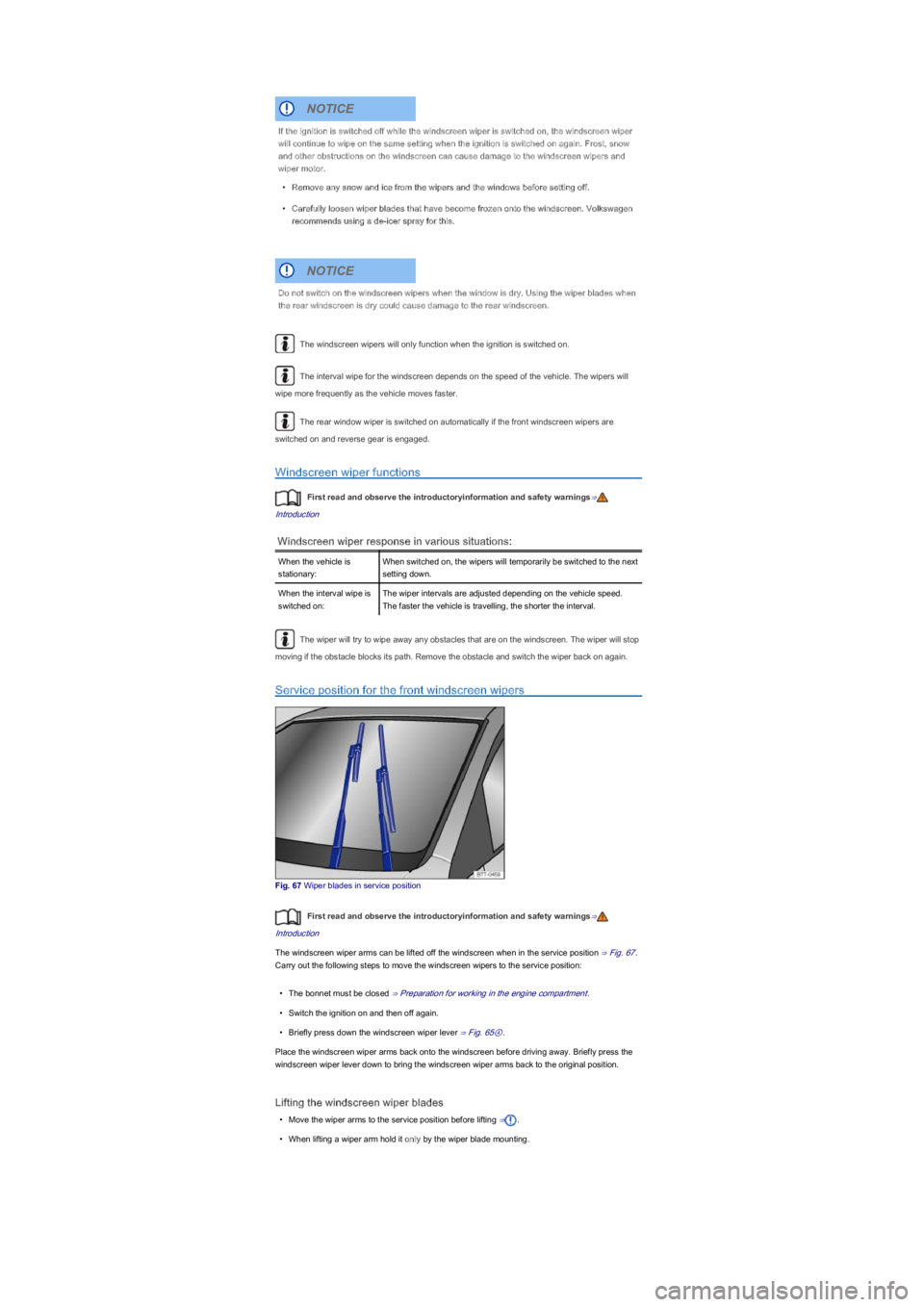
Windscreen wiper functions
First read and observe the introductoryinformation and safety warnings⇒
Introduction
Windscreen wiper response in various situations:
When the vehicle is
stationary:
When switched on, the wipers will temporarily be switched to the next
setting down.
When the interval wipe is
switched on:
The wiper intervals are adjusted depending on the vehicle speed.
The faster the vehicle is travelling, the shorter the interval.
The wiper will try to wipe away any obstacles that are on the windscreen. The wiper will stop
moving if the obstacle blocks its path. Remove the obstacle and switch the wiper back on again.
Service position for the front windscreen wipers
Fig. 67 Wiper blades in service position
First read and observe the introductoryinformation and safety warnings⇒
Introduction
The windscreen wiper arms can be lifted off the windscreen when in the service position ⇒ Fig. 67.
Carry out the following steps to move the windscreen wipers to the service position:
•The bonnet must be closed ⇒ Preparation for working in the engine compartment.
•Switch the ignition on and then off again.
•Briefly press down the windscreen wiper lever ⇒ Fig. 65④.
Place the windscreen wiper arms back onto the windscreen before driving away. Briefly press the
windscreen wiper lever down to bring the windscreen wiper arms back to the original position.
Lifting the windscreen wiper blades
•Move the wiper arms to the service position before lifting ⇒.
•When lifting a wiper arm hold it only by the wiper blade mounting.
If the ignition is switched off while the windscreen wiper is switched on, the windscreen wiper
will continue to wipe on the same setting when the ignition is switched on again. Frost, snow
and other obstructions on the windscreen can cause damage to the windscreen wipers and
wiper motor.
•Remove any snow and ice from the wipers and the windows before setting off.
•Carefully loosen wiper blades that have become frozen onto the windscreen. Volkswagen
recommends using a de-icer spray for this.
NOTICE
Do not switch on the windscreen wipers when the window is dry. Using the wiper blades when
the rear windscreen is dry could cause damage to the rear windscreen.
NOTICE