ESP VOLKSWAGEN UP! 2021 Owner´s Manual
[x] Cancel search | Manufacturer: VOLKSWAGEN, Model Year: 2021, Model line: UP!, Model: VOLKSWAGEN UP! 2021Pages: 211, PDF Size: 5.98 MB
Page 159 of 211
The tyres and wheel rims are an essential part of the vehicle's design. The tyres and rims approved
by Volkswagen are specifically matched to the characteristics of the vehicle and make a major
contribution to good road holding and safe handling.
Avoiding damage to the tyres
•If you have to drive over a kerb or similar obstacle, drive slowly and at a right angle if possible.
•Inspect the tyres regularly for damage such as cuts, cracks or blisters.
•Remove foreign objects that are in the outer tyre tread and have not penetrated the inner
tyre⇒ Tyre damage.
•Always respond to any warning messages given by the tyre monitoring system.
•Damaged or worn tyres must be replaced immediately ⇒ Tyre damage.
•Regularly check the tyres for hidden damage ⇒ Tyre damage.
•Never exceed the top speed and load permitted for the tyres that are fitted ⇒ Tyre lettering.
•Protect the wheels, including the spare wheel, from contact with corrosive substances, including
oils, lubricants, fuel and brake fluid ⇒.
•Replace missing dust caps immediately.
Tyres with directional tread pattern
Tyres with directional tread pattern have been developed to roll in one direction only. An arrow on
the tyre sidewall indicates the direction of rotation on tyres with directional tread ⇒ Tyre lettering.
The direction of rotation must be adhered to. This is the only guarantee for optimum grip and helps
to avoid aquaplaning, excessive noise and wear.
If, however, the tyre is fitted in the opposite direction to the tread pattern, you must take more care
when driving as the tyre is now no longer being used according to its designation. This is
particularly important on wet roads. The tyres must be replaced as quickly as possible or be fitted
with the tread in the correct direction.
Rotating wheels front to rear
Regularly rotating the wheels as shown in the illustration ⇒ Fig. 130 is recommended to help
ensure that tyres wear evenly. All the tyres will then last for about the same time.
Volkswagen recommends having the wheels changed by a qualified workshop.
Tyres that are older than 6 years
Tyres age through physical and chemical processes that can impair their function. Tyres that are
stored unused for an extended period will harden and become brittle more quickly than tyres which
are in constant use.
Volkswagen recommends replacing tyres that are older than 6 years with new tyres. This also
applies to tyres, including the spare wheel, which appear to still be in good condition and whose
tread depth has not yet reached the minimum value stipulated by legislation ⇒.
The age of a tyre can be determined from the manufacturing date, which is a component of the tyre
identification number () ⇒ Tyre lettering.
Storing tyres
Mark tyres before you remove them to indicate the direction of rotation. This ensures you will be
able to mount them correctly when you replace them (left, right, front, rear). When removed, the
wheels or tyres should be stored in a cool, dry and preferably dark place. Do not store tyres
mounted on the rim vertically.
Any tyres not fitted on rims should be kept in suitable sleeves to protect against dirt and should be
stored vertically (standing on the tread).
Old tyres should be disposed of as required by legislation.
Corrosive liquids and other substances can cause visible and invisible damage to the tyres,
which can cause the tyre to burst.
•Always keep chemicals, oils, lubricants, fuel, brake fluid and other corrosive substances
away from the tyres.
WARNING
Old tyres – even if they have not been used – can suddenly lose pressure or burst, especially
at high speeds, and thus cause accidents and serious injuries.
•Avoid using tyres that are more than six years old. If you have no alternative, drive slowly
and with extra care at all times.
WARNING
Page 161 of 211
•The tread depth of new tyres may vary, according to the type and make of tyre and the tread
pattern.
Replacing tyres
•Tyres should be replaced at least in pairs and not individually (i.e. both front tyres or both rear
tyres together) ⇒.
•Old tyres should only be replaced by tyres that have been approved by Volkswagen for the
vehicle type. Ensure that the tyres used are correct in respect of size, diameter, load-carrying
capacity and maximum speed.
•Never use tyres with an effective size that is larger than Volkswagen-approved tyres. Larger
wheels could rub against the body or other parts of the vehicle.
Despite identical size details, the actual size of the various tyre makes may vary from these
specified dimensions, or the tyre contours may vary considerably.
Volkswagen-approved tyres are guaranteed to have the dimensions that are suitable for the
vehicle. The salesperson will have to provide a certificate from the tyre manufacturer for other tyre
makes to prove that the tyre is also suitable for the vehicle. This certificate must be stored in a safe
place in the vehicle.
Tyre pressure
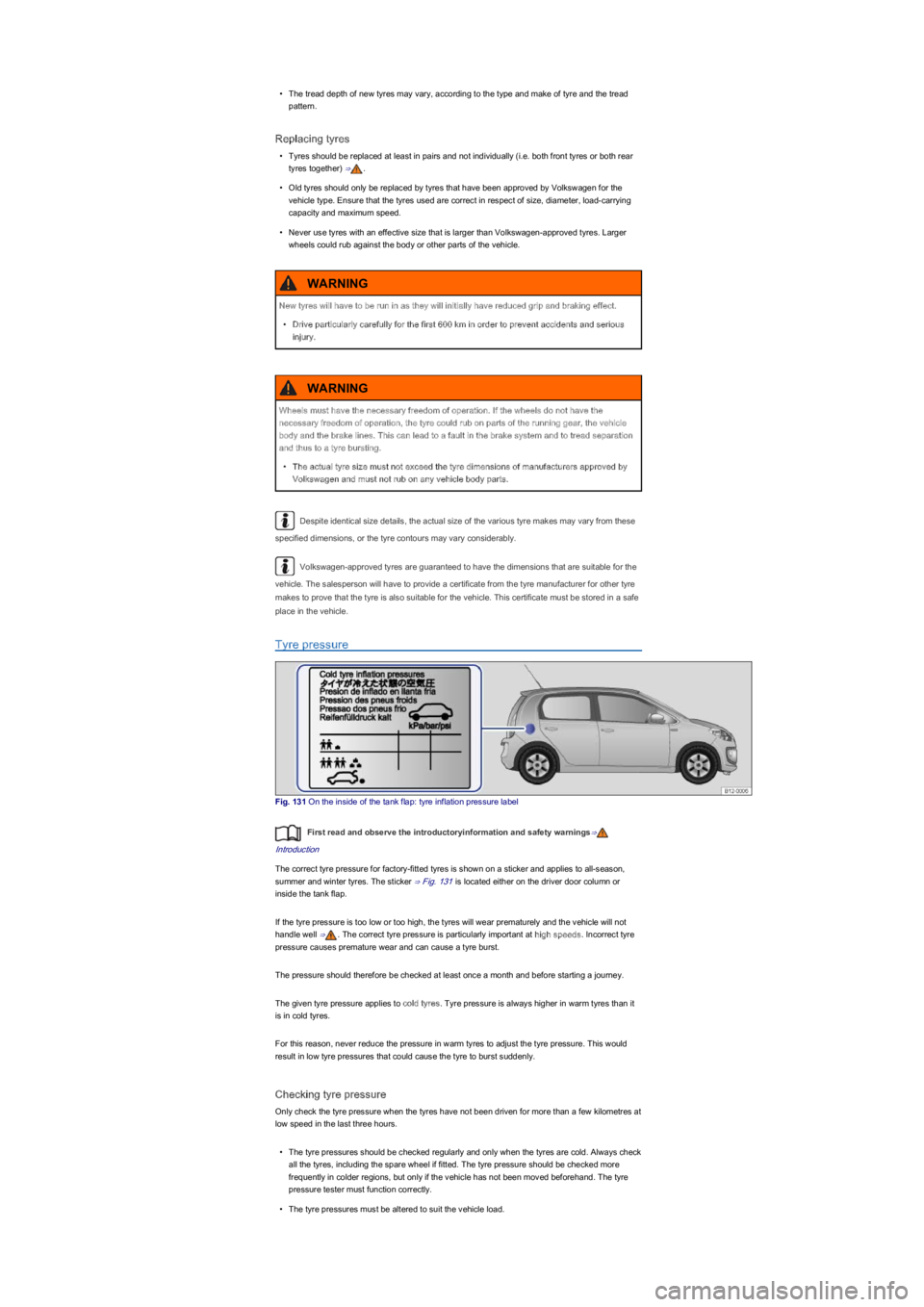
Fig. 131 On the inside of the tank flap: tyre inflation pressure label
First read and observe the introductoryinformation and safety warnings⇒
Introduction
The correct tyre pressure for factory-fitted tyres is shown on a sticker and applies to all-season,
summer and winter tyres. The sticker ⇒ Fig. 131 is located either on the driver door column or
inside the tank flap.
If the tyre pressure is too low or too high, the tyres will wear prematurely and the vehicle will not
handle well ⇒. The correct tyre pressure is particularly important at high speeds. Incorrect tyre
pressure causes premature wear and can cause a tyre burst.
The pressure should therefore be checked at least once a month and before starting a journey.
The given tyre pressure applies to cold tyres. Tyre pressure is always higher in warm tyres than it
is in cold tyres.
For this reason, never reduce the pressure in warm tyres to adjust the tyre pressure. This would
result in low tyre pressures that could cause the tyre to burst suddenly.
Checking tyre pressure
Only check the tyre pressure when the tyres have not been driven for more than a few kilometres at
low speed in the last three hours.
•The tyre pressures should be checked regularly and only when the tyres are cold. Always check
all the tyres, including the spare wheel if fitted. The tyre pressure should be checked more
frequently in colder regions, but only if the vehicle has not been moved beforehand. The tyre
pressure tester must function correctly.
•The tyre pressures must be altered to suit the vehicle load.
New tyres will have to be run in as they will initially have reduced grip and braking effect.
•Drive particularly carefully for the first 600 km in order to prevent accidents and serious
injury.
WARNING
Wheels must have the necessary freedom of operation. If the wheels do not have the
necessary freedom of operation, the tyre could rub on parts of the running gear, the vehicle
body and the brake lines. This can lead to a fault in the brake system and to tread separation
and thus to a tyre bursting.
•The actual tyre size must not exceed the tyre dimensions of manufacturers approved by
Volkswagen and must not rub on any vehicle body parts.
WARNING
Page 163 of 211
Tyre damage
First read and observe the introductoryinformation and safety warnings⇒
Introduction
Damage to tyres and rims is often not readily visible. Any unusual vibrations or signs that the car is
pulling to one side may indicate that one of the tyres is damaged ⇒.
•Reduce your speed immediately if you suspect that a wheel is damaged.
•Check the tyres and rims for damage.
•If the tyre is damaged, do not drive on. Seek expert assistance.
•If there is no visible damage, drive slowly and cautiously to the next qualified workshop in order
to have the vehicle checked.
Foreign bodies in the tyre
•Leave the foreign body in the tyre if it has entered the inner tyre. However, foreign bodies that
are stuck between the tyre tread blocks can be removed.
•For vehicles with a spare wheel or temporary spare wheel: where appropriate, change the
damaged wheel ⇒ Changing a wheel If required, seek expert assistance when changing the
damaged wheel. Volkswagen recommends using a Volkswagen dealership for this purpose.
•For vehicles with a breakdown set: if required, seal the tyre and pump it up using the
breakdown set ⇒ Breakdown set. Proceed to a qualified workshop. Volkswagen recommends
using a Volkswagen dealership for this purpose.
•Check the pressure and adjust it as required.
Tyre wear
Tyre wear is affected by several factors. These include:
•Driving style.
•Unbalanced wheels.
•Running gear setting.
Driving style – fast cornering, heavy acceleration and hard braking all increase tyre wear. The
running gear should be checked by a qualified workshop if the tyres show excessive wear despite a
normal driving style.
Unbalanced wheels – the wheels on new vehicles are balanced. However, various factors
encountered in normal driving can cause them to become unbalanced, which results in steering
vibration. Unbalanced wheels will affect levels of wear on the steering system and the suspension.
In this case the wheels should be balanced again. A new tyre will have to be balanced after fitting.
Running gear setting – incorrect wheel alignment causes excessive tyre wear, impairing the safety
of the vehicle. The wheel alignment should be checked by a qualified workshop if tyres show
excessive wear.
Spare wheel or temporary spare wheel
Worn tyres are a safety risk and can lead to a loss of control of the vehicle and cause serious
injury.
•Tyres must be replaced at the latest when the tread is worn down to the tread wear
indicators.
•Worn tyres have considerably less tread, particularly on wet roads, which can cause the
vehicle to glide along the road surface (aquaplaning).
•Worn tyres reduce the possibility of controlling the vehicle well in normal and difficult
driving situations and increase braking distance and the risk of sliding.
WARNING
If you notice unusual vibration or the car pulling to one side while the vehicle is in motion, this
may indicate that one of the tyres is damaged.
•Reduce speed immediately and park the vehicle without obstructing traffic.
•Check the tyres and rims for damage.
•Never drive on if wheels or tyres are damaged. Seek expert assistance instead.
•If there is no visible damage, drive slowly and cautiously to the next qualified workshop in
order to have the vehicle checked.
WARNING
Page 166 of 211
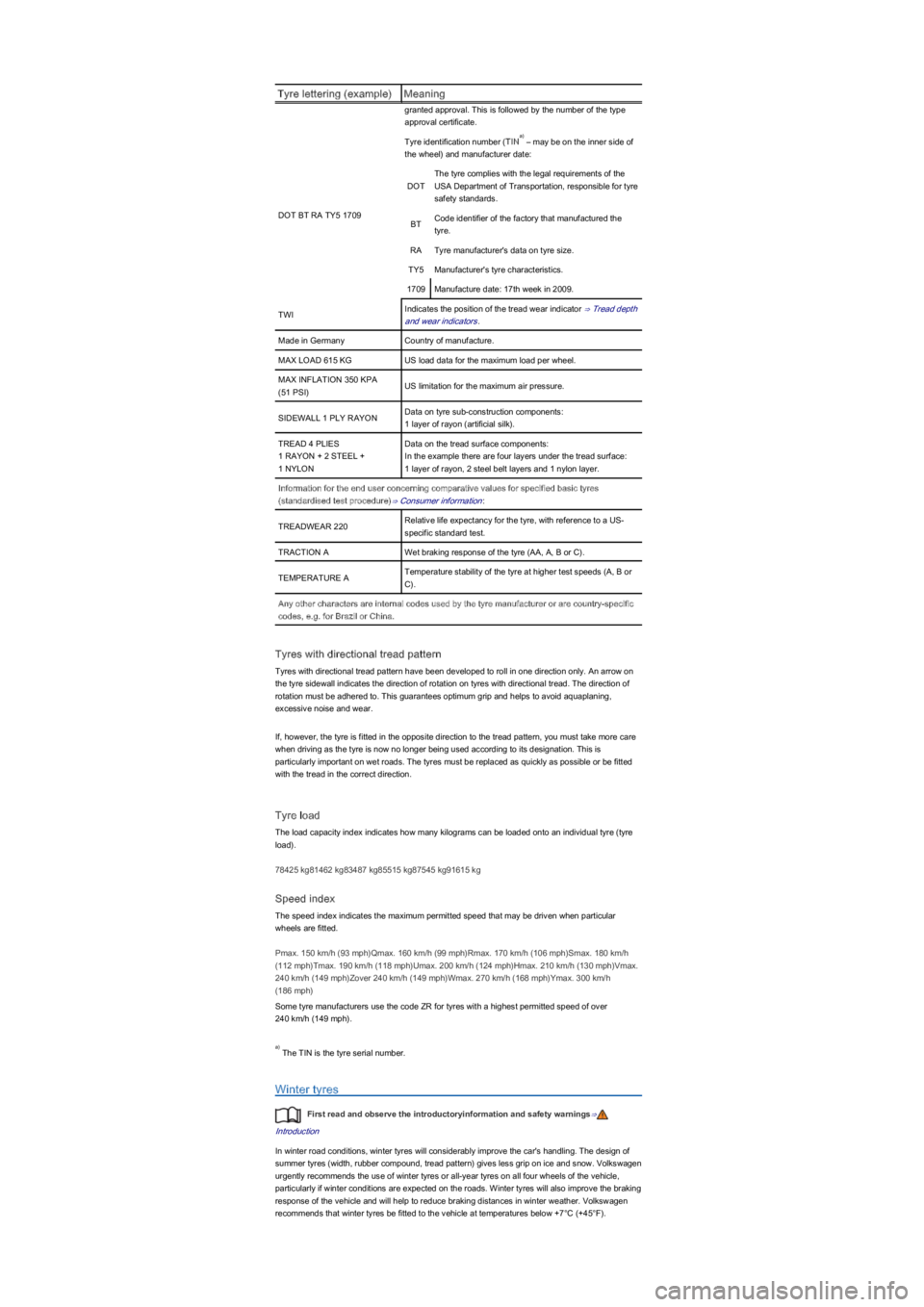
Tyre lettering (example)Meaning
granted approval. This is followed by the number of the type
approval certificate.
DOT BT RA TY5 1709
Tyre identification number (TIN – may be on the inner side of
the wheel) and manufacturer date:
DOT
The tyre complies with the legal requirements of the
USA Department of Transportation, responsible for tyre
safety standards.
BTCode identifier of the factory that manufactured the
tyre.
RATyre manufacturer's data on tyre size.
TY5Manufacturer's tyre characteristics.
1709Manufacture date: 17th week in 2009.
TWIIndicates the position of the tread wear indicator ⇒ Tread depth
and wear indicators.
Made in GermanyCountry of manufacture.
MAX LOAD 615 KGUS load data for the maximum load per wheel.
MAX INFLATION 350 KPA
(51 PSI)US limitation for the maximum air pressure.
SIDEWALL 1 PLY RAYONData on tyre sub-construction components:
1 layer of rayon (artificial silk).
TREAD 4 PLIES
1 RAYON + 2 STEEL +
1 NYLON
Data on the tread surface components:
In the example there are four layers under the tread surface:
1 layer of rayon, 2 steel belt layers and 1 nylon layer.
Information for the end user concerning comparative values for specified basic tyres
(standardised test procedure)⇒ Consumer information:
TREADWEAR 220Relative life expectancy for the tyre, with reference to a US-
specific standard test.
TRACTION AWet braking response of the tyre (AA, A, B or C).
TEMPERATURE ATemperature stability of the tyre at higher test speeds (A, B or
C).
Any other characters are internal codes used by the tyre manufacturer or are country-specific
codes, e.g. for Brazil or China.
Tyres with directional tread pattern
Tyres with directional tread pattern have been developed to roll in one direction only. An arrow on
the tyre sidewall indicates the direction of rotation on tyres with directional tread. The direction of
rotation must be adhered to. This guarantees optimum grip and helps to avoid aquaplaning,
excessive noise and wear.
If, however, the tyre is fitted in the opposite direction to the tread pattern, you must take more care
when driving as the tyre is now no longer being used according to its designation. This is
particularly important on wet roads. The tyres must be replaced as quickly as possible or be fitted
with the tread in the correct direction.
Tyre load
The load capacity index indicates how many kilograms can be loaded onto an individual tyre (tyre
load).
78425 kg81462 kg83487 kg85515 kg87545 kg91615 kg
Speed index
The speed index indicates the maximum permitted speed that may be driven when particular
wheels are fitted.
Pmax. 150 km/h (93 mph)Qmax. 160 km/h (99 mph)Rmax. 170 km/h (106 mph)Smax. 180 km/h
(112 mph)Tmax. 190 km/h (118 mph)Umax. 200 km/h (124 mph)Hmax. 210 km/h (130 mph)Vmax.
240 km/h (149 mph)Zover 240 km/h (149 mph)Wmax. 270 km/h (168 mph)Ymax. 300 km/h
(186 mph)
Some tyre manufacturers use the code ZR for tyres with a highest permitted speed of over
240 km/h (149 mph).
The TIN is the tyre serial number.
Winter tyres
First read and observe the introductoryinformation and safety warnings⇒
Introduction
In winter road conditions, winter tyres will considerably improve the car's handling. The design of
summer tyres (width, rubber compound, tread pattern) gives less grip on ice and snow. Volkswagen
urgently recommends the use of winter tyres or all-year tyres on all four wheels of the vehicle,
particularly if winter conditions are expected on the roads. Winter tyres will also improve the braking
response of the vehicle and will help to reduce braking distances in winter weather. Volkswagen
recommends that winter tyres be fitted to the vehicle at temperatures below +7°C (+45°F).
a)
a)
Page 167 of 211
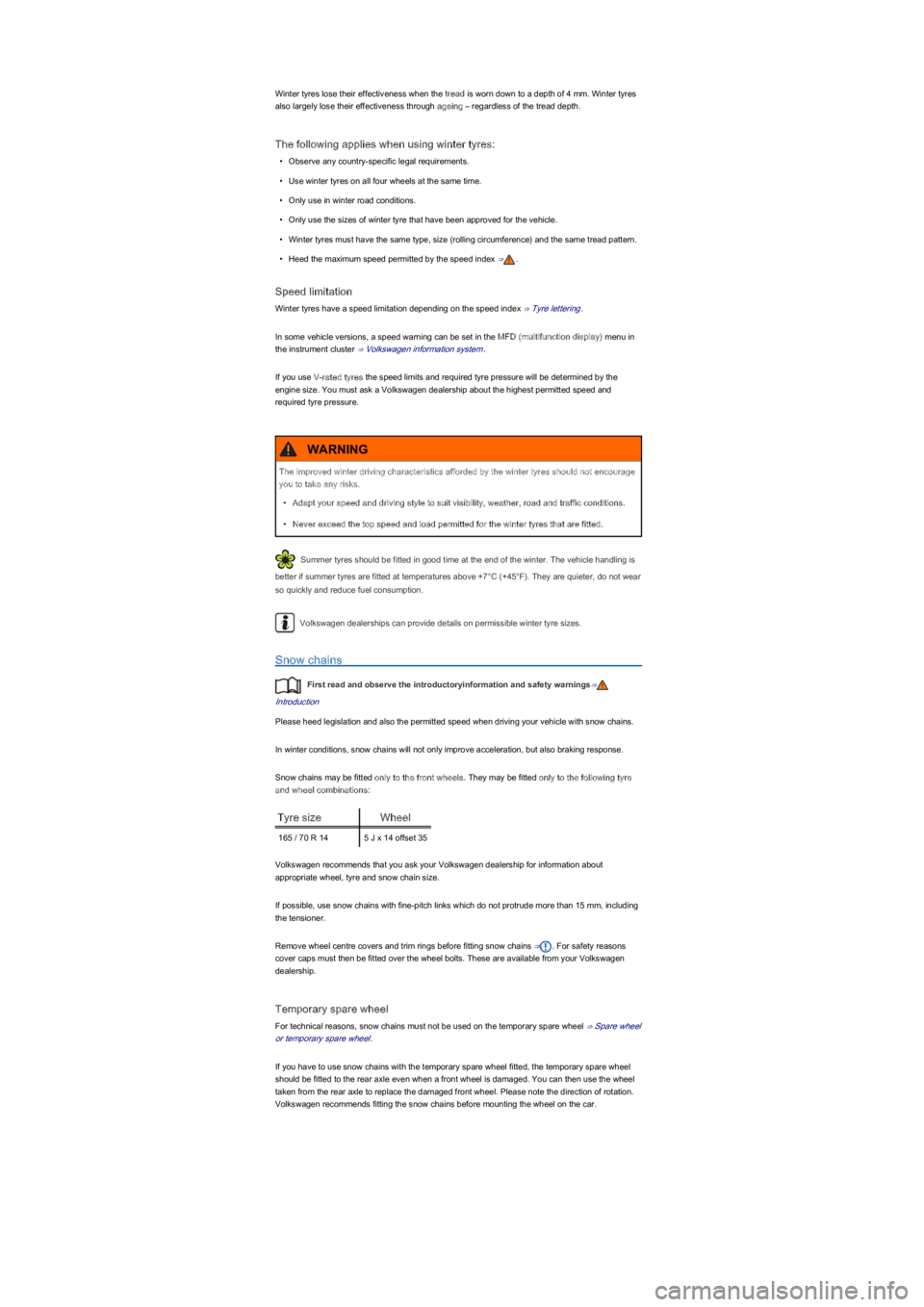
Winter tyres lose their effectiveness when the tread is worn down to a depth of 4 mm. Winter tyres
also largely lose their effectiveness through ageing – regardless of the tread depth.
The following applies when using winter tyres:
•Observe any country-specific legal requirements.
•Use winter tyres on all four wheels at the same time.
•Only use in winter road conditions.
•Only use the sizes of winter tyre that have been approved for the vehicle.
•Winter tyres must have the same type, size (rolling circumference) and the same tread pattern.
•Heed the maximum speed permitted by the speed index ⇒.
Speed limitation
Winter tyres have a speed limitation depending on the speed index ⇒ Tyre lettering.
In some vehicle versions, a speed warning can be set in the MFD (multifunction display) menu in
the instrument cluster ⇒ Volkswagen information system.
If you use V-rated tyres the speed limits and required tyre pressure will be determined by the
engine size. You must ask a Volkswagen dealership about the highest permitted speed and
required tyre pressure.
Summer tyres should be fitted in good time at the end of the winter. The vehicle handling is
better if summer tyres are fitted at temperatures above +7°C (+45°F). They are quieter, do not wear
so quickly and reduce fuel consumption.
Volkswagen dealerships can provide details on permissible winter tyre sizes.
Snow chains
First read and observe the introductoryinformation and safety warnings⇒
Introduction
Please heed legislation and also the permitted speed when driving your vehicle with snow chains.
In winter conditions, snow chains will not only improve acceleration, but also braking response.
Snow chains may be fitted only to the front wheels. They may be fitted only to the following tyre
and wheel combinations:
Tyre sizeWheel
165 / 70 R 145 J x 14 offset 35
Volkswagen recommends that you ask your Volkswagen dealership for information about
appropriate wheel, tyre and snow chain size.
If possible, use snow chains with fine-pitch links which do not protrude more than 15 mm, including
the tensioner.
Remove wheel centre covers and trim rings before fitting snow chains ⇒. For safety reasons
cover caps must then be fitted over the wheel bolts. These are available from your Volkswagen
dealership.
Temporary spare wheel
For technical reasons, snow chains must not be used on the temporary spare wheel ⇒ Spare wheel
or temporary spare wheel.
If you have to use snow chains with the temporary spare wheel fitted, the temporary spare wheel
should be fitted to the rear axle even when a front wheel is damaged. You can then use the wheel
taken from the rear axle to replace the damaged front wheel. Please note the direction of rotation.
Volkswagen recommends fitting the snow chains before mounting the wheel on the car.
The improved winter driving characteristics afforded by the winter tyres should not encourage
you to take any risks.
•Adapt your speed and driving style to suit visibility, weather, road and traffic conditions.
•Never exceed the top speed and load permitted for the winter tyres that are fitted.
WARNING
Page 169 of 211
Running-in
First read and observe the introductoryinformation and safety warnings⇒
Introduction
Please follow the regulations concerning running-in new parts.
Running in a new engine
Any new engine has to be run in during the first 1,500 kilometres. During its first few hours of
running, the internal friction in the engine is greater than later on when all the moving parts have
bedded down.
The style of driving during the first 1,500 kilometres will also affect the engine quality. Even after
this time – and especially with a cold engine – drive the vehicle at moderate speeds in order to
reduce engine wear and to increase the mileage that the engine can cover. Do not drive at engine
speeds that are too low. Always shift down gear if the engine is not running smoothly. The
following applies up to 1,000 kilometres:
•Do not depress the accelerator fully.
•Do not drive the vehicle at more than 2/3 of the top engine speed.
From 1,000 to 1,500 kilometres, gradually increase driving performance to top speed and highest
engine speed.
Running in new tyres and brake pads
•New wheels and tyres ⇒ Wheels and tyres
•Information on the brakes ⇒ Braking, stopping and parking
If the engine is run in gently, the life of the engine will be increased and its oil consumption
reduced.
Accessories and parts
First read and observe the introductoryinformation and safety warnings⇒
Introduction
Volkswagen recommends that you seek advice from a Volkswagen dealership before purchasing
accessories, spare parts or service fluids. For example, if the vehicle is to be retrofitted with
accessories or if parts have to be renewed. Volkswagen dealerships can recommend accessories,
parts and service fluids suitable for your requirements. They can also answer any questions you
might have regarding official regulations.
Volkswagen recommends that you only use approved Volkswagen accessories and Volkswagen
Genuine Parts. These parts and accessories have been specially tested by Volkswagen for
suitability, reliability and safety. And Volkswagen dealerships are qualified to install them correctly.
Although the market is constantly scrutinised, Volkswagen cannot assume responsibility for the
reliability, safety and suitability of products Volkswagen has not approved. Volkswagen can
therefore assume no responsibility for these parts, even if they have been approved by an official
testing agency or are covered by an official approval certificate.
Any retro-fitted equipment that has a direct effect on the vehicle and/or the way it is driven must be
approved by Volkswagen for use in your vehicle and bear the e mark (the European Union's
authorization symbol). These devices include cruise control systems or an electronically controlled
suspension.
Any additional electrical components fitted that do not serve to control the vehicle itself must bear
the mark (manufacturer conformity declaration in the European Union). Such devices include
refrigerator boxes, laptops and ventilator fans.
Unsuitable spare parts and accessories, incorrectly carried out work, modifications and
repairs can lead to damage to the vehicle and cause accidents and serious injuries.
•Volkswagen strongly recommends that you only use approved Volkswagen accessories
and Volkswagen Genuine Parts. These parts and accessories have been specially tested
by Volkswagen for suitability, reliability and safety.
•Repairs and modifications to your vehicle should only be carried out by a qualified
workshop. Qualified workshops have the necessary tools, diagnostic equipment, repair
information and qualified personnel.
•Never fit parts to your vehicle that are in any way different from the factory-fitted parts.
•Never secure or mount objects such as drink holders or telephone holders on or next to
the airbag covers or within the deployment zone of the airbag.
•Only use rim/tyre combinations that have been approved by Volkswagen for your vehicle
type.
WARNING
®
®
Page 170 of 211
Service fluids and consumables
First read and observe the introductoryinformation and safety warnings⇒
Introduction
All service fluids and consumables, e.g. toothed belts, tyres, coolant, engine oil, spark plugs and
vehicle batteries, are being constantly developed. For this reason, service fluids and consumables
should be replaced at a qualified workshop. A Volkswagen dealership is always kept up to date on
innovations.
Leaking service fluids can pollute the environment. Spilt service fluids must be collected in
suitable containers and disposed of properly and with respect for the environment.
Repairs and technical modifications
First read and observe the introductoryinformation and safety warnings⇒
Introduction
Repairs and modifications must always be carried out according to Volkswagen specifications⇒
.
Unauthorised modifications to the electronic components or software in the vehicle may cause
faults. As the electronic components are linked together in networks, these faults may indirectly
affect the working of other systems. This can seriously impair safety, lead to excessive wear of
components, and also invalidate the type approval for the vehicle.
The Volkswagen dealership cannot be held liable for any damage caused by technical
modifications and/or work performed incorrectly.
The Volkswagen dealership cannot be held liable for any damage caused by technical
modifications and/or work performed incorrectly, nor are these covered by the Volkswagen
guarantee.
Volkswagen recommends that all repairs and technical modifications are performed by an
authorised Volkswagen dealership using Volkswagen Genuine Parts.
Vehicles with special auxiliary equipment or body parts
The manufacturer of these components must ensure that these parts (fittings) adhere to the
stipulated environmental laws and regulations, particularly the EU directive 2000/53/EC concerning
end-of-life vehicles and EU directive 2003/11/EC concerning the restriction on the marketing and
use of certain dangerous substances and preparations.
Incorrectly performed repairs or modifications to your vehicle can impair the effectiveness of
the airbags, cause faults, accidents and fatal injury.
•Never secure or mount objects such as drink holders or telephone holders either on or
next to the airbag covers or within the deployment zones of the airbag modules.
•Objects either on or next to the airbag module covers or are in the deployment zone of the
airbags can cause serious or even fatal injuries should the airbags be activated.
WARNING
Unsuitable service fluids and consumables, and the incorrect use of these fluids and
consumables, can cause accidents, serious injuries, burns or poisoning.
•Service fluids must be kept in their original sealed container.
•Never store service fluids in empty food containers, bottles or any other non-original
containers as people finding these containers could drink them.
•Keep children away from all service fluids and consumables.
•Always read and follow the information and warnings on the service fluid packaging.
•When using products that give off harmful fumes, always work outdoors or in a well-
ventilated area.
•Never use fuel, turpentine, engine oil, nail varnish remover or other volatile fluids for
vehicle care. They are toxic and highly flammable. They could cause fires and explosions.
WARNING
•Only use suitable service fluids for refilling. Never use the wrong service fluid. Failure to
observe this warning can result in serious malfunctions and engine damage.
•Optional equipment and other accessories in front of the air inlet reduce the cooling effect
of the coolant. The engine may overheat at high ambient temperatures and high engine
loads.
NOTICE
®
Page 172 of 211
You will need an external aerial to use a two-way radio in the vehicle.
Any retrofit installation of electrical or electronic equipment in the vehicle will affect its vehicle type
approval. Under certain circumstances, this can negate the type approval for the vehicle.
Volkswagen has approved the vehicle for use with two-way radios subject to the following
conditions:
•Correct installation of external aerial.
•A maximum transmitting power of 10 watts.
An external aerial is needed to give the equipment its optimal range.
Check first with a qualified workshop if you wish to use a two-way radio with a transmitting power of
over 10 watts. A qualified workshop is familiar with the technical options for retrofitting. Volkswagen
recommends using a Volkswagen dealership for this purpose.
Please observe legislation and the instructions and information given in the operating manuals for
radio equipment.
Information stored in the control units
First read and observe the introductoryinformation and safety warnings⇒
Introduction
Your vehicle is factory fitted with electronic control units which are responsible for engine and
gearbox management. The control units also monitor the function of the exhaust system and the
airbags.
These electronic control units continuously evaluate data relevant to the vehicle while the vehicle is
being driven. Only these data will be stored if there are any faults recorded or any deviations from
the specified values. This is generally displayed by the indicator lamps on the instrument cluster.
Special units are required to read and evaluate data stored in the control units.
These data are stored so that specialist workshops can diagnose and solve problems. The
following data may have been stored:
•Engine and gearbox-relevant data.
•Speed.
•Direction of travel.
•Braking power.
•Seat belt monitor.
The control units never record conversations that take place in the vehicle. It is neither possible nor
permitted to use the stored data to create movement profiles.
When the vehicle is being used, situations may arise in which the stored data (alone or in
conjunction with other information such as accident reports, vehicle damage, witness statements
etc.) can become assignable to a particular person, in which case it may be necessary to consult an
expert and use the expert's information.
In vehicles with an emergency call function via a mobile telephone or other units, the current
location can be transmitted. In the event of an accident in which the control units register that an
airbag has been triggered, the system can automatically send out a signal. This depends on your
service provider. Transmission is possible only in areas with a sufficiently strong mobile telephone
signal.
Additional functions that are contractually agreed with the customer, e.g. vehicle positioning in an
emergency, allow certain vehicle data to be transmitted from the vehicle.
If radio equipment is not secured or not properly secured in the vehicle, it could be flung
though the interior during a sudden driving or braking manoeuvre, or in the event of an
accident. This can cause injuries.
•While the vehicle is in motion, always secure two-way radios properly outside the airbag
deployment zones or stow them away safely.
WARNING
If two-way radios that are not connected to an external aerial are used, electromagnetic
radiation in the vehicle could exceed limit values and thus be a health hazard for drivers and
other vehicle occupants. This also applies to external aerials that have not been correctly
installed.
•Two-way radios should only be used in the vehicle if an external aerial is properly
connected.
CAUTION
Page 173 of 211
Event data recorder
The vehicle is not fitted with an event data recorder.
Event data recorders temporarily store vehicle information. This provides precise information in the
event of an accident. In vehicles with an airbag system, data that might be relevant in the event of
an accident can be stored, e.g. impact speed, belt buckle status, seat positions and trigger speed.
The scope of the data is manufacturer-specific.
An event data recorder may only be fitted if the owner has approved the procedure. This is covered
by legislation in some countries.
Reprogramming control units
All data for the control of components are stored in the control units. Some convenience functions,
such as lane change flash, single door unlocking and displays, can be reprogrammed using special
workshop equipment. If this is the case, the descriptions in your vehicle wallet will no longer
correspond with the original functions. Volkswagen recommends that you have any reprogramming
confirmed in the service schedule under Workshop comments.
Information about possible reprogramming can be obtained from the Volkswagen dealership.
Reading the vehicle's event memory
A diagnostic interface for reading the event memories is located in the vehicle interior ⇒. Data
relating to the function and status of the electronic control units are stored in the event memory.
Additional information on the stored data is available from qualified workshops.
The diagnosis interface is located behind near the fuse box in the footwell on the driver side.
The event memory should only be read and reset by a qualified workshop.
After a fault has been rectified, the information in the memory pertaining to the fault is deleted.
Other memory content is overwritten on an on-going basis.
Using a mobile telephone in the vehicle without a connection to the
external aerial
First read and observe the introductoryinformation and safety warnings⇒
Introduction
Both during telephone calls and in standby mode, mobile telephones transmit and receive radio
waves, which may also be termed "high-frequency energy". Current scientific literature warns us
that radio waves can be harmful to human beings if they exceed certain limits. Government bodies
and international committees have introduced threshold values and guidelines to ensure that
electromagnetic radiation produced by mobile telephones does not pose a hazard to health.
However, there is no proven scientific evidence that demonstrates that cordless telephones are
absolutely safe.
For this reason, some experts are calling for more precautions to be taken in the use of mobile
telephones, by taking steps to reduce the level of personal exposure to electromagnetic radiation.
If a mobile telephone that is not connected to the vehicle's external aerial is used inside the vehicle,
the level of electromagnetic radiation could be higher than when the mobile telephone is connected
to an integrated aerial or any other external aerial.
If the vehicle is fitted with a suitable hands-free unit which enables the use of innumerable
additional functions of Bluetooth compatible mobile telephones, this will satisfy the legal
requirements in many countries which permit the use of a mobile telephone in a vehicle only if a
hands-free unit is used.
The hands-free system of the portable navigation device (delivered by Volkswagen) in your vehicle
has been developed for mobile telephones that are compatible with Bluetooth⇒ Portable
navigation device. Mobile telephones must be located in a suitable telephone holder or be stored
securely in the vehicle. If a telephone holder is used it must be securely attached to the base plate.
This is the only way to ensure that the mobile telephone is securely attached to the dash panel and
always within reach of the driver. Depending on the hands-free system, the connection between the
mobile telephone and the external aerial is established either via the telephone holder or via an
existing Bluetooth connection between the mobile telephone and the vehicle.
Connecting the mobile telephone is to a telephone aerial integrated in the vehicle or to an external
telephone aerial reduces the electromagnetic radiation generated by the telephone which could
affect the human body. Using an aerial also improves the quality of the signal.
Incorrect use of the diagnostic interface can cause faults, which can result in accidents and
serious injuries.
•Never read the event memory using the diagnostic interface yourself.
•The diagnostic interface should only be read by a qualified workshop.
WARNING
®
®
®
Page 175 of 211
•Picture viewer.
•Navigation.
•Hands-free system for a mobile telephone via Bluetooth.
•Display for open doors or tailgate.
•ParkPilot ⇒ ParkPilot.
•Gear change indicator and driving style.
•Think-Blue-Trainer.
•Fuel warning.
Select user's manual for the portable navigation device (delivered by
Volkswagen)
•Switch on portable navigation device (delivered by Volkswagen).
•Touch the more function button on the screen.
•Press the Handbook function button.
•Select the required chapter and press the corresponding function button.
Removing the portable navigation device
•Use one hand to get a secure grip on the upper and lower edges of the portable navigation
device.
•Press the release button ⇒ Fig. 135A (arrow) until the device can be removed from the holder.
•Remove the portable navigation device and stow it securely.
•Remove the portable navigation device holder if necessary.
Installing the portable navigation device
•Fit the portable navigation device holder if necessary ⇒.
•Use one hand to get a secure grip on the upper and lower edges of the portable navigation
device.
•Place the portable navigation device in the upper holder and push on the lower edge until it
perceptibly engages ⇒.
Removing the portable navigation device holder
•If necessary, remove the portable navigation device.
•With one hand, take a firm grip of the holder's supporting arm and press the release button
⇒ Fig. 135B (arrow).
•Pull the holder up out of the dash panel.
•If necessary, close the opening by attaching the cover in the direction of the arrow ⇒ Fig. 136.
Fitting the portable navigation device holder mounting
•If necessary, remove the cover for the holder mount in the opposite direction of the arrow
⇒ Fig. 136.
•Insert the holder into the opening from above and push down until it perceptibly engages ⇒.
Accidents and injuries can occur if the driver is distracted. Operating the portable navigation
device can distract you from the road.
•Always drive carefully and responsibly.
•Select volume settings that allow signals from outside the vehicle to be easily heard at all
times (e.g. emergency service sirens).
•Setting the volume too high may damage your hearing. This also applies even if you are
only exposed to high volumes for short periods.
WARNING
Driving recommendations and traffic symbols displayed by the navigation system may differ
from the current traffic situation.
•Traffic signs and traffic regulations have priority over the recommendations and displays
provided by the navigation system.
•Adapt your speed and driving style to suit visibility, weather, road and traffic conditions.
WARNING