ESP VOLKSWAGEN UP! 2021 Owner´s Manual
[x] Cancel search | Manufacturer: VOLKSWAGEN, Model Year: 2021, Model line: UP!, Model: VOLKSWAGEN UP! 2021Pages: 211, PDF Size: 5.98 MB
Page 69 of 211
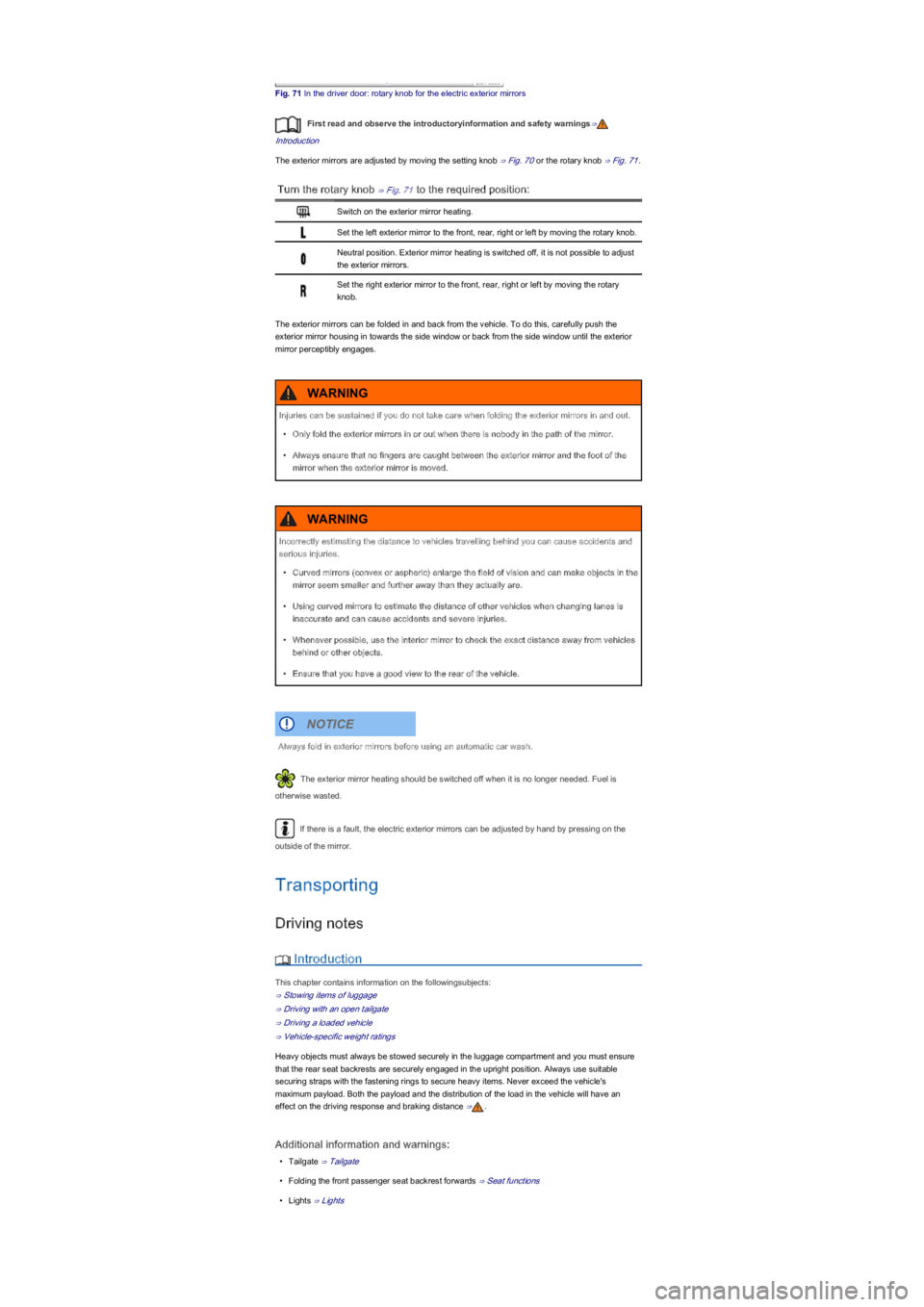
Fig. 71 In the driver door: rotary knob for the electric exterior mirrors
First read and observe the introductoryinformation and safety warnings⇒
Introduction
The exterior mirrors are adjusted by moving the setting knob ⇒ Fig. 70 or the rotary knob ⇒ Fig. 71.
Turn the rotary knob ⇒ Fig. 71 to the required position:
Switch on the exterior mirror heating.
Set the left exterior mirror to the front, rear, right or left by moving the rotary knob.
Neutral position. Exterior mirror heating is switched off, it is not possible to adjust
the exterior mirrors.
Set the right exterior mirror to the front, rear, right or left by moving the rotary
knob.
The exterior mirrors can be folded in and back from the vehicle. To do this, carefully push the
exterior mirror housing in towards the side window or back from the side window until the exterior
mirror perceptibly engages.
The exterior mirror heating should be switched off when it is no longer needed. Fuel is
otherwise wasted.
If there is a fault, the electric exterior mirrors can be adjusted by hand by pressing on the
outside of the mirror.
Transporting
Driving notes
Introduction
This chapter contains information on the followingsubjects:
⇒ Stowing items of luggage
⇒ Driving with an open tailgate
⇒ Driving a loaded vehicle
⇒ Vehicle-specific weight ratings
Heavy objects must always be stowed securely in the luggage compartment and you must ensure
that the rear seat backrests are securely engaged in the upright position. Always use suitable
securing straps with the fastening rings to secure heavy items. Never exceed the vehicle's
maximum payload. Both the payload and the distribution of the load in the vehicle will have an
effect on the driving response and braking distance ⇒.
Additional information and warnings:
•Tailgate ⇒ Tailgate
•Folding the front passenger seat backrest forwards ⇒ Seat functions
•Lights ⇒ Lights
Injuries can be sustained if you do not take care when folding the exterior mirrors in and out.
•Only fold the exterior mirrors in or out when there is nobody in the path of the mirror.
•Always ensure that no fingers are caught between the exterior mirror and the foot of the
mirror when the exterior mirror is moved.
WARNING
Incorrectly estimating the distance to vehicles travelling behind you can cause accidents and
serious injuries.
•Curved mirrors (convex or aspheric) enlarge the field of vision and can make objects in the
mirror seem smaller and further away than they actually are.
•Using curved mirrors to estimate the distance of other vehicles when changing lanes is
inaccurate and can cause accidents and severe injuries.
•Whenever possible, use the interior mirror to check the exact distance away from vehicles
behind or other objects.
•Ensure that you have a good view to the rear of the vehicle.
WARNING
Always fold in exterior mirrors before using an automatic car wash.
NOTICE
Page 72 of 211
spare tyre ⇒. Additional equipment and retrofitted accessories increase the stated kerb weight
and reduce the maximum permitted load accordingly.
The load comprises the weights of the following:
•Passengers
•All luggage
•Roof load including roof carrier system
Petrol engines
Engine powerECGearbox
type
Kerb
weight
Gross
vehicle
weight
rating
Gross
axle
weight
rating,
front
Gross
axle
weight
rating,
rear
44 kWCHYA
MG5929 kg –
1,032 kg
1,290 kg680 kg640 kg
AG5932 kg –
1,035 kg
55 kWCHYB
MG5929 kg –
1,032 kg
1,290 kg680 kg640 kg
AG5932 kg –
1,035 kg
Natural gas engine
Engine powerECGearbox
type
Kerb
weight
Gross
vehicle
weight
rating
Gross
axle
weight
rating,
front
Gross
axle
weight
rating,
rear
50 kWCPGAMG5
1,031 kg
– 1,118
kg
1,370 kg700 kg700 kg
Luggage compartment
Introduction
This chapter contains information on the followingsubjects:
⇒ Folding the backrests on the rear bench seat forwards and backwards
⇒ Luggage compartment cover
⇒ Variable luggage compartment floor
⇒ Fastening rings
⇒ Bag hook
Heavy objects must always be transported in the luggage compartment and you must ensure that
the rear seat backrests are securely engaged in the upright position. Always use suitable securing
straps with the fastening rings. Never exceed the vehicle's maximum payload. Both the payload
and the distribution of the load in the vehicle will have an effect on the driving response and braking
distance ⇒.
Additional information and warnings:
•Airbag system ⇒ Airbag system
•Lights ⇒ Lights
•Transporting ⇒ Driving notes
•Wheels and tyres ⇒ Wheels and tyres
Exceeding the maximum permissible weights and axle loads can cause damage to the
vehicle, accidents and serious injuries.
•The actual axle loads must never exceed the maximum permissible axle loads.
•The payload and the distribution of the load in the vehicle have an effect on the driving
response and braking distance of the vehicle. Adjust your speed accordingly.
WARNING
The payload should be distributed as evenly as possible in the vehicle. When transporting
heavy objects in the luggage compartment, they should be placed either in front of or over the
rear axle in order to minimise the effect on the vehicle's handling.
NOTICE
Page 73 of 211
The ventilation openings between the rear window and the luggage compartment cover must
not be covered as this would prevent stale air escaping from the vehicle.
Folding the backrests on the rear bench seat forwards and backwards
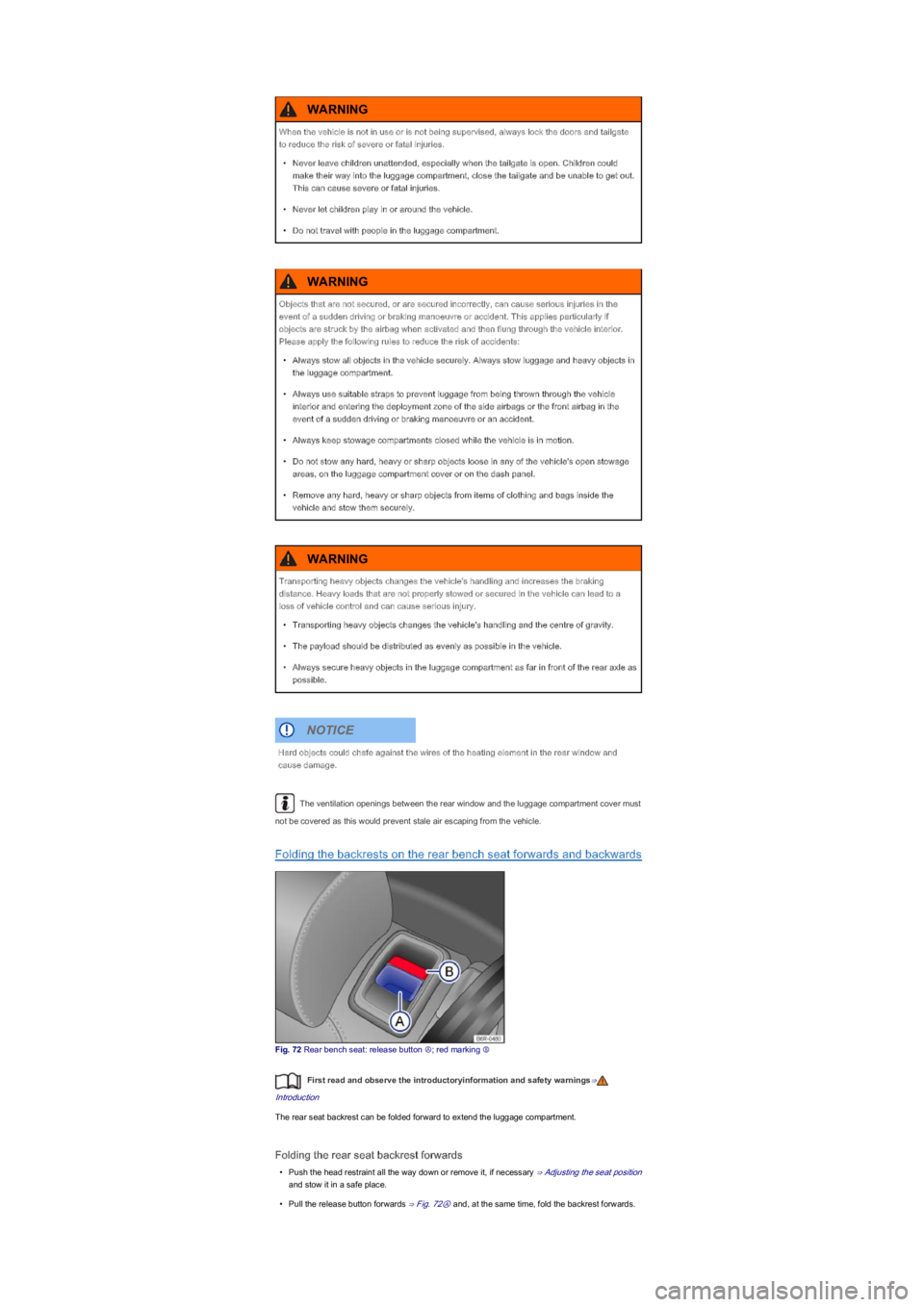
Fig. 72 Rear bench seat: release button Ⓐ; red marking Ⓑ
First read and observe the introductoryinformation and safety warnings⇒
Introduction
The rear seat backrest can be folded forward to extend the luggage compartment.
Folding the rear seat backrest forwards
•Push the head restraint all the way down or remove it, if necessary ⇒ Adjusting the seat position
and stow it in a safe place.
•Pull the release button forwards ⇒ Fig. 72Ⓐ and, at the same time, fold the backrest forwards.
When the vehicle is not in use or is not being supervised, always lock the doors and tailgate
to reduce the risk of severe or fatal injuries.
•Never leave children unattended, especially when the tailgate is open. Children could
make their way into the luggage compartment, close the tailgate and be unable to get out.
This can cause severe or fatal injuries.
•Never let children play in or around the vehicle.
•Do not travel with people in the luggage compartment.
WARNING
Objects that are not secured, or are secured incorrectly, can cause serious injuries in the
event of a sudden driving or braking manoeuvre or accident. This applies particularly if
objects are struck by the airbag when activated and then flung through the vehicle interior.
Please apply the following rules to reduce the risk of accidents:
•Always stow all objects in the vehicle securely. Always stow luggage and heavy objects in
the luggage compartment.
•Always use suitable straps to prevent luggage from being thrown through the vehicle
interior and entering the deployment zone of the side airbags or the front airbag in the
event of a sudden driving or braking manoeuvre or an accident.
•Always keep stowage compartments closed while the vehicle is in motion.
•Do not stow any hard, heavy or sharp objects loose in any of the vehicle's open stowage
areas, on the luggage compartment cover or on the dash panel.
•Remove any hard, heavy or sharp objects from items of clothing and bags inside the
vehicle and stow them securely.
WARNING
Transporting heavy objects changes the vehicle's handling and increases the braking
distance. Heavy loads that are not properly stowed or secured in the vehicle can lead to a
loss of vehicle control and can cause serious injury.
•Transporting heavy objects changes the vehicle's handling and the centre of gravity.
•The payload should be distributed as evenly as possible in the vehicle.
•Always secure heavy objects in the luggage compartment as far in front of the rear axle as
possible.
WARNING
Hard objects could chafe against the wires of the heating element in the rear window and
cause damage.
NOTICE
Page 77 of 211
Roof carrier
Introduction
This chapter contains information on the followingsubjects:
⇒ Attaching the mounts and load carrier system
⇒ Loading the load carrier system
The roof of the vehicle has been designed for optimum aerodynamic effect. It is therefore no longer
possible to attach conventional roof carrier systems to a rain channel on the roof.
As the rain channels have been integrated into the roof for better aerodynamics, only mounts or
roof carriers approved by Volkswagen can be used.
When should the roof carrier be removed?
•When it is no longer being used.
•When the vehicle is driving through a car wash.
•When the vehicle height exceeds the required clearance height, e.g. in a garage.
Additional information and warnings:
•Lights ⇒ Lights
•Transporting ⇒ Transporting
•Driving with respect for the environment ⇒ Driving with respect for the environment
•Wheels and tyres ⇒ Wheels and tyres
•Accessories, modifications, repairs and renewal of parts ⇒ Accessories, modifications, repairs
and renewal of parts
Driving with a fitted roof carrier will increase air resistance and thus increase fuel
consumption.
Attaching the mounts and load carrier system
Never use the bag hooks as fastening rings for straps. The bag hook could break off during a
sudden braking manoeuvre or accident.
WARNING
The bag hooks can only carry a maximum of 1.5 kg.
NOTICE
When transporting heavy or bulky objects in the roof carrier, the vehicle's handling will change
due to a shift in the centre of gravity and an increased susceptibility to crosswinds.
•Always secure loads properly using suitable and undamaged securing straps.
•Cargo that is large, heavy, bulky, long or flat will have a negative effect on the vehicle
aerodynamics, centre of gravity and overall handling.
•Avoid abrupt and sudden driving and braking manoeuvres.
•Adapt your speed and driving style to suit visibility, weather, road and traffic conditions.
WARNING
•Always remove the roof carrier before driving through an automatic car wash.
•The vehicle's height is changed by the installation of the roof carrier system and the load
secured on it. Check and compare the height of the vehicle with clearance heights, e.g. for
underpasses and garage doors.
•The roof carrier system and its load must not obstruct you from opening and closing the
electric panorama sliding/tilting glass roof and tailgate. The roof aerial must also remain
unaffected.
•When opening the tailgate, take care not to let it hit the roof load.
NOTICE
Page 88 of 211
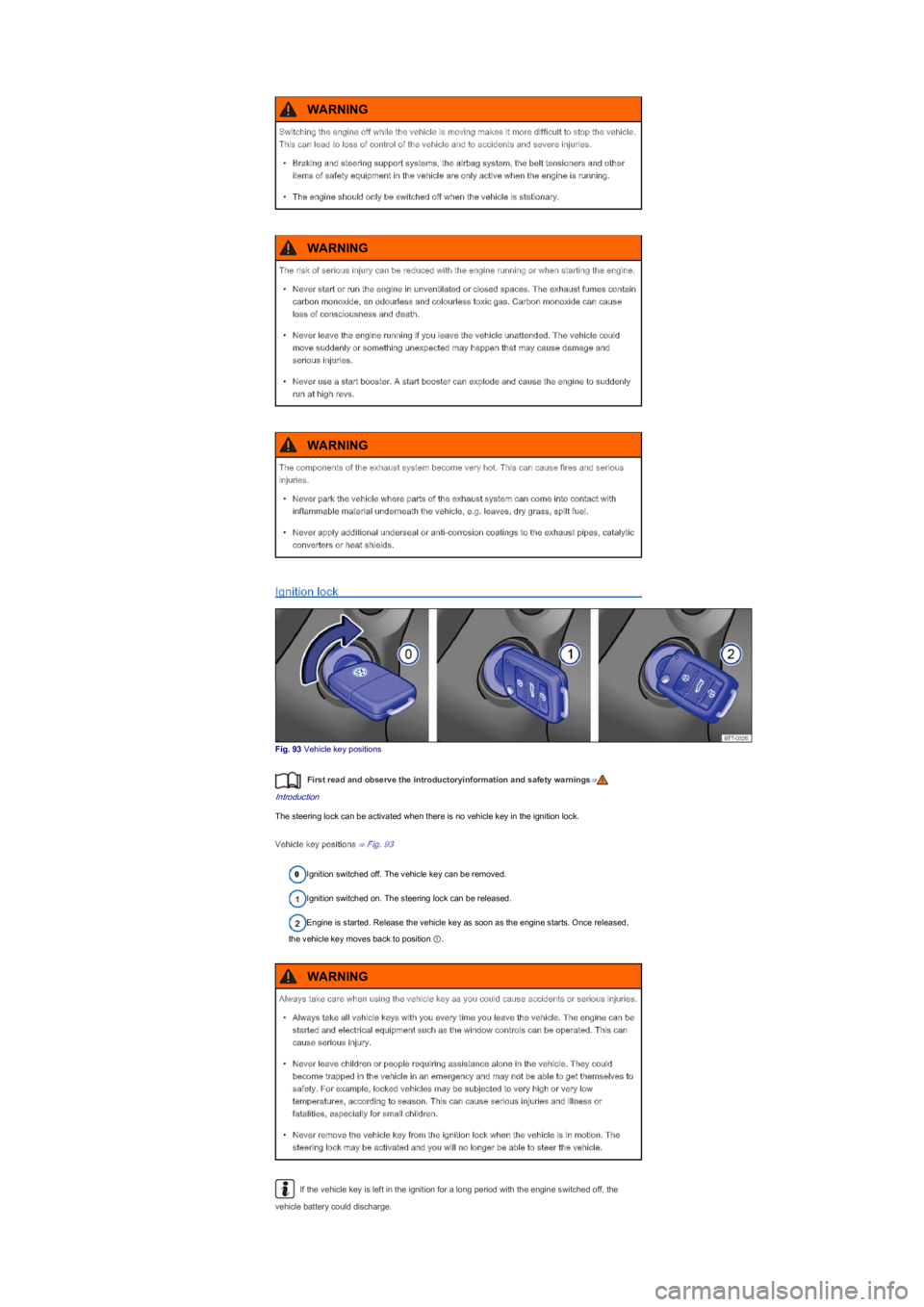
Ignition lock
Fig. 93 Vehicle key positions
First read and observe the introductoryinformation and safety warnings⇒
Introduction
The steering lock can be activated when there is no vehicle key in the ignition lock.
Vehicle key positions ⇒ Fig. 93
Ignition switched off. The vehicle key can be removed.
Ignition switched on. The steering lock can be released.
Engine is started. Release the vehicle key as soon as the engine starts. Once released,
the vehicle key moves back to position ①.
If the vehicle key is left in the ignition for a long period with the engine switched off, the
vehicle battery could discharge.
Switching the engine off while the vehicle is moving makes it more difficult to stop the vehicle.
This can lead to loss of control of the vehicle and to accidents and severe injuries.
•Braking and steering support systems, the airbag system, the belt tensioners and other
items of safety equipment in the vehicle are only active when the engine is running.
•The engine should only be switched off when the vehicle is stationary.
WARNING
The risk of serious injury can be reduced with the engine running or when starting the engine.
•Never start or run the engine in unventilated or closed spaces. The exhaust fumes contain
carbon monoxide, an odourless and colourless toxic gas. Carbon monoxide can cause
loss of consciousness and death.
•Never leave the engine running if you leave the vehicle unattended. The vehicle could
move suddenly or something unexpected may happen that may cause damage and
serious injuries.
•Never use a start booster. A start booster can explode and cause the engine to suddenly
run at high revs.
WARNING
The components of the exhaust system become very hot. This can cause fires and serious
injuries.
•Never park the vehicle where parts of the exhaust system can come into contact with
inflammable material underneath the vehicle, e.g. leaves, dry grass, spilt fuel.
•Never apply additional underseal or anti-corrosion coatings to the exhaust pipes, catalytic
converters or heat shields.
WARNING
Always take care when using the vehicle key as you could cause accidents or serious injuries.
•Always take all vehicle keys with you every time you leave the vehicle. The engine can be
started and electrical equipment such as the window controls can be operated. This can
cause serious injury.
•Never leave children or people requiring assistance alone in the vehicle. They could
become trapped in the vehicle in an emergency and may not be able to get themselves to
safety. For example, locked vehicles may be subjected to very high or very low
temperatures, according to season. This can cause serious injuries and illness or
fatalities, especially for small children.
•Never remove the vehicle key from the ignition lock when the vehicle is in motion. The
steering lock may be activated and you will no longer be able to steer the vehicle.
WARNING
Page 91 of 211
•Tow-starting and towing ⇒ Tow-starting and towing
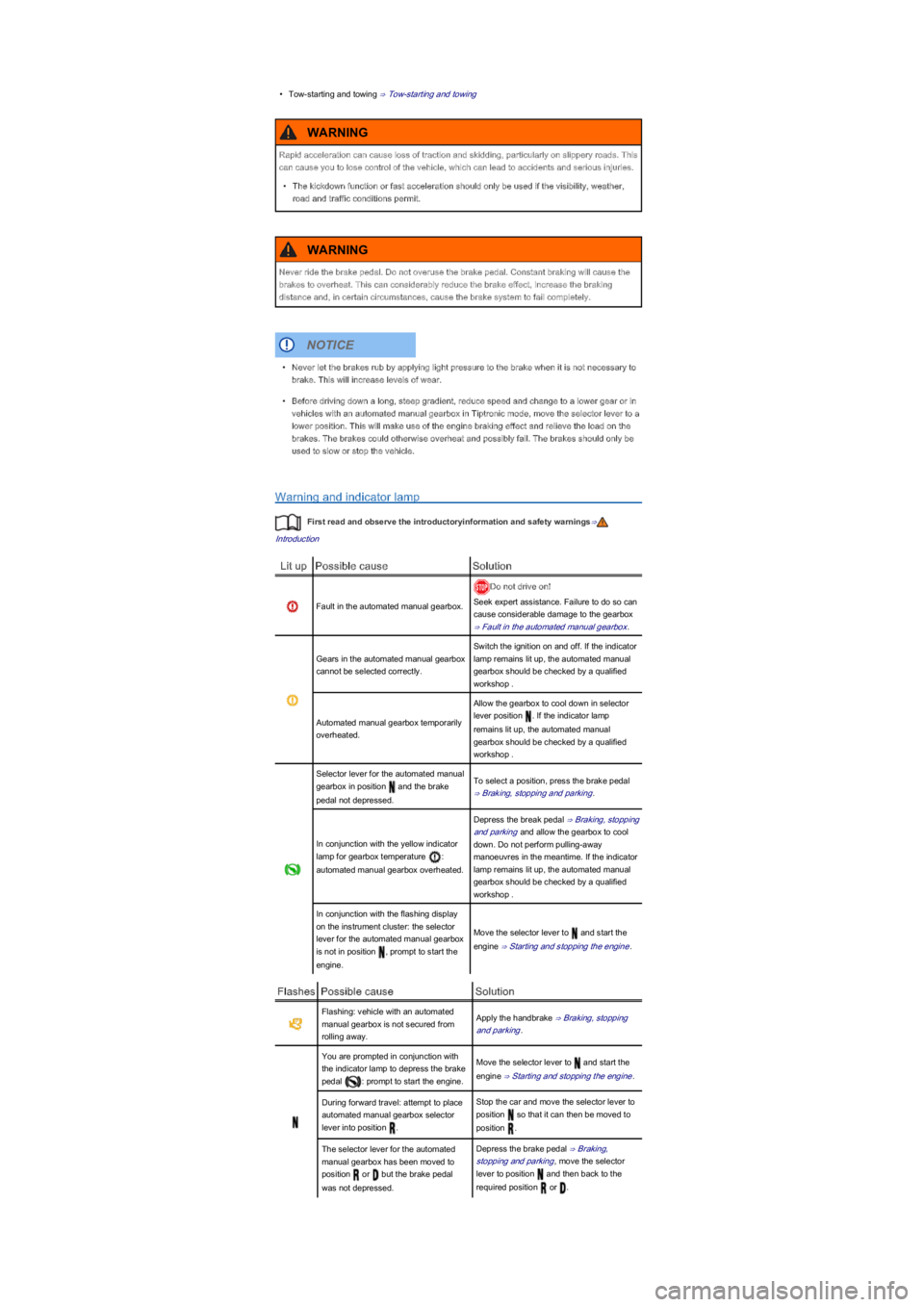
Warning and indicator lamp
First read and observe the introductoryinformation and safety warnings⇒
Introduction
Lit upPossible causeSolution
Fault in the automated manual gearbox.
Do not drive on!
Seek expert assistance. Failure to do so can
cause considerable damage to the gearbox
⇒ Fault in the automated manual gearbox.
Gears in the automated manual gearbox
cannot be selected correctly.
Switch the ignition on and off. If the indicator
lamp remains lit up, the automated manual
gearbox should be checked by a qualified
workshop .
Automated manual gearbox temporarily
overheated.
Allow the gearbox to cool down in selector
lever position . If the indicator lamp
remains lit up, the automated manual
gearbox should be checked by a qualified
workshop .
Selector lever for the automated manual
gearbox in position and the brake
pedal not depressed.
To select a position, press the brake pedal
⇒ Braking, stopping and parking.
In conjunction with the yellow indicator
lamp for gearbox temperature :
automated manual gearbox overheated.
Depress the break pedal ⇒ Braking, stopping
and parking and allow the gearbox to cool
down. Do not perform pulling-away
manoeuvres in the meantime. If the indicator
lamp remains lit up, the automated manual
gearbox should be checked by a qualified
workshop .
In conjunction with the flashing display
on the instrument cluster: the selector
lever for the automated manual gearbox
is not in position , prompt to start the
engine.
Move the selector lever to and start the
engine ⇒ Starting and stopping the engine.
FlashesPossible causeSolution
Flashing: vehicle with an automated
manual gearbox is not secured from
rolling away.
Apply the handbrake ⇒ Braking, stopping
and parking.
You are prompted in conjunction with
the indicator lamp to depress the brake
pedal : prompt to start the engine.
Move the selector lever to and start the
engine ⇒ Starting and stopping the engine.
During forward travel: attempt to place
automated manual gearbox selector
lever into position .
Stop the car and move the selector lever to
position so that it can then be moved to
position .
The selector lever for the automated
manual gearbox has been moved to
position or but the brake pedal
was not depressed.
Depress the brake pedal ⇒ Braking,
stopping and parking, move the selector
lever to position and then back to the
required position or .
Rapid acceleration can cause loss of traction and skidding, particularly on slippery roads. This
can cause you to lose control of the vehicle, which can lead to accidents and serious injuries.
•The kickdown function or fast acceleration should only be used if the visibility, weather,
road and traffic conditions permit.
WARNING
Never ride the brake pedal. Do not overuse the brake pedal. Constant braking will cause the
brakes to overheat. This can considerably reduce the brake effect, increase the braking
distance and, in certain circumstances, cause the brake system to fail completely.
WARNING
•Never let the brakes rub by applying light pressure to the brake when it is not necessary to
brake. This will increase levels of wear.
•Before driving down a long, steep gradient, reduce speed and change to a lower gear or in
vehicles with an automated manual gearbox in Tiptronic mode, move the selector lever to a
lower position. This will make use of the engine braking effect and relieve the load on the
brakes. The brakes could otherwise overheat and possibly fail. The brakes should only be
used to slow or stop the vehicle.
NOTICE
Page 94 of 211
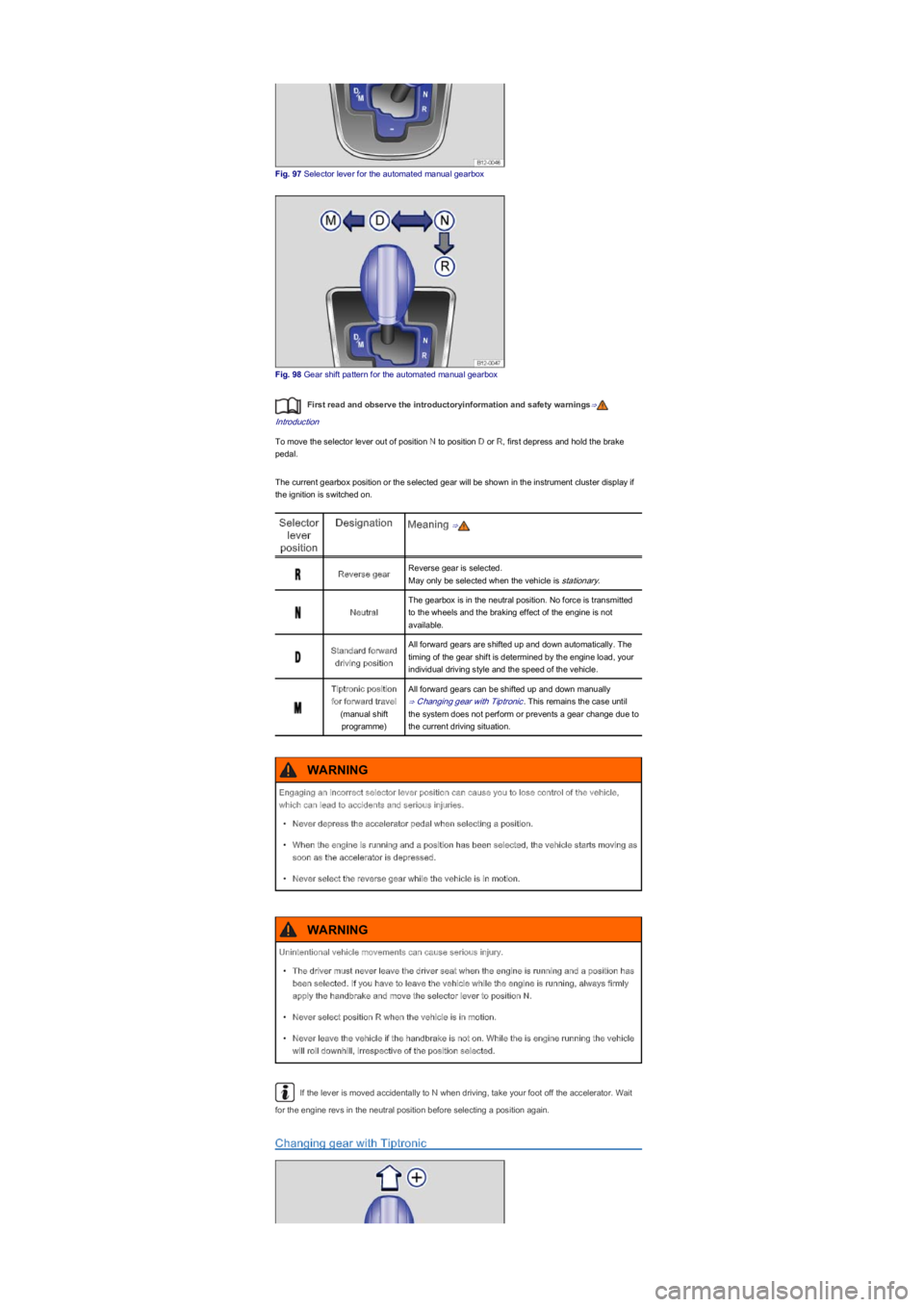
Fig. 97 Selector lever for the automated manual gearbox
Fig. 98 Gear shift pattern for the automated manual gearbox
First read and observe the introductoryinformation and safety warnings⇒
Introduction
To move the selector lever out of position N to position D or R, first depress and hold the brake
pedal.
The current gearbox position or the selected gear will be shown in the instrument cluster display if
the ignition is switched on.
Selector
lever
position
DesignationMeaning ⇒
Reverse gearReverse gear is selected.
May only be selected when the vehicle is stationary.
Neutral
The gearbox is in the neutral position. No force is transmitted
to the wheels and the braking effect of the engine is not
available.
Standard forward
driving position
All forward gears are shifted up and down automatically. The
timing of the gear shift is determined by the engine load, your
individual driving style and the speed of the vehicle.
Tiptronic position
for forward travel
(manual shift
programme)
All forward gears can be shifted up and down manually
⇒ Changing gear with Tiptronic. This remains the case until
the system does not perform or prevents a gear change due to
the current driving situation.
If the lever is moved accidentally to N when driving, take your foot off the accelerator. Wait
for the engine revs in the neutral position before selecting a position again.
Changing gear with Tiptronic
Engaging an incorrect selector lever position can cause you to lose control of the vehicle,
which can lead to accidents and serious injuries.
•Never depress the accelerator pedal when selecting a position.
•When the engine is running and a position has been selected, the vehicle starts moving as
soon as the accelerator is depressed.
•Never select the reverse gear while the vehicle is in motion.
WARNING
Unintentional vehicle movements can cause serious injury.
•The driver must never leave the driver seat when the engine is running and a position has
been selected. If you have to leave the vehicle while the engine is running, always firmly
apply the handbrake and move the selector lever to position N.
•Never select position R when the vehicle is in motion.
•Never leave the vehicle if the handbrake is not on. While the is engine running the vehicle
will roll downhill, irrespective of the position selected.
WARNING
Page 97 of 211
Driving in the correct gear can reduce fuel consumption.
The display on the gear-change indicator will disappear when the clutch pedal is depressed.
In some vehicles the gear recommendation may be displayed on the screen of the portable
navigation device (delivered by Volkswagen) ⇒ Accessories, modifications, repairs and renewal of
parts.
Braking, stopping and parking
Introduction
This chapter contains information on the followingsubjects:
⇒ Warning and indicator lamps
⇒ Handbrake
⇒ Parking
⇒ Information on the brakes
⇒ Brake assist systems
⇒ Brake fluid
The brake assist systems are the electronic brake pressure distribution system (EBV), anti-lock
brake system (ABS), the brake assist system (BAS), the electronic differential lock (EDS), traction
control (TC), the traction control system (TCS) and the electronic stabilisation programme (ESC).
Additional information and warnings:
•Pull-away assist systems ⇒ Pull-away assist systems
•Wheels and tyres ⇒ Wheels and tyres
•Accessories, modifications, repairs and renewal of parts ⇒ Accessories, modifications, repairs
and renewal of parts
The gear-change indicator is only designed to assist the driver and cannot replace the driver's
own judgement.
•The driver has full responsibility for selecting the correct gear in all situations, e.g. when
overtaking or when driving up and down hills.
CAUTION
Page 98 of 211
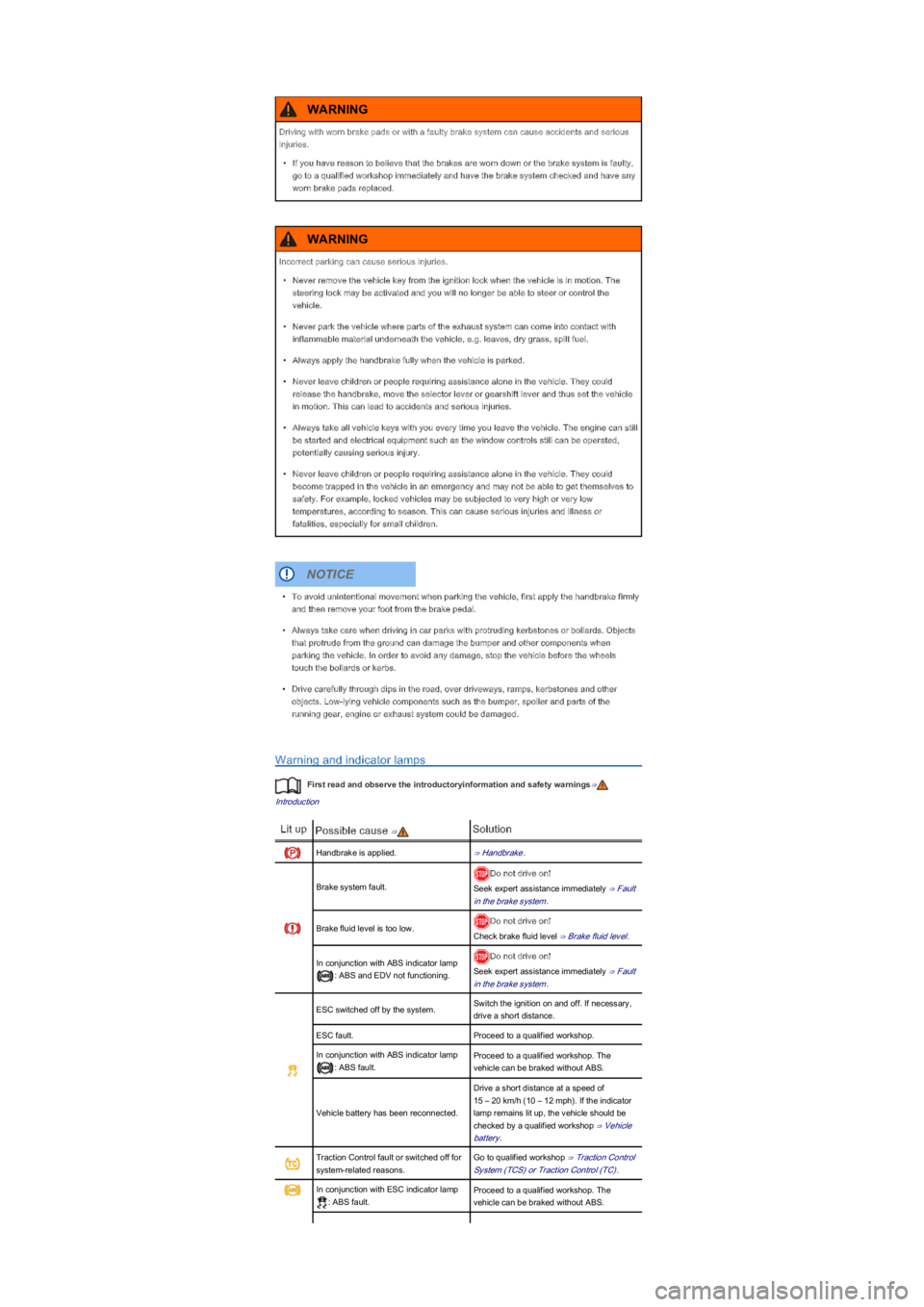
Warning and indicator lamps
First read and observe the introductoryinformation and safety warnings⇒
Introduction
Lit upPossible cause ⇒Solution
Handbrake is applied.⇒ Handbrake.
Brake system fault.
Do not drive on!
Seek expert assistance immediately ⇒ Fault
in the brake system.
Brake fluid level is too low.Do not drive on!
Check brake fluid level ⇒ Brake fluid level.
In conjunction with ABS indicator lamp
: ABS and EDV not functioning.
Do not drive on!
Seek expert assistance immediately ⇒ Fault
in the brake system.
ESC switched off by the system.Switch the ignition on and off. If necessary,
drive a short distance.
ESC fault.Proceed to a qualified workshop.
In conjunction with ABS indicator lamp
: ABS fault.
Proceed to a qualified workshop. The
vehicle can be braked without ABS.
Vehicle battery has been reconnected.
Drive a short distance at a speed of
15 – 20 km/h (10 – 12 mph). If the indicator
lamp remains lit up, the vehicle should be
checked by a qualified workshop ⇒ Vehicle
battery.
Traction Control fault or switched off for
system-related reasons.
Go to qualified workshop ⇒ Traction Control
System (TCS) or Traction Control (TC).
In conjunction with ESC indicator lamp
: ABS fault.
Proceed to a qualified workshop. The
vehicle can be braked without ABS.
Driving with worn brake pads or with a faulty brake system can cause accidents and serious
injuries.
•If you have reason to believe that the brakes are worn down or the brake system is faulty,
go to a qualified workshop immediately and have the brake system checked and have any
worn brake pads replaced.
WARNING
Incorrect parking can cause serious injuries.
•Never remove the vehicle key from the ignition lock when the vehicle is in motion. The
steering lock may be activated and you will no longer be able to steer or control the
vehicle.
•Never park the vehicle where parts of the exhaust system can come into contact with
inflammable material underneath the vehicle, e.g. leaves, dry grass, spilt fuel.
•Always apply the handbrake fully when the vehicle is parked.
•Never leave children or people requiring assistance alone in the vehicle. They could
release the handbrake, move the selector lever or gearshift lever and thus set the vehicle
in motion. This can lead to accidents and serious injuries.
•Always take all vehicle keys with you every time you leave the vehicle. The engine can still
be started and electrical equipment such as the window controls still can be operated,
potentially causing serious injury.
•Never leave children or people requiring assistance alone in the vehicle. They could
become trapped in the vehicle in an emergency and may not be able to get themselves to
safety. For example, locked vehicles may be subjected to very high or very low
temperatures, according to season. This can cause serious injuries and illness or
fatalities, especially for small children.
WARNING
•To avoid unintentional movement when parking the vehicle, first apply the handbrake firmly
and then remove your foot from the brake pedal.
•Always take care when driving in car parks with protruding kerbstones or bollards. Objects
that protrude from the ground can damage the bumper and other components when
parking the vehicle. In order to avoid any damage, stop the vehicle before the wheels
touch the bollards or kerbs.
•Drive carefully through dips in the road, over driveways, ramps, kerbstones and other
objects. Low-lying vehicle components such as the bumper, spoiler and parts of the
running gear, engine or exhaust system could be damaged.
NOTICE
Page 99 of 211
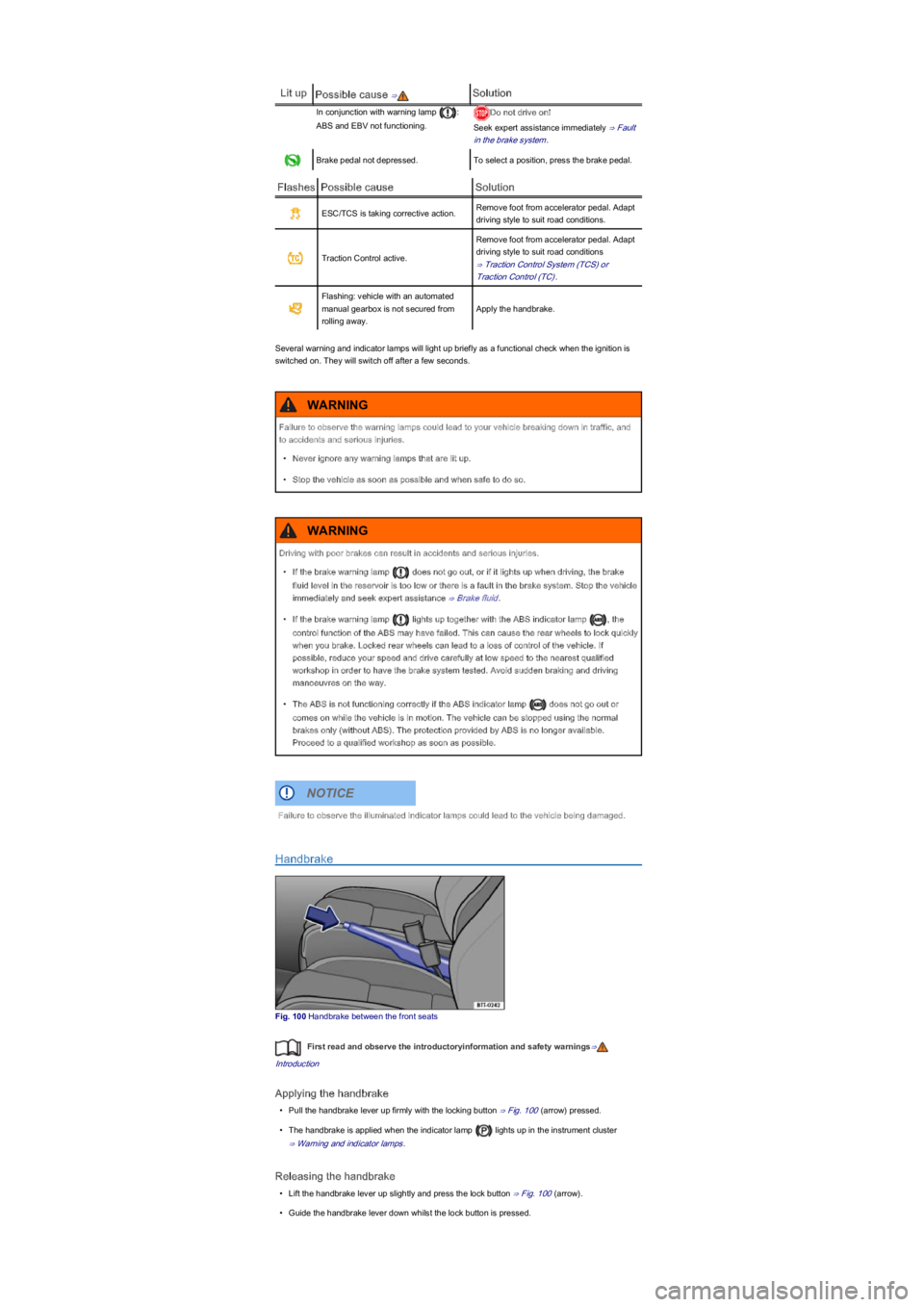
Lit upPossible cause ⇒Solution
In conjunction with warning lamp :
ABS and EBV not functioning.
Do not drive on!
Seek expert assistance immediately ⇒ Fault
in the brake system.
Brake pedal not depressed.To select a position, press the brake pedal.
FlashesPossible causeSolution
ESC/TCS is taking corrective action.Remove foot from accelerator pedal. Adapt
driving style to suit road conditions.
Traction Control active.
Remove foot from accelerator pedal. Adapt
driving style to suit road conditions
⇒ Traction Control System (TCS) or
Traction Control (TC).
Flashing: vehicle with an automated
manual gearbox is not secured from
rolling away.
Apply the handbrake.
Several warning and indicator lamps will light up briefly as a functional check when the ignition is
switched on. They will switch off after a few seconds.
Handbrake
Fig. 100 Handbrake between the front seats
First read and observe the introductoryinformation and safety warnings⇒
Introduction
Applying the handbrake
•Pull the handbrake lever up firmly with the locking button ⇒ Fig. 100 (arrow) pressed.
•The handbrake is applied when the indicator lamp lights up in the instrument cluster
⇒ Warning and indicator lamps.
Releasing the handbrake
•Lift the handbrake lever up slightly and press the lock button ⇒ Fig. 100 (arrow).
•Guide the handbrake lever down whilst the lock button is pressed.
Failure to observe the warning lamps could lead to your vehicle breaking down in traffic, and
to accidents and serious injuries.
•Never ignore any warning lamps that are lit up.
•Stop the vehicle as soon as possible and when safe to do so.
WARNING
Driving with poor brakes can result in accidents and serious injuries.
•If the brake warning lamp does not go out, or if it lights up when driving, the brake
fluid level in the reservoir is too low or there is a fault in the brake system. Stop the vehicle
immediately and seek expert assistance ⇒ Brake fluid.
•If the brake warning lamp lights up together with the ABS indicator lamp , the
control function of the ABS may have failed. This can cause the rear wheels to lock quickly
when you brake. Locked rear wheels can lead to a loss of control of the vehicle. If
possible, reduce your speed and drive carefully at low speed to the nearest qualified
workshop in order to have the brake system tested. Avoid sudden braking and driving
manoeuvres on the way.
•The ABS is not functioning correctly if the ABS indicator lamp does not go out or
comes on while the vehicle is in motion. The vehicle can be stopped using the normal
brakes only (without ABS). The protection provided by ABS is no longer available.
Proceed to a qualified workshop as soon as possible.
WARNING
Failure to observe the illuminated indicator lamps could lead to the vehicle being damaged.
NOTICE