instrument panel VOLVO S90 TWIN ENGINE 2019 Manual PDF
[x] Cancel search | Manufacturer: VOLVO, Model Year: 2019, Model line: S90 TWIN ENGINE, Model: VOLVO S90 TWIN ENGINE 2019Pages: 669, PDF Size: 14.33 MB
Page 308 of 669
DRIVER SUPPORT
* Option/accessory.306
Symbols and messages forAdaptive Cruise Control
A number of symbols and messages relating to
Adaptive Cruise Control (ACC49) may be dis-played in the instrument panel and/or the head-up display*.
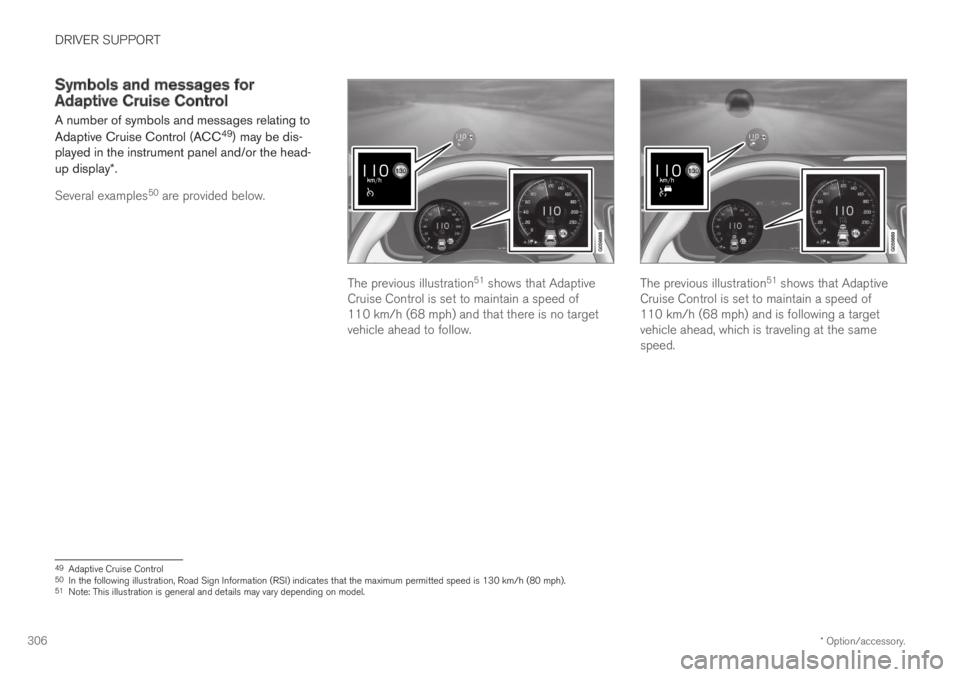
Several examples50 are provided below.
The previous illustration51 shows that AdaptiveCruise Control is set to maintain a speed of110 km/h (68 mph) and that there is no targetvehicle ahead to follow.
The previous illustration51 shows that AdaptiveCruise Control is set to maintain a speed of110 km/h (68 mph) and is following a targetvehicle ahead, which is traveling at the samespeed.
49Adaptive Cruise Control50In the following illustration, Road Sign Information (RSI) indicates that the maximum permitted speed is 130 km/h (80 mph).51Note: This illustration is general and details may vary depending on model.
Page 313 of 669

DRIVER SUPPORT
}}
* Option/accessory.311
Instrument panel
Speed indicators52.
Set speed
Speed of the vehicle ahead
The current speed of your vehicle
See "Pilot Assist symbols and messages" forexamples of different combinations of symbolsdepending on the traffic situation.
Related information
Pilot Assist and collision warning (p. 311)
Head-up display for Pilot Assist during colli-sion risks (p. 312)
Activating and starting Pilot Assist (p. 312)
Managing Pilot Assist speed (p. 314)
Setting a time interval for Pilot Assist(p. 315)
Deactivating/reactivating Pilot Assist(p. 316)
Passing assistance with Pilot Assist (p. 318)
Starting passing assistance with Pilot Assist(p. 319)
Passing assistance with Pilot Assist limita-tions (p. 319)
Switching target vehicles with Pilot Assist(p. 319)
Auto-hold braking with Pilot Assist (p. 320)
Pilot Assist limitations (p. 321)
Pilot Assist* symbols and messages (p. 322)
Pilot Assist and collision warning
Pilot Assist can alert the driver if the distance tothe vehicle ahead suddenly decreases to anunsafe distance.
Collision warning audible signal and symbol53.
Acoustic collision warning signal
Collision warning symbol
Camera/radar sensor distance monitoring
Pilot Assist uses approx. 40% of the vehicle'sbraking capacity. If a situation requires morebraking force than Pilot Assist can provide, and ifthe driver does not apply the brakes, a warninglight and audible warning signal will be activated
52Note: This illustration is general and details may vary depending on model.53The illustration is generic - details may vary according to vehicle model.
Page 317 of 669
DRIVER SUPPORT
}}
* Option/accessory.315
Setting a time interval for PilotAssist
Pilot Assist can be set to different time intervals.
Different time intervals to thevehicle ahead can be selectedand are shown in the instru-ment panel as 1–5 horizontalbars. The more bars, the longerthe time interval. One bar rep-resents an interval ofapprox. 1 second to the vehicle ahead. 5 barsrepresents approx. 3 seconds.
NOTE
When the symbol in the instrument panelshows a vehicle and a steering wheel, PilotAssist follows a vehicle ahead at a presettime interval.
When only a steering wheel is shown, there isno vehicle ahead within a reasonable dis-tance.
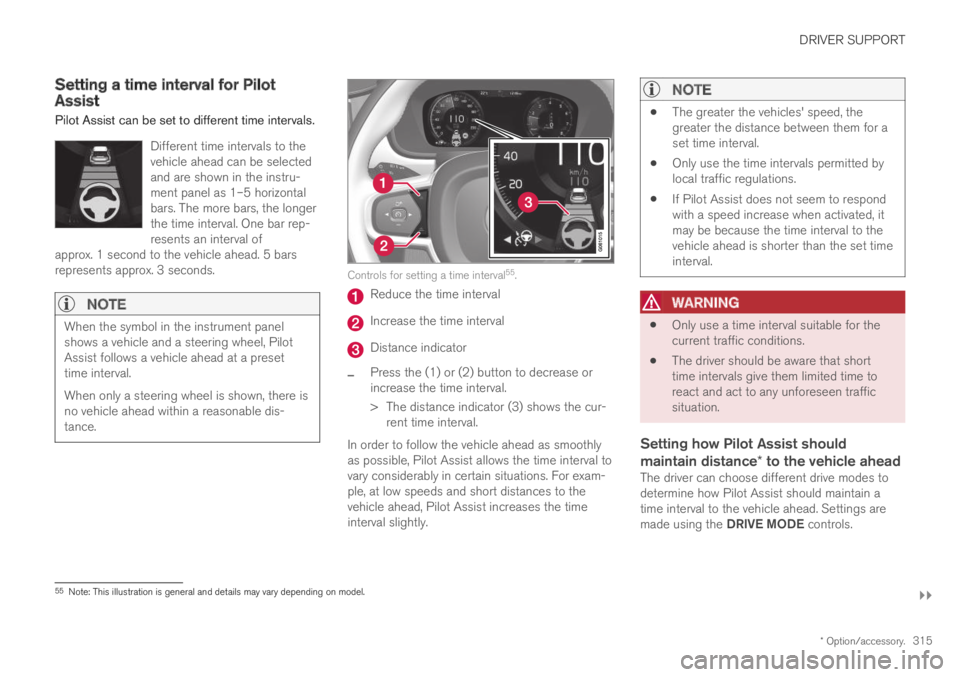
Controls for setting a time interval55.
Reduce the time interval
Increase the time interval
Distance indicator
–Press the (1) or (2) button to decrease orincrease the time interval.
> The distance indicator (3) shows the cur-rent time interval.
In order to follow the vehicle ahead as smoothlyas possible, Pilot Assist allows the time interval tovary considerably in certain situations. For exam-ple, at low speeds and short distances to thevehicle ahead, Pilot Assist increases the timeinterval slightly.
NOTE
The greater the vehicles' speed, thegreater the distance between them for aset time interval.
Only use the time intervals permitted bylocal traffic regulations.
If Pilot Assist does not seem to respondwith a speed increase when activated, itmay be because the time interval to thevehicle ahead is shorter than the set timeinterval.
WARNING
Only use a time interval suitable for thecurrent traffic conditions.
The driver should be aware that shorttime intervals give them limited time toreact and act to any unforeseen trafficsituation.
Setting how Pilot Assist should
maintain distance * to the vehicle ahead
The driver can choose different drive modes todetermine how Pilot Assist should maintain atime interval to the vehicle ahead. Settings aremade using the DRIVE MODE controls.
55Note: This illustration is general and details may vary depending on model.
Page 318 of 669
||
DRIVER SUPPORT
316
Select one of the following:
Eco - Pilot Assist will focus on providingoptimal fuel economy, which will increase thetime interval to the vehicle ahead.
Comfort - Pilot Assist will focus on followingthe set time interval to the vehicle ahead assmoothly as possible.
Dynamic - Pilot Assist will focus on follow-ing the set time interval to the vehicle aheadmore exactly, which could mean faster accel-eration and heavier braking.
For more information, see "Drive modes".
Related information
Pilot Assist (p. 308)
Drive modes (p. 446)
Managing Cruise Control speed (p. 285)
Deactivating/reactivating PilotAssist
Pilot Assist can be temporarily put into standbymode and then reactivated.
Deactivating and putting Pilot Assist in
standby mode
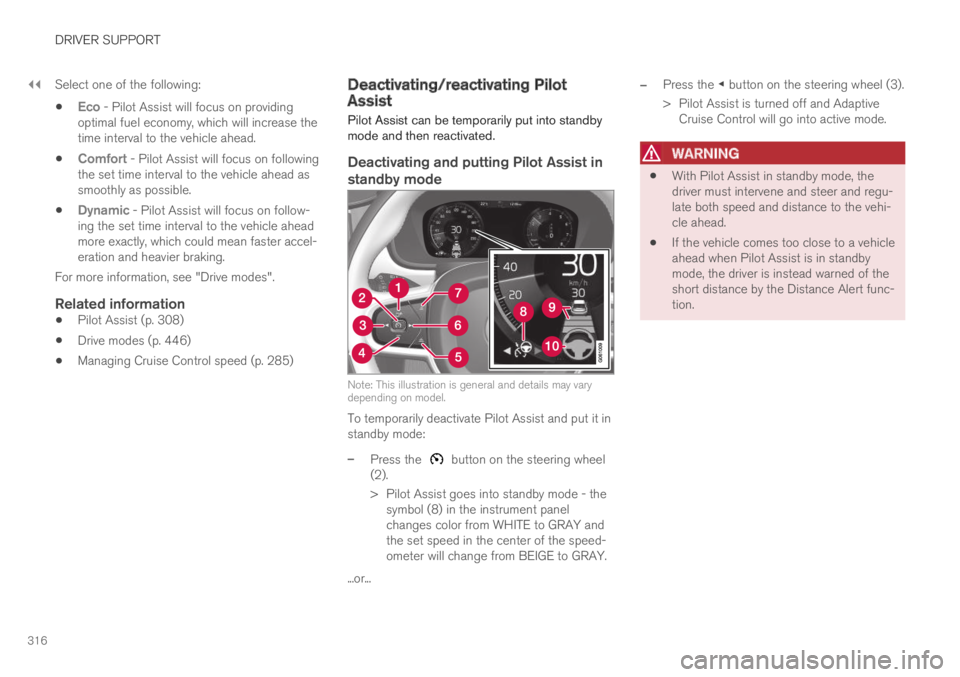
Note: This illustration is general and details may varydepending on model.
To temporarily deactivate Pilot Assist and put it instandby mode:
–Press the button on the steering wheel(2).
> Pilot Assist goes into standby mode - thesymbol (8) in the instrument panelchanges color from WHITE to GRAY andthe set speed in the center of the speed-ometer will change from BEIGE to GRAY.
...or...
–Press the ◀ button on the steering wheel (3).
> Pilot Assist is turned off and AdaptiveCruise Control will go into active mode.
WARNING
With Pilot Assist in standby mode, thedriver must intervene and steer and regu-late both speed and distance to the vehi-cle ahead.
If the vehicle comes too close to a vehicleahead when Pilot Assist is in standbymode, the driver is instead warned of theshort distance by the Distance Alert func-tion.
Page 319 of 669

DRIVER SUPPORT
}}
317
Standby mode due to action by the driver
Pilot Assist will be temporarily deactivated andput in standby mode if:
the brakes are applied.
the gear selector is moved to N
a turn signal is used for more than 1 minute.
the vehicle is driven faster than the setspeed for more than 1 minute
Temporarily increasing speed using the accelera-tor pedal, e.g. when passing another vehicle, willnot affect the setting. The vehicle will return tothe set speed when the accelerator pedal isreleased.
When the turn signals are used, Pilot Assist'ssteering assistance will be temporarily deacti-vated. When the turn signal is switched off, steer-ing assistance will be automatically reactivated ifthe traffic lane's side markings can still bedetected.
Automatic standby mode
Pilot Assist is dependent on other systems, such
as Electronic Stability Control (ESC56). If any ofthese other systems stops working, Pilot Assistwill automatically switch off.
WARNING
With automatic standby mode, the driver iswarned by an acoustic signal and a messageon the instrument panel.
The driver must then regulate vehiclespeed, apply the brakes if necessary, andmaintain a safe distance to other vehicles.
Adaptive Cruise Control may go into standbymode if, e.g.:
the driver opens the door.
the brake temperature is high.
the driver's hands are not on the steeringwheel.
the parking brake is applied.
the engine speed (rpm) is too low/high.
the driver unbuckles the seat belt.
one or more of the wheels lose traction.
the camera/radar sensor is covered by snowor heavy rain (the camera lens/radar wavesare blocked)
your vehicle's speed goes below 5 km/h(3 mph) and Pilot Assist cannot determine ifthe vehicle ahead is stationary or if it isanother object, e.g. a speed bump.
your vehicle's speed goes under 5 km/h(3 mph) and the vehicle ahead turns so thatPilot Assist no longer has a vehicle to follow.
Reactivating Pilot Assist from standby
mode
Note: This illustration is general and details may varydepending on model.
To reactivate Pilot Assist:
–Press the button on the steering wheel(1).
> Speed will be set to the most recentlystored speed.
56Electronic Stability Control
Page 324 of 669

||
DRIVER SUPPORT
* Option/accessory.322
Steep roads and/or heavy loads
Pilot Assist is primarily intended to be driven onflat roads. The function may not be able to main-tain the correct time interval to the vehicle aheadwhen driving down steep hills. The driver shouldbe extra attentive and prepared to apply thebrakes.
Do not use Pilot Assist if the vehicle is carry-ing a heavy load or towing a trailer.
NOTE
Pilot Assist cannot be activated if a trailer,bike carrier or similar is connected to thevehicle electrical system.
Other limitations
The Off Road drive mode cannot beselected when Pilot Assist is activated.
NOTE
The function uses the vehicle's combinedcamera and radar unit, which has certain gen-eral limitations; see sections "Camera limita-tions" and "Radar sensor limitations".
Related information
Pilot Assist (p. 308)
Speed-dependent steering wheel resistance(p. 270)
Camera limitations (p. 330)
Radar sensor limitations (p. 325)
Pilot Assist* symbols and messages
A number of symbols and messages relating toPilot Assist may be displayed in the instrumentpanel and/or the head-up display*.
Page 327 of 669

DRIVER SUPPORT
}}
325
Radar sensor limitations
The radar sensor used by several of the driversupport functions has certain limitations, whichalso affect the functions using the radar sensor.
Obstructed camera
The area marked in the illustration must be kept free ofdecals, objects, solar film, etc.60
The radar sensor is located on the upper interiorsection of the windshield along with the camera.
CAUTION
Do not place, affix or mount anything on theinside or outside of the windshield, or in frontof or around the camera and radar unit – thiscould disrupt camera and radar-based func-tions.
It could cause functions to be reduced, deac-tivated completely or produce an incorrectfunction response.
If this symbol and the message"Windscreen sensor Sensorblocked, see Owner's manual" isdisplayed in the instrument panel, itmeans that the camera and radar sensor areunable to detect other vehicles, cyclists, pedes-trians and large animals in front of the vehicleand that the vehicle's camera and radar-basedfunctions may be obstructed, reduced, completelydisabled or providing inaccurate responses.
The following table shows some of the situations that can cause the message to be displayed, and suggested actions:
CauseAction
The area of the windshield in front of the camera/radar sensor is dirty orcovered by ice or snow.Clean the windshield in front of the camera/radar sensor and remove dirt, iceand snow.
Thick fog, heavy rain or snow is blocking the radar signals or the camera'srange of visibility.No action. Heavy precipitation may sometimes prevent the camera/radar sensorfrom functioning.
60Note: This illustration is general and details may vary depending on model.
Page 338 of 669

||
DRIVER SUPPORT
336
2 - Brake assistance
If the risk of a collision increases after the colli-sion warning, brake support will be activated.
If the system determines that the pressure thedriver is exerting on the brake pedal is insufficientto prevent the collision, brake support willincrease pressure.
3 - Auto-brake
The automatic braking function is activated at thelast moment.
If the driver has not taken evasive action by thisstage and a collision is imminent, the automaticbraking function will be triggered. This occurswhether or not the driver is pressing the brakepedal. Full braking force will be applied to reducethe speed at impact or reduced braking effect willbe applied if this is sufficient to avoid the colli-sion.
The seat belt tensioners may be activated alongwith the automatic braking function. See "Seatbelt tensioners" for more information.
In certain situations, auto-braking may begin witha limited braking force before applying full brak-ing force.
If City Safety has prevented a collision, the vehi-cle will be kept at a standstill until the drivertakes action. If the vehicle has slowed to avoidcolliding with a slower-moving vehicle ahead, yourspeed will be reduced to that vehicle's speed.
Auto-braking can always be cancelled if thedriver presses hard on the accelerator pedal.
NOTE
When City Safety activates the brakes, thebrake lights come on.
When City Safety applies the brakes, a text mes-sage will appear in the instrument panel to notifythe driver that the function is/was activated.
WARNING
City Safety may not be used to change howthe driver operates the vehicle. The drivermust not only rely on City Safety to brake thevehicle.
Related information
City Safety™ (p. 333)
Setting a warning distance for CitySafety
City Safety is always active, but the function'swarning distance can be adjusted.
NOTE
The City Safety function cannot be deacti-vated. It is activated automatically each timethe engine/electric motor is started.
The alert distance determines the sensitivity ofthe system and regulates the distance at whichthe light, sound and brake pulsations will be acti-vated.
To select warning distance:
1. Select SettingsMy CarIntelliSafe inthe center display's Top view.
2.Under City Safety Warning, tap Late,Normal or Early to set the desired warningdistance.
If the driver feels that the Early setting is givingtoo many warnings or finds them irritating, theNormal or Late warning distance settings canbe selected instead.
If the driver feels that the warnings are too fre-quent and distracting, the warning distance canbe reduced. This will reduce the total number ofwarnings, but it will also result in City Safety pro-viding warnings at a later stage.
Page 345 of 669
DRIVER SUPPORT
}}
343
City Safety limitations
City Safety functionality may be reduced in cer-tain situations.
Surroundings
Low objects
Hanging objects, such as flags for overhangingloads or accessories such as auxiliary lights orfront protective grids that extend beyond theheight of the hood, may limit City Safety function-ality.
Slippery road conditions
The extended braking distance on slippery roadsmay reduce City Safety's capacity to help avoid acollision. In these types of situations, the Anti-lock Braking System and Electronic Stability Con-
trol (ESC68) will help provide optimal brakingpower with maintained stability.
Backlighting
The visual warning signal in the windshield maybe difficult to detect in bright sunlight, if there arereflections, or if the driver is wearing sunglassesor not looking straight ahead.
Heat
If the temperature in the passenger compartmentis high due to e.g. bright sunlight, the visual warn-ing signal in the windshield may be temporarilydisabled.
Camera and radar sensor's field of vision
The camera's field of vision is limited and in cer-tain situations, it may be unable to detect pedes-trians, large animals, cyclists or vehicles, or it maydetect them later than expected.
Vehicles that are dirty may be detected later thanclean vehicles, and in dark conditions, motorcy-cles may be detected late or not at all.
If a text message displayed in the instrumentpanel indicates that the camera/radar sensor isobstructed, it may be difficult for City Safety todetect pedestrians, large animals, cyclists, vehi-cles or lane markings in front of the vehicle. CitySafety functionality may therefore be reduced.
Text messages may not be displayed for all situa-tions in which the windshield sensors areblocked. The driver must therefore always keepthe windshield in front of the camera/radar sen-sor clean.
CAUTION
Maintenance and replacement of City Safetycomponents may only be performed by aworkshop – an authorized Volvo workshop isrecommended.
Driver intervention
Backing up
City Safety is temporarily deactivated when thevehicle is backing up.
Low speed
City Safety is not activated at very low speedsunder 4 km/h (3 mph). The system will thereforenot intervene in situations in which your vehicle isapproaching another vehicle very slowly, such aswhen parking.
Active driver
Action by the driver always has priority. CitySafety will therefore not react or will react at alater stage with a warning or intervention in situa-tions in which the driver is clearly steering andoperating the accelerator pedal, even if a collisionis unavoidable.
An active and aware driving style may thereforedelay collision warnings and intervention in orderto minimize unnecessary warnings.
68Electronic Stability Control
Page 347 of 669
DRIVER SUPPORT
345
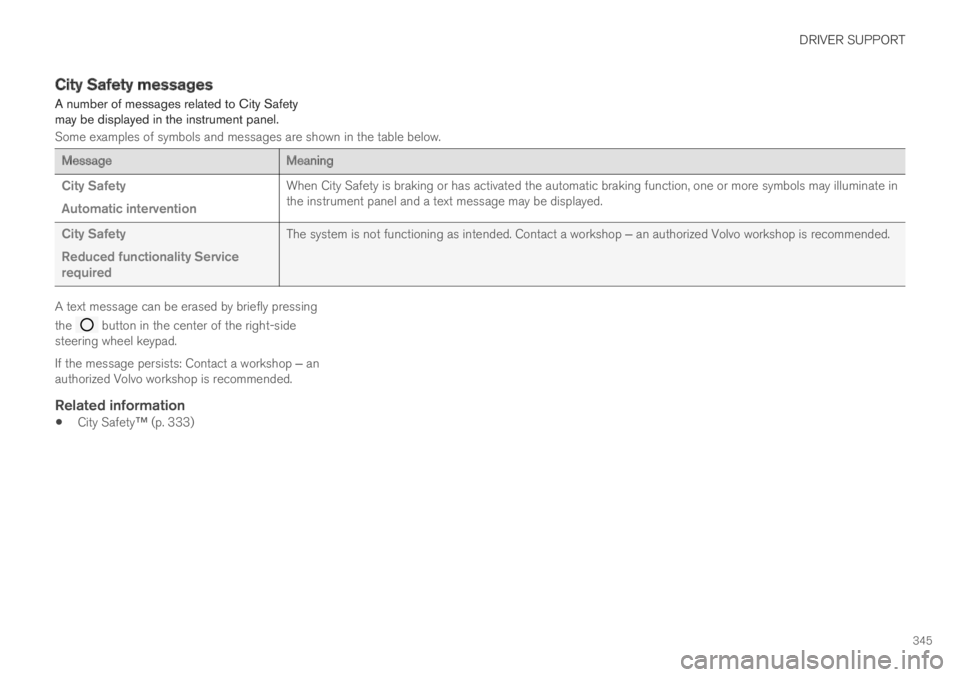
City Safety messages
A number of messages related to City Safetymay be displayed in the instrument panel.
Some examples of symbols and messages are shown in the table below.
MessageMeaning
City Safety
Automatic intervention
When City Safety is braking or has activated the automatic braking function, one or more symbols may illuminate inthe instrument panel and a text message may be displayed.
City Safety
Reduced functionality Servicerequired
The system is not functioning as intended. Contact a workshop ‒ an authorized Volvo workshop is recommended.
A text message can be erased by briefly pressing
the button in the center of the right-sidesteering wheel keypad.
If the message persists: Contact a workshop ‒ anauthorized Volvo workshop is recommended.
Related information
City Safety™ (p. 333)