wheel VOLVO V60 2014 Service Manual
[x] Cancel search | Manufacturer: VOLVO, Model Year: 2014, Model line: V60, Model: VOLVO V60 2014Pages: 442, PDF Size: 13.85 MB
Page 164 of 442
06 Locks and alarm
06
162* Option/accessory, for more information, see Introduction.
Keyless drive* - unlocking with the key blade
If central locking cannot be unlocked with the PCC, e.g. if the batteries are discharged, thenthe left-hand front door can be opened withthe PCC's detachable key blade (see Detach-able key blade - detaching/attaching (p. 155)).
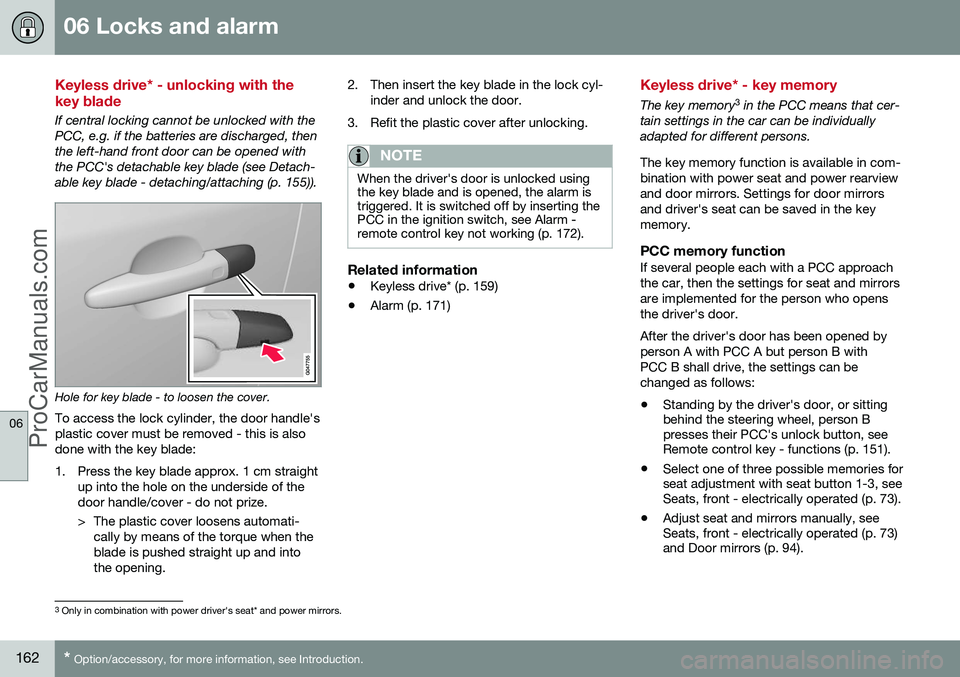
Hole for key blade - to loosen the cover.
To access the lock cylinder, the door handle's plastic cover must be removed - this is alsodone with the key blade:
1. Press the key blade approx. 1 cm straight up into the hole on the underside of the door handle/cover - do not prize.
> The plastic cover loosens automati-cally by means of the torque when the blade is pushed straight up and intothe opening. 2. Then insert the key blade in the lock cyl-
inder and unlock the door.
3. Refit the plastic cover after unlocking.
NOTE
When the driver's door is unlocked using the key blade and is opened, the alarm istriggered. It is switched off by inserting thePCC in the ignition switch, see Alarm -remote control key not working (p. 172).
Related information
• Keyless drive* (p. 159)
• Alarm (p. 171)
Keyless drive* - key memory
The key memory 3
in the PCC means that cer-
tain settings in the car can be individually adapted for different persons. The key memory function is available in com- bination with power seat and power rearviewand door mirrors. Settings for door mirrorsand driver's seat can be saved in the keymemory.
PCC memory functionIf several people each with a PCC approachthe car, then the settings for seat and mirrorsare implemented for the person who opensthe driver's door. After the driver's door has been opened by person A with PCC A but person B withPCC B shall drive, the settings can bechanged as follows:
• Standing by the driver's door, or sitting behind the steering wheel, person Bpresses their PCC's unlock button, seeRemote control key - functions (p. 151).
• Select one of three possible memories forseat adjustment with seat button 1-3, seeSeats, front - electrically operated (p. 73).
• Adjust seat and mirrors manually, seeSeats, front - electrically operated (p. 73)and Door mirrors (p. 94).
3
Only in combination with power driver's seat* and power mirrors.
ProCarManuals.co’
Page 177 of 442
07 Driver support
07
* Option/accessory, for more information, see Introduction.175
Active chassis - Four C*
Active chassis "Four-C" (Continously Controlled Chassis Concept), regulates thecharacteristics of the shock absorbers so thatthe car's driving characteristics can beadjusted. There are three settings: Comfort,
Sport and Advanced .
ComfortThis setting means that the car is perceivedas being more comfortable on rough anduneven road surfaces. Shock absorption issoft and the movement of the body is smoothand gentle.
SportThis setting means that the car is perceivedas being more sporty and is recommendedfor more active driving. Steering response isfaster than in the Comfort mode. Shockabsorption is harder and the body follows theroad in order to reduce rolling during corner-ing.
AdvancedThis setting is only recommended on veryeven and smooth road surfaces. The shock absorbers are optimised for maxi- mum roadholding and rolling in bends is fur-ther minimised.
Operation
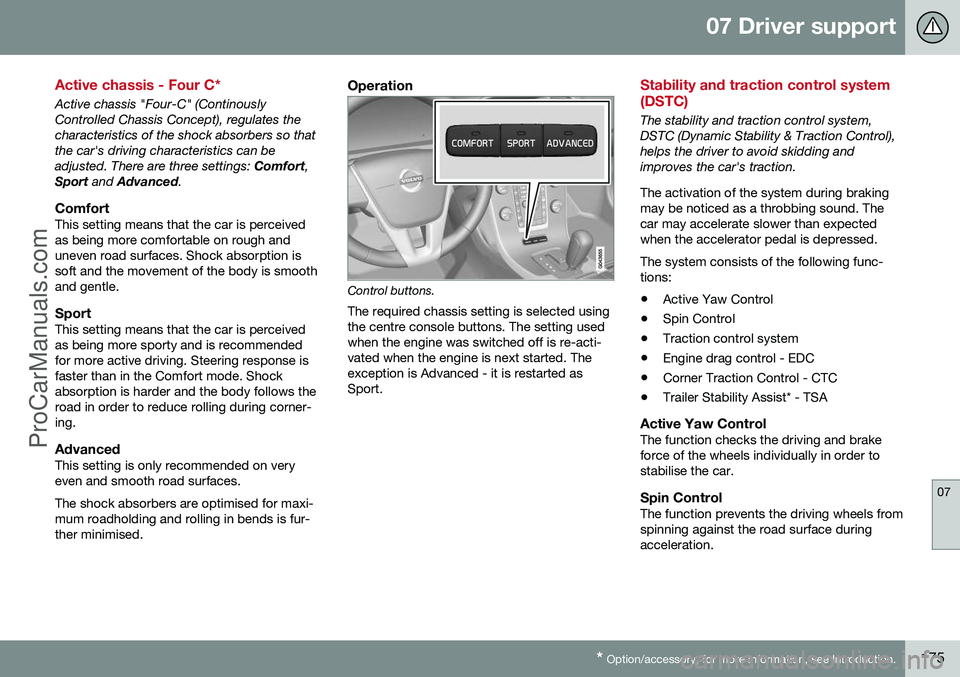
Control buttons.
The required chassis setting is selected using the centre console buttons. The setting usedwhen the engine was switched off is re-acti-vated when the engine is next started. Theexception is Advanced - it is restarted asSport.
Stability and traction control system (DSTC)
The stability and traction control system, DSTC (Dynamic Stability & Traction Control),helps the driver to avoid skidding andimproves the car's traction. The activation of the system during braking may be noticed as a throbbing sound. Thecar may accelerate slower than expectedwhen the accelerator pedal is depressed. The system consists of the following func- tions: • Active Yaw Control
• Spin Control
• Traction control system
• Engine drag control - EDC
• Corner Traction Control - CTC
• Trailer Stability Assist* - TSA
Active Yaw ControlThe function checks the driving and brake force of the wheels individually in order tostabilise the car.
Spin ControlThe function prevents the driving wheels fromspinning against the road surface duringacceleration.
ProCarManuals.co’
Page 178 of 442
||
07 Driver support
07
176* Option/accessory, for more information, see Introduction.
Traction control systemThe function is active at low speed and trans- fers power from the driving wheel that is spin-ning to the one that is not.
Engine drag control (EDC)EDC (Engine Drag Control) prevents involun-tary wheel locking, e.g. after shifting down orengine braking when driving in low gears onslippery road surfaces. Involuntary wheel locking while driving can, amongst other things, impair the driver's abil-ity to steer the car.
Corner Traction Control (CTC)*CTC compensates for understeer and allowshigher than normal acceleration in a bendwithout wheelspin on the inner wheel, e.g. onan arcing motorway entrance road to quicklyreach the prevailing traffic speed.
Trailer Stability Assist 1Trailer stability assist (p. 312) function is tostabilise the car and trailer combination if itbegins to snake. For more information, seeDriving with a trailer (p. 306).
NOTE
The function is deactivated if the driver selects
Sport mode.
Related information
•Stability and traction control system (DSTC) - operation (p. 176)
• Stability and traction control system(DSTC) - symbols and messages (p. 178)
Stability and traction control system (DSTC) - operation
The stability and traction control system (p. 175) (DSTC - Dynamic Stability & TractionControl), helps the driver to avoid skiddingand improves the car's traction.
Selection of level - Sport modeThe stability and traction control system isalways activated - it cannot be switched off. However, the driver can select the
Sport
mode, which allows for a more active driving experience. In Sport mode the system
detects whether the accelerator pedal, steer-ing wheel movements and cornering are moreactive than in normal driving and then allowscontrolled skidding with the rear section up toa certain level before it intervenes and stabil-ises the car. If the driver interrupts a controlled skid by releasing the accelerator pedal then the sta-bility and traction control system intervenesand stabilises the car. With Sport mode, maximum traction is
obtained if the car has become stuck, or when driving on a loose surface - e.g. sand ordeep snow. Sport mode is selected in the menu system
MY CAR. For a description of the menu sys- tem, see MY CAR (p. 103).
1 Included in the installation of Volvo genuine towbar.
ProCarManuals.co’
Page 184 of 442
07 Driver support
07
182* Option/accessory, for more information, see Introduction.
Speed limiter*
A (Speed Limiter) can be regarded as a reverse cruise control - the driver regulatesthe speed using the accelerator pedal but isprevented from accidentally exceeding a pre-selected/set speed by the speed limiter.
Overview
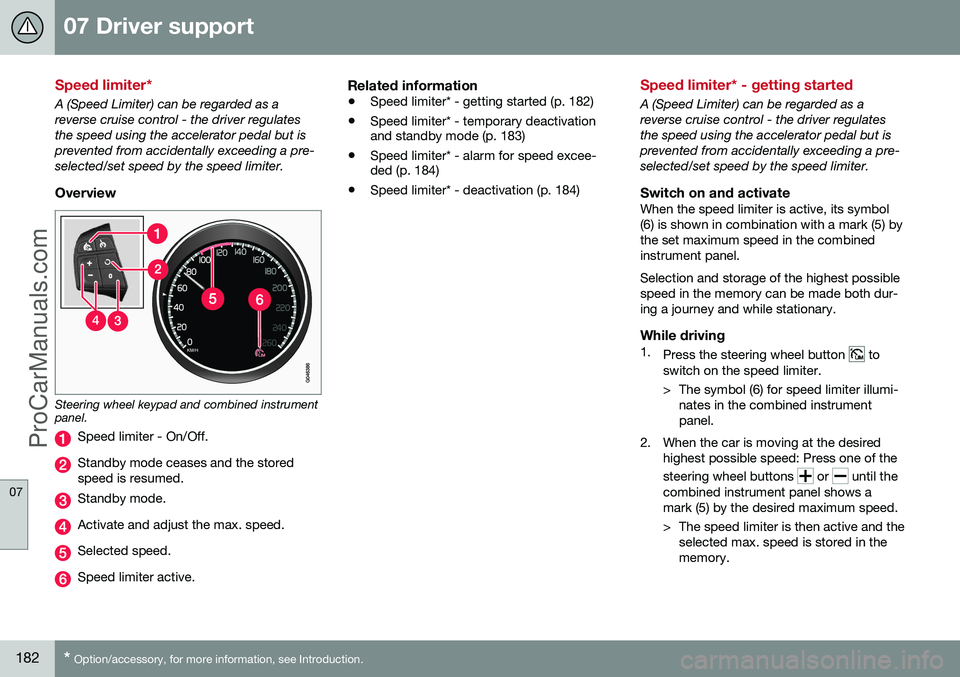
Steering wheel keypad and combined instrument panel.
Speed limiter - On/Off.
Standby mode ceases and the stored speed is resumed.
Standby mode.
Activate and adjust the max. speed.
Selected speed.
Speed limiter active.
Related information
• Speed limiter* - getting started (p. 182)
• Speed limiter* - temporary deactivation and standby mode (p. 183)
• Speed limiter* - alarm for speed excee-ded (p. 184)
• Speed limiter* - deactivation (p. 184)
Speed limiter* - getting started
A (Speed Limiter) can be regarded as a reverse cruise control - the driver regulatesthe speed using the accelerator pedal but isprevented from accidentally exceeding a pre-selected/set speed by the speed limiter.
Switch on and activateWhen the speed limiter is active, its symbol(6) is shown in combination with a mark (5) bythe set maximum speed in the combinedinstrument panel. Selection and storage of the highest possible speed in the memory can be made both dur-ing a journey and while stationary.
While driving1.
Press the steering wheel button to
switch on the speed limiter.
> The symbol (6) for speed limiter illumi- nates in the combined instrument panel.
2. When the car is moving at the desired highest possible speed: Press one of the steering wheel buttons
or until the
combined instrument panel shows a mark (5) by the desired maximum speed.
> The speed limiter is then active and the selected max. speed is stored in the memory.
ProCarManuals.co’
Page 185 of 442
07 Driver support
07
* Option/accessory, for more information, see Introduction.183
When stationary1.
Press the steering wheel button to
switch on the speed limiter.
2. Scroll with the
button until the com-
bined instrument panel shows a mark (5) by the desired maximum speed.
> The speed limiter is then active and the selected max. speed is stored in the memory.
Related information
• Speed limiter* (p. 182)
• Speed limiter* - changing speed (p. 183)
• Speed limiter* - temporary deactivation and standby mode (p. 183)
• Speed limiter* - deactivation (p. 184)
• Speed limiter* - alarm for speed excee-ded (p. 184)
Speed limiter* - changing speed
A (Speed Limiter) can be regarded as a reverse cruise control - the driver regulatesthe speed using the accelerator pedal but isprevented from accidentally exceeding a pre-selected/set speed by the speed limiter. To change the stored speed: •
Adjust with short presses on
or -
every press gives +/- 5 km/h. The last presses made are stored in the memory.
To adjust +/- 1 km/h: • Hold the button depressed and release when the combined instrument panelshows a mark (5) by the desired maxi-mum speed.
Related information
•Speed limiter* (p. 182)
• Speed limiter* - getting started (p. 182)
• Speed limiter* - temporary deactivationand standby mode (p. 183)
• Speed limiter* - deactivation (p. 184)
• Speed limiter* - alarm for speed excee-ded (p. 184)
Speed limiter* - temporary deactivation and standby mode
A (Speed Limiter) can be regarded as a reverse cruise control - the driver regulatesthe speed using the accelerator pedal but isprevented from accidentally exceeding a pre-selected/set speed by the speed limiter.
Temporary deactivation - standby modeTo temporarily deactivate the speed limiterand set it in standby mode:
–Press .
> The mark (5) in the combined instru- ment panel changes colour from GREEN to WHITE and the driver cantemporarily exceed the set maximumspeed. The speed limiter is reactivated with one press on
. The mark (5) then
changes colour from WHITE to GREEN and the car's maximum speed is lim-ited once again.
Temporary deactivation with the accelerator pedal
The speed limiter can also be set in standby mode with the accelerator pedal, e.g. for rap-idly accelerating the car out of a situation:
ProCarManuals.co’
Page 186 of 442
||
07 Driver support
07
184* Option/accessory, for more information, see Introduction.
–Depress the accelerator pedal fully.
> The combined instrument panel shows
the stored maximum speed with a col- oured mark (5) and the driver can tem-porarily exceed the set maximumspeed - the mark (5) changes colourduring this time from GREEN toWHITE. The speed limiter is automatically reac- tivated after the release of the acceler-ator pedal and the car's speed isslowed down to below the selected/stored maximum speed - the display'smark (5) changes colour from WHITEto GREEN and the car's maximumspeed is again limited.
Related information
• Speed limiter* (p. 182)
• Speed limiter* - getting started (p. 182)
• Speed limiter* - changing speed (p. 183)
• Speed limiter* - deactivation (p. 184)
• Speed limiter* - alarm for speed excee- ded (p. 184)
Speed limiter* - alarm for speed exceeded
A (Speed Limiter) can be regarded as a reverse cruise control - the driver regulatesthe speed using the accelerator pedal but isprevented from accidentally exceeding apre-selected/set speed by the speed limiter. On a steep downhill gradient the speed limit- er's engine braking effect may be inadequateand the selected maximum speed is excee-ded. The driver is alerted about this with anacoustic signal. The signal is active until the driver has slowed to below the selected maximum speed.
NOTE
The alarm is only activated after 5 seconds if the speed has been exceeded by at least3 km/h provided that none of the buttons
or has been depressed during the
last half minute.
Related information
• Speed limiter* (p. 182)
• Speed limiter* - changing speed (p. 183)
• Speed limiter* - getting started (p. 182)
• Speed limiter* - temporary deactivation and standby mode (p. 183)
• Speed limiter* - deactivation (p. 184)
Speed limiter* - deactivation
A (Speed Limiter) can be regarded as a reverse cruise control - the driver regulatesthe speed using the accelerator pedal but isprevented from accidentally exceeding a pre-selected/set speed by the speed limiter. To deactivate the speed limiter:
–Press the steering wheel button .
> The combined instrument panel's sym- bol for the speed limiter (6) and the mark for the set speed (5) are extin-guished. The selected and storedspeed are thus deleted from the mem-ory and cannot be resumed with the
button.
The driver can then use the accelerator pedal to choose a speed without limi-tation.
Related information
• Speed limiter* (p. 182)
• Speed limiter* - getting started (p. 182)
• Speed limiter* - temporary deactivation and standby mode (p. 183)
• Speed limiter* - alarm for speed excee-ded (p. 184)
ProCarManuals.co’
Page 187 of 442
07 Driver support
07
* Option/accessory, for more information, see Introduction.185
Cruise control*
The cruise control (CC – Cruise Control) helps the driver maintain an even speed, resulting ina more relaxed driving on motorways andlong, straight roads in regular traffic flows.
Overview
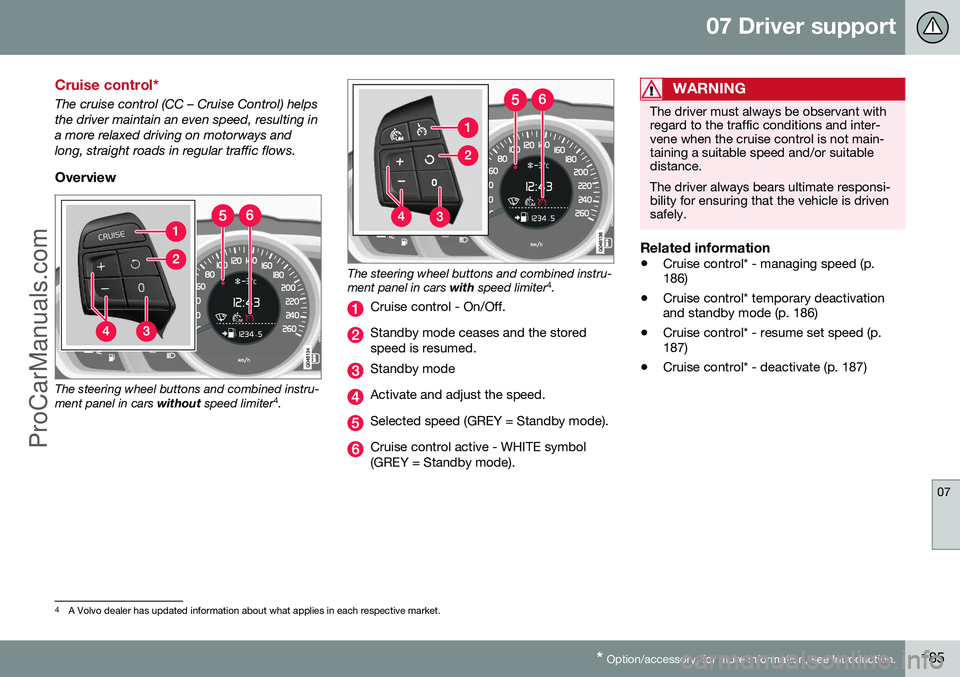
The steering wheel buttons and combined instru- ment panel in cars without speed limiter 4
.
The steering wheel buttons and combined instru- ment panel in cars with speed limiter 4
.
Cruise control - On/Off.
Standby mode ceases and the stored speed is resumed.
Standby mode
Activate and adjust the speed.
Selected speed (GREY = Standby mode).
Cruise control active - WHITE symbol (GREY = Standby mode).
WARNING
The driver must always be observant with regard to the traffic conditions and inter-vene when the cruise control is not main-taining a suitable speed and/or suitabledistance. The driver always bears ultimate responsi- bility for ensuring that the vehicle is drivensafely.
Related information
• Cruise control* - managing speed (p. 186)
• Cruise control* temporary deactivationand standby mode (p. 186)
• Cruise control* - resume set speed (p.187)
• Cruise control* - deactivate (p. 187)
4
A Volvo dealer has updated information about what applies in each respective market.
ProCarManuals.co’
Page 188 of 442
07 Driver support
07
186* Option/accessory, for more information, see Introduction.
Cruise control* - managing speed
The cruise control (CC – Cruise Control) helps the driver to maintain an even speed. It ispossible to activate, set or change the speed.
Activating and setting the speedTo enable cruise control:
• Press the steering wheel button
> The cruise control symbol in the com-
bined instrument panel changes from WHITE to GREY and shows that thecruise control is in standby mode.
To activate cruise control:
• At the required speed - press the steering wheel button
or .
> The current speed is stored in the mem- ory and the combined instrument panel's marking (5) is illuminated/turns WHITE atthe selected speed.
NOTE
Cruise Control cannot be enabled at speeds below 30 km/h.
Changing the speedTo change the stored speed: • Adjust with short presses on
or -
every press gives +/- 5 km/h. The last presses made are stored in the memory.
To adjust +/- 1 km/h: •
Hold down the button and release it atthe required speed.
A temporary increase in speed with the accel- erator pedal, e.g. during overtaking, does notaffect the cruise control setting - the carreturns to the set speed when the acceleratorpedal is released.
NOTE
If any of the Cruise Control buttons are held depressed for several minutes then itis blocked and deactivated. To be able toreactivate Cruise Control, the car must bestopped and the engine restarted.
Related information
• Cruise control* (p. 185)
• Cruise control* temporary deactivation and standby mode (p. 186)
• Cruise control* - resume set speed (p.187)
• Cruise control* - deactivate (p. 187)
Cruise control* temporary deactivation and standby mode
The cruise control (CC – Cruise Control) helps the driver to maintain an even speed. Thefunction can be temporarily deactivated andset in standby mode.
Temporary deactivation - standby modeTo temporarily disengage cruise control andset it in standby mode:
• Press the steering wheel button
.
> The combined instrument panel's mark- ing (5) and the symbol (6) change colour from WHITE to GREY.
Automatic standby modeCruise control is temporarily disengaged andset in standby mode if:
• wheels lose traction
• the foot brake is used
• speed falls below approx. 30 km/h
ProCarManuals.co’
Page 189 of 442
07 Driver support
07
* Option/accessory, for more information, see Introduction.187
•
the clutch pedal is held depressed for a short time - however, a few seconds does not activate standby mode 5
• the gear selector is moved to neutral position (automatic gearbox)
• the driver maintains a speed higher thanthe set speed for longer than 1 minute.
The driver must then regulate the speed.
Related information
• Cruise control* (p. 185)
• Cruise control* - managing speed (p. 186)
• Cruise control* - resume set speed (p.187)
• Cruise control* - deactivate (p. 187)
Cruise control* - resume set speed
The cruise control (CC – Cruise Control) helps the driver to maintain an even speed. Aftertemporary deactivation and standby mode (p.186) it is possible to resume the set speed. To reactivate the cruise control from standby mode: •
Press the steering wheel button
.
> The combined instrument panel's mark- ing (5) and symbol (6) change colour from GREY to WHITE and the speed is thenset to the last speed stored.
NOTE
A marked speed increase may occur once the speed has been resumed by selecting
.
Related information
• Cruise control* (p. 185)
• Cruise control* - managing speed (p. 186)
• Cruise control* temporary deactivation and standby mode (p. 186)
• Cruise control* - deactivate (p. 187)
Cruise control* - deactivate
The cruise control (CC – Cruise Control) helps the driver to maintain an even speed. How itis deactivated is described here. The cruise control is deactivated with a steer- ing wheel button (1) or by switching off theengine - the set speed is deleted from the memory and cannot be resumed with the
button.
Related information
•
Cruise control* (p. 185)
• Cruise control* - managing speed (p. 186)
• Cruise control* temporary deactivation and standby mode (p. 186)
• Cruise control* - resume set speed (p.187)
5
Cars with 4-cyl 2.0L engine also allow gear changing.
ProCarManuals.co’
Page 191 of 442
07 Driver support
07
}}
* Option/accessory, for more information, see Introduction.189
Adaptive cruise control* - function
The adaptive cruise control (ACC – Adaptive Cruise Control) helps the driver to maintain aneven speed and a safe distance from the vehi-cle ahead. It consists of a cruise control sys-tem and a coordinated spacing system.
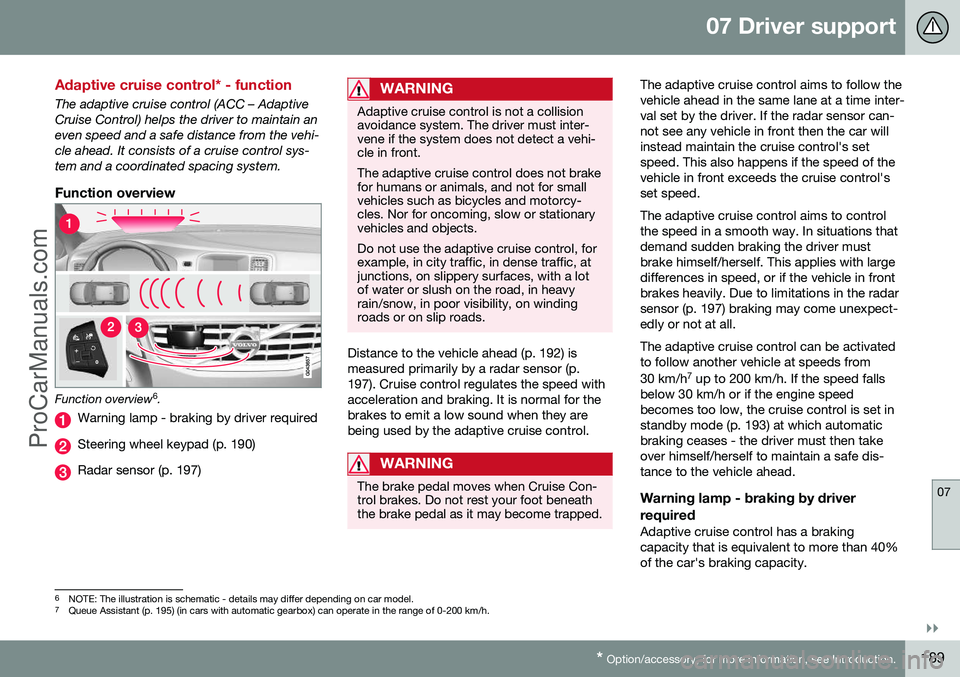
Function overview
Function overview 6
.
Warning lamp - braking by driver required
Steering wheel keypad (p. 190)
Radar sensor (p. 197)
WARNING
Adaptive cruise control is not a collision avoidance system. The driver must inter-vene if the system does not detect a vehi-cle in front. The adaptive cruise control does not brake for humans or animals, and not for smallvehicles such as bicycles and motorcy-cles. Nor for oncoming, slow or stationaryvehicles and objects. Do not use the adaptive cruise control, for example, in city traffic, in dense traffic, atjunctions, on slippery surfaces, with a lotof water or slush on the road, in heavyrain/snow, in poor visibility, on windingroads or on slip roads.
Distance to the vehicle ahead (p. 192) is measured primarily by a radar sensor (p.197). Cruise control regulates the speed withacceleration and braking. It is normal for thebrakes to emit a low sound when they arebeing used by the adaptive cruise control.
WARNING
The brake pedal moves when Cruise Con- trol brakes. Do not rest your foot beneaththe brake pedal as it may become trapped.
The adaptive cruise control aims to follow the vehicle ahead in the same lane at a time inter-val set by the driver. If the radar sensor can-not see any vehicle in front then the car willinstead maintain the cruise control's setspeed. This also happens if the speed of thevehicle in front exceeds the cruise control'sset speed. The adaptive cruise control aims to control the speed in a smooth way. In situations thatdemand sudden braking the driver mustbrake himself/herself. This applies with largedifferences in speed, or if the vehicle in frontbrakes heavily. Due to limitations in the radarsensor (p. 197) braking may come unexpect-edly or not at all. The adaptive cruise control can be activated to follow another vehicle at speeds from 30 km/h 7
up to 200 km/h. If the speed falls
below 30 km/h or if the engine speed becomes too low, the cruise control is set instandby mode (p. 193) at which automaticbraking ceases - the driver must then takeover himself/herself to maintain a safe dis-tance to the vehicle ahead.
Warning lamp - braking by driver required
Adaptive cruise control has a braking capacity that is equivalent to more than 40%of the car's braking capacity.
6 NOTE: The illustration is schematic - details may differ depending on car model.
7 Queue Assistant (p. 195) (in cars with automatic gearbox) can operate in the range of 0-200 km/h.
ProCarManuals.co’