light VOLVO V90 2017 Owners Manual
[x] Cancel search | Manufacturer: VOLVO, Model Year: 2017, Model line: V90, Model: VOLVO V90 2017Pages: 594, PDF Size: 15.07 MB
Page 486 of 594
WHEELS AND TYRES
484
Tread wear indicators on the tyres Tread wear indicators show the status of the tyre's tread depth.
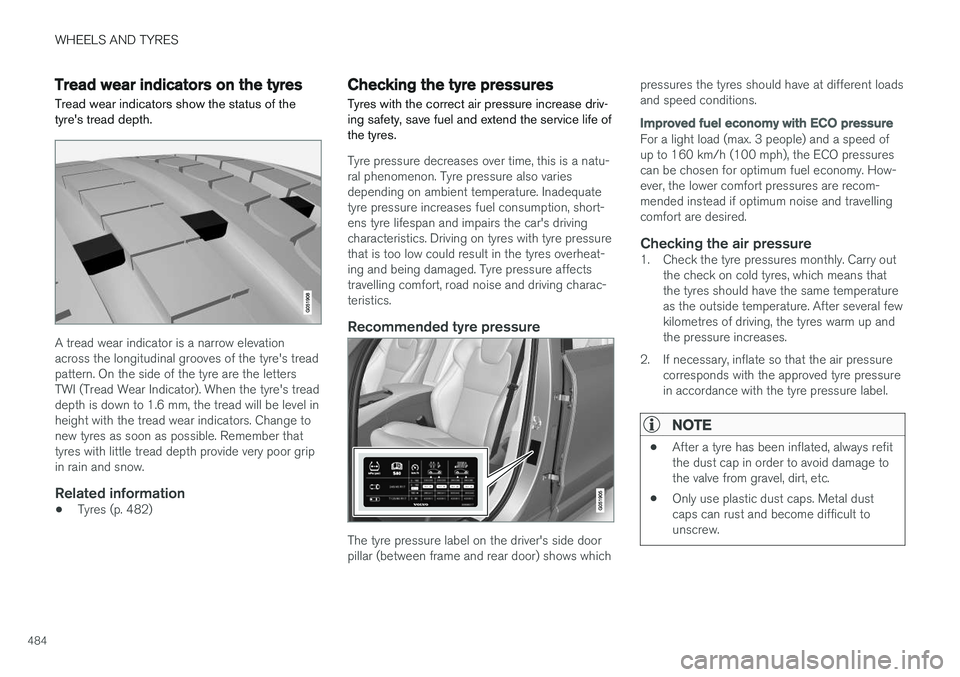
A tread wear indicator is a narrow elevation across the longitudinal grooves of the tyre's treadpattern. On the side of the tyre are the lettersTWI (Tread Wear Indicator). When the tyre's treaddepth is down to 1.6 mm, the tread will be level inheight with the tread wear indicators. Change tonew tyres as soon as possible. Remember thattyres with little tread depth provide very poor gripin rain and snow.
Related information
•Tyres (p. 482)
Checking the tyre pressures Tyres with the correct air pressure increase driv- ing safety, save fuel and extend the service life ofthe tyres.
Tyre pressure decreases over time, this is a natu- ral phenomenon. Tyre pressure also variesdepending on ambient temperature. Inadequatetyre pressure increases fuel consumption, short-ens tyre lifespan and impairs the car's drivingcharacteristics. Driving on tyres with tyre pressurethat is too low could result in the tyres overheat-ing and being damaged. Tyre pressure affectstravelling comfort, road noise and driving charac-teristics.
Recommended tyre pressure
The tyre pressure label on the driver's side door pillar (between frame and rear door) shows which pressures the tyres should have at different loadsand speed conditions.
Improved fuel economy with ECO pressure
For a light load (max. 3 people) and a speed of up to 160 km/h (100 mph), the ECO pressurescan be chosen for optimum fuel economy. How-ever, the lower comfort pressures are recom-mended instead if optimum noise and travellingcomfort are desired.
Checking the air pressure1. Check the tyre pressures monthly. Carry out
the check on cold tyres, which means thatthe tyres should have the same temperatureas the outside temperature. After several fewkilometres of driving, the tyres warm up andthe pressure increases.
2. If necessary, inflate so that the air pressure corresponds with the approved tyre pressurein accordance with the tyre pressure label.
NOTE
• After a tyre has been inflated, always refit the dust cap in order to avoid damage tothe valve from gravel, dirt, etc.
• Only use plastic dust caps. Metal dustcaps can rust and become difficult tounscrew.
Page 493 of 594
WHEELS AND TYRES
}}
491
Using the emergency puncture repair kit Seal a puncture with the emergency puncture repair kit, Temporary Mobility Kit (TMK).
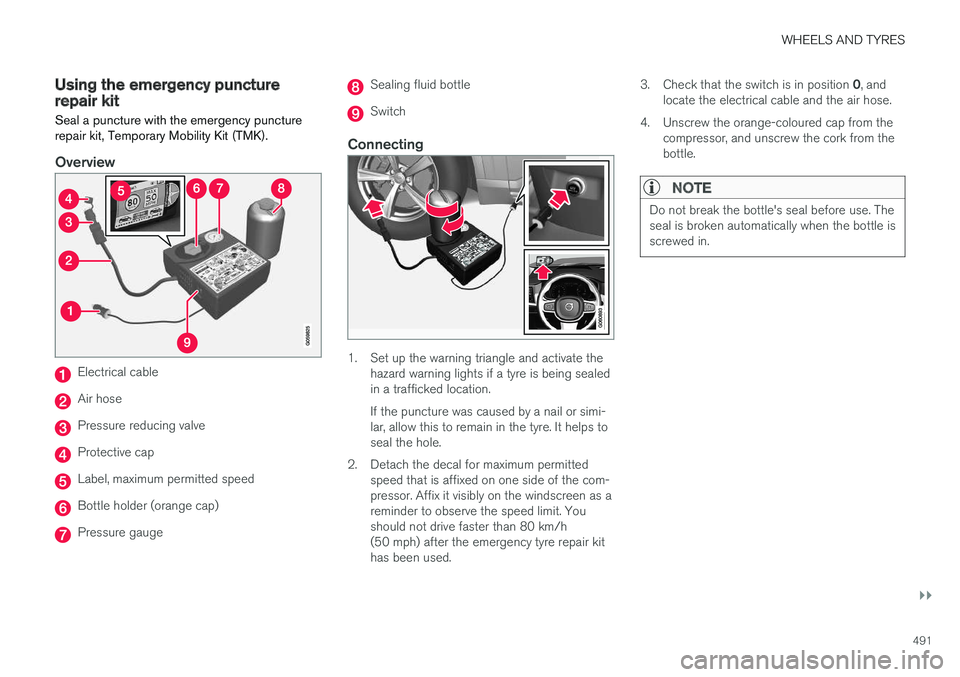
Overview
Electrical cable
Air hose
Pressure reducing valve
Protective cap
Label, maximum permitted speed
Bottle holder (orange cap)
Pressure gauge
Sealing fluid bottle
Switch
Connecting
1. Set up the warning triangle and activate thehazard warning lights if a tyre is being sealed in a trafficked location. If the puncture was caused by a nail or simi- lar, allow this to remain in the tyre. It helps toseal the hole.
2. Detach the decal for maximum permitted speed that is affixed on one side of the com-pressor. Affix it visibly on the windscreen as areminder to observe the speed limit. Youshould not drive faster than 80 km/h(50 mph) after the emergency tyre repair kithas been used. 3.
Check that the switch is in position 0, and
locate the electrical cable and the air hose.
4. Unscrew the orange-coloured cap from the compressor, and unscrew the cork from thebottle.
NOTE
Do not break the bottle's seal before use. The seal is broken automatically when the bottle isscrewed in.
Page 497 of 594
WHEELS AND TYRES
}}
* Option/accessory.495
IMPORTANT
Risk of overheating. The compressor must not run for more than 10 minutes.
5. Inflate the tyre to the pressure specified on
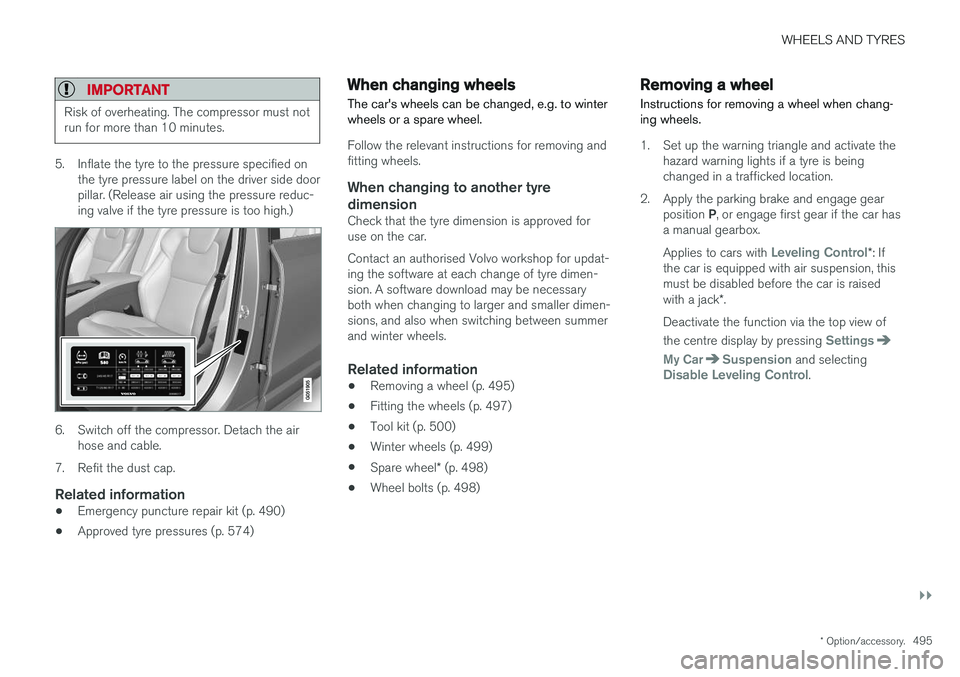
the tyre pressure label on the driver side door pillar. (Release air using the pressure reduc-ing valve if the tyre pressure is too high.)
6. Switch off the compressor. Detach the airhose and cable.
7. Refit the dust cap.
Related information
• Emergency puncture repair kit (p. 490)
• Approved tyre pressures (p. 574)
When changing wheels
The car's wheels can be changed, e.g. to winter wheels or a spare wheel.
Follow the relevant instructions for removing and fitting wheels.
When changing to another tyre
dimension
Check that the tyre dimension is approved foruse on the car. Contact an authorised Volvo workshop for updat- ing the software at each change of tyre dimen-sion. A software download may be necessaryboth when changing to larger and smaller dimen-sions, and also when switching between summerand winter wheels.
Related information
• Removing a wheel (p. 495)
• Fitting the wheels (p. 497)
• Tool kit (p. 500)
• Winter wheels (p. 499)
• Spare wheel
* (p. 498)
• Wheel bolts (p. 498)
Removing a wheel
Instructions for removing a wheel when chang- ing wheels.
1. Set up the warning triangle and activate the hazard warning lights if a tyre is being changed in a trafficked location.
2. Apply the parking brake and engage gear position P, or engage first gear if the car has
a manual gearbox. Applies to cars with
Leveling Control* : If
the car is equipped with air suspension, this must be disabled before the car is raised with a jack *.
Deactivate the function via the top view of the centre display by pressing
Settings
My CarSuspension and selectingDisable Leveling Control.
Page 516 of 594
MAINTENANCE AND SERVICE
514
Opening and closing the bonnet
The bonnet can be opened using the handle in the passenger compartment and a handle underthe bonnet.
Open the bonnet
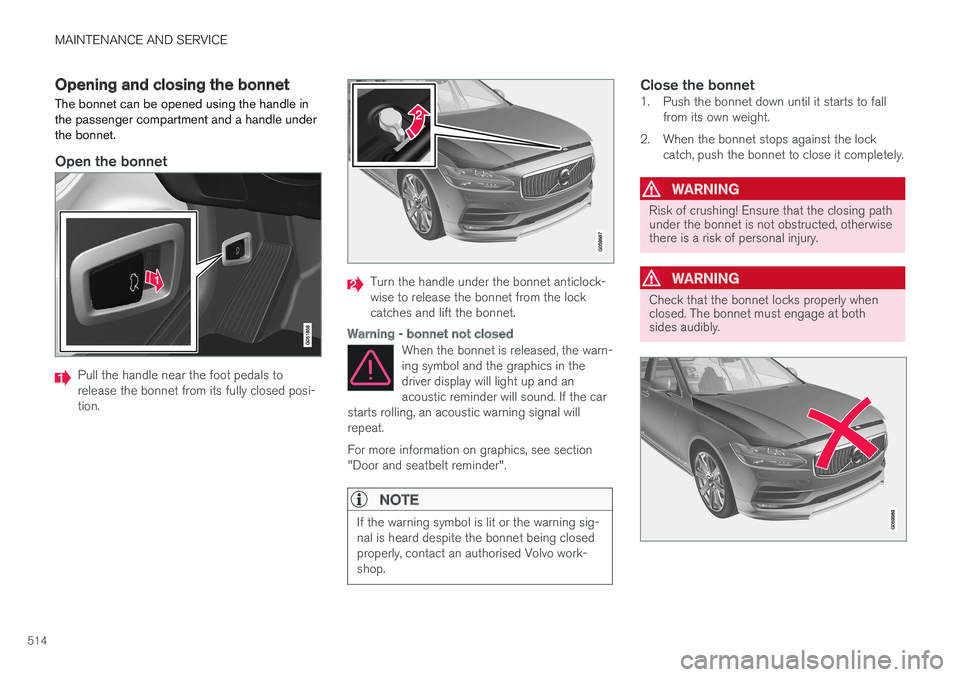
Pull the handle near the foot pedals to release the bonnet from its fully closed posi-tion.
Turn the handle under the bonnet anticlock- wise to release the bonnet from the lockcatches and lift the bonnet.
Warning - bonnet not closed
When the bonnet is released, the warn- ing symbol and the graphics in thedriver display will light up and anacoustic reminder will sound. If the car
starts rolling, an acoustic warning signal willrepeat. For more information on graphics, see section "Door and seatbelt reminder".
NOTE
If the warning symbol is lit or the warning sig- nal is heard despite the bonnet being closedproperly, contact an authorised Volvo work-shop.
Close the bonnet1. Push the bonnet down until it starts to fall from its own weight.
2. When the bonnet stops against the lock catch, push the bonnet to close it completely.
WARNING
Risk of crushing! Ensure that the closing path under the bonnet is not obstructed, otherwisethere is a risk of personal injury.
WARNING
Check that the bonnet locks properly when closed. The bonnet must engage at bothsides audibly.
Page 522 of 594
MAINTENANCE AND SERVICE
520
Servicing the climate control system The air conditioning system must only be serv- iced and repaired by an authorised workshop.
Troubleshooting and repairThe air conditioning system contains fluorescent tracing agents. Ultraviolet light must be used dur-ing leak detection. Volvo recommends that you contact an author- ised Volvo workshop.
Cars with R134a refrigerant
WARNING
The air conditioning system contains pressur- ised refrigerant R134a. This system must onlybe serviced and repaired by an authorisedworkshop.
Cars with R1234yf refrigerant
WARNING
The air conditioning system contains pressur- ised refrigerant R1234yf. In accordance withSAE J2845 (Technician Training for SafeService and Containment of RefrigerantsUsed in Mobile A/C System), service andrepair of the refrigerant system must only beperformed by trained and certified techniciansin order to ensure the safety of the system.
Related information
•Volvo service programme (p. 506)
Bulb replacement
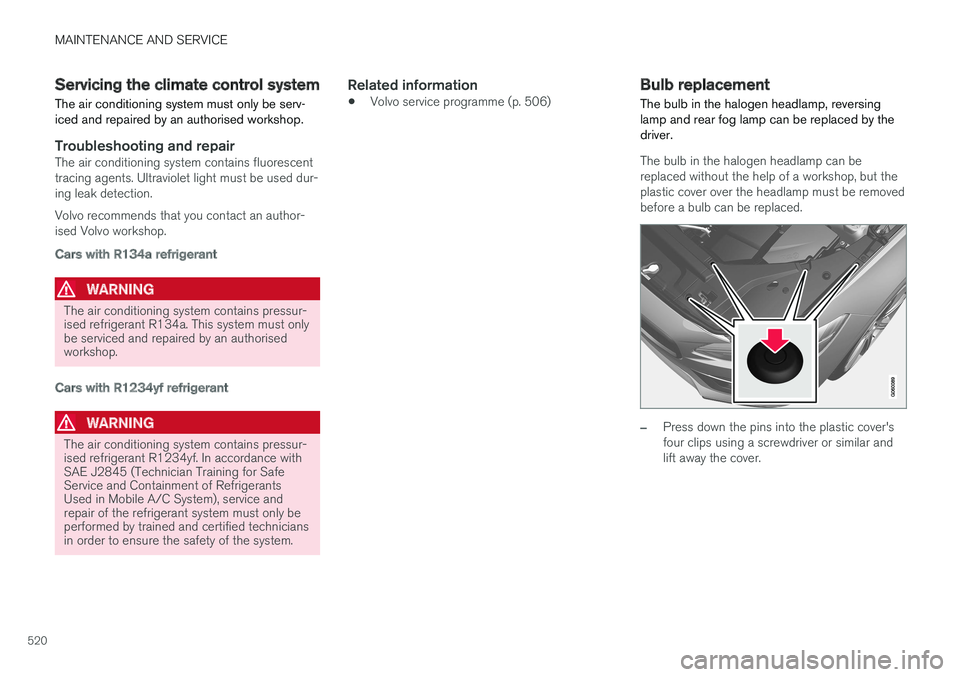
The bulb in the halogen headlamp, reversing lamp and rear fog lamp can be replaced by thedriver.
The bulb in the halogen headlamp can be replaced without the help of a workshop, but theplastic cover over the headlamp must be removedbefore a bulb can be replaced.
–Press down the pins into the plastic cover's four clips using a screwdriver or similar andlift away the cover.
Page 523 of 594
MAINTENANCE AND SERVICE
}}
* Option/accessory.521
NOTE
Points to remember when the cover is refit- ted: •The pin in the clip needs to be pressed back fully before the clip is refitted in thecover.
• When the cover is refitted, the pin mustbe pressed in until the end surface islevel with the surface of the clip.
The reversing lamp bulb and the rear fog lamp bulb can be replaced without assistance from aworkshop. Contact a workshop 9
if there is a fault in bulbs
other than the bulbs in the halogen headlamps, the reversing lamp bulb or the rear fog lamp bulb. If a fault occurs in LED 10
lamps, the entire lamp
unit usually must be replaced.
WARNING
The car's electrical system must be in ignition position 0 when replacing bulbs.
IMPORTANT
Never touch the glass part of the bulbs with your fingers. Grease from your fingers isvaporised by the heat, coating the reflectorand then causing damage.
NOTE
If an error message remains after the broken bulb has been replaced then we recommendvisiting an authorised Volvo workshop.
NOTE
Outside lighting such as headlamps and rear lamps may temporarily have condensation onthe inside of the lens. This is normal, all exte-rior lighting is designed to withstand this.Condensation is normally vented out of thelamp housing when the lamp has beenswitched on for a time.
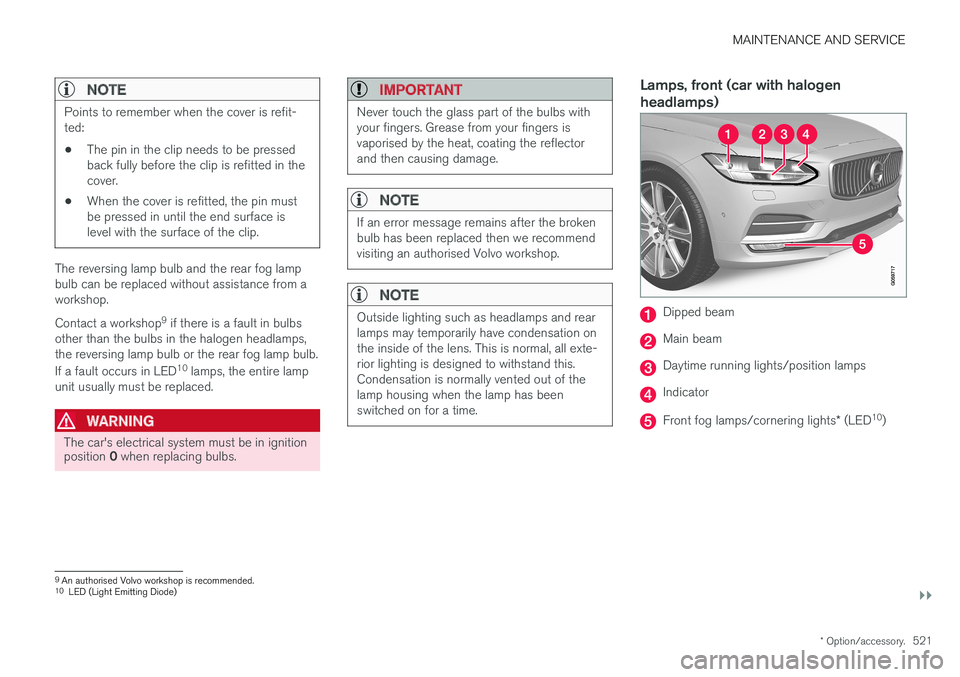
Lamps, front (car with halogen headlamps)
Dipped beam
Main beam
Daytime running lights/position lamps
Indicator
Front fog lamps/cornering lights * (LED 10
)
9An authorised Volvo workshop is recommended.
10 LED (Light Emitting Diode)
Page 524 of 594
||
MAINTENANCE AND SERVICE
522
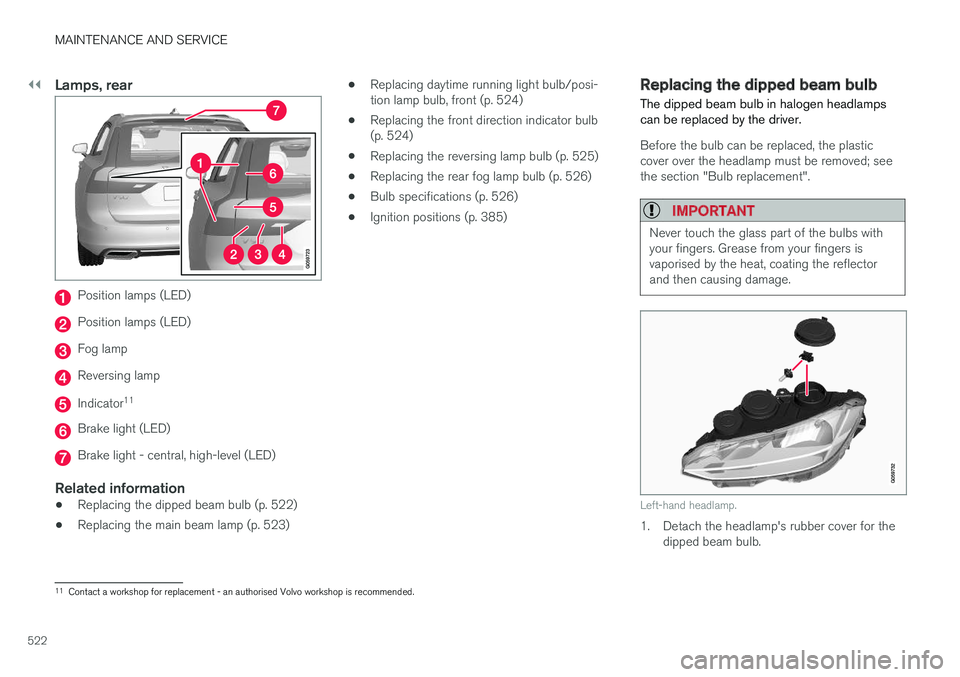
Lamps, rear
Position lamps (LED)
Position lamps (LED)
Fog lamp
Reversing lamp
Indicator11
Brake light (LED)
Brake light - central, high-level (LED)
Related information
•
Replacing the dipped beam bulb (p. 522)
• Replacing the main beam lamp (p. 523) •
Replacing daytime running light bulb/posi- tion lamp bulb, front (p. 524)
• Replacing the front direction indicator bulb(p. 524)
• Replacing the reversing lamp bulb (p. 525)
• Replacing the rear fog lamp bulb (p. 526)
• Bulb specifications (p. 526)
• Ignition positions (p. 385)
Replacing the dipped beam bulb
The dipped beam bulb in halogen headlamps can be replaced by the driver.
Before the bulb can be replaced, the plastic cover over the headlamp must be removed; seethe section "Bulb replacement".
IMPORTANT
Never touch the glass part of the bulbs with your fingers. Grease from your fingers isvaporised by the heat, coating the reflectorand then causing damage.
Left-hand headlamp.
1. Detach the headlamp's rubber cover for the dipped beam bulb.
11Contact a workshop for replacement - an authorised Volvo workshop is recommended.
Page 526 of 594
MAINTENANCE AND SERVICE
524
Replacing daytime running light bulb/position lamp bulb, front
The bulb for the daytime running light/position lamp in halogen headlamps can be replaced bythe driver.
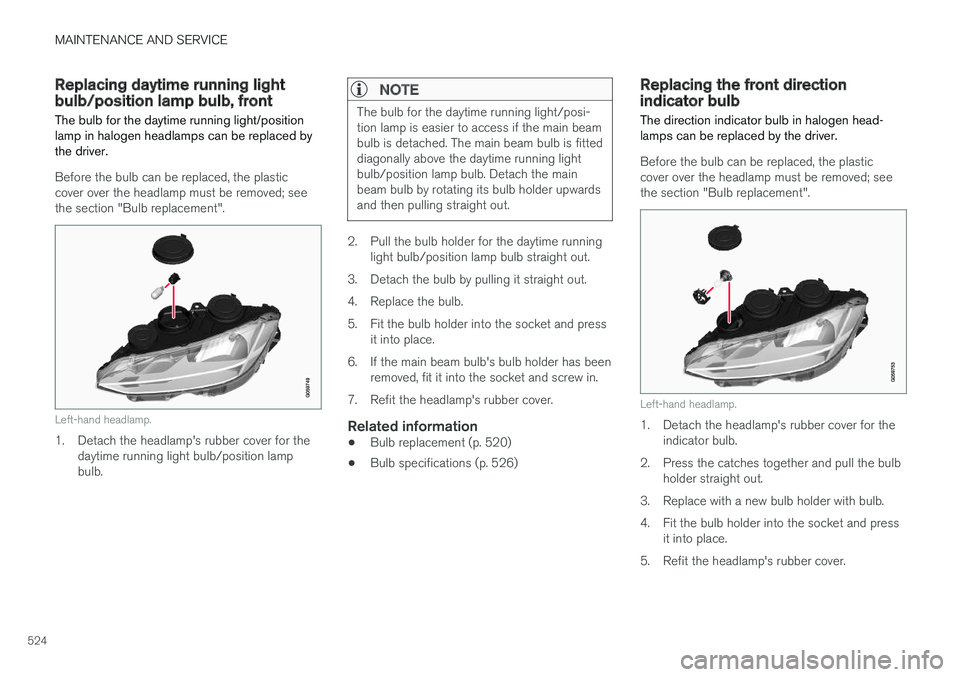
Before the bulb can be replaced, the plastic
cover over the headlamp must be removed; see the section "Bulb replacement".
Left-hand headlamp.
1. Detach the headlamp's rubber cover for the daytime running light bulb/position lamp bulb.
NOTE
The bulb for the daytime running light/posi- tion lamp is easier to access if the main beambulb is detached. The main beam bulb is fitteddiagonally above the daytime running lightbulb/position lamp bulb. Detach the mainbeam bulb by rotating its bulb holder upwardsand then pulling straight out.
2. Pull the bulb holder for the daytime runninglight bulb/position lamp bulb straight out.
3. Detach the bulb by pulling it straight out.
4. Replace the bulb.
5. Fit the bulb holder into the socket and press it into place.
6. If the main beam bulb's bulb holder has been removed, fit it into the socket and screw in.
7. Refit the headlamp's rubber cover.
Related information
• Bulb replacement (p. 520)
• Bulb specifications (p. 526)
Replacing the front direction indicator bulb
The direction indicator bulb in halogen head- lamps can be replaced by the driver.
Before the bulb can be replaced, the plastic cover over the headlamp must be removed; seethe section "Bulb replacement".
Left-hand headlamp.
1. Detach the headlamp's rubber cover for the indicator bulb.
2. Press the catches together and pull the bulb holder straight out.
3. Replace with a new bulb holder with bulb.
4. Fit the bulb holder into the socket and press it into place.
5. Refit the headlamp's rubber cover.
Page 528 of 594
MAINTENANCE AND SERVICE
526
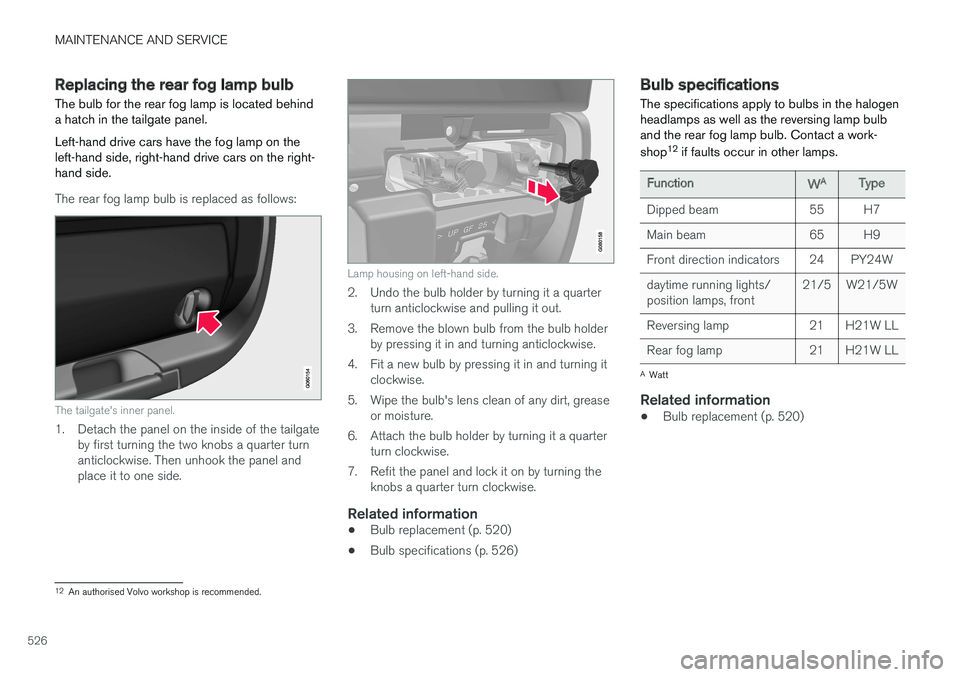
Replacing the rear fog lamp bulb The bulb for the rear fog lamp is located behind a hatch in the tailgate panel. Left-hand drive cars have the fog lamp on the left-hand side, right-hand drive cars on the right-hand side.
The rear fog lamp bulb is replaced as follows:
The tailgate's inner panel.
1. Detach the panel on the inside of the tailgateby first turning the two knobs a quarter turn anticlockwise. Then unhook the panel andplace it to one side.
Lamp housing on left-hand side.
2. Undo the bulb holder by turning it a quarterturn anticlockwise and pulling it out.
3. Remove the blown bulb from the bulb holder by pressing it in and turning anticlockwise.
4. Fit a new bulb by pressing it in and turning it clockwise.
5. Wipe the bulb's lens clean of any dirt, grease or moisture.
6. Attach the bulb holder by turning it a quarter turn clockwise.
7. Refit the panel and lock it on by turning the knobs a quarter turn clockwise.
Related information
• Bulb replacement (p. 520)
• Bulb specifications (p. 526)
Bulb specifications The specifications apply to bulbs in the halogen headlamps as well as the reversing lamp bulband the rear fog lamp bulb. Contact a work- shop 12
if faults occur in other lamps.
Function WA
Type
Dipped beam 55 H7
Main beam 65 H9
Front direction indicators 24 PY24Wdaytime running lights/ position lamps, front 21/5 W21/5W
Reversing lamp 21 H21W LL
Rear fog lamp 21 H21W LL
A Watt
Related information
• Bulb replacement (p. 520)
12
An authorised Volvo workshop is recommended.
Page 529 of 594
MAINTENANCE AND SERVICE
527
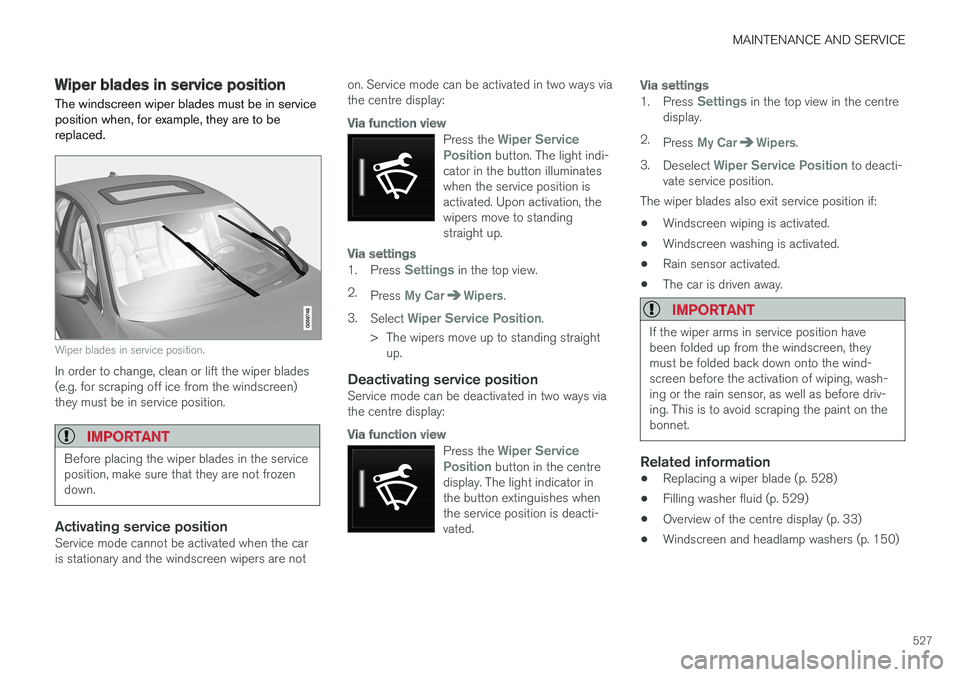
Wiper blades in service position The windscreen wiper blades must be in service position when, for example, they are to bereplaced.
Wiper blades in service position.
In order to change, clean or lift the wiper blades (e.g. for scraping off ice from the windscreen)they must be in service position.
IMPORTANT
Before placing the wiper blades in the service position, make sure that they are not frozendown.
Activating service positionService mode cannot be activated when the car is stationary and the windscreen wipers are noton. Service mode can be activated in two ways viathe centre display:
Via function view
Press the Wiper Service
Position button. The light indi-
cator in the button illuminates when the service position isactivated. Upon activation, thewipers move to standingstraight up.
Via settings
1. Press Settings in the top view.
2. Press
My CarWipers.
3. Select
Wiper Service Position.
> The wipers move up to standing straight up.
Deactivating service positionService mode can be deactivated in two ways via the centre display:
Via function view
Press the Wiper Service
Position button in the centre
display. The light indicator in the button extinguishes whenthe service position is deacti-vated.
Via settings
1. Press Settings in the top view in the centre
display.
2. Press
My CarWipers.
3. Deselect
Wiper Service Position to deacti-
vate service position.
The wiper blades also exit service position if:
• Windscreen wiping is activated.
• Windscreen washing is activated.
• Rain sensor activated.
• The car is driven away.
IMPORTANT
If the wiper arms in service position have been folded up from the windscreen, theymust be folded back down onto the wind-screen before the activation of wiping, wash-ing or the rain sensor, as well as before driv-ing. This is to avoid scraping the paint on thebonnet.
Related information
• Replacing a wiper blade (p. 528)
• Filling washer fluid (p. 529)
• Overview of the centre display (p. 33)
• Windscreen and headlamp washers (p. 150)