wheel VOLVO V90 2017 Owners Manual
[x] Cancel search | Manufacturer: VOLVO, Model Year: 2017, Model line: V90, Model: VOLVO V90 2017Pages: 594, PDF Size: 15.07 MB
Page 500 of 594
WHEELS AND TYRES
* Option/accessory.
498
Wheel bolts
Wheel bolts are used to attach the wheels to the hubs.
IMPORTANT
The wheel bolts must be tightened to 140 Nm. Overtightening or loose tightening maydamage the nuts and the bolts.
Only use rims that are tested and approved by Volvo and which are Volvo genuine accessories. Check the tightening torque of the wheel bolts with a torque wrench. Do not use lubricant on the threads of the wheel
bolts.
Locking wheel bolts *In the foam block under the cargo area floor there is space for the sleeve for the lockablewheel bolts.
Related information
•When changing wheels (p. 495)
Spare wheel
*
The spare wheel, the Temporary spare type, can be used to temporarily replace a punctured nor-mal wheel.
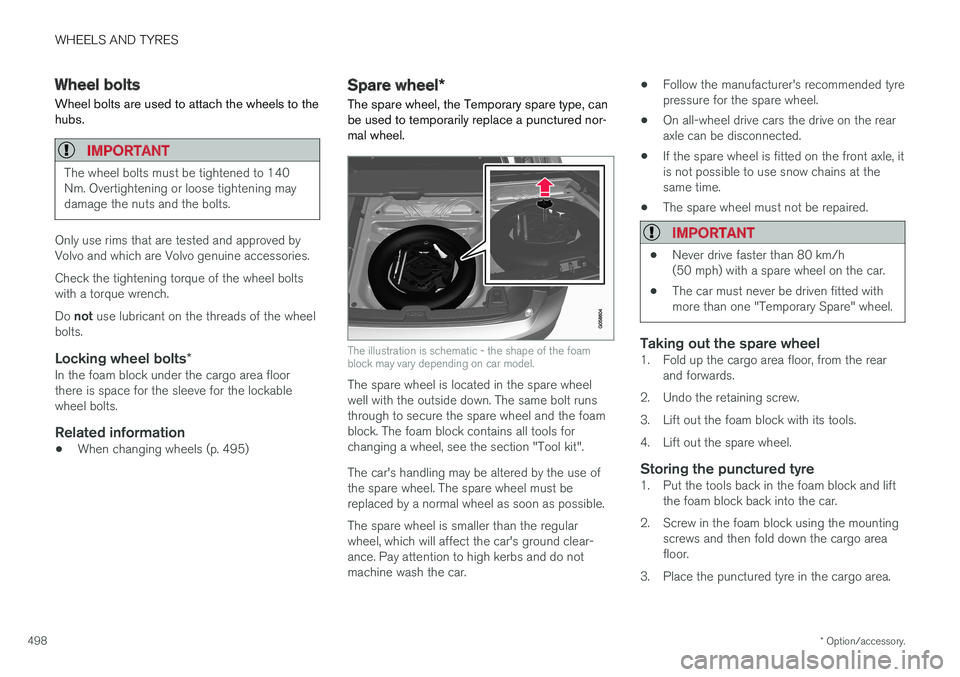
The illustration is schematic - the shape of the foam block may vary depending on car model.
The spare wheel is located in the spare wheel well with the outside down. The same bolt runsthrough to secure the spare wheel and the foamblock. The foam block contains all tools forchanging a wheel, see the section "Tool kit". The car's handling may be altered by the use of the spare wheel. The spare wheel must bereplaced by a normal wheel as soon as possible. The spare wheel is smaller than the regular wheel, which will affect the car's ground clear-ance. Pay attention to high kerbs and do notmachine wash the car. •
Follow the manufacturer's recommended tyrepressure for the spare wheel.
• On all-wheel drive cars the drive on the rearaxle can be disconnected.
• If the spare wheel is fitted on the front axle, itis not possible to use snow chains at thesame time.
• The spare wheel must not be repaired.
IMPORTANT
• Never drive faster than 80 km/h (50 mph) with a spare wheel on the car.
• The car must never be driven fitted withmore than one "Temporary Spare" wheel.
Taking out the spare wheel1. Fold up the cargo area floor, from the rear
and forwards.
2. Undo the retaining screw.
3. Lift out the foam block with its tools.
4. Lift out the spare wheel.
Storing the punctured tyre1. Put the tools back in the foam block and lift the foam block back into the car.
2. Screw in the foam block using the mounting screws and then fold down the cargo area floor.
3. Place the punctured tyre in the cargo area.
Page 501 of 594
WHEELS AND TYRES
* Option/accessory.499
Related information
•Removing a wheel (p. 495)
• Fitting the wheels (p. 497)
• Tool kit (p. 500)
• Jack
* (p. 501)
Winter wheels
Winter wheels are adapted for winter road con- ditions.
Volvo recommends winter tyres with particular dimensions. Tyre dimensions are dependent onengine variant. When driving on winter tyres, thecorrect type of tyres must be fitted to all fourwheels.
NOTE
Contact a Volvo dealer for advice about which wheel rim and type of tyre are most suitable.
Tips for changing to winter tyresWhen summer and winter wheels are changed, mark which side of the car they were mounted on, for example L for left and R for right.
Studded tyresStudded winter tyres should be run in gently for 500-1000 km so the studs settle properly intothe tyres. This gives the tyre, and especially thestuds, a longer service life.
NOTE
The legal provisions for the use of studded tyres vary from country to country.
Tread depthRoad conditions with ice, slush and low tempera- tures place considerably higher demands on tyresthan summer conditions. Volvo therefore recom-mends not to drive on winter tyres that have atread depth of less than 4 mm.
Snow chainsVolvo recommends that snow chains are notused on wheel dimensions greater than18 inches. Mounting instructions are supplied with Volvo original snow chains. Snow chains may only be used on the front wheels (also applies to all-wheel drive cars).Never drive faster than 50 km/h (30 mph) withsnow chains. Avoid driving on bare ground as thiswears out both the snow chains and tyres.
WARNING
Use Volvo genuine snow chains or equivalent chains designed for the car model, and tyre and rim dimensions. Only single-sided snow
chains are permitted. In the event of uncertainty about the show chain, Volvo recommends that an authorisedVolvo workshop should be contacted. Thewrong snow chains may cause serious dam-age to the car and lead to an accident.
Related information
• When changing wheels (p. 495)
Page 502 of 594
WHEELS AND TYRES
* Option/accessory.
500
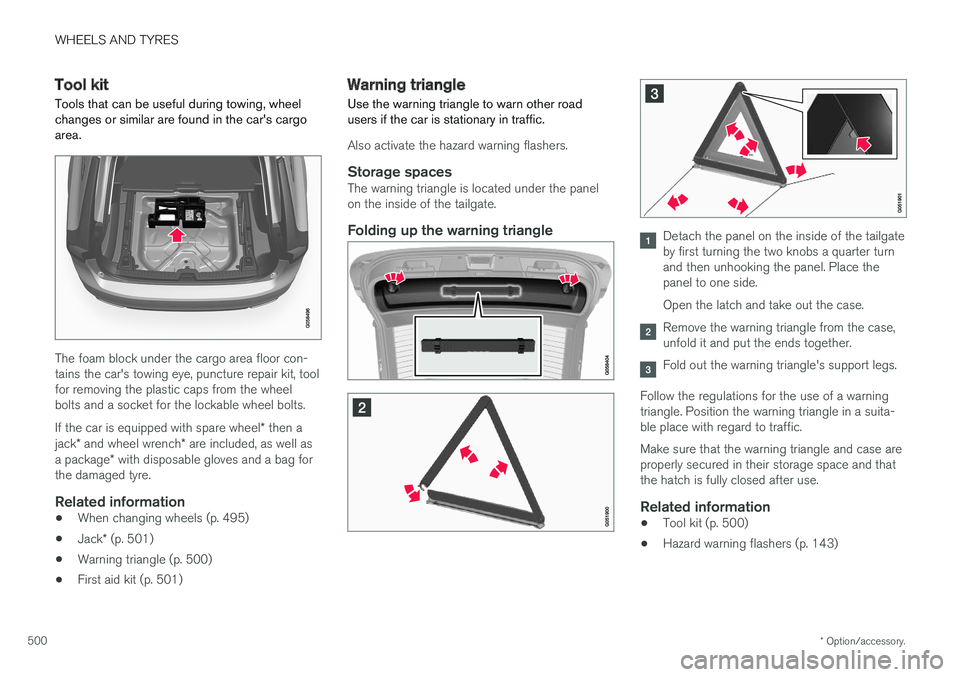
Tool kit Tools that can be useful during towing, wheel changes or similar are found in the car's cargoarea.
The foam block under the cargo area floor con- tains the car's towing eye, puncture repair kit, toolfor removing the plastic caps from the wheelbolts and a socket for the lockable wheel bolts. If the car is equipped with spare wheel * then a
jack * and wheel wrench * are included, as well as
a package * with disposable gloves and a bag for
the damaged tyre.
Related information
• When changing wheels (p. 495)
• Jack
* (p. 501)
• Warning triangle (p. 500)
• First aid kit (p. 501)
Warning triangle
Use the warning triangle to warn other road users if the car is stationary in traffic.
Also activate the hazard warning flashers.
Storage spacesThe warning triangle is located under the panel on the inside of the tailgate.
Folding up the warning triangleDetach the panel on the inside of the tailgate by first turning the two knobs a quarter turnand then unhooking the panel. Place thepanel to one side. Open the latch and take out the case.
Remove the warning triangle from the case, unfold it and put the ends together.
Fold out the warning triangle's support legs.
Follow the regulations for the use of a warning triangle. Position the warning triangle in a suita-ble place with regard to traffic. Make sure that the warning triangle and case are properly secured in their storage space and thatthe hatch is fully closed after use.
Related information
• Tool kit (p. 500)
• Hazard warning flashers (p. 143)
Page 503 of 594
WHEELS AND TYRES
* Option/accessory.501
Jack*
Use the jack to raise the car when changing a wheel.
Only use the original jack when fitting a spare wheel or when changing between summer andwinter wheels. The jack's thread must always bewell greased.
IMPORTANT
The tools and jack * must be stored in the
intended location in the car's cargo area when not in use.
The jack needs to be cranked together to the correct position in order to have space.
NOTE
The normal car jack is only designed for occa- sional, short-term use, such as when chang-ing a wheel after a puncture, changing to win-ter/summer wheels, etc. Only the jack for thespecific car model may be used to raise thecar. If the car is to be jacked up more often, orfor a longer time than is required just tochange a wheel, use of a garage jack is rec-ommended. In this instance, follow theinstructions for use that come with the equip-ment.
Applies to cars with level control *
If the car is equipped with air suspension then this must be deactivated before the car is raisedwith the jack. Switch off the function via the centre display:1.
Press on
Settings in the top view:
2. Press
My CarSuspension .
3. Select
Disable Leveling Control.
Related information
• Tool kit (p. 500)
• Raise the car (p. 512)
First aid kit The first aid kit contains first aid equipment.
Store the first aid kit in the space on the right- hand side in the cargo area.
Related information
•
Tool kit (p. 500)
Page 504 of 594
WHEELS AND TYRES
502
Dimension designation for wheel rim
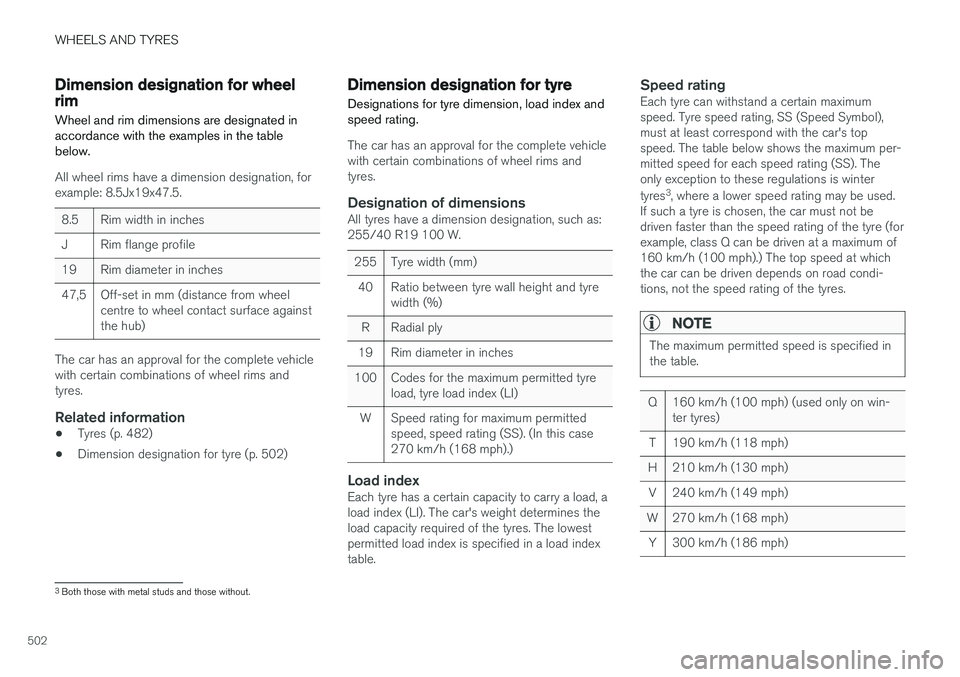
Wheel and rim dimensions are designated in accordance with the examples in the tablebelow.
All wheel rims have a dimension designation, for example: 8.5Jx19x47.5.
8.5 Rim width in inches
J Rim flange profile
19 Rim diameter in inches
47,5 Off-set in mm (distance from wheel centre to wheel contact surface against the hub)
The car has an approval for the complete vehicle with certain combinations of wheel rims andtyres.
Related information
•Tyres (p. 482)
• Dimension designation for tyre (p. 502)
Dimension designation for tyre
Designations for tyre dimension, load index and speed rating.
The car has an approval for the complete vehicle with certain combinations of wheel rims andtyres.
Designation of dimensionsAll tyres have a dimension designation, such as:255/40 R19 100 W.
255 Tyre width (mm)
40 Ratio between tyre wall height and tyre width (%)
R Radial ply
19 Rim diameter in inches
100 Codes for the maximum permitted tyre load, tyre load index (LI)
W Speed rating for maximum permitted speed, speed rating (SS). (In this case 270 km/h (168 mph).)
Load indexEach tyre has a certain capacity to carry a load, a load index (LI). The car's weight determines theload capacity required of the tyres. The lowestpermitted load index is specified in a load indextable.
Speed ratingEach tyre can withstand a certain maximumspeed. Tyre speed rating, SS (Speed Symbol),must at least correspond with the car's topspeed. The table below shows the maximum per-mitted speed for each speed rating (SS). Theonly exception to these regulations is winter tyres3
, where a lower speed rating may be used.
If such a tyre is chosen, the car must not be driven faster than the speed rating of the tyre (forexample, class Q can be driven at a maximum of160 km/h (100 mph).) The top speed at whichthe car can be driven depends on road condi-tions, not the speed rating of the tyres.
NOTE
The maximum permitted speed is specified in the table.
Q 160 km/h (100 mph) (used only on win- ter tyres)
T 190 km/h (118 mph)
H 210 km/h (130 mph) V 240 km/h (149 mph)
W 270 km/h (168 mph) Y 300 km/h (186 mph)
3 Both those with metal studs and those without.
Page 505 of 594
WHEELS AND TYRES
503
WARNING
The lowest permitted load index (LI) and speed rating (SS) for the tyres for eachrespective engine variant are shown in thecar's registration document. If a tyre with toolow a load index or speed rating is used, itmay overheat and be damaged.
Related information
•Tyres (p. 482)
• Dimension designation for wheel rim (p. 502)
• Approved tyre pressures (p. 574)
Page 515 of 594
MAINTENANCE AND SERVICE
* Option/accessory.513
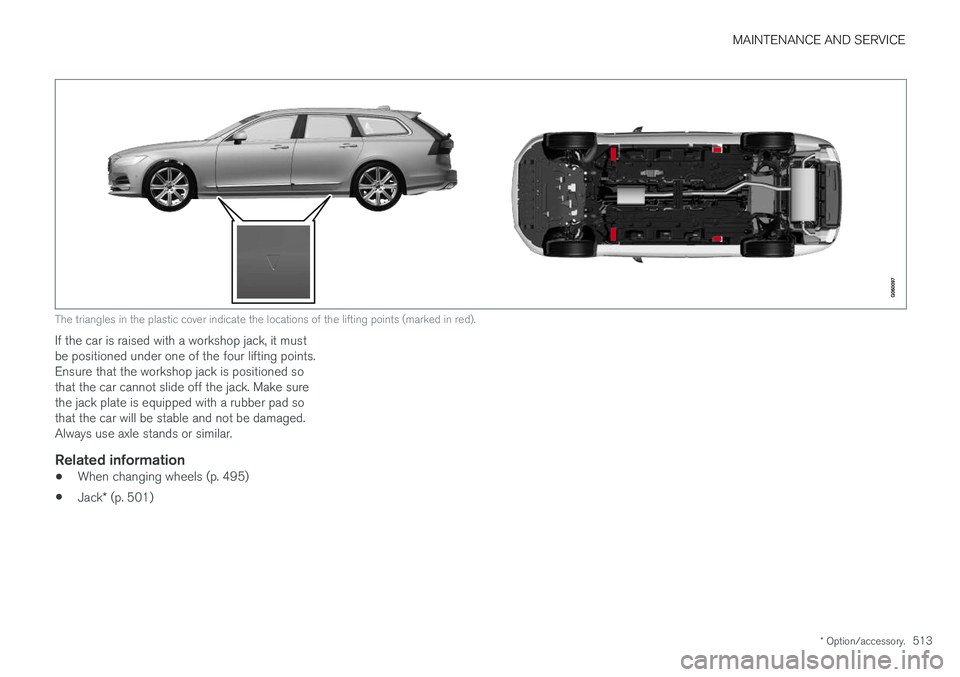
The triangles in the plastic cover indicate the locations of the lifting points (marked in red).
If the car is raised with a workshop jack, it must be positioned under one of the four lifting points.Ensure that the workshop jack is positioned sothat the car cannot slide off the jack. Make surethe jack plate is equipped with a rubber pad sothat the car will be stable and not be damaged.Always use axle stands or similar.
Related information
•When changing wheels (p. 495)
• Jack
* (p. 501)
Page 546 of 594
||
MAINTENANCE AND SERVICE
* Option/accessory.
544
Positions
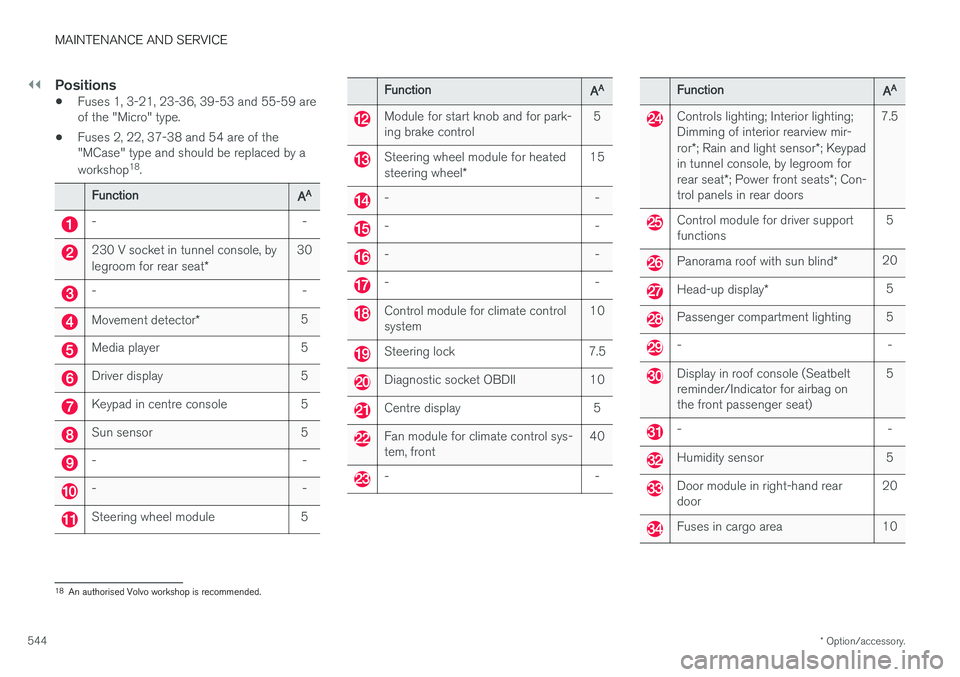
• Fuses 1, 3-21, 23-36, 39-53 and 55-59 are of the "Micro" type.
• Fuses 2, 22, 37-38 and 54 are of the"MCase" type and should be replaced by a workshop 18
.
Function AA
- -
230 V socket in tunnel console, by legroom for rear seat
*30
- -
Movement detector
* 5
Media player 5
Driver display 5
Keypad in centre console 5
Sun sensor 5
- -
- -
Steering wheel module 5
Function
AA
Module for start knob and for park- ing brake control 5
Steering wheel module for heated steering wheel
* 15
- -
- -
- -
- -
Control module for climate control system
10
Steering lock 7.5
Diagnostic socket OBDII 10
Centre display 5
Fan module for climate control sys- tem, front40
- -
Function
AA
Controls lighting; Interior lighting; Dimming of interior rearview mir- ror
*; Rain and light sensor *; Keypad
in tunnel console, by legroom forrear seat *; Power front seats *; Con-
trol panels in rear doors 7.5
Control module for driver support functions
5
Panorama roof with sun blind
*20
Head-up display
* 5
Passenger compartment lighting 5
- -
Display in roof console (Seatbelt reminder/Indicator for airbag onthe front passenger seat) 5
- -
Humidity sensor 5
Door module in right-hand rear door
20
Fuses in cargo area 10
18
An authorised Volvo workshop is recommended.
Page 551 of 594
MAINTENANCE AND SERVICE
}}
549
Cleaning the exterior
The car should be washed as soon as it becomes dirty. This means that the car is easierto clean since the dirt does not attach as firmly.It also reduces the risk of scratches and keepsthe car fresh. Wash the car in a car wash with oilseparator. Use car shampoo.
Handwashing
• Remove bird droppings from the paintwork as soon as possible. Bird droppings containchemicals that affect and discolour paintworkvery quickly. For example, use soft paper orsponge soaked in plenty of water. An author-ised Volvo workshop is recommended for theremoval of any discoloration.
• Hose down the underbody.
• Rinse the entire car until the dissolved dirthas been removed so as to reduce the risk ofscratches from washing. Do not spray directlyonto the locks.
• If necessary, use cold degreasing agent onvery dirty surfaces. Note that in this case, thesurfaces must not be hot from the sun.
• Wash using a sponge, car shampoo andplenty of lukewarm water.
• Clean the wiper blades with a lukewarm soapsolution or car shampoo.
• Dry the car using a clean, soft chamois or awater scraper. If you avoid allowing drops ofwater to dry in strong sunlight, you reduce the risk of water drying stains which mayneed to be polished out.
WARNING
Always have the engine cleaned by a work- shop. There is a risk of fire if the engine is hot.
IMPORTANT
Dirty headlamps have impaired functionality. Clean them regularly, e.g. when refuelling. Do not use any corrosive cleaning agents but use water and a non-scratching spongeinstead.
NOTE
Outside lighting such as headlamps and rear lamps may temporarily have condensation onthe inside of the lens. This is normal, all exte-rior lighting is designed to withstand this.Condensation is normally vented out of thelamp housing when the lamp has beenswitched on for a time.
Automatic car washAn automatic car wash is a simple and quick way of washing the car, but it cannot reach every-where. Washing the car by hand is recommendedto achieve a good result, or to supplement auto-matic car washes with washing by hand.
NOTE
The car must only be washed by hand over the first few months. This is because the paintis more delicate when it is new.
IMPORTANT
Before driving the car into an automatic car wash, deactivate the functions for Automaticbraking when stationary (Auto Hold) andAutomatic application of parking brake. Ifthese functions are not deactivated, the brakesystem will jam when the car is stationary andthe car will not be able to move.
In car washes where the car is towed through with rolling wheels, the following applies:
1. Drive into the automatic car wash.
2. Deactivate the function for automatic braking
when stationary (Auto Hold) using the switch in the tunnel console.
3. Deactivate the function for automatic appli- cation of parking brake via the centre display.
4. Move the gear lever to position N.
Page 552 of 594
||
MAINTENANCE AND SERVICE
* Option/accessory.
550 5. Switch off the engine by turning the start
knob in the tunnel console to STOP. Hold
the knob in STOP position for at least
4 seconds.
> The car is ready for the automatic car wash.
IMPORTANT
The system will automatically switch to P
mode unless the above step is followed. The wheels are locked in P mode, which they
should not be when putting the car through an automatic car wash.
High-pressure washingWhen using high-pressure washing, use sweep- ing movements and make sure that the nozzledoes not come closer than 30 cm to the surfaceof the car. Do not spray directly onto the locks.
Testing the brakesLightly depress the brake pedal now and thenwhen driving long distances in rain or slush. Theheat from the friction causes the brake linings towarm up and dry. Do the same thing after startingin very damp or cold weather.
WARNING
Always test the brakes after washing the car, including the parking brake, to ensure thatmoisture and corrosion do not attack thebrake linings and reduce braking perform-ance.
Wiper bladesAsphalt, dust and salt residue on wiper blades, as well as insects, ice etc. on the windscreen, impairthe service life of wiper blades. When cleaning, set the wiper blades in service position.
NOTE
Wash the wiper blades and windscreen regu- larly with lukewarm soap solution or carshampoo. Do not use any strong solvents.
Exterior plastic, rubber and trim components
A special cleaning agent available from Volvo dealers is recommended for the cleaning andcare of coloured plastic parts, rubber and trimcomponents, e.g. glossy trim mouldings. Whenusing such a cleaning agent the instructionsmust be followed carefully. The frames around the side windows, the car's roof rails and the door frames at the windows *
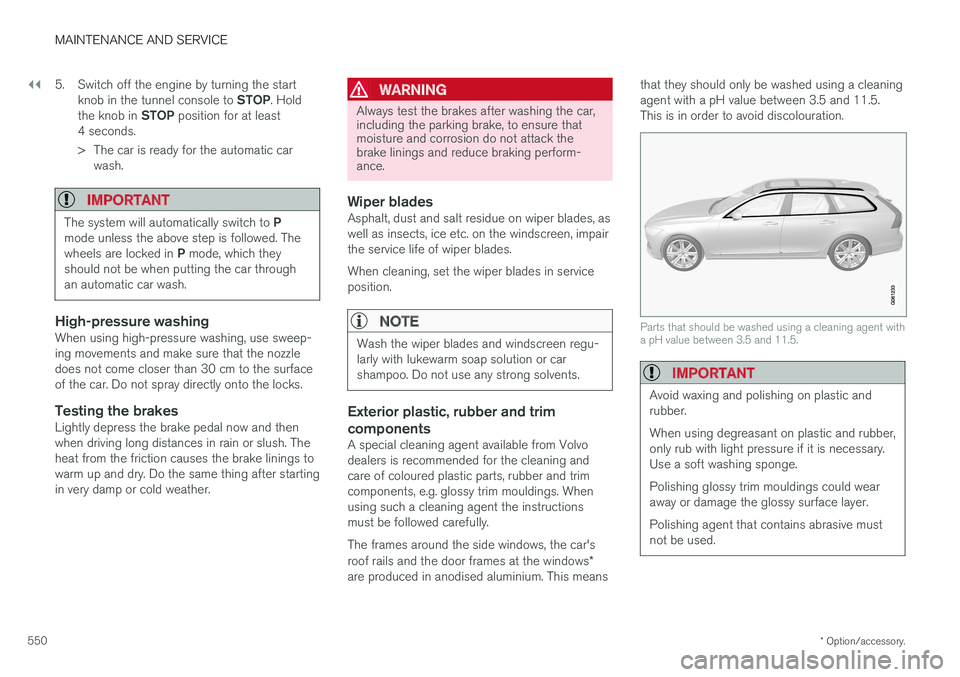
are produced in anodised aluminium. This means that they should only be washed using a cleaning agent with a pH value between 3.5 and 11.5.This is in order to avoid discolouration.
Parts that should be washed using a cleaning agent with a pH value between 3.5 and 11.5.
IMPORTANT
Avoid waxing and polishing on plastic and rubber. When using degreasant on plastic and rubber, only rub with light pressure if it is necessary.Use a soft washing sponge. Polishing glossy trim mouldings could wear away or damage the glossy surface layer. Polishing agent that contains abrasive must not be used.