warning VOLVO V90 2017 Owners Manual
[x] Cancel search | Manufacturer: VOLVO, Model Year: 2017, Model line: V90, Model: VOLVO V90 2017Pages: 594, PDF Size: 15.07 MB
Page 518 of 594
MAINTENANCE AND SERVICE
516
Engine oil
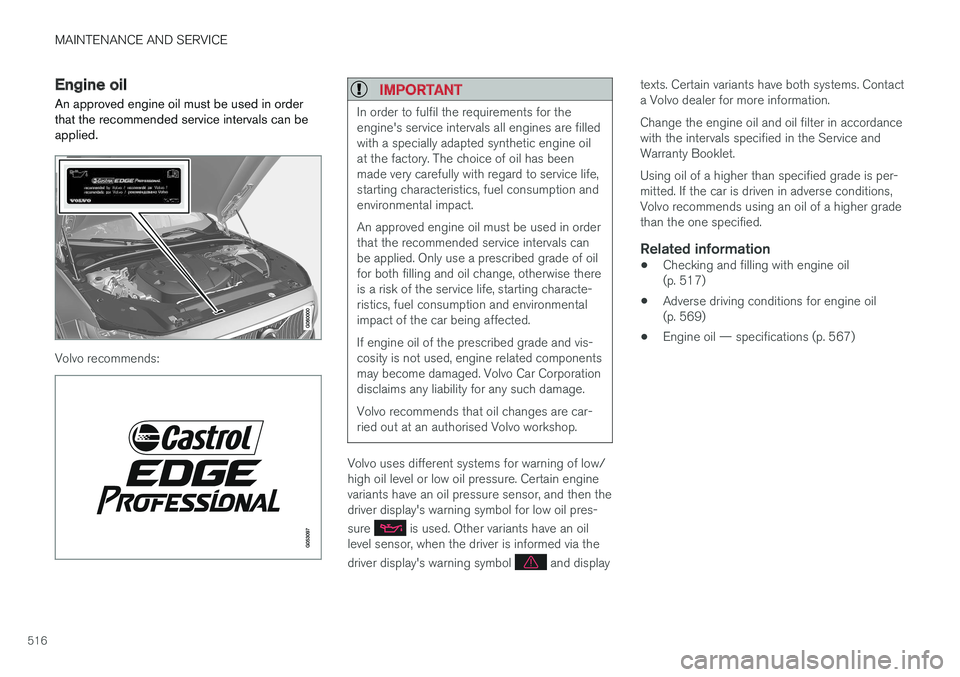
An approved engine oil must be used in order that the recommended service intervals can beapplied.
Volvo recommends:
IMPORTANT
In order to fulfil the requirements for the engine's service intervals all engines are filledwith a specially adapted synthetic engine oilat the factory. The choice of oil has beenmade very carefully with regard to service life,starting characteristics, fuel consumption andenvironmental impact. An approved engine oil must be used in order that the recommended service intervals canbe applied. Only use a prescribed grade of oilfor both filling and oil change, otherwise thereis a risk of the service life, starting characte-ristics, fuel consumption and environmentalimpact of the car being affected. If engine oil of the prescribed grade and vis- cosity is not used, engine related componentsmay become damaged. Volvo Car Corporationdisclaims any liability for any such damage. Volvo recommends that oil changes are car- ried out at an authorised Volvo workshop.
Volvo uses different systems for warning of low/ high oil level or low oil pressure. Certain enginevariants have an oil pressure sensor, and then thedriver display's warning symbol for low oil pres- sure
is used. Other variants have an oil
level sensor, when the driver is informed via the driver display's warning symbol
and display texts. Certain variants have both systems. Contact a Volvo dealer for more information. Change the engine oil and oil filter in accordance with the intervals specified in the Service andWarranty Booklet. Using oil of a higher than specified grade is per- mitted. If the car is driven in adverse conditions,Volvo recommends using an oil of a higher gradethan the one specified.
Related information
•
Checking and filling with engine oil(p. 517)
• Adverse driving conditions for engine oil(p. 569)
• Engine oil — specifications (p. 567)
Page 519 of 594
MAINTENANCE AND SERVICE
}}
517
Checking and filling with engine oil The oil level is detected with the electronic oil level sensor.
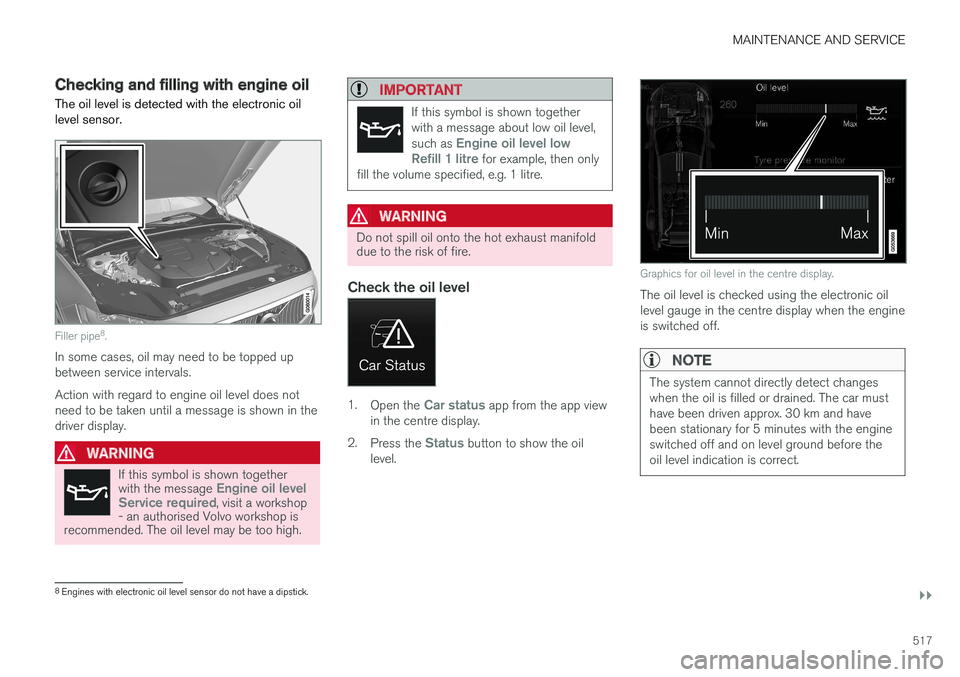
Filler pipe8
.
In some cases, oil may need to be topped up between service intervals. Action with regard to engine oil level does not need to be taken until a message is shown in thedriver display.
WARNING
If this symbol is shown together with the message Engine oil level
Service required, visit a workshop
- an authorised Volvo workshop is
recommended. The oil level may be too high.
IMPORTANT
If this symbol is shown together with a message about low oil level, such as
Engine oil level low
Refill 1 litre for example, then only
fill the volume specified, e.g. 1 litre.
WARNING
Do not spill oil onto the hot exhaust manifold due to the risk of fire.
Check the oil level
1. Open the Car status app from the app view
in the centre display.
2. Press the
Status button to show the oil
level.
Graphics for oil level in the centre display.
The oil level is checked using the electronic oil level gauge in the centre display when the engineis switched off.
NOTE
The system cannot directly detect changes when the oil is filled or drained. The car musthave been driven approx. 30 km and havebeen stationary for 5 minutes with the engineswitched off and on level ground before theoil level indication is correct.
8 Engines with electronic oil level sensor do not have a dipstick.
Page 520 of 594
||
MAINTENANCE AND SERVICE
518
NOTE
If the right conditions for measuring the oil level (time after engine shutdown, the car'sinclination, outside temperature, etc.) are not met, then the message
No value availablewill be shown in the centre display. This does not mean that there is something wrong in
the car's systems.
Related information
• Engine oil (p. 516)
• Engine oil — specifications (p. 567)
• Adverse driving conditions for engine oil (p. 569)
• Ignition positions (p. 385)
• Car status (p. 506)
Topping up coolant
The coolant cools the internal combustion engine to the correct operating temperature. Theheat that is transferred from the engine to thecoolant can be used to heat the passenger com-partment.
When topping up the coolant, follow the instruc- tions on the packaging. Never top up with wateronly. The risk of freezing increases with both toolittle and too much coolant concentrate.
WARNING
Coolant can be very hot. If the coolant requires topping up when the engine is atoperating temperature, unscrew the expan-sion tank cap slowly to gently release theoverpressure.
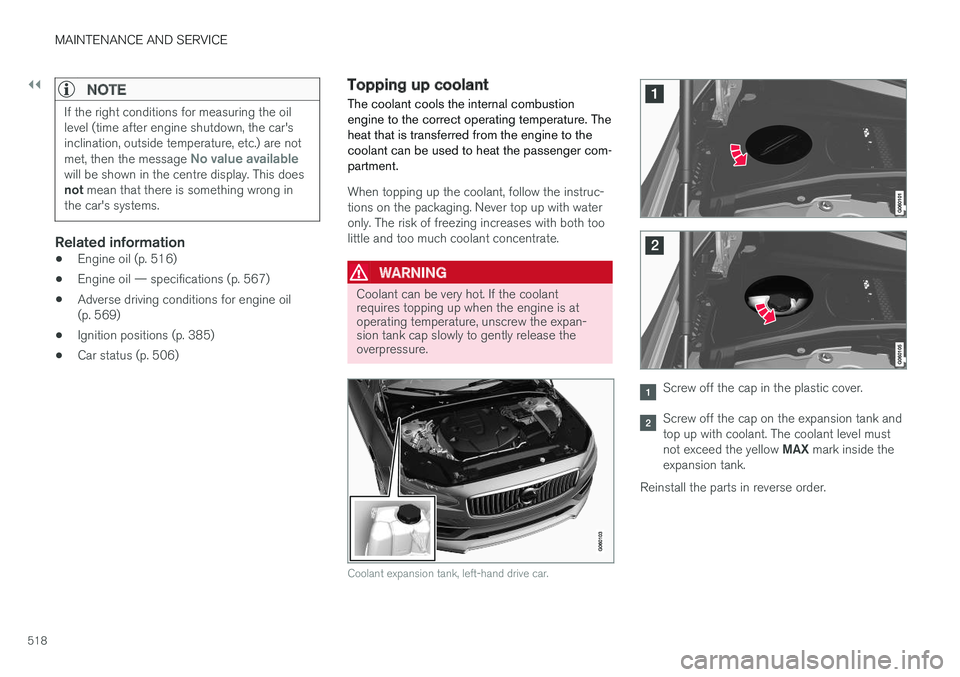
Coolant expansion tank, left-hand drive car.
Screw off the cap in the plastic cover.
Screw off the cap on the expansion tank and top up with coolant. The coolant level must not exceed the yellow MAX mark inside the
expansion tank.
Reinstall the parts in reverse order.
Page 522 of 594
MAINTENANCE AND SERVICE
520
Servicing the climate control system The air conditioning system must only be serv- iced and repaired by an authorised workshop.
Troubleshooting and repairThe air conditioning system contains fluorescent tracing agents. Ultraviolet light must be used dur-ing leak detection. Volvo recommends that you contact an author- ised Volvo workshop.
Cars with R134a refrigerant
WARNING
The air conditioning system contains pressur- ised refrigerant R134a. This system must onlybe serviced and repaired by an authorisedworkshop.
Cars with R1234yf refrigerant
WARNING
The air conditioning system contains pressur- ised refrigerant R1234yf. In accordance withSAE J2845 (Technician Training for SafeService and Containment of RefrigerantsUsed in Mobile A/C System), service andrepair of the refrigerant system must only beperformed by trained and certified techniciansin order to ensure the safety of the system.
Related information
•Volvo service programme (p. 506)
Bulb replacement
The bulb in the halogen headlamp, reversing lamp and rear fog lamp can be replaced by thedriver.
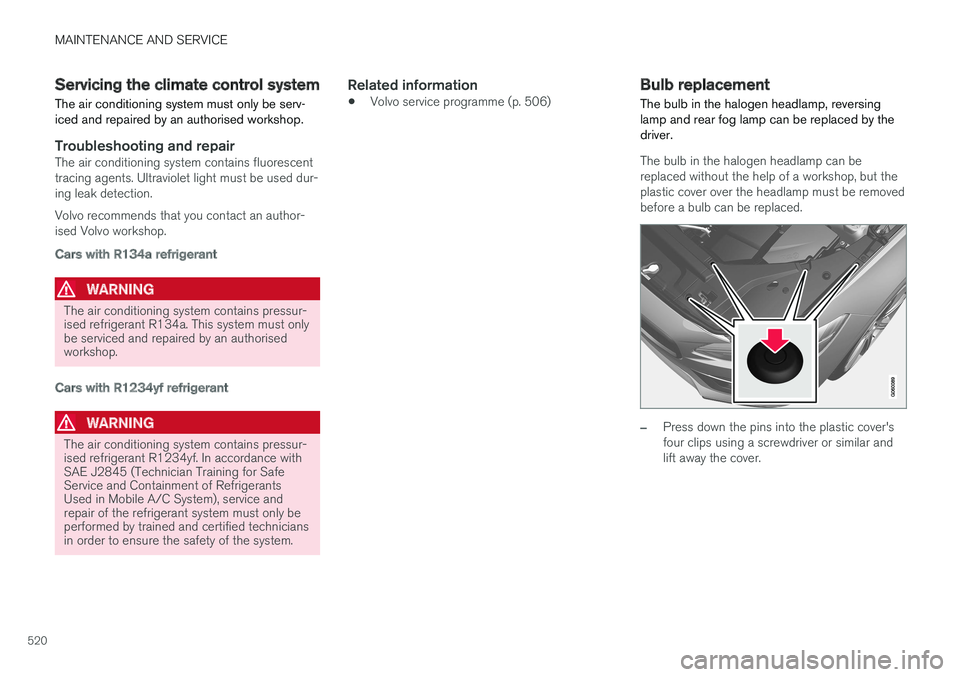
The bulb in the halogen headlamp can be replaced without the help of a workshop, but theplastic cover over the headlamp must be removedbefore a bulb can be replaced.
–Press down the pins into the plastic cover's four clips using a screwdriver or similar andlift away the cover.
Page 523 of 594
MAINTENANCE AND SERVICE
}}
* Option/accessory.521
NOTE
Points to remember when the cover is refit- ted: •The pin in the clip needs to be pressed back fully before the clip is refitted in thecover.
• When the cover is refitted, the pin mustbe pressed in until the end surface islevel with the surface of the clip.
The reversing lamp bulb and the rear fog lamp bulb can be replaced without assistance from aworkshop. Contact a workshop 9
if there is a fault in bulbs
other than the bulbs in the halogen headlamps, the reversing lamp bulb or the rear fog lamp bulb. If a fault occurs in LED 10
lamps, the entire lamp
unit usually must be replaced.
WARNING
The car's electrical system must be in ignition position 0 when replacing bulbs.
IMPORTANT
Never touch the glass part of the bulbs with your fingers. Grease from your fingers isvaporised by the heat, coating the reflectorand then causing damage.
NOTE
If an error message remains after the broken bulb has been replaced then we recommendvisiting an authorised Volvo workshop.
NOTE
Outside lighting such as headlamps and rear lamps may temporarily have condensation onthe inside of the lens. This is normal, all exte-rior lighting is designed to withstand this.Condensation is normally vented out of thelamp housing when the lamp has beenswitched on for a time.
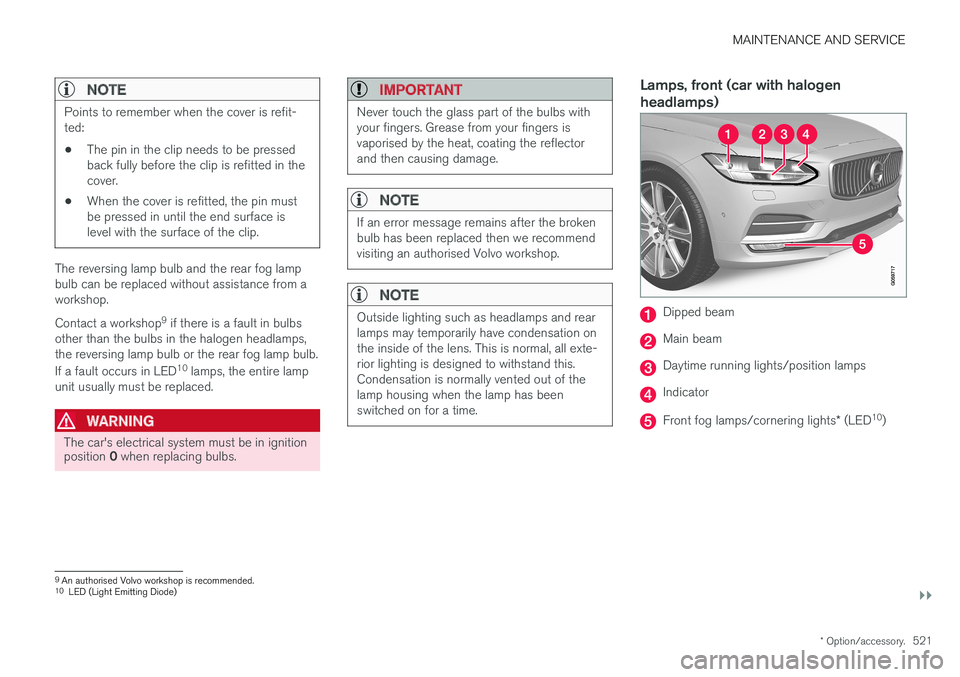
Lamps, front (car with halogen headlamps)
Dipped beam
Main beam
Daytime running lights/position lamps
Indicator
Front fog lamps/cornering lights * (LED 10
)
9An authorised Volvo workshop is recommended.
10 LED (Light Emitting Diode)
Page 532 of 594
||
MAINTENANCE AND SERVICE
530
IMPORTANT
Use Volvo genuine washer fluid or equivalent with a recommended pH of between 6 and 8,in working dilution (e.g. 1:1 with neutralwater).
IMPORTANT
Use washer fluid with antifreeze when the temperature is below freezing to avoid freez-ing in the pump, reservoir and hoses.
Volume:• Cars
with headlamp washing: 5.5 litres.
• Cars
without headlamp washing: 3.5 litres.
Related information
•Windscreen and headlamp washers (p. 150)
• Opening and closing the bonnet (p. 514)
Starter battery
The electrical system is single-pole and uses the chassis and engine casing as a conductor. The starter battery is used to start up the electri- cal system and drive the starter motor as well asother electrical equipment in the car. The starter battery should be replaced by a workshop 13
.
The car has a voltage-regulated AC alternator. The starter battery is a 12 V AGM battery, designed for the carbon dioxide reducing func-tions, Start/Stop and regenerative charging, andto support the functionality of the car's differentsystems. The service life and function of the starter battery is influenced by factors such as the number ofstarts, discharging, driving style, driving condi-tions, climatic conditions etc. • Never disconnect the starter battery when the engine is running.
• Check that the cables to the starter batteryare correctly connected and properly tight-ened.
WARNING
•
The battery can generate oxyhydrogen gas, which is highly explosive. A spark canbe formed if a jump lead is connectedincorrectly, and this can be enough forthe battery to explode.
• The battery contains sulphuric acid, whichcan cause serious burns.
• If sulphuric acid comes into contact witheyes, skin or clothing, flush with largequantities of water. If acid splashes intothe eyes - seek medical attention imme-diately.
When connecting an external starter battery orbattery charger, use the car's charging points inthe engine compartment. The battery terminalson the car's starter battery in the cargo area must not be used.
During charging, both the starter battery and the support battery are charged.
13 An authorised Volvo workshop is recommended.
Page 535 of 594
MAINTENANCE AND SERVICE
}}
533
Symbols on the batteries
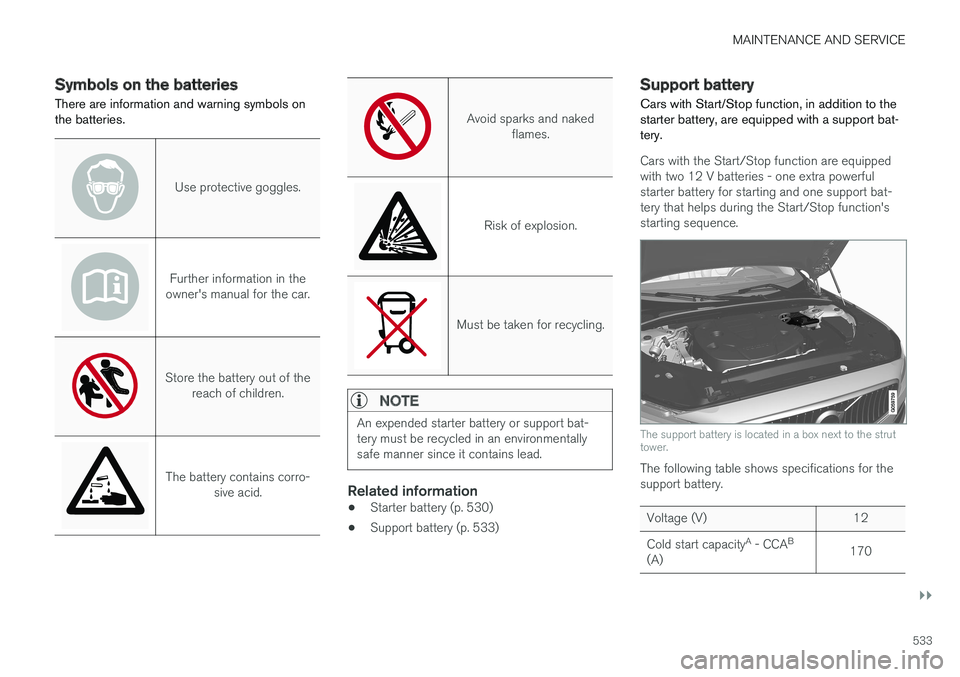
There are information and warning symbols on the batteries.
Use protective goggles.
Further information in the
owner's manual for the car.
Store the battery out of the reach of children.
The battery contains corro- sive acid.
Avoid sparks and nakedflames.
Risk of explosion.
Must be taken for recycling.
NOTE
An expended starter battery or support bat- tery must be recycled in an environmentallysafe manner since it contains lead.
Related information
•Starter battery (p. 530)
• Support battery (p. 533)
Support battery Cars with Start/Stop function, in addition to the starter battery, are equipped with a support bat-tery.
Cars with the Start/Stop function are equipped with two 12 V batteries - one extra powerfulstarter battery for starting and one support bat-tery that helps during the Start/Stop function'sstarting sequence.
The support battery is located in a box next to the strut tower.
The following table shows specifications for the support battery.
Voltage (V) 12 Cold start capacity A
- CCA B
(A) 170
Page 538 of 594
MAINTENANCE AND SERVICE
536
Replacing a fuse All electrical functions and components are pro- tected by a number of fuses in order to protectthe car's electrical system from damage by shortcircuiting or overloading.
Changing1. Look in the fuse diagram to locate the fuse.
2. Pull out the fuse and check from the side tosee whether the curved wire has blown.
3. If this is the case, replace it with a new fuse of the same colour and amperage.
WARNING
Never use a foreign object or a fuse with an amperage higher than that specified whenreplacing a fuse. This could cause significantdamage to the electrical system and possiblylead to fire.
Related information
• Fuses (p. 535)
• Fuses in engine compartment (p. 537)
• Fuses under glovebox (p. 542)
• Fuses in cargo area (p. 546)
Page 551 of 594
MAINTENANCE AND SERVICE
}}
549
Cleaning the exterior
The car should be washed as soon as it becomes dirty. This means that the car is easierto clean since the dirt does not attach as firmly.It also reduces the risk of scratches and keepsthe car fresh. Wash the car in a car wash with oilseparator. Use car shampoo.
Handwashing
• Remove bird droppings from the paintwork as soon as possible. Bird droppings containchemicals that affect and discolour paintworkvery quickly. For example, use soft paper orsponge soaked in plenty of water. An author-ised Volvo workshop is recommended for theremoval of any discoloration.
• Hose down the underbody.
• Rinse the entire car until the dissolved dirthas been removed so as to reduce the risk ofscratches from washing. Do not spray directlyonto the locks.
• If necessary, use cold degreasing agent onvery dirty surfaces. Note that in this case, thesurfaces must not be hot from the sun.
• Wash using a sponge, car shampoo andplenty of lukewarm water.
• Clean the wiper blades with a lukewarm soapsolution or car shampoo.
• Dry the car using a clean, soft chamois or awater scraper. If you avoid allowing drops ofwater to dry in strong sunlight, you reduce the risk of water drying stains which mayneed to be polished out.
WARNING
Always have the engine cleaned by a work- shop. There is a risk of fire if the engine is hot.
IMPORTANT
Dirty headlamps have impaired functionality. Clean them regularly, e.g. when refuelling. Do not use any corrosive cleaning agents but use water and a non-scratching spongeinstead.
NOTE
Outside lighting such as headlamps and rear lamps may temporarily have condensation onthe inside of the lens. This is normal, all exte-rior lighting is designed to withstand this.Condensation is normally vented out of thelamp housing when the lamp has beenswitched on for a time.
Automatic car washAn automatic car wash is a simple and quick way of washing the car, but it cannot reach every-where. Washing the car by hand is recommendedto achieve a good result, or to supplement auto-matic car washes with washing by hand.
NOTE
The car must only be washed by hand over the first few months. This is because the paintis more delicate when it is new.
IMPORTANT
Before driving the car into an automatic car wash, deactivate the functions for Automaticbraking when stationary (Auto Hold) andAutomatic application of parking brake. Ifthese functions are not deactivated, the brakesystem will jam when the car is stationary andthe car will not be able to move.
In car washes where the car is towed through with rolling wheels, the following applies:
1. Drive into the automatic car wash.
2. Deactivate the function for automatic braking
when stationary (Auto Hold) using the switch in the tunnel console.
3. Deactivate the function for automatic appli- cation of parking brake via the centre display.
4. Move the gear lever to position N.
Page 552 of 594
||
MAINTENANCE AND SERVICE
* Option/accessory.
550 5. Switch off the engine by turning the start
knob in the tunnel console to STOP. Hold
the knob in STOP position for at least
4 seconds.
> The car is ready for the automatic car wash.
IMPORTANT
The system will automatically switch to P
mode unless the above step is followed. The wheels are locked in P mode, which they
should not be when putting the car through an automatic car wash.
High-pressure washingWhen using high-pressure washing, use sweep- ing movements and make sure that the nozzledoes not come closer than 30 cm to the surfaceof the car. Do not spray directly onto the locks.
Testing the brakesLightly depress the brake pedal now and thenwhen driving long distances in rain or slush. Theheat from the friction causes the brake linings towarm up and dry. Do the same thing after startingin very damp or cold weather.
WARNING
Always test the brakes after washing the car, including the parking brake, to ensure thatmoisture and corrosion do not attack thebrake linings and reduce braking perform-ance.
Wiper bladesAsphalt, dust and salt residue on wiper blades, as well as insects, ice etc. on the windscreen, impairthe service life of wiper blades. When cleaning, set the wiper blades in service position.
NOTE
Wash the wiper blades and windscreen regu- larly with lukewarm soap solution or carshampoo. Do not use any strong solvents.
Exterior plastic, rubber and trim components
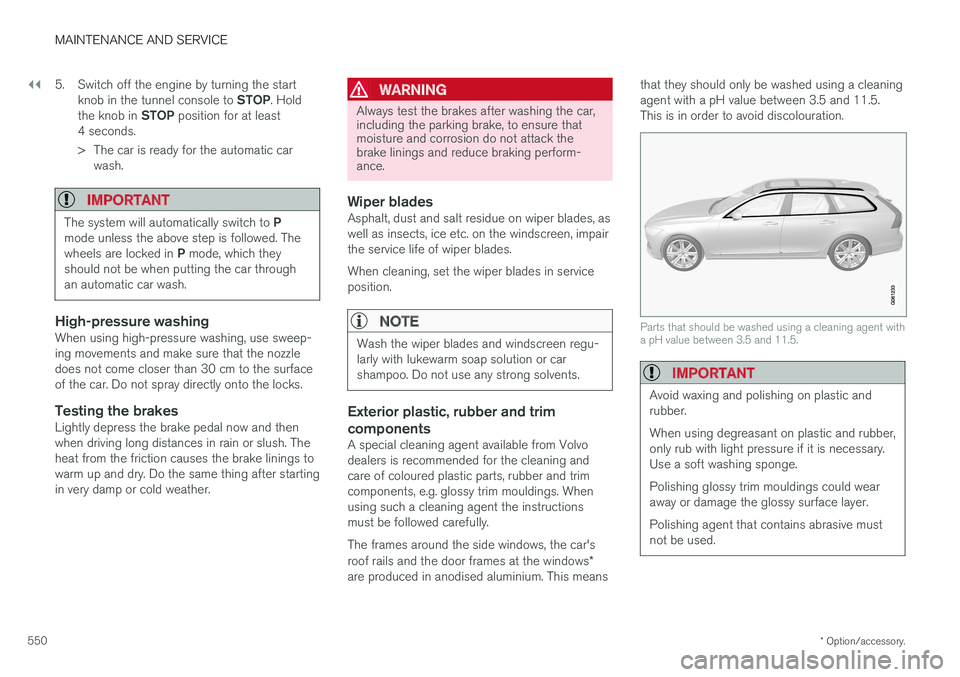
A special cleaning agent available from Volvo dealers is recommended for the cleaning andcare of coloured plastic parts, rubber and trimcomponents, e.g. glossy trim mouldings. Whenusing such a cleaning agent the instructionsmust be followed carefully. The frames around the side windows, the car's roof rails and the door frames at the windows *
are produced in anodised aluminium. This means that they should only be washed using a cleaning agent with a pH value between 3.5 and 11.5.This is in order to avoid discolouration.
Parts that should be washed using a cleaning agent with a pH value between 3.5 and 11.5.
IMPORTANT
Avoid waxing and polishing on plastic and rubber. When using degreasant on plastic and rubber, only rub with light pressure if it is necessary.Use a soft washing sponge. Polishing glossy trim mouldings could wear away or damage the glossy surface layer. Polishing agent that contains abrasive must not be used.