towing VOLVO V90 2017 User Guide
[x] Cancel search | Manufacturer: VOLVO, Model Year: 2017, Model line: V90, Model: VOLVO V90 2017Pages: 594, PDF Size: 15.07 MB
Page 429 of 594
STARTING AND DRIVING
* Option/accessory.427
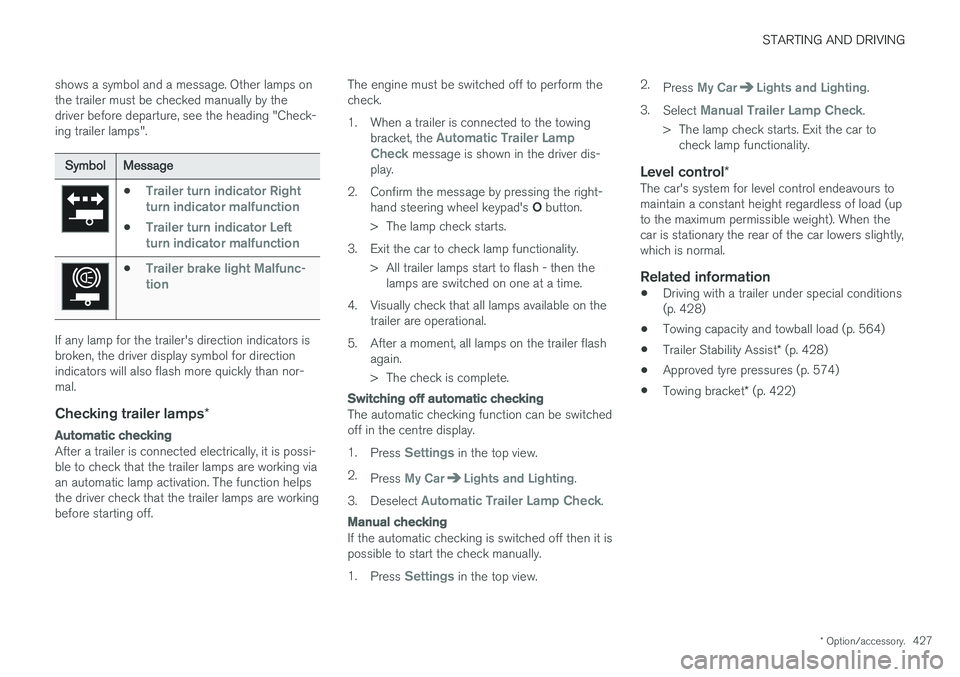
shows a symbol and a message. Other lamps on the trailer must be checked manually by thedriver before departure, see the heading "Check-ing trailer lamps".
Symbol
Message
•Trailer turn indicator Right
turn indicator malfunction
•Trailer turn indicator Left
turn indicator malfunction
•Trailer brake light Malfunc-
tion
If any lamp for the trailer's direction indicators is broken, the driver display symbol for directionindicators will also flash more quickly than nor-mal.
Checking trailer lamps *
Automatic checking
After a trailer is connected electrically, it is possi- ble to check that the trailer lamps are working viaan automatic lamp activation. The function helpsthe driver check that the trailer lamps are workingbefore starting off. The engine must be switched off to perform thecheck.
1. When a trailer is connected to the towing
bracket, the
Automatic Trailer Lamp
Check message is shown in the driver dis-
play.
2. Confirm the message by pressing the right- hand steering wheel keypad's O button.
> The lamp check starts.
3. Exit the car to check lamp functionality. > All trailer lamps start to flash - then thelamps are switched on one at a time.
4. Visually check that all lamps available on the trailer are operational.
5. After a moment, all lamps on the trailer flash again.
> The check is complete.
Switching off automatic checking
The automatic checking function can be switched off in the centre display. 1.Press
Settings in the top view.
2. Press
My CarLights and Lighting.
3. Deselect
Automatic Trailer Lamp Check.
Manual checking
If the automatic checking is switched off then it is possible to start the check manually. 1.Press
Settings in the top view. 2.
Press
My CarLights and Lighting.
3. Select
Manual Trailer Lamp Check.
> The lamp check starts. Exit the car to check lamp functionality.
Level control *The car's system for level control endeavours to maintain a constant height regardless of load (upto the maximum permissible weight). When thecar is stationary the rear of the car lowers slightly,which is normal.
Related information
•Driving with a trailer under special conditions(p. 428)
• Towing capacity and towball load (p. 564)
• Trailer Stability Assist
* (p. 428)
• Approved tyre pressures (p. 574)
• Towing bracket
* (p. 422)
Page 432 of 594
STARTING AND DRIVING
* Option/accessory.
430
Towing eye
Use the towing eye for towing. The towing eye is screwed into a threaded socket behind a coveron the right-hand side of the bumper, front orrear.
NOTE
If the car is equipped with a towing bracket, there is no rear mounting for a towing eye.
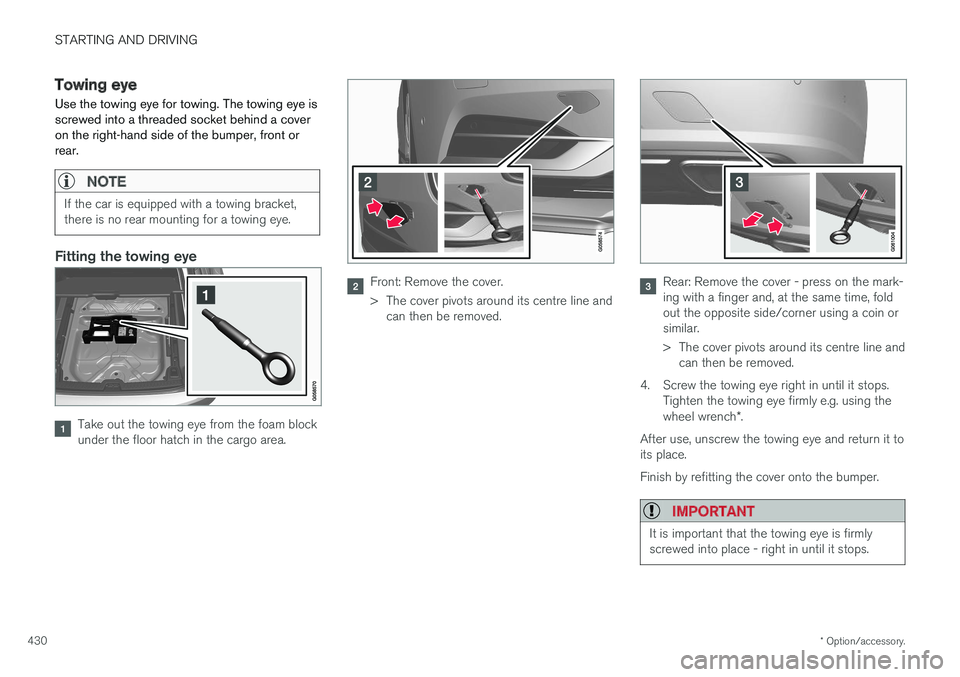
Fitting the towing eye
Take out the towing eye from the foam block under the floor hatch in the cargo area.
Front: Remove the cover.
> The cover pivots around its centre line and can then be removed.Rear: Remove the cover - press on the mark- ing with a finger and, at the same time, foldout the opposite side/corner using a coin orsimilar.
> The cover pivots around its centre line andcan then be removed.
4. Screw the towing eye right in until it stops. Tighten the towing eye firmly e.g. using the wheel wrench *.
After use, unscrew the towing eye and return it to its place. Finish by refitting the cover onto the bumper.
IMPORTANT
It is important that the towing eye is firmly screwed into place - right in until it stops.
Page 433 of 594
STARTING AND DRIVING
}}
431
The towing eye may be used to pull the car up onto a recovery vehicle with a flatbed platform.The car's position and ground clearance deter-mine whether it is possible. If the slope of the recovery vehicle's ramp is too steep, or if the ground clearance under the car isinadequate, then the car may be damaged if youtry to pull it up using the towing eye. If necessary, raise the car by using the recovery vehicle's lifting device. Do not use the towing eye.
WARNING
No one/nothing is allowed to remain behind the recovery vehicle while the car pulled uponto the flatbed platform.
IMPORTANT
The towing eye is only designed for towing on roads -
not for pulling the car unstuck or out
of a ditch. Call a recovery service for recovery assistance.
Related information
• Towing (p. 431)
• Recovering the car (p. 432)
Towing
During towing, one vehicle pulls another vehicle along behind it by means of a towline.
Find out the statutory maximum speed limit for towing before the towing begins.
Preparations and towing1. Activate the car's hazard warning flashers.
2. Secure the towline in the towing eye.
3. Deactivate the steering lock by unlocking the car.
NOTE
In ignition position II the steering lock is
deactivated if the car has been unlocked. See section “Ignition position” for more informa-tion.
4. Set the car in ignition position II by turning
the ignition dial to START and holding the
ignition dial in the START position for
approx. 4 seconds. Then release the knob, which automatically returns to its startingposition.
5. Move the gear selector to neutral position N
and release the parking brake.
> The towing vehicle can now start towing. 6. Keep the towline taut when the towing vehi-
cle reduces speed by holding your foot gen- tly pressed on the brake pedal - therebyavoiding unnecessary jerking.
7. Be prepared to brake to stop.
IMPORTANT
Note that the car must always be towed with the wheels rolling forward. • Do not tow cars with automatic transmis- sion at speeds higher than 80 km/h(50 mph) or for distances in excess of 80km.
WARNING
•Check that the steering lock is unlocked before towing.
• Ignition position
II must be active - in
ignition position I all airbags are deacti-
vated.
• Always keep the remote control key in thecar when it is being towed.
WARNING
The brake servo and power steering do not work when the engine is switched off - thebrake pedal needs to be depressedabout 5 times more heavily and the steering isconsiderably heavier than normal.
Page 434 of 594
||
STARTING AND DRIVING
* Option/accessory.
432
Jump startingDo not tow the car to jump start the engine. Use a donor battery if the starter battery is dischargedand the engine does not start.
IMPORTANT
The catalytic converter may be damaged dur- ing attempts to tow-start the engine.
Related information
• Warning triangle (p. 500)
• Towing eye (p. 430)
• Recovering the car (p. 432)
• Using jump starting with another battery (p. 388)
• Ignition positions (p. 385)
Recovering the car For recovery, the car is taken away with the help of another vehicle.
Call a recovery service for recovery assistance. The towing eye can be used to pull the car up onto a recovery vehicle with a flatbed platform. Applies to cars with level control
*: If the car is
equipped with air suspension , this must be disa- bled before the car is raised. Deactivating thefunction via the centre display. 1. Press
Settings in the top view.
2. Press
My CarSuspension .
3. Select
Disable Leveling Control.
The car's position and ground clearance deter- mine whether it is possible to pull it up onto aflatbed platform. If the slope of the recovery vehi-cle's ramp is too steep, or if the ground clearanceunder the car is inadequate, then the car may bedamaged if you try to pull it up. The car shouldthen be lifted using the recovery vehicle's liftingdevice.
WARNING
No one/nothing is allowed to remain behind the recovery vehicle while the car pulled uponto the flatbed platform.
IMPORTANT
The towing eye is only designed for towing on roads - not for pulling the car unstuck or out
of a ditch. Call a recovery service for recovery assistance.
IMPORTANT
Note that the car must always be transported with the wheels rolling forward.
NOTE
If the car is equipped with a towing bracket, there is no rear mounting for a towing eye.
Related information
• Towing (p. 431)
• Towing eye (p. 430)
Page 498 of 594
||
WHEELS AND TYRES
* Option/accessory.
496
WARNING
Check that the jack is not damaged, that the threads are thoroughly lubricated and that it isfree from dirt.
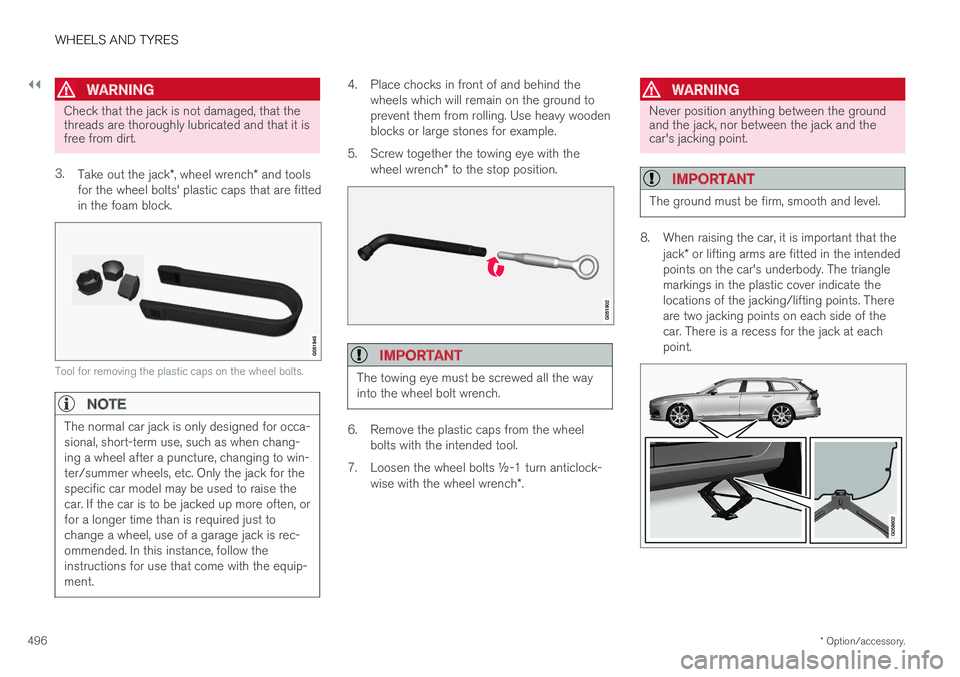
3. Take out the jack *, wheel wrench * and tools
for the wheel bolts' plastic caps that are fitted in the foam block.
Tool for removing the plastic caps on the wheel bolts.
NOTE
The normal car jack is only designed for occa- sional, short-term use, such as when chang-ing a wheel after a puncture, changing to win-ter/summer wheels, etc. Only the jack for thespecific car model may be used to raise thecar. If the car is to be jacked up more often, orfor a longer time than is required just tochange a wheel, use of a garage jack is rec-ommended. In this instance, follow theinstructions for use that come with the equip-ment.
4. Place chocks in front of and behind the wheels which will remain on the ground to prevent them from rolling. Use heavy woodenblocks or large stones for example.
5. Screw together the towing eye with the wheel wrench * to the stop position.
IMPORTANT
The towing eye must be screwed all the way into the wheel bolt wrench.
6. Remove the plastic caps from the wheel
bolts with the intended tool.
7. Loosen the wheel bolts ½-1 turn anticlock- wise with the wheel wrench *.
WARNING
Never position anything between the ground and the jack, nor between the jack and thecar's jacking point.
IMPORTANT
The ground must be firm, smooth and level.
8. When raising the car, it is important that the
jack* or lifting arms are fitted in the intended
points on the car's underbody. The triangle markings in the plastic cover indicate thelocations of the jacking/lifting points. Thereare two jacking points on each side of thecar. There is a recess for the jack at eachpoint.
Page 502 of 594
WHEELS AND TYRES
* Option/accessory.
500
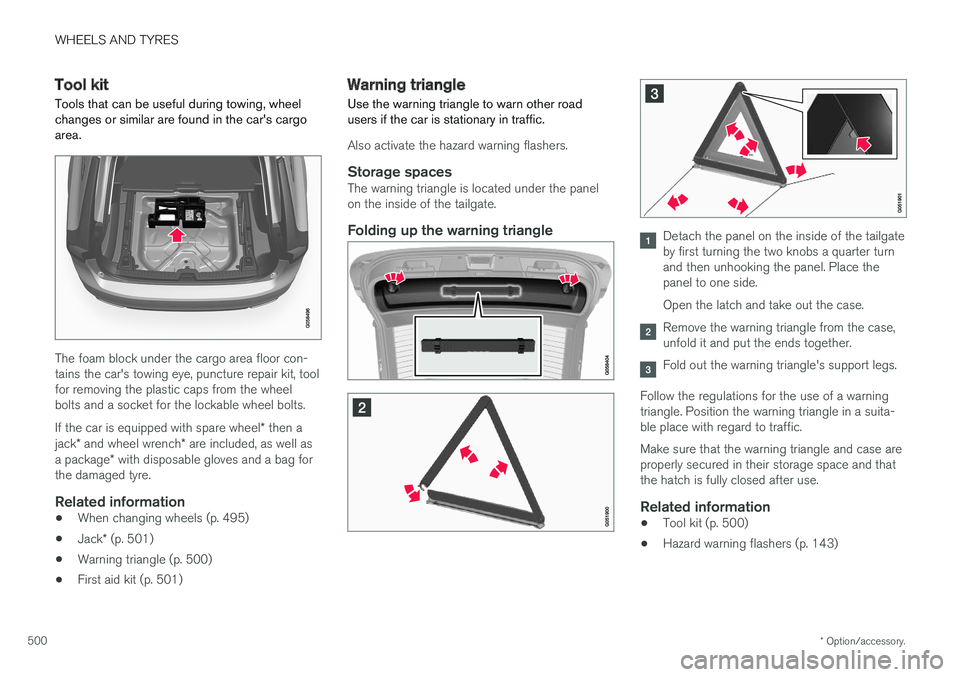
Tool kit Tools that can be useful during towing, wheel changes or similar are found in the car's cargoarea.
The foam block under the cargo area floor con- tains the car's towing eye, puncture repair kit, toolfor removing the plastic caps from the wheelbolts and a socket for the lockable wheel bolts. If the car is equipped with spare wheel * then a
jack * and wheel wrench * are included, as well as
a package * with disposable gloves and a bag for
the damaged tyre.
Related information
• When changing wheels (p. 495)
• Jack
* (p. 501)
• Warning triangle (p. 500)
• First aid kit (p. 501)
Warning triangle
Use the warning triangle to warn other road users if the car is stationary in traffic.
Also activate the hazard warning flashers.
Storage spacesThe warning triangle is located under the panel on the inside of the tailgate.
Folding up the warning triangleDetach the panel on the inside of the tailgate by first turning the two knobs a quarter turnand then unhooking the panel. Place thepanel to one side. Open the latch and take out the case.
Remove the warning triangle from the case, unfold it and put the ends together.
Fold out the warning triangle's support legs.
Follow the regulations for the use of a warning triangle. Position the warning triangle in a suita-ble place with regard to traffic. Make sure that the warning triangle and case are properly secured in their storage space and thatthe hatch is fully closed after use.
Related information
• Tool kit (p. 500)
• Hazard warning flashers (p. 143)
Page 565 of 594
SPECIFICATIONS
563
Weights Max. gross vehicle weight, etc. can be read on a label in the car.
Kerb weight includes the driver, the fuel tank 90% full and all fluids. The weight of passengers and accessories, and towball load (when a trailer is hitched) influencethe load capacity and are not included in the kerbweight. Permitted max. load = Gross vehicle weight - Kerb weight.
NOTE
The documented kerb weight applies to cars in the standard version - i.e. a car withoutextra equipment or accessories. This meansthat for every accessory added the loadingcapacity of the car is reduced correspondinglyby the weight of the accessory. Examples of accessories that reduce load capacity are the different equipment levels(e.g. Kinetic, Momentum, Summum), as wellas other accessories such as towbar, loadcarrier, space box, audio system, auxiliarylamps, GPS, fuel-driven heater, safety grille,carpets, cargo cover, power seats, etc. Weighing the car is a certain way of ascer- taining the kerb weight of your own particularcar.
WARNING
The car's driving characteristics change depending on how heavily it is loaded andhow the load is distributed.
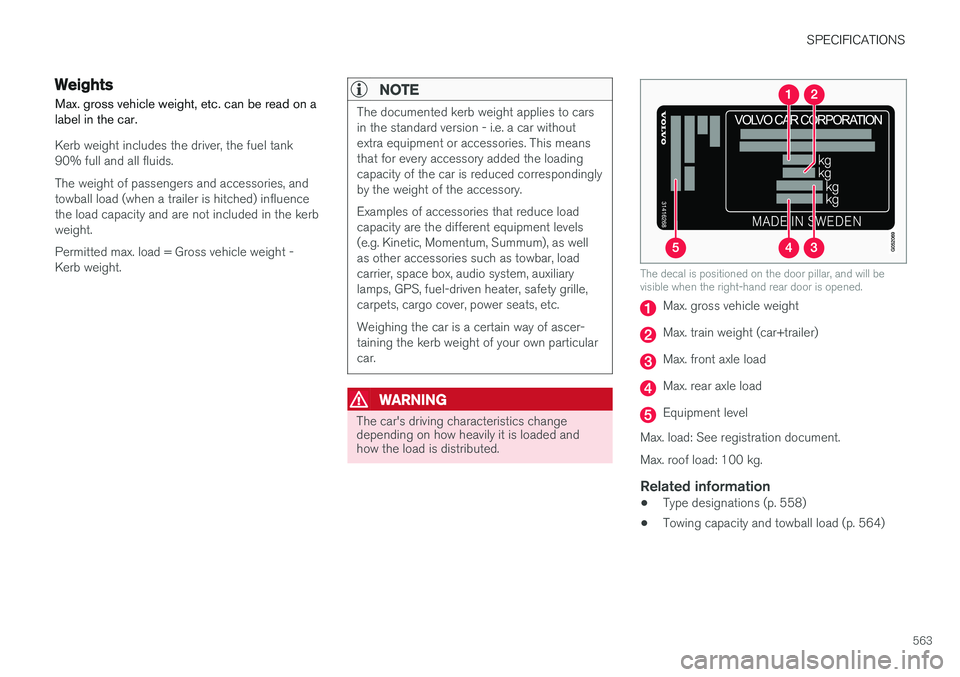
The decal is positioned on the door pillar, and will be visible when the right-hand rear door is opened.
Max. gross vehicle weight
Max. train weight (car+trailer)
Max. front axle load
Max. rear axle load
Equipment level
Max. load: See registration document. Max. roof load: 100 kg.
Related information
• Type designations (p. 558)
• Towing capacity and towball load (p. 564)
Page 566 of 594
SPECIFICATIONS
564
Towing capacity and towball load
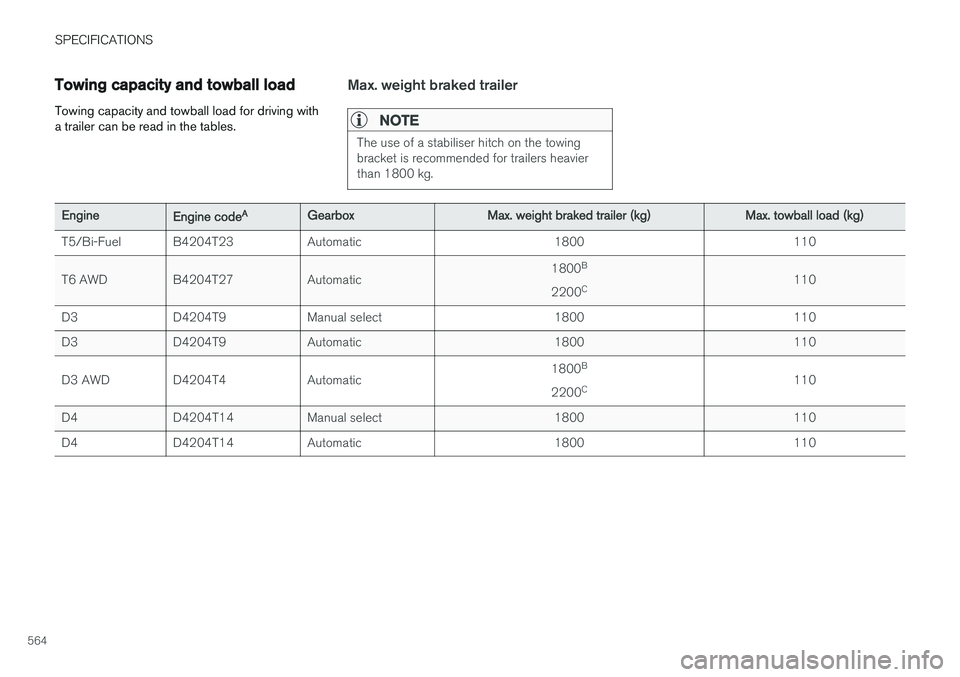
Towing capacity and towball load for driving with a trailer can be read in the tables.Max. weight braked trailer
NOTE
The use of a stabiliser hitch on the towing bracket is recommended for trailers heavierthan 1800 kg.
Engine Engine codeA
Gearbox Max. weight braked trailer (kg) Max. towball load (kg)
T5/Bi-Fuel B4204T23 Automatic 1800 110
T6 AWD B4204T27 Automatic 1800
B
2200 C 110
D3 D4204T9 Manual select 1800 110
D3 D4204T9 Automatic 1800 110
D3 AWD D4204T4 Automatic 1800
B
2200 C 110
D4 D4204T14 Manual select 1800 110
D4 D4204T14 Automatic 1800 110
Page 567 of 594
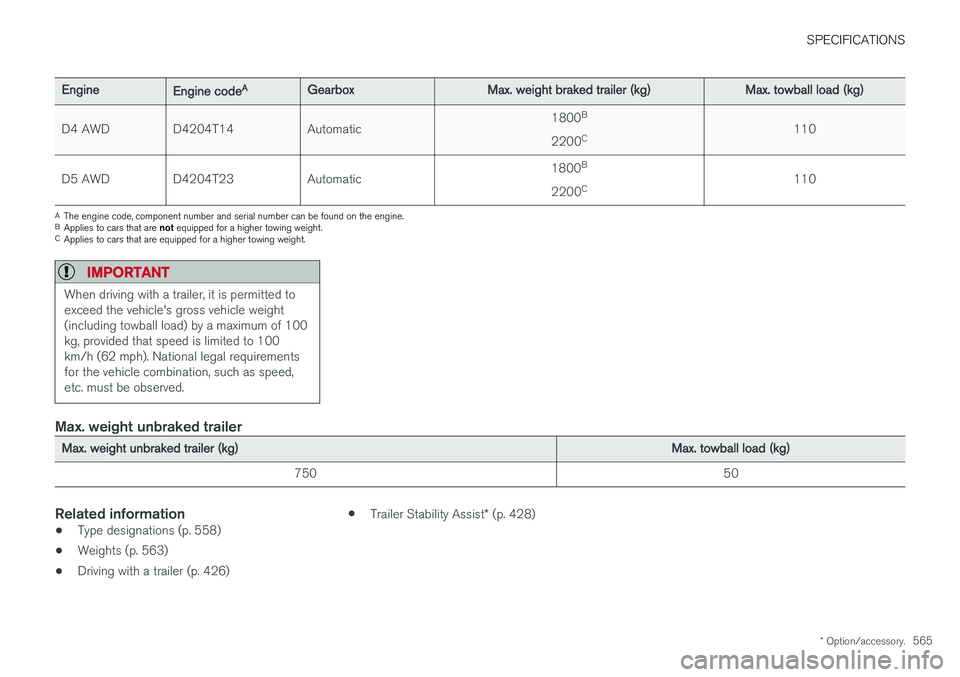
SPECIFICATIONS
* Option/accessory.565
Engine
Engine codeA
Gearbox Max. weight braked trailer (kg) Max. towball load (kg)
D4 AWD D4204T14 Automatic 1800
B
2200 C 110
D5 AWD D4204T23 Automatic 1800
B
2200 C 110
A
The engine code, component number and serial number can be found on the engine.
B Applies to cars that are not equipped for a higher towing weight.
C Applies to cars that are equipped for a higher towing weight.
IMPORTANT
When driving with a trailer, it is permitted to exceed the vehicle's gross vehicle weight(including towball load) by a maximum of 100kg, provided that speed is limited to 100km/h (62 mph). National legal requirementsfor the vehicle combination, such as speed,etc. must be observed.
Max. weight unbraked trailer
Max. weight unbraked trailer (kg) Max. towball load (kg)
750 50
Related information
•Type designations (p. 558)
• Weights (p. 563)
• Driving with a trailer (p. 426) •
Trailer Stability Assist
* (p. 428)
Page 571 of 594
SPECIFICATIONS
569
Adverse driving conditions for engine oil Adverse driving conditions can lead to abnor- mally high oil temperature or oil consumption.Below are some examples of adverse drivingconditions.
Check the oil level more frequently for long jour- neys:• towing a caravan or trailer
• in mountainous regions
• at high speeds
• in temperatures colder than -30 °C or hotterthan +40 °C.
The above also apply to shorter driving distancesat low temperatures. Choose a fully synthetic engine oil for adverse driving conditions. It provides extra protection forthe engine.
Volvo recommends:
IMPORTANT
In order to fulfil the requirements for the engine's service intervals all engines are filledwith a specially adapted synthetic engine oilat the factory. The choice of oil has beenmade very carefully with regard to service life,starting characteristics, fuel consumption andenvironmental impact. An approved engine oil must be used in order that the recommended service intervals canbe applied. Only use a prescribed grade of oilfor both filling and oil change, otherwise thereis a risk of the service life, starting characte-ristics, fuel consumption and environmentalimpact of the car being affected. If engine oil of the prescribed grade and vis- cosity is not used, engine related componentsmay become damaged. Volvo Car Corporationdisclaims any liability for any such damage. Volvo recommends that oil changes are car- ried out at an authorised Volvo workshop.
Related information
• Engine oil — specifications (p. 567)
• Engine oil (p. 516)