tow VOLVO XC60 2009 Owner´s Manual
[x] Cancel search | Manufacturer: VOLVO, Model Year: 2009, Model line: XC60, Model: VOLVO XC60 2009Pages: 297, PDF Size: 21.16 MB
Page 238 of 297
06 Maintenance and specificationsReplacing bulbs 06
236 1. Remove the headlight housing from the
vehicle (see page 233).
2. Remove the bulb holder by turning it coun-
terclockwise and pulling it out of the head-
light housing.
3. Pull out the burned out bulb and install a new one. It can only be inserted in one
position.
4. Reinsert the bulb holder into the headlight housing and turn it clockwise.
5. Reinstall the headlight housing.
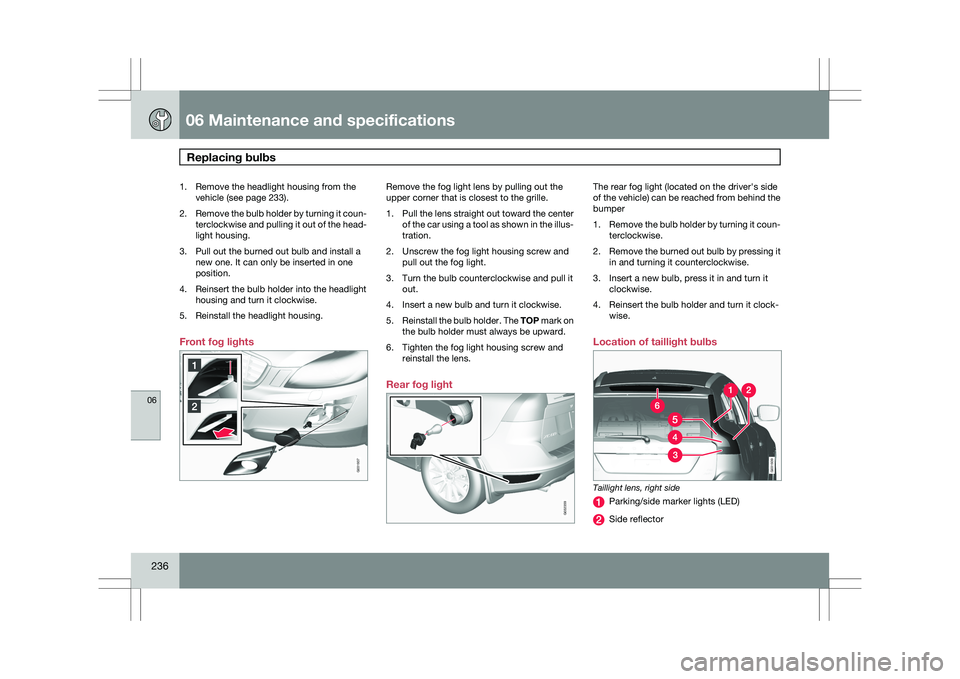
Front fog lights Remove the fog light lens by pulling out the
upper corner that is closest to the grille.
1.
Pull the lens straight out toward the center
of the car using a tool as shown in the illus-
tration.
2. Unscrew the fog light housing screw and pull out the fog light.
3. Turn the bulb counterclockwise and pull it out.
4. Insert a new bulb and turn it clockwise.
5. Reinstall the bulb holder. The TOP mark on
the bulb holder must always be upward.
6. Tighten the fog light housing screw and reinstall the lens.
Rear fog light The rear fog light (located on the driver\fs side
of the vehicle) can be reached from behind the
bumper
1.
Remove the bulb holder by turning it coun-
terclockwise.
2. Remove the burned out bulb by pressing it
in and turning it counterclockwise.
3. Insert a new bulb, press it in and turn it clockwise.
4. Reinsert the bulb holder and turn it clock- wise.
Location of taillight bulbs Taillight lens, right side
Parking/side marker lights (LED)
Side reflector G031937 G032359 G031939
Page 243 of 297
06 Maintenance and specifications
Wiper blades and washer fluid06
241
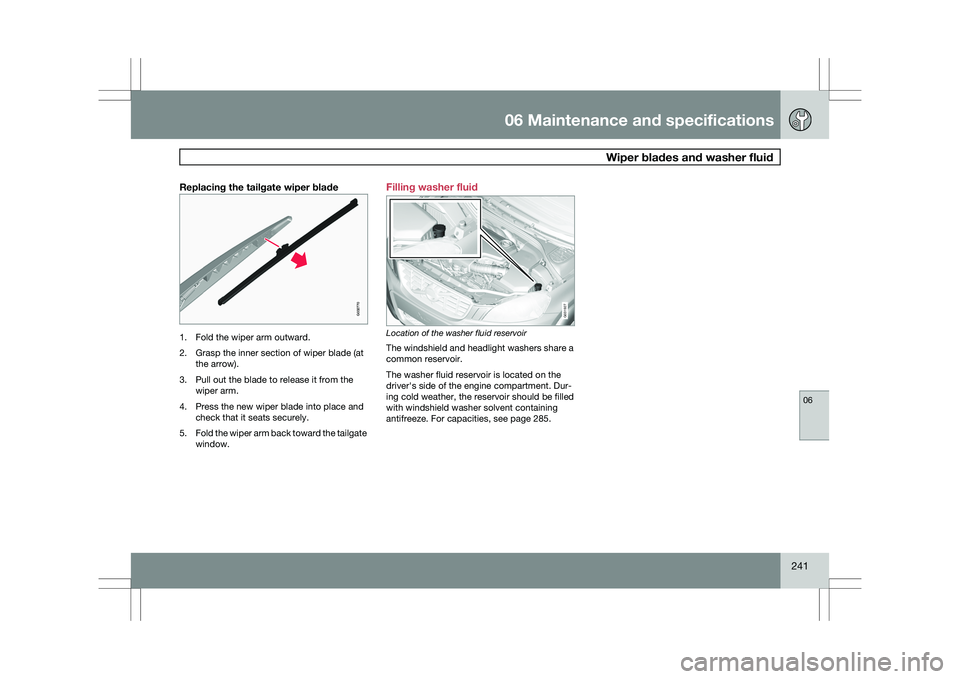
Replacing the tailgate wiper blade1. Fold the wiper arm outward.
2. Grasp the inner section of wiper blade (at
the arrow).
3. Pull out the blade to release it from the wiper arm.
4. Press the new wiper blade into place and check that it seats securely.
5. Fold the wiper arm back toward the tailgate
window. Filling washer fluid
Location of the washer fluid reservoir
The windshield and headlight washers share a
common reservoir.
The washer fluid reservoir is located on the
driver\fs side of the engine compartment. Dur-
ing cold weather, the reservoir should be filled
with windshield washer solvent containing
antifreeze. For capacities, see page 285. G032770 G031927
Page 263 of 297
06 Maintenance and specifications
Wheels and tires06
}}
261
Vehicle loading
Properly loading your vehicle will provide maxi-
mum return of vehicle design performance.
Before loading your vehicle, familiarize yourself
with the following terms for determining your
vehicle\fs weight ratings, with or without a
trailer, from the vehicle\fs Federal/Canadian
Motor Vehicle Safety Standards (FMVSS/
CMVSS) label, and the vehicle\fs tire informa-
tion placard:
Curb weightThe weight of the vehicle including a full tank
of fuel and all standard equipment. It does not
include passengers, cargo, or optional equip-
ment.
Capacity weightAll weight added to the curb weight, including
cargo and optional equipment. When towing,
trailer hitch tongue load is also part of cargo
weight.
NOTE
For trailer towing information, please refer to
the section "Towing a trailer"
on page 217.
Permissible axle weightThe maximum allowable weight that can be
carried by a single axle (front or rear). These
numbers are shown on the Federal/Canadian
Motor Vehicle Safety Standards (FMVSS/
CMVSS) label. The total load on each axle must
never exceed its maximum permissible weight.
Gross vehicle weight (GVW)The vehicle\fs curb weight + cargo + passen-
gers.
NOTE \b
The location of the various labels in your
vehicle can be found on page 279
.
\b A table listing important weight limits for
your vehicle can be found on page
282.
Steps for Determining Correct Load
Limit
1. Locate the statement "the combined
weight of occupants and cargo should
never exceed XXX pounds" on your vehi-
cle\fs placard. 2. Determine the combined weight of the
driver and passengers that will be riding in
your vehicle.
3. Subtract the combined weight of the driver
and passengers from XXX kilograms or
XXX pounds.
4. The resulting figure equals the available amount of cargo and luggage load
capacity. For example, if the "XXX" amount
equals 1400 lbs. and there will be five
150 lb. passengers in your vehicle, the
amount of available cargo and luggage
load capacity is 650 lbs. (1400 – 750
(5 × 150) = 650 lbs.)
5. Determine the combined weight of luggage
and cargo being loaded on the vehicle.
That weight may not safely exceed the
available cargo and luggage load capacity
calculated in Step 4.
6. If your vehicle will be towing a trailer, load from your trailer will be transferred to your
vehicle. Consult this manual 1
to determine
how this reduces the available cargo and
luggage load capacity of your vehicle. 1
See the section "Trailer Towing on page
217.
Page 269 of 297
06 Maintenance and specifications
Wheels and tires06
}}
267
Accessing the tire sealing systemThe tire sealing system is stowed under the
floor of the cargo area. To access it:
1.
Fold up or remove any protective floor cov-
ering or carpet.
2. Open the floor hatch.
3. Remove the retaining screws.
4. Lift out the foam plastic block holding the jack and lug wrench.
5. Lift out the tire sealing system.
NOTE \b
The tire sealing system is only intended
to seal holes on the tire’s tread area, not
the sidewall.
\b Tires with large holes or tears cannot be
repaired with the tire sealing system.
WARNING \b
After using the tire sealing system, the
vehicle should not be driven farther than
approximately 120 miles (200 km).
\b Have the tire inspected by a trained and
qualified Volvo service technician as
soon as possible to determine if it can
be permanently repaired or must be
replaced.
\b The vehicle should not be driven faster
than 50 mph (80 km/h) while using a tire
that has been temporarily repaired with
the tire sealing system.
\b After using the tire sealing system, drive
carefully and avoid abrupt steering
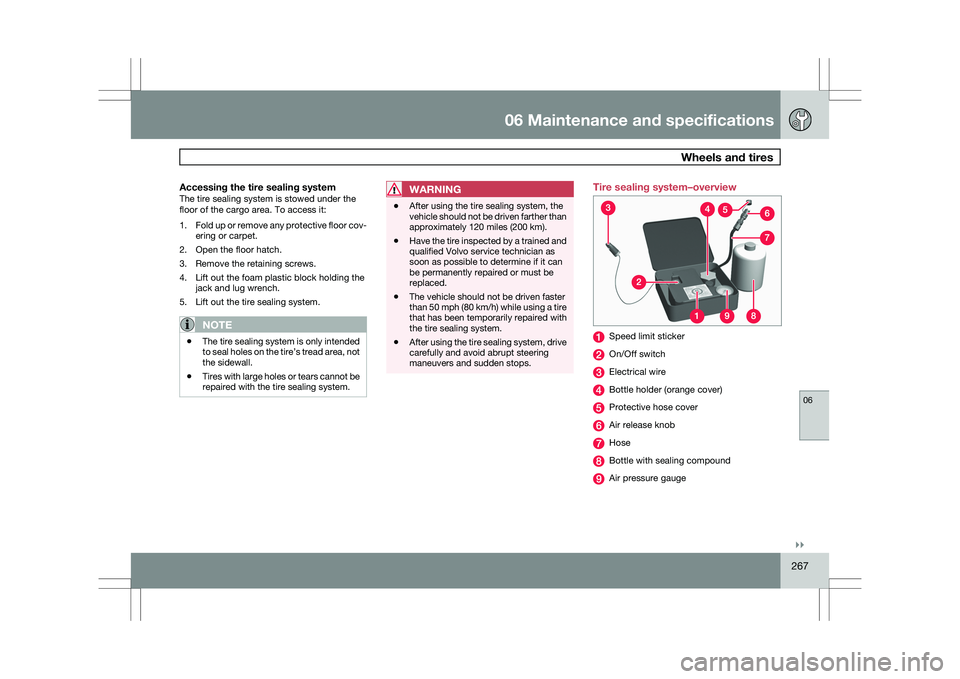
maneuvers and sudden stops. Tire sealing system–overview
Speed limit sticker
On/Off switch
Electrical wire
Bottle holder (orange cover)
Protective hose cover
Air release knob
Hose
Bottle with sealing compound
Air pressure gauge
Page 271 of 297
06 Maintenance and specifications
Wheels and tires06
}}
269
3. Ensure that the on/off switch is in posi-
tion 0 (the 0 side of the switch should be
pressed down).
WARNING Contact with the sealing compound may
cause skin irritation. If contact occurs, wash
the affected area immediately with soap and
water.
4. Unscrew the orange cover over the bottle
holder and unscrew the cap on the bottle
of sealing compound.
NOTE Do not break the seal on the bottle. This
occurs automatically when the bottle is
screwed into the holder.
5. Screw the bottle into the bottle holder.
WARNING
The bottle is equipped with a catch to keep
it securely in place and help prevent sealing
compound leakage. Once in place, the bot-
tle cannot be unscrewed. This must be done
by a trained and qualified Volvo service
technician. 6.
Remove the valve cap from the tire’s infla-
tion valve and screw the tire sealing sys-
tem’s hose connector onto the valve as
tightly as possible by hand.
7. Connect the electrical wire to the nearest 12-volt socket in the vehicle.
8. Start the vehicle’s engine.
WARNING The vehicle´s engine should be running
when the tire sealing system is used to avoid
battery drain. Therefore, be sure the vehicle
is parked in a well ventilated place, or out-
doors, before using the system.
9.
Start the tire sealing system’s compressor
by pressing the on/off switch to position I.
WARNING \b
Never stand next to the tire being inflated
when the compressor is in operation.
\b If cracks, bubbles, etc. form on the tire,
switch off the compressor immediately.
\b If there is visible damage to the sidewall
or the rim, the tire cannot be repaired.
The vehicle should not be driven if this
occurs. Contact a towing service or
Volvo On Call Roadside Assistance if
applicable.
NOTE The air pressure gauge will temporarily
show an increase in pressure to approxi-
mately 88 psi (6 bar) while the sealing com-
pound is being pumped into the tire. The
pressure should return to a normal level
after approximately 30 seconds.
10. Within seven minutes, inflate the tire to
between
22—44 psi (1.8—3.0 bar). Switch
off the compressor briefly to get a clear
reading from the pressure gauge. The
compressor should not be used for more
than 10 minutes at a time to avoid over-
heating.
Page 272 of 297
06 Maintenance and specificationsWheels and tires 06
270
CAUTION The compressor should not be used for
more than 10 minutes at a time to avoid
overheating.
WARNING
If the pressure remains below 22 psi
(1.8 bar) after approximately seven minutes,
turn off the compressor. In this case, the
hole is too large to be sealed and the vehicle
should not be driven.
11.
Switch off the compressor and disconnect
the electrical wire from the 12-volt
socket.
12. Unscrew the hose from the tire’s inflation valve and reinstall the valve cap.
13. Immediately drive the vehicle for approxi- mately 2 miles (3 km) at a maximum speed
of 50 mph (80 km/h) to distribute the seal-
ing compound in the tire.
NOTE \b
Safely stow the tire sealing system in a
convenient place as it will soon be used
again to check the tire’s inflation pres-
sure.
\b The empty bottle of sealing compound
cannot be removed from the bottle
holder. Consult a trained and qualified
Volvo service technician to have the
bottle removed and properly disposed
of.
WARNING If heavy vibrations, unsteady steering
behavior, or noises should occur while driv-
ing, reduce speed and park the vehicle in a
safe place. Recheck the tire for bumps,
cracks, or other visible damage, and
recheck its inflation pressure. If the pressure
is below 19 psi (1.3 bar), do not continue
driving. Have the vehicle towed to a trained
and qualified Volvo service technician.
Stage 2: Checking inflation pressure1. Connect the tire sealing system as descri-
bed in stage 1.
2. Refer to the inflation pressure tablesfor the
correct inflation pressure. If the tire needs
to be inflated, start the tire sealing system’s compressor. If necessary, release air from
the tire by turning the air release knob
counterclockwise.
CAUTION The compressor should not be used for
more than 10 minutes at a time to avoid
overheating.
WARNING
If you interrupt your trip for more than 1
hour, check the inflation pressure in the
damaged tire again before continuing.
Replacing the sealing compound
container
The sealing compound container must be
replaced if:
\b
the tire sealing system has been used to
repair a tire
\b the container’s expiration date has passed
(see the date on decal).
Page 276 of 297
06 Maintenance and specificationsVehicle care 06
274 Washing the car
WARNING
Be sure that the compressor is not con-
nected to a 12-volt socket while replacing
the container.
The following points should be kept in mind
when washing and cleaning the car:
\b
The car should be washed at regular inter-
vals since dirt, dust, insects and tar spots
adhere to the paint and may cause dam-
age. To help prevent corrosion, it is partic-
ularly important to wash the car frequently
in the wintertime.
\b Avoid washing your car in direct sunlight.
Doing so may cause detergents and wax
to dry out and become abrasive. To avoid
scratching, use lukewarm water to soften
the dirt before you wash with a soft
sponge, and plenty of sudsy water.
\b Bird droppings: Remove from paintwork
as soon as possible. Otherwise the finish
may be permanently damaged.
\b A detergent can be used to facilitate the
softening of dirt and oil.
\b A water-soluble grease solvent may be
used in cases of sticky dirt. However, use
a wash place equipped with a drainage
separator. \b
Dry the car with a clean chamois and
remember to clean the drain holes in the
doors and rocker panels.
\b Tar spots can be removed with kerosene
or tar remover after the car has been
washed.
\b A stiff-bristle brush and lukewarm soapy
water can be used to clean the wiper
blades. Frequent cleaning of the wind-
shield and wiper blades improves visibility
considerably and also helps prolong the
service life of the wiper blades.
\b Wash off the dirt from the underside (wheel
housings, fenders, etc).
\b In areas of high industrial fallout, more fre-
quent washing is recommended.
\b After cleaning the engine, the spark plug
wells should be inspected for water and
blown dry if necessary.
NOTE When washing the car, remember to remove
dirt from the drain holes in the doors and
sills.
CAUTION \b
During high pressure washing, the
spray mouthpiece must never be closer
to the vehicle than 13" (30 cm). Do not
spray into the locks.
\b Dirt, snow, etc., on the headlights can
reduce lighting capacity considerably.
Clean the headlights regularly, for
example when refueling.
\b When washing or steam cleaning the
engine, avoid spraying water or steam
directly on the electrical components or
toward the rear side of the engine. Spe-
cial moonroof cautions:
\b Always close the moonroof and sun
shade before washing your vehicle.
\b Never use abrasive cleaning agents on
the moonroof.
\b Never use wax on the rubber seals
around the moonroof.
Exterior componentsVolvo recommends the use of special cleaning
products, available at your Volvo retailer, for
cleaning colored plastic, rubber, or ornamental
components such as chromed strips on the
exterior of your vehicle. The instructions for
using these products should be followed care-
Page 278 of 297
06 Maintenance and specificationsVehicle care 06
276
CAUTION Volvo does not recommend the use of long-
life or durable paint protection coatings,
some of which may claim to prevent pitting,
fading, oxidation, etc. These coatings have
not been tested by Volvo for compatibility
with your vehicle\fs clear coat. Some of them
may cause the clear coat to soften, crack,
or cloud. Damage caused by application of
paint protection coatings may not be cov-
ered under your vehicle\fs paint warranty.
Cleaning the interior
Only use cleaning agents and car care prod-
ucts recommended by Volvo. Clean regularly
and follow the instructions included with the
car care product.
Upholstery care
Fabric
Clean with soapy water or a detergent. For
more difficult spots caused by oil, ice cream,
shoe polish, grease, etc., use a clothing/fabric
stain remover. Consult your Volvo retailer.
Alcantera
TM
suede-like materialSuede-like upholstery can be cleaned with a
soft cloth and mild soap solution.
Leather careVolvo\fs leather upholstery is manufactured
with a protectant to repel soiling. Over time, sunlight, grease and dirt can break down the
protection. Staining, cracking, scuffing, and
fading can result.
Volvo offers an easy-to-use, non-greasy
leather care kit formulated to clean and beau-
tify your vehicle\fs leather, and to renew the
protective qualities of its finish. The cleaner
removes dirt and oil buildup. The light cream
protectant restores a barrier against soil and
sunlight.
Volvo also offers a special leather softener that
should be applied after the cleaner and pro-
tectant. It leaves leather soft and smooth, and
reduces friction between leather and other fin-
ishes in the vehicle.
Volvo recommends cleaning, protecting and
conditioning your vehicle\fs leather two to four
times a year. Ask your Volvo retailer about
Leather Care Kit 951 0251 and Leather Soft-
ener 943 7429.
Cleaning leather upholstery1. Pour leather cleaner on a damp sponge
and squeeze it until the cleaner foams.
2. Apply the foam to the stain by moving the sponge with circular movements.
3. Dampen the stain thoroughly with the sponge. Let the sponge absorb the stain,
do not rub. 4. Dry the stain with soft paper towels or a
towel, and allow the leather to dry com-
pletely.
Protecting leather upholstery1.Put a small amount of protectant cream on
a cloth and apply a thin coating of cream
to the upholstery with light circular move-
ments.
2. Allow the leather to dry for 20 minutes.
This will help the leather resist staining and
protect against sunlight\fs harmful UV rays.
Page 279 of 297
06 Maintenance and specifications
Vehicle care06
}}
277
CAUTION\b
Under no circumstances should gaso-
line, naphtha or similar cleaning agents
be used on the plastic or the leather
since these can cause damage.
\b Take extra care when removing stains
such as ink or lipstick since the coloring
can spread.
\b Use solvents sparingly. Too much sol-
vent can damage the seat padding.
\b Start from the outside of the stain and
work toward the center.
\b Sharp objects (e.g. pencils or pens in a
pocket) or Velcro fasteners on clothing
may damage the textile upholstery.
\b Clothing that is not colorfast, such as
new jeans or suede garments, may stain
the upholstery.
Cleaning the seat beltsClean only with lukewarm water and a mild
soap solution.
Cleaning floor matsThe floor mats should be vacuumed or brushed
clean regularly, especially during winter when
they should be taken out for drying. Spots on
textile mats can be removed with a mild deter- gent. For best protection in winter, Volvo rec-
ommends the use of Volvo rubber floor mats.
Consult your Volvo retailer.
Spots on interior plastic, metal, or wood
surfaces
Cleaning interior plastic components should
be done with a cleaning agent specially
designed for this purpose. Consult your Volvo
retailer.
Touching up paintwork
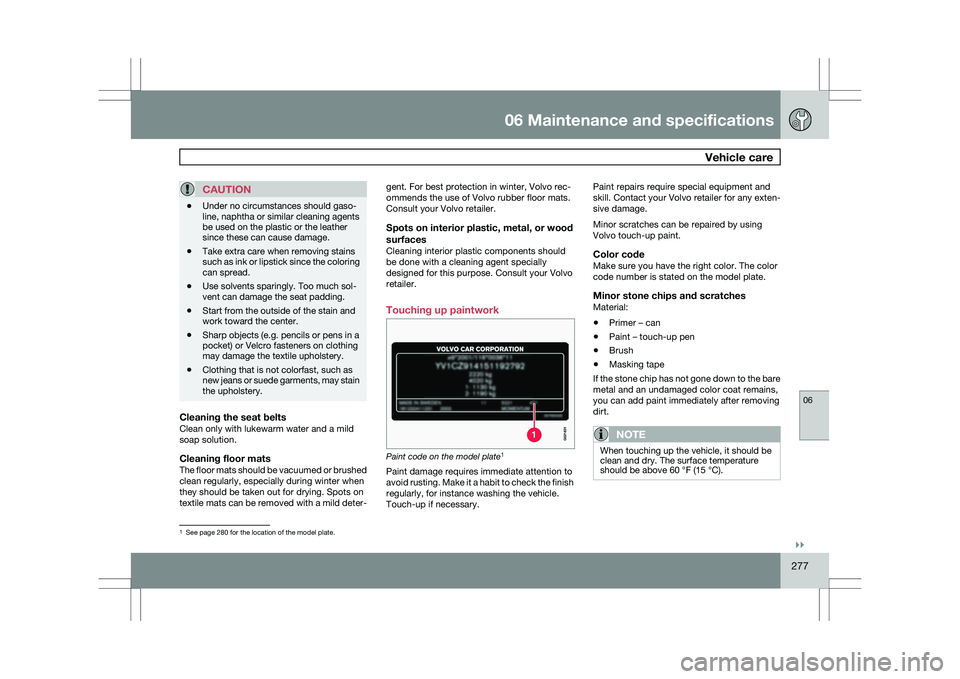
Paint code on the model plate
1
Paint damage requires immediate attention to
avoid rusting. Make it a habit to check the finish
regularly, for instance washing the vehicle.
Touch-up if necessary. Paint repairs require special equipment and
skill. Contact your Volvo retailer for any exten-
sive damage.
Minor scratches can be repaired by using
Volvo touch-up paint.Color codeMake sure you have the right color. The color
code number is stated on the model plate.
Minor stone chips and scratchesMaterial:
\b
Primer – can
\b Paint – touch-up pen
\b Brush
\b Masking tape
If the stone chip has not gone down to the bare
metal and an undamaged color coat remains,
you can add paint immediately after removing
dirt.
NOTE When touching up the vehicle, it should be
clean and dry. The surface temperature
should be above 60 °F (15 °C).
1
See page 280 for the location of the model plate.
Page 286 of 297
06 Maintenance and specificationsSpecifications 06
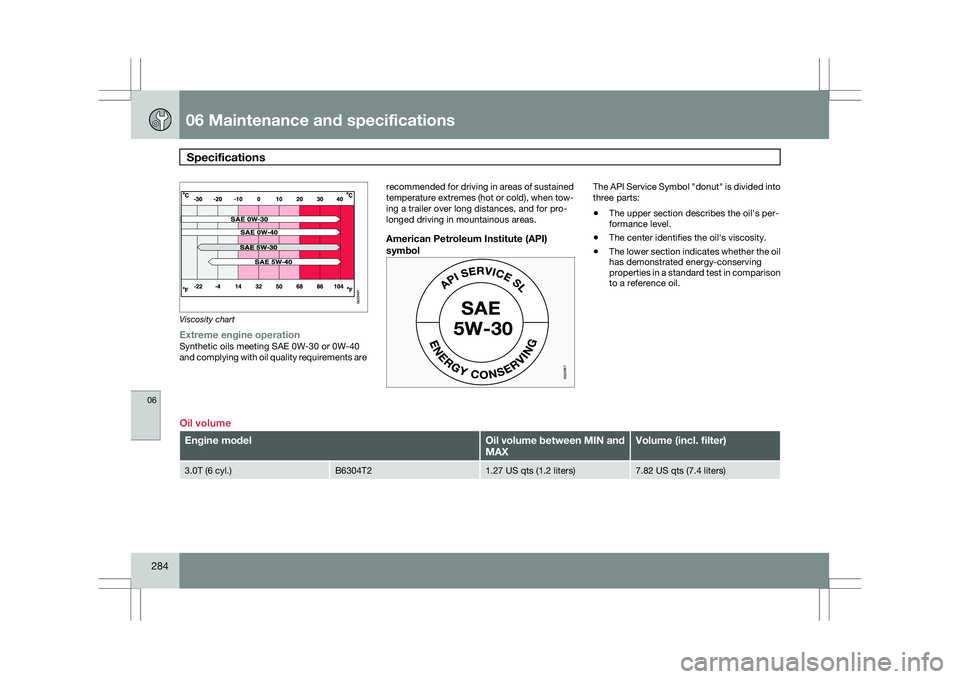
284 Viscosity chart
Extreme engine operationSynthetic oils meeting SAE 0W-30 or 0W-40
and complying with oil quality requirements are
recommended for driving in areas of sustained
temperature extremes (hot or cold), when tow-
ing a trailer over long distances, and for pro-
longed driving in mountainous areas.
American Petroleum Institute (API)
symbol The API Service Symbol "donut" is divided into
three parts:
\b
The upper section describes the oil\fs per-
formance level.
\b The center identifies the oil\fs viscosity.
\b The lower section indicates whether the oil
has demonstrated energy-conserving
properties in a standard test in comparison
to a reference oil.
Oil volume Engine model Oil volume between MIN and
MAX Volume (incl. filter)
3.0T (6 cyl.) B6304T2 1.27 US qts (1.2 liters) 7.82 US qts (7.4 liters)
G023491
G022917