remove seats VOLVO XC60 2009 Owner´s Manual
[x] Cancel search | Manufacturer: VOLVO, Model Year: 2009, Model line: XC60, Model: VOLVO XC60 2009Pages: 297, PDF Size: 21.16 MB
Page 18 of 297
01 SafetySeat belts 01
16 Seat belt use during pregnancy
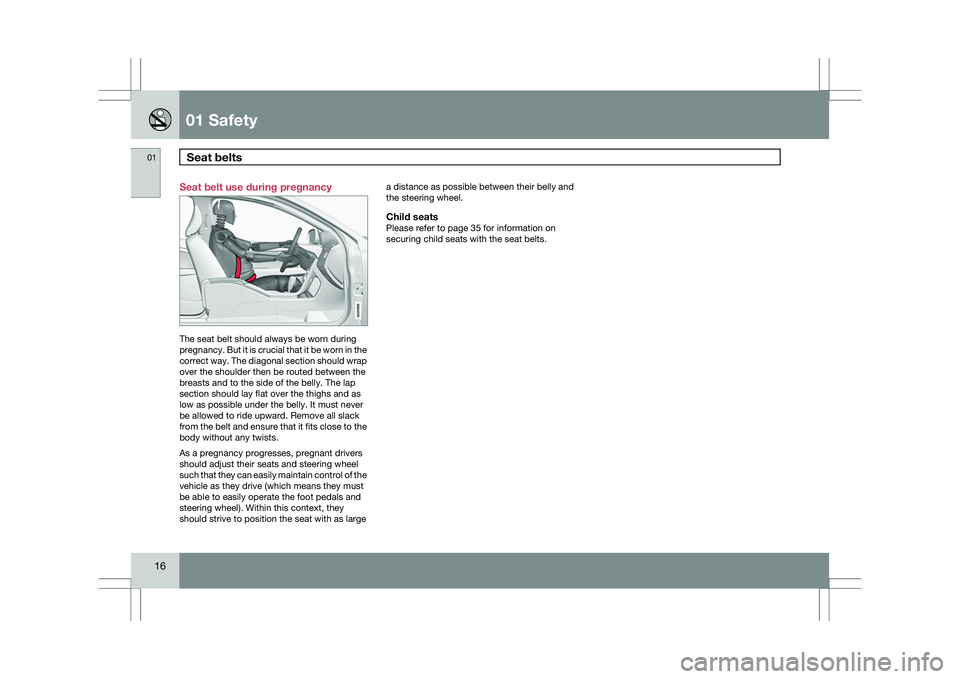
The seat belt should always be worn during
pregnancy. But it is crucial that it be worn in the
correct way. The diagonal section should wrap
over the shoulder then be routed between the
breasts and to the side of the belly. The lap
section should lay flat over the thighs and as
low as possible under the belly. It must never
be allowed to ride upward. Remove all slack
from the belt and ensure that it fits close to the
body without any twists.
As a pregnancy progresses, pregnant drivers
should adjust their seats and steering wheel
such that they can easily maintain control of the
vehicle as they drive (which means they must
be able to easily operate the foot pedals and
steering wheel). Within this context, they
should strive to position the seat with as large a distance as possible between their belly and
the steering wheel.
Child seatsPlease refer to page 35 for information on
securing child seats with the seat belts. G020998
Page 25 of 297
01 Safety
Occupant Weight Sensor01
}}
23
WARNING\b
Never try to open, remove, or repair any
components in the OWS system. This
could result in system malfunction.
Maintenance or repairs should only be
carried out by an a trained and qualified
Volvo service technician.
\b The front passenger\fs seat should not
be modified in any way. This could
reduce pressure on the seat cushion,
which might interfere with the OWS sys-
tem\fs function. Passeng-
er\fs seat
occu-
pancy sta-
tus OWS indi-
cator light
status Passeng-
er\fs side
front air-
bag status
Seat unoc-
cupied OWS indica-
tor light
lights up. Passenger\fs
side front
airbag disa-
bled
Seat occu-
pied by low
weight
occupant/
object
A OWS indica-
tor light
lights up Passenger\fs
side front
airbag disa-
bled
Seat occu-
pied by
heavy occu-
pant/object OWS indica-
tor light is
not lit Passenger\fs
side front
airbag ena-
bled
A
Volvo recommends that children always be properly
restrained in appropriate child restraints in the rear seats. Do
not assume that the passenger\fs side front airbag is disabled
unless the PASSENGER AIRBAG OFF indicator lamp is lit.
Make sure the child restraint is properly installed. If there is
any doubt as to the status of the passenger\fs side front air-
bag, move the child restraint to the rear seat.
The OWS is designed to enable (may inflate)
the passenger\fs side front airbag anytime the
system senses that a person of adult size is
sitting properly in the front passenger\fs seat. The PASSENGER AIRBAG OFF indicator lamp
will be off and remain off.
If a person of adult size is sitting in the front
passenger\fs seat, but the PASSENGER AIR-
BAG OFF indicator lamp is on, it is possible that
the person isn\ft sitting properly in the seat. If
this happens:
\b
Turn the vehicle off and ask the person to
place the seatback in an upright position.
\b Have the person sit upright in the seat,
centered on the seat cushion, with the per-
son\fs legs comfortably extended.
\b Restart the vehicle and have the person
remain in this position for about two
minutes. This will allow the system to
detect that person and enable the pas-
senger\fs frontal airbag.
\b If the PASSENGER AIRBAG OFF indicator
lamp remains on even after this, the person
should be advised to ride in the rear seat.
This condition reflects limitations of the OWS
classification capability. It does not indicate
OWS malfunction.
ModificationsIf you are considering modifying your vehicle in
any way to accommodate a disability, for
example by altering or adapting the driver\fs or
front passenger\fs seat(s) and/or airbag sys-
tems, please contact Volvo at:
Page 40 of 297
01 SafetyInfant seats 01
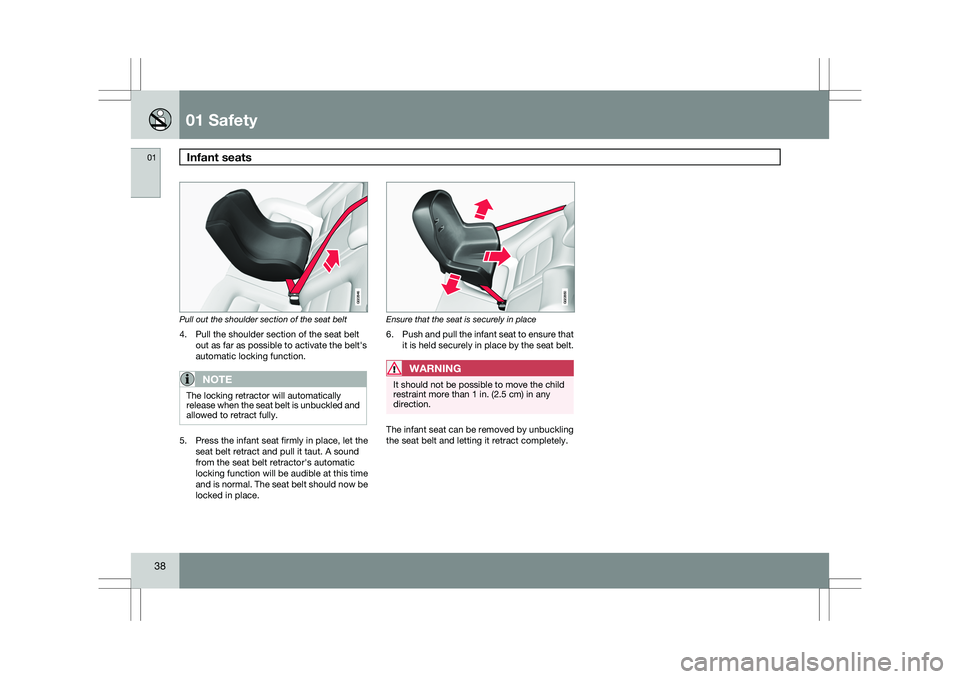
38 Pull out the shoulder section of the seat belt
4. Pull the shoulder section of the seat belt
out as far as possible to activate the belt\fs
automatic locking function.
NOTE The locking retractor will automatically
release when the seat belt is unbuckled and
allowed to retract fully.
5. Press the infant seat firmly in place, let the
seat belt retract and pull it taut. A sound
from the seat belt retractor\fs automatic
locking function will be audible at this time
and is normal. The seat belt should now be
locked in place. Ensure that the seat is securely in place
6.
Push and pull the infant seat to ensure that
it is held securely in place by the seat belt.WARNING It should not be possible to move the child
restraint more than 1 in. (2.5 cm) in any
direction.
The infant seat can be removed by unbuckling
the seat belt and letting it retract completely. G022846 G022850
Page 42 of 297
01 SafetyConvertible seats 01
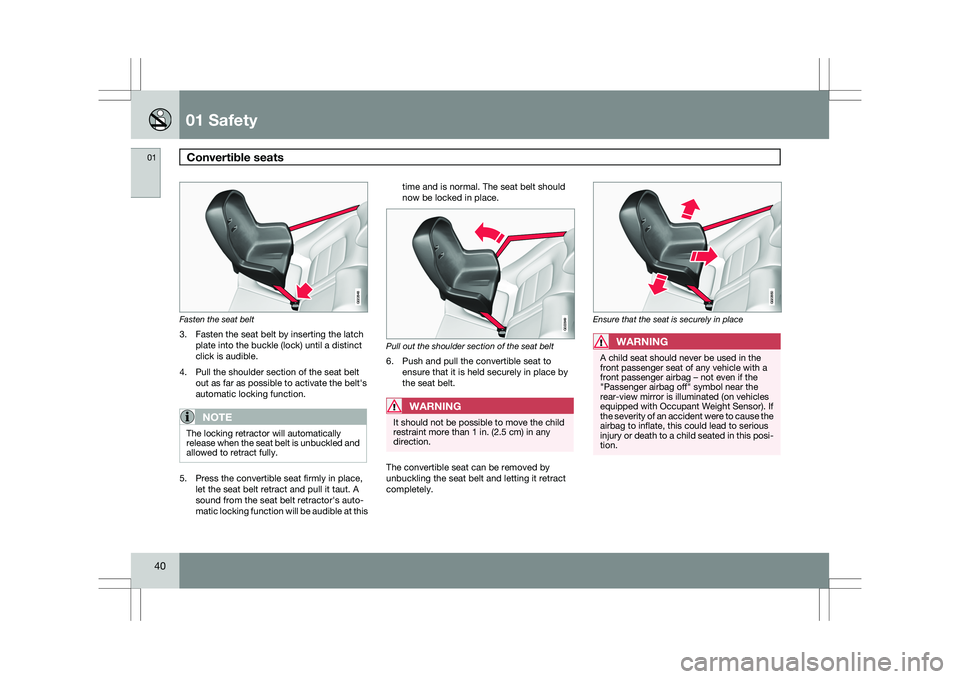
40 Fasten the seat belt
3. Fasten the seat belt by inserting the latch
plate into the buckle (lock) until a distinct
click is audible.
4. Pull the shoulder section of the seat belt out as far as possible to activate the belt\fs
automatic locking function.
NOTE The locking retractor will automatically
release when the seat belt is unbuckled and
allowed to retract fully.
5. Press the convertible seat firmly in place,
let the seat belt retract and pull it taut. A
sound from the seat belt retractor\fs auto-
matic locking function will be audible at this time and is normal. The seat belt should
now be locked in place.
Pull out the shoulder section of the seat belt
6. Push and pull the convertible seat to
ensure that it is held securely in place by
the seat belt.WARNING It should not be possible to move the child
restraint more than 1 in. (2.5 cm) in any
direction.
The convertible seat can be removed by
unbuckling the seat belt and letting it retract
completely. Ensure that the seat is securely in place
WARNING
A child seat should never be used in the
front passenger seat of any vehicle with a
front passenger airbag – not even if the
"Passenger airbag off" symbol near the
rear-view mirror is illuminated (on vehicles
equipped with Occupant Weight Sensor). If
the severity of an accident were to cause the
airbag to inflate, this could lead to serious
injury or death to a child seated in this posi-
tion. G022848 G022849 G022850
Page 81 of 297
03 Your driving environment
Ignition modes03
}}
79
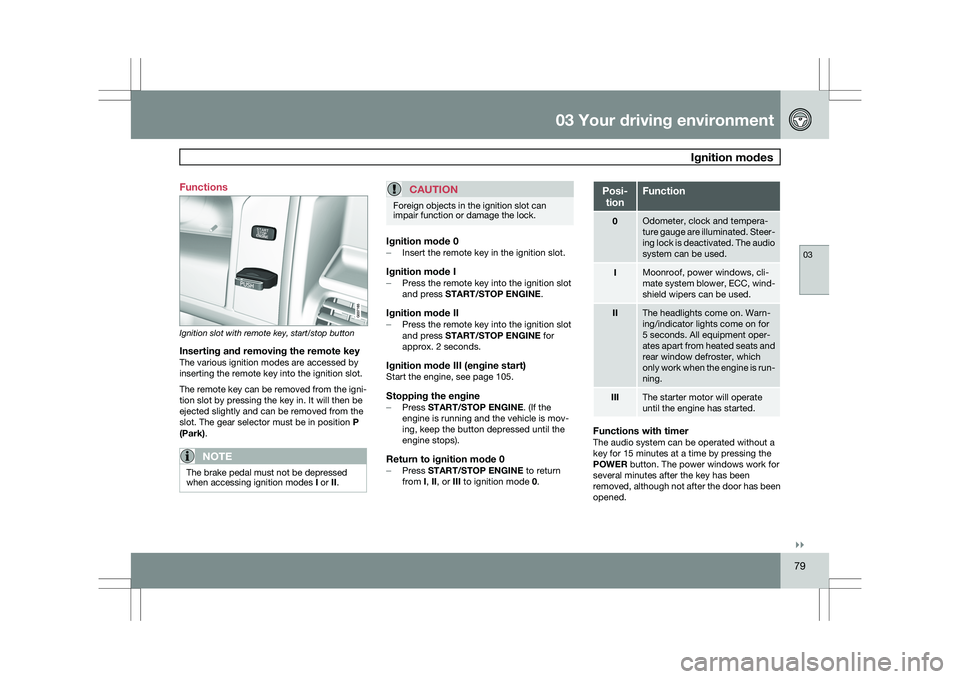
Functions
Ignition slot with remote key, start/stop button
Inserting and removing the remote keyThe various ignition modes are accessed by
inserting the remote key into the ignition slot.
The remote key can be removed from the igni-
tion slot by pressing the key in. It will then be
ejected slightly and can be removed from the
slot. The gear selector must be in position
P
(Park).
NOTE The brake pedal must not be depressed
when accessing ignition modes
I or II.
CAUTION Foreign objects in the ignition slot can
impair function or damage the lock.
Ignition mode 0–
Insert the remote key in the ignition slot.
Ignition mode I–Press the remote key into the ignition slot
and press START/STOP ENGINE.
Ignition mode II–Press the remote key into the ignition slot
and press START/STOP ENGINE for
approx. 2 seconds.
Ignition mode III (engine start)Start the engine, see page 105.
Stopping the engine–
Press START/STOP ENGINE. (If the
engine is running and the vehicle is mov-
ing, keep the button depressed until the
engine stops).
Return to ignition mode 0–Press START/STOP ENGINE to return
from I, II, or III to ignition mode 0. Posi-
tion Function
0 Odometer, clock and tempera-
ture gauge are illuminated. Steer-
ing lock is deactivated. The audio
system can be used.
I Moonroof, power windows, cli-
mate system blower, ECC, wind-
shield wipers can be used.
II The headlights come on. Warn-
ing/indicator lights come on for
5 seconds. All equipment oper-
ates apart from heated seats and
rear window defroster, which
only work when the engine is run-
ning.
III The starter motor will operate
until the engine has started.
Functions with timerThe audio system can be operated without a
key for 15 minutes at a time by pressing the
POWER button. The power windows work for
several minutes after the key has been
removed, although not after the door has been
opened.