ECU VOLVO XC60 TWIN ENGINE 2019 Workshop Manual
[x] Cancel search | Manufacturer: VOLVO, Model Year: 2019, Model line: XC60 TWIN ENGINE, Model: VOLVO XC60 TWIN ENGINE 2019Pages: 695, PDF Size: 14.96 MB
Page 578 of 695
||
WHEELS AND TIRES
576
WARNING
The vehicle must never be driven withmore than one "Temporary Spare" tiremounted.
Driving with a spare wheel may alter thedriving characteristics of the vehicle.Replace the spare wheel with a normalwheel as soon as possible.
The spare wheel is smaller than the nor-mal wheel, which affects the vehicle'sground clearance. Watch for high curbsand do not wash the vehicle in an auto-matic car wash when a spare wheel ismounted.
Follow the manufacturer's recommendedtire inflation pressure for the spare wheel.
On all-wheel drive vehicles, the drive onthe rear axle can be disconnected.
If the spare wheel is mounted on thefront axle, snow chains must not be used.
The spare wheel must not be repaired.
CAUTION
The vehicle must not be driven with wheels ofdifferent dimensions or with a spare tire otherthan the one that came with the vehicle. Theuse of different size wheels can seriouslydamage your vehicle's transmission.
Related information
When changing wheels (p. 570)
Recommended tire pressure (p. 565)
Accessing the spare wheel
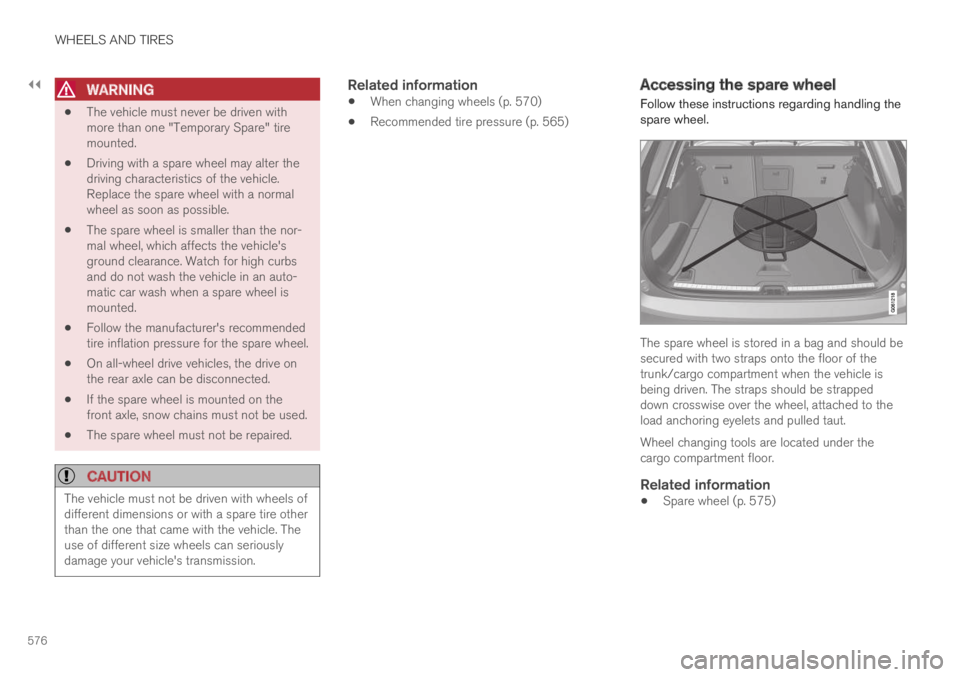
Follow these instructions regarding handling thespare wheel.
The spare wheel is stored in a bag and should besecured with two straps onto the floor of thetrunk/cargo compartment when the vehicle isbeing driven. The straps should be strappeddown crosswise over the wheel, attached to theload anchoring eyelets and pulled taut.
Wheel changing tools are located under thecargo compartment floor.
Related information
Spare wheel (p. 575)
Page 597 of 695
LOADING, STORAGE AND PASSENGER COMPARTMENT
}}
* Option/accessory.595
Cargo compartment
The vehicle has a flexible cargo compartmentthat makes it possible to carry and secure largeobjects.
The cargo capacity of the vehicle can be consid-erably increased by folding down the rear seatbackrests. To make loading and unloading easier,the rear section of the vehicle can be raised andlowered using the level control function*. Use theload anchoring eyelets or grocery bag holders tohelp secure objects in place, and the retractablecargo compartment cover* to help concealobjects in the cargo compartment.
If the vehicle is equipped with a temporary sparetire, this is secured to the cargo compartmentfloor under the cover. The towing eyelet and tiresealing system are located under the cargo com-partment floor.
Related information
Loading recommendations (p. 595)
Grocery bag holders (p. 597)
Load anchoring eyelets (p. 598)
Installing and removing the cargo compart-ment cover* (p. 598)
Loading recommendations
There are a number of things to consider whencarrying loads in or on the vehicle.
Load-carrying capacity is determined by the vehi-cle's curb weight. The total weight of all passen-gers and any installed accessories reduces thevehicle's load-carrying capacity by the corres-ponding amount.
WARNING
The vehicle's driving characteristics changedepending on the weight and position of theload.
Loading the cargo compartment/trunk
Position objects so they are pressing againstthe rear seat backrests.
Distribute the load evenly.
Heavy objects should be positioned as lowas possible. Avoid placing heavy objects onfolded-down seat backrests.
Cover sharp corners with a soft cloth or simi-lar to help prevent damage to the upholstery.
Use the load anchoring eyelets and tension-ing straps or similar to secure all objects.
WARNING
In a head-on collision at a speed of 50 km/h(30 mph), an unsecured object weighing 20kg (44 pounds) can reach a projectile weightequivalent to 1000 kg (2200 pounds).
WARNING
If objects are loaded higher than the upperedge of the side windows, leave a 10 cm (4in.) space between the objects and the win-dow. Objects placed closer to this couldimpede the function of the inflatable curtainconcealed inside the headlining.
WARNING
Always secure the load. Otherwise, it may shiftduring heavy braking and injure people in thevehicle.
Cover sharp edges and sharp corners withsomething soft.
Turn off the engine and apply the parkingbrake when loading/unloading long objects.Otherwise, it is possible for the load to reachthe gear lever or gear selector and move it toa drive position – which could cause the vehi-cle to begin rolling.
Page 598 of 695
||
LOADING, STORAGE AND PASSENGER COMPARTMENT
* Option/accessory.596
Extra cargo space
The rear seat backrests can be folded down toincrease cargo compartment space and simplifyloading. If the rear seat backrests are foldeddown, make sure that no objects loaded into thevehicle prevent the WHIPS system for the frontseats from functioning correctly.
The ski hatch in the rear seat can be folded downto carry skis or other long, thin objects.
Raising/lowering the rear end of the
vehicle *
The rear end of the vehicle can be lowered orraised for easier loading or to facilitate attachinga trailer*.
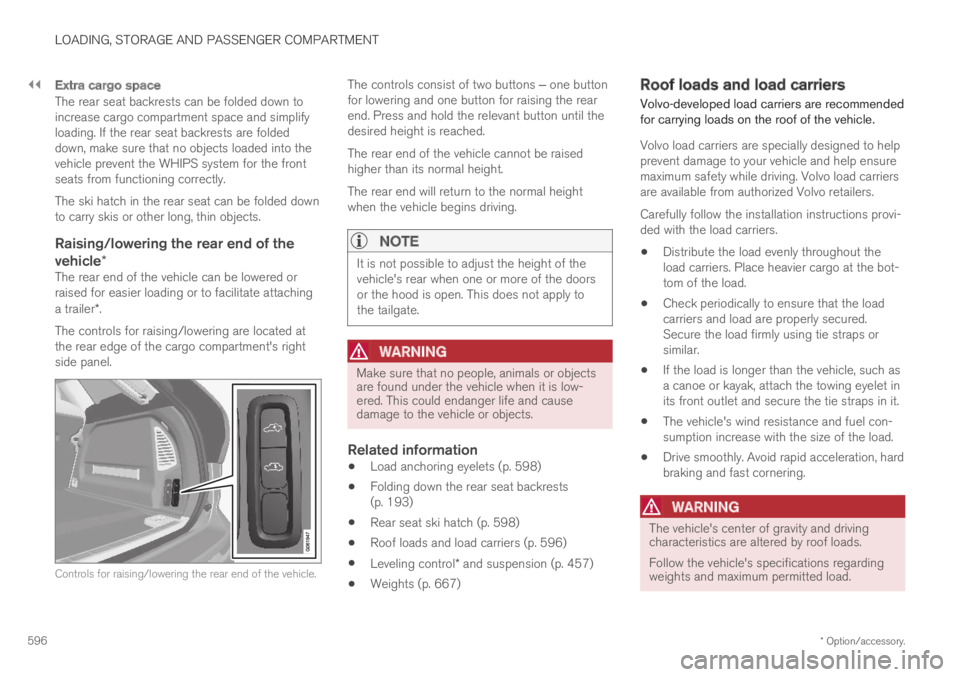
The controls for raising/lowering are located atthe rear edge of the cargo compartment's rightside panel.
Controls for raising/lowering the rear end of the vehicle.
The controls consist of two buttons ‒ one buttonfor lowering and one button for raising the rearend. Press and hold the relevant button until thedesired height is reached.
The rear end of the vehicle cannot be raisedhigher than its normal height.
The rear end will return to the normal heightwhen the vehicle begins driving.
NOTE
It is not possible to adjust the height of thevehicle's rear when one or more of the doorsor the hood is open. This does not apply tothe tailgate.
WARNING
Make sure that no people, animals or objectsare found under the vehicle when it is low-ered. This could endanger life and causedamage to the vehicle or objects.
Related information
Load anchoring eyelets (p. 598)
Folding down the rear seat backrests(p. 193)
Rear seat ski hatch (p. 598)
Roof loads and load carriers (p. 596)
Leveling control* and suspension (p. 457)
Weights (p. 667)
Roof loads and load carriers
Volvo-developed load carriers are recommendedfor carrying loads on the roof of the vehicle.
Volvo load carriers are specially designed to helpprevent damage to your vehicle and help ensuremaximum safety while driving. Volvo load carriersare available from authorized Volvo retailers.
Carefully follow the installation instructions provi-ded with the load carriers.
Distribute the load evenly throughout theload carriers. Place heavier cargo at the bot-tom of the load.
Check periodically to ensure that the loadcarriers and load are properly secured.Secure the load firmly using tie straps orsimilar.
If the load is longer than the vehicle, such asa canoe or kayak, attach the towing eyelet inits front outlet and secure the tie straps in it.
The vehicle's wind resistance and fuel con-sumption increase with the size of the load.
Drive smoothly. Avoid rapid acceleration, hardbraking and fast cornering.
WARNING
The vehicle's center of gravity and drivingcharacteristics are altered by roof loads.
Follow the vehicle's specifications regardingweights and maximum permitted load.
Page 600 of 695
LOADING, STORAGE AND PASSENGER COMPARTMENT
* Option/accessory.598
Load anchoring eyelets
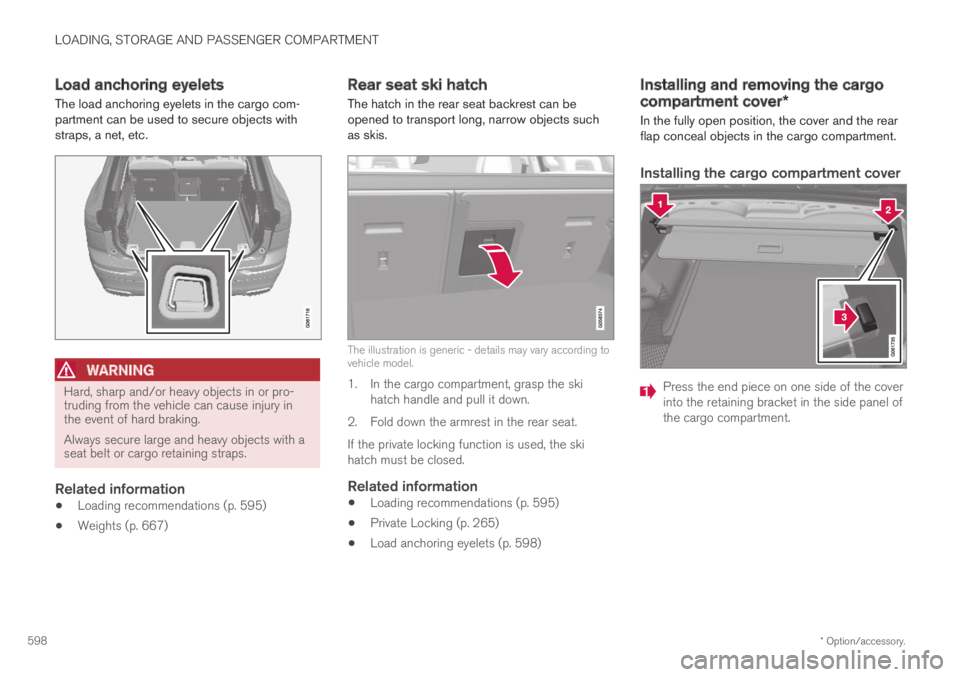
The load anchoring eyelets in the cargo com-partment can be used to secure objects withstraps, a net, etc.
WARNING
Hard, sharp and/or heavy objects in or pro-truding from the vehicle can cause injury inthe event of hard braking.
Always secure large and heavy objects with aseat belt or cargo retaining straps.
Related information
Loading recommendations (p. 595)
Weights (p. 667)
Rear seat ski hatch
The hatch in the rear seat backrest can beopened to transport long, narrow objects suchas skis.
The illustration is generic - details may vary according tovehicle model.
1. In the cargo compartment, grasp the skihatch handle and pull it down.
2.Fold down the armrest in the rear seat.
If the private locking function is used, the skihatch must be closed.
Related information
Loading recommendations (p. 595)
Private Locking (p. 265)
Load anchoring eyelets (p. 598)
Installing and removing the cargo
compartment cover*
In the fully open position, the cover and the rearflap conceal objects in the cargo compartment.
Installing the cargo compartment cover
Press the end piece on one side of the coverinto the retaining bracket in the side panel ofthe cargo compartment.
Page 601 of 695
LOADING, STORAGE AND PASSENGER COMPARTMENT
}}
599
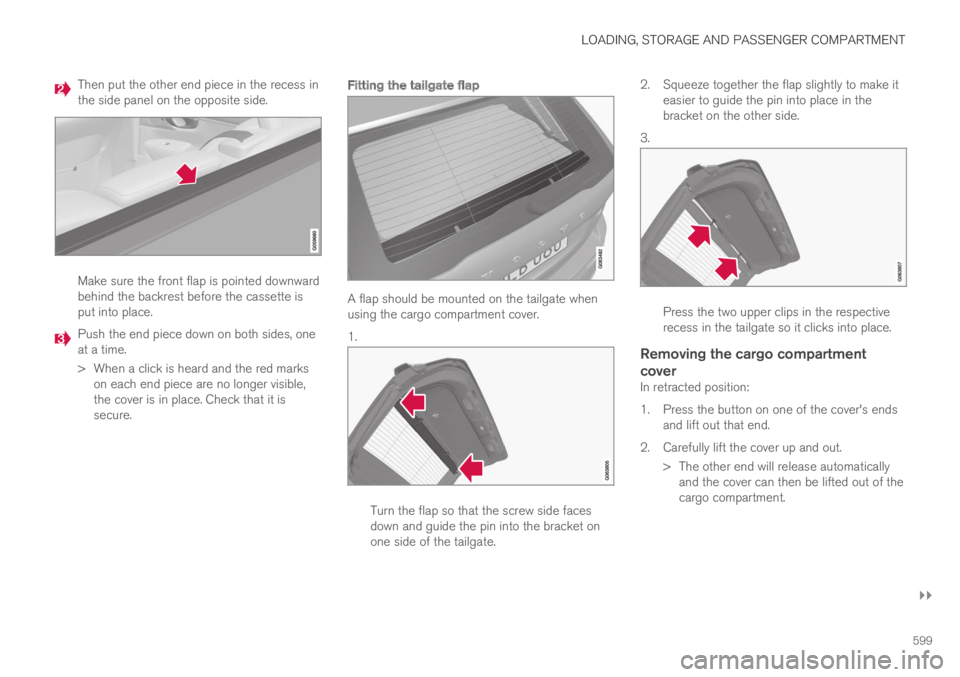
Then put the other end piece in the recess inthe side panel on the opposite side.
Make sure the front flap is pointed downwardbehind the backrest before the cassette isput into place.
Push the end piece down on both sides, oneat a time.
>When a click is heard and the red markson each end piece are no longer visible,the cover is in place. Check that it issecure.
Fitting the tailgate flap
A flap should be mounted on the tailgate whenusing the cargo compartment cover.
1.
Turn the flap so that the screw side facesdown and guide the pin into the bracket onone side of the tailgate.
2.Squeeze together the flap slightly to make iteasier to guide the pin into place in thebracket on the other side.
3.
Press the two upper clips in the respectiverecess in the tailgate so it clicks into place.
Removing the cargo compartment
cover
In retracted position:
1. Press the button on one of the cover's endsand lift out that end.
2. Carefully lift the cover up and out.
> The other end will release automaticallyand the cover can then be lifted out of thecargo compartment.
Page 603 of 695
LOADING, STORAGE AND PASSENGER COMPARTMENT
}}
601
Fully open
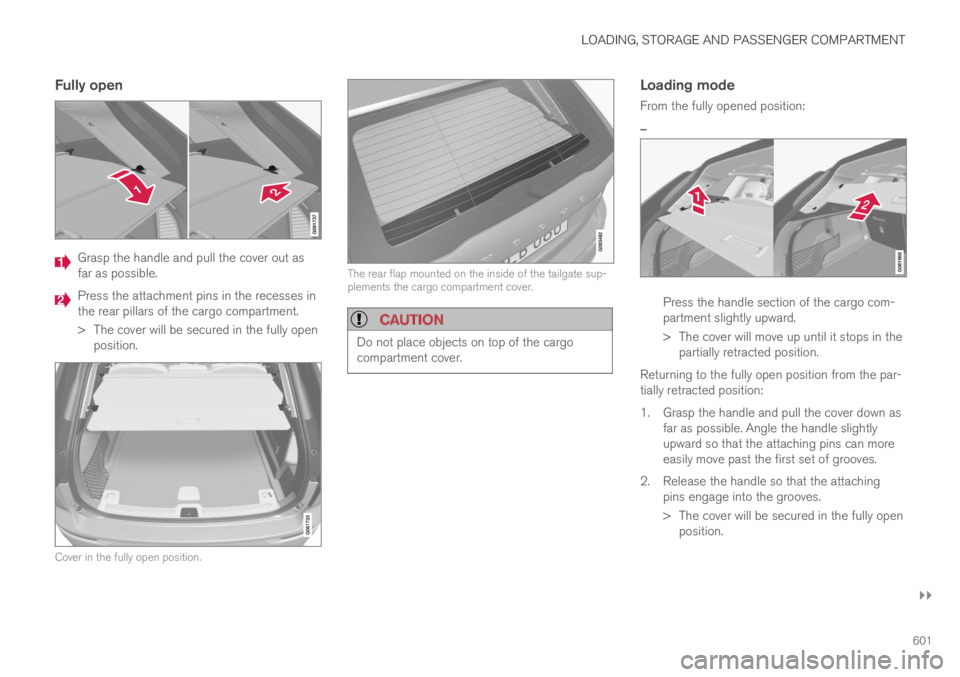
Grasp the handle and pull the cover out asfar as possible.
Press the attachment pins in the recesses inthe rear pillars of the cargo compartment.
>The cover will be secured in the fully openposition.
Cover in the fully open position.
The rear flap mounted on the inside of the tailgate sup-plements the cargo compartment cover.
CAUTION
Do not place objects on top of the cargocompartment cover.
Loading mode
From the fully opened position:
–
Press the handle section of the cargo com-partment slightly upward.
>The cover will move up until it stops in thepartially retracted position.
Returning to the fully open position from the par-tially retracted position:
1. Grasp the handle and pull the cover down asfar as possible. Angle the handle slightlyupward so that the attaching pins can moreeasily move past the first set of grooves.
2. Release the handle so that the attachingpins engage into the grooves.
> The cover will be secured in the fully openposition.
Page 604 of 695
||
LOADING, STORAGE AND PASSENGER COMPARTMENT
* Option/accessory.602
CAUTION
When in the loading position, the cargo com-partment cover can obstruct visibility to therear. Make sure that the cargo compartmentcover is fully extended or fully retracted duringdriving.
Retracting the cover
1. From the fully opened position:
Lift the cover's handle and pull it rearward torelease the cover's attaching pins from thegrooves. Let the cover retract.
From the partially retracted position:
Grasp the handle and pull the cover out ofthe groves to the fully open position. Lift thehandle and pull it rearward to release thecover's attaching pins from the grooves. Letthe cover retract.
2. Let the cover retract with its attaching pinsabove the side panels until it stops in thefully retracted position.
Related information
Installing and removing the cargo compart-ment cover* (p. 598)
Installing and removing the steel
cargo grid*
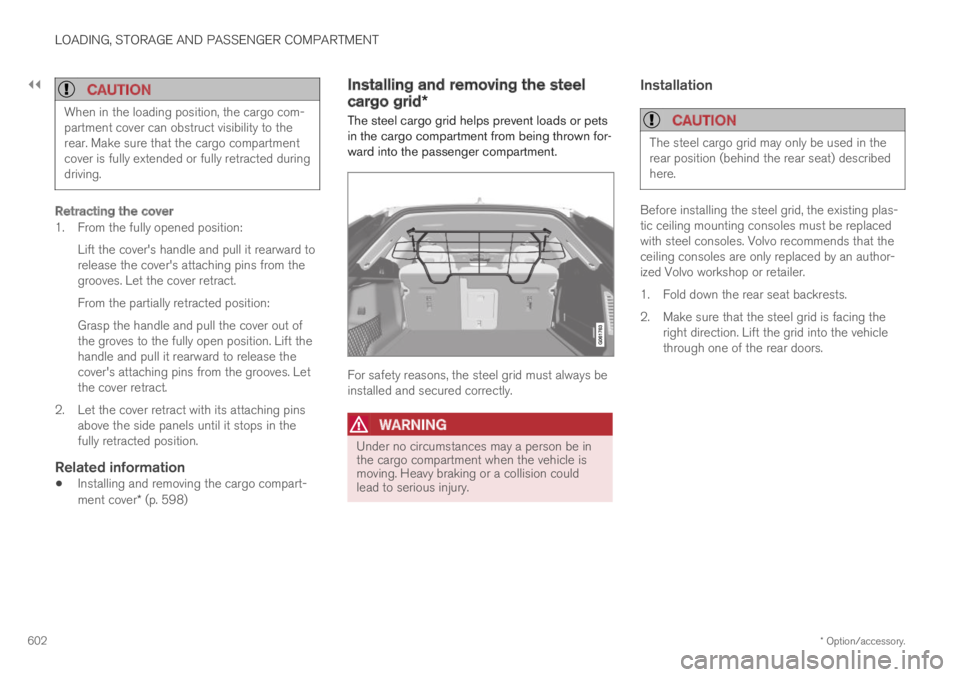
The steel cargo grid helps prevent loads or petsin the cargo compartment from being thrown for-ward into the passenger compartment.
For safety reasons, the steel grid must always beinstalled and secured correctly.
WARNING
Under no circumstances may a person be inthe cargo compartment when the vehicle ismoving. Heavy braking or a collision couldlead to serious injury.
Installation
CAUTION
The steel cargo grid may only be used in therear position (behind the rear seat) describedhere.
Before installing the steel grid, the existing plas-tic ceiling mounting consoles must be replacedwith steel consoles. Volvo recommends that theceiling consoles are only replaced by an author-ized Volvo workshop or retailer.
1.Fold down the rear seat backrests.
2. Make sure that the steel grid is facing theright direction. Lift the grid into the vehiclethrough one of the rear doors.
Page 605 of 695
LOADING, STORAGE AND PASSENGER COMPARTMENT
}}
* Option/accessory.603
3.
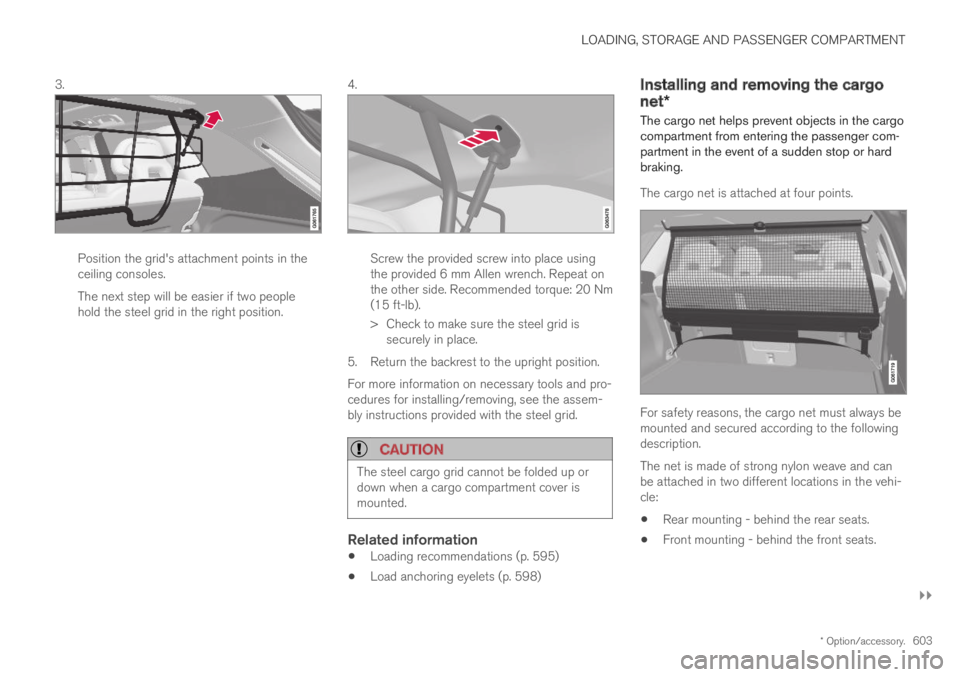
Position the grid's attachment points in theceiling consoles.
The next step will be easier if two peoplehold the steel grid in the right position.
4.
Screw the provided screw into place usingthe provided 6 mm Allen wrench. Repeat onthe other side. Recommended torque: 20 Nm(15 ft-lb).
>Check to make sure the steel grid issecurely in place.
5. Return the backrest to the upright position.
For more information on necessary tools and pro-cedures for installing/removing, see the assem-bly instructions provided with the steel grid.
CAUTION
The steel cargo grid cannot be folded up ordown when a cargo compartment cover ismounted.
Related information
Loading recommendations (p. 595)
Load anchoring eyelets (p. 598)
Installing and removing the cargo
net*
The cargo net helps prevent objects in the cargocompartment from entering the passenger com-partment in the event of a sudden stop or hardbraking.
The cargo net is attached at four points.
For safety reasons, the cargo net must always bemounted and secured according to the followingdescription.
The net is made of strong nylon weave and canbe attached in two different locations in the vehi-cle:
Rear mounting - behind the rear seats.
Front mounting - behind the front seats.
Page 606 of 695
||
LOADING, STORAGE AND PASSENGER COMPARTMENT
604
WARNING
Objects in the cargo compartment mustalways be securely anchored, even with a cor-rectly installed cargo net.
Installing the cargo net
WARNING
All of the cargo net's upper consoles, hooksand straps must be securely mounted andattached before the net is used.
Never use the net if it is damaged.
NOTE
With front mounting, the cargo net is mosteasily installed via a rear door.
1. Fold out the cargo net and make sure thatthe upper rod folds out and locks into posi-tion.
2.Insert one of the net's hooks into the front orrear ceiling mounting point with the straplock facing you.
3. Insert the net's other upper hook into theceiling mounting point on the opposite side.
The telescopic spring-loaded hooks makemounting easier.
Make sure that the net's hooks are pushedforward as far as possible into their respec-tive mounting points.
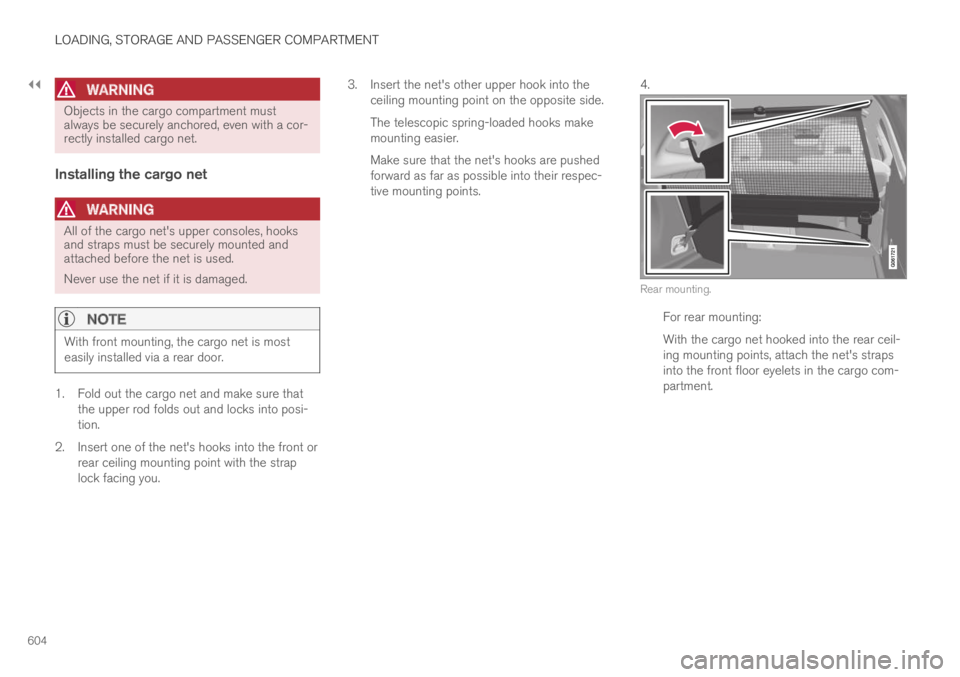
4.
Rear mounting.
For rear mounting:
With the cargo net hooked into the rear ceil-ing mounting points, attach the net's strapsinto the front floor eyelets in the cargo com-partment.
Page 612 of 695
||
MAINTENANCE AND SERVICE
610
Monthly:
Check cold tire pressure in all tires. Inspectthe tires for wear.
Check that engine coolant and other fluidlevels are between the indicated "min" and"max" markings.
Clean interior glass surfaces with a glasscleaner and soft paper towels.
Wipe driver information displays with a softcloth.
Visually inspect battery terminals for corro-sion. Corrosion may indicate a loose terminalconnector, or a battery near the end of itsuseful service life. Consult your Volvo retailerfor additional information.
As needed:
Wash the car, including the undercarriage, toreduce wear that can be caused by a buildup ofdirt, and corrosion that can be caused by salt res-idues.
Clean leaves and twigs from air intake vents atthe base of the windshield, and from other placeswhere they may collect.
NOTE
Complete service information for qualifiedtechnicians is available online for purchase orsubscription at www.volvotechinfo.com.
Related information
Vehicle status (p. 612)
Scheduling service and repairs (p. 613)
Connecting equipment to the vehicle's datalink connector (p. 37)
Technician certification (p. 38)
Climate control system service (p. 619)
Maintenance of the brake system (p. 438)
Engine compartment overview (p. 620)
Data transfer between vehicle andworkshop over Wi-Fi
Volvo workshops have a designated Wi-Fi net-work for secure data transfer between your vehi-cle and the workshop. Your visit to the workshopwill be easier and more effective when diagnos-tics information and software can be transferredover the workshop's network.
When you arrive at the workshop, your servicetechnician can connect your vehicle to the work-shop's Wi-Fi network to perform troubleshootingand download software. For this type of commu-nication, the vehicle only connects to a work-shop's network. It is not possible to connect thevehicle to another Wi-Fi network (e.g. your homenetwork) in the same way as to a workshop's net-work.
Connecting with remote key
Connection is usually managed by the servicetechnician, who will use the remote key buttons. Itis therefore important to bring a key with buttonswith you when you visit the workshop. Pressingthe lock button on the remote key three times willconnect the vehicle to the workshop's Wi-Fi net-work.
When the car is connected to a Wi-Fi network,
the symbol appears in the center display.