warning lights VOLVO XC90 TWIN ENGINE 2018 User Guide
[x] Cancel search | Manufacturer: VOLVO, Model Year: 2018, Model line: XC90 TWIN ENGINE, Model: VOLVO XC90 TWIN ENGINE 2018Pages: 686, PDF Size: 17 MB
Page 342 of 686

||DRIVER SUPPORT
340
and lower body in combination with normal
human movements.
If large portions of the cyclist's body or the bicy-
cle itself are not visible to the function's camera,
it will not be able to detect a cyclist.
The system can only detect adult cyclists riding
on bicycles intended for adults.
WARNING
City Safety is supplementary driver support,
but it cannot detect all cyclists in all situations
and, for example, cannot see:
• partially obscured cyclists.
• cyclists if the background contrast of the
cyclist is poor - warning and brake inter-
ventions may then be late or not occur at
all.
• cyclists in clothing that hides their body
contour.
• bikes loaded with large objects.
The driver is always responsible for ensuring
that the vehicle is driven correctly and with a
safety distance suitable for the speed.
Pedestrians Optimal examples of what the system considers to be a
pedestrian: clear body contours.
For optimal performance, the system's function
for pedestrian detection needs the clearest pos-
sible information about body and bicycle con-
tours. This entails being able to detect the con-
tours of the pedestrian's head, arm, shoulders,
legs, torso and lower body in combination with
normal human movements.
In order to detect a pedestrian, there must be a
contrast to the background, which could depend
on clothing, weather conditions, etc. If there is lit-
tle contrast, the person may be detected late or
not at all, which may result in a delayed reaction
from the system or no reaction at all.
City Safety can detect pedestrians even in dark
conditions if they are illuminated by the vehicle's
headlights.WARNING City Safety is supplementary driver support,
but it cannot detect all pedestrians in all sit-
uations and, for example, cannot see:
• partially obscured pedestrians, people in
clothing that hides their body contour or
pedestrians shorter than 80 cm (32 in.).
• pedestrians if the background contrast of
the pedestrians is poor - warning and
brake interventions may then be late or
not occur at all.
• pedestrians who are carrying large
objects.
The driver is always responsible for ensuring
that the vehicle is driven correctly and with a
safety distance suitable for the speed.
Page 343 of 686

DRIVER SUPPORT
}}
341
Large animals Optimal examples of what City Safety would interpret as
a large animal: stationary or moving slowly and with clear
body contours.
For optimal performance, the system's function
for detecting large animals (e.g. moose, horses,
etc.) needs the clearest possible information
about body contours. This entails being able to
detect the animal straight from the side in combi-
nation with normal movements for that animal.
If parts of the animal's body are not visible to the
function's camera, the system will not be able to
detect the animal.
City Safety can detect large animals even in dark
conditions if they are illuminated by the vehicle's
headlights.WARNING City Safety is supplementary driver support,
but it cannot detect all large animals in all sit-
uations and, for example, cannot see:
• partially obscured larger animals.
• larger animals seen from the front or from
behind.
• running or fast moving larger animals.
• larger animals if the contrast of the ani-
mal's background is poor - warning and
brake interventions may then occur late
or not at all.
• smaller animals such as cats and dogs.
The driver is always responsible for ensuring
that the vehicle is driven correctly and with a
safety distance suitable for the speed.
Related information
• City Safety™ (p. 335) City Safety in crossing traffic
City Safety
can assist the driver when turning in
the path of an oncoming vehicle in an intersec-
tion. : Sector in which City Safety can detect an oncoming
vehicle in crossing traffic.
In order for City Safety to detect an oncoming
vehicle in situations where there is a risk of a col-
lision, that vehicle must be within the sector in
which City Safety can analyze the situation.
The following criteria must also be met:
• your vehicle's speed must be at least 4 km/h
(3 mph)
• your vehicle must be making a left turn
• the oncoming vehicle's headlights must be
on
Page 344 of 686

||DRIVER SUPPORT
342
WARNING
•
The "City Safety in crossing traffic" func-
tion is supplementary driver support
intended to improve driving safety – it
cannot handle all situations in all traffic,
weather and road conditions.
• Warnings and brake interventions due to
a collision risk with an oncoming vehicle
often come very late.
• Never wait for a collision warning or for
City Safety to intervene.
• City Safety is not a substitute for the driv-
er's attention and judgment. The driver is
always responsible for ensuring the vehi-
cle is driven in a safe manner, at the
appropriate speed, with an appropriate
distance to other vehicles, and in accord-
ance with current traffic rules and regula-
tions.
Related information
•
City Safety™ (p. 335) Limitations of City Safety in
crossing traffic
In certain situations, it may be difficult for City
Safety to help the driver avoid a collision with
crossing traffic. For example:
• on slippery roads when Electronic Stability
Control (ESC) is actively operating
• if an approaching vehicle is detected at a late
stage
• if the oncoming vehicle is partially obstructed
by another vehicle or object
• if the oncoming vehicle's headlights are off
• if the oncoming vehicle is moving erratically
and e.g. suddenly changes lanes at a late
stage.
NOTE The function uses the vehicle's camera unit,
which has some general limitations – see the
section "Camera unit limitations".
NOTE
The function uses the vehicle's radar unit,
which has some general limitations – see the
section "Radar unit limitations".
Related information
•
City Safety™ (p. 335)
Page 346 of 686

DRIVER SUPPORT
344City Safety limitations
City Safety functionality may be reduced in cer-
tain situations.
Surroundings
Low objects
Hanging objects, such as flags for overhanging
loads or accessories such as auxiliary lights or
front protective grids that extend beyond the
height of the hood, may limit City Safety function-
ality.
Slippery road conditions
The extended braking distance on slippery roads
may reduce City Safety's capacity to help avoid a
collision. In these types of situations, the Anti-
lock Braking System and Electronic Stability Con-
trol (ESC 77
) will help provide optimal braking
power with maintained stability.
Backlighting
The visual warning signal in the windshield may
be difficult to detect in bright sunlight, if there are
reflections, or if the driver is wearing sunglasses
or not looking straight ahead.
Heat
If the temperature in the passenger compartment
is high due to e.g. bright sunlight, the visual warn-
ing signal in the windshield may be temporarily
disabled.
Camera and radar sensor's field of vision
The camera's field of vision is limited and in cer-
tain situations, it may be unable to detect pedes-
trians, large animals, cyclists or vehicles, or it may
detect them later than expected.
Vehicles that are dirty may be detected later than
clean vehicles, and in dark conditions, motorcy-
cles may be detected late or not at all.
If a text message displayed in the instrument
panel indicates that the camera/radar sensor is
obstructed, it may be difficult for City Safety to
detect pedestrians, large animals, cyclists, vehi-
cles or lane markings in front of the vehicle. City
Safety functionality may therefore be reduced.
Text messages may not be displayed for all situa-
tions in which the windshield sensors are
blocked. The driver must therefore always keep
the windshield in front of the camera/radar sen-
sor clean.
CAUTION Maintenance and replacement of City Safety
components may only be performed by a
workshop – an authorized Volvo workshop is
recommended.
Driver intervention
Backing up
City Safety is temporarily deactivated when the
vehicle is backing up.
Low speed
City Safety is not activated at very low speeds
under 4 km/h (3 mph). The system will therefore
not intervene in situations in which your vehicle is
approaching another vehicle very slowly, such as
when parking.
Active driver
Action by the driver always has priority. City
Safety will therefore not react or will react at a
later stage with a warning or intervention in situa-
tions in which the driver is clearly steering and
operating the accelerator pedal, even if a collision
is unavoidable.
An active and aware driving style may therefore
delay collision warnings and intervention in order
to minimize unnecessary warnings.
77
Electronic Stability Control
Page 347 of 686
DRIVER SUPPORT
345
Other limitations
WARNING•
Warnings and brake interventions can be
triggered late or not at all if the traffic sit-
uation or external influences prevent the
camera and radar unit from properly
detecting pedestrians, cyclists, large ani-
mals or vehicles ahead of the vehicle.
• To be able to detect vehicles at night, its
front and rear lights must work and illumi-
nate clearly.
• The camera and radar unit have a limited
range for pedestrians and cyclists – the
system can provide effective warnings
and brake interventions if the relative
speed is lower than 50 km/h (30 mph).
For stationary or slow-moving vehicles,
warnings and brake interventions are
effective at vehicle speeds of up to
70 km/h (43 mph). Speed reduction for
large animals is less than 15 km/h
(9 mph) and can be achieved at vehicle
speeds over 70 km/h (43 mph). At lower
speeds, the warning and brake interven-
tion for large animals is less effective.
• Warnings for stationary or slow-moving
vehicles and large animals can be disen-
gaged due to darkness or poor visibility. •
Warnings and brake interventions for
pedestrians and cyclists are disengaged
at vehicle speeds over 80 km/h
(50 mph).
• Do not place, affix or mount anything on
the inside or outside of the windshield, or
in front of or around the camera and
radar unit – this could disrupt camera-
based functions.
• Objects, snow, ice or dirt in the area of
the camera sensor can reduce the func-
tion, disengage it completely or give an
improper function response.
NOTE The function uses the vehicle's camera unit,
which has some general limitations – see the
section "Camera unit limitations".
NOTE
The function uses the vehicle's radar unit,
which has some general limitations – see the
section "Radar unit limitations".
Market limitationsCity Safety is not available in all countries. If City
Safety is not shown in the center display's
Settings menu, your vehicle is not equipped with
this function. In the center display's Top view, tap:
• Settings My Car IntelliSafe
Related information
•
City Safety™ (p. 335)
Page 351 of 686
DRIVER SUPPORT
}}
349
given, the indicator light will become brighter and
begin flashing.
NOTE
The light illuminates on the side of the vehicle
where the system has detected the vehicle. If
the vehicle is passed on both sides simulta-
neously, both lights come on.
WARNING
•
The BLIS function is supplementary driver
support intended to facilitate driving and
help make it safer – it cannot handle all
situations in all traffic, weather and road
conditions.
• The responsibility for changing lanes
safely and using good judgment always
rests with the driver.
• BLIS is not a substitute for the driver's
attention and judgment. The driver is
always responsible for ensuring the vehi-
cle is driven in a safe manner, at the
appropriate speed, with an appropriate
distance to other vehicles, and in accord-
ance with current traffic rules and regula-
tions.
Related information
•Activating/deactivating BLIS (p. 349)
• BLIS limitations (p. 350) •
Recommended maintenance for BLIS
(p. 351)
• BLIS messages (p. 352) Activating/deactivating BLIS
The BLIS
80
function can be activated/deacti-
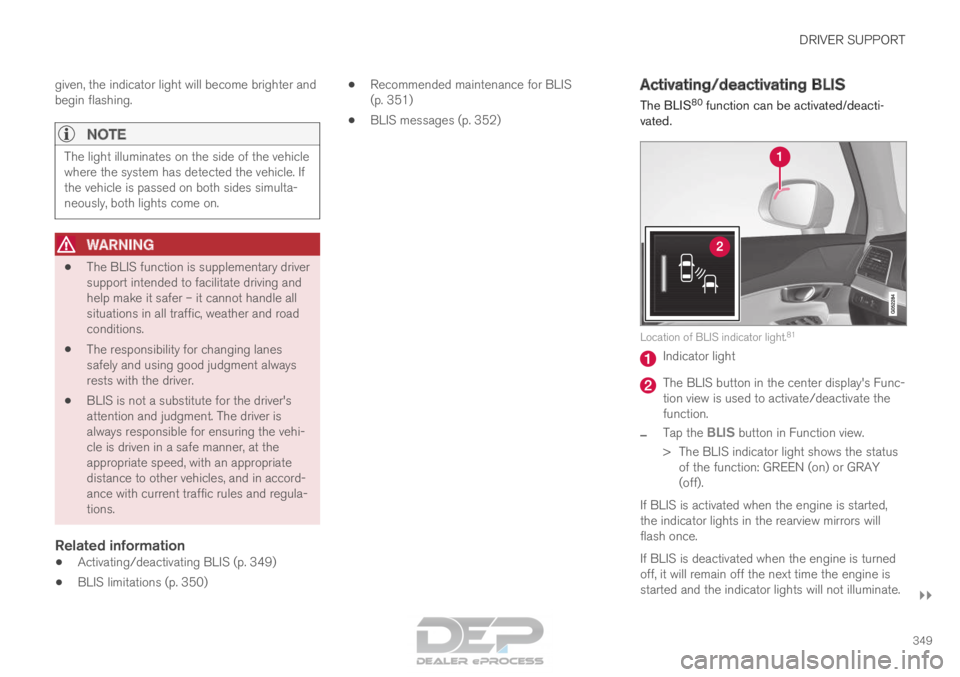
vated. Location of BLIS indicator light.
81 Indicator light
The BLIS button in the center display's Func-
tion view is used to activate/deactivate the
function.
– Tap the
BLIS button in Function view.
>
The BLIS indicator light shows the status
of the function: GREEN (on) or GRAY
(off).
If BLIS is activated when the engine is started,
the indicator lights in the rearview mirrors will
flash once.
If BLIS is deactivated when the engine is turned
off, it will remain off the next time the engine is
started and the indicator lights will not illuminate.
Page 385 of 686

DRIVER SUPPORT
}}
* Option/accessory. 383
CAUTIONWhen installing auxiliary lights: Make sure
these do not obscure the sensors – the auxili-
ary lights could be perceived as an obstacle.
Related information
•
Park Assist* (p. 381) Activating/deactivating Park Assist
The Park Assist Pilot function can be activated/
deactivated.
On/OffPark Assist's front and side sensors are automat-
ically activated when the engine is started. The
rear sensors are activated if the vehicle is moving
backward or reverse gear is engaged.
The function can be activated/
deactivated in the center dis-
play's Function view. –
Tap the
Park Assist button in Function view.
>
The Park Assist Pilot indicator light shows
the status of the function: GREEN (on) or
GRAY (off).
In vehicles equipped with Park Assist Camera,
Park Assist can also be activated/deactivated
from the relevant camera view.
Related information
• Park Assist* (p. 381) Park Assist limitations
Park Assist may not be able to detect all condi-
tions in all situations and functionality may there-
fore be limited in certain cases.
The driver should be aware of the following limi-
tations for Park Assist:
WARNING Be extra cautious when
reversing if this symbol is
shown when a trailer, bike
carrier or similar is attached
and electrically connected
to the vehicle.
The symbol indicates that
the rear parking assist sensors are deacti-
vated and will not warn of any obstacles.
Page 409 of 686
HYBRID INFORMATION
}}
407
Charging the hybrid battery
In addition to the conventional fuel tank, your
vehicle is also equipped with a rechargeable
lithium-ion hybrid battery.
The hybrid battery can be recharged using the
charging cable stored in a storage space in the
cargo compartment.
WARNING
The hybrid electrical system in your vehicle
uses high voltage electrical current. Any dam-
age to this system or to the hybrid battery
may result in the danger of overheating, fire,
or serious injury. If the vehicle is involved in a
collision or subjected to flooding, fire, etc.,
have it inspected by a trained and qualified
Volvo service technician. Prior to this inspec-
tion, the vehicle should be parked outdoors at
a safe distance from any building or poten-
tially flammable materials.
The hybrid battery's charging time depends on
the charging current used.
NOTE The capacity of the hybrid battery diminishes
somewhat with age and use, which could
result in increased use of the gasoline engine
and consequently, slightly higher fuel con-
sumption.
WARNING If the hybrid battery needs to be replaced, this
may only be done by Volvo retailer or author-
ized Volvo workshop.
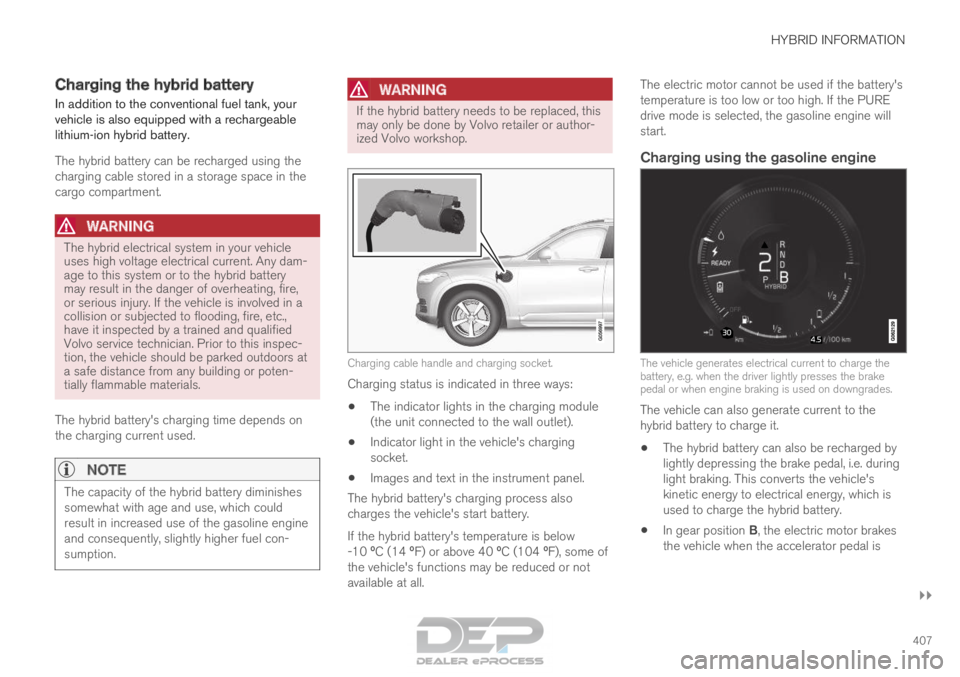
Charging cable handle and charging socket.
Charging status is indicated in three ways:
• The indicator lights in the charging module
(the unit connected to the wall outlet).
• Indicator light in the vehicle's charging
socket.
• Images and text in the instrument panel.
The hybrid battery's charging process also
charges the vehicle's start battery.
If the hybrid battery's temperature is below
-10 ºC (14 ºF) or above 40 ºC (104 ºF), some of
the vehicle's functions may be reduced or not
available at all. The electric motor cannot be used if the battery's
temperature is too low or too high. If the PURE
drive mode is selected, the gasoline engine will
start.
Charging using the gasoline engine
The vehicle generates electrical current to charge the
battery, e.g. when the driver lightly presses the brake
pedal or when engine braking is used on downgrades.
The vehicle can also generate current to the
hybrid battery to charge it.
• The hybrid battery can also be recharged by
lightly depressing the brake pedal, i.e. during
light braking. This converts the vehicle's
kinetic energy to electrical energy, which is
used to charge the hybrid battery.
• In gear position B, the electric motor brakes
the vehicle when the accelerator pedal is
Page 417 of 686
HYBRID INFORMATION
415
Charging status in the charging
cable's charging module
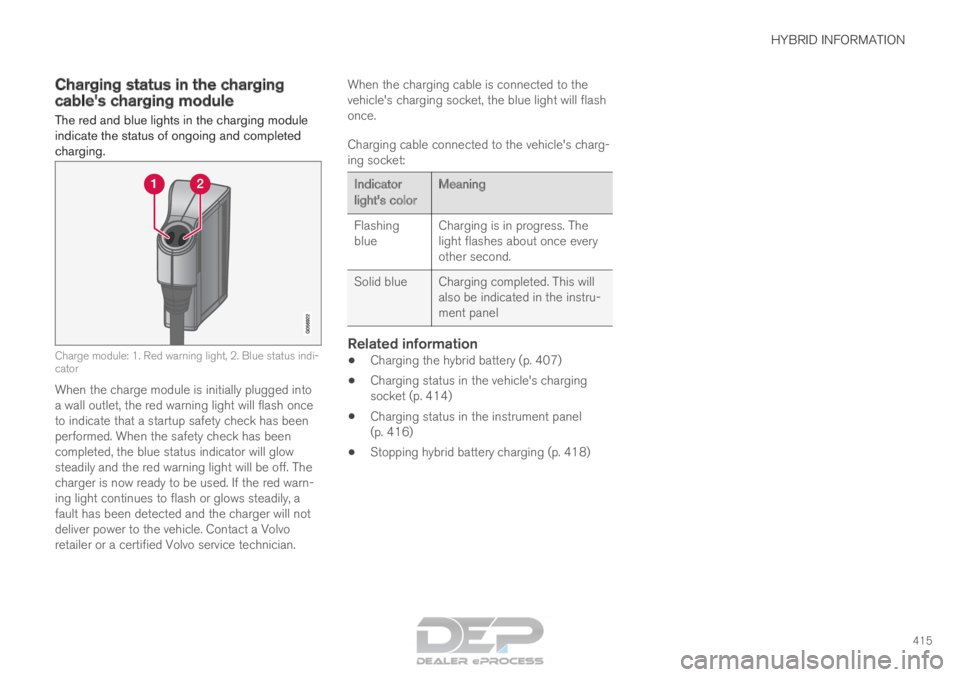
The red and blue lights in the charging module
indicate the status of ongoing and completed
charging. Charge module: 1. Red warning light, 2. Blue status indi-
cator
When the charge module is initially plugged into
a wall outlet, the red warning light will flash once
to indicate that a startup safety check has been
performed. When the safety check has been
completed, the blue status indicator will glow
steadily and the red warning light will be off. The
charger is now ready to be used. If the red warn-
ing light continues to flash or glows steadily, a
fault has been detected and the charger will not
deliver power to the vehicle. Contact a Volvo
retailer or a certified Volvo service technician. When the charging cable is connected to the
vehicle's charging socket, the blue light will flash
once.
Charging cable connected to the vehicle's charg-
ing socket: Indicator
light's color
Meaning
Flashing
blue Charging is in progress. The
light flashes about once every
other second.
Solid blue
Charging completed. This will
also be indicated in the instru-
ment panel
Related information
• Charging the hybrid battery (p. 407)
• Charging status in the vehicle's charging
socket (p. 414)
• Charging status in the instrument panel
(p. 416)
• Stopping hybrid battery charging (p. 418)
Page 430 of 686
||STARTING AND DRIVING
428
Mode
Functions
II •The headlights illuminate.
• Warning/indicator lights illumi-
nate for 5 seconds.
• A number of other systems are
activated. However, seat and rear
window heating can only be acti-
vated when the engine is running.
This ignition mode uses a lot of
current from the battery and
should be avoided whenever pos-
sible! A
Also activated when the door is opened.
Related information
• Starting the vehicle (p. 424)
• Adjusting the steering wheel (p. 199)
• Jump starting using another battery (p. 469)
• Selecting ignition mode (p. 428) Selecting ignition mode
The vehicle's ignition can be put in various
modes (levels) to make different functions availa-
ble.
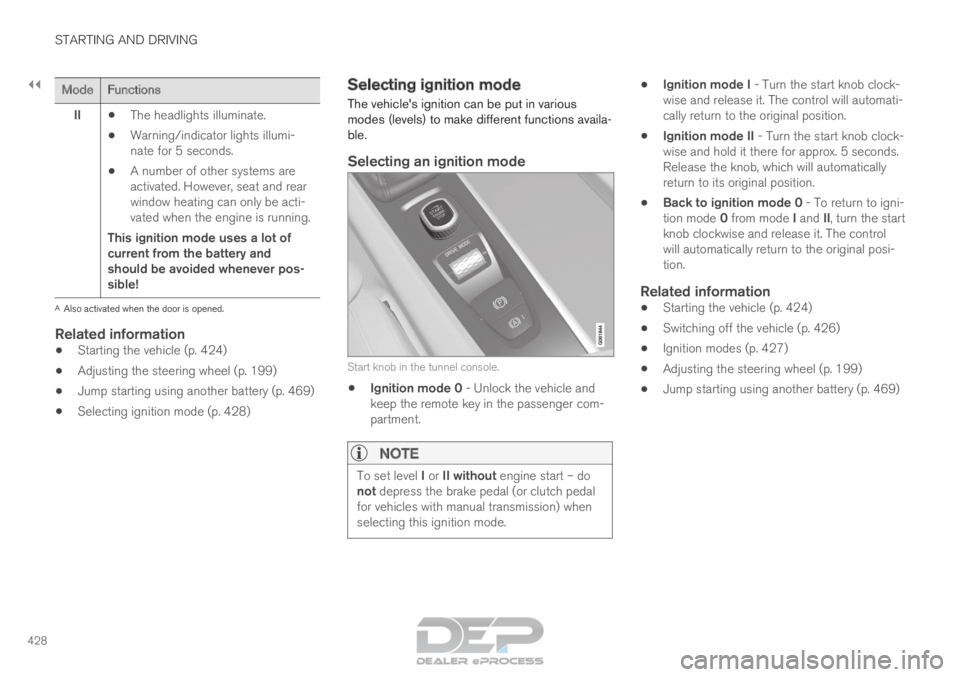
Selecting an ignition mode Start knob in the tunnel console.
•
Ignition mode 0 - Unlock the vehicle and
keep the remote key in the passenger com-
partment.
NOTE To set level I or II without engine start – do
not depress the brake pedal (or clutch pedal
for vehicles with manual transmission) when
selecting this ignition mode. •
Ignition mode I - Turn the start knob clock-
wise and release it. The control will automati-
cally return to the original position.
• Ignition mode II - Turn the start knob clock-
wise and hold it there for approx. 5 seconds.
Release the knob, which will automatically
return to its original position.
• Back to ignition mode 0 - To return to igni-
tion mode 0 from mode I and II, turn the start
knob clockwise and release it. The control
will automatically return to the original posi-
tion.
Related information
• Starting the vehicle (p. 424)
• Switching off the vehicle (p. 426)
• Ignition modes (p. 427)
• Adjusting the steering wheel (p. 199)
• Jump starting using another battery (p. 469)