service VOLVO XC90 TWIN ENGINE 2019 Repair Manual
[x] Cancel search | Manufacturer: VOLVO, Model Year: 2019, Model line: XC90 TWIN ENGINE, Model: VOLVO XC90 TWIN ENGINE 2019Pages: 697, PDF Size: 10.33 MB
Page 442 of 697
||STARTING AND DRIVING
440
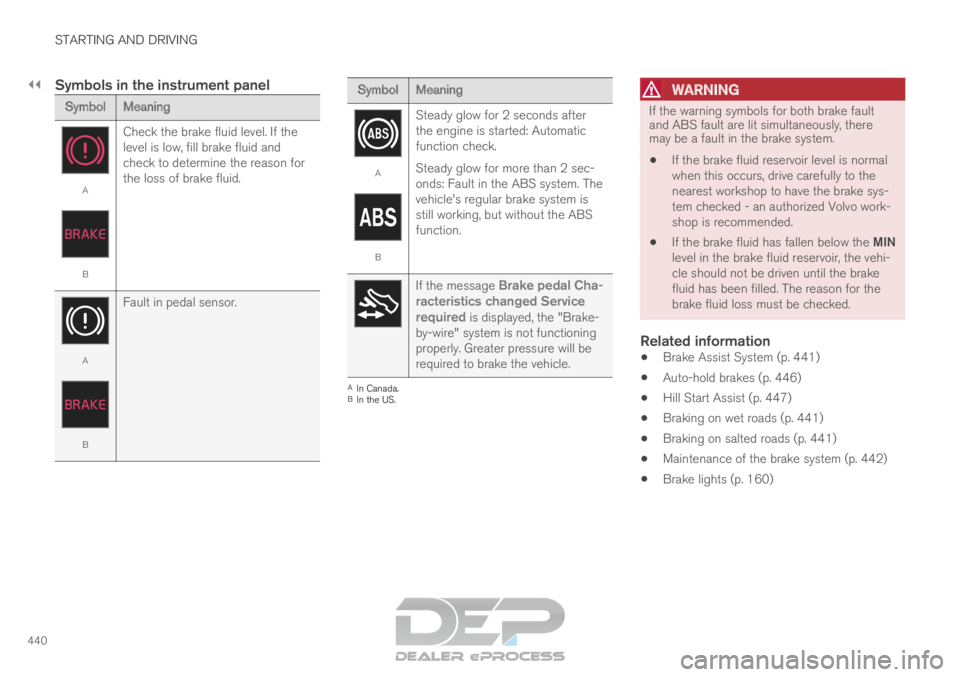
Symbols in the instrument panel
Symbol
Meaning A
B
Check the brake fluid level. If the
level is low, fill brake fluid and
check to determine the reason for
the loss of brake fluid. A
B
Fault in pedal sensor. Symbol
Meaning A
B
Steady glow for 2 seconds after
the engine is started: Automatic
function check.
Steady glow for more than 2 sec-
onds: Fault in the ABS system. The
vehicle's regular brake system is
still working, but without the ABS
function. If the message Brake pedal Cha-
racteristics changed Service
required is displayed, the "Brake-
by-wire" system is not functioning
properly. Greater pressure will be
required to brake the vehicle. A
In Canada.
B In the US.WARNING If the warning symbols for both brake fault
and ABS fault are lit simultaneously, there
may be a fault in the brake system.
If the brake fluid reservoir level is normal
when this occurs, drive carefully to the
nearest workshop to have the brake sys-
tem checked - an authorized Volvo work-
shop is recommended.
If the brake fluid has fallen below the MIN
level in the brake fluid reservoir, the vehi-
cle should not be driven until the brake
fluid has been filled. The reason for the
brake fluid loss must be checked.
Related information
Brake Assist System (p. 441)
Auto-hold brakes (p. 446)
Hill Start Assist (p. 447)
Braking on wet roads (p. 441)
Braking on salted roads (p. 441)
Maintenance of the brake system (p. 442)
Brake lights (p. 160)
Page 444 of 697
STARTING AND DRIVING
442Maintenance of the brake system
Regularly check the brake system components
for wear.
To keep the vehicle as safe and reliable as possi-
ble, follow the Volvo service schedule specified in
the Warranty and Maintenance Records Informa-
tion booklet. New and replaced brake pads and
brake discs do not provide optimal braking effect
until they are "broken in" by driving a few hun-
dred kilometers (miles). Compensate for the
reduced braking effect by applying greater pres-
sure to the brake pedal. Volvo recommends only
using brake pads approved for your Volvo.
CAUTION The brake system's components should be
regularly checked for wear.
Contact a workshop for advice on how to do
this or let a workshop perform the inspection
- an authorized Volvo workshop is recom-
mended.
Related information
Brakes (p. 439) Parking brake
The parking brake helps keep the vehicle sta-
tionary by mechanically locking two wheels.
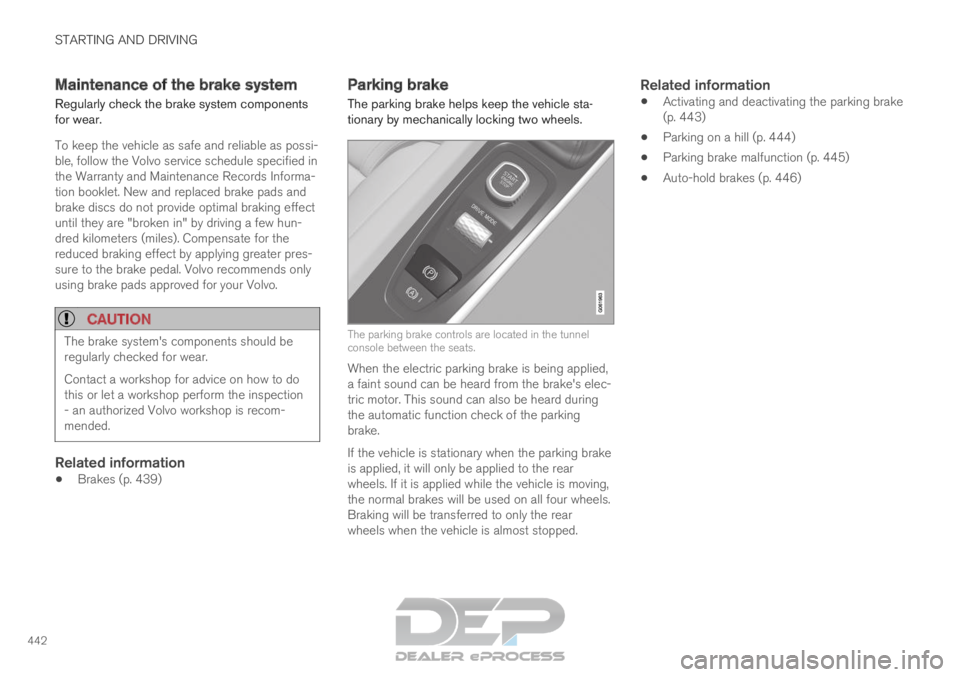
The parking brake controls are located in the tunnel
console between the seats.
When the electric parking brake is being applied,
a faint sound can be heard from the brake's elec-
tric motor. This sound can also be heard during
the automatic function check of the parking
brake.
If the vehicle is stationary when the parking brake
is applied, it will only be applied to the rear
wheels. If it is applied while the vehicle is moving,
the normal brakes will be used on all four wheels.
Braking will be transferred to only the rear
wheels when the vehicle is almost stopped.
Related information
Activating and deactivating the parking brake
(p. 443)
Parking on a hill (p. 444)
Parking brake malfunction (p. 445)
Auto-hold brakes (p. 446)
Page 447 of 697
STARTING AND DRIVING
445
Parking brake malfunction
If you are unable to deactivate or activate the
parking brake after several attempts, contact an
authorized Volvo workshop.
A audible warning signal will sound if the parking
brake is applied while the vehicle is being driven.
If the vehicle must be parked before the problem
is rectified, turn the wheels as when parking on
an incline and put the gear selector in P.
Low battery charge levelIf the battery charge level is too low, it will not be
possible to apply or release the parking brake.
Connect an auxiliary battery to the vehicle if the
battery is discharged.
Replacing brake padsDue to the design of the electric parking brake,
the rear brake pads must be replaced by a work-
shop. An authorized Volvo workshop is recom-
mended.
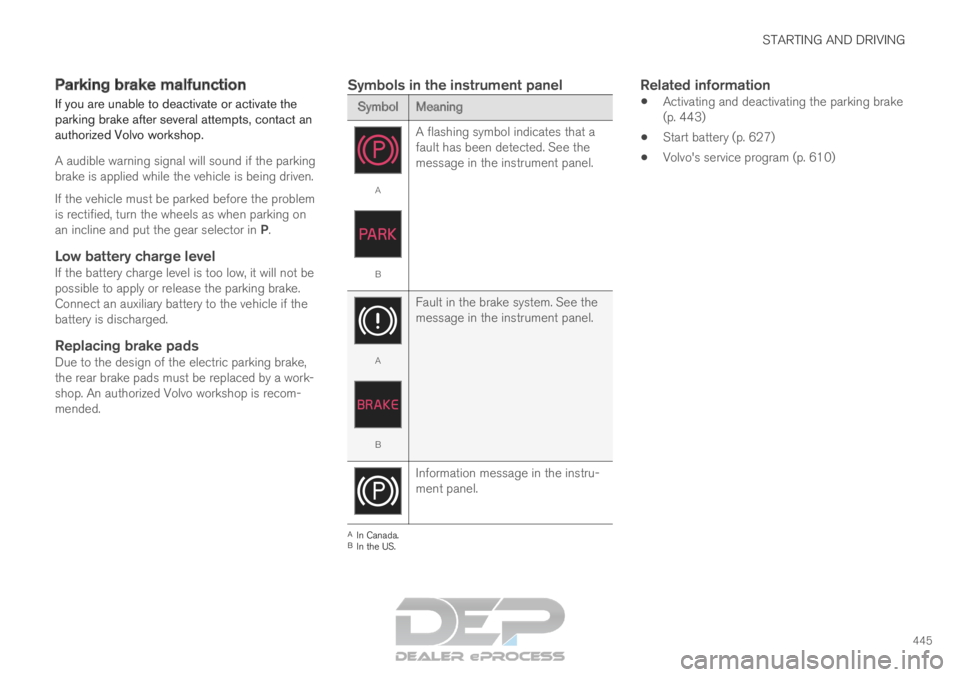
Symbols in the instrument panel Symbol
Meaning A
B
A flashing symbol indicates that a
fault has been detected. See the
message in the instrument panel. A
B
Fault in the brake system. See the
message in the instrument panel. Information message in the instru-
ment panel.
A
In Canada.
B In the US.Related information
Activating and deactivating the parking brake
(p. 443)
Start battery (p. 627)
Volvo's service program (p. 610)
Page 464 of 697
||STARTING AND DRIVING
462
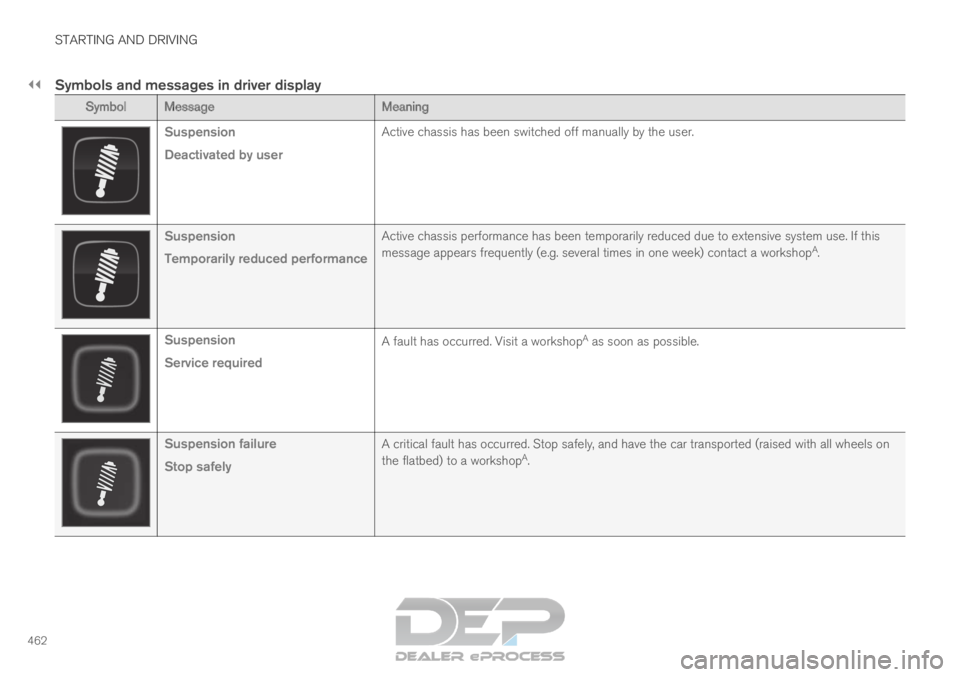
Symbols and messages in driver display
Symbol
Message MeaningSuspension
Deactivated by user
Active chassis has been switched off manually by the user.Suspension
Temporarily reduced performance
Active chassis performance has been temporarily reduced due to extensive\
system use. If this
message appears frequently (e.g. several times in one week) contact a \
workshop
A
. Suspension
Service required
A fault has occurred. Visit a workshop
A
as soon as possible. Suspension failure
Stop safely
A critical fault has occurred. Stop safely, and have the car transported\
(raised with all wheels on
the flatbed) to a workshop
A
.
Page 477 of 697

STARTING AND DRIVING
}}
475
Refueling
The fuel tank is equipped with a fuel filling sys-
tem without a cover.
Refueling the vehicle at a service
station Refueling is done as follows.
1.
Turn off the engine and open the fuel filler
door.
NOTE Refueling must be done within approximately
seven minutes of opening the fuel filler door.
After this time, the valve opened by pushing
the button for opening the fuel filler door will
close and it will no longer be possible to
refuel without the pump's nozzle switching off.
If the valve is closed before refueling is com-
plete - press the button again and wait until
the driver display shows the message
Fuel
tank Ready for refueling. 2. Select a fuel approved for use in the vehicle.
For more information on approved fuels, see
the section on “Fuel”.
3.
Insert the pump's nozzle into the fuel filler
pipe's opening. There are two flaps just
inside the fuel filler pipe and the pump's noz-
zle must push both of these flaps open
before fuel can be added. 4. Avoid overfilling the tank. Do not press the
handle on the filler nozzle again after it has
initially stopped pumping.
> The fuel tank is now filled.
NOTE An over-full tank may overflow in hot weather.
CAUTION
Avoid spilling gasoline during refueling. In
addition to causing damage to the environ-
ment, gasolines containing alcohol can cause
damage to painted surfaces, which may not
be covered under the New Vehicle Limited
Warranty.
Refueling from a fuel containerWhen filling from a fuel container, use the funnel
provided in a foam block under the floor hatch in
the cargo compartment.
1. Open the fuel filler door.
2. Insert the funnel into the fuel filler pipe's
opening. There are two flaps just inside the
fuel filler pipe and the tube section of the
funnel must push both of these flaps open
before fuel can be added.
Page 478 of 697
||STARTING AND DRIVING
476
WARNING
California Proposition 65
Operating, servicing and maintaining a pas-
senger vehicle can expose you to chemicals
including engine exhaust, carbon monoxide,
phthalates, and lead, which are known to the
State of California to cause cancer and birth
defects or other reproductive harm. To mini-
mize exposure, avoid breathing exhaust, do
not idle the engine except as necessary, serv-
ice your vehicle in a well ventilated area and
wear gloves or wash your hands frequently
when servicing your vehicle. For more infor-
mation go to www.P65Warnings.ca.gov/
passenger-vehicle.
Related information
Opening/closing the fuel filler door (p. 474)
Fuel (p. 476) Fuel
Volvo recommends the use of detergent gaso-
line to control engine deposits.
Deposit control gasoline (gasoline with
detergent additives)
Detergent gasoline is effective in keeping injec-
tors and intake valves clean. Consistent use of
deposit control gasolines will help ensure good
driveability and fuel economy. If you are not sure
whether the gasoline contains deposit control
additives, check with the service station operator.
NOTE Volvo recommends not using external fuel
injector cleaning systems, e.g. do not add
detergent additives to gasoline before or after
refueling.
Unleaded fuelAll Volvo vehicles have a three-way catalytic con-
verter and must only use unleaded gasoline. US
and Canadian regulations require that pumps
delivering unleaded gasoline are labeled
"UNLEADED". Only the nozzles of these pumps
will fit in your vehicle's fuel filler inlet. It is unlaw-
ful to dispense leaded fuel into a vehicle labeled
"unleaded gasoline only". Leaded gasoline dam-
ages the three-way catalytic converter and the
heated oxygen sensor system. Repeated use of
leaded gasoline will lessen the effectiveness ofthe emission control system and could result in
loss of emission warranty coverage. State and
local vehicle inspection programs will make
detection of misfueling easier, possibly resulting
in emission test failure for misfueled vehicles.
NOTE
Some U.S. and Canadian gasolines contain an
octane enhancing additive called methyl-
cyclopentadienyl manganese tricarbonyl
(MMT). If such fuels are used, your Emission
Control System performance may be affected,
and the Check Engine Light (malfunction
indicator light) located on your instrument
panel may light. If this occurs, please return
your vehicle to a trained and qualified Volvo
service technician for service.
Gasoline containing alcohol and ethers,
"Oxygenated fuels"
Some fuel suppliers sell gasoline containing
"oxygenates" which are usually alcohols or
ethers. In some areas, state or local laws require
that the service pump be marked indicating use
of alcohols or ethers. However, there are areas in
which the pumps are unmarked. If you are not
sure whether there is alcohol or ethers in the
gasoline you buy, check with the service station
operator. To meet seasonal air quality standards,
some areas require the use of "oxygenated" fuel.
Page 479 of 697
STARTING AND DRIVING
}}
477
Volvo permits the use of the following "oxygen-
ated" fuels. However, the specified octane ratings
must still be met.
Alcohol - Ethanol
Fuels containing up to 10% ethanol by volume
may be used. Ethanol may also be referred to as
Ethyl alcohol, or "Gasohol".
Ethers - MTBE/ETBE: Fuels containing up to
22% MTBE/ETBE by volume may be used.
MethanolDo not use gasolines containing methanol
(methyl alcohol, wood alcohol). This practice can
result in vehicle performance deterioration and
can damage critical parts in the fuel system. Such
damage may not be covered under the New
Vehicle Limited Warranty.
Related information
Octane rating (p. 477)
Opening/closing the fuel filler door (p. 474)
Refueling (p. 475)
Emission controls (p. 479) Octane rating
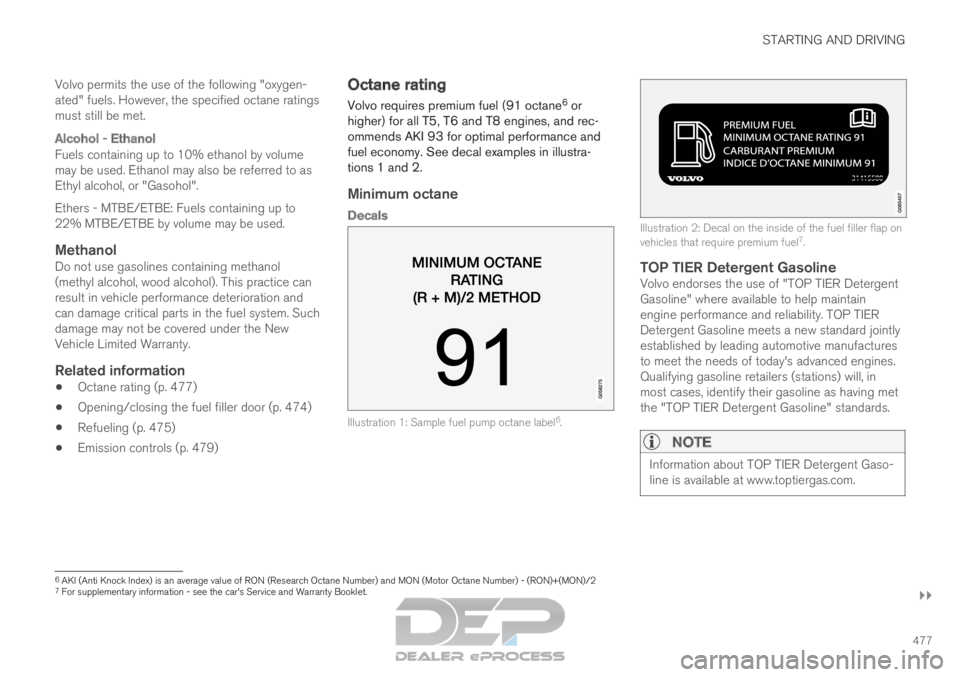
Volvo requires premium fuel (91 octane
6
or
higher) for all T5, T6 and T8 engines, and rec-
ommends AKI 93 for optimal performance and
fuel economy. See decal examples in illustra-
tions 1 and 2.
Minimum octane
Decals Illustration 1: Sample fuel pump octane label
6
. Illustration 2: Decal on the inside of the fuel filler flap on
vehicles that require premium fuel
7
.
TOP TIER Detergent GasolineVolvo endorses the use of "TOP TIER Detergent
Gasoline" where available to help maintain
engine performance and reliability. TOP TIER
Detergent Gasoline meets a new standard jointly
established by leading automotive manufactures
to meet the needs of today's advanced engines.
Qualifying gasoline retailers (stations) will, in
most cases, identify their gasoline as having met
the "TOP TIER Detergent Gasoline" standards.
NOTE Information about TOP TIER Detergent Gaso-
line is available at www.toptiergas.com.
6
AKI (Anti Knock Index) is an average value of RON (Research Octane Nu\
mber) and MON (Motor Octane Number) - (RON)+(MON)/2
7 For supplementary information - see the car's Service and Warranty Bo\
oklet.
Page 480 of 697
||STARTING AND DRIVING
478
NOTE
When switching to higher octane fuel or
changing gasoline brands, it may be neces-
sary to fill the tank more than once before a
difference in engine operation is noticeable.
Fuel FormulationsDo not use gasoline that contains lead or manga-
nese as a knock inhibitor, and do not use lead
additives. Besides damaging the exhaust emis-
sion control systems on your vehicle, lead has
been strongly linked to certain forms of cancer.
Many fuels contain benzene as a solvent.
Unburned benzene has been strongly linked to
certain forms of cancer. If you live in an area
where you must fill your own gas tank, take pre-
cautions. These may include:
standing upwind away from the filler nozzle
while refueling
refueling only at gas stations with vapor
recovery systems that fully seal the mouth of
the filler neck during refueling
wearing neoprene gloves while handling a
fuel filler nozzle.
Use of AdditivesWith the exception of gas line antifreeze during
winter months, do not add solvents, thickeners, or other store-bought additives to your vehicle's
fuel, cooling, or lubricating systems. Overuse may
damage your engine, and some of these additives
contain organically volatile chemicals. Do not
needlessly expose yourself to these chemicals.
WARNING Never carry a cell phone that is switched on
while refueling your vehicle. If the phone rings,
this may cause a spark that could ignite gaso-
line fumes, resulting in fire and injury.
WARNING
Carbon monoxide is a poisonous, colorless,
and odorless gas. It is present in all exhaust
gases. If you ever smell exhaust fumes inside
the vehicle, make sure the passenger com-
partment is ventilated, and immediately return
the vehicle to a trained and qualified Volvo
service technician for correction.
Demanding drivingIn demanding driving conditions, such as when
towing a trailer or driving in hot weather or for
prolonged periods at high altitudes, it may be a
good idea to switch to a higher-octane fuel (AKI
6
91 or higher) or to switch to another brand of
gasoline in order to fully utilize the vehicle's
engine capacity and optimize traction.
Related information
Fuel (p. 476)
Emission controls (p. 479) 6
AKI (Anti Knock Index) is an average value of RON (Research Octane Nu\
mber) and MON (Motor Octane Number) - (RON)+(MON)/2
Page 483 of 697
STARTING AND DRIVING
}}
481
Jump starting using another battery
If the start battery is discharged, current from
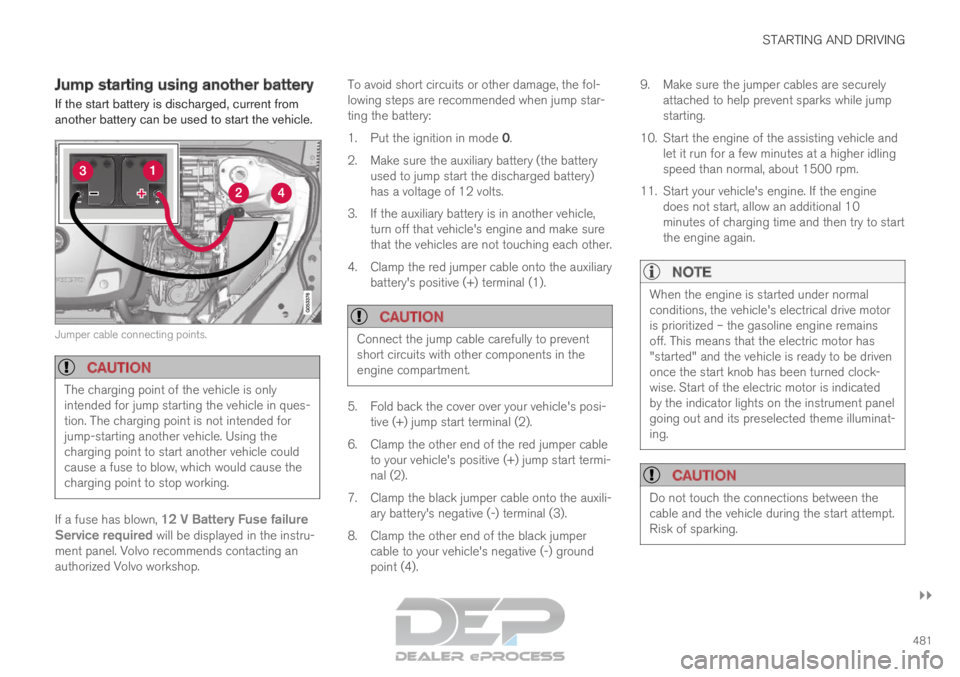
another battery can be used to start the vehicle. Jumper cable connecting points.
CAUTION
The charging point of the vehicle is only
intended for jump starting the vehicle in ques-
tion. The charging point is not intended for
jump-starting another vehicle. Using the
charging point to start another vehicle could
cause a fuse to blow, which would cause the
charging point to stop working.
If a fuse has blown, 12 V Battery Fuse failure
Service required will be displayed in the instru-
ment panel. Volvo recommends contacting an
authorized Volvo workshop. To avoid short circuits or other damage, the fol-
lowing steps are recommended when jump star-
ting the battery:
1.
Put the ignition in mode 0.
2.
Make sure the auxiliary battery (the battery
used to jump start the discharged battery)
has a voltage of 12 volts.
3. If the auxiliary battery is in another vehicle, turn off that vehicle's engine and make sure
that the vehicles are not touching each other.
4. Clamp the red jumper cable onto the auxiliary battery's positive (+) terminal (1).
CAUTION Connect the jump cable carefully to prevent
short circuits with other components in the
engine compartment.
5. Fold back the cover over your vehicle's posi-
tive (+) jump start terminal (2).
6.
Clamp the other end of the red jumper cable
to your vehicle's positive (+) jump start termi-
nal (2).
7. Clamp the black jumper cable onto the auxili- ary battery's negative (-) terminal (3).
8. Clamp the other end of the black jumper cable to your vehicle's negative (-) ground
point (4). 9. Make sure the jumper cables are securely
attached to help prevent sparks while jump
starting.
10. Start the engine of the assisting vehicle and let it run for a few minutes at a higher idling
speed than normal, about 1500 rpm.
11. Start your vehicle's engine. If the engine does not start, allow an additional 10
minutes of charging time and then try to start
the engine again.
NOTE When the engine is started under normal
conditions, the vehicle's electrical drive motor
is prioritized – the gasoline engine remains
off. This means that the electric motor has
"started" and the vehicle is ready to be driven
once the start knob has been turned clock-
wise. Start of the electric motor is indicated
by the indicator lights on the instrument panel
going out and its preselected theme illuminat-
ing.
CAUTION
Do not touch the connections between the
cable and the vehicle during the start attempt.
Risk of sparking.
Page 491 of 697
STARTING AND DRIVING
}}
* Option/accessory. 489
Recovery
This section refers to transporting the vehicle
with a tow truck or similar vehicle.
Call a professional towing service for assistance.
In certain conditions, the towing eyelet can be
used to pull the vehicle onto a flatbed tow truck.
CAUTION Note that vehicles with Twin Engine must
always be towed raised with all wheels on the
tow truck.
For vehicles equipped with leveling control*:
If the vehicle is equipped with pneumatic suspen-
sion, this feature must be turned off before the
vehicle is lifted onto a tow truck. Turning off the
function in the center display.
1. Tap Settings in the Top view.
2.
Tap My Car Parking Brake and
Suspension .
3. Select Disable Leveling Control.
The vehicle's location and ground clearance
determine if it can be lifted onto a tow truck. If
the incline of the tow truck is too steep or if the
ground clearance under the vehicle is insufficient,
attempting to pull it up may result in damage. In
this case, the vehicle should only be lifted with
the tow truck's lifting equipment.
WARNING No person or object should be behind the tow
truck when the vehicle is lifted onto the bed
of the truck.
Related information
Attaching and removing the towing eyelet
(p. 488) HomeLink
®
*10
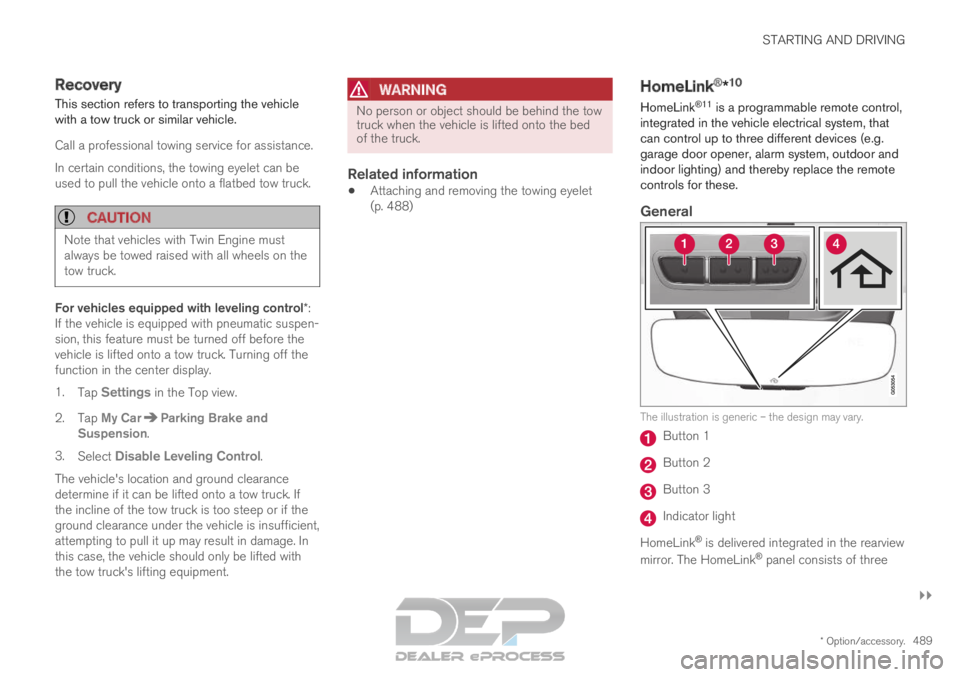
HomeLink ®11
is a programmable remote control,
integrated in the vehicle electrical system, that
can control up to three different devices (e.g.
garage door opener, alarm system, outdoor and
indoor lighting) and thereby replace the remote
controls for these.
General The illustration is generic – the design may vary.
Button 1
Button 2
Button 3
Indicator light
HomeLink ®
is delivered integrated in the rearview
mirror. The HomeLink ®
panel consists of three