tires YAMAHA EC-03 2011 Owners Manual
[x] Cancel search | Manufacturer: YAMAHA, Model Year: 2011, Model line: EC-03, Model: YAMAHA EC-03 2011Pages: 78, PDF Size: 2.04 MB
Page 6 of 78
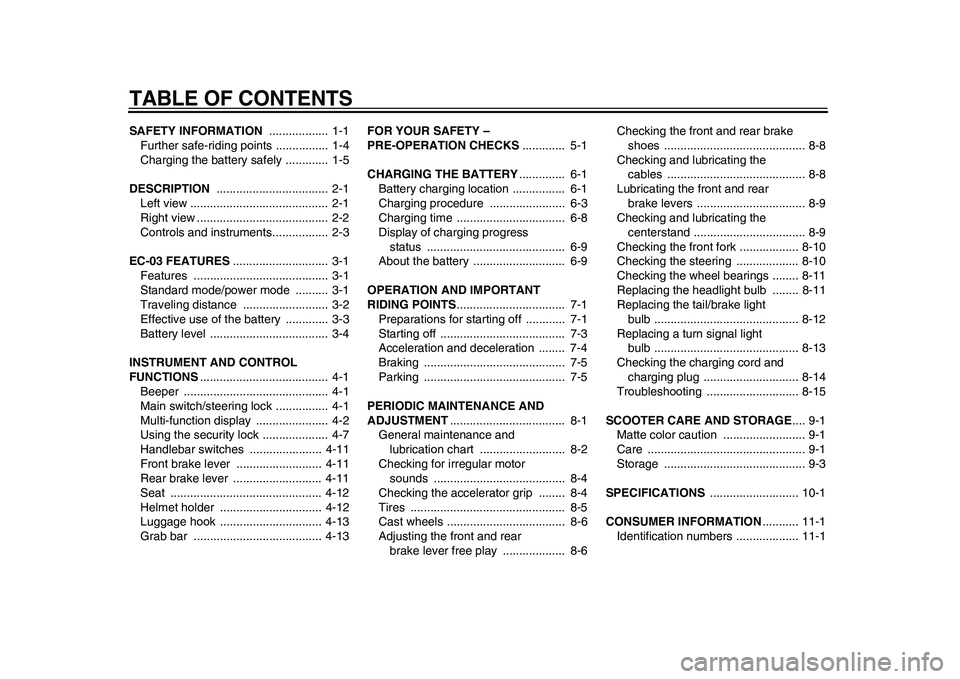
TABLE OF CONTENTSSAFETY INFORMATION .................. 1-1
Further safe-riding points ................ 1-4
Charging the battery safely ............. 1-5
DESCRIPTION .................................. 2-1
Left view .......................................... 2-1
Right view ........................................ 2-2
Controls and instruments................. 2-3
EC-03 FEATURES............................. 3-1
Features ......................................... 3-1
Standard mode/power mode .......... 3-1
Traveling distance .......................... 3-2
Effective use of the battery ............. 3-3
Battery level .................................... 3-4
INSTRUMENT AND CONTROL
FUNCTIONS....................................... 4-1
Beeper ............................................ 4-1
Main switch/steering lock ................ 4-1
Multi-function display ...................... 4-2
Using the security lock .................... 4-7
Handlebar switches ...................... 4-11
Front brake lever .......................... 4-11
Rear brake lever ........................... 4-11
Seat .............................................. 4-12
Helmet holder ............................... 4-12
Luggage hook ............................... 4-13
Grab bar ....................................... 4-13FOR YOUR SAFETY –
PRE-OPERATION CHECKS............. 5-1
CHARGING THE BATTERY.............. 6-1
Battery charging location ................ 6-1
Charging procedure ....................... 6-3
Charging time ................................. 6-8
Display of charging progress
status .......................................... 6-9
About the battery ............................ 6-9
OPERATION AND IMPORTANT
RIDING POINTS................................. 7-1
Preparations for starting off ............ 7-1
Starting off ...................................... 7-3
Acceleration and deceleration ........ 7-4
Braking ........................................... 7-5
Parking ........................................... 7-5
PERIODIC MAINTENANCE AND
ADJUSTMENT................................... 8-1
General maintenance and
lubrication chart .......................... 8-2
Checking for irregular motor
sounds ........................................ 8-4
Checking the accelerator grip ........ 8-4
Tires ............................................... 8-5
Cast wheels .................................... 8-6
Adjusting the front and rear
brake lever free play ................... 8-6Checking the front and rear brake
shoes ........................................... 8-8
Checking and lubricating the
cables .......................................... 8-8
Lubricating the front and rear
brake levers ................................. 8-9
Checking and lubricating the
centerstand .................................. 8-9
Checking the front fork .................. 8-10
Checking the steering ................... 8-10
Checking the wheel bearings ........ 8-11
Replacing the headlight bulb ........ 8-11
Replacing the tail/brake light
bulb ............................................ 8-12
Replacing a turn signal light
bulb ............................................ 8-13
Checking the charging cord and
charging plug ............................. 8-14
Troubleshooting ............................ 8-15
SCOOTER CARE AND STORAGE.... 9-1
Matte color caution ......................... 9-1
Care ................................................ 9-1
Storage ........................................... 9-3
SPECIFICATIONS ........................... 10-1
CONSUMER INFORMATION........... 11-1
Identification numbers ................... 11-11CB-9-E0.book 1 ページ 2010年10月15日 金曜日 午前10時19分
Page 9 of 78
1-3
1
SAFETY INFORMATION
imize imbalance or instability.
Shifting weights can create a sud-
den imbalance. Make sure that ac-
cessories and cargo are securely
attached to the scooter before
riding. Check accessory mounts
and cargo restraints frequently.
• Properly adjust the suspension
for your load (suspension-ad-
justable models only), and
check the condition and pres-
sure of your tires.
• Never attach any large or heavy
items to the handlebar, front
fork, or front fender. Such items
can create unstable handling or
a slow steering response.
This vehicle is not designed to
pull a trailer or to be attached to
a sidecar.
Genuine Yamaha Accessories
Choosing accessories for your vehicle
is an important decision. Genuine
Yamaha accessories, which are avail-
able only from a Yamaha dealer, have
been designed, tested, and approved
by Yamaha for use on your vehicle.
Many companies with no connection toYamaha manufacture parts and acces-
sories or offer other modifications for
Yamaha vehicles. Yamaha is not in a
position to test the products that these
aftermarket companies produce.
Therefore, Yamaha can neither en-
dorse nor recommend the use of ac-
cessories not sold by Yamaha or
modifications not specifically recom-
mended by Yamaha, even if sold and
installed by a Yamaha dealer.
Aftermarket Parts, Accessories,
and Modifications
While you may find aftermarket prod-
ucts similar in design and quality to
genuine Yamaha accessories, recog-
nize that some aftermarket accessories
or modifications are not suitable be-
cause of potential safety hazards to you
or others. Installing aftermarket prod-
ucts or having other modifications per-
formed to your vehicle that change any
of the vehicle’s design or operation
characteristics can put you and others
at greater risk of serious injury or death.
You are responsible for injuries related
to changes in the vehicle.
Keep the following guidelines in mind,as well as those provided under “Load-
ing” when mounting accessories.
Never install accessories or carry
cargo that would impair the perfor-
mance of your scooter. Carefully
inspect the accessory before using
it to make sure that it does not in
any way reduce ground clearance
or cornering clearance, limit sus-
pension travel, steering travel or
control operation, or obscure lights
or reflectors.
• Accessories fitted to the handle-
bar or the front fork area can
create instability due to improper
weight distribution or aerody-
namic changes. If accessories
are added to the handlebar or
front fork area, they must be as
lightweight as possible and
should be kept to a minimum.
• Bulky or large accessories may
seriously affect the stability of
the scooter due to aerodynamic
effects. Wind may attempt to lift
the scooter, or the scooter may
become unstable in cross
winds. These accessories may
also cause instability when
1CB-9-E0.book 3 ページ 2010年10月15日 金曜日 午前10時19分
Page 10 of 78
1-4
SAFETY INFORMATION
1passing or being passed by
large vehicles.
• Certain accessories can dis-
place the operator from his or
her normal riding position. This
improper position limits the free-
dom of movement of the opera-
tor and may limit control ability,
therefore, such accessories are
not recommended.
Use caution when adding electri-
cal accessories. If electrical acces-
sories exceed the capacity of the
scooter’s electrical system, an
electric failure could result, which
could cause a dangerous loss of
lights or motor power.
Aftermarket Tires and Rims
The tires and rims that came with your
scooter were designed to match the
performance capabilities and to provide
the best combination of handling, brak-
ing, and comfort. Other tires, rims, siz-
es, and combinations may not be
appropriate. Refer to page 8-5 for tire
specifications and more information on
replacing your tires.Transporting the Scooter
Be sure to observe following instruc-
tions before transporting the scooter in
another vehicle.
Remove all loose items from the
scooter.
Point the front wheel straight
ahead on the trailer or in the truck
bed, and choke it in a rail to pre-
vent movement.
Secure the scooter with tie-downs
or suitable straps that are attached
to solid parts of the scooter, such
as the frame or upper front fork tri-
ple clamp (and not, for example, to
rubber-mounted handlebars or
turn signals, or parts that could
break). Choose the location for the
straps carefully so the straps will
not rub against painted surfaces
during transport.
The suspension should be com-
pressed somewhat by the
tie-downs, if possible, so that the
scooter will not bounce excessive-
ly during transport.
EAUT2030
Further safe-riding points
Make sure to signal clearly when
making turns.
Braking can be extremely difficult
on a wet road. Avoid hard braking,
because the scooter could slide.
Apply the brakes slowly when
stopping on a wet surface.
Slow down as you approach a cor-
ner or turn. Once you have com-
pleted a turn, accelerate slowly.
Be careful when passing parked
cars. A driver might not see you
and open a door in your path.
Railroad crossings, streetcar rails,
iron plates on road construction
sites, and manhole covers be-
come extremely slippery when
wet. Slow down and cross them
with caution. Keep the scooter up-
right, otherwise it could slide out
from under you.
The brake lining could get wet
when you wash the scooter. After
washing the scooter, check the
brakes before riding.
Always wear a helmet, gloves,
trousers (tapered around the cuff
1CB-9-E0.book 4 ページ 2010年10月15日 金曜日 午前10時19分
Page 33 of 78
5-1
2
3
456
7
8
9
FOR YOUR SAFETY – PRE-OPERATION CHECKS
EAU15596
Inspect your vehicle each time you use it to make sure the vehicle is in safe operating condition. Always follow the inspection
and maintenance procedures and schedules described in the Owner’s Manual.
WARNING
EWA11151
Failure to inspect or maintain the vehicle properly increases the possibility of an accident or equipment damage.
Do not operate the vehicle if you find any problem. If a problem cannot be corrected by the procedures provided inthis manual, have the vehicle inspected by a Yamaha dealer.
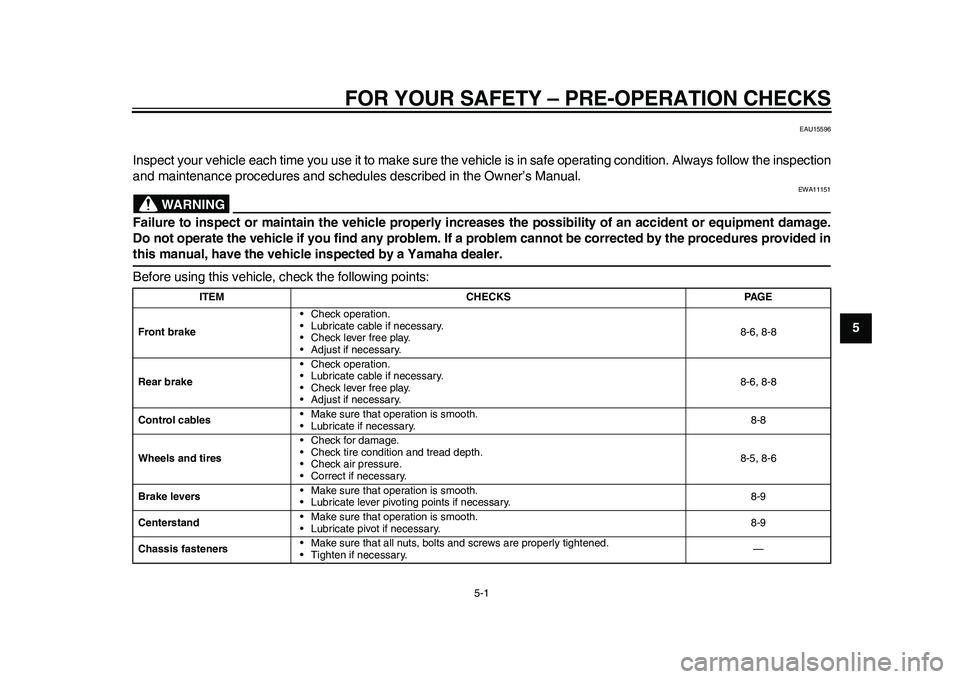
Before using this vehicle, check the following points:
ITEM CHECKS PAGE
Front brake• Check operation.
• Lubricate cable if necessary.
• Check lever free play.
• Adjust if necessary.8-6, 8-8
Rear brake• Check operation.
• Lubricate cable if necessary.
• Check lever free play.
• Adjust if necessary.8-6, 8-8
Control cables• Make sure that operation is smooth.
• Lubricate if necessary.8-8
Wheels and tires• Check for damage.
• Check tire condition and tread depth.
• Check air pressure.
• Correct if necessary.8-5, 8-6
Brake levers• Make sure that operation is smooth.
• Lubricate lever pivoting points if necessary.8-9
Centerstand• Make sure that operation is smooth.
• Lubricate pivot if necessary.8-9
Chassis fasteners• Make sure that all nuts, bolts and screws are properly tightened.
• Tighten if necessary.—
1CB-9-E0.book 1 ページ 2010年10月15日 金曜日 午前10時19分
Page 51 of 78
PERIODIC MAINTENANCE AND ADJUSTMENT
8-2
2
3
4
5
6
789
EAU50610
TIP
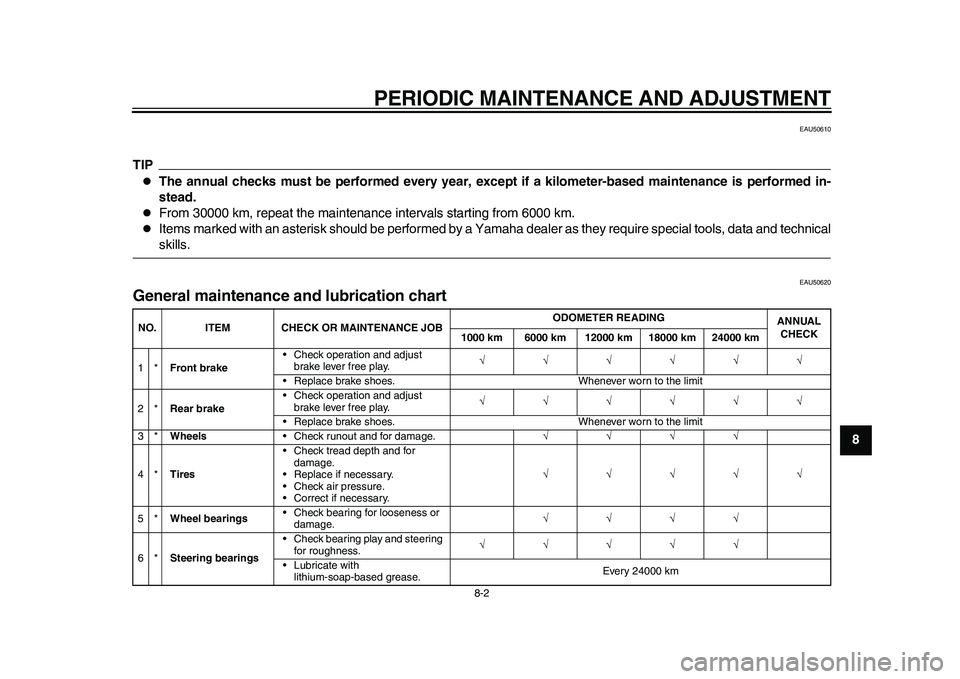
The annual checks must be performed every year, except if a kilometer-based maintenance is performed in-
stead.
From 30000 km, repeat the maintenance intervals starting from 6000 km.
Items marked with an asterisk should be performed by a Yamaha dealer as they require special tools, data and technicalskills.
EAU50620
General maintenance and lubrication chart NO. ITEM CHECK OR MAINTENANCE JOBODOMETER READING
ANNUAL
CHECK
1000 km 6000 km 12000 km 18000 km 24000 km
1*Front brake• Check operation and adjust
brake lever free play.
• Replace brake shoes. Whenever worn to the limit
2*Rear brake• Check operation and adjust
brake lever free play.
• Replace brake shoes. Whenever worn to the limit
3*Wheels• Check runout and for damage.
4*Tires• Check tread depth and for
damage.
• Replace if necessary.
• Check air pressure.
• Correct if necessary.
5*Wheel bearings• Check bearing for looseness or
damage.
6*Steering bearings• Check bearing play and steering
for roughness.
• Lubricate with
lithium-soap-based grease.Every 24000 km
1CB-9-E0.book 2 ページ 2010年10月15日 金曜日 午前10時19分
Page 54 of 78
PERIODIC MAINTENANCE AND ADJUSTMENT
8-5
1
2
3
4
5
6
78
9
EAU50673
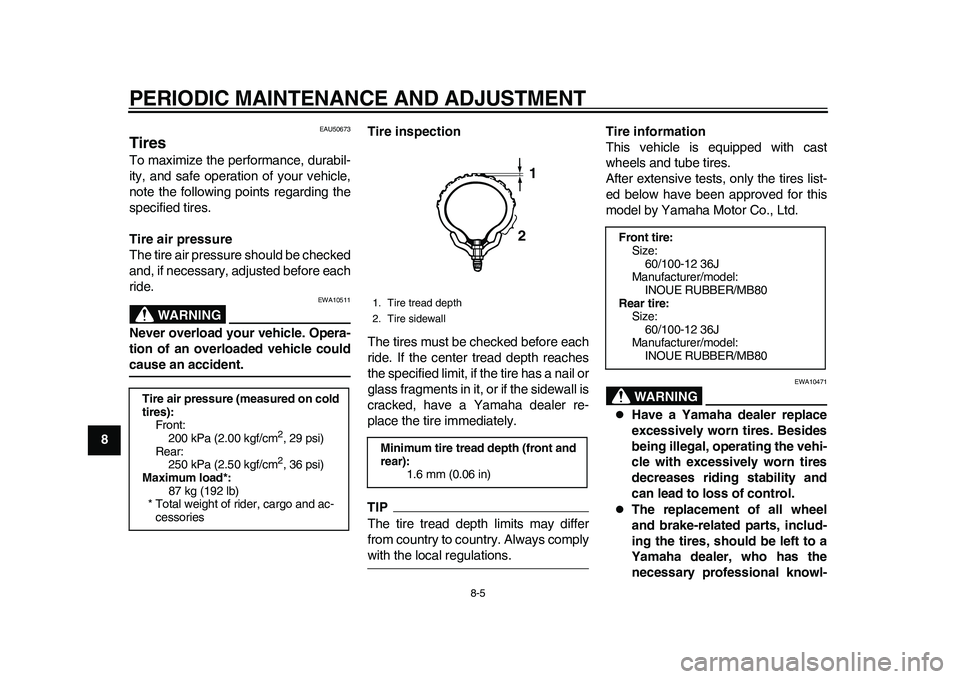
Tires To maximize the performance, durabil-
ity, and safe operation of your vehicle,
note the following points regarding the
specified tires.
Tire air pressure
The tire air pressure should be checked
and, if necessary, adjusted before each
ride.
WARNING
EWA10511
Never overload your vehicle. Opera-
tion of an overloaded vehicle couldcause an accident.Tire inspection
The tires must be checked before each
ride. If the center tread depth reaches
the specified limit, if the tire has a nail or
glass fragments in it, or if the sidewall is
cracked, have a Yamaha dealer re-
place the tire immediately.
TIPThe tire tread depth limits may differ
from country to country. Always complywith the local regulations.Tire information
This vehicle is equipped with cast
wheels and tube tires.
After extensive tests, only the tires list-
ed below have been approved for this
model by Yamaha Motor Co., Ltd.
WARNING
EWA10471
Have a Yamaha dealer replace
excessively worn tires. Besides
being illegal, operating the vehi-
cle with excessively worn tires
decreases riding stability and
can lead to loss of control.
The replacement of all wheel
and brake-related parts, includ-
ing the tires, should be left to a
Yamaha dealer, who has the
necessary professional knowl-
Tire air pressure (measured on cold
tires):
Front:
200 kPa (2.00 kgf/cm
2, 29 psi)
Rear:
250 kPa (2.50 kgf/cm2, 36 psi)
Maximum load*:
87 kg (192 lb)
* Total weight of rider, cargo and ac-
cessories
1. Tire tread depth
2. Tire sidewallMinimum tire tread depth (front and
rear):
1.6 mm (0.06 in)
12
Front tire:
Size:
60/100-12 36J
Manufacturer/model:
INOUE RUBBER/MB80
Rear tire:
Size:
60/100-12 36J
Manufacturer/model:
INOUE RUBBER/MB80
1CB-9-E0.book 5 ページ 2010年10月15日 金曜日 午前10時19分
Page 55 of 78
PERIODIC MAINTENANCE AND ADJUSTMENT
8-6
2
3
4
5
6
789 edge and experience to do so.
Ride at moderate speeds after
changing a tire since the tire
surface must first be “broken
in” for it to develop its optimalcharacteristics.
EAU22002
Cast wheels
WARNING
EWA10610
The wheels on this model are not de-
signed for use with tubeless tires.
Do not attempt to use tubeless tireson this model.
To maximize the performance, durabil-
ity, and safe operation of your vehicle,
note the following points regarding the
specified wheels.
The wheel rims should be checked
for cracks, bends, warpage or
damage before each ride. If any
damage is found, have a Yamaha
dealer replace the wheel. Do not
attempt even the smallest repair to
the wheel. A deformed or cracked
wheel must be replaced.
The wheel should be balanced
whenever either the tire or wheel
has been changed or replaced. An
unbalanced wheel can result in
poor performance, adverse han-
dling characteristics, and a short-
ened tire life.
EAU22152
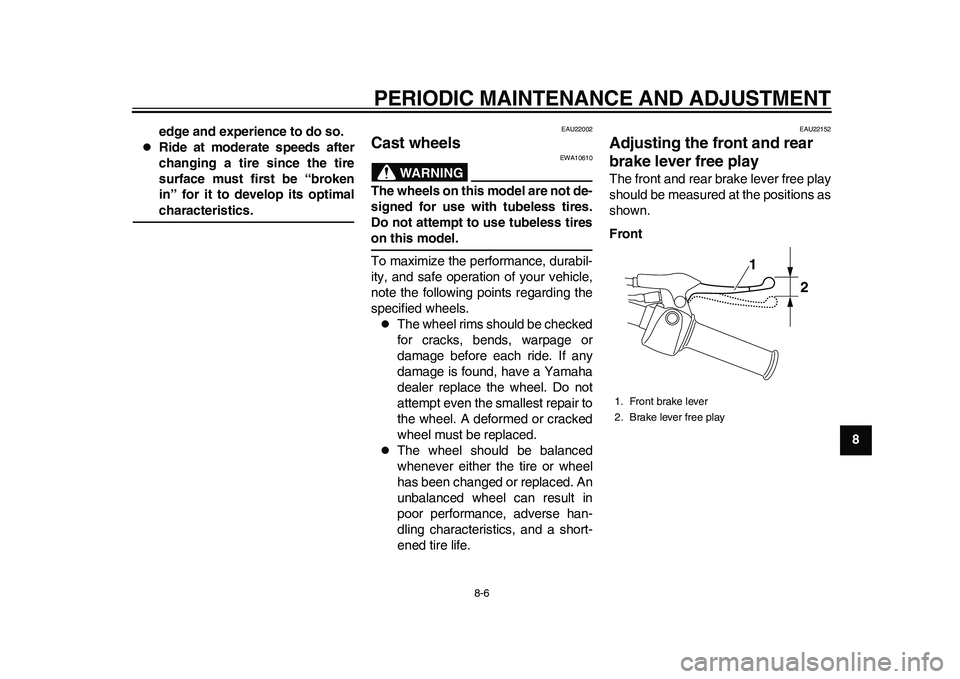
Adjusting the front and rear
brake lever free play The front and rear brake lever free play
should be measured at the positions as
shown.
Front1. Front brake lever
2. Brake lever free play
1
2
1CB-9-E0.book 6 ページ 2010年10月15日 金曜日 午前10時19分
Page 72 of 78
SCOOTER CARE AND STORAGE
9-3
1
2
3
4
5
6
7
893. To prevent corrosion, it is recom-
mended to apply a corrosion pro-
tection spray on all metal,
including chrome- and nickel-plat-
ed, surfaces.
4. Use spray oil as a universal clean-
er to remove any remaining dirt.
5. Touch up minor paint damage
caused by stones, etc.
6. Wax all painted surfaces.
7. Let the scooter dry completely be-
fore storing or covering it.
WARNING
EWA15820
Contaminants on the brakes or tires
can cause loss of control.
Make sure that there is no oil or
wax on the brakes or tires. If
necessary, wash the tires with
warm water and a mild deter-
gent.
Before operating the scooter,
test its braking performanceand cornering behavior.
NOTICE
ECA10800
Apply spray oil and wax spar-
ingly and make sure to wipe offany excess.
Never apply oil or wax to any
rubber and plastic parts, but
treat them with a suitable care
product.
Avoid using abrasive polishing
compounds as they will wearaway the paint.
TIP
Consult a Yamaha dealer for ad-
vice on what products to use.
Washing, rainy weather or humid
climates can cause the headlight
lens to fog. Turning the headlight
on for a short period of time will
help remove the moisture from thelens.
EAU50842
Storage Short-term
Always store your scooter in a cool, dry
place and, if necessary, protect it
against dust with a porous cover. Be
sure the motor is cool before covering
the scooter.NOTICE
ECA17130
Storing the scooter in a poorly
ventilated room or covering it
with a tarp while it is still wet,
will allow water and humidity to
seep in and cause rust, power
unit failure, electric leakage, or
short-circuiting.
To prevent corrosion, avoid
damp cellars, stables (because
of the presence of ammonia)
and areas where strong chemi-cals are stored.
Long-term
NOTICE
ECA17142
Charge the battery if the level
drops to the last segment. In or-
1CB-9-E0.book 3 ページ 2010年10月15日 金曜日 午前10時19分
Page 73 of 78
SCOOTER CARE AND STORAGE
9-4
2
3
4
5
6
7
89
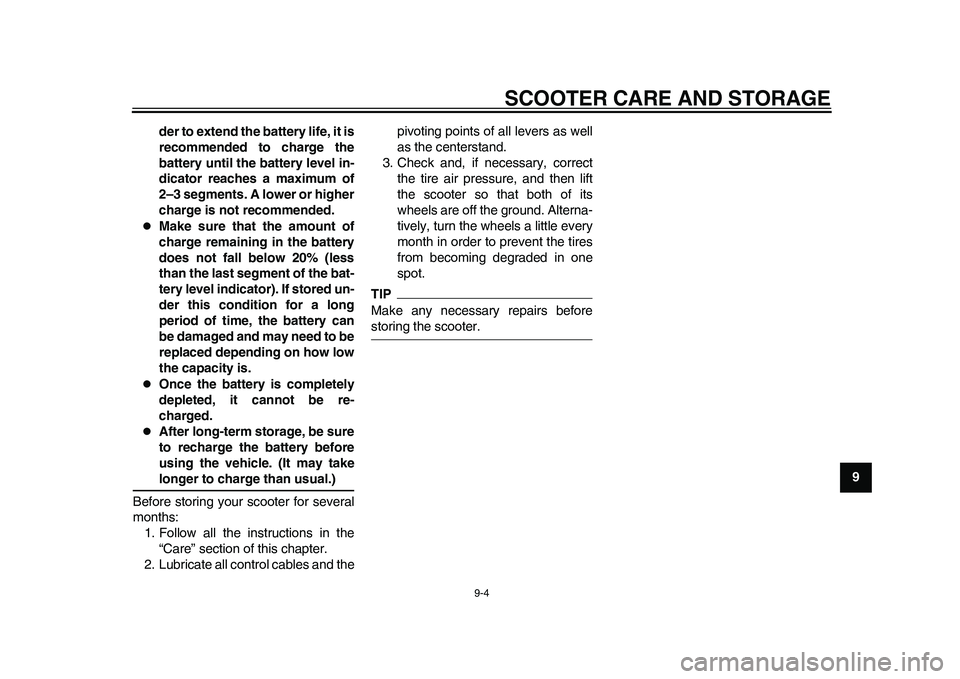
der to extend the battery life, it is
recommended to charge the
battery until the battery level in-
dicator reaches a maximum of
2–3 segments. A lower or higher
charge is not recommended.
Make sure that the amount of
charge remaining in the battery
does not fall below 20% (less
than the last segment of the bat-
tery level indicator). If stored un-
der this condition for a long
period of time, the battery can
be damaged and may need to be
replaced depending on how low
the capacity is.
Once the battery is completely
depleted, it cannot be re-
charged.
After long-term storage, be sure
to recharge the battery before
using the vehicle. (It may takelonger to charge than usual.)
Before storing your scooter for several
months:
1. Follow all the instructions in the
“Care” section of this chapter.
2. Lubricate all control cables and thepivoting points of all levers as well
as the centerstand.
3. Check and, if necessary, correct
the tire air pressure, and then lift
the scooter so that both of its
wheels are off the ground. Alterna-
tively, turn the wheels a little every
month in order to prevent the tires
from becoming degraded in one
spot.
TIPMake any necessary repairs beforestoring the scooter.
1CB-9-E0.book 4 ページ 2010年10月15日 金曜日 午前10時19分
Page 74 of 78
10-1
1
2
3
4
5
6
7
8
910
SPECIFICATIONS
EAU50970
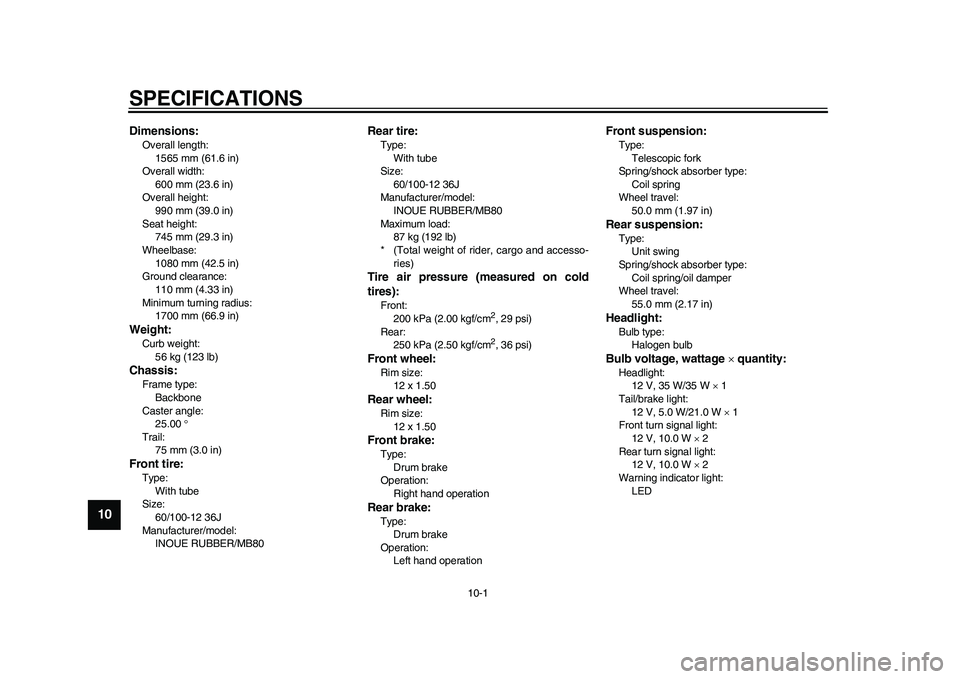
Dimensions:Overall length:
1565 mm (61.6 in)
Overall width:
600 mm (23.6 in)
Overall height:
990 mm (39.0 in)
Seat height:
745 mm (29.3 in)
Wheelbase:
1080 mm (42.5 in)
Ground clearance:
110 mm (4.33 in)
Minimum turning radius:
1700 mm (66.9 in)Weight:Curb weight:
56 kg (123 lb)Chassis:Frame type:
Backbone
Caster angle:
25.00
Trail:
75 mm (3.0 in)Front tire:Type:
With tube
Size:
60/100-12 36J
Manufacturer/model:
INOUE RUBBER/MB80
Rear tire:Type:
With tube
Size:
60/100-12 36J
Manufacturer/model:
INOUE RUBBER/MB80
Maximum load:
87 kg (192 lb)
* (Total weight of rider, cargo and accesso-
ries)Tire air pressure (measured on cold
tires):Front:
200 kPa (2.00 kgf/cm
2, 29 psi)
Rear:
250 kPa (2.50 kgf/cm2, 36 psi)
Front wheel:Rim size:
12 x 1.50Rear wheel:Rim size:
12 x 1.50Front brake:Type:
Drum brake
Operation:
Right hand operationRear brake:Type:
Drum brake
Operation:
Left hand operation
Front suspension:Type:
Telescopic fork
Spring/shock absorber type:
Coil spring
Wheel travel:
50.0 mm (1.97 in)Rear suspension:Type:
Unit swing
Spring/shock absorber type:
Coil spring/oil damper
Wheel travel:
55.0 mm (2.17 in)Headlight:Bulb type:
Halogen bulbBulb voltage, wattage quantity:Headlight:
12 V, 35 W/35 W 1
Tail/brake light:
12 V, 5.0 W/21.0 W 1
Front turn signal light:
12 V, 10.0 W 2
Rear turn signal light:
12 V, 10.0 W 2
Warning indicator light:
LED
1CB-9-E0.book 1 ページ 2010年10月15日 金曜日 午前10時19分