engine YAMAHA GIGGLE50 2007 User Guide
[x] Cancel search | Manufacturer: YAMAHA, Model Year: 2007, Model line: GIGGLE50, Model: YAMAHA GIGGLE50 2007Pages: 72, PDF Size: 1.05 MB
Page 28 of 72
4-2
1
2
3
4
5
6
7
8
9
PRE-OPERATION CHECKS
EAU15605
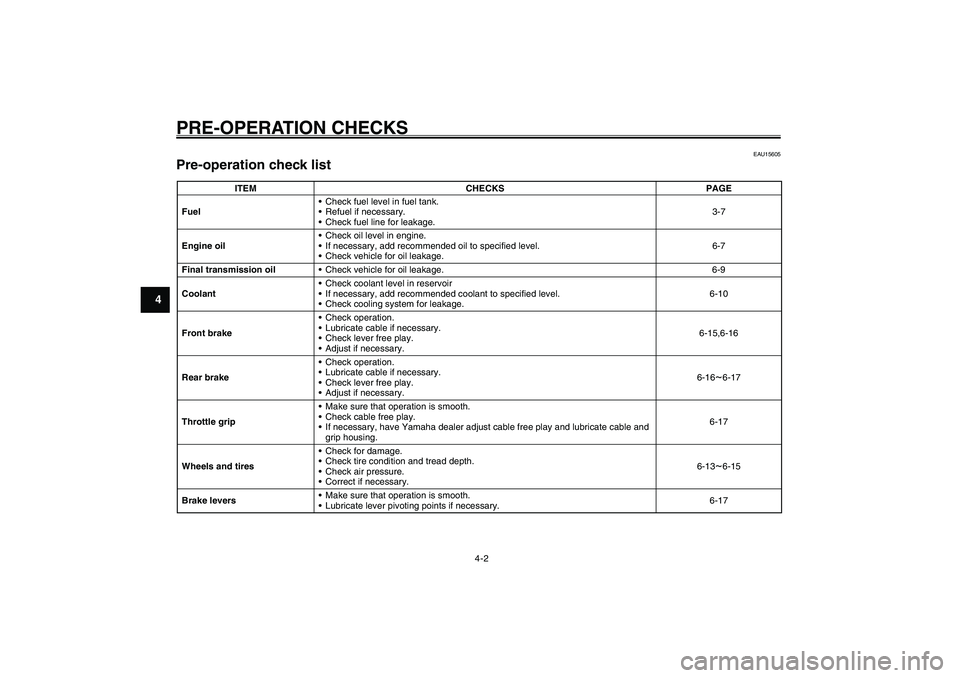
Pre-operation check listPre-operation check list
ITEM CHECKS PAGE
Fuel• Check fuel level in fuel tank.
• Refuel if necessary.
• Check fuel line for leakage.3-7
Engine oil• Check oil level in engine.
• If necessary, add recommended oil to specified level.
• Check vehicle for oil leakage.6-7
Final transmission oil• Check vehicle for oil leakage. 6-9
Coolant• Check coolant level in reservoir
• If necessary, add recommended coolant to specified level.
• Check cooling system for leakage.6-10
Front brake• Check operation.
• Lubricate cable if necessary.
• Check lever free play.
• Adjust if necessary.6-15,6-16
Rear brake• Check operation.
• Lubricate cable if necessary.
• Check lever free play.
• Adjust if necessary.6-16
~6-17
Throttle grip• Make sure that operation is smooth.
• Check cable free play.
• If necessary, have Yamaha dealer adjust cable free play and lubricate cable and
grip housing.6-17
Wheels and tires• Check for damage.
• Check tire condition and tread depth.
• Check air pressure.
• Correct if necessary.6-13~6-15
Brake levers• Make sure that operation is smooth.
• Lubricate lever pivoting points if necessary.6-1
7
15P-F8199-E0_ch4.pmd2007/06/13, 11:16 2
Page 30 of 72

5-1
1
2
3
4
5
6
7
8
9
OPERATION AND IMPORTANT RIDING POINTS
EAU15942
OPERATION AND IMPORTANT RIDING POINTS
EAU15980
EWA10870
w● ●● ●
●
Become thoroughly familiar with
all operating controls and their
functions before riding. Consult
a Yamaha dealer regarding any
control or function that you do
not thoroughly understand.
● ●● ●
●
Never start the engine or oper-
ate it in a closed area for any
length of time. Exhaust fumes
are poisonous, and inhaling
them can cause loss of con-
sciousness and death within a
short time. Always make sure
that there is adequate ventila-
tion.
● ●● ●
●
For safety, always start the en-
gine with the centerstand down.
Starting the engine
EAUT2250
Starting the engine
ECA10250
cCSee page 5-3 for engine break-in in-
structions prior to operating the ve-
hicle for the first time.1. Turn the key to “ON”.
ECAT1070
cCThe engine trouble warning light and
coolant temperature warning light
should come on for a few seconds,
then go off. If these warning lights
do not go off, have a Yamaha dealer
check their electrical circuits.2. Close the throttle completely.
3. Start the engine by pushing the
start switch while applying the front
or rear brake.NOTE:
If the engine does not start, release the
start switch, wait a few seconds, and
then try again. Each starting attempt
should be as short as possible to pre-serve the battery. Do not crank the en-
gine more than 5 seconds on any one
attempt. If the engine does not start with
the starter motor, try using the
kickstarter.
ECA11040
cCFor maximum engine life, never ac-
celerate hard when the engine is
cold!
15P-F8199-E0_ch5.pmd2007/06/13, 11:17 1
Page 31 of 72

5-2
1
2
3
4
5
6
7
8
9
OPERATION AND IMPORTANT RIDING POINTS
EAU16760
Starting offNOTE:
Before starting off, allow the engine to
warm up.1. While pulling the rear brake lever
with your left hand and holding the
grab bar with your right hand, push
the scooter off the centerstand.
2. Sit astride the seat, and then ad-
just the rear view mirrors.
3. Switch the turn signal on.
4. Check for oncoming traffic, and
then slowly turn the throttle grip (on
the right) in order to take off.
5. Switch the turn signal off. Starting off
Acceleration and deceleration
Braking
EAU16780
Acceleration and decelerationZAUM00**
(a) (b)
The speed can be adjusted by opening
and closing the throttle. To increase the
speed, turn the throttle grip in direction
(a). To reduce the speed, turn the throttle
grip in direction (b).
EAU16792
Braking1. Close the throttle completely.
2. Apply both front and rear brakes
simultaneously while gradually in-
creasing the pressure.
EWA10300
w● ●● ●
●
Avoid braking hard or suddenly
(especially when leaning over to
one side), otherwise the scooter
may skid or overturn.
● ●● ●
●
Railroad crossings, streetcar
rails, iron plates on road con-
struction sites, and manhole
covers become extremely slip-
pery when wet. Therefore, slow
down when approaching such
areas and cross them with cau-
tion.
● ●● ●
●
Keep in mind that braking on a
wet road is much more difficult.
● ●● ●
●
Ride slowly down a hill, as brak-
ing downhill can be very diffi-
cult.
15P-F8199-E0_ch5.pmd2007/06/13, 11:17 2
Page 32 of 72

5-3
1
2
3
4
5
6
7
8
9
OPERATION AND IMPORTANT RIDING POINTS
EAU17212
ParkingWhen parking, stop the engine, and
then remove the key from the main
switch.
EWA10310
w● ●● ●
●
Since the engine and exhaust
system can become very hot,
park in a place where pedestri-
ans or children are not likely to
touch them.
● ●● ●
●
Do not park on a slope or on soft
ground, otherwise the vehicle
may overturn.
ECA10380
cCNever park in an area where there are
fire hazards such as grass or other
flammable materials.
Engine break-in
Parking
EAU16830
Engine break-inThere is never a more important period
in the life of your engine than the period
between 0 and 1000 km (600 mi). For
this reason, you should read the follow-
ing material carefully.
Since the engine is brand new, do not
put an excessive load on it for the first
1000 km (600 mi). The various parts in
the engine wear and polish themselves
to the correct operating clearances.
During this period, prolonged full-throttle
operation or any condition that might
result in engine overheating must be
avoided.
EAU16950
0 ~ 150 km (0 ~ 90 mi)
Avoid prolonged operation above 1/3
throttle.
After every hour of operation, stop the
engine, and then let it cool for five to
ten minutes.
Vary the engine speed from time to time.
Do not operate the engine at one set
throttle position.150 ~ 500 km (90 ~ 300 mi)
Avoid prolonged operation above 1/2
throttle.
Rev the engine freely through the gears,
but do not use full throttle at any time.
500 ~ 1000 km (300 ~ 600 mi)
Avoid prolonged operation above 3/4
throttle.
ECA10350
cCAfter 1000 km (600 mi) of operation,
the engine oil must be changed and
the oil strainer cleaned.1000 km (600 mi) and beyond
Avoid prolonged full-throttle operation.
Vary the speed occasionally.
ECA10270
cCIf any engine trouble should occur
during the engine break-in period,
immediately have a Yamaha dealer
check the vehicle.
15P-F8199-E0_ch5.pmd2007/06/13, 11:17 3
Page 34 of 72
6-2
1
2
3
4
5
6
7
8
9
EAU17226
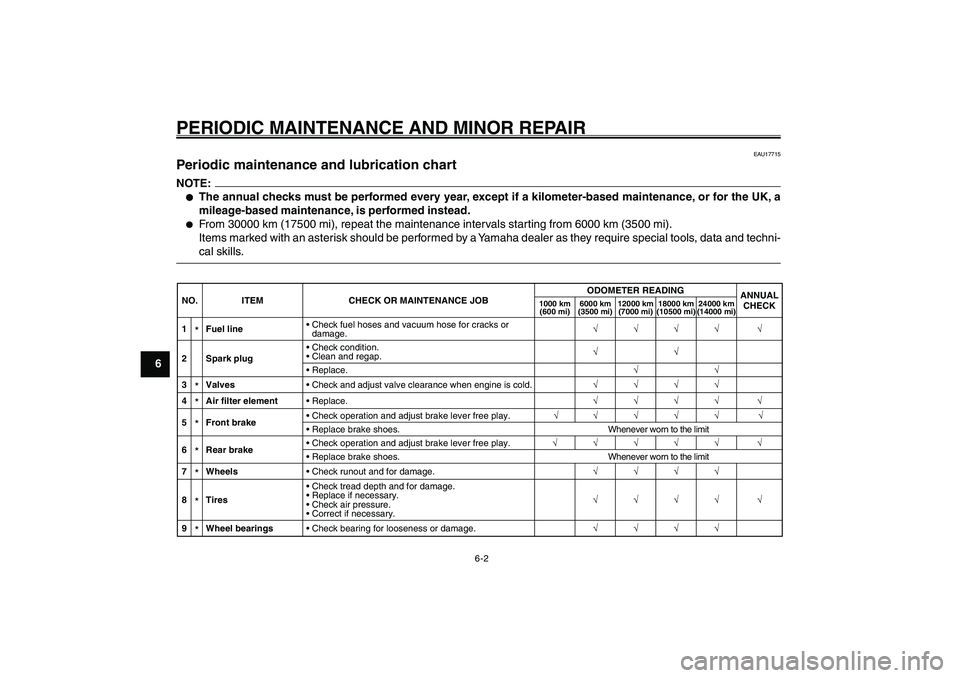
PERIODIC MAINTENANCE AND MINOR REPAIRPeriodic maintenance and lubrication chart
ANNUAL
CHECK
1000 km
(600 mi)6000 km
(3500 mi)12000 km
(7000 mi)18000 km
(10500 mi)24000 km
(14000 mi)
1
*Fuel line• Check fuel hoses and vacuum hose for cracks or
damage.———— —
2 Spark plug• Check condition.
• Clean and regap.——
• Replace.——
3*Valves• Check and adjust valve clearance when engine is cold.————
4*Air filter element• Replace.———— —
5*Front brake• Check operation and adjust brake lever free play.—— — — — —
• Replace brake shoes. Whenever worn to the limit
6*Rear brake• Check operation and adjust brake lever free play.————— —
• Replace brake shoes. Whenever worn to the limit
7*Wheels• Check runout and for damage.————
8*Tires• Check tread depth and for damage.
• Replace if necessary.
• Check air pressure.
• Correct if necessary.———— —
9*Wheel bearings• Check bearing for looseness or damage.————
EAU17715
Periodic maintenance and lubrication chartNOTE:● ●● ●
●
The annual checks must be performed every year, except if a kilometer-based maintenance, or for the UK, a
mileage-based maintenance, is performed instead.
●
From 30000 km (17500 mi), repeat the maintenance intervals starting from 6000 km (3500 mi).
Items marked with an asterisk should be performed by a Yamaha dealer as they require special tools, data and techni-
cal skills.
15P-F8199-E0_ch6.pmd2007/06/21, 11:09 2
Page 35 of 72

6-3
1
2
3
4
5
6
7
8
9
EAU17226
PERIODIC MAINTENANCE AND MINOR REPAIR
10
*Steering bearings• Check bearing assemblies for looseness.
• Moderately repack with lithium-soap-based grease
every 12000 km (7000 mi) or 24 months.——Repack.—Repack.—
11*Chassis fasteners• Make sure that all nuts, bolts and screws are properly
tightened.———— —
12Front brake lever
pivot shaft• Lubricate with lithium-soap-based grease.———— —
13Rear brake lever pivot
shaft• Lubricate with lithium-soap-based grease.———— —
14 Centerstand• Check operation.
• Lubricate.———— —
15*Front fork• Check operation and for oil leakage.————
16*Shock absorber
assembly• Check operation and shock absorber for oil leakage.————
17*Fuel injection• Check engine idle speed.————— —
18Engine oil• Change. (See page 6-7.)
• Check oil level and vehicle for oil leakage.—Every 3000 km (1750 mi)
19
*Engine oil strainer•Clean.—Every 6000 km (3500 mi)
20*Cooling system• Check coolant level and vehicle for coolant leakage.———— —
• Change. Every 3 years
21 Final transmission oil• Check vehicle for oil leakage.—— —
• Change.—————
22*V-belt• Replace. Every 10000 km (6000 mi)
23*Front and rear brake
switches• Check operation.————— —
24Moving parts and
cables• Lubricate.———— — NO. ITEM CHECK OR MAINTENANCE JOBODOMETER READING
ANNUAL
CHECK
1000 km
(600 mi)6000 km
(3500 mi)12000 km
(7000 mi)18000 km
(10500 mi)24000 km
(14000 mi)
15P-F8199-E0_ch6.pmd2007/06/21, 11:09 3
Page 38 of 72

6-6
1
2
3
4
5
6
7
8
9
EAU17226
PERIODIC MAINTENANCE AND MINOR REPAIRPanel CTo remo
ve the panel
ZAUM00**
1
1. Panel C1. Open the seat. (See page 3-9.)
2. Remove the screws, and then take
the panel off.To install the panel
Place the panel in the original position,
and then install the screws.
EAUT2070
Checking the spark plugThe spark plug is an important engine
component, which is easy to check.
Since heat and deposits will cause any
spark plug to slowly erode, the spark
plug should be removed and checked
in accordance with the periodic main-
tenance and lubrication chart. In addi-
tion, the condition of the spark plug can
reveal the condition of the engine.
To remove the spark plug
1. Remove panel A. (See page 6-5.)
2. Remove the spark plug cap.ZAUM00**
1
1. Spark plug wrench
Spark plug, checking
3. Remove the spark plug as shown,
with a spark plug wrench available
at a Yamaha dealer.
To check the spark plug
1. Check that the porcelain insulator
around the center electrode of the
spark plug is a medium-to-light tan
(the ideal color when the vehicle is
ridden normally).
NOTE:
If the spark plug shows a distinctly dif-
ferent color, the engine could be oper-
ating improperly. Do not attempt to di-
agnose such problems yourself. In-
stead, have a Yamaha dealer check the
vehicle.2. Check the spark plug for electrode
erosion and excessive carbon or
other deposits, and replace it if
necessary.Specified spark plug:
CR7E (NGK)
15P-F8199-E0_ch6.pmd2007/06/21, 11:09 6
Page 39 of 72

6-7
1
2
3
4
5
6
7
8
9
EAU17226
PERIODIC MAINTENANCE AND MINOR REPAIR
To install the spark plug
1. Measure the spark plug gap with a
wire thickness gauge and, if nec-
essary, adjust the gap to specifi-
cation.Spark plug gap:
0.7 ~ 0.8 mm (0.028 ~ 0.031 in)2. Clean the surface of the spark plug
gasket and its mating surface, and
then wipe off any grime from the
spark plug threads.
3. Install the spark plug with the spark
plug wrench, and then tighten it to
the specified torque.Tightening torque:
Spark plug:
NOTE:
If a torque wrench is not available when
installing a spark plug, a good estimate
of the correct torque is 1/4~1/2 turn past
finger tight. However, the spark plug
should be tightened to the specified
torque as soon as possible.
4. Install the spark plug cap.
5. Install the panel.
EAUT1460
Engine oil and oil strainerThe engine oil level should be checked
before each ride. In addition, the oil must
be changed and the oil strainer cleaned
at the intervals specified in the periodic
maintenance and lubrication chart.
To check the engine oil level
1. Place the vehicle on the
centerstand.NOTE:
Make sure that the vehicle is positioned
straight up when checking the oil level.
A slight tilt to the side can result in a
false reading.2. Start the engine, warm it up for sev-
eral minutes, and then turn it off. Engine oil
15P-F8199-E0_ch6.pmd2007/06/21, 11:09 7
Page 40 of 72

6-8
1
2
3
4
5
6
7
8
9
EAU17226
PERIODIC MAINTENANCE AND MINOR REPAIRZAUM00**
1
2
3
1. Engine oil filler cap
2. Maximum level mark
3. Minimum level mark3. Wait a few minutes until the oil
settles, remove the oil filler cap,
wipe the dipstick clean, insert it
back into the oil filler hole (without
screwing it in), and then remove it
again to check the oil level.NOTE:
The engine oil should be between the
minimum and maximum level marks.4. If the engine oil is below the mini-
mum level mark, add sufficient oil
of the recommended type to raise
it to the correct level.5. Insert the dipstick into the oil filler
hole, and then tighten the oil filler
cap.
To change the engine oil and clean
the oil strainer
1. Start the engine, warm it up for sev-
eral minutes, and then turn it off.
2. Place an oil pan under the engine
to collect the used oil.
3. Remove the engine oil filler cap and
the engine oil drain bolts A and B
to drain the oil from the crankcase.
ZAUM00**
1
1. Engine oil drain bolt A
ZAUM00**
1
1. Engine oil drain bolt B
ECAT1020
cCWhen removing the engine oil drain
bolt B, the O-ring, compression
spring, and oil strainer will fall out.
Take care not to lose these parts.4. Clean the oil strainer with solvent,
and then check it for damage and
replace it if necessary.
5. Check the O-ring for damage and
replace it if necessary.
6. Install the oil strainer, compression
spring, O-ring and engine oil drain
bolt B.
15P-F8199-E0_ch6.pmd2007/06/21, 11:09 8
Page 41 of 72

6-9
1
2
3
4
5
6
7
8
9
EAU17226
PERIODIC MAINTENANCE AND MINOR REPAIR
NOTE:
Make sure that the O-ring is properly
seated.7. Install engine oil drain bolt A, and
then tighten both drain bolts to their
specified torques.Tightening torque:
Engine oil drain bolt A:
Engine oil drain bolt B:
ZAUM00**
1
1. Oil filler hole
8. Add the specified amount of the
recommended engine oil, and then
install and tighten the oil filler cap.Recommended engine oil:
See page 8-1.
Oil change quantity:
0.78 L (0.82 US qt) (0.69 Imp.qt)
ECA11670
cC● ●● ●
●
Do not use oils with a diesel
specification of “CD” or oils of a
higher quality than specified. In
addition, do not use oils labeled
“ENERGY CONSERVING II” or
higher.
● ●● ●
●
Be sure no foreign material en-
ters the crankcase.
9. Start the engine, and then let it idle
for several minutes while checking
it for oil leakage. If oil is leaking,
immediately turn the engine off and
check for the cause.
10. Turn the engine off, and then check
the oil level and correct it if neces-
sary.
EAUT1560
Final transmission oilThe final transmission case must be
checked for oil leakage before each ride.
If any leakage is found, have a Yamaha
dealer check and repair the scooter. In
addition, the final transmission oil must
be changed as follows at the intervals
specified in the periodic maintenance
and lubrication chart.
1. Start the engine, warm it up by
riding the scooter for several min-
utes, and then stop the engine.
2. Place the scooter on the
centerstand.
3. Place an oil pan under the final
transmission case to collect the
used oil. Final transmission oil
15P-F8199-E0_ch6.pmd2007/06/21, 11:09 9