brake YAMAHA MT-03 2012 User Guide
[x] Cancel search | Manufacturer: YAMAHA, Model Year: 2012, Model line: MT-03, Model: YAMAHA MT-03 2012Pages: 98, PDF Size: 5.32 MB
Page 47 of 98
1
2
3
4
5
6
7
8
9
10
PERIODIC MAINTENANCE AND MINOR REPAIR
6-56-5
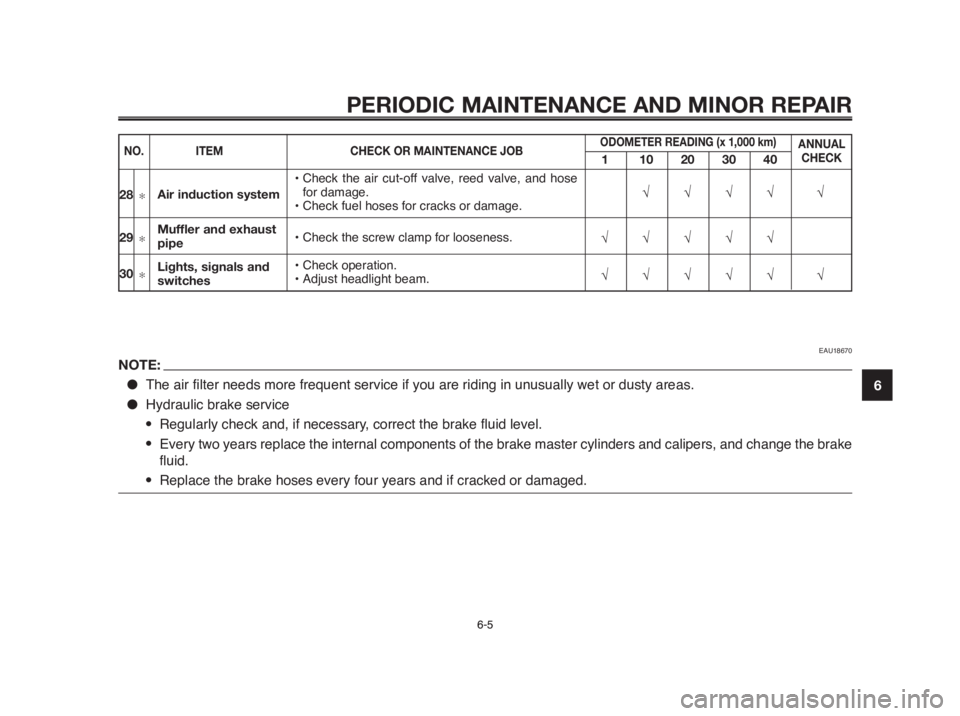
NO. ITEM CHECK OR MAINTENANCE JOBODOMETER READING (x 1,000 km)
110203040
ANNUAL
CHECK
• Check the air cut-off valve, reed valve, and hose
for damage.
• Check fuel hoses for cracks or damage.
• Check the screw clamp for looseness.
• Check operation.
• Adjust headlight beam. Air induction system
Muffler and exhaust
pipe
Lights, signals and
switches 28
✻
29✻
30✻
EAU18670
NOTE:
●The air filter needs more frequent service if you are riding in unusually wet or dusty areas.
●Hydraulic brake service
●Regularly check and, if necessary, correct the brake fluid level.
●Every two years replace the internal components of the brake master cylinders and calipers, and change the brake
fluid.
●Replace the brake hoses every four years and if cracked or damaged.√√√√ √
√√√√√
√√√√√ √
Page 59 of 98
1
2
3
4
5
6
7
8
9
10
PERIODIC MAINTENANCE AND MINOR REPAIR
●Adjust the suspension and tire
air pressure with regard to the
load.
●Check the tire condition and air
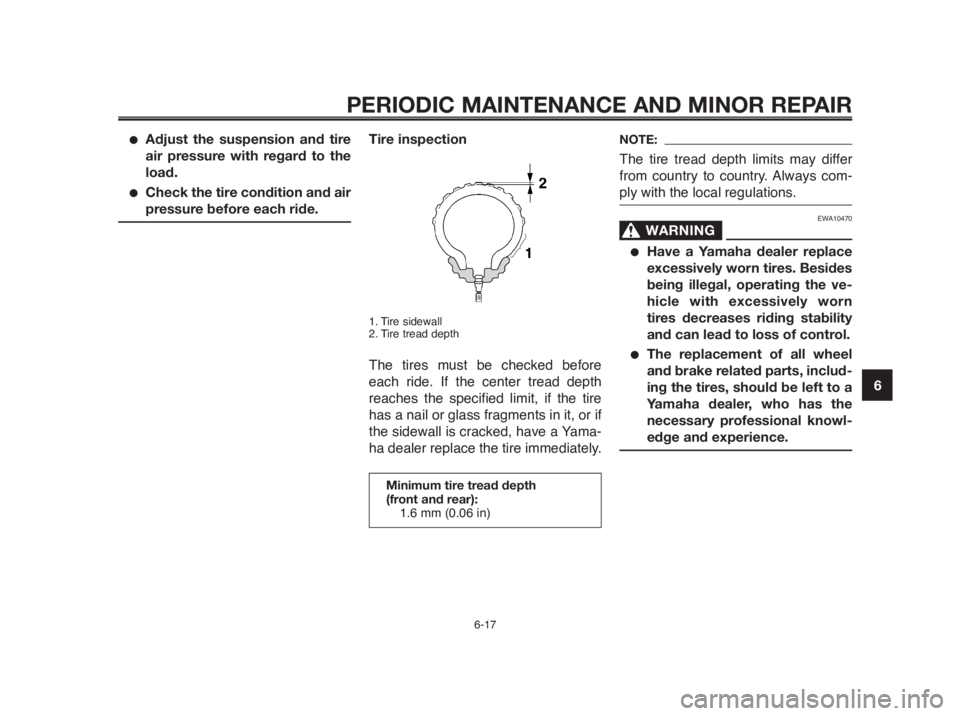
pressure before each ride.Tire inspection
1. Tire sidewall
2. Tire tread depth
The tires must be checked before
each ride. If the center tread depth
reaches the specified limit, if the tire
has a nail or glass fragments in it, or if
the sidewall is cracked, have a Yama-
ha dealer replace the tire immediately.
NOTE:
The tire tread depth limits may differ
from country to country. Always com-
ply with the local regulations.
EWA10470
WARNING0
●Have a Yamaha dealer replace
excessively worn tires. Besides
being illegal, operating the ve-
hicle with excessively worn
tires decreases riding stability
and can lead to loss of control.
●The replacement of all wheel
and brake related parts, includ-
ing the tires, should be left to a
Yamaha dealer, who has the
necessary professional knowl-
edge and experience.
6-17
Minimum tire tread depth
(front and rear):
1.6 mm (0.06 in)
Page 62 of 98
PERIODIC MAINTENANCE AND MINOR REPAIR
NOTE:
If the specified clutch lever free play
could be obtained as described
above, tighten the locknut and skip the
rest of the procedure, otherwise pro-
ceed as follows.
3. Fully turn the adjusting bolt at the
clutch lever in direction (a) to
loosen the clutch cable.
4. Loosen the locknut at the
crankcase.
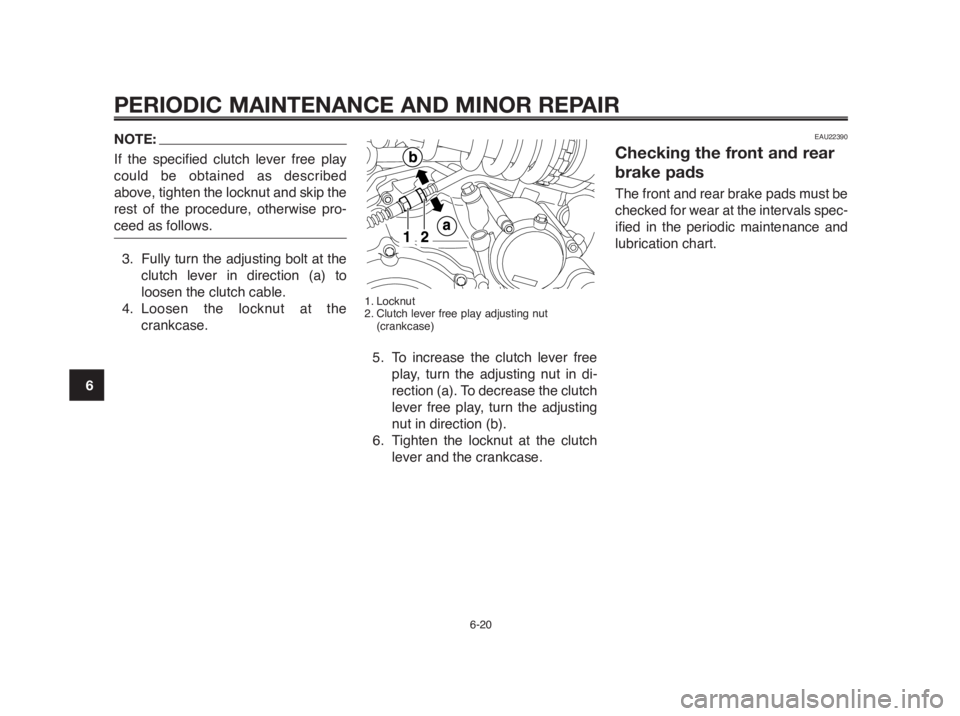
1. Locknut
2. Clutch lever free play adjusting nut
(crankcase)
5. To increase the clutch lever free
play, turn the adjusting nut in di-
rection (a). To decrease the clutch
lever free play, turn the adjusting
nut in direction (b).
6. Tighten the locknut at the clutch
lever and the crankcase.
EAU22390
Checking the front and rear
brake pads
The front and rear brake pads must be
checked for wear at the intervals spec-
ified in the periodic maintenance and
lubrication chart.
6-20
1
2
3
4
5
6
7
8
9
10
Page 63 of 98
1
2
3
4
5
6
7
8
9
10
PERIODIC MAINTENANCE AND MINOR REPAIR
EAU22420
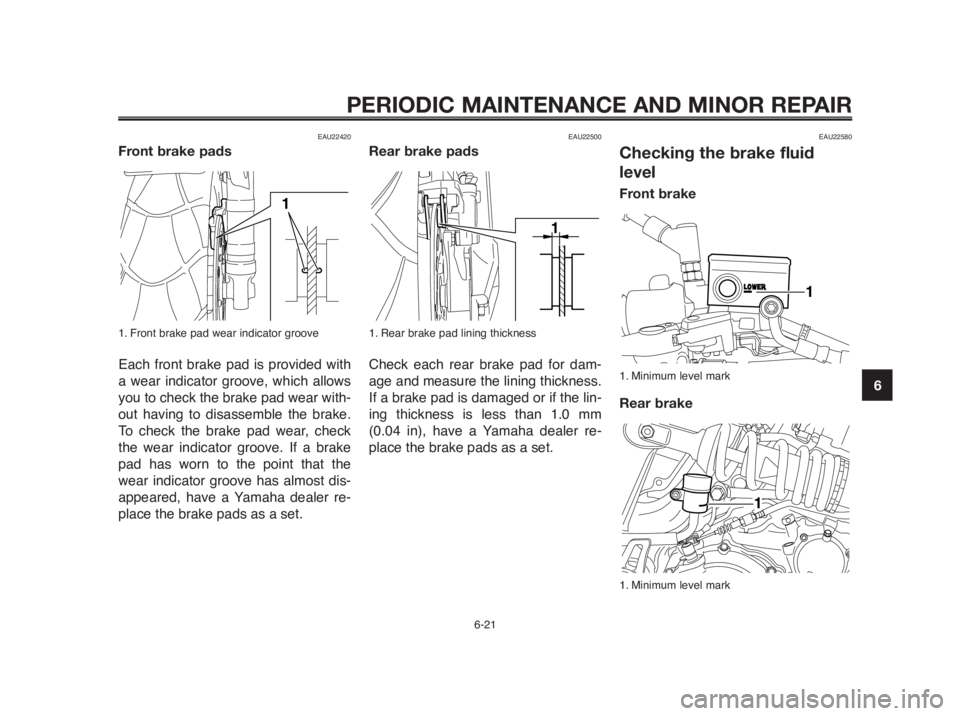
Front brake pads
1. Front brake pad wear indicator groove
Each front brake pad is provided with
a wear indicator groove, which allows
you to check the brake pad wear with-
out having to disassemble the brake.
To check the brake pad wear, check
the wear indicator groove. If a brake
pad has worn to the point that the
wear indicator groove has almost dis-
appeared, have a Yamaha dealer re-
place the brake pads as a set.
EAU22500
Rear brake pads
1. Rear brake pad lining thickness
Check each rear brake pad for dam-
age and measure the lining thickness.
If a brake pad is damaged or if the lin-
ing thickness is less than 1.0 mm
(0.04 in), have a Yamaha dealer re-
place the brake pads as a set.
EAU22580
Checking the brake fluid
level
Front brake
1. Minimum level mark
Rear brake
1. Minimum level mark
6-21
Page 64 of 98
PERIODIC MAINTENANCE AND MINOR REPAIR
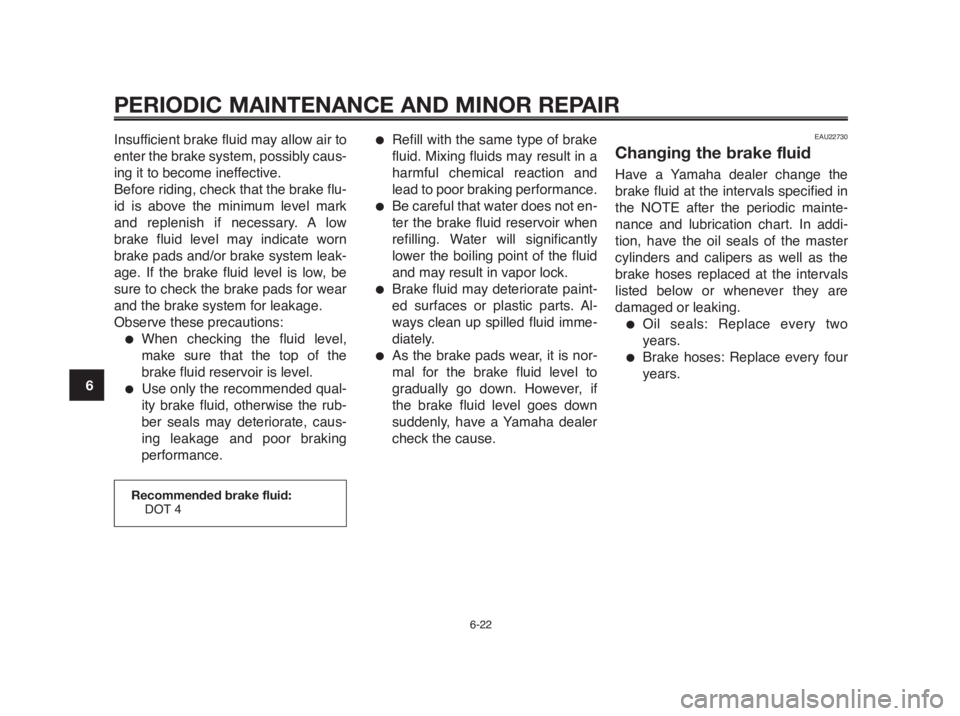
Insufficient brake fluid may allow air to
enter the brake system, possibly caus-
ing it to become ineffective.
Before riding, check that the brake flu-
id is above the minimum level mark
and replenish if necessary. A low
brake fluid level may indicate worn
brake pads and/or brake system leak-
age. If the brake fluid level is low, be
sure to check the brake pads for wear
and the brake system for leakage.
Observe these precautions:
●When checking the fluid level,
make sure that the top of the
brake fluid reservoir is level.
●Use only the recommended qual-
ity brake fluid, otherwise the rub-
ber seals may deteriorate, caus-
ing leakage and poor braking
performance.
●Refill with the same type of brake
fluid. Mixing fluids may result in a
harmful chemical reaction and
lead to poor braking performance.
●Be careful that water does not en-
ter the brake fluid reservoir when
refilling. Water will significantly
lower the boiling point of the fluid
and may result in vapor lock.
●Brake fluid may deteriorate paint-
ed surfaces or plastic parts. Al-
ways clean up spilled fluid imme-
diately.
●As the brake pads wear, it is nor-
mal for the brake fluid level to
gradually go down. However, if
the brake fluid level goes down
suddenly, have a Yamaha dealer
check the cause.
6-22
1
2
3
4
5
6
7
8
9
10
Recommended brake fluid:
DOT 4
EAU22730
Changing the brake fluid
Have a Yamaha dealer change the
brake fluid at the intervals specified in
the NOTE after the periodic mainte-
nance and lubrication chart. In addi-
tion, have the oil seals of the master
cylinders and calipers as well as the
brake hoses replaced at the intervals
listed below or whenever they are
damaged or leaking.
●Oil seals: Replace every two
years.
●Brake hoses: Replace every four
years.
Page 68 of 98
PERIODIC MAINTENANCE AND MINOR REPAIR
6-26
1
2
3
4
5
6
7
8
9
10
EAU23140
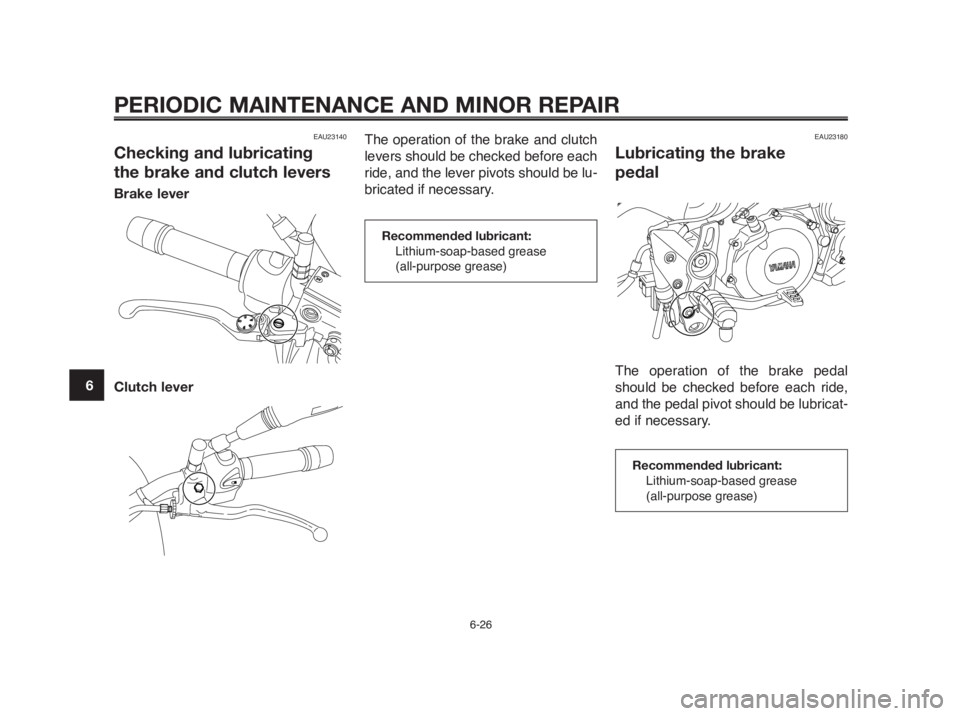
Checking and lubricating
the brake and clutch levers
Brake lever
Clutch lever
The operation of the brake and clutch
levers should be checked before each
ride, and the lever pivots should be lu-
bricated if necessary.
Recommended lubricant:
Lithium-soap-based grease
(all-purpose grease)
EAU23180
Lubricating the brake
pedal
The operation of the brake pedal
should be checked before each ride,
and the pedal pivot should be lubricat-
ed if necessary.
Recommended lubricant:
Lithium-soap-based grease
(all-purpose grease)
Page 69 of 98
1
2
3
4
5
6
7
8
9
10
PERIODIC MAINTENANCE AND MINOR REPAIR
EAU23200
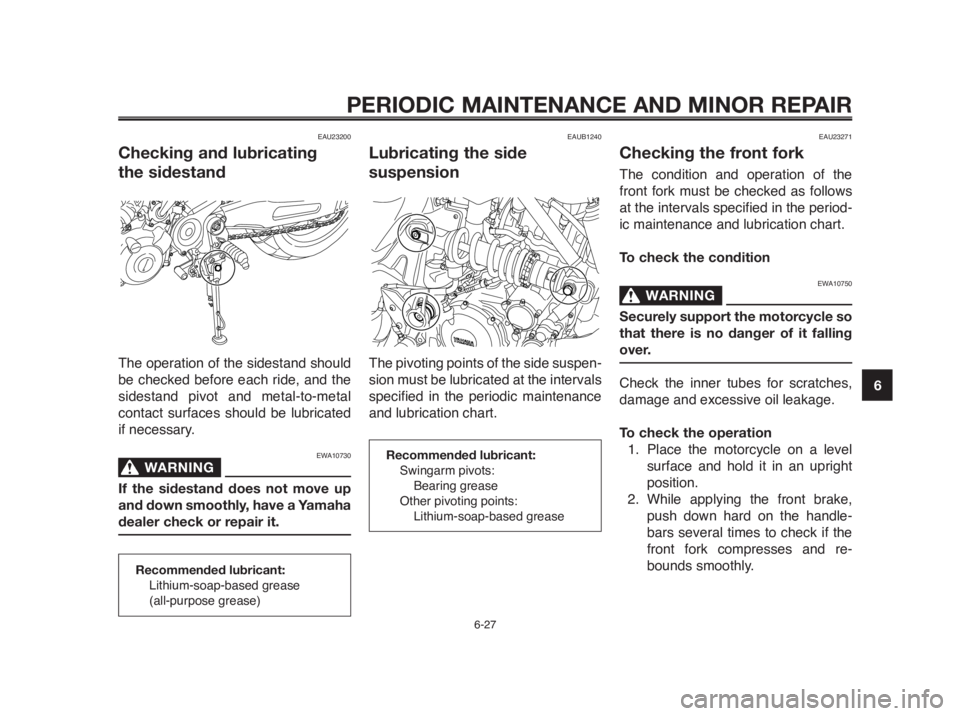
Checking and lubricating
the sidestand
The operation of the sidestand should
be checked before each ride, and the
sidestand pivot and metal-to-metal
contact surfaces should be lubricated
if necessary.
EWA10730
WARNING0
If the sidestand does not move up
and down smoothly, have a Yamaha
dealer check or repair it.
EAUB1240
Lubricating the side
suspension
The pivoting points of the side suspen-
sion must be lubricated at the intervals
specified in the periodic maintenance
and lubrication chart.
Recommended lubricant:
Lithium-soap-based grease
(all-purpose grease)
Recommended lubricant:
Swingarm pivots:
Bearing grease
Other pivoting points:
Lithium-soap-based grease
EAU23271
Checking the front fork
The condition and operation of the
front fork must be checked as follows
at the intervals specified in the period-
ic maintenance and lubrication chart.
To check the condition
EWA10750
WARNING0
Securely support the motorcycle so
that there is no danger of it falling
over.
Check the inner tubes for scratches,
damage and excessive oil leakage.
To check the operation
1. Place the motorcycle on a level
surface and hold it in an upright
position.
2. While applying the front brake,
push down hard on the handle-
bars several times to check if the
front fork compresses and re-
bounds smoothly.
6-27
Page 76 of 98
PERIODIC MAINTENANCE AND MINOR REPAIR
●Headlight lens
•Do not affix any type of tinted
film or stickers to the head-
light lens.
•Do not use a headlight bulb
of a wattage higher than
specified.
5. Install the headlight bulb cover,
and then connect the coupler.
6. Have a Yamaha dealer adjust the
headlight beam if necessary.
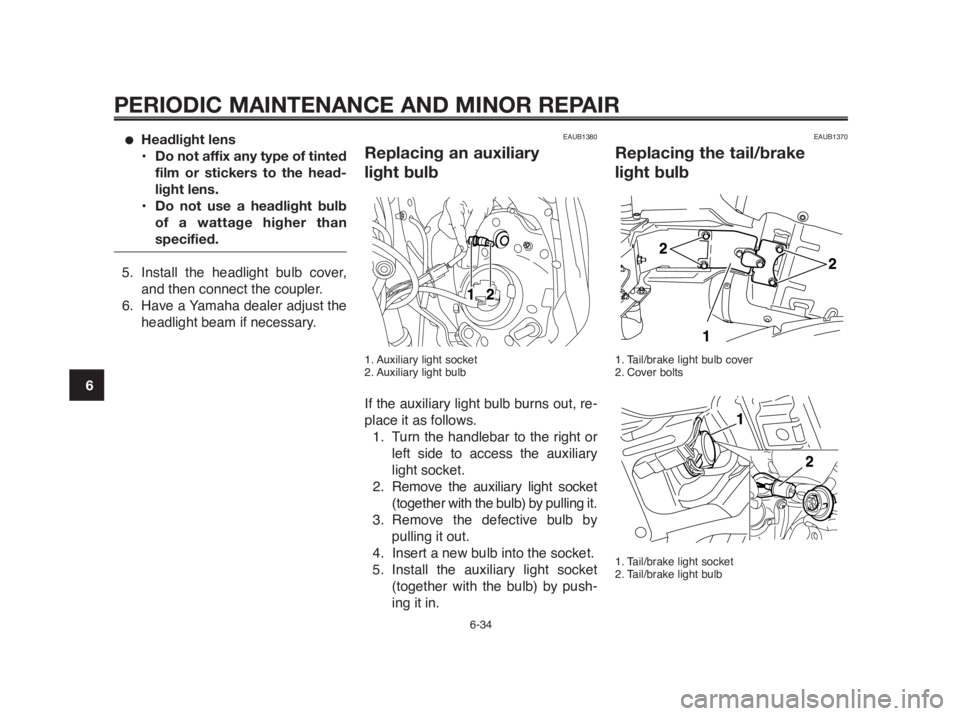
EAUB1380
Replacing an auxiliary
light bulb
1. Auxiliary light socket
2. Auxiliary light bulb
If the auxiliary light bulb burns out, re-
place it as follows.
1. Turn the handlebar to the right or
left side to access the auxiliary
light socket.
2. Remove the auxiliary light socket
(together with the bulb) by pulling it.
3. Remove the defective bulb by
pulling it out.
4. Insert a new bulb into the socket.
5. Install the auxiliary light socket
(together with the bulb) by push-
ing it in.
EAUB1370
Replacing the tail/brake
light bulb
1. Tail/brake light bulb cover
2. Cover bolts
1. Tail/brake light socket
2. Tail/brake light bulb
6-34
1
2
3
4
5
6
7
8
9
10
Page 77 of 98

1
2
3
4
5
6
7
8
9
10
PERIODIC MAINTENANCE AND MINOR REPAIR
1. Remove the tail/brake light bulb
cover by removing the bolts.
2. Remove the socket (together with
the bulb) by turning it counter-
clockwise.
3. Remove the defective bulb by
pushing it in and turning it coun-
terclockwise.
4. Insert a new bulb into the socket,
push it in, and then turn it clock-
wise until it stops.
5. Install the socket (together with
the bulb) by turning it clockwise.
6. Place the tail/brake light bulb
cover in its original position, insert
the bolts and then tighten them to
the specified torque.EAU24202
Replacing a turn signal
light bulb
1. Screw
2. Turn signal light lens
3. Turn signal light bulb
1. Remove the turn signal light lens
by removing the screw.
2. Remove the defective bulb by
pushing it in and turning it coun-
terclockwise.
3. Insert a new bulb into the socket,
push it in, and then turn it clock-
wise until it stops.
4. Install the lens by installing the
screw.
ECA11190CAUTION:
Do not overtighten the screw, oth-
erwise the lens may break.
6-35
Tightening torque:
Tail/brake light bulb cover bolt:
10 Nm (1.0 m·kgf, 7.2 ft·lbf)
Page 79 of 98
1
2
3
4
5
6
7
8
9
10
PERIODIC MAINTENANCE AND MINOR REPAIR
6-37
To service the rear wheel
Raise the rear wheel off the ground by
using a motorcycle stand or, if a mo-
torcycle stand is not available, by plac-
ing a jack either under each side of the
frame in front of the rear wheel or un-
der each side of the swingarm.EAU24360
Front wheelEAU34390
To remove the front wheel
EWA10820
WARNING0
●It is advisable to have a Yama-
ha dealer service the wheel.
●Securely support the motorcy-
cle so that there is no danger of
it falling over.
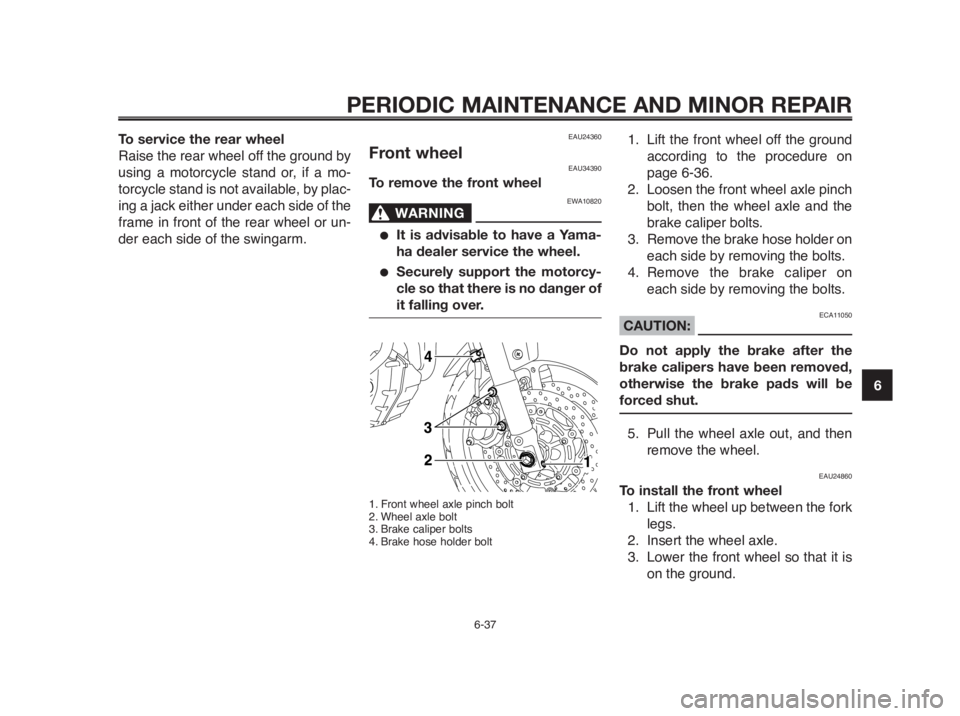
1. Front wheel axle pinch bolt
2. Wheel axle bolt
3. Brake caliper bolts
4. Brake hose holder bolt
1. Lift the front wheel off the ground
according to the procedure on
page 6-36.
2. Loosen the front wheel axle pinch
bolt, then the wheel axle and the
brake caliper bolts.
3. Remove the brake hose holder on
each side by removing the bolts.
4. Remove the brake caliper on
each side by removing the bolts.
ECA11050CAUTION:
Do not apply the brake after the
brake calipers have been removed,
otherwise the brake pads will be
forced shut.
5. Pull the wheel axle out, and then
remove the wheel.
EAU24860
To install the front wheel
1. Lift the wheel up between the fork
legs.
2. Insert the wheel axle.
3. Lower the front wheel so that it is
on the ground.