warning YAMAHA SR125 2000 User Guide
[x] Cancel search | Manufacturer: YAMAHA, Model Year: 2000, Model line: SR125, Model: YAMAHA SR125 2000Pages: 78, PDF Size: 8.59 MB
Page 30 of 78
OPERATION AND IMPORTANT RIDING POINTS
5-6
5
EAU00438
0 ~ 150 km
Avoid operation above 1/3 throttle.
Stop the engine and let it cool for 5 to
10 minutes after every hour of opera-
tion. Vary the speed of the motorcycle
from time to time. Do not operate it at
one set throttle position.
150 ~ 500 km
Avoid prolonged operation above
1/2 throttle.
500 ~ 1,000 km
Avoid cruising speeds in excess of
3/4 throttle.
EC000050
CAUTION:@ After 1,000 km of operation, be sure
to replace the engine oil. @
1,000 km and beyond
Avoid prolonged full-throttle operation.
Vary speed occasionally.
EC000049
CAUTION:@ If any engine trouble should occur
during the break-in period, consult a
Yamaha dealer immediately. @
EAU00457
ParkingWhen parking the motorcycle, stop the
engine and remove the ignition key.
Turn the fuel cock to “OFF” whenever
stopping the engine.
EW000058
WARNING
@ The exhaust system is hot. Park the
motorcycle in a place where pedes-
trians or children are not likely to
touch the motorcycle. Do not park
the motorcycle on a slope or soft
ground; the motorcycle may over-
turn. @
E_3mw.book Page 6 Monday, February 5, 2001 9:54 AM
Page 31 of 78
6-1
6
EAU00462
6-PERIODIC MAINTENANCE AND MINOR REPAIR
EAU00464
Periodic inspection, adjustment and lu-
brication will keep your motorcycle in
the safest and most efficient condition
possible. Safety is an obligation of the
motorcycle owner. The maintenance
and lubrication schedule chart should
be considered strictly as a guide to
general maintenance and lubrication
intervals. YOU MUST TAKE INTO
CONSIDERATION THAT WEATHER,
TERRAIN, GEOGRAPHICAL LOCA-
TIONS, AND A VARIETY OF INDIVID-
UAL USES ALL TEND TO DEMAND
THAT EACH OWNER ALTER THIS
TIME SCHEDULE TO SHORTER IN-
TERVALS TO MATCH THE ENVI-
RONMENT. The most important points
of motorcycle inspection, adjustment,
and lubrication are explained in the fol-
lowing pages.
EW000060
WARNING
@ If you are not familiar with motor-
cycle service, this work should be
done by a Yamaha dealer. @
EAU01175
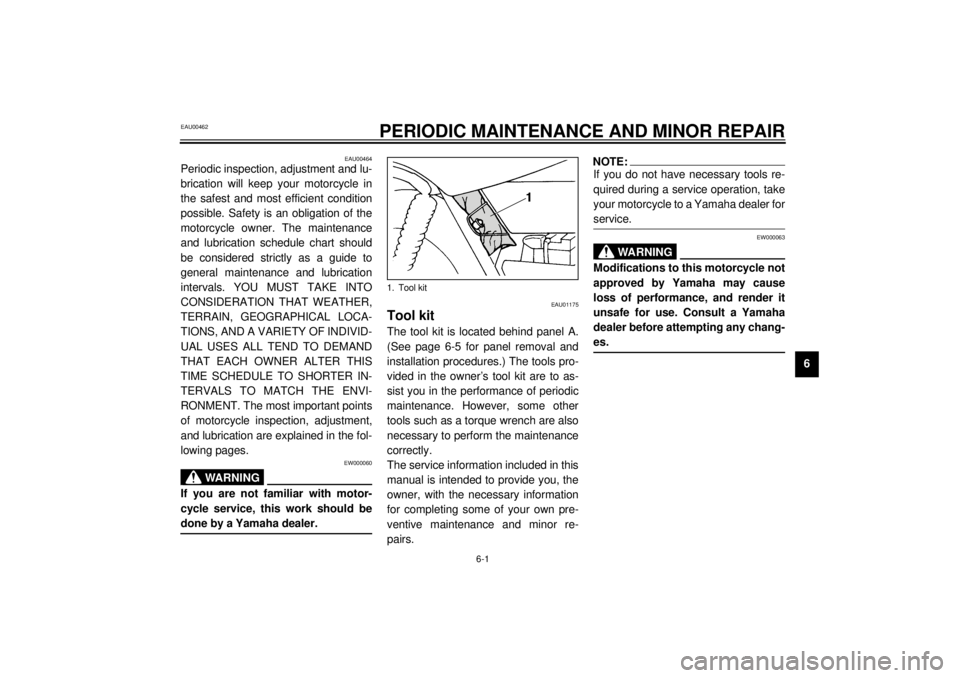
Tool kitThe tool kit is located behind panel A.
(See page 6-5 for panel removal and
installation procedures.) The tools pro-
vided in the owner’s tool kit are to as-
sist you in the performance of periodic
maintenance. However, some other
tools such as a torque wrench are also
necessary to perform the maintenance
correctly.
The service information included in this
manual is intended to provide you, the
owner, with the necessary information
for completing some of your own pre-
ventive maintenance and minor re-
pairs.
NOTE:@ If you do not have necessary tools re-
quired during a service operation, take
your motorcycle to a Yamaha dealer for
service. @
EW000063
WARNING
@ Modifications to this motorcycle not
approved by Yamaha may cause
loss of performance, and render it
unsafe for use. Consult a Yamaha
dealer before attempting any chang-
es. @
1. Tool kit
E_3mw.book Page 1 Monday, February 5, 2001 9:54 AM
Page 43 of 78
PERIODIC MAINTENANCE AND MINOR REPAIR
6-13
6
EAU00637
Valve clearance adjustmentThe correct valve clearance changes
with use, resulting in improper fuel/air
supply or engine noise. To prevent this,
the valve clearance must be adjusted
regularly. This adjustment however,
should be left to a professional
Yamaha service technician.
EAU00647
TiresTo ensure maximum performance,
long service, and safe operation, note
the following:
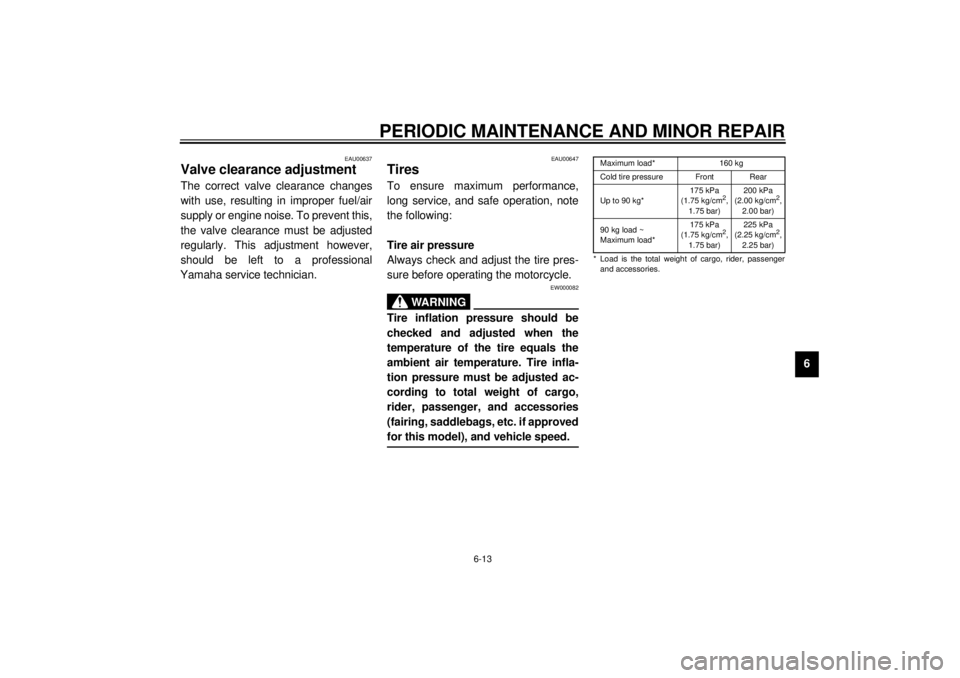
Tire air pressure
Always check and adjust the tire pres-
sure before operating the motorcycle.
EW000082
WARNING
@ Tire inflation pressure should be
checked and adjusted when the
temperature of the tire equals the
ambient air temperature. Tire infla-
tion pressure must be adjusted ac-
cording to total weight of cargo,
rider, passenger, and accessories
(fairing, saddlebags, etc. if approved
for this model), and vehicle speed. @
CE-32EMaximum load* 160 kg
Cold tire pressure Front Rear
Up to 90 kg*175 kPa
(1.75 kg/cm
2,
1.75 bar)200 kPa
(2.00 kg/cm
2,
2.00 bar)
90 kg load ~
Maximum load*175 kPa
(1.75 kg/cm
2,
1.75 bar)225 kPa
(2.25 kg/cm
2,
2.25 bar)
* Load is the total weight of cargo, rider, passenger
and accessories.
E_3mw.book Page 13 Monday, February 5, 2001 9:54 AM
Page 44 of 78
PERIODIC MAINTENANCE AND MINOR REPAIR
6-14
6
EW000083
WARNING
@ Proper loading of your motorcycle
is important for several characteris-
tics of your motorcycle, such as
handling, braking, performance and
safety. Do not carry loosely packed
items that can shift. Securely pack
your heaviest items close to the
center of the motorcycle, and dis-
tribute the weight evenly from side
to side. Properly adjust the suspen-
sion for your load, and check the
condition and pressure of your tires.
NEVER OVERLOAD YOUR MOTOR-
CYCLE. Make sure the total weight
of the cargo, rider, passenger, and
accessories (fairing, saddlebags,
etc. if approved for this model) does
not exceed the maximum load of the
motorcycle. Operation of an over-
loaded motorcycle could cause tire
damage, an accident, or even injury. @
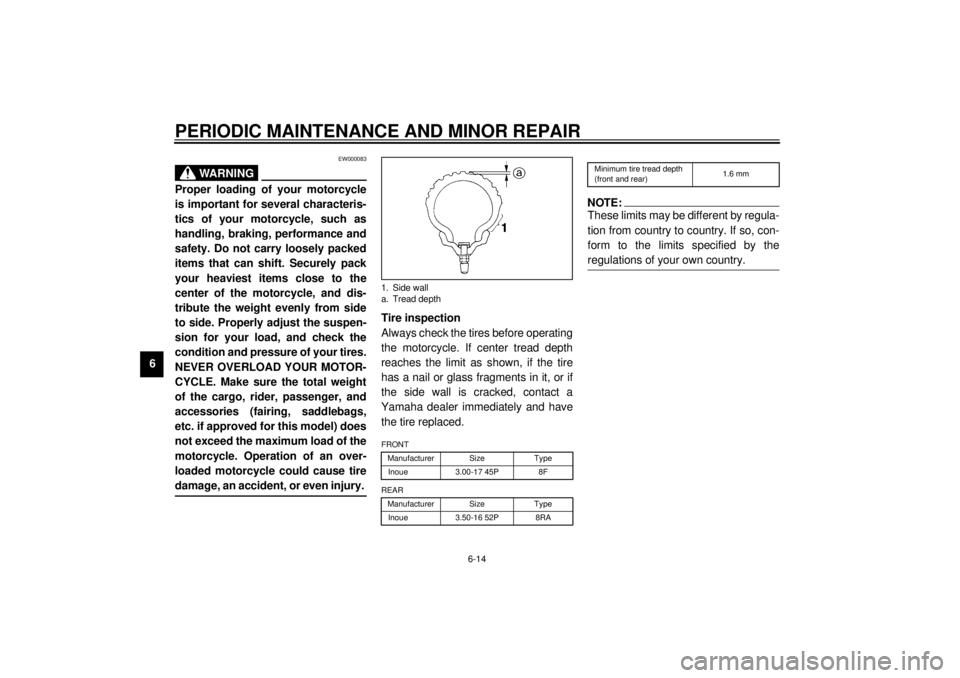
Tire inspection
Always check the tires before operating
the motorcycle. If center tread depth
reaches the limit as shown, if the tire
has a nail or glass fragments in it, or if
the side wall is cracked, contact a
Yamaha dealer immediately and have
the tire replaced.CE-10ECE-26E
NOTE:@ These limits may be different by regula-
tion from country to country. If so, con-
form to the limits specified by the
regulations of your own country. @
1. Side wall
a. Tread depthFRONT
Manufacturer Size Type
Inoue 3.00-17 45P 8F
REAR
Manufacturer Size Type
Inoue 3.50-16 52P 8RA
Minimum tire tread depth
(front and rear)1.6 mm
E_3mw.book Page 14 Monday, February 5, 2001 9:54 AM
Page 45 of 78
PERIODIC MAINTENANCE AND MINOR REPAIR
6-15
6
EAU00681
WARNING
@ l
Operating the motorcycle with
excessively worn tires decrease
riding stability and can lead to
loss of control. Have excessive-
ly worn tires replaced by a
Yamaha dealer immediately.
Brakes, tires, and related wheel
parts replacement should be
left to a Yamaha Service Techni-
cian.
l
Patching a punctured tube is
not recommended. If it is abso-
lutely necessary to do so, use
great care and replace the tube
as soon as possible with a good
quality replacement.
@
EAU00685
WheelsTo ensure maximum performance,
long service, and safe operation, note
the following:l
Always inspect the wheels before
a ride. Check for cracks, bends or
warpage of the wheel. Be sure the
spokes are tight and undamaged.
If any abnormal condition exists in
a wheel, consult a Yamaha dealer.
Do not attempt even small repairs
to the wheel. If a wheel is de-
formed or cracked, it must be re-
placed.
l
Tires and wheels should be bal-
anced whenever either one is
changed or replaced. Failure to
have a wheel balanced can result
in poor performance, adverse han-
dling characteristics, and short-
ened tire life.
l
Ride at moderate speeds after
changing a tire since the tire sur-
face must first be broken in for it to
develop its optimal characteristics.
E_3mw.book Page 15 Monday, February 5, 2001 9:54 AM
Page 47 of 78
PERIODIC MAINTENANCE AND MINOR REPAIR
6-17
6
EW000099
WARNING
@ l
Check the brake lever free play.
Be sure the brake is working
properly.
l
A soft or spongy feeling in the
brake lever can indicate the
presence of air in the brake sys-
tem. This air must be removed
by bleeding the brake system
before the motorcycle is operat-
ed. Air in the system will cause
greatly diminished braking ca-
pability and can result in loss of
control and an accident. Have a
Yamaha dealer inspect and
bleed the system if necessary.
@
EAU01105
Rear brake pedal height and
free play adjustment
EW000104
WARNING
@ It is advisable to have a Yamaha
dealer make this adjustment. @
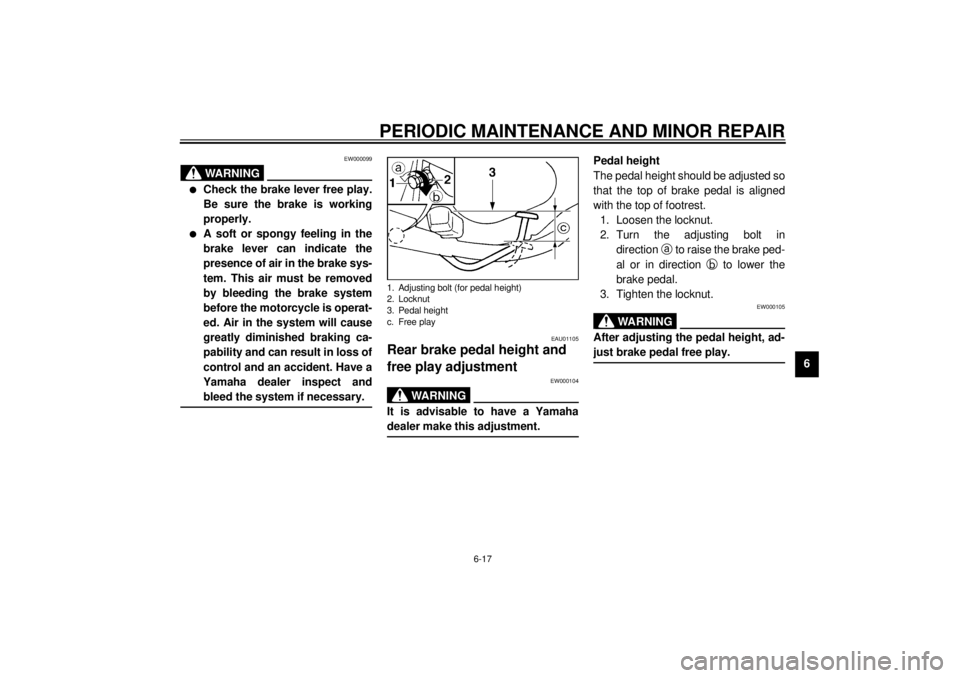
Pedal height
The pedal height should be adjusted so
that the top of brake pedal is aligned
with the top of footrest.
1. Loosen the locknut.
2. Turn the adjusting bolt in
direction
a to raise the brake ped-
al or in direction
b to lower the
brake pedal.
3. Tighten the locknut.
EW000105
WARNING
@ After adjusting the pedal height, ad-
just brake pedal free play. @
1. Adjusting bolt (for pedal height)
2. Locknut
3. Pedal height
c. Free play
E_3mw.book Page 17 Monday, February 5, 2001 9:54 AM
Page 48 of 78
PERIODIC MAINTENANCE AND MINOR REPAIR
6-18
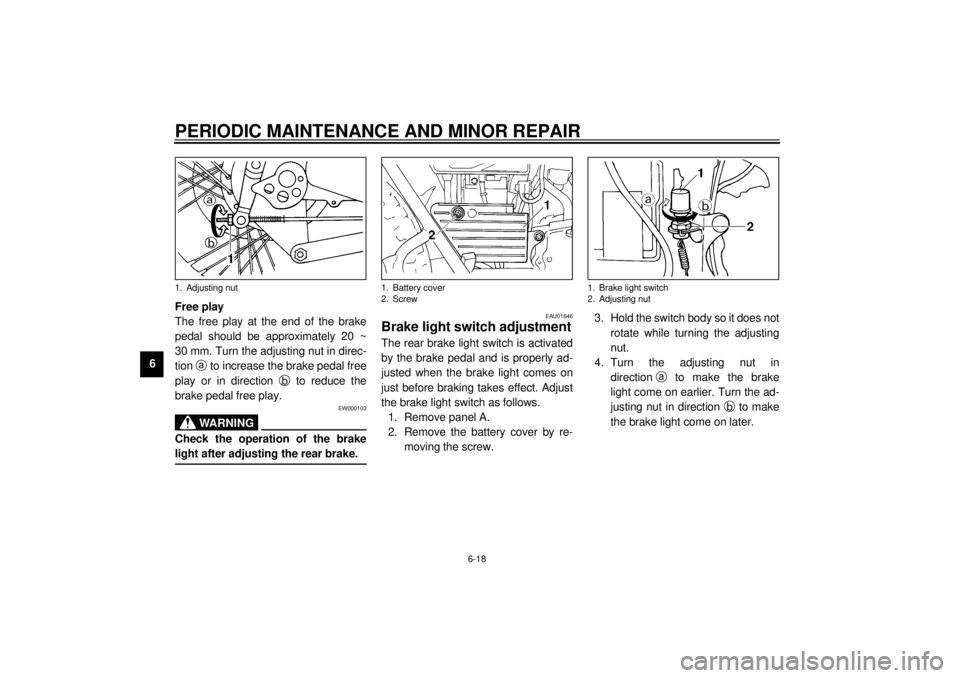
6Free play
The free play at the end of the brake
pedal should be approximately 20 ~
30 mm. Turn the adjusting nut in direc-
tion
a to increase the brake pedal free
play or in direction
b to reduce the
brake pedal free play.
EW000103
WARNING
@ Check the operation of the brake
light after adjusting the rear brake. @
EAU01646
Brake light switch adjustmentThe rear brake light switch is activated
by the brake pedal and is properly ad-
justed when the brake light comes on
just before braking takes effect. Adjust
the brake light switch as follows.
1. Remove panel A.
2. Remove the battery cover by re-
moving the screw.3. Hold the switch body so it does not
rotate while turning the adjusting
nut.
4. Turn the adjusting nut in
direction
a to make the brake
light come on earlier. Turn the ad-
justing nut in direction
b to make
the brake light come on later.
1. Adjusting nut
1. Battery cover
2. Screw
1. Brake light switch
2. Adjusting nut
E_3mw.book Page 18 Monday, February 5, 2001 9:54 AM
Page 52 of 78

PERIODIC MAINTENANCE AND MINOR REPAIR
6-22
6
EAU01533
Drive chain slack adjustment1. Loosen the rear brake adjusting
nut.
2. Loosen the wheel axle nut.3. To tighten the chain, turn the chain
adjusting plates in direction
a.
To loosen the chain, turn the chain
adjusting plates in direction
b and
push the wheel forward. Turn each
chain adjusting plate to exactly the
same position to maintain correct
axle alignment.
EC000096
CAUTION:@ Too little chain slack will overload
the engine and other vital parts.
Keep the slack within the specified
limits. @
4. Tighten the wheel axle nut to the
specified torque.
5. Adjust the brake pedal free play.
EW000103
WARNING
@ Check the operation of the brake
light after adjusting the rear brake. @
1. Adjusting nut
1. Axle nut
2. Chain adjusting plate
Tightening torque:
Wheel axle nut:
65 Nm (6.5 m·kg)
E_3mw.book Page 22 Monday, February 5, 2001 9:54 AM
Page 53 of 78
PERIODIC MAINTENANCE AND MINOR REPAIR
6-23
6
EAU01106*
Drive chain lubricationThe chain consists of many parts which
work with each other. If the chain is not
maintained properly, it will wear out
quickly. Therefore, the chain must be
serviced regularly. This service is es-
pecially necessary when riding in dusty
areas.
The drive chain should be lubricated
every 500 km. First, remove all dirt and
mud from the chain with a brush or
cloth. Then, spray any of the many
brands of spray-type chain lubricant
between both rows of side plates and
on all center rollers.
To clean the chain thoroughly, remove
it from the motorcycle, dip it in solvent,
and clean out as much dirt as possible.
Then, take the chain out of the solvent
to dry it, and immediately lubricate it to
prevent it from rusting.
EAU02962
Cable inspection and
lubrication
EW000112
WARNING
@ Damage to the outer housing of ca-
bles may lead to internal rusting and
interfere with the cable movement.
Replace damaged cables as soon as
possible to prevent unsafe condi-
tions. @Lubricate the cables and cable ends. If
a cable does not operate smoothly, ask
a Yamaha dealer to replace it.
EAU00773
Throttle cable and grip
lubricationThe throttle twist grip assembly should
be greased at the time that the cable is
lubricated, since the grip must be re-
moved to get at the end of the throttle
cable. After removing the screws, hold
the end of the cable up in the air and
put in several drops of lubricant. With
the throttle grip disassembled, coat the
metal surface of the grip assembly with
a suitable all-purpose grease.
Recommended lubricant:
Engine oil
E_3mw.book Page 23 Monday, February 5, 2001 9:54 AM
Page 55 of 78
PERIODIC MAINTENANCE AND MINOR REPAIR
6-25
6
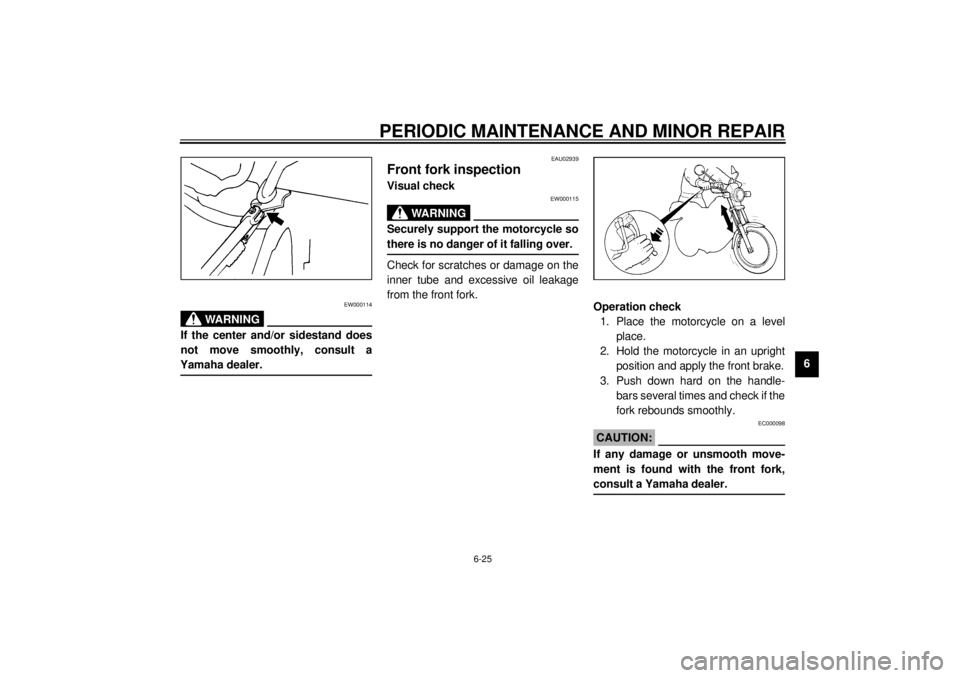
EW000114
WARNING
@ If the center and/or sidestand does
not move smoothly, consult a
Yamaha dealer. @
EAU02939
Front fork inspectionVisual check
EW000115
WARNING
@ Securely support the motorcycle so
there is no danger of it falling over. @Check for scratches or damage on the
inner tube and excessive oil leakage
from the front fork.
Operation check
1. Place the motorcycle on a level
place.
2. Hold the motorcycle in an upright
position and apply the front brake.
3. Push down hard on the handle-
bars several times and check if the
fork rebounds smoothly.
EC000098
CAUTION:@ If any damage or unsmooth move-
ment is found with the front fork,
consult a Yamaha dealer. @
E_3mw.book Page 25 Monday, February 5, 2001 9:54 AM