key YAMAHA SR400 2016 User Guide
[x] Cancel search | Manufacturer: YAMAHA, Model Year: 2016, Model line: SR400, Model: YAMAHA SR400 2016Pages: 96, PDF Size: 2.52 MB
Page 38 of 96
Operation and important riding points
5-6
1
2
3
4
5
6
7
8
9
10
11
12
13
14
EAU17214
Parking
When parking, stop the engine, and
then remove the key from the main
switch.
WARNING
EWA10312
Since the engine and exhaust
system can become very hot,
park in a place where pedestri-
ans or children are not likely to
touch them and be burned.
Do not park on a slope or on soft
ground, otherwise the vehicle
may overturn, increasing the
risk of a fuel leak and fire.
Do not park near grass or other
flammable materials which
might catch fire.
2RD-28199-E1.book 6 ページ 2015年9月3日 木曜日 午後3時42分
Page 40 of 96
Periodic maintenance and adjustment
6-2
1
2
3
4
5
6
7
8
9
10
11
12
13
14
EAU17303
Emission controls not only function to
ensure cleaner air, but are also vital to
proper engine operation and maximum
performance. In the following periodic
maintenance charts, the services relat-
ed to emissions control are grouped
separately. These services require
specialized data, knowledge, and
equipment. Maintenance, replacement,
or repair of the emission control devic-
es and systems may be performed by
any repair establishment or individual
that is certified (if applicable). Yamaha
dealers are trained and equipped to
perform these particular services.
EAU59370
Owner’s tool kit
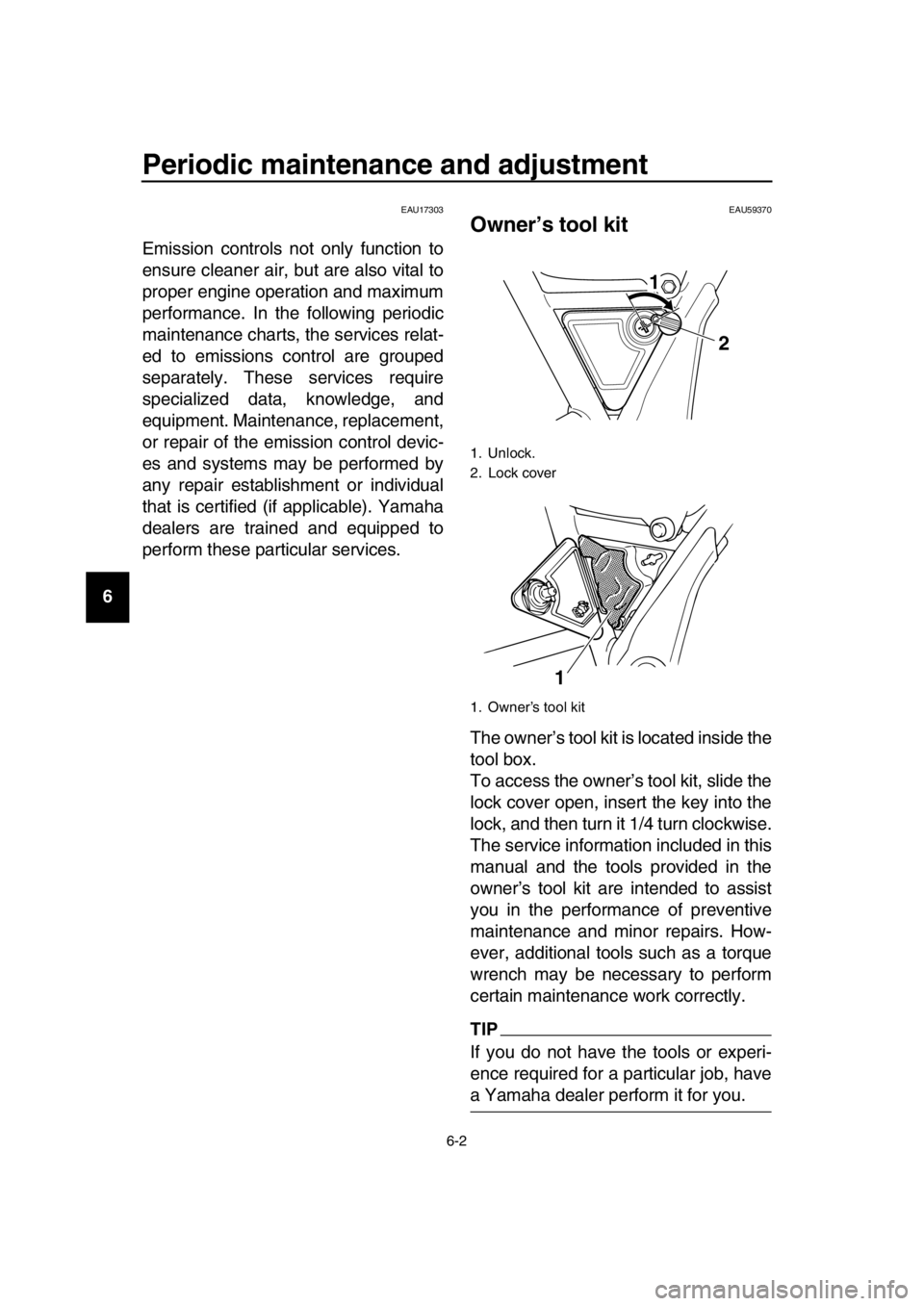
The owner’s tool kit is located inside the
tool box.
To access the owner’s tool kit, slide the
lock cover open, insert the key into the
lock, and then turn it 1/4 turn clockwise.
The service information included in this
manual and the tools provided in the
owner’s tool kit are intended to assist
you in the performance of preventive
maintenance and minor repairs. How-
ever, additional tools such as a torque
wrench may be necessary to perform
certain maintenance work correctly.
TIP
If you do not have the tools or experi-
ence required for a particular job, have
a Yamaha dealer perform it for you.
1. Unlock.
2. Lock cover
1. Owner’s tool kit
1 2
1
2RD-28199-E1.book 2 ページ 2015年9月3日 木曜日 午後3時42分
Page 45 of 96
Periodic maintenance and adjustment
6-7
1
2
3
4
5
6
7
8
9
10
11
12
13
14
EAU59460
Removing and installing the
panel
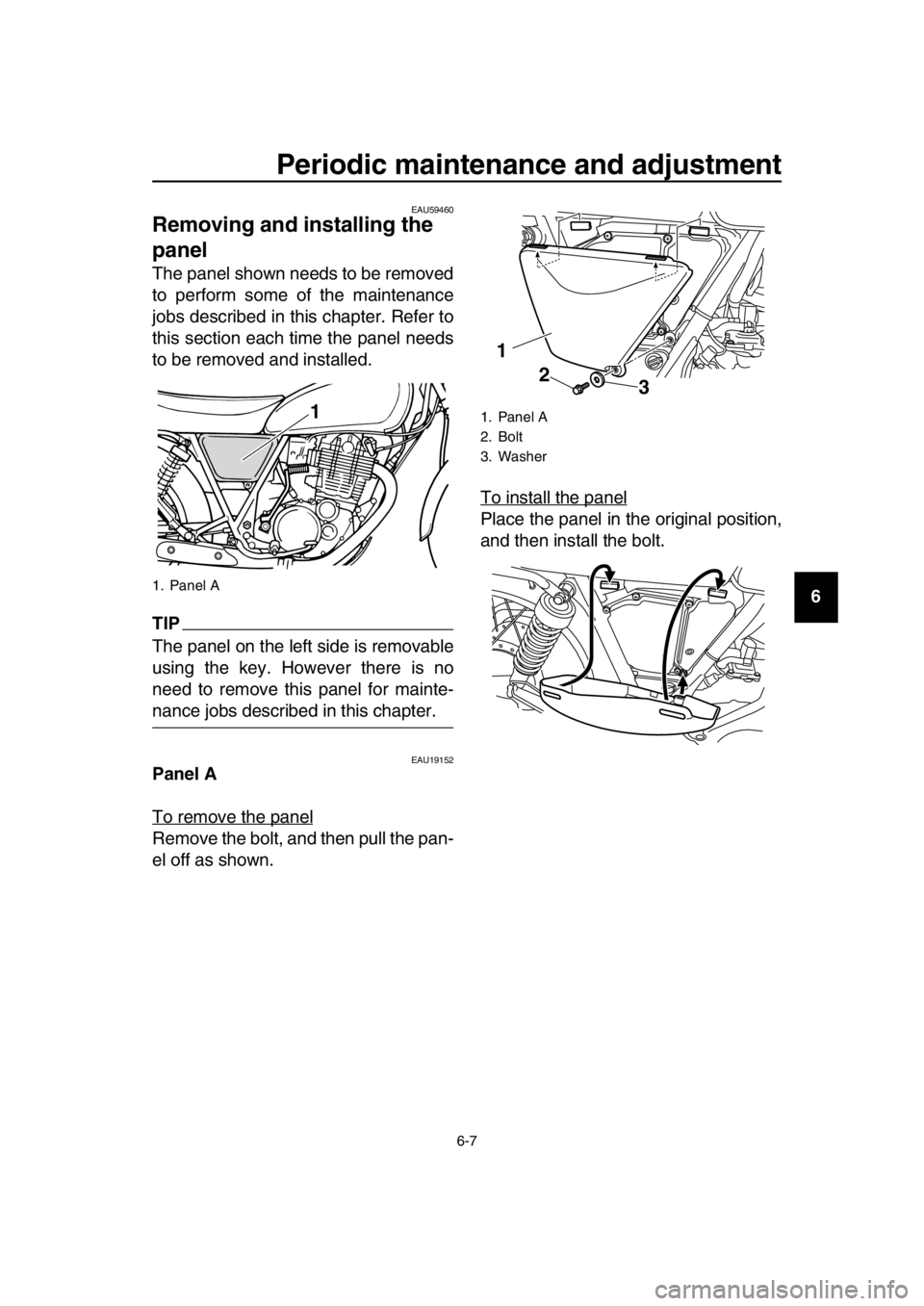
The panel shown needs to be removed
to perform some of the maintenance
jobs described in this chapter. Refer to
this section each time the panel needs
to be removed and installed.
TIP
The panel on the left side is removable
using the key. However there is no
need to remove this panel for mainte-
nance jobs described in this chapter.
EAU19152Panel A
To remove the panel
Remove the bolt, and then pull the pan-
el off as shown. To install the panel
Place the panel in the original position,
and then install the bolt.
1. Panel A
11. Panel A
2. Bolt
3. Washer
1
2
3
2RD-28199-E1.book 7 ページ 2015年9月3日 木曜日 午後3時42分
Page 70 of 96
Periodic maintenance and adjustment
6-32
1
2
3
4
5
6
7
8
9
10
11
12
13
14 sparks, flames, cigarettes, etc.,
away from the battery and pro-
vide sufficient ventilation when
charging it in an enclosed
space.
KEEP THIS AND ALL BATTER-
IES OUT OF THE REACH OF
CHILDREN.
To charge the battery
Have a Yamaha dealer charge the bat-
tery as soon as possible if it seems to
have discharged. Keep in mind that the
battery tends to discharge more quickly
if the vehicle is equipped with optional
electrical accessories.
NOTICE
ECA16522
To charge a VRLA (Valve Regulated
Lead Acid) battery, a special (con-
stant-voltage) battery charger is re-
quired. Using a conventional battery
charger will damage the battery.
To store the battery 1. If the vehicle will not be used for more than one month, remove the
battery, fully charge it, and then
place it in a cool, dry place.
NOTICE: When removing the
battery, be sure the key is
turned to “OFF” before discon-
necting the coupler.
[ECA16323]
2. If the battery will be stored for more than two months, check it at least
once a month and fully charge it if
necessary.
3. Fully charge the battery before in- stallation. NOTICE: When install-
ing the battery, be sure the key
is turned to “OFF” before con- necting the coupler.
[ECA16931]
NOTICE
ECA16531
Always keep the battery charged.
Storing a discharged battery can
cause permanent battery damage.
2RD-28199-E1.book 32 ページ 2015年9月3日 木曜日 午後3時42分
Page 71 of 96
Periodic maintenance and adjustment
6-33
1
2
3
4
5
6
7
8
9
10
11
12
13
14
EAU59443
Replacing the fuses
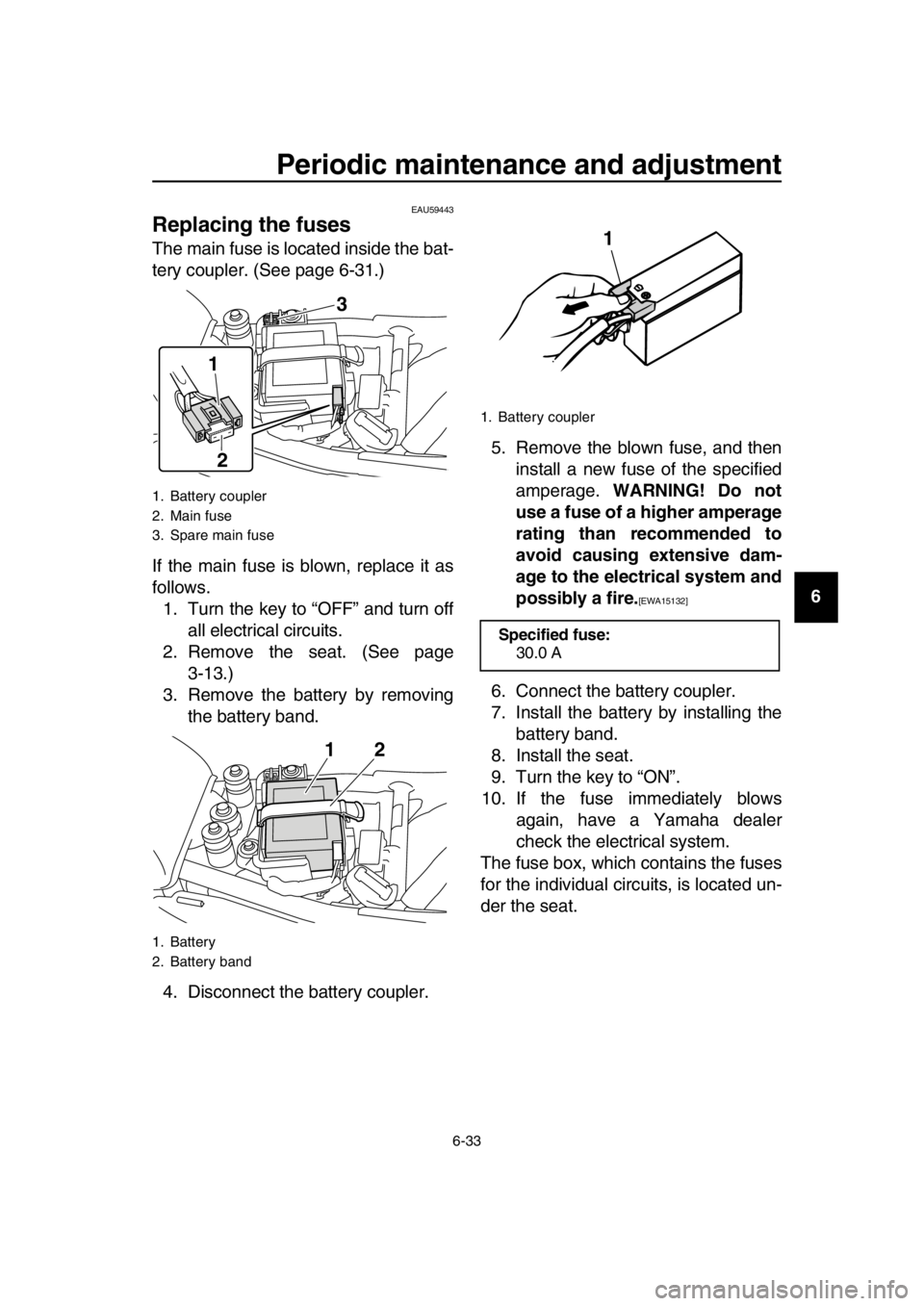
The main fuse is located inside the bat-
tery coupler. (See page 6-31.)
If the main fuse is blown, replace it as
follows. 1. Turn the key to “OFF” and turn off all electrical circuits.
2. Remove the seat. (See page 3-13.)
3. Remove the battery by removing the battery band.
4. Disconnect the battery coupler. 5. Remove the blown fuse, and then
install a new fuse of the specified
amperage. WARNING! Do not
use a fuse of a higher amperage
rating than recommended to
avoid causing extensive dam-
age to the electrical system and
possibly a fire.
[EWA15132]
6. Connect the battery coupler.
7. Install the battery by installing the battery band.
8. Install the seat.
9. Turn the key to “ON”.
10. If the fuse immediately blows again, have a Yamaha dealer
check the electrical system.
The fuse box, which contains the fuses
for the individual circ uits, is located un-
der the seat.
1. Battery coupler
2. Main fuse
3. Spare main fuse
1. Battery
2. Battery band
3
1
2
12
1. Battery coupler
Specified fuse: 30.0 A
1
2RD-28199-E1.book 33 ページ 2015年9月3日 木曜日 午後3時42分
Page 72 of 96

Periodic maintenance and adjustment
6-34
1
2
3
4
5
6
7
8
9
10
11
12
13
14 If a fuse is blown, replace it as follows.
1. Turn the key to “OFF” and turn off the electrical circuit in question.
2. Remove the seat. (See page 3-13.)
3. Remove the blown fuse, and then install a new fuse of the specified
amperage. WARNING! Do not
use a fuse of a higher amperage
rating than recommended to
avoid causing extensive dam-
age to the electrical system and
possibly a fire.
[EWA15132]
4. Turn the key to “ON” and turn on the electrical circuit in question to
check if the device operates.
5. If a fuse immediately blows again, have a Yamaha dealer check the
electrical system.
1. Fuse box
1. Headlight fuse
2. Signaling system fuse
3. Ignition fuse
4. Backup fuse
5. Fuel injection system fuse
6. Parking lighting fuse
7. Spare fuse
1
12
3 4
5
7
6
Specified fuses: Signaling system fuse:
15.0 A
Headlight fuse: 15.0 A
Ignition fuse: 10.0 A
Backup fuse:
7.5 A
Fuel injection system fuse: 7.5 A
Parking lighting fuse: 7.5 A
2RD-28199-E1.book 34 ページ 2015年9月3日 木曜日 午後3時42分
Page 81 of 96
Periodic maintenance and adjustment
6-43
1
2
3
4
5
6
7
8
9
10
11
12
13
14
EAU67930
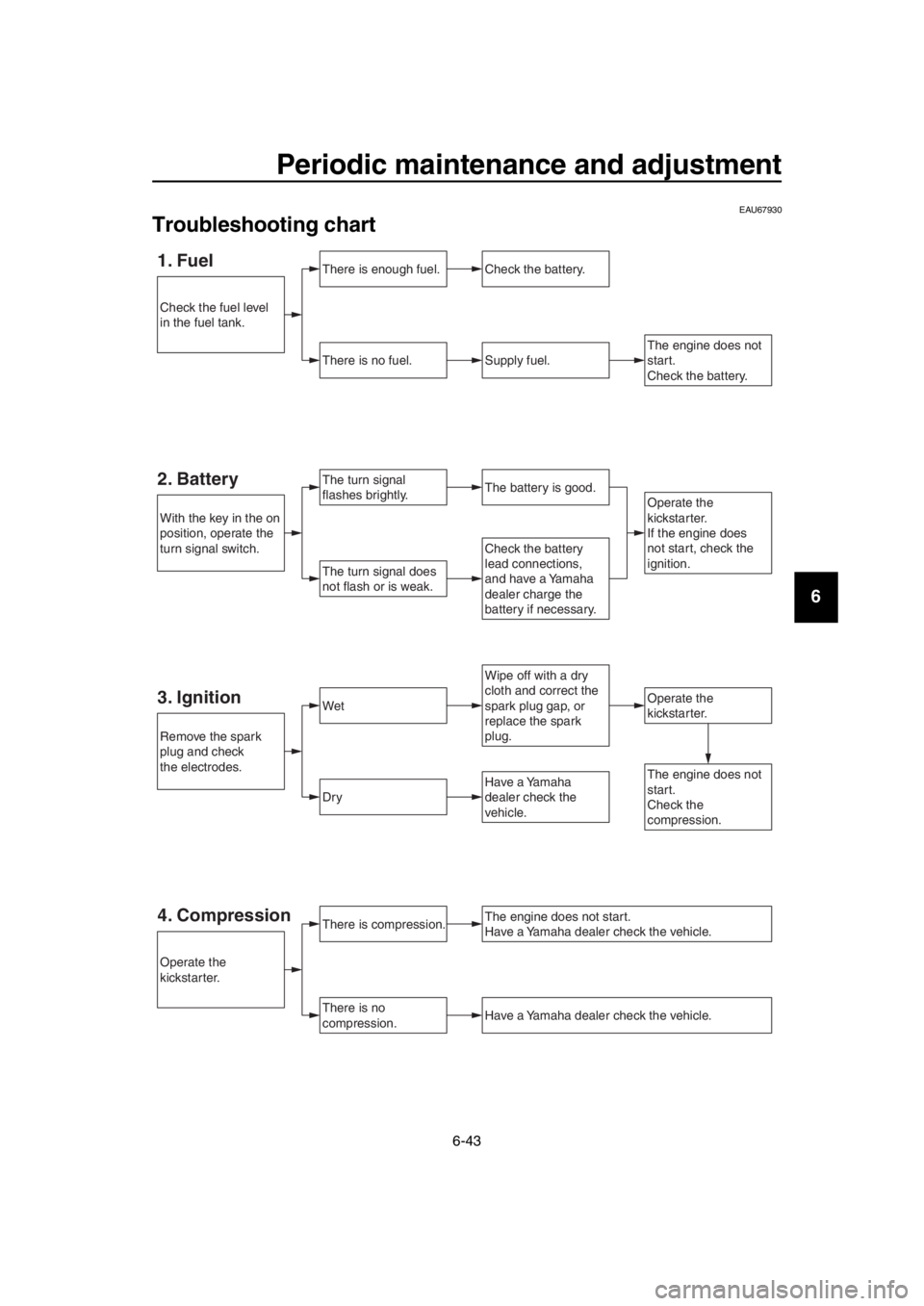
Troubleshooting chart
1. FuelThere is enough fuel.
There is no fuel.Supply fuel.
Check the battery.
The turn signal
flashes brightly.
The turn signal does
not flash or is weak.
The engine does not
start.
Check the battery.
Wipe off with a dry
cloth and correct the
spark plug gap, or
replace the spark
plug.
Check the battery
lead connections,
and have a Yamaha
dealer charge the
battery if necessary.
Operate the
kickstarter.
If the engine does
not start, check the
ignition.
2. BatteryThe battery is good.
3. IgnitionWet
Dry
There is compression.
There is no
compression.
Operate the
kickstarter.
The engine does not start.
Have a Yamaha dealer check the vehicle.
Have a Yamaha dealer check the vehicle.
The engine does not
start.
Check the
compression.Have a Yamaha
dealer check the
vehicle.
Remove the spark
plug and check
the electrodes.
With the key in the on
position, operate the
turn signal switch.
Operate the
kickstarter.
Check the fuel level
in the fuel tank.
4. Compression
2RD-28199-E1.book 43 ページ 2015年9月3日 木曜日 午後3時42分