warning YAMAHA SUPERJET 2013 User Guide
[x] Cancel search | Manufacturer: YAMAHA, Model Year: 2013, Model line: SUPERJET, Model: YAMAHA SUPERJET 2013Pages: 78, PDF Size: 3.29 MB
Page 44 of 78
Pre-operation checks
38
Make sure that there is the proper amount of
throttle lever free play when the throttle lever
is in the fully closed (idle) position.
EJU32663Engine shut-off cord (lanyard) check
Make sure that the engine shut-off cord (lan-
yard) is not damaged. If the cord is damaged,
replace it. WARNING! Never try to repair
the engine shut-off cord (lanyard) or tie it
together. The engine shut-off cord (lan-
yard) may not pull free when the operator
falls off, allowing the watercraft to contin-
ue to run and cause an accident.
[EWJ01220] EJU41020
Switch checks
NOTICE
ECJ01360
Do not run the engine for more than 15
seconds on land without supplying water,
otherwise the engine could overheat.
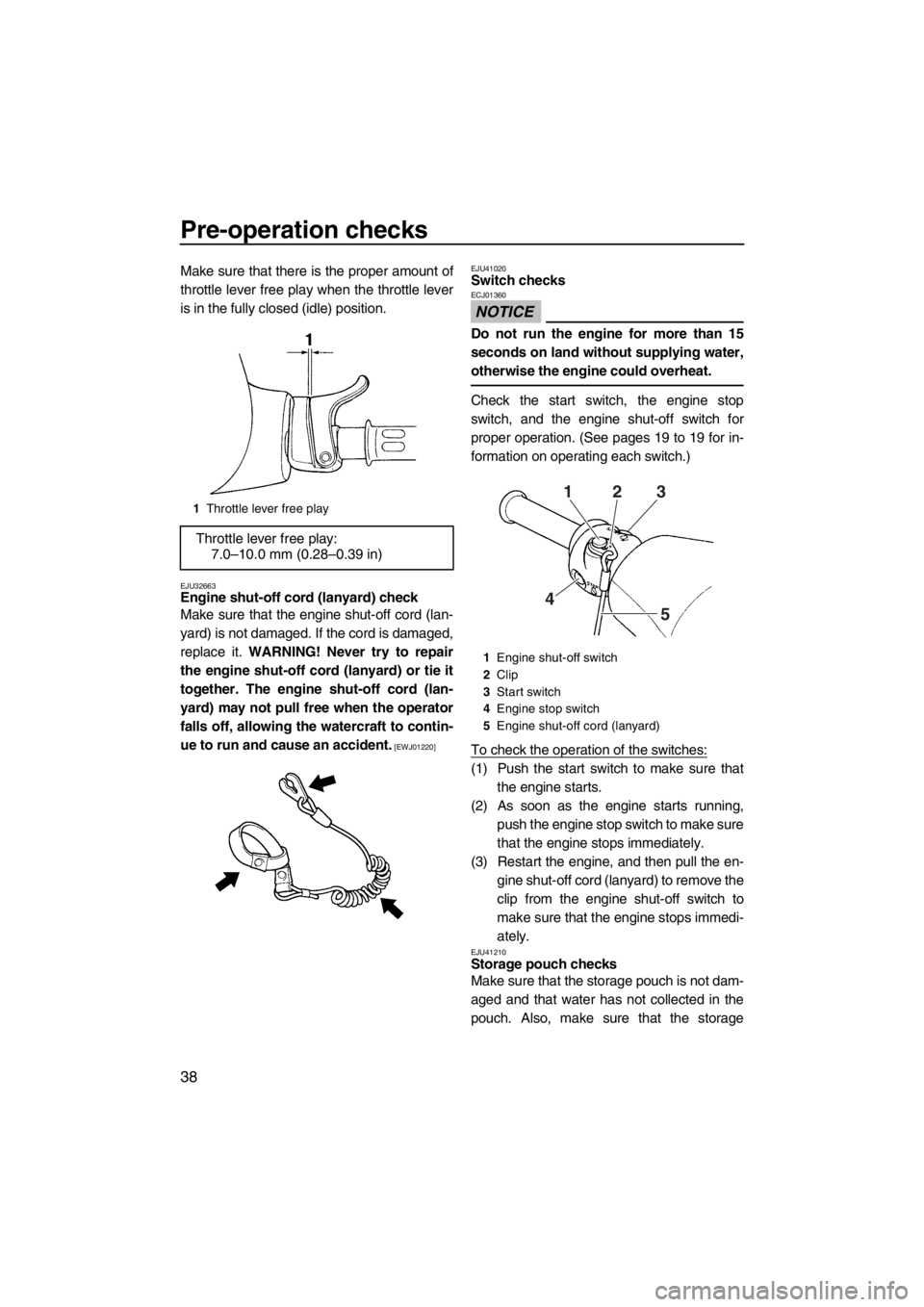
Check the start switch, the engine stop
switch, and the engine shut-off switch for
proper operation. (See pages 19 to 19 for in-
formation on operating each switch.)
To check the operation of the switches:
(1) Push the start switch to make sure that
the engine starts.
(2) As soon as the engine starts running, push the engine stop switch to make sure
that the engine stops immediately.
(3) Restart the engine, and then pull the en- gine shut-off cord (lanyard) to remove the
clip from the engine shut-off switch to
make sure that the engine stops immedi-
ately.
EJU41210Storage pouch checks
Make sure that the storage pouch is not dam-
aged and that water has not collected in the
pouch. Also, make sure that the storage
1Throttle lever free play
Throttle lever free play:
7.0–10.0 mm (0.28–0.39 in)
1Engine shut-off switch
2 Clip
3 Start switch
4 Engine stop switch
5 Engine shut-off cord (lanyard)
123
4 5
UF2F75E0.book Page 38 Thursday, July 5, 2012 8:50 AM
Page 46 of 78
Operation
40
EJU32902
Operating your watercraft
WARNING
EWJ00510
Before operating your watercraft, become
familiar with all of the controls. Consult a
Yamaha dealer about any control or func- tion that you do not fully understand. Fail-
ure to understand how the controls work
could cause an accident or prevent you
from avoiding an accident.
EJU32923Getting to know your watercraft
Operating your watercraft requires skills ac-
quired through practice over a period of time.
Take the time to learn the basic techniques
well before attempting more difficult maneu-
vers.
Operating your new watercraft can be a very
enjoyable activity, providing you with hours of
pleasure. However, it is essential to familiar-
ize yourself with the operation of the water-
craft to achieve the skill level necessary to
enjoy riding safely.
Before operating this watercraft, read this
owner’s/operator’s manual, the Riding Prac-
tice Guide, the Riding Instruction card, and all
labels on the watercraft. Pay particular atten-
tion to the safety information beginning on
page 8. These materials should give you an
understanding of the watercraft and its opera-
tion.
Remember: This watercraft is designed to
carry the operator only. Never have more than
one person on the watercraft at any time.
EJU32984Learning to operate your watercraft
Before operating the watercraft, always per-
form the pre-operation checks listed on page
33. The short time spent checking the water-
craft will reward you with added safety and re-
liability. Check local laws before operating your water-
craft.
Operate defensively at safe speeds and keep
a safe distance away from people, objects,
and other watercraft. Select a wide area to
practice maneuvering in, where there is good
visibility and light boat traffic.
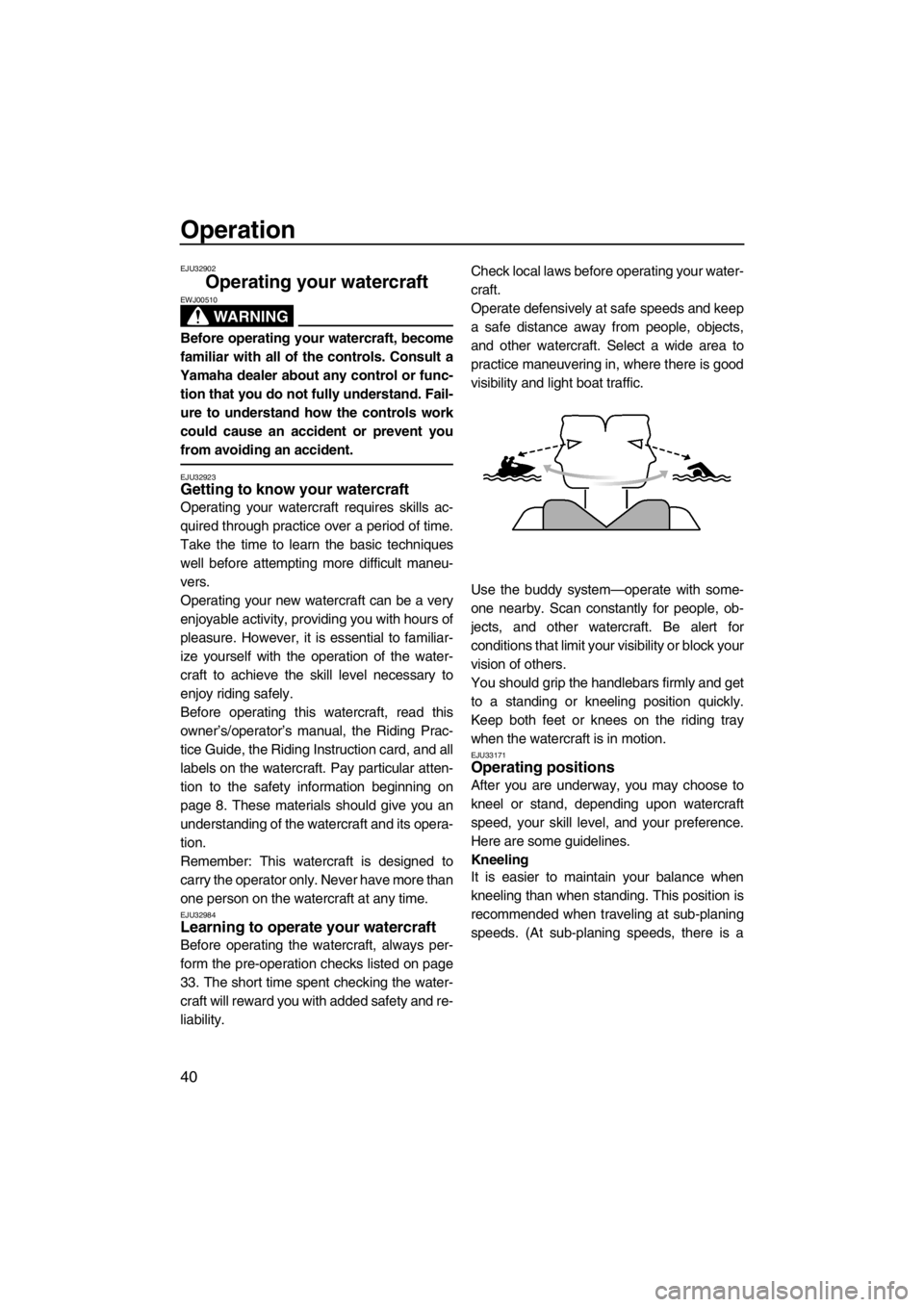
Use the buddy system—operate with some-
one nearby. Scan constantly for people, ob-
jects, and other watercraft. Be alert for
conditions that limit your visibility or block your
vision of others.
You should grip the handlebars firmly and get
to a standing or kneeling position quickly.
Keep both feet or knees on the riding tray
when the watercraft is in motion.
EJU33171Operating positions
After you are underway, you may choose to
kneel or stand, depending upon watercraft
speed, your skill level,
and your preference.
Here are some guidelines.
Kneeling
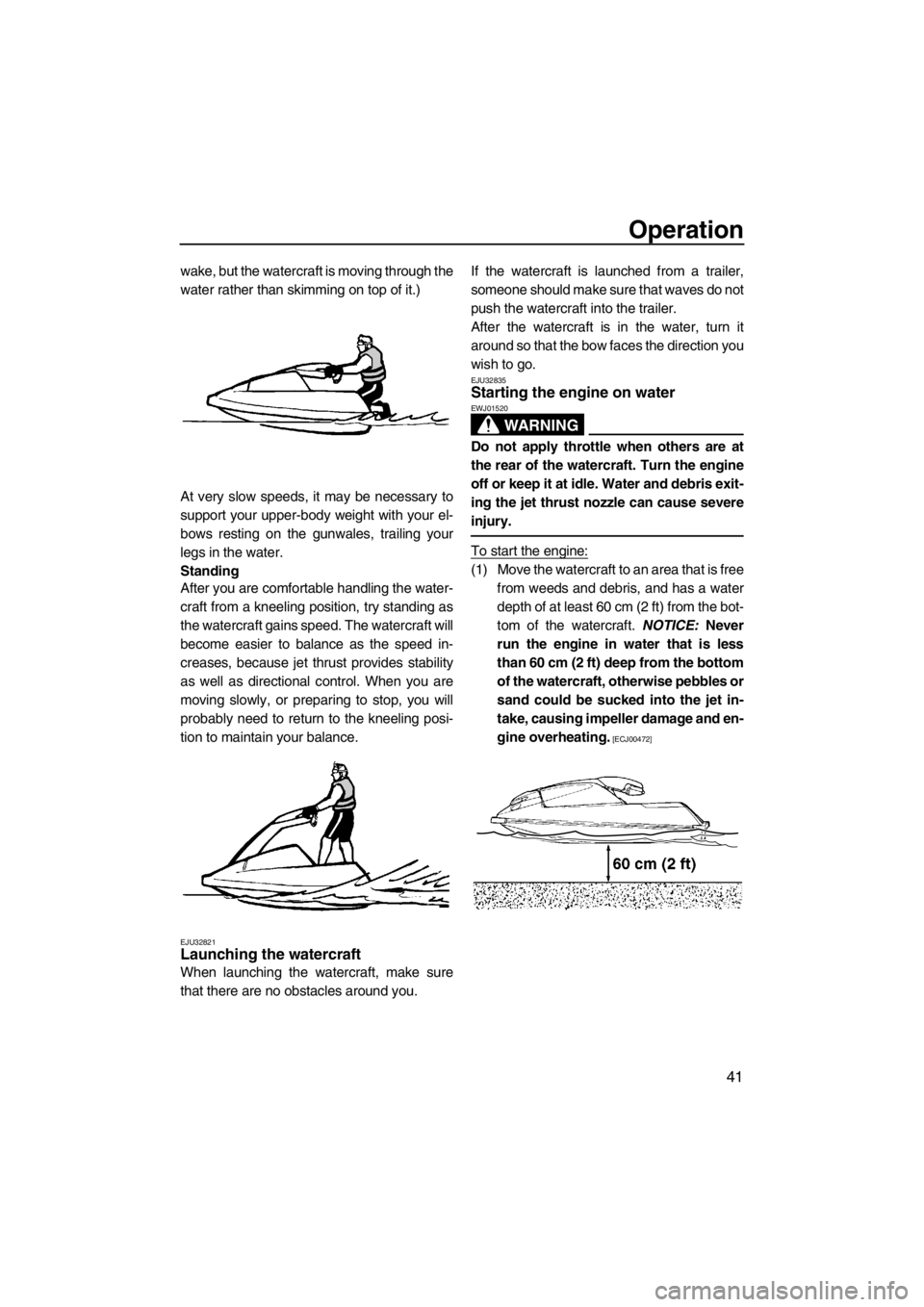
It is easier to maintain your balance when
kneeling than when standing. This position is
recommended when traveling at sub-planing
speeds. (At sub-planing speeds, there is a
UF2F75E0.book Page 40 Thursday, July 5, 2012 8:50 AM
Page 47 of 78
Operation
41
wake, but the watercraft is moving through the
water rather than skimming on top of it.)
At very slow speeds, it may be necessary to
support your upper-body weight with your el-
bows resting on the gunwales, trailing your
legs in the water.
Standing
After you are comfortable handling the water-
craft from a kneeling position, try standing as
the watercraft gains speed. The watercraft will
become easier to balance as the speed in-
creases, because jet thrust provides stability
as well as directional control. When you are
moving slowly, or preparing to stop, you will
probably need to return to the kneeling posi-
tion to maintain your balance.
EJU32821Launching the watercraft
When launching the watercraft, make sure
that there are no obstacles around you.If the watercraft is launched from a trailer,
someone should make sure that waves do not
push the watercraft into the trailer.
After the watercraft is in the water, turn it
around so that the bow faces the direction you
wish to go.
EJU32835Starting the engine on water
WARNING
EWJ01520
Do not apply throttle when others are at
the rear of the watercraft. Turn the engine
off or keep it at idle. Water and debris exit-
ing the jet thrust nozzle can cause severe
injury.
To start the engine:
(1) Move the watercraft to an area that is free
from weeds and debris, and has a water
depth of at least 60 cm (2 ft) from the bot-
tom of the watercraft. NOTICE: Never
run the engine in water that is less
than 60 cm (2 ft) deep from the bottom
of the watercraft, otherwise pebbles or
sand could be sucked into the jet in-
take, causing impeller damage and en-
gine overheating.
[ECJ00472]
UF2F75E0.book Page 41 Thursday, July 5, 2012 8:50 AM
Page 48 of 78
Operation
42
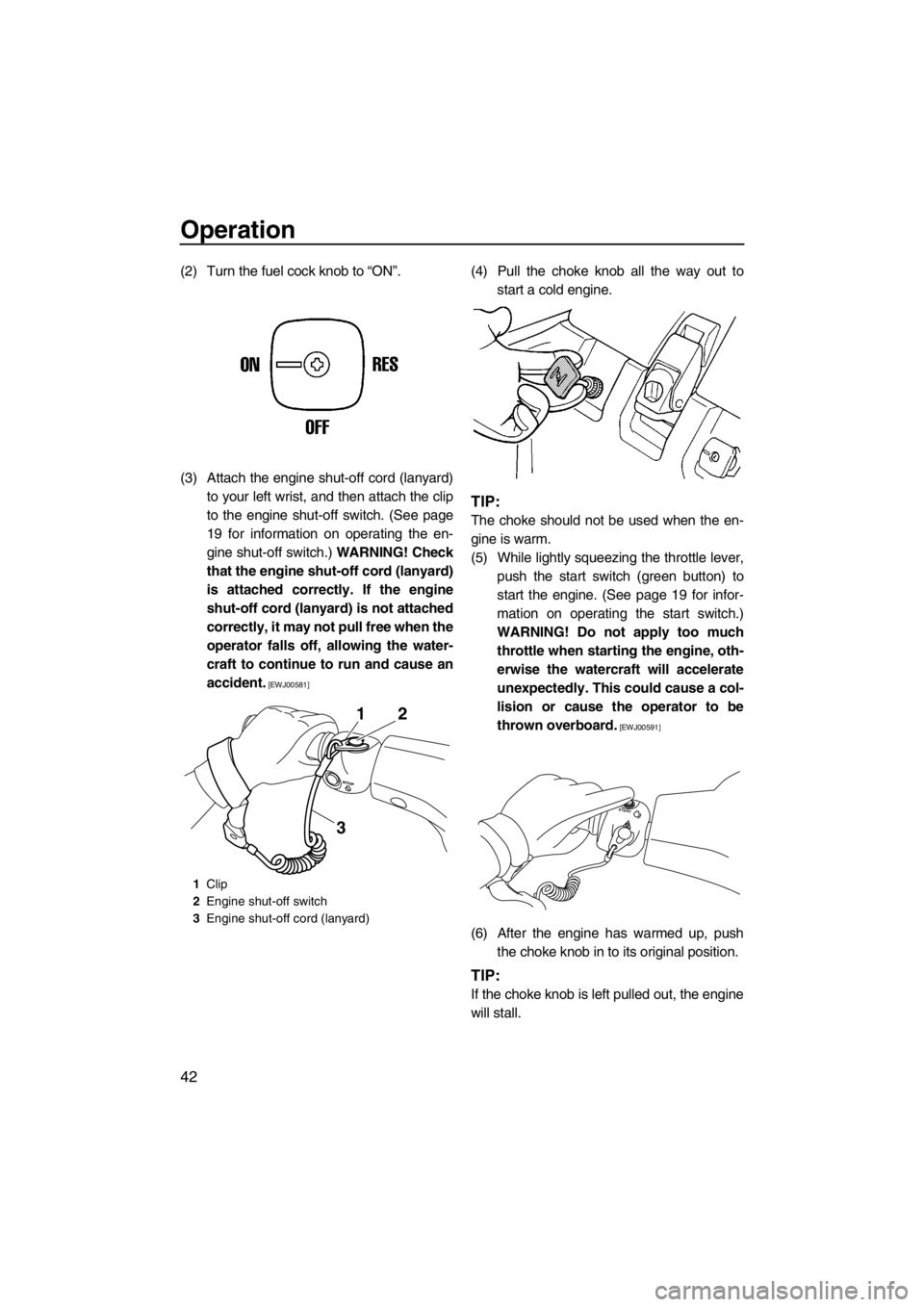
(2) Turn the fuel cock knob to “ON”.
(3) Attach the engine shut-off cord (lanyard)to your left wrist, and then attach the clip
to the engine shut-off switch. (See page
19 for information on operating the en-
gine shut-off switch.) WARNING! Check
that the engine shut-off cord (lanyard)
is attached correctly. If the engine
shut-off cord (lanyard) is not attached
correctly, it may not pull free when the
operator falls off, allowing the water-
craft to continue to run and cause an
accident.
[EWJ00581]
(4) Pull the choke knob all the way out to start a cold engine.
TIP:
The choke should not be used when the en-
gine is warm.
(5) While lightly squeezing the throttle lever,push the start switch (green button) to
start the engine. (See page 19 for infor-
mation on operating the start switch.)
WARNING! Do not apply too much throttle when starting the engine, oth-
erwise the watercraft will accelerate
unexpectedly. This could cause a col-
lision or cause the operator to be
thrown overboard.
[EWJ00591]
(6) After the engine has warmed up, push the choke knob in to its original position.
TIP:
If the choke knob is left pulled out, the engine
will stall.
1Clip
2 Engine shut-off switch
3 Engine shut-off cord (lanyard)
12
3
START
UF2F75E0.book Page 42 Thursday, July 5, 2012 8:50 AM
Page 49 of 78
Operation
43
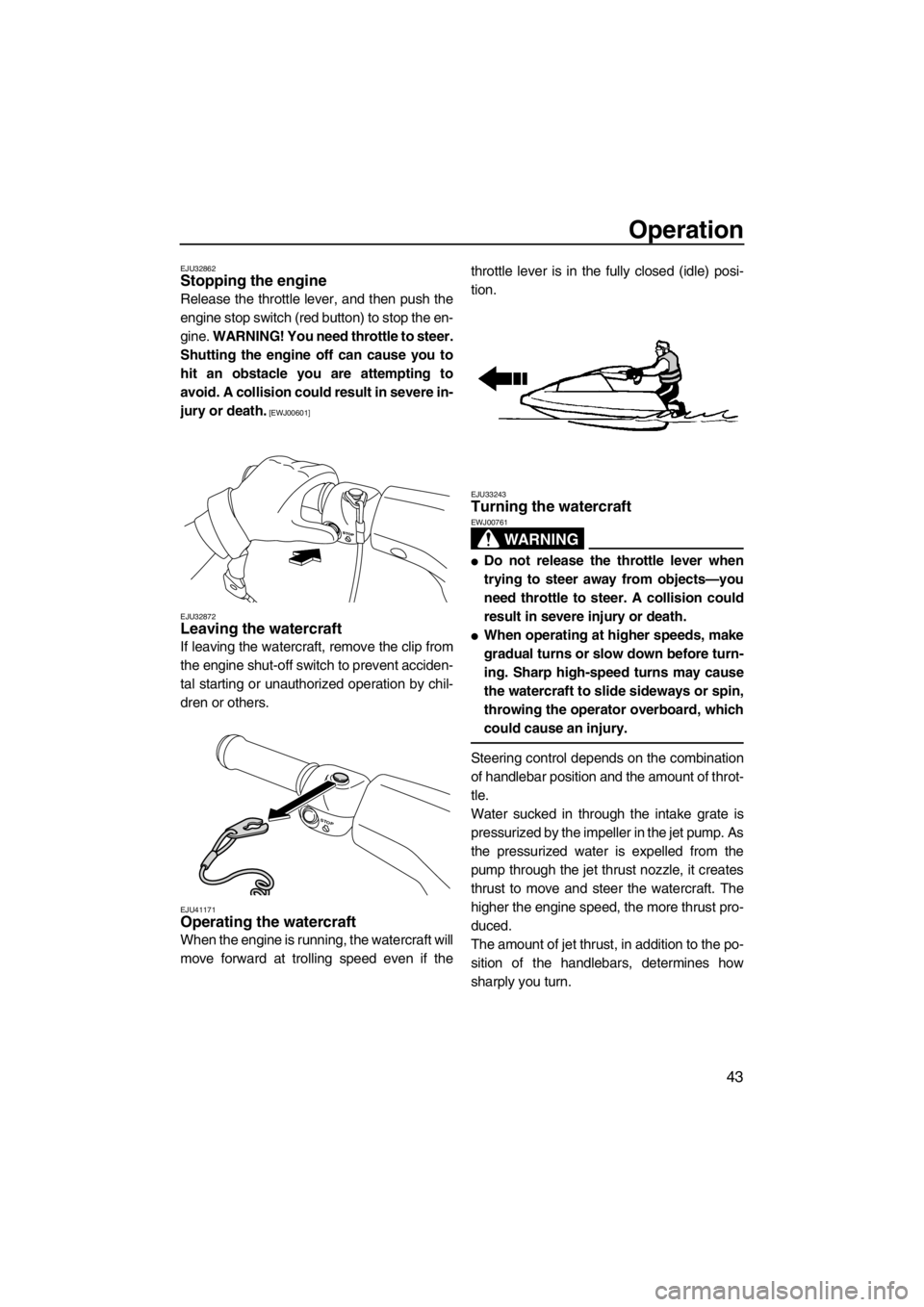
EJU32862Stopping the engine
Release the throttle lever, and then push the
engine stop switch (red button) to stop the en-
gine. WARNING! You need throttle to steer.
Shutting the engine off can cause you to
hit an obstacle you are attempting to
avoid. A collision could result in severe in-
jury or death.
[EWJ00601]
EJU32872
Leaving the watercraft
If leaving the watercraft, remove the clip from
the engine shut-off switch to prevent acciden-
tal starting or unauthorized operation by chil-
dren or others.
EJU41171Operating the watercraft
When the engine is running, the watercraft will
move forward at trolling speed even if the throttle lever is in the fully closed (idle) posi-
tion.
EJU33243Turning the watercraft
WARNING
EWJ00761
●Do not release the throttle lever when
trying to steer away from objects—you
need throttle to steer. A collision could
result in severe injury or death.
●When operating at higher speeds, make
gradual turns or slow down before turn-
ing. Sharp high-speed turns may cause
the watercraft to slide sideways or spin,
throwing the operator overboard, which
could cause an injury.
Steering control depends on the combination
of handlebar position and the amount of throt-
tle.
Water sucked in through the intake grate is
pressurized by the impeller in the jet pump. As
the pressurized water is expelled from the
pump through the jet thrust nozzle, it creates
thrust to move and steer the watercraft. The
higher the engine speed, the more thrust pro-
duced.
The amount of jet thrust, in addition to the po-
sition of the handlebars, determines how
sharply you turn.
STOP
UF2F75E0.book Page 43 Thursday, July 5, 2012 8:50 AM
Page 51 of 78
Operation
45
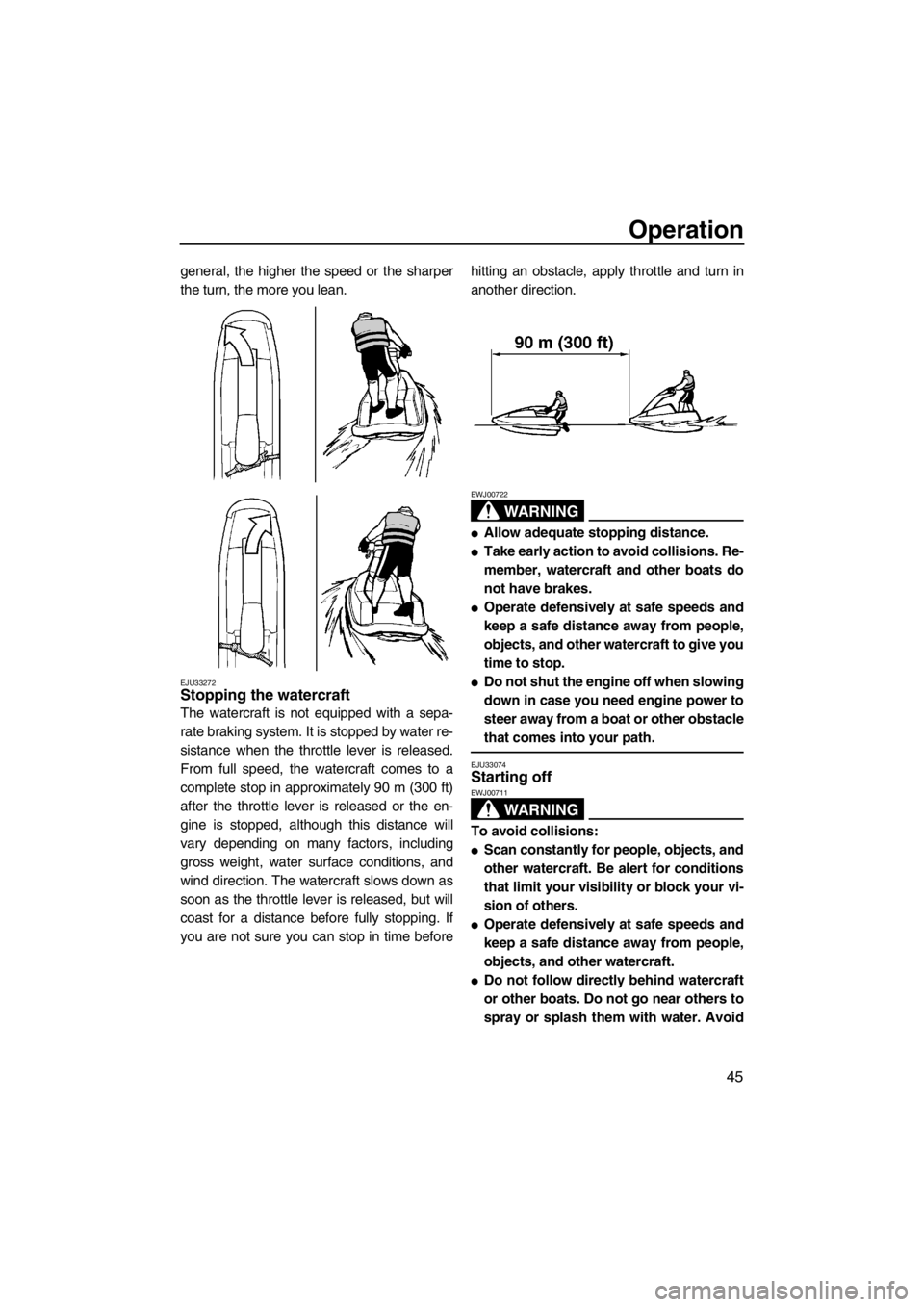
general, the higher the speed or the sharper
the turn, the more you lean.
EJU33272Stopping the watercraft
The watercraft is not equipped with a sepa-
rate braking system. It is stopped by water re-
sistance when the throttle lever is released.
From full speed, the watercraft comes to a
complete stop in approximately 90 m (300 ft)
after the throttle lever is released or the en-
gine is stopped, although this distance will
vary depending on many factors, including
gross weight, water surface conditions, and
wind direction. The watercraft slows down as
soon as the throttle lever is released, but will
coast for a distance before fully stopping. If
you are not sure you can stop in time beforehitting an obstacle, apply throttle and turn in
another direction.
WARNING
EWJ00722
●Allow adequate stopping distance.
●Take early action to avoid collisions. Re-
member, watercraft and other boats do
not have brakes.
●Operate defensively at safe speeds and
keep a safe distance away from people,
objects, and other watercraft to give you
time to stop.
●Do not shut the engine off when slowing
down in case you need engine power to
steer away from a boat or other obstacle
that comes into your path.
EJU33074Starting off
WARNING
EWJ00711
To avoid collisions:
●Scan constantly for people, objects, and
other watercraft. Be alert for conditions
that limit your visibility or block your vi-
sion of others.
●Operate defensively at safe speeds and
keep a safe distance away from people,
objects, and other watercraft.
●Do not follow directly behind watercraft
or other boats. Do not go near others to
spray or splash them with water. Avoid
UF2F75E0.book Page 45 Thursday, July 5, 2012 8:50 AM
Page 52 of 78
Operation
46
sharp turns or other maneuvers that
make it hard for others to avoid you or
understand where you are going. Avoid
areas with submerged objects or shal-
low water.
●Take early action to avoid collisions. Re-
member, watercraft and other boats do
not have brakes. Do not release the
throttle lever when trying to steer away
from objects—you need throttle to steer.
WARNING
EWJ00632
Avoid forceful jet thrust and limited visibil-
ity while reboarding. Get to a standing or
kneeling position quickly, but do not ex-
pose yourself to the forceful jet thrust.
NOTICE
ECJ01340
Never run the engine in water that is less
than 60 cm (2 ft) deep from the bottom of
the watercraft, otherwise pebbles or sand
could be sucked into the jet intake, caus-
ing impeller damage and engine overheat-
ing.
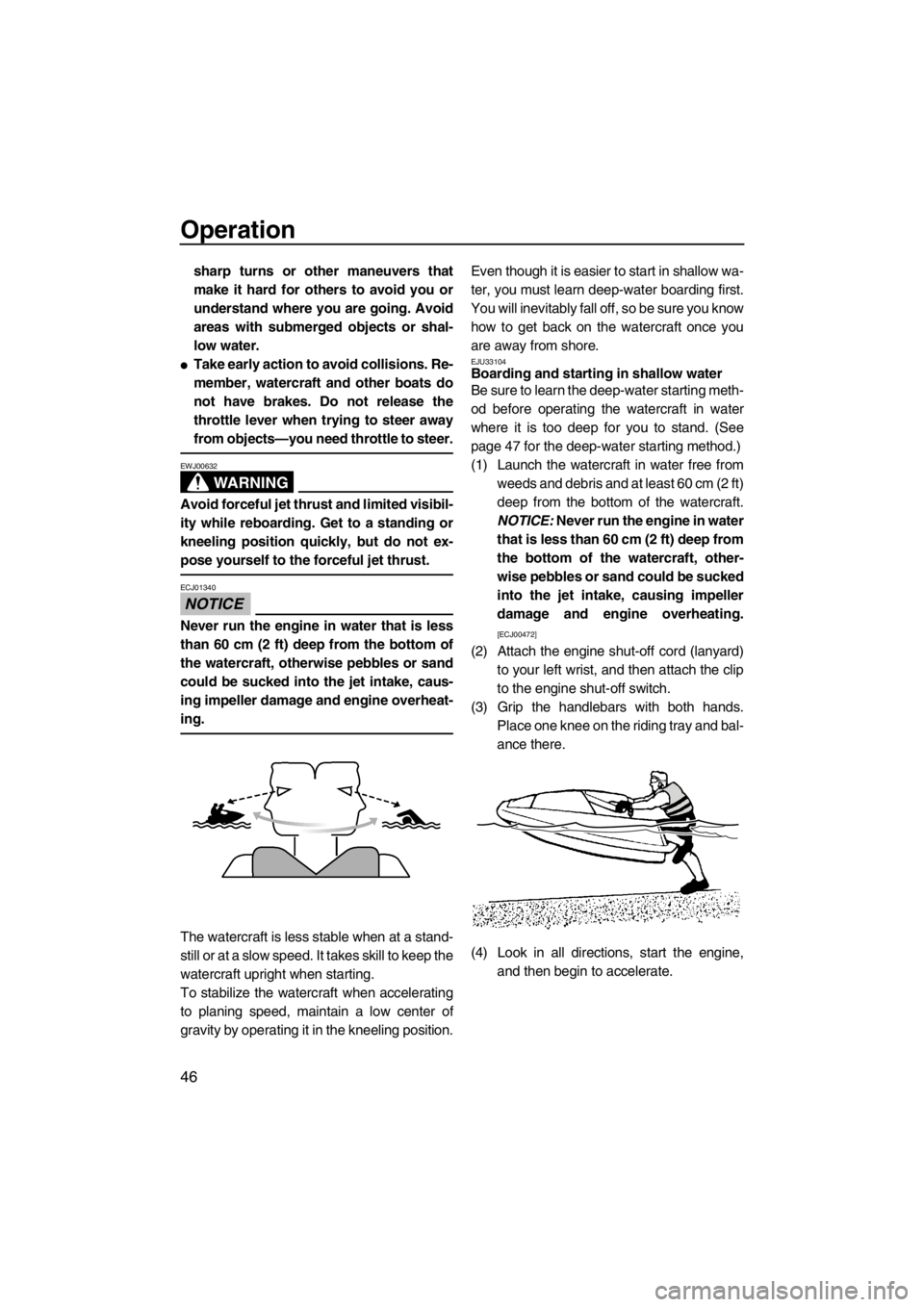
The watercraft is less stable when at a stand-
still or at a slow speed. It takes skill to keep the
watercraft upright when starting.
To stabilize the watercraft when accelerating
to planing speed, maintain a low center of
gravity by operating it in the kneeling position.Even though it is easier to start in shallow wa-
ter, you must learn deep-water boarding first.
You will inevitably fall off, so be sure you know
how to get back on the watercraft once you
are away from shore.
EJU33104Boarding and starting in shallow water
Be sure to learn the deep-water starting meth-
od before operating the watercraft in water
where it is too deep for you to stand. (See
page 47 for the deep-water starting method.)
(1) Launch the watercraft in water free from
weeds and debris and at least 60 cm (2 ft)
deep from the bottom of the watercraft.
NOTICE: Never run the engine in water
that is less than 60 cm (2 ft) deep from
the bottom of the watercraft, other-
wise pebbles or sand could be sucked
into the jet intake, causing impeller
damage and engine overheating.
[ECJ00472]
(2) Attach the engine shut-off cord (lanyard) to your left wrist, and then attach the clip
to the engine shut-off switch.
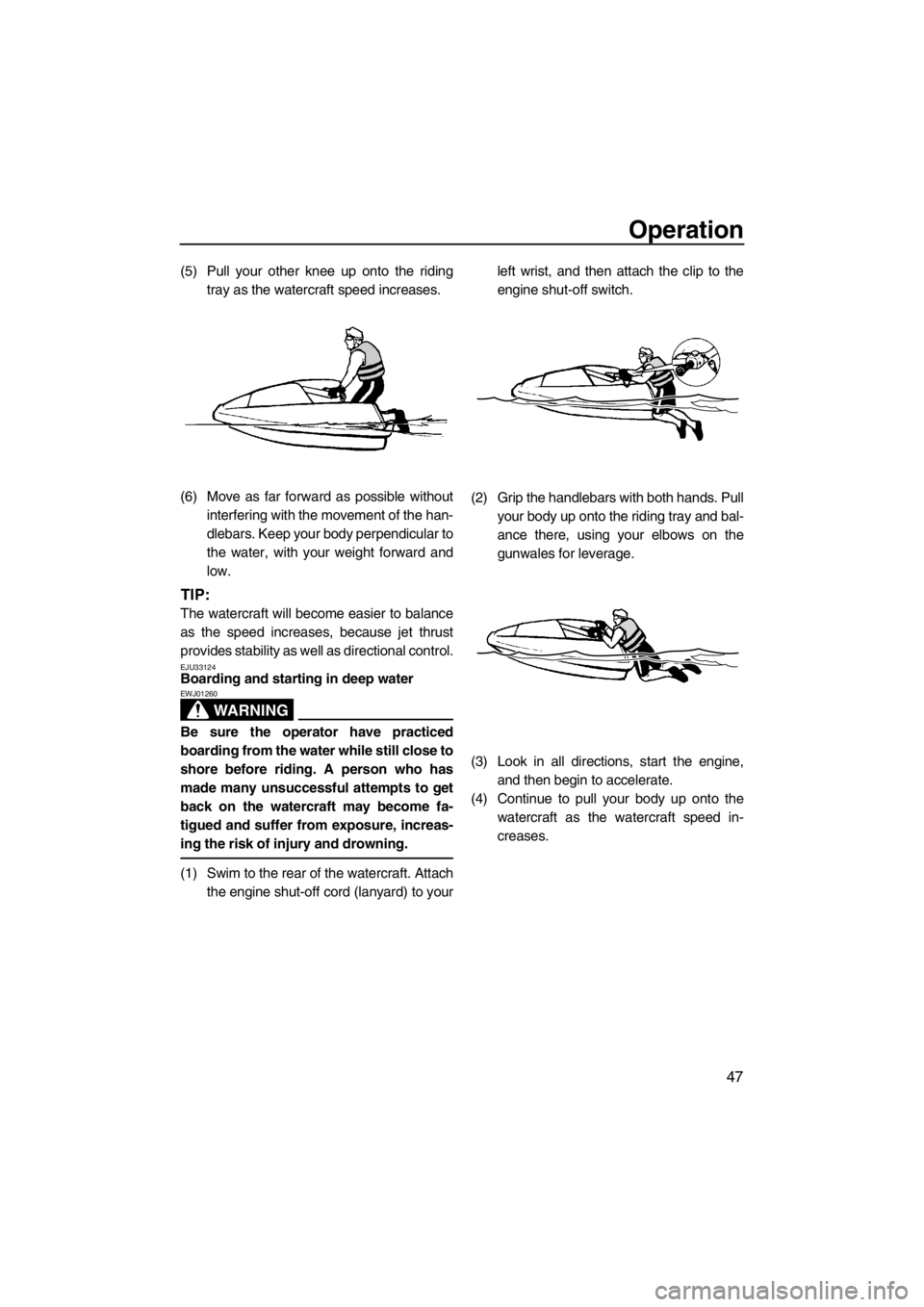
(3) Grip the handlebars with both hands. Place one knee on the riding tray and bal-
ance there.
(4) Look in all directions, start the engine, and then begin to accelerate.
UF2F75E0.book Page 46 Thursday, July 5, 2012 8:50 AM
Page 53 of 78
Operation
47
(5) Pull your other knee up onto the ridingtray as the watercraft speed increases.
(6) Move as far forward as possible without interfering with the movement of the han-
dlebars. Keep your body perpendicular to
the water, with your weight forward and
low.
TIP:
The watercraft will become easier to balance
as the speed increases, because jet thrust
provides stability as well as directional control.
EJU33124Boarding and starting in deep water
WARNING
EWJ01260
Be sure the operator have practiced
boarding from the water while still close to
shore before riding. A person who has
made many unsuccessful attempts to get
back on the watercraft may become fa-
tigued and suffer from exposure, increas-
ing the risk of injury and drowning.
(1) Swim to the rear of the watercraft. Attachthe engine shut-off cord (lanyard) to your left wrist, and then attach the clip to the
engine shut-off switch.
(2) Grip the handlebars with both hands. Pull your body up onto the riding tray and bal-
ance there, using your elbows on the
gunwales for leverage.
(3) Look in all directions, start the engine, and then begin to accelerate.
(4) Continue to pull your body up onto the watercraft as the watercraft speed in-
creases.
UF2F75E0.book Page 47 Thursday, July 5, 2012 8:50 AM
Page 54 of 78
Operation
48
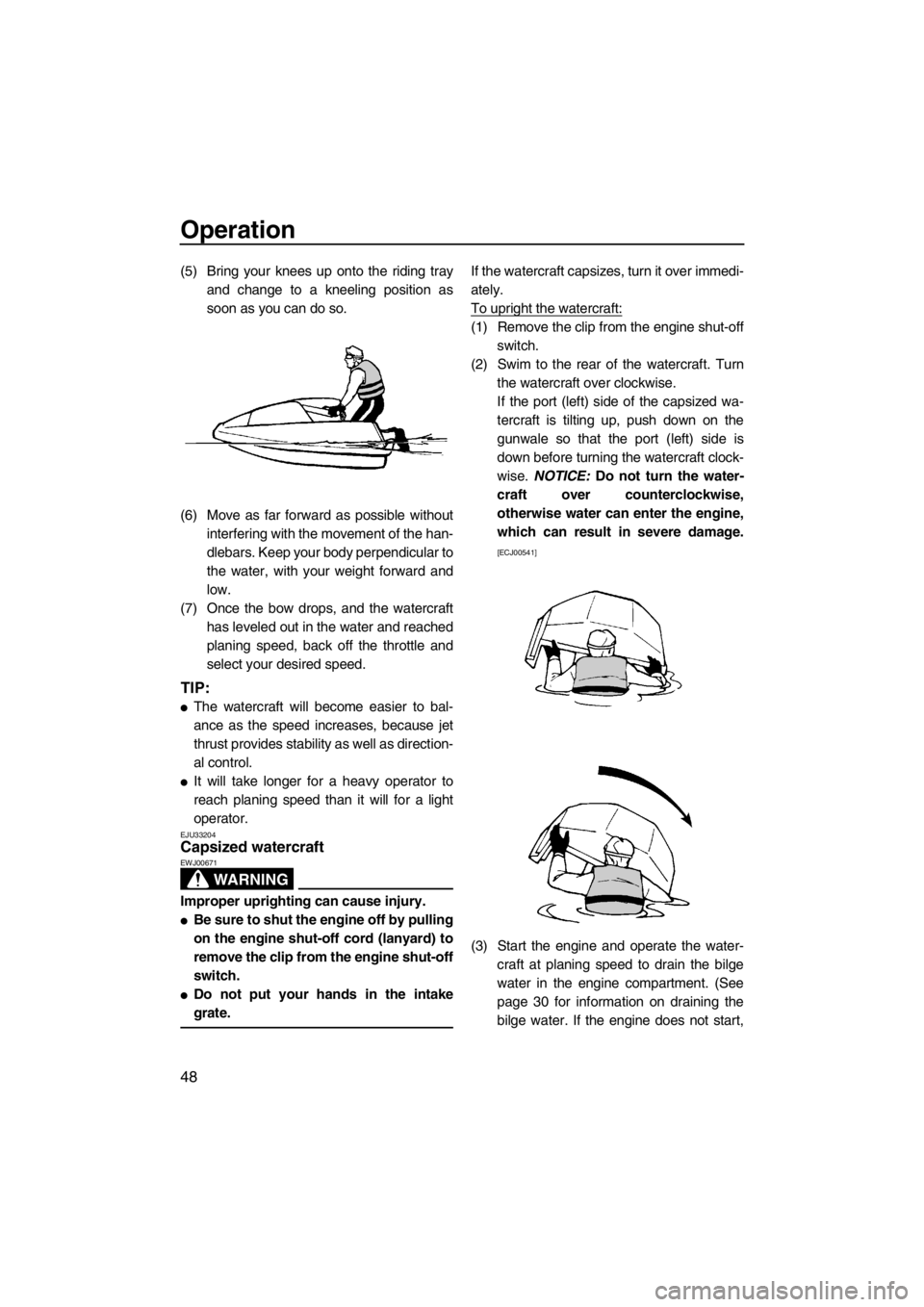
(5) Bring your knees up onto the riding trayand change to a kneeling position as
soon as you can do so.
(6) Move as far forward as possible without interfering with the movement of the han-
dlebars. Keep your body perpendicular to
the water, with your weight forward and
low.
(7) Once the bow drops, and the watercraft has leveled out in the water and reached
planing speed, back off the throttle and
select your desired speed.
TIP:
●The watercraft will become easier to bal-
ance as the speed increases, because jet
thrust provides stability as well as direction-
al control.
●It will take longer for a heavy operator to
reach planing speed than it will for a light
operator.
EJU33204Capsized watercraft
WARNING
EWJ00671
Improper uprighting can cause injury.
●Be sure to shut the engine off by pulling
on the engine shut-off cord (lanyard) to
remove the clip from the engine shut-off
switch.
●Do not put your hands in the intake
grate.
If the watercraft capsizes, turn it over immedi-
ately.
To upright the watercraft:
(1) Remove the clip from the engine shut-offswitch.
(2) Swim to the rear of the watercraft. Turn the watercraft over clockwise.
If the port (left) side of the capsized wa-
tercraft is tilting up, push down on the
gunwale so that the port (left) side is
down before turning the watercraft clock-
wise. NOTICE: Do not turn the water-
craft over counterclockwise,
otherwise water can enter the engine,
which can result in severe damage.
[ECJ00541]
(3) Start the engine and operate the water- craft at planing speed to drain the bilge
water in the engine compartment. (See
page 30 for information on draining the
bilge water. If the engine does not start,
UF2F75E0.book Page 48 Thursday, July 5, 2012 8:50 AM
Page 55 of 78

Operation
49
see “Towing the watercraft” on page 68
or “Submerged watercraft” on page 68.)
NOTICE: Do not run the engine at full
throttle for at least 1 minute after the
engine has been restarted. Bilge water
in the engine compartment can splash
into the engine, which can result in se-
vere damage.
[ECJ00553]
EJU33302
Beaching the watercraft
To beach the watercraft:
(1) Make sure that there are no boats, swim- mers, or obstacles near the beach.
(2) Release the throttle lever to reduce speed about 90 m (300 ft) before you
reach the intended beaching area.
(3) Slowly approach the beach and stop the engine just before reaching land.
WARNING! You need throttle to steer. Shutting the engine off can cause you
to hit an obstacle you are attempting
to avoid. A collision could result in se-
vere injury or death.
[EWJ00601] NOTICE:
Never run the engine in water that is
less than 60 cm (2 ft) deep from the
bottom of the watercraft, otherwise
pebbles or sand could be sucked into
the jet intake, causing impeller dam-
age and engine overheating.
[ECJ00472]
(4) Get off the watercraft and pull it up on the beach.
EJU37193Operating in weeded areas
Always avoid using your watercraft in areas
where weed growth is thick. If operating in
weeded areas is unavoidable, alternately
squeeze the throttle lever and relax your grip
on the throttle lever to vary the engine speed.
Weeds tend to become clogged more when
operating at a steady speed and at trolling
speed. If weeds may have clogged the intake area, clean the jet intake. (See page 66 for in-
formation on the jet intake.)
EJU41060After removing the watercraft from the
water
NOTICE
ECJ01360
Do not run the engine for more than 15
seconds on land without supplying water,
otherwise the engine could overheat.
After operating and removing the watercraft
from the water, promptly discharge the re-
maining water from the cooling water passag-
es.
To discharge water from the cooling water
passages:
(1) Make sure that the area around the wa-
tercraft is clear, and then start the engine.
(2) Discharge the remaining water out of the cooling water passages by alternately
squeezing and releasing the throttle lever
quickly for 10 to 15 seconds.
(3) Stop the engine.
UF2F75E0.book Page 49 Thursday, July 5, 2012 8:50 AM