battery YAMAHA TMAX 2017 User Guide
[x] Cancel search | Manufacturer: YAMAHA, Model Year: 2017, Model line: TMAX, Model: YAMAHA TMAX 2017Pages: 124, PDF Size: 14.56 MB
Page 57 of 124
![YAMAHA TMAX 2017 User Guide Instrument and control functions
5-24
1
2
3
4
5
6
7
8
9
10
11
12
13
14
partment. To prevent damaging the
seat hinges, do not place any items
in this area.
[ECA16092]
TIP
Some helmets cannot be stor](/img/51/51470/w960_51470-56.png "YAMAHA TMAX 2017 User Guide Instrument and control functions
5-24
1
2
3
4
5
6
7
8
9
10
11
12
13
14
partment. To prevent damaging the
seat hinges, do not place any items
in this area.
[ECA16092]
TIP
Some helmets cannot be stor")
Instrument and control functions
5-24
1
2
3
4
5
6
7
8
9
10
11
12
13
14
partment. To prevent damaging the
seat hinges, do not place any items
in this area.
[ECA16092]
TIP
Some helmets cannot be stored in
the rear storage compartment be-
cause of their size or shape.
Do not leave your scooter unat-
tended with the seat open.
Do not place the smart key inside
the rear storage compartment. It
may get locked inside and the
smart key system not operate nor-
mally.
NOTICE
ECA15963
Do not leave the seat open for
an extended period of time, oth-
erwise the light may cause the
battery to discharge.
Since the storage compartment
may get wet while the scooter is
being washed, wrap any articles
stored in the compartment in a
plastic bag.
To avoid humidity from spread-
ing through the storage com-
partment and to discourage
possible mold growth, wrap wet articles in a plastic bag before
storing them in the compart-
ment.
Do not keep anything valuable
or breakable in the storage com-
partment.
Since the storage compartment
accumulates heat from the en-
gine and from direct sunlight,
do not store anything suscepti-
ble to heat, such as food or
flammable items, inside the
compartment.
WARNING
EWA15401
Do not exceed the maximum load of
199 kg (439 lb) (XP530D-A)
202 kg (445 lb) (XP530-A, XP530E-A)
for the vehicle.
1. Rear storage compartment
2. Shaded area
2
1
BV1-28199-E0.book 24 ページ 2016年12月19日 月曜日 午前11時25分
Page 61 of 124
Instrument and control functions
5-28
1
2
3
4
5
6
7
8
9
10
11
12
13
14
TIP
To obtain a precise adjustment, it is ad-
visable to check the actual total number
of clicks or turns of the damping force
adjusting mechanism. This adjustment
range may not exactly match the spec-
ifications listed due to small differences
in production.
EAU77352
Auxiliary DC jack
This model is equipped with a 12 V aux-
iliary DC jack. The DC jack is located in-
side the front storage compartment.
NOTICE
ECA15432
The accessory connected to the
auxiliary DC jack should not be used
with the engine turned off, and the
load must never exceed 24 W (2 A) ,
otherwise the fuse may blow or the
battery may discharge.
To use the auxiliary DC jack 1. Open the front storage compart- ment.
2. Turn the vehicle power off.
3. Remove the auxiliary DC jack cap.
4. Turn the accessory off.
5. Insert the accessory plug into the auxiliary DC jack.
6. Turn the vehicle power on and start the engine.
7. Turn the accessory on.
TIP
When finished with your ride, be sure to
turn off the accessory, disconnect it,
and then install the auxiliary DC jack
cap.
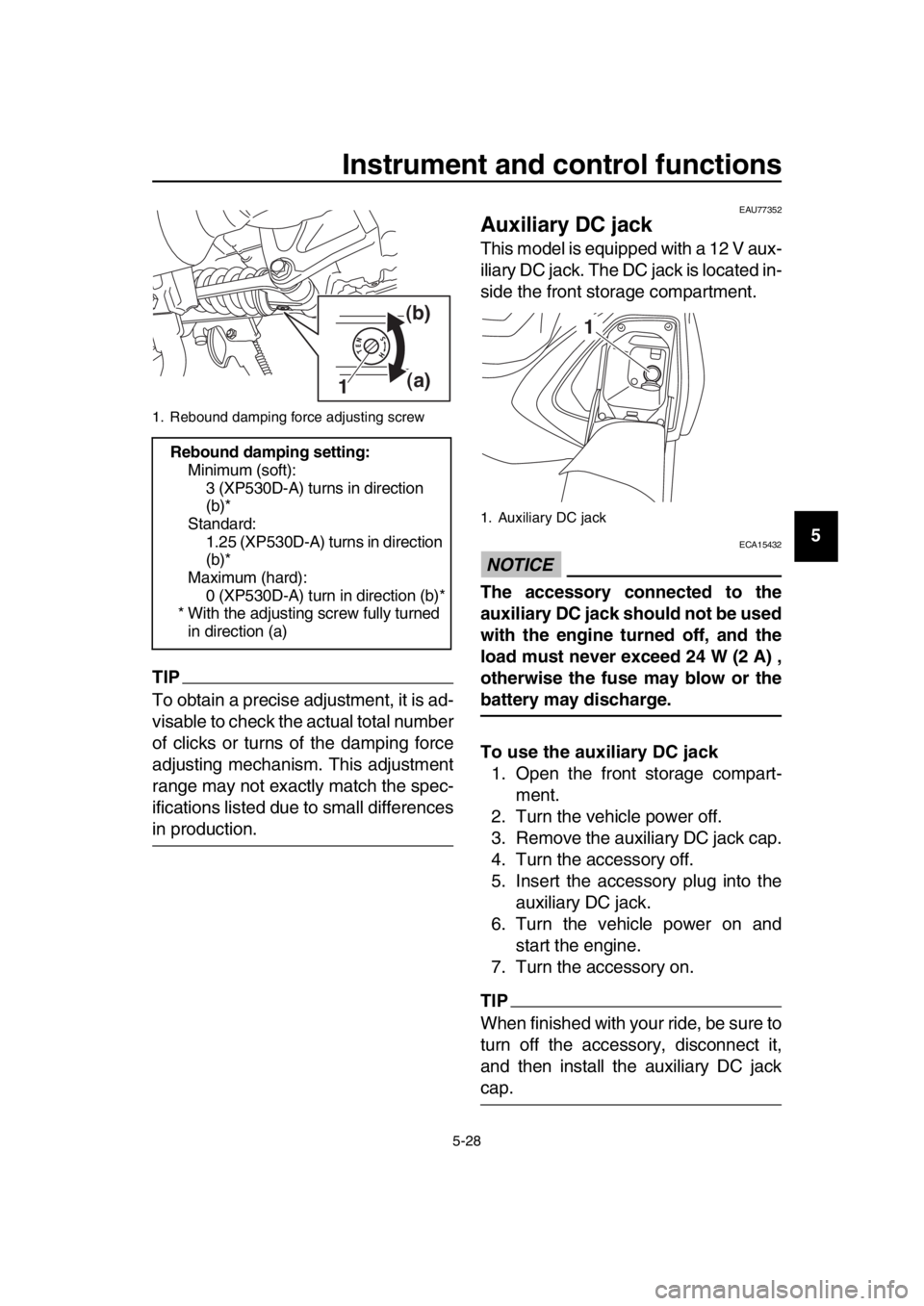
1. Rebound damping force adjusting screw
Rebound damping setting: Minimum (soft):
3 (XP530D-A) turns in direction
(b)*
Standard:
1.25 (XP530D-A) turns in direction
(b)*
Maximum (hard):
0 (XP530D-A) turn in direction (b)*
* With the adjusting screw fully turned in direction (a)
(a)
(b)1
1. Auxiliary DC jack
1
BV1-28199-E0.book 28 ページ 2016年12月19日 月曜日 午前11時25分
Page 68 of 124
Operation and important riding points
7-2
1
2
3
4
5
6
7
8
9
10
11
12
13
14
EAU77082
Starting the engine
NOTICE
ECA10251
See page 7-5 for engine break-in in-
structions prior to operating the ve-
hicle for the first time.
In order for the ignition circuit cut-off
system to enable starting, the sides-
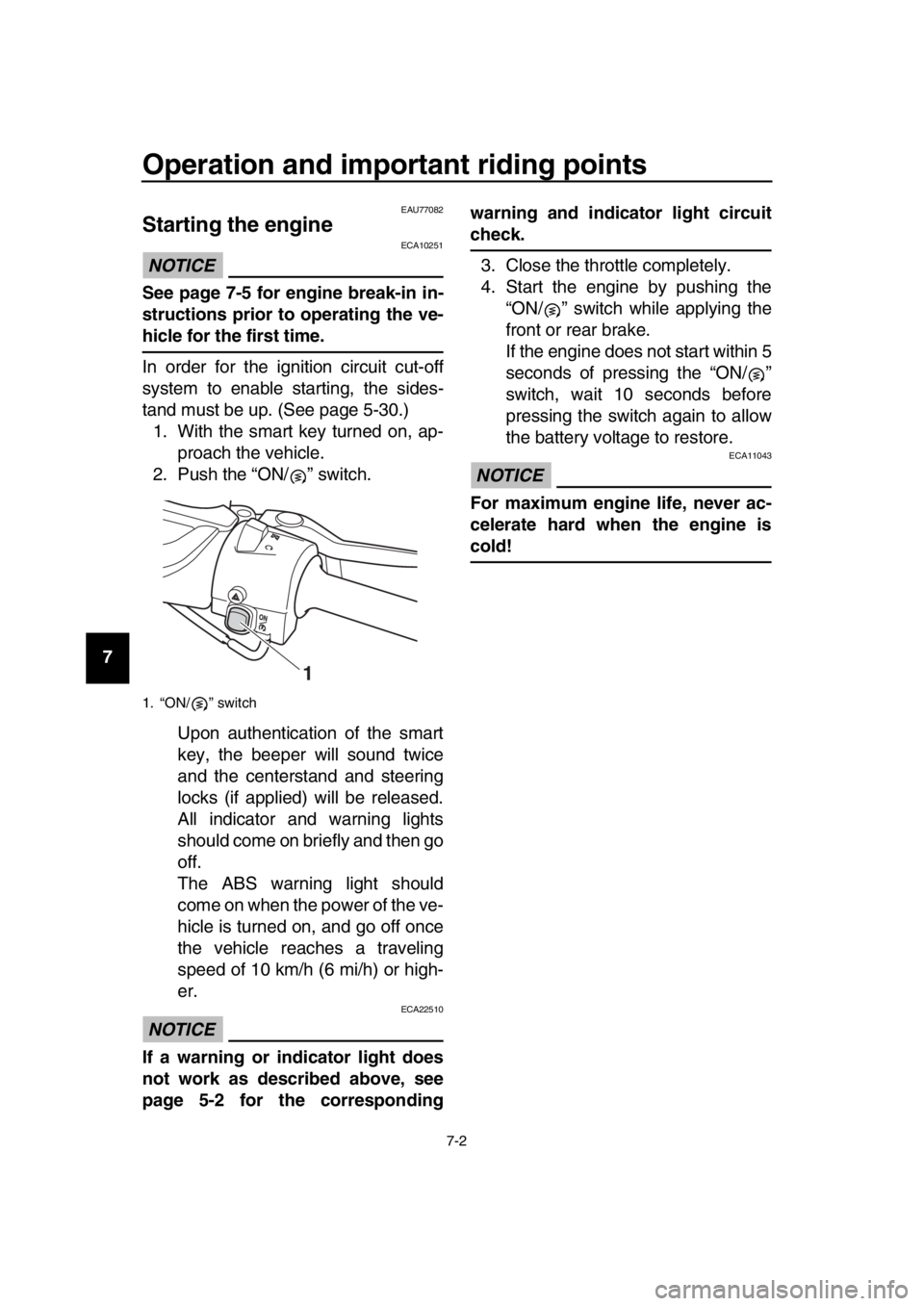
tand must be up. (See page 5-30.) 1. With the smart key turned on, ap- proach the vehicle.
2. Push the “ON/ ” switch.
Upon authentication of the smart
key, the beeper will sound twice
and the centerstand and steering
locks (if applied) will be released.
All indicator and warning lights
should come on briefly and then go
off.
The ABS warning light should
come on when the power of the ve-
hicle is turned on, and go off once
the vehicle reaches a traveling
speed of 10 km/h (6 mi/h) or high-
er.
NOTICE
ECA22510
If a warning or indicator light does
not work as described above, see
page 5-2 for the corresponding warning and indicator light circuit
check.
3. Close the throttle completely.
4. Start the engine by pushing the “ON/ ” switch while applying the
front or rear brake.
If the engine does not start within 5
seconds of pressing the “ON/ ”
switch, wait 10 seconds before
pressing the switch again to allow
the battery voltage to restore.
NOTICE
ECA11043
For maximum engine life, never ac-
celerate hard when the engine is
cold!
1. “ON/ ” switch
1
BV1-28199-E0.book 2 ページ 2016年12月19日 月曜日 午前11時25分
Page 100 of 124
Periodic maintenance and adjustment
8-28
1
2
3
4
5
6
7
8
9
10
11
12
13
14
EAU23292
Checking the wheel bearings
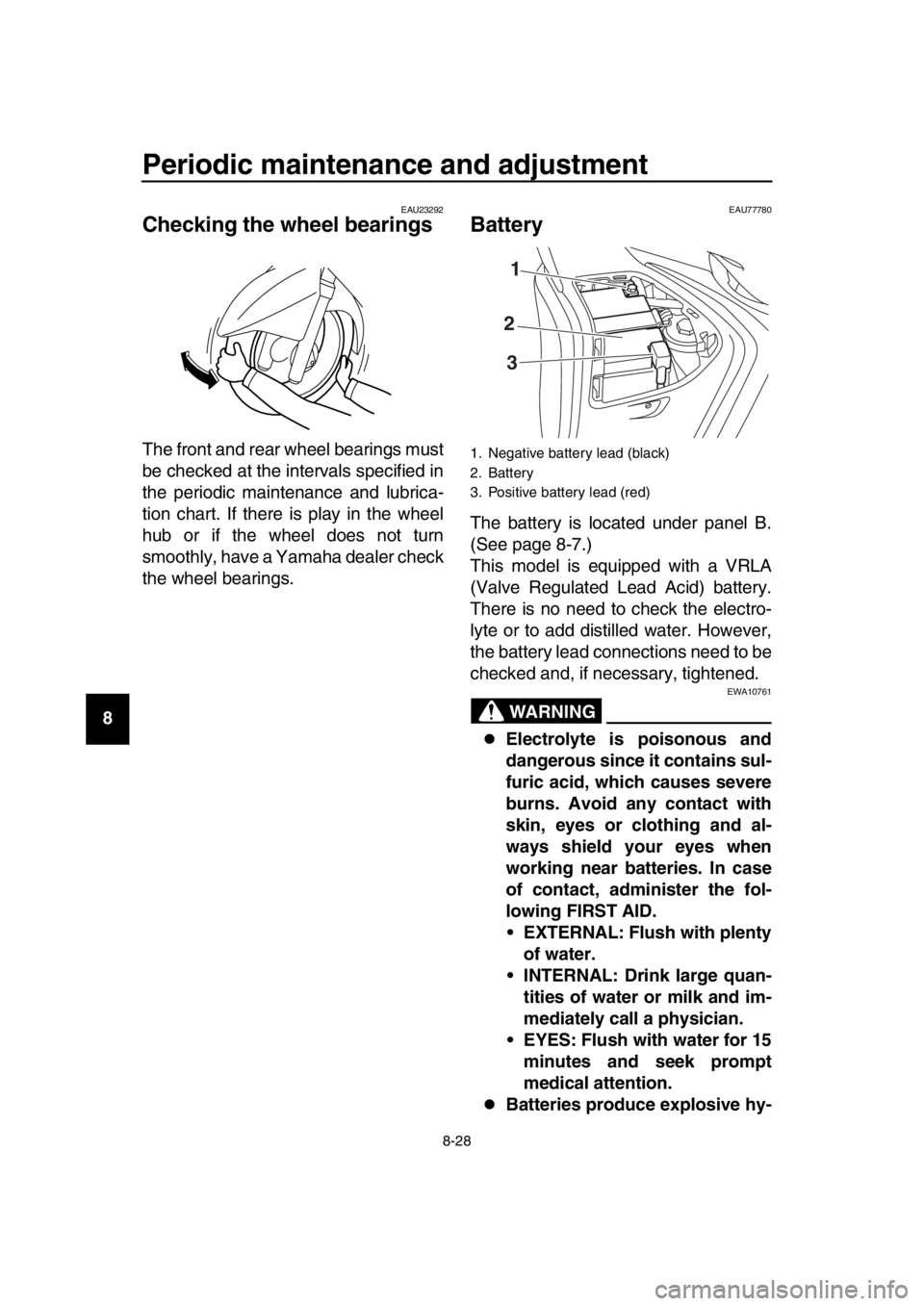
The front and rear wheel bearings must
be checked at the intervals specified in
the periodic maintenance and lubrica-
tion chart. If there is play in the wheel
hub or if the wheel does not turn
smoothly, have a Yamaha dealer check
the wheel bearings.
EAU77780
Battery
The battery is located under panel B.
(See page 8-7.)
This model is equipped with a VRLA
(Valve Regulated Lead Acid) battery.
There is no need to check the electro-
lyte or to add distilled water. However,
the battery lead connections need to be
checked and, if necessary, tightened.
WARNING
EWA10761
Electrolyte is poisonous and
dangerous since it contains sul-
furic acid, which causes severe
burns. Avoid any contact with
skin, eyes or clothing and al-
ways shield your eyes when
working near batteries. In case
of contact, administer the fol-
lowing FIRST AID. EXTERNAL: Flush with plenty of water.
INTERNAL: Drink large quan- tities of water or milk and im-
mediately call a physician.
EYES: Flush with water for 15 minutes and seek prompt
medical attention.
Batteries produce explosive hy-
1. Negative battery lead (black)
2. Battery
3. Positive battery lead (red)
1
2 3
BV1-28199-E0.book 28 ページ 2016年12月19日 月曜日 午前11時25分
Page 101 of 124
Periodic maintenance and adjustment
8-29
1
2
3
4
5
6
7
8
9
10
11
12
13
14
drogen gas. Therefore, keep
sparks, flames, cigarettes, etc.,
away from the battery and pro-
vide sufficient ventilation when
charging it in an enclosed
space.
KEEP THIS AND ALL BATTER-
IES OUT OF THE REACH OF
CHILDREN.
To charge the battery
Have a Yamaha dealer charge the bat-
tery as soon as possible if it seems to
have discharged. Keep in mind that the
battery tends to discharge more quickly
if the vehicle is equipped with optional
electrical accessories.
NOTICE
ECA16522
To charge a VRLA (Valve Regulated
Lead Acid) battery, a special (con-
stant-voltage) battery charger is re-
quired. Using a conventional battery
charger will damage the battery.
To store the battery 1. If the vehicle will not be used for more than one month, remove the
battery, fully charge it, and then
place it in a cool, dry place.
NOTICE: When removing the
battery, be sure turn the vehicle
power off, then disconnect the
negative lead before discon-
necting the positive lead.
[ECA21900]
2. If the battery will be stored for more than two months, check it at least
once a month and fully charge it if
necessary.
3. Fully charge the battery before in- stallation. NOTICE: When install- ing the battery, connect the
positive lead before connecting
the negative lead.
[ECA21910]
4. After installation, make sure that
the battery leads are properly con-
nected to the battery terminals.
NOTICE
ECA16531
Always keep the battery charged.
Storing a discharged battery can
cause permanent battery damage.
BV1-28199-E0.book 29 ページ 2016年12月19日 月曜日 午前11時25分
Page 106 of 124

Periodic maintenance and adjustment
8-34
1
2
3
4
5
6
7
8
9
10
11
12
13
14
EAU25864
Troubleshooting
Although Yamaha scooters receive a
thorough inspection before shipment
from the factory, trouble may occur dur-
ing operation. Any problem in the fuel,
compression, or ignition systems, for
example, can cause poor starting and
loss of power.
The following troubleshooting chart
represents a quick and easy procedure
for checking these vital systems your-
self. However, should your scooter re-
quire any repair, take it to a Yamaha
dealer, whose skilled technicians have
the necessary tools, experience, and
know-how to service the scooter prop-
erly.
Use only genuine Yamaha replace-
ment parts. Imitation parts may look like
Yamaha parts, but they are often inferi-
or, have a shorter service life and can
lead to expensive repair bills.
WARNING
EWA15142
When checking the fuel system, do
not smoke, and make sure there are
no open flames or sparks in the ar-
ea, including pilot lights from water
heaters or furnaces. Gasoline or
gasoline vapors can ignite or ex-
plode, causing severe injury or
property damage.
EAU77992Smart key system troubleshooting
Please check the following items when
the smart key system does not work.
Is the smart key turned on? (See
page 3-5.)
Is the smart key battery dis-
charged? (See page 3-6.)
Is the smart key battery installed correctly? (See page 3-6.)
Is the smart key being used in a lo-
cation with strong radio waves or
other electromagnetic noise? (See
page 3-1.)
Are you using the smart key that is
registered to the vehicle?
Is the vehicle battery discharged?
When the vehicle battery is dis-
charged, the smart key system will
not operate. Please have the vehi-
cle battery charged or replaced.
(See page 8-28.)
If the smart key system does not work
after checking the above items, have a
Yamaha dealer check the smart key
system.
TIP
See Emergency mode on page 8-37 for
information on starting the engine with-
out the smart key.
BV1-28199-E0.book 34 ページ 2016年12月19日 月曜日 午前11時25分
Page 107 of 124

Periodic maintenance and adjustment
8-35
1
2
3
4
5
6
7
8
9
10
11
12
13
14
EAU63470
Troubleshooting charts
Starting problems or poor engine performance
1. FuelThere is enough fuel.
There is no fuel.
Check the battery.
Supply fuel.
The engine turns over
quickly.
The engine turns over
slowly.
The engine does not
start.
Check the battery.
Wipe off with a dry
cloth and correct the
spark plug gaps, or
replace the spark
plugs.
Check the battery
lead connections, and
have a Yamaha dealer
charge the battery if
necessary.
2. BatteryThe battery is good.
The engine does not
start.
Check the ignition.
3. IgnitionWetOperate the electric
starter.
Dry
There is compression.
There is no
compression.
The engine does not start.
Have a Yamaha dealer check the vehicle.
Have a Yamaha dealer check the vehicle.
The engine does not
start.
Check the
compression.Have a Yamaha
dealer check the
vehicle.
Remove the spark
plugs and check
the electrodes.
Operate the electric
starter.
Operate the electric
starter.
Check the fuel level
in the fuel tank.
4. Compression
BV1-28199-E0.book 35 ページ 2016年12月19日 月曜日 午前11時25分
Page 109 of 124
Periodic maintenance and adjustment
8-37
1
2
3
4
5
6
7
8
9
10
11
12
13
14
EAU77371
Emergency mode
When the smart key is lost, damaged,
or its battery has discharged, the vehi-
cle can still be turned on and the engine
started. You will need a mechanical key
and the smart key system identification
number (see page 3-3). To operate the
vehicle in emergency mode, carry out
the following steps.
TIP
Emergency mode operation will be
cancelled if the respective steps are not
carried out within the time set for each
operation or if the “OFF/LOCK” switch
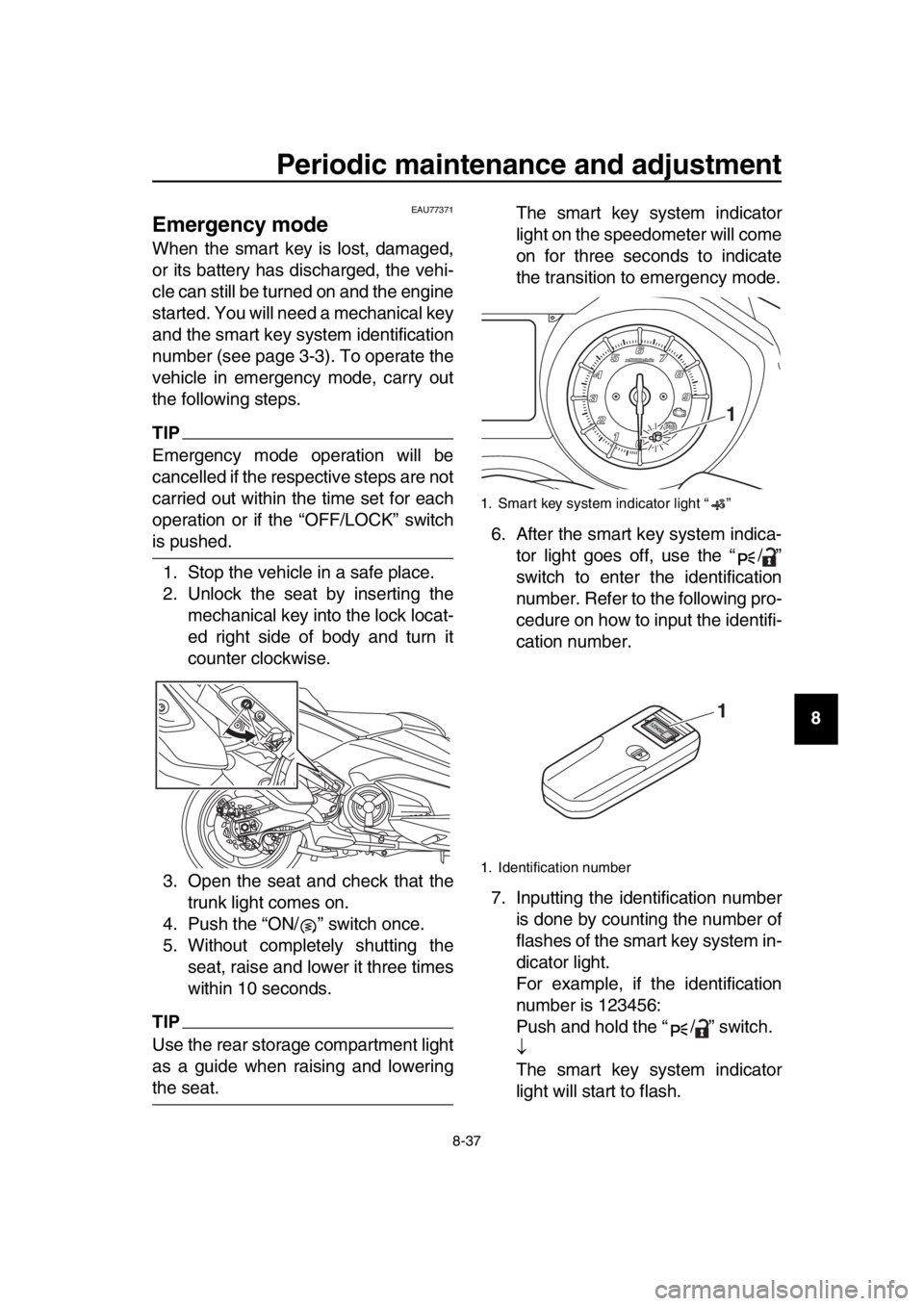
is pushed. 1. Stop the vehicle in a safe place.
2. Unlock the seat by inserting the mechanical key into the lock locat-
ed right side of body and turn it
counter clockwise.
3. Open the seat and check that the trunk light comes on.
4. Push the “ON/ ” switch once.
5. Without completely shutting the seat, raise and lower it three times
within 10 seconds.
TIP
Use the rear storage compartment light
as a guide when raising and lowering
the seat. The smart key system indicator
light on the speedometer will come
on for three seconds to indicate
the transition to emergency mode.
6. After the smart key system indica- tor light goes off, use the “ / ”
switch to enter the identification
number. Refer to the following pro-
cedure on how to input the identifi-
cation number.
7. Inputting the identification number is done by counting the number of
flashes of the smart key system in-
dicator light.
For example, if the identification
number is 123456:
Push and hold the “ / ” switch.
The smart key system indicator
light will start to flash.
1. Smart key system indicator light “ ”
1. Identification number
1
1
BV1-28199-E0.book 37 ページ 2016年12月19日 月曜日 午前11時25分
Page 114 of 124

Scooter care and storage
9-4
1
2
3
4
5
6
7
8
9
10
11
12
13
14
EAU36554
Storage
Short-term
Always store your scooter in a cool, dry
place and, if necessary, protect it
against dust with a porous cover. Be
sure the engine and the exhaust sys-
tem are cool before covering the scoot-
er.
NOTICE
ECA10821
Storing the scooter in a poorly
ventilated room or covering it
with a tarp, while it is still wet,
will allow water and humidity to
seep in and cause rust.
To prevent corrosion, avoid
damp cellars, stables (because
of the presence of ammonia)
and areas where strong chemi-
cals are stored.
Long-term
Before storing your scooter for several
months: 1. Follow all the instructions in the “Care” section of this chapter.
2. Fill up the fuel tank and add fuel stabilizer (if available) to prevent
the fuel tank from rusting and the
fuel from deteriorating.
3. Perform the following steps to pro- tect the cylinders, piston rings, etc.
from corrosion.
a. Remove the spark plug caps and the spark plugs.
b. Pour a teaspoonful of engine oil into the spark plug bores.
c. Install the spark plug caps onto the spark plugs, and then place
the spark plugs on the cylinder head so that the electrodes are
grounded. (This will limit spark-
ing during the next step.)
d. Turn the engine over several
times with the starter. (This will
coat the cylinder walls with oil.)
e. Remove the spark plug caps from the spark plugs, and then
install the spark plugs and the
spark plug caps. WARNING!
To prevent damage or injury
from sparking, make sure to
ground the spark plug elec-
trodes while turning the en-
gine over.
[EWA10952]
4. Lubricate all control cables and the pivoting points of all levers and
pedals as well as of the sides-
tand/centerstand.
5. Check and, if necessary, correct the tire air pressure, and then lift
the scooter so that both of its
wheels are off the ground. Alterna-
tively, turn the wheels a little every
month in order to prevent the tires
from becoming degraded in one
spot.
6. Cover the muffler outlet with a plastic bag to prevent moisture
from entering it.
7. Remove the battery and fully charge it. Store it in a cool, dry
place and charge it once a month.
Do not store the battery in an ex-
cessively cold or warm place [less
than 0 C (30 F) or more than 30
C (90 F)]. For more information
on storing the battery, see page
8-28.
TIP
Make any necessary repairs before
BV1-28199-E0.book 4 ページ 2016年12月19日 月曜日 午前11時25分
Page 117 of 124

Specifications
10-2
1
2
3
4
5
6
7
8
9
10
11
12
13
14
Front tire:
Type:Tubeless
Size: 120/70R15M/C(56H)
Manufacturer/model:
BRIDGESTONE/BATTLAXSCF (XP530-A,
XP530E-A)
DUNLOP/ROADSMART3 (XP530D-A)
Rear tire:
Type:Tubeless
Size: 160/60R15M/C(67H)
Manufacturer/model: BRIDGESTONE/BATTLAXSCR (XP530-
A, XP530E-A)
DUNLOP/ROADSMART3 (XP530D-A)
Loading:
Maximum load:199 kg (439 lb) (XP530D-A)
202 kg (445 lb) (XP530-A, XP530E-A)
* (Total weight of rider, passenger, cargo and accessories)
Tire air pressure (measured on cold
tires):
1 person:Front:225 kPa (2.25 kgf/cm
2, 33 psi)
Rear: 250 kPa (2.50 kgf/cm
2, 36 psi)
2 persons:
Front:225 kPa (2.25 kgf/cm
2, 33 psi)
Rear:
280 kPa (2.80 kgf/cm
2, 41 psi)
Front wheel:
Wheel type: Cast wheel
Rim size: 15M/C x MT3.5
Rear wheel:
Wheel type:
Cast wheel
Rim size: 15M/C x MT4.5
Front brake:
Type:
Hydraulic dual disc brake Specified brake fluid:
DOT 4
Rear brake:
Type:Hydraulic single disc brake
Specified brake fluid:
DOT 4
Front suspension:
Type:Telescopic fork
Spring:
Coil spring
Shock absorber: Hydraulic damper
Wheel travel: 120 mm (4.7 in)
Rear suspension:
Type:Swingarm
Spring: Coil spring
Shock absorber:
Gas-hydraulic damper
Wheel travel: 117 mm (4.6 in)
Electrical system:
System voltage:
12 V
Ignition system: TCI
Charging system: AC magneto
Battery:
Model:YTZ12S
Voltage, capacity: 12 V, 11.0 Ah (10 HR)
Bulb wattage:
Headlight:LED
Brake/tail light:
LED
Front turn signal light: 21.0 W
Rear turn signal light: 21.0 W
Auxiliary light:
LED
License plate light: 5.0 W
BV1-28199-E0.book 2 ページ 2016年12月19日 月曜日 午前11時25分