check oil YAMAHA TMAX 2019 User Guide
[x] Cancel search | Manufacturer: YAMAHA, Model Year: 2019, Model line: TMAX, Model: YAMAHA TMAX 2019Pages: 122, PDF Size: 14.98 MB
Page 82 of 122
Periodic maintenance and adjustment
8-11
1
2
3
4
5
6
7
8
9
10
11
12
13
14 To change the engine oil (and re-
place the oil filter cartridge)
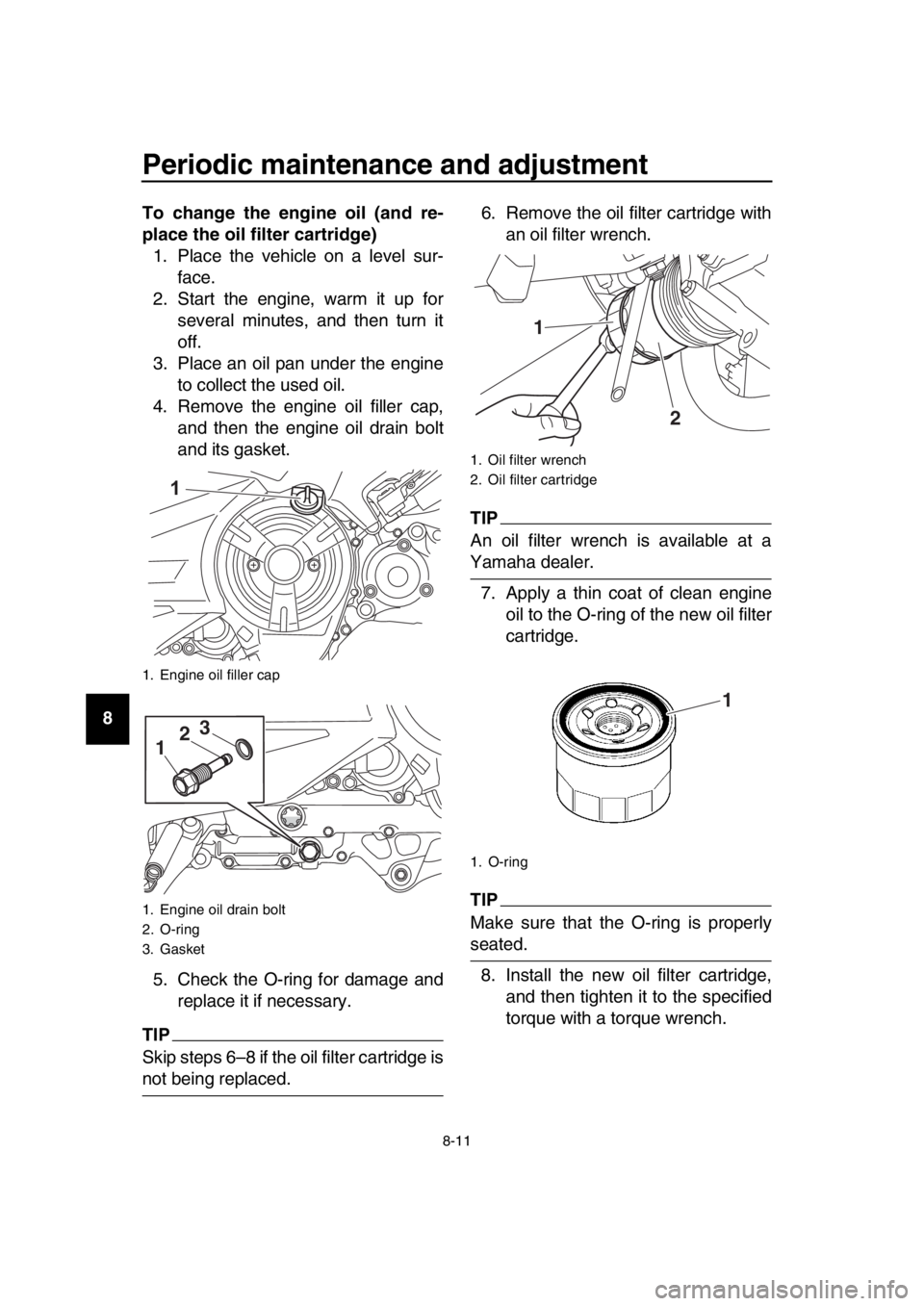
1. Place the vehicle on a level sur- face.
2. Start the engine, warm it up for several minutes, and then turn it
off.
3. Place an oil pan under the engine to collect the used oil.
4. Remove the engine oil filler cap, and then the engine oil drain bolt
and its gasket.
5. Check the O-ring for damage and replace it if necessary.
TIP
Skip steps 6–8 if the oil filter cartridge is
not being replaced. 6. Remove the oil filter cartridge with
an oil filter wrench.
TIP
An oil filter wrench is available at a
Yamaha dealer.
7. Apply a thin coat of clean engine oil to the O-ring of the new oil filter
cartridge.
TIP
Make sure that the O-ring is properly
seated.
8. Install the new oil filter cartridge, and then tighten it to the specified
torque with a torque wrench.
1. Engine oil filler cap
1. Engine oil drain bolt
2. O-ring
3. Gasket
1
12
3
1. Oil filter wrench
2. Oil filter cartridge
1. O-ring
1
2
1
BV1-9-E2.book 11 ページ 2018年8月28日 火曜日 午後5時28分
Page 83 of 122
Periodic maintenance and adjustment
8-12
1
2
3
4
5
6
7
8
9
10
11
12
13
14
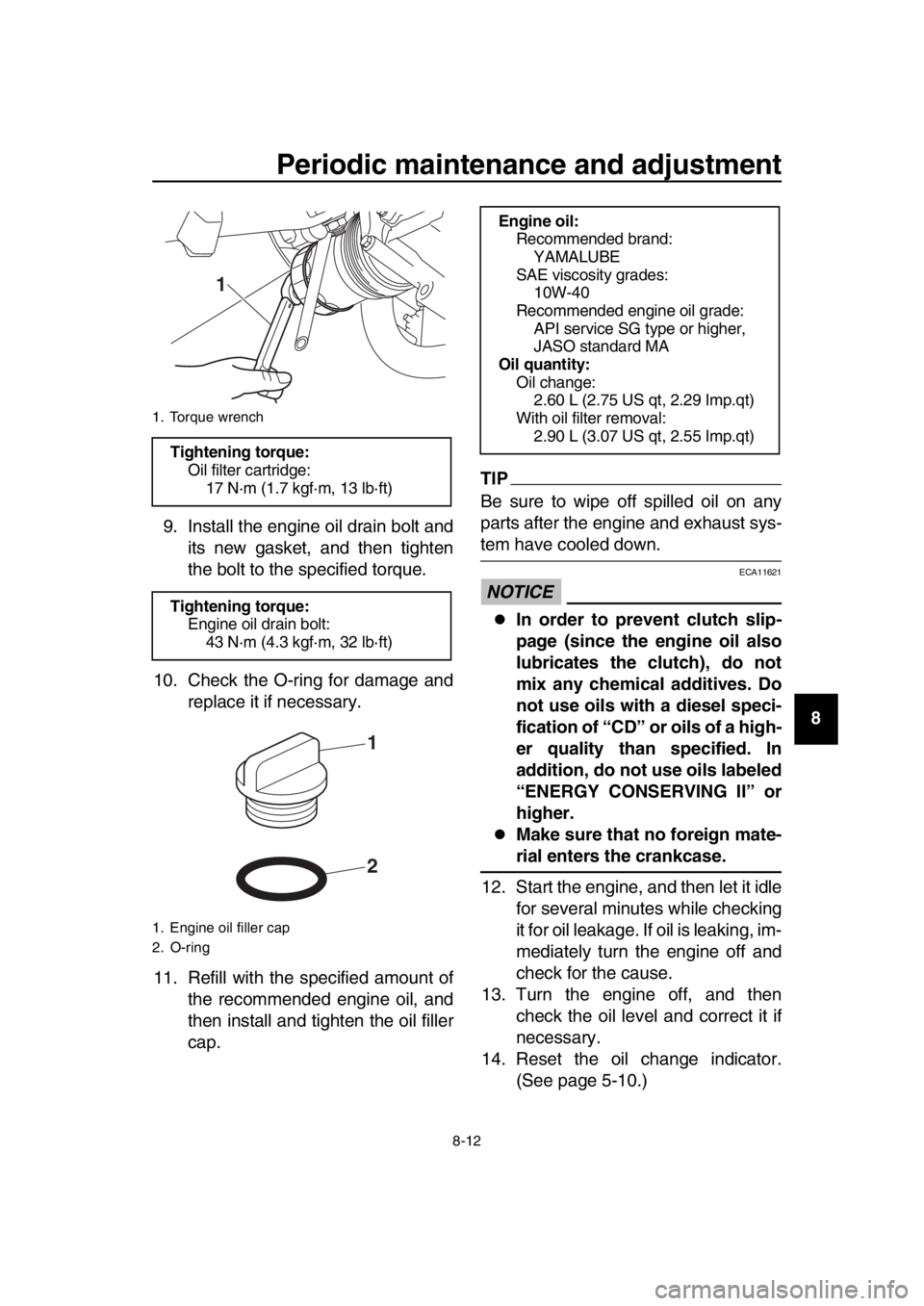
9. Install the engine oil drain bolt and
its new gasket, and then tighten
the bolt to the specified torque.
10. Check the O-ring for damage and replace it if necessary.
11. Refill with the specified amount of the recommended engine oil, and
then install and tighten the oil filler
cap.
TIP
Be sure to wipe off spilled oil on any
parts after the engine and exhaust sys-
tem have cooled down.
NOTICE
ECA11621
In order to prevent clutch slip-
page (since the engine oil also
lubricates the clutch), do not
mix any chemical additives. Do
not use oils with a diesel speci-
fication of “CD” or oils of a high-
er quality than specified. In
addition, do not use oils labeled
“ENERGY CONSERVING II” or
higher.
Make sure that no foreign mate-
rial enters the crankcase.
12. Start the engine, and then let it idle for several minutes while checking
it for oil leakage. If oil is leaking, im-
mediately turn the engine off and
check for the cause.
13. Turn the engine off, and then check the oil level and correct it if
necessary.
14. Reset the oil change indicator. (See page 5-10.)
1. Torque wrench
Tightening torque:Oil filter cartridge:
17 N·m (1.7 kgf·m, 13 lb·ft)
Tightening torque: Engine oil drain bolt:43 N·m (4.3 kgf·m, 32 lb·ft)
1. Engine oil filler cap
2. O-ring
1
2
1
Engine oil:Recommended brand:
YAMALUBE
SAE viscosity grades: 10W-40
Recommended engine oil grade: API service SG type or higher,
JASO standard MA
Oil quantity: Oil change: 2.60 L (2.75 US qt, 2.29 Imp.qt)
With oil filter removal: 2.90 L (3.07 US qt, 2.55 Imp.qt)
BV1-9-E2.book 12 ページ 2018年8月28日 火曜日 午後5時28分
Page 84 of 122
Periodic maintenance and adjustment
8-13
1
2
3
4
5
6
7
8
9
10
11
12
13
14
EAU85450
Why Yamalube
YAMALUBE oil is a Genuine YAMAHA
Part born of the engineers’ passion and
belief that engine oil is an important liq-
uid engine component. We form teams
of specialists in the fields of mechanical
engineering, chemistry, electronics and
track testing, and have them develop
the engine together with the oil it will
use. Yamalube oils take full advantage
of the base oil’s qualities and blend in
the ideal balance of additives to make
sure the final oil clears our performance
standards. Thus, Yamalube mineral,
semisynthetic and synthetic oils have
their own distinct characters and value.
Yamaha’s experience gained over
many years of research and develop-
ment into oil since the 1960’s helps
make Yamalube the best choice for
your Yamaha engine.
EAUS1203
Coolant
The coolant level should be checked
regularly. In addition, the coolant must
be changed at the intervals specified in
the periodic maintenance chart.
TIP
If genuine Yamaha coolant is not avail-
able, use an ethylene glycol antifreeze
containing corrosion inhibitors for alu-
minum engines and mix with distilled
water at a 1:1 ratio.
EAU52025To check the coolant level
Since the coolant level varies with en-
gine temperature, check when the en-
gine is cold. 1. Park the vehicle on a level surface.
2. Hold the vehicle upright, or place it on the centerstand.
3. Look at the coolant level through the check window.
Recommended coolant:YAMALUBE coolant
Coolant quantity: Coolant reservoir (max level mark):0.25 L (0.26 US qt, 0.22 Imp.qt)
Radiator (including all routes): 1.67 L (1.77 US qt, 1.47 Imp.qt)
BV1-9-E2.book 13 ページ 2018年8月28日 火曜日 午後5時28分
Page 94 of 122
Periodic maintenance and adjustment
8-23
1
2
3
4
5
6
7
8
9
10
11
12
13
14
A low brake fluid level may indicate
worn brake pads or brake system
leakage; therefore, be sure to
check the brake pads for wear and
the brake system for leakage.
If the brake fluid level goes down
suddenly, have a Yamaha dealer
check the cause before further rid-
ing.
WARNING
EWA15991
Improper maintenance can result in
loss of braking ability. Observe
these precautions:
Insufficient brake fluid may al-
low air to enter the brake sys-
tem, reducing braking
performance.
Clean the filler cap before re-
moving. Use only DOT 4 brake
fluid from a sealed container.
Use only the specified brake flu-
id; otherwise, the rubber seals
may deteriorate, causing leak-
age.
Refill with the same type of
brake fluid. Adding a brake fluid
other than DOT 4 may result in a
harmful chemical reaction.
Be careful that water does not
enter the brake fluid reservoir
when refilling. Water will signifi-
cantly lower the boiling point of
the fluid and may result in vapor
lock.
EAU22734
Changing the brake fluid
Have a Yamaha dealer change the
brake fluid every 2 years. In addition,
have the seals of the master cylinders
and brake calipers, as well as the brake
hoses replaced at the intervals listed
below or sooner if they are damaged or
leaking.
Brake seals: every 2 years
Brake hoses: every 4 years
BV1-9-E2.book 23 ページ 2018年8月28日 火曜日 午後5時28分
Page 97 of 122
Periodic maintenance and adjustment
8-26
1
2
3
4
5
6
7
8
9
10
11
12
13
14
EAU23215
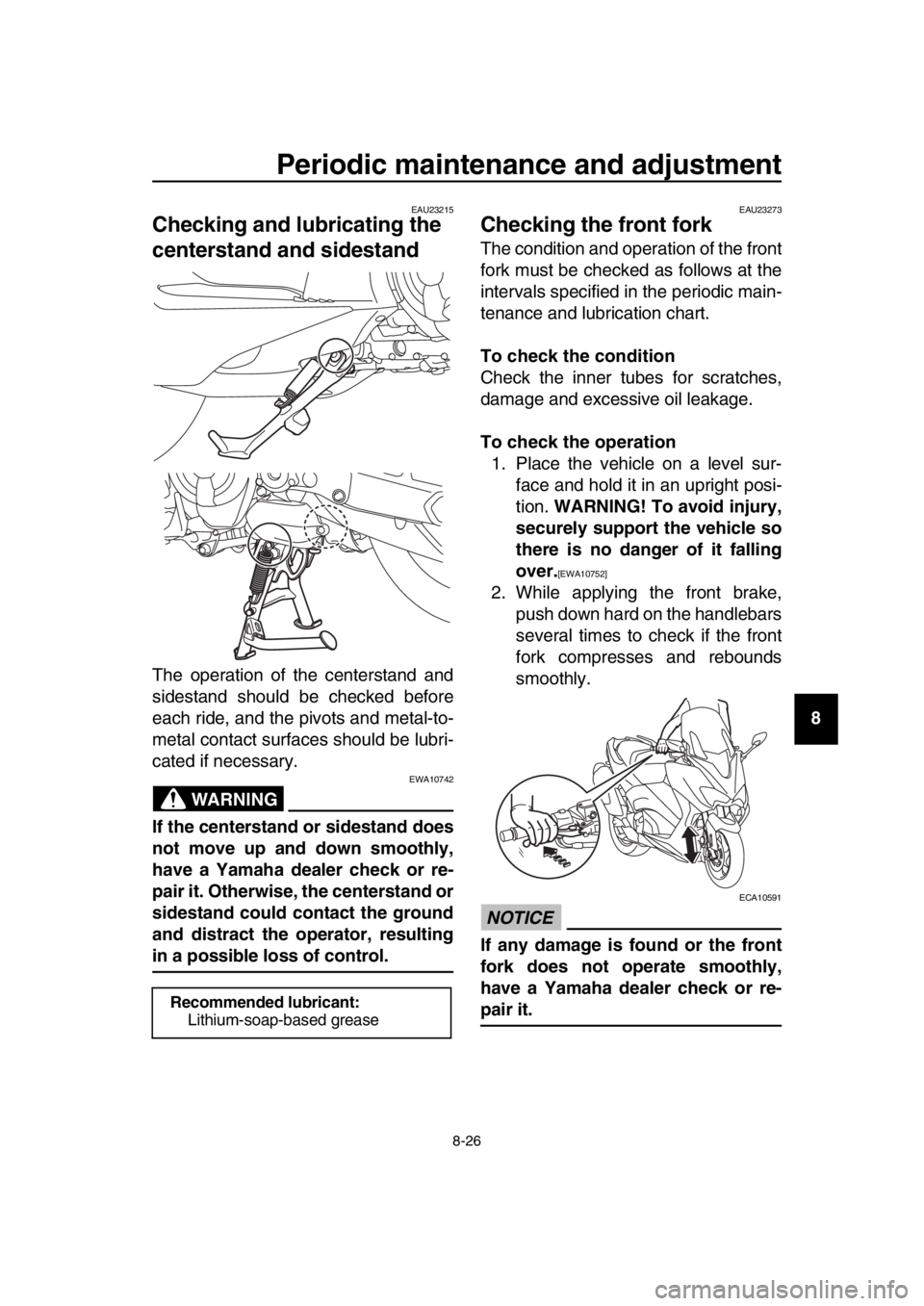
Checking and l ubricating the
centerstand and sidestand
The operation of the centerstand and
sidestand should be checked before
each ride, and the pivots and metal-to-
metal contact surfaces should be lubri-
cated if necessary.
WARNING
EWA10742
If the centerstand or sidestand does
not move up and down smoothly,
have a Yamaha dealer check or re-
pair it. Otherwise, the centerstand or
sidestand could contact the ground
and distract the operator, resulting
in a possible loss of control.
EAU23273
Checking the front fork
The condition and operation of the front
fork must be checked as follows at the
intervals specified in the periodic main-
tenance and lubrication chart.
To check the condition
Check the inner tubes for scratches,
damage and excessive oil leakage.
To check the operation
1. Place the vehicle on a level sur- face and hold it in an upright posi-
tion. WARNING! To avoid injury,
securely support the vehicle so
there is no danger of it falling
over.
[EWA10752]
2. While applying the front brake, push down hard on the handlebars
several times to check if the front
fork compresses and rebounds
smoothly.
NOTICE
ECA10591
If any damage is found or the front
fork does not operate smoothly,
have a Yamaha dealer check or re-
pair it.Recommended lubricant:Lithium-soap-based grease
BV1-9-E2.book 26 ページ 2018年8月28日 火曜日 午後5時28分
Page 113 of 122
Scooter care and storage
9-4
1
2
3
4
5
6
7
8
9
10
11
12
13
14
EAU83472
Storage
Always store the vehicle in a cool, dry
place. If necessary, protect it against
dust with a porous cover. Be sure the
engine and the exhaust system are
cool before covering the vehicle. If the
vehicle often sits for weeks at a time be-
tween uses, the use of a quality fuel
stabilizer is recommended after each
fill-up.
NOTICE
ECA21170
Storing the vehicle in a poorly
ventilated room or covering it
with a tarp, while it is still wet,
will allow water and humidity to
seep in and cause rust.
To prevent corrosion, avoid
damp cellars, stables (because
of the presence of ammonia)
and areas where strong chemi-
cals are stored.
Long term storage
Before storing the vehicle long term (60
days or more): 1. Make all necessary repairs and perform any outstanding mainte-
nance.
2. Follow all instructions in the Care section of this chapter.
3. Fill up the fuel tank, adding fuel stabilizer according to product in-
structions. Run the engine for 5
minutes to distribute treated fuel
through the fuel system.
4. For vehicles equipped with a fuel cock: Turn the fuel cock lever to
the off position.
5. For vehicles with a carburetor: To prevent fuel deposits from building up, drain the fuel in the carburetor
float chamber into a clean contain-
er. Retighten the drain bolt and
pour the fuel back into the fuel
tank.
6. Use a quality engine fogging oil ac- cording to product instructions to
protect internal engine compo-
nents from corrosion. If engine fog-
ging oil is not available, perform
the following steps for each cylin-
der:
a. Remove the spark plug cap and spark plug.
b. Pour a teaspoonful of engine oil into the spark plug bore.
c. Install the spark plug cap onto the spark plug, and then place
the spark plug on the cylinder
head so that the electrodes are
grounded. (This will limit spark-
ing during the next step.)
d. Turn the engine over several times with the starter. (This will
coat the cylinder wall with oil.)
WARNING! To prevent dam-
age or injury from sparking,
make sure to ground the
spark plug electrodes while
turning the engine
over.
[EWA10952]
e. Remove the spark plug capfrom the spark plug, and then
install the spark plug and the
spark plug cap.
7. Lubricate all control cables, pivots, levers and pedals, as well as the
sidestand and centerstand (if
equipped).
8. Check and correct the tire air pres- sure, and then lift the vehicle so
that all wheels are off the ground.
BV1-9-E2.book 4 ページ 2018年8月28日 火曜日 午後5時28分
Page 119 of 122

12-1
1
2
3
4
5
6
7
8
9
10
11
12
13
14
Index
A
ABS warning light ....................................5-3
Acceleration and deceleration .................7-3
Air filter element, engine........................8-15
Anti-lock brake system (ABS)................5-18
Auxiliary DC jack ...................................5-28
B
Battery ...................................................8-28
Brake fluid, changing .............................8-23
Brake fluid level, checking .....................8-22
Brake lever, front ...................................5-17
Brake lever, rear ....................................5-17
Brake levers, lubricating ........................8-25
Braking ....................................................7-4
C
Cables, checking and lubricating...........8-24
Canister .................................................8-10
Care.........................................................9-1
Catalytic converter.................................5-22
Centerstand and sidestand, checking and lubricating.....................................8-26
Coolant ..................................................8-13
Cruise control indicator lights ..................5-2
Cruise control switches ...........................5-2
Cruise control system (XP530D-A) .........4-1
D
Data recording, vehicle..........................11-2
Diagnostic connector .............................11-2
Dimmer/Pass switch ................................5-1
D-mode (drive mode) ..............................4-3
Drive belt slack ......................................8-24
Drive mode switch ...................................5-2
E
Emergency mode ..................................8-37
Engine break-in .......................................7-5
Engine idling speed, checking ...............8-16
Engine oil and oil filter cartridge ............8-10
Engine serial number ............................11-1
Engine stop switch ..................................5-1
Engine trouble warning light ....................5-2
F
Front and rear brake lever free play,
checking ..............................................8-20
Front and rear brake pads, checking.....8-22
Front fork, checking ...............................8-26
Fuel .......................................................5-20
Fuel consumption, tips for reducing ........7-5
Fuel tank cap .........................................5-19
Fuel tank overflow hose ........................5-22
Fuses, replacing ....................................8-29
H
Handlebar switches................................. 5-1
Hazard switch ......................................... 5-1
High beam indicator light ........................ 5-2
Horn switch ............................................. 5-1
How to lock the centerstand.................. 3-10
How to lock the steering........................ 3-10
I
Identification numbers ........................... 11-1
Ignition circuit cut-off system................. 5-29
Indicator lights and warning lights ........... 5-2
K
Key, handling of smart and mechanical key ........................................................ 3-3
L
License plate light bulb, replacing ......... 8-32
M
Maintenance and lubrication, periodic .... 8-4
Maintenance, emission control system ... 8-3
Matte color, caution................................. 9-1
Menu switch ............................................ 5-2
Model label............................................ 11-1
Multi-function display .............................. 5-5
O
Operating range of the smart key system .................................................. 3-2
P
Panels, removing and installing .............. 8-7
Parking .................................................... 7-6
Parking mode ........................................ 3-13
Part locations .......................................... 2-1
Powering off the vehicle .......................... 3-9
Powering on the vehicle .......................... 3-8
Power on/Starter switch .......................... 5-1
R
Rear brake lock cable, adjusting ........... 8-21
Rear brake lock, checking..................... 8-21
Rear brake lock lever ............................ 5-18
Rear view mirrors .................................. 5-26
S
Safe-riding points .................................... 1-5
Safety information ................................... 1-1
Select switch ........................................... 5-2
Shock absorber assembly..................... 5-26
Sidestand .............................................. 5-29
Smart key ................................................ 3-5
Smart key battery, replacing ................... 3-6
Smart key system ................................... 3-1
Smart key system indicator light ............. 5-3
Smart key system, troubleshooting ....... 8-33
BV1-9-E2.book 1 ページ 2018年8月28日 火曜日 午後5時28分