wheel YAMAHA TMAX 2019 User Guide
[x] Cancel search | Manufacturer: YAMAHA, Model Year: 2019, Model line: TMAX, Model: YAMAHA TMAX 2019Pages: 122, PDF Size: 14.98 MB
Page 65 of 122

For your safety – pre-operation checks
6-2
1
2
3
4
5
6
7
8
9
10
11
12
13
14
Wheels and tires Check for damage.
Check tire condition and tread depth.
Check air pressure.
Correct if necessary. 8-18,
8-20
Brake levers Make sure that operation is smooth.
Lubricate lever pivoting points if necessary. 8-25
Centerstand, sidestand Make sure that operation is smooth.
Lubricate pivots if necessary. 8-26
Chassis fasteners Make sure that all nuts, bolts and screws are properly
tightened.
Tighten if necessary. —
Instruments, lights,
signals and switches Check operation.
Correct if necessary.
—
Sidestand switch Check operation of ignition circuit cut-off system.
If system is not working correctly, have Yamaha dealer
check vehicle. 5-29
ITEM CHECKS PAGE
BV1-9-E2.book 2 ページ 2018年8月28日 火曜日 午後5時28分
Page 75 of 122
Periodic maintenance and adjustment
8-4
1
2
3
4
5
6
7
8
9
10
11
12
13
14
EAU71372
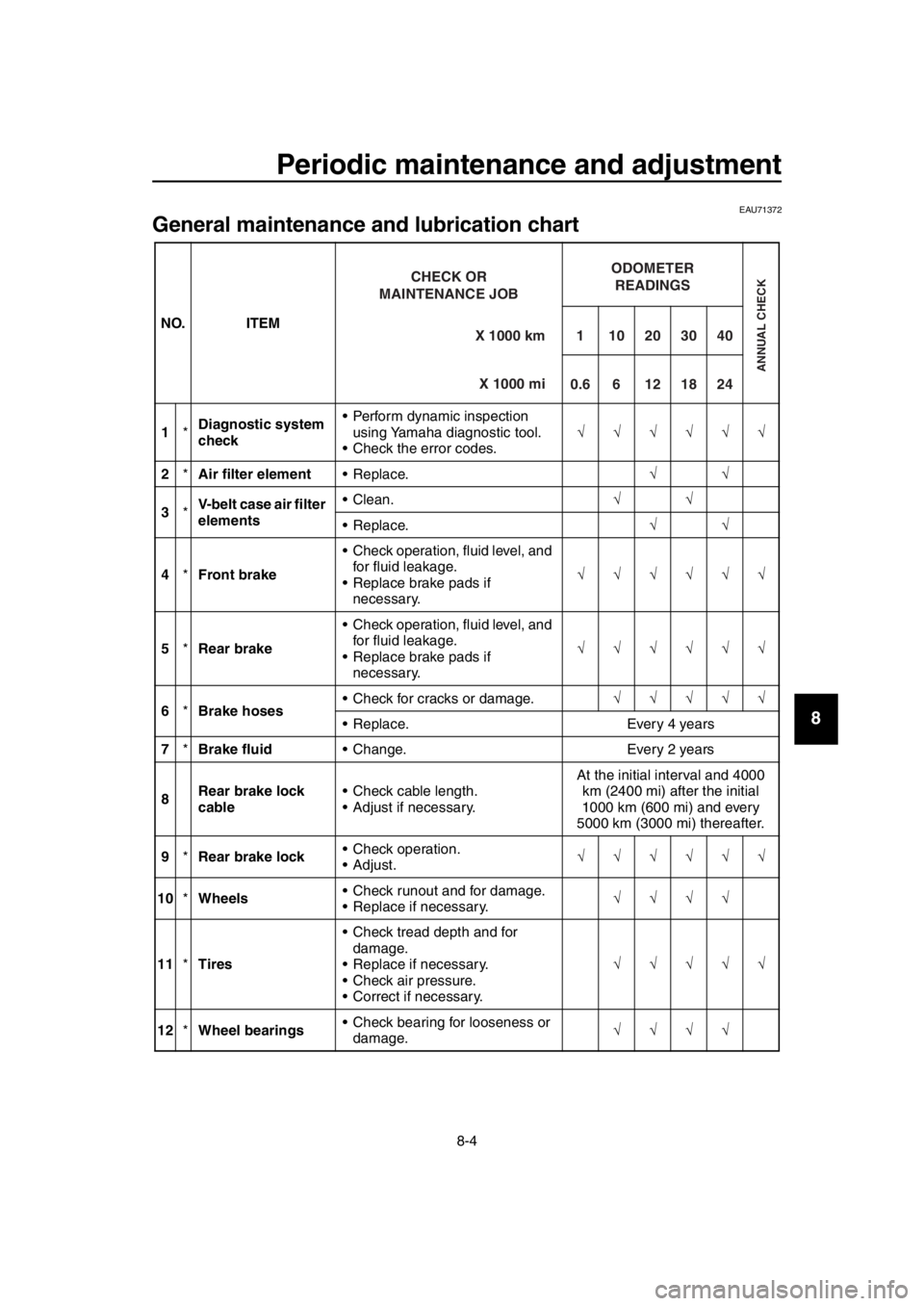
General maintenance and lubrication chart
NO. ITEM
1 *Diagnostic system
check Perform dynamic inspection
using Yamaha diagnostic tool.
Check the error codes.
2 *Air filter element Replace.
3 *V-belt case air filter
elements Clean.
Replace.
4 *Front brake Check operation, fluid level, and
for fluid leakage.
Replace brake pads if necessary.
5 *Rear brake Check operation, fluid level, and
for fluid leakage.
Replace brake pads if necessary.
6 *Brake hoses Check for cracks or damage.
Replace. Every 4 years
7 *Brake fluid Change. Every 2 years
8 Rear brake lock
cable Check cable length.
Adjust if necessary. At the initial interval and 4000
km (2400 mi) after the initial
1000 km (600 mi) and every
5000 km (3000 mi) thereafter.
9 *Rear brake lock Check operation.
Adjust.
10 *Wheels Check runout and for damage.
Replace if necessary.
11 *Tires Check tread depth and for
damage.
Replace if necessary.
Check air pressure.
Correct if necessary.
12 *Wheel bearings Check bearing for looseness or
damage. X 1000 km
CHECK OR
MAINTENANCE JOB
X 1000 mi
ODOMETER READINGS
ANNUAL CHECK
110203040
0.66121824
BV1-9-E2.book 4 ページ 2018年8月28日 火曜日 午後5時28分
Page 90 of 122
Periodic maintenance and adjustment
8-19
1
2
3
4
5
6
7
8
9
10
11
12
13
14
TIP
The tire tread depth limits may differ
from country to country. Always comply
with the local regulations.
WARNING
EWA10472
Have a Yamaha dealer replace
excessively worn tires. Besides
being illegal, operating the vehi-
cle with excessively worn tires
decreases riding stability and
can lead to loss of control.
The replacement of all wheel
and brake-related parts, includ-
ing the tires, should be left to a
Yamaha dealer, who has the
necessary professional knowl-
edge and experience to do so.
Ride at moderate speeds after
changing a tire since the tire
surface must first be “broken
in” for it to develop its optimal
characteristics.
Tire information
This model is equipped with tubeless
tires and tire air valves.
Tires age, even if they have not been
used or have only been used occasion-
ally. Cracking of the tread and sidewall
rubber, sometimes accompanied by
carcass deformation, is an evidence of
ageing. Old and aged tires shall be
checked by tire specialists to ascertain
their suitability for further use.
WARNING
EWA16101
The front and rear tires should
be of the same make and de-
sign, otherwise the handling
characteristics of the vehicle
may be different, which could
lead to an accident.
Always make sure that the valve
caps are securely installed to
prevent air pressure leakage.
Use only the tire valves and
valve cores listed below to
avoid tire deflation during a ride.
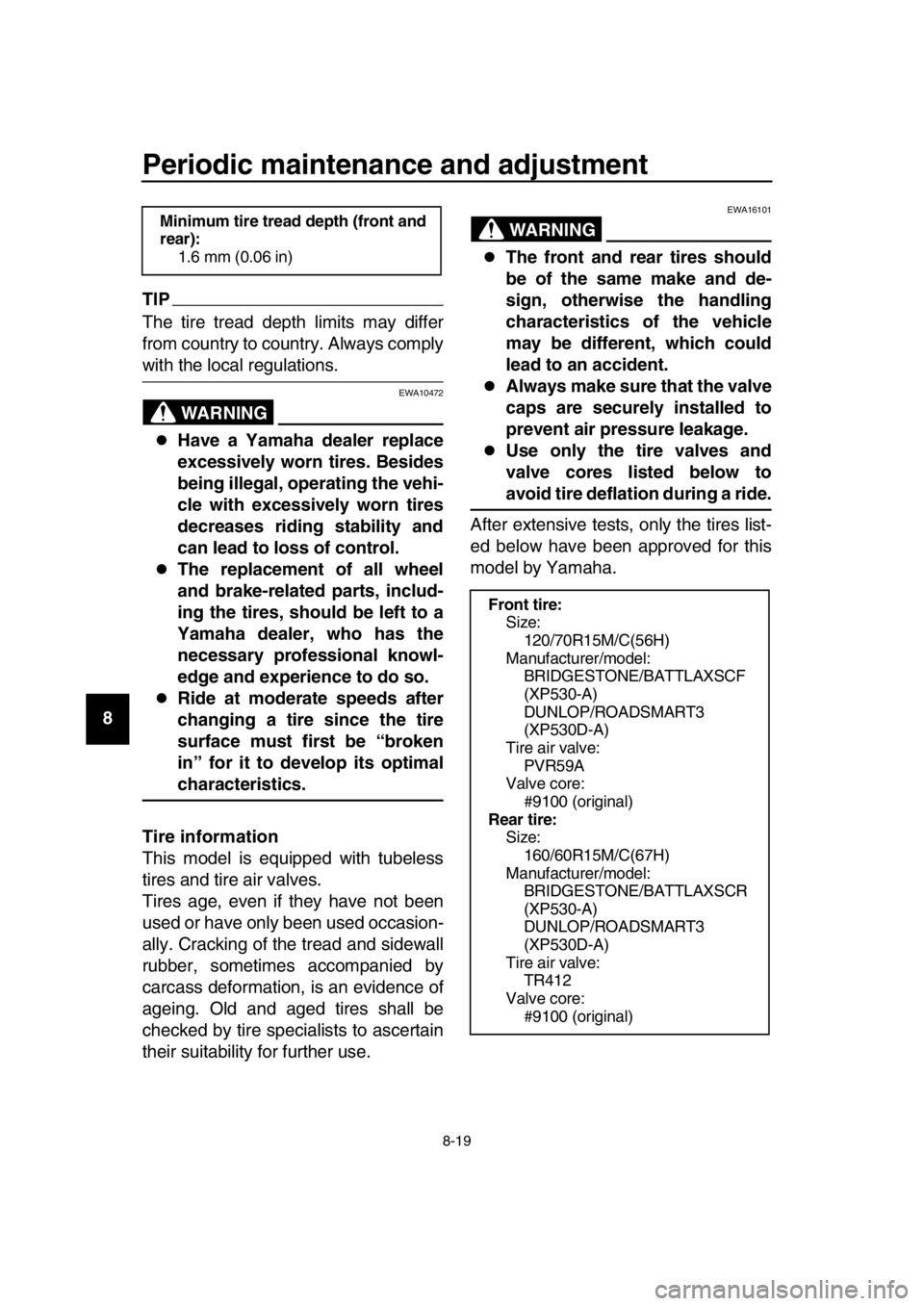
After extensive tests, only the tires list-
ed below have been approved for this
model by Yamaha.
Minimum tire tread depth (front and
rear): 1.6 mm (0.06 in)
Front tire:Size:120/70R15M/C(56H)
Manufacturer/model:
BRIDGESTONE/BATTLAXSCF
(XP530-A)
DUNLOP/ROADSMART3
(XP530D-A)
Tire air valve: PVR59A
Valve core: #9100 (original)
Rear tire:
Size:160/60R15M/C(67H)
Manufacturer/model:
BRIDGESTONE/BATTLAXSCR
(XP530-A)
DUNLOP/ROADSMART3
(XP530D-A)
Tire air valve: TR412
Valve core: #9100 (original)
BV1-9-E2.book 19 ページ 2018年8月28日 火曜日 午後5時28分
Page 91 of 122
Periodic maintenance and adjustment
8-20
1
2
3
4
5
6
7
8
9
10
11
12
13
14
EAU51921
Cast wheels
To maximize the performance, durabil-
ity, and safe operation of your vehicle,
note the following points regarding the
specified wheels.
The wheel rims should be checked
for cracks, bends, warpage or oth-
er damage before each ride. If any
damage is found, have a Yamaha
dealer replace the wheel. Do not
attempt even the smallest repair to
the wheel. A deformed or cracked
wheel must be replaced.
The wheel should be balanced
whenever either the tire or wheel
has been changed or replaced. An
unbalanced wheel can result in
poor performance, adverse han-
dling characteristics, and a short-
ened tire life.
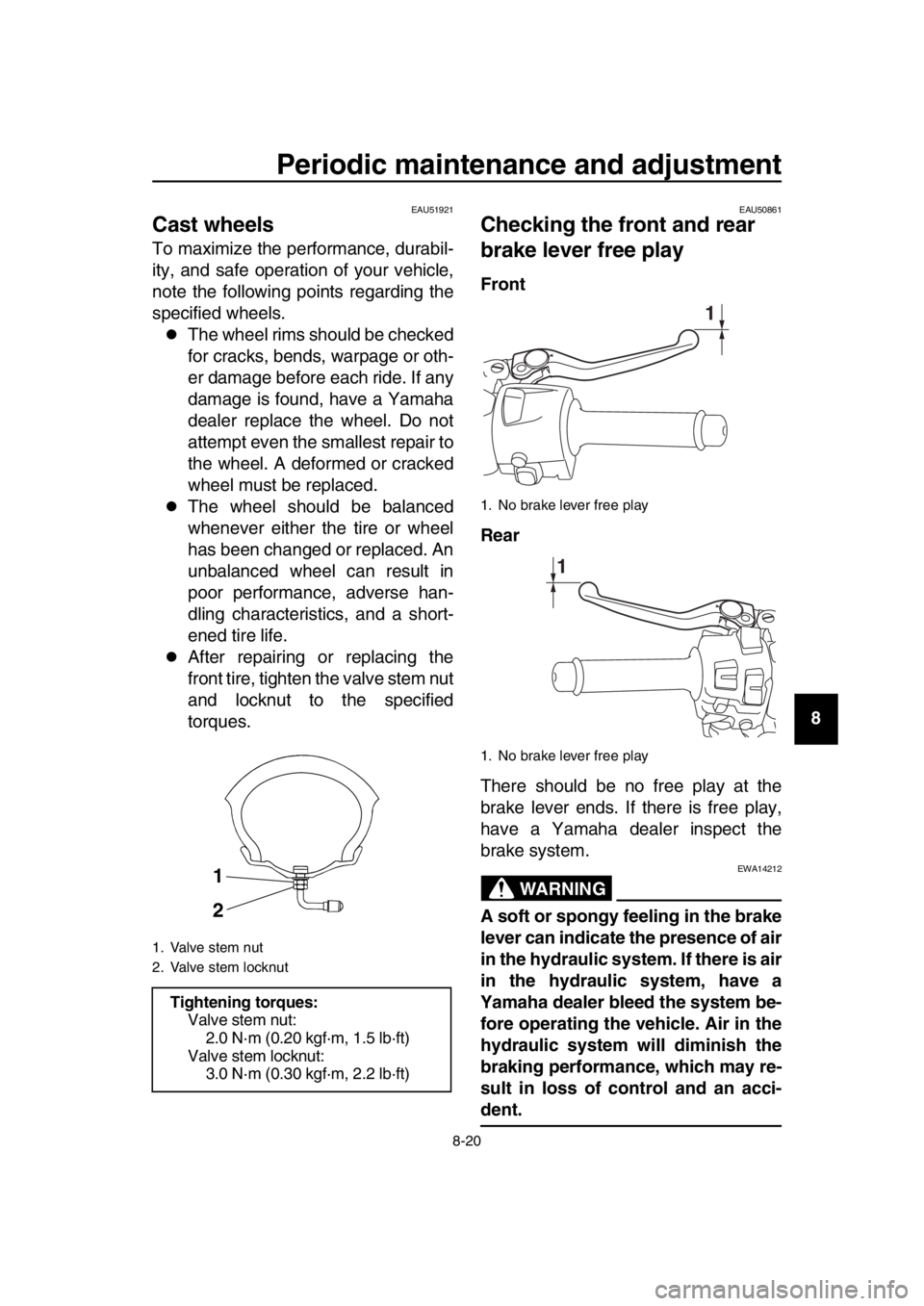
After repairing or replacing the
front tire, tighten the valve stem nut
and locknut to the specified
torques.
EAU50861
Checking the front and rear
brake lever free play
Front
Rear
There should be no free play at the
brake lever ends. If there is free play,
have a Yamaha dealer inspect the
brake system.
WARNING
EWA14212
A soft or spongy feeling in the brake
lever can indicate the presence of air
in the hydraulic system. If there is air
in the hydraulic system, have a
Yamaha dealer bleed the system be-
fore operating the vehicle. Air in the
hydraulic system will diminish the
braking performance, which may re-
sult in loss of control and an acci-
dent.
1. Valve stem nut
2. Valve stem locknut
Tightening torques: Valve stem nut:
2.0 N·m (0.20 kgf·m, 1.5 lb·ft)
Valve stem locknut: 3.0 N·m (0.30 kgf·m, 2.2 lb·ft)
1
2
1. No brake lever free play
1. No brake lever free play
1
1
BV1-9-E2.book 20 ページ 2018年8月28日 火曜日 午後5時28分
Page 92 of 122
Periodic maintenance and adjustment
8-21
1
2
3
4
5
6
7
8
9
10
11
12
13
14
EAU53033
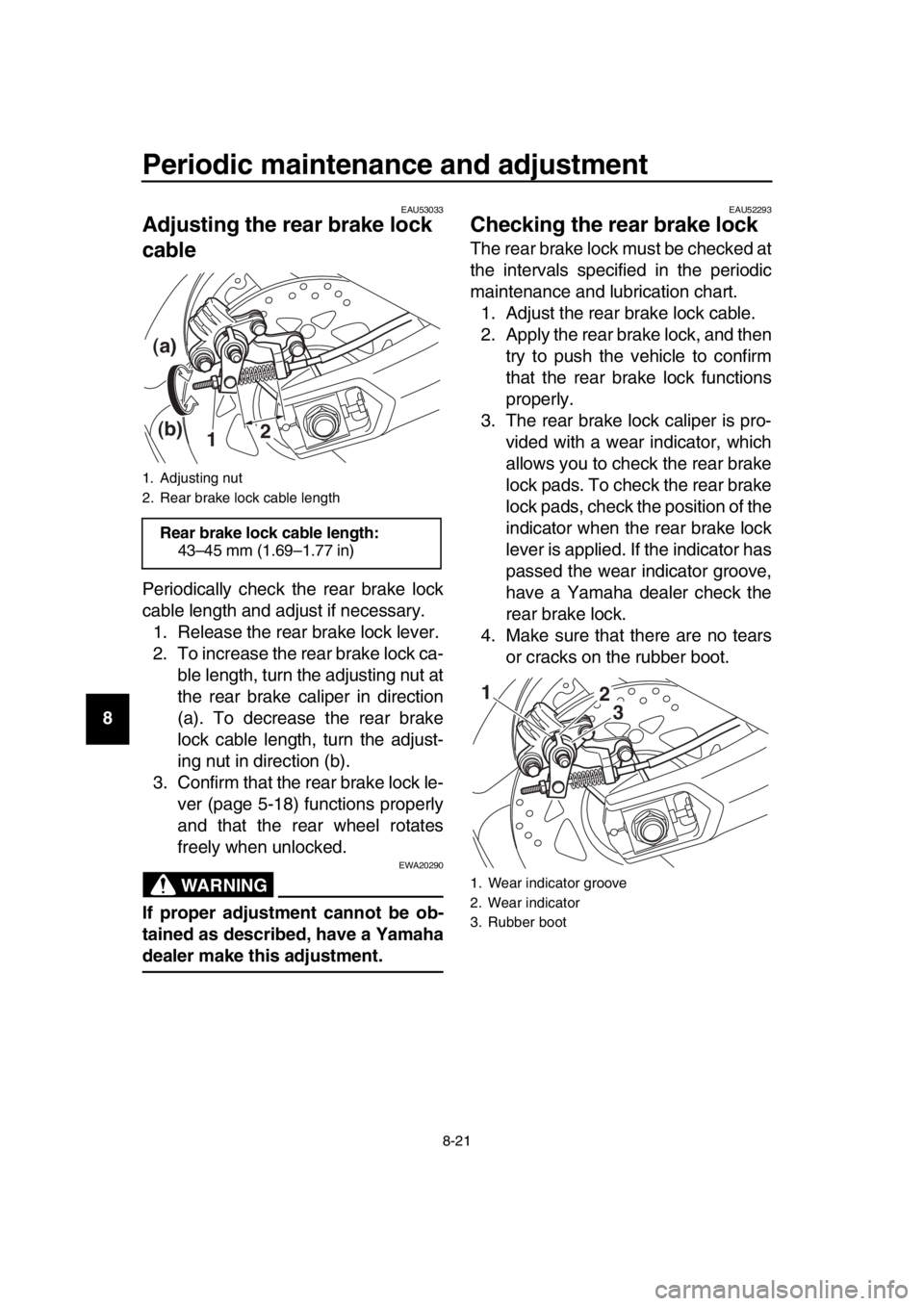
Adjusting the rear brake lock
cable
Periodically check the rear brake lock
cable length and adjust if necessary. 1. Release the rear brake lock lever.
2. To increase the rear brake lock ca- ble length, turn the adjusting nut at
the rear brake caliper in direction
(a). To decrease the rear brake
lock cable length, turn the adjust-
ing nut in direction (b).
3. Confirm that the rear brake lock le- ver (page 5-18) functions properly
and that the rear wheel rotates
freely when unlocked.
WARNING
EWA20290
If proper adjustment cannot be ob-
tained as described, have a Yamaha
dealer make this adjustment.
EAU52293
Checking the rear brake lock
The rear brake lock must be checked at
the intervals specified in the periodic
maintenance and lubrication chart.1. Adjust the rear brake lock cable.
2. Apply the rear brake lock, and then try to push the vehicle to confirm
that the rear brake lock functions
properly.
3. The rear brake lock caliper is pro- vided with a wear indicator, which
allows you to check the rear brake
lock pads. To check the rear brake
lock pads, check the position of the
indicator when the rear brake lock
lever is applied. If the indicator has
passed the wear indicator groove,
have a Yamaha dealer check the
rear brake lock.
4. Make sure that there are no tears or cracks on the rubber boot.
1. Adjusting nut
2. Rear brake lock cable length
Rear brake lock cable length:43–45 mm (1.69–1.77 in)
12
(a)
(b)
1. Wear indicator groove
2. Wear indicator
3. Rubber boot
2 31
BV1-9-E2.book 21 ページ 2018年8月28日 火曜日 午後5時28分
Page 98 of 122
Periodic maintenance and adjustment
8-27
1
2
3
4
5
6
7
8
9
10
11
12
13
14
EAU45512
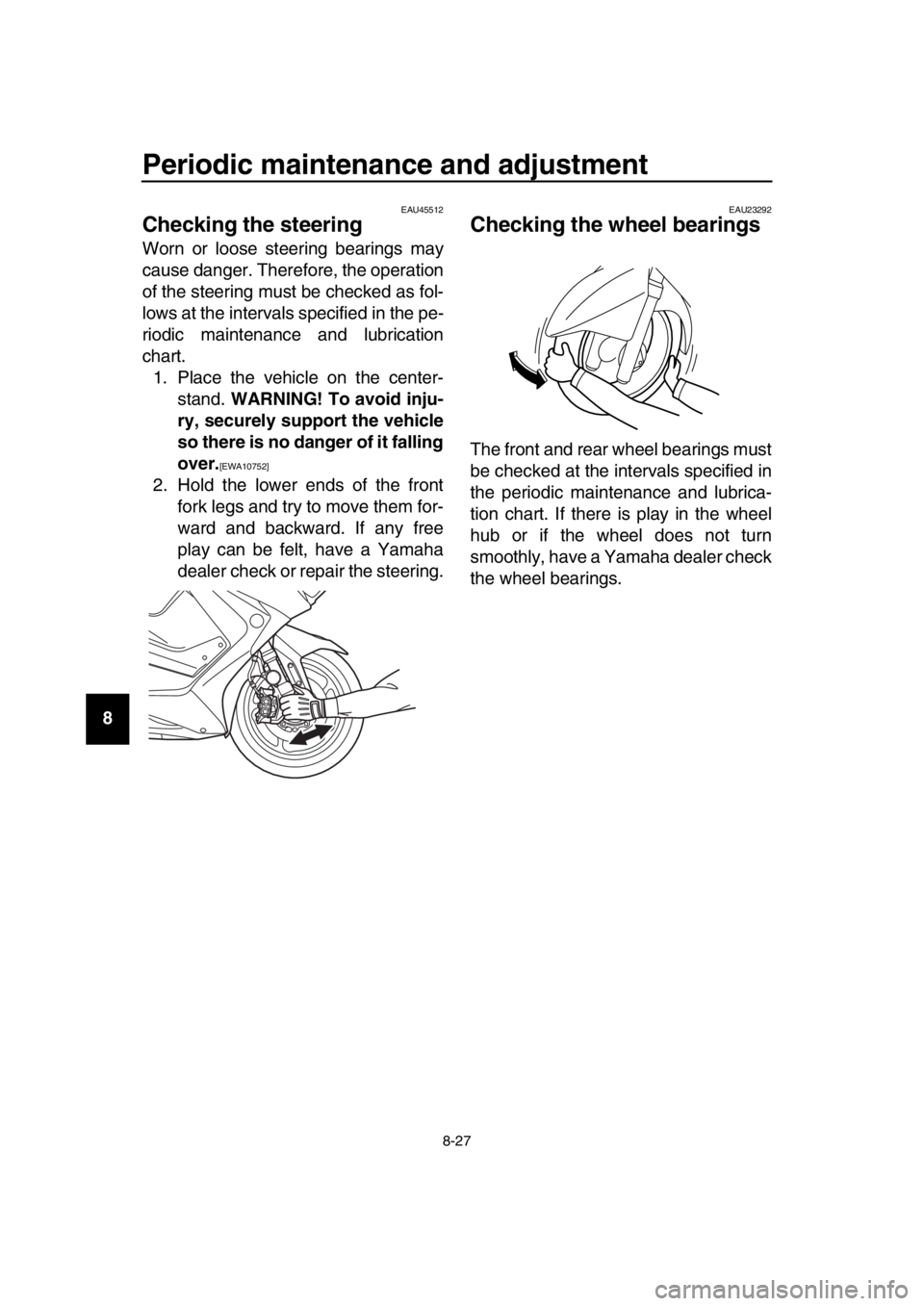
Checking the steering
Worn or loose steering bearings may
cause danger. Therefore, the operation
of the steering must be checked as fol-
lows at the intervals specified in the pe-
riodic maintenance and lubrication
chart. 1. Place the vehicle on the center- stand. WARNING! To avoid inju-
ry, securely support the vehicle
so there is no danger of it falling
over.
[EWA10752]
2. Hold the lower ends of the front fork legs and try to move them for-
ward and backward. If any free
play can be felt, have a Yamaha
dealer check or repair the steering.
EAU23292
Checking the wheel bearings
The front and rear wheel bearings must
be checked at the intervals specified in
the periodic maintenance and lubrica-
tion chart. If there is play in the wheel
hub or if the wheel does not turn
smoothly, have a Yamaha dealer check
the wheel bearings.
BV1-9-E2.book 27 ページ 2018年8月28日 火曜日 午後5時28分
Page 110 of 122
9-1
1
2
3
4
5
6
7
8
9
10
11
12
13
14
Scooter care and storage
EAU37834
Matte color caution
NOTICE
ECA15193
Some models are equipped with
matte colored finished parts. Be
sure to consult a Yamaha dealer for
advice on what products to use be-
fore cleaning the vehicle. Using a
brush, harsh chemical products or
cleaning compounds when cleaning
these parts will scratch or damage
their surface. Wax also should not
be applied to any matte colored fin-
ished parts.
EAU83443
Care
Frequent, thorough cleaning of the ve-
hicle will not only enhance its appear-
ance but also will improve its general
performance and extend the useful life
of many components. Washing, clean-
ing, and polishing will also give you a
chance to inspect the condition of the
vehicle more frequently. Be sure to
wash the vehicle after riding in the rain
or near the sea, because salt is corro-
sive to metals.
TIP
The roads of heavy snowfall areas
may be sprayed with salt as a de-
icing method. This salt can stay on
the roads well into spring, so be
sure to wash the underside and
chassis parts after riding in such
areas.
Genuine Yamaha care and main-
tenance products are sold under
the YAMALUBE brand in many
markets worldwide.
See your Yamaha dealer for addi-
tional cleaning tips.
NOTICE
ECA26280
Improper cleaning can cause cos-
metic and mechanical damage. Do
not use:
high-pressure washers or
steam-jet cleaners. Excessive
water pressure may cause water
seepage and deterioration of
wheel bearings, brakes, trans-
mission seals and electrical de-
vices. Avoid high-pressure
detergent applications such as
those available in coin-operated
BV1-9-E2.book 1 ページ 2018年8月28日 火曜日 午後5時28分
Page 111 of 122

Scooter care and storage
9-2
1
2
3
4
5
6
7
8
9
10
11
12
13
14
car washers.
harsh chemicals, including
strong acidic wheel cleaners,
especially on spoke or magne-
sium wheels.
harsh chemicals, abrasive
cleaning compounds, or wax on
matte-finished parts. Brushes
can scratch and damage the
matte-finish, use soft sponge or
towel only.
towels, sponges, or brushes
contaminated with abrasive
cleaning products or strong
chemicals such as, solvents,
gasoline, rust removers, brake
fluid, or antifreeze, etc.
Before washing 1. Park the vehicle out of direct sun- light and allow it to cool. This will
help avoid water spots.
2. Make sure all caps, covers, electri- cal couplers and connectors are
tightly installed.
3. Cover the muffler end with a plas- tic bag and a strong rubber band.
4. Pre-soak stubborn stains like in- sects or bird droppings with a wet
towel for a few minutes.
5. Remove road grime and oil stains with a quality degreasing agent
and a plastic-bristle brush or
sponge. NOTICE: Do not use de-
greasing agent on areas requir-
ing lubrication such as seals,
gaskets, and wheel axles. Fol-
low product instructions.
[ECA26290]
Washing 1. Rinse off any degreaser and spray down the vehicle with a garden hose. Use only enough pressure to
do the job. Avoid spraying water
directly into the muffler, instrument
panel, air inlet, or other inner areas
such as underseat storage com-
partments.
2. Wash the vehicle with a quality au- tomotive-type detergent mixed
with cool water and a soft, clean
towel or sponge. Use an old tooth-
brush or plastic-bristle brush for
hard-to-reach places. NOTICE:
Use cold water if the vehicle has
been exposed to salt. Warm wa-
ter will increase salt’s corrosive
properties.
[ECA26301]
3. For windshield-equipped vehicles:Clean the windshield with a soft
towel or sponge dampened with
water and a pH neutral detergent.
If necessary, use a high-quality
windshield cleaner or polish for
motorcycles. NOTICE: Never use
any strong chemicals to clean
the windshield. Additionally,
some cleaning compounds for
plastic may scratch the wind-
shield, so be sure to test all
cleaning products before gener-
al application.
[ECA26310]
4. Rinse off thoroughly with clean wa- ter. Be sure to remove all deter-
gent residues, as they can be
harmful to plastic parts.
After washing 1. Dry the vehicle with a chamois or absorbent towel, preferably micro-
fiber terrycloth.
2. For drive chain-equipped models: Dry and then lubricate the drive
chain to prevent rust.
BV1-9-E2.book 2 ページ 2018年8月28日 火曜日 午後5時28分
Page 113 of 122
Scooter care and storage
9-4
1
2
3
4
5
6
7
8
9
10
11
12
13
14
EAU83472
Storage
Always store the vehicle in a cool, dry
place. If necessary, protect it against
dust with a porous cover. Be sure the
engine and the exhaust system are
cool before covering the vehicle. If the
vehicle often sits for weeks at a time be-
tween uses, the use of a quality fuel
stabilizer is recommended after each
fill-up.
NOTICE
ECA21170
Storing the vehicle in a poorly
ventilated room or covering it
with a tarp, while it is still wet,
will allow water and humidity to
seep in and cause rust.
To prevent corrosion, avoid
damp cellars, stables (because
of the presence of ammonia)
and areas where strong chemi-
cals are stored.
Long term storage
Before storing the vehicle long term (60
days or more): 1. Make all necessary repairs and perform any outstanding mainte-
nance.
2. Follow all instructions in the Care section of this chapter.
3. Fill up the fuel tank, adding fuel stabilizer according to product in-
structions. Run the engine for 5
minutes to distribute treated fuel
through the fuel system.
4. For vehicles equipped with a fuel cock: Turn the fuel cock lever to
the off position.
5. For vehicles with a carburetor: To prevent fuel deposits from building up, drain the fuel in the carburetor
float chamber into a clean contain-
er. Retighten the drain bolt and
pour the fuel back into the fuel
tank.
6. Use a quality engine fogging oil ac- cording to product instructions to
protect internal engine compo-
nents from corrosion. If engine fog-
ging oil is not available, perform
the following steps for each cylin-
der:
a. Remove the spark plug cap and spark plug.
b. Pour a teaspoonful of engine oil into the spark plug bore.
c. Install the spark plug cap onto the spark plug, and then place
the spark plug on the cylinder
head so that the electrodes are
grounded. (This will limit spark-
ing during the next step.)
d. Turn the engine over several times with the starter. (This will
coat the cylinder wall with oil.)
WARNING! To prevent dam-
age or injury from sparking,
make sure to ground the
spark plug electrodes while
turning the engine
over.
[EWA10952]
e. Remove the spark plug capfrom the spark plug, and then
install the spark plug and the
spark plug cap.
7. Lubricate all control cables, pivots, levers and pedals, as well as the
sidestand and centerstand (if
equipped).
8. Check and correct the tire air pres- sure, and then lift the vehicle so
that all wheels are off the ground.
BV1-9-E2.book 4 ページ 2018年8月28日 火曜日 午後5時28分
Page 114 of 122
Scooter care and storage
9-5
1
2
3
4
5
6
7
8
9
10
11
12
13
14 Otherwise, turn the wheels a little
once a month in order to prevent
the tires from becoming degraded
in one spot.
9. Cover the muffler outlet with a plastic bag to prevent moisture
from entering it.
10. Remove the battery and fully charge it, or attach a maintenance
charger to keep the battery opti-
mally charged. NOTICE: Confirm
that the battery and its charger
are compatible. Do not charge a
VRLA battery with a convention-
al charger.
[ECA26330]
TIP
If the battery will be removed,
charge it once a month and store it
in a temperate location between 0-
30 C (32-90 F).
See page 8-28 for more informa-
tion on charging and storing the
battery.
BV1-9-E2.book 5 ページ 2018年8月28日 火曜日 午後5時28分