light YAMAHA TMAX 2019 Owner's Guide
[x] Cancel search | Manufacturer: YAMAHA, Model Year: 2019, Model line: TMAX, Model: YAMAHA TMAX 2019Pages: 122, PDF Size: 14.98 MB
Page 67 of 122
Operation and important riding points
7-2
1
2
3
4
5
6
7
8
9
10
11
12
13
14
EAU77082
Starting the engine
NOTICE
ECA10251
See page 7-5 for engine break-in in-
structions prior to operating the ve-
hicle for the first time.
In order for the ignition circuit cut-off
system to enable starting, the sides-
tand must be up. (See page 5-29.) 1. With the smart key turned on, ap- proach the vehicle.
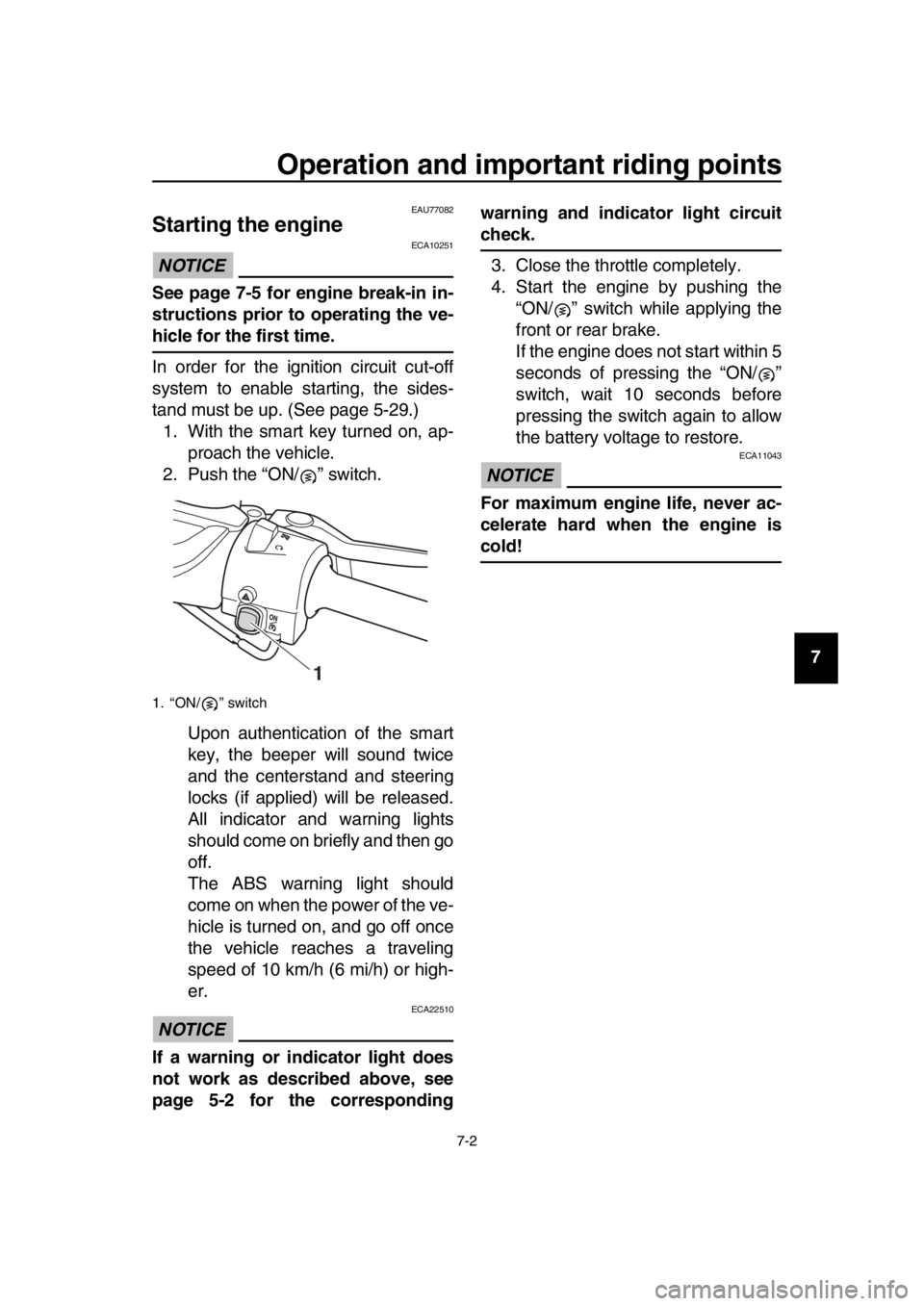
2. Push the “ON/ ” switch.
Upon authentication of the smart
key, the beeper will sound twice
and the centerstand and steering
locks (if applied) will be released.
All indicator and warning lights
should come on briefly and then go
off.
The ABS warning light should
come on when the power of the ve-
hicle is turned on, and go off once
the vehicle reaches a traveling
speed of 10 km/h (6 mi/h) or high-
er.
NOTICE
ECA22510
If a warning or indicator light does
not work as described above, see
page 5-2 for the corresponding warning and indicator light circuit
check.
3. Close the throttle completely.
4. Start the engine by pushing the “ON/ ” switch while applying the
front or rear brake.
If the engine does not start within 5
seconds of pressing the “ON/ ”
switch, wait 10 seconds before
pressing the switch again to allow
the battery voltage to restore.
NOTICE
ECA11043
For maximum engine life, never ac-
celerate hard when the engine is
cold!
1. “ON/ ” switch
1
BV1-9-E2.book 2 ページ 2018年8月28日 火曜日 午後5時28分
Page 70 of 122
Operation and important riding points
7-5
1
2
3
4
5
6
7
8
9
10
11
12
13
14
EAU16821
Tips for reducing fuel
consumption
Fuel consumption depends largely on
your riding style. Consider the following
tips to reduce fuel consumption:
Avoid high engine speeds during
acceleration.
Avoid high engine speeds with no
load on the engine.
Turn the engine off instead of let-
ting it idle for an extended length of
time (e.g., in traffic jams, at traffic
lights or at railroad crossings).
EAU16842
Engine break-in
There is never a more important period
in the life of your engine than the period
between 0 and 1600 km (1000 mi). For
this reason, you should read the follow-
ing material carefully.
Since the engine is brand new, do not
put an excessive load on it for the first
1600 km (1000 mi). The various parts in
the engine wear and polish themselves
to the correct operating clearances.
During this period, prolonged full-throt-
tle operation or any condition that might
result in engine overheating must be
avoided.
EAU36532
0–1000 km (0–600 mi)
Avoid prolonged operation above 5100
r/min. NOTICE: After 1000 km (600
mi) of operation, the engine oil must
be changed, and the oil filter car-
tridge or element replaced.
[ECA11283]
1000–1600 km (600–1000 mi)
Avoid prolonged operation above 6100
r/min.
1600 km (1000 mi) and beyond
The vehicle can now be operated nor-
mally.
NOTICE
ECA10311
Keep the engine speed out of
the tachometer red zone.
If any engine trouble should oc-
cur during the engine break-in
period, immediately have a
Yamaha dealer check the vehi-
cle.
BV1-9-E2.book 5 ページ 2018年8月28日 火曜日 午後5時28分
Page 77 of 122
Periodic maintenance and adjustment
8-6
1
2
3
4
5
6
7
8
9
10
11
12
13
14
EAU72781
TIP
Air filters
The engine air filter uses a disposable oil-coated paper element. This element
cannot be cleaned with compressed air, doing so will only damage it.
If you often ride in the rain or in dusty areas, have the engine air filter and V-
belt air filter elements serviced more frequently.
Hydraulic brake service
Regularly check the brake fluid levels in the reservoirs, and refill as necessary.
Replace the internal components of the brake master cylinders and calipers,
and change the brake fluid every 2 years.
Replace the brake hoses every 4 years, or sooner if cracked or damaged.
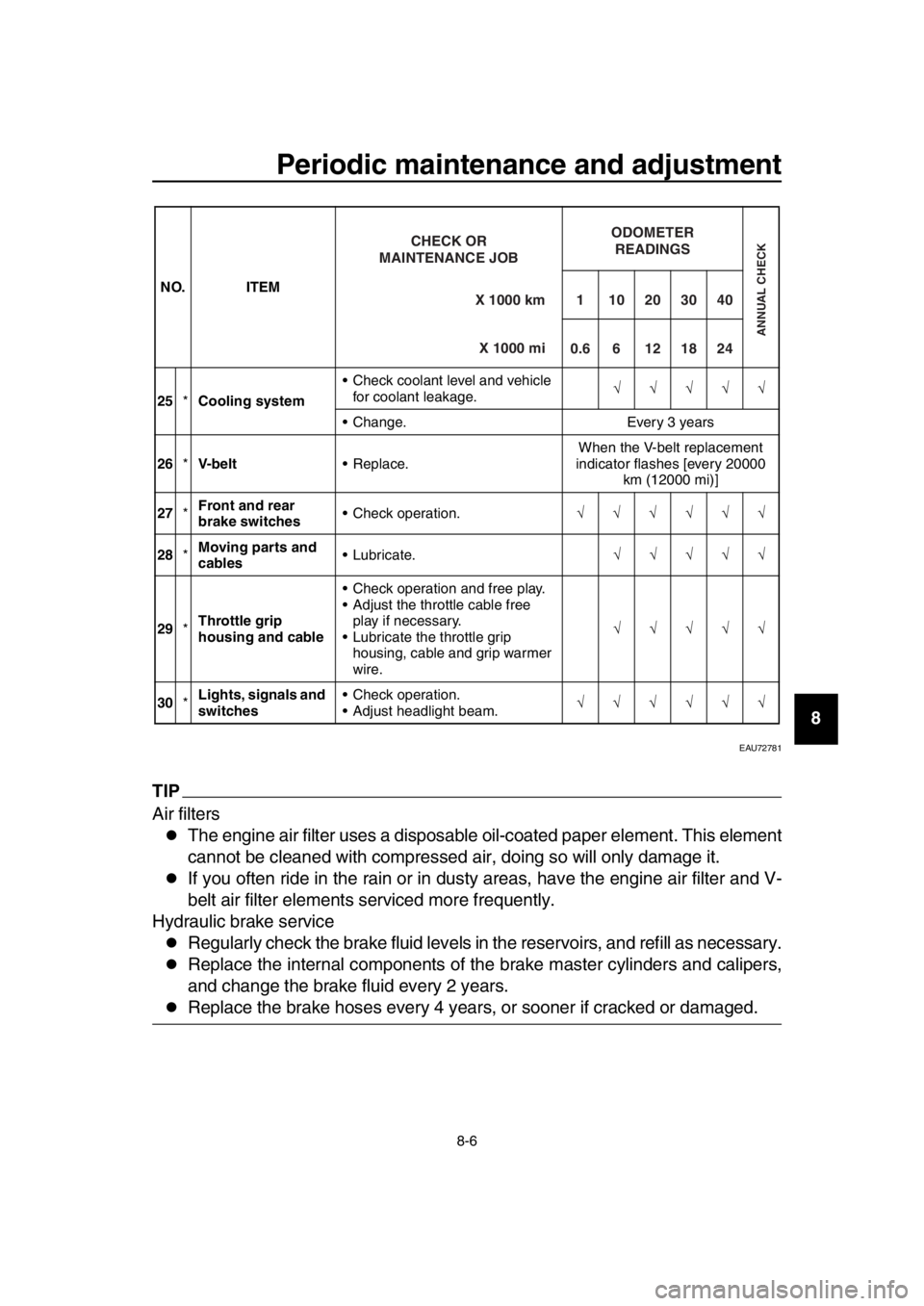
25*Cooling system Check coolant level and vehicle
for coolant leakage.
Change. Every 3 years
26 *V- b e l t Replace. When the V-belt replacement
indicator flashes [every 20000 km (12000 mi)]
27 *Front and rear
brake switches Check operation.
28 *Moving parts and
cables Lubricate.
29 *Throttle grip
housing and cable Check operation and free play.
Adjust the throttle cable free
play if necessary.
Lubricate the throttle grip housing, cable and grip warmer
wire.
30 *Lights, signals and
switches Check operation.
Adjust headlight beam.
NO. ITEM
X 1000 km
CHECK OR
MAINTENANCE JOB
X 1000 mi
ODOMETER READINGS
ANNUAL CHECK
110203040
0.66121824
BV1-9-E2.book 6 ページ 2018年8月28日 火曜日 午後5時28分
Page 80 of 122
Periodic maintenance and adjustment
8-9
1
2
3
4
5
6
7
8
9
10
11
12
13
14
EAU19643
Checking the spark plugs
The spark plugs are important engine
components, which should be checked
periodically, preferably by a Yamaha
dealer. Since heat and deposits will
cause any spark plug to slowly erode,
they should be removed and checked
in accordance with the periodic mainte-
nance and lubrication chart. In addition,
the condition of the spark plugs can re-
veal the condition of the engine.
The porcelain insulator around the cen-
ter electrode of each spark plug should
be a medium-to-light tan (the ideal color
when the vehicle is ridden normally),
and all spark plugs installed in the en-
gine should have the same color. If any
spark plug shows a distinctly different
color, the engine could be operating im-
properly. Do not attempt to diagnose
such problems yourself. Instead, have
a Yamaha dealer check the vehicle.
If a spark plug shows signs of electrode
erosion and excessive carbon or other
deposits, it should be replaced.
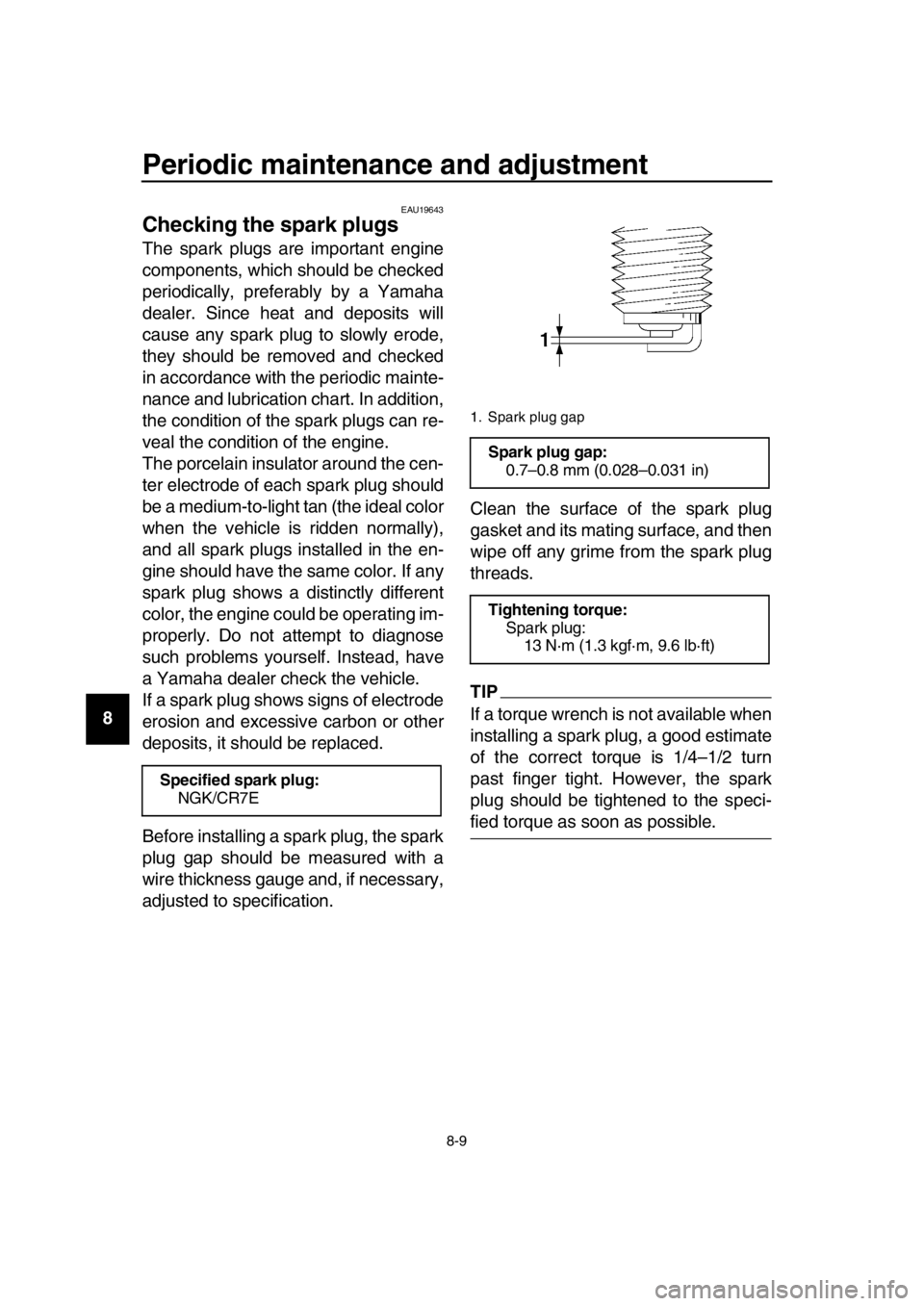
Before installing a spark plug, the spark
plug gap should be measured with a
wire thickness gauge and, if necessary,
adjusted to specification. Clean the surface of the spark plug
gasket and its mating surface, and then
wipe off any grime from the spark plug
threads.
TIP
If a torque wrench is not available when
installing a spark plug, a good estimate
of the correct torque is 1/4–1/2 turn
past finger tight. However, the spark
plug should be tightened to the speci-
fied torque as soon as possible.
Specified spark plug:
NGK/CR7E
1. Spark plug gap
Spark plug gap:0.7–0.8 mm (0.028–0.031 in)
Tightening torque: Spark plug:
13 N·m (1.3 kgf·m, 9.6 lb·ft)
BV1-9-E2.book 9 ページ 2018年8月28日 火曜日 午後5時28分
Page 81 of 122
Periodic maintenance and adjustment
8-10
1
2
3
4
5
6
7
8
9
10
11
12
13
14
EAU36112
Canister
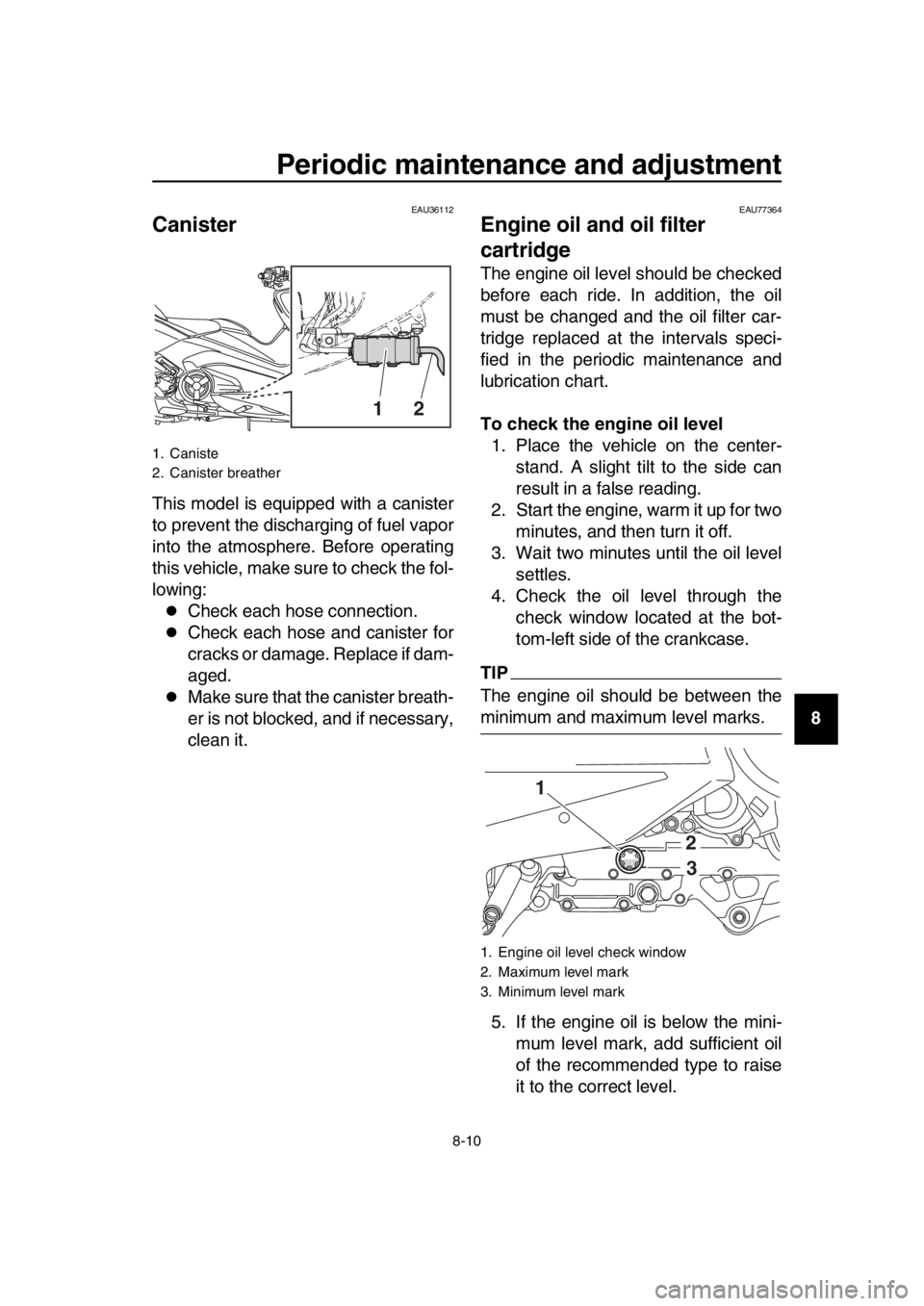
This model is equipped with a canister
to prevent the discharging of fuel vapor
into the atmosphere. Before operating
this vehicle, make sure to check the fol-
lowing:
Check each hose connection.
Check each hose and canister for
cracks or damage. Replace if dam-
aged.
Make sure that the canister breath-
er is not blocked, and if necessary,
clean it.
EAU77364
Engine oil and oil filter
cartridge
The engine oil level should be checked
before each ride. In addition, the oil
must be changed and the oil filter car-
tridge replaced at the intervals speci-
fied in the periodic maintenance and
lubrication chart.
To check the engine oil level 1. Place the vehicle on the center- stand. A slight tilt to the side can
result in a false reading.
2. Start the engine, warm it up for two minutes, and then turn it off.
3. Wait two minutes until the oil level settles.
4. Check the oil level through the check window located at the bot-
tom-left side of the crankcase.
TIP
The engine oil should be between the
minimum and maximum level marks.
5. If the engine oil is below the mini- mum level mark, add sufficient oil
of the recommended type to raise
it to the correct level.
1. Caniste
2. Canister breather
12
1. Engine oil level check window
2. Maximum level mark
3. Minimum level mark
2
3
1
BV1-9-E2.book 10 ページ 2018年8月28日 火曜日 午後5時28分
Page 101 of 122
Periodic maintenance and adjustment
8-30
1
2
3
4
5
6
7
8
9
10
11
12
13
14
(XP530-A)
(XP530D-A)
(XP530D-A)
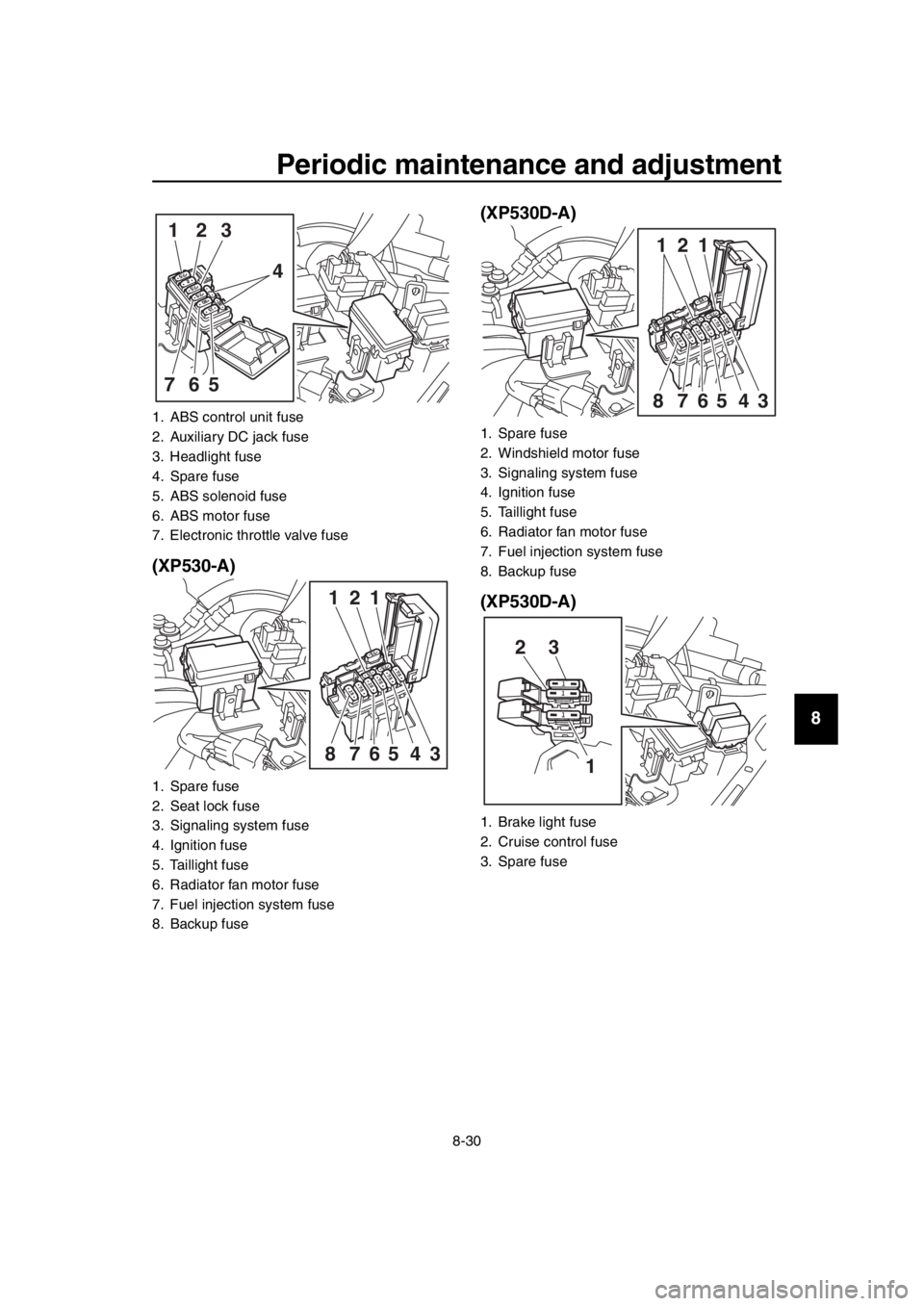
1. ABS control unit fuse
2. Auxiliary DC jack fuse
3. Headlight fuse
4. Spare fuse
5. ABS solenoid fuse
6. ABS motor fuse
7. Electronic throttle valve fuse
1. Spare fuse
2. Seat lock fuse
3. Signaling system fuse
4. Ignition fuse
5. Taillight fuse
6. Radiator fan motor fuse
7. Fuel injection system fuse
8. Backup fuse
4
765 123
1
34568
12
7
1. Spare fuse
2. Windshield motor fuse
3. Signaling system fuse
4. Ignition fuse
5. Taillight fuse
6. Radiator fan motor fuse
7. Fuel injection system fuse
8. Backup fuse
1. Brake light fuse
2. Cruise control fuse
3. Spare fuse
1
34568
12
7
3
1
2
BV1-9-E2.book 30 ページ 2018年8月28日 火曜日 午後5時28分
Page 102 of 122
Periodic maintenance and adjustment
8-31
1
2
3
4
5
6
7
8
9
10
11
12
13
14 3. Turn the vehicle power on and turn
on the electrical circuit in question
to check if the device operates.
4. If the fuse immediately blows again, have a Yamaha dealer
check the electrical system.
EAU77162
Vehicle lights
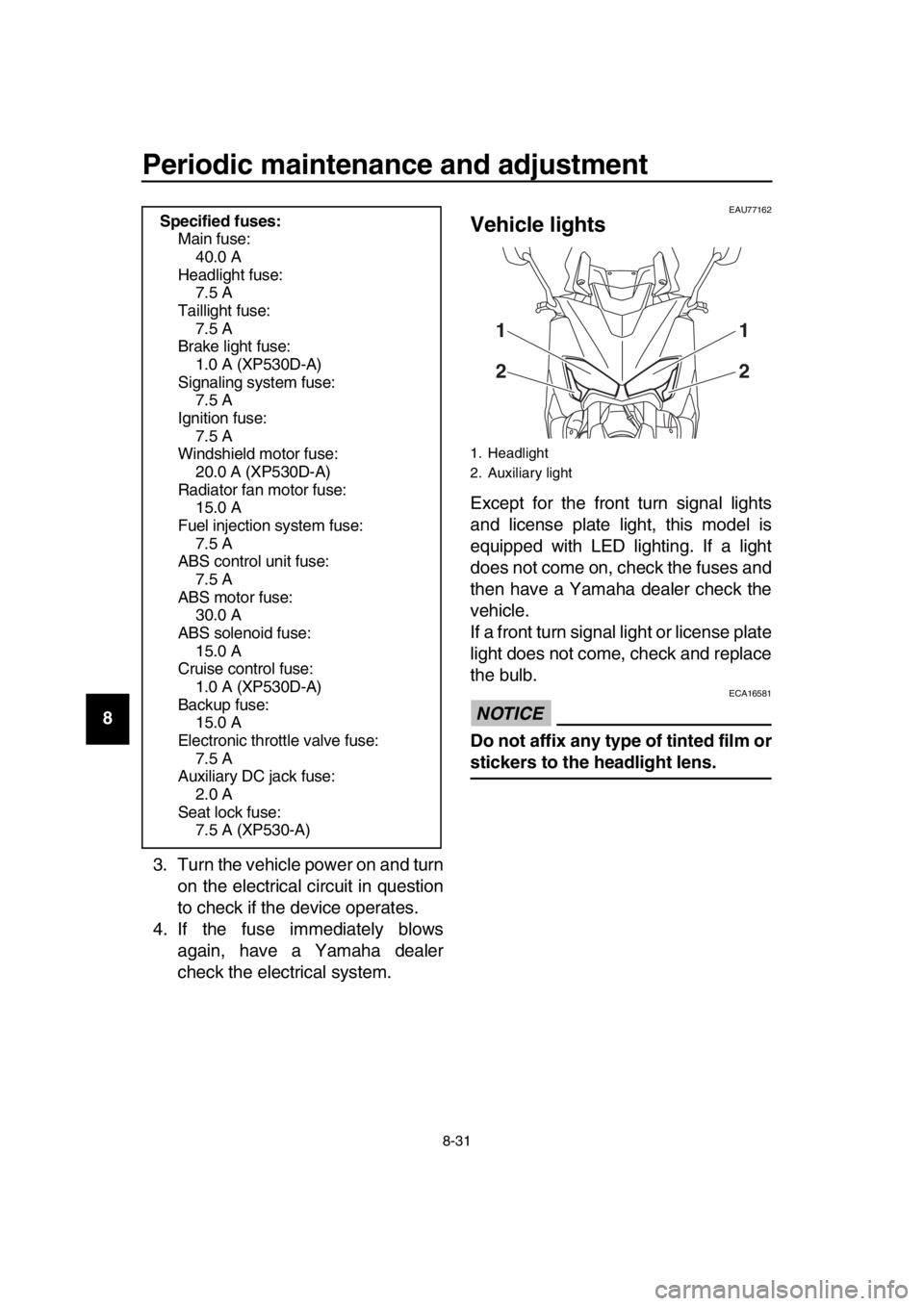
Except for the front turn signal lights
and license plate light, this model is
equipped with LED lighting. If a light
does not come on, check the fuses and
then have a Yamaha dealer check the
vehicle.
If a front turn signal light or license plate
light does not come, check and replace
the bulb.
NOTICE
ECA16581
Do not affix any type of tinted film or
stickers to the headlight lens.
Specified fuses:Main fuse:
40.0 A
Headlight fuse: 7.5 A
Taillight fuse: 7.5 A
Brake light fuse:
1.0 A (XP530D-A)
Signaling system fuse: 7.5 A
Ignition fuse: 7.5 A
Windshield motor fuse:
20.0 A (XP530D-A)
Radiator fan motor fuse: 15.0 A
Fuel injection system fuse: 7.5 A
ABS control unit fuse:
7.5 A
ABS motor fuse: 30.0 A
ABS solenoid fuse:
15.0 A
Cruise control fuse: 1.0 A (XP530D-A)
Backup fuse: 15.0 A
Electronic thrott le valve fuse:
7.5 A
Auxiliary DC jack fuse: 2.0 A
Seat lock fuse: 7.5 A (XP530-A)
1. Headlight
2. Auxiliary light
1
21
2
BV1-9-E2.book 31 ページ 2018年8月28日 火曜日 午後5時28分
Page 103 of 122
Periodic maintenance and adjustment
8-32
1
2
3
4
5
6
7
8
9
10
11
12
13
14
EAU52323
Replacing a front turn signal
light bulb
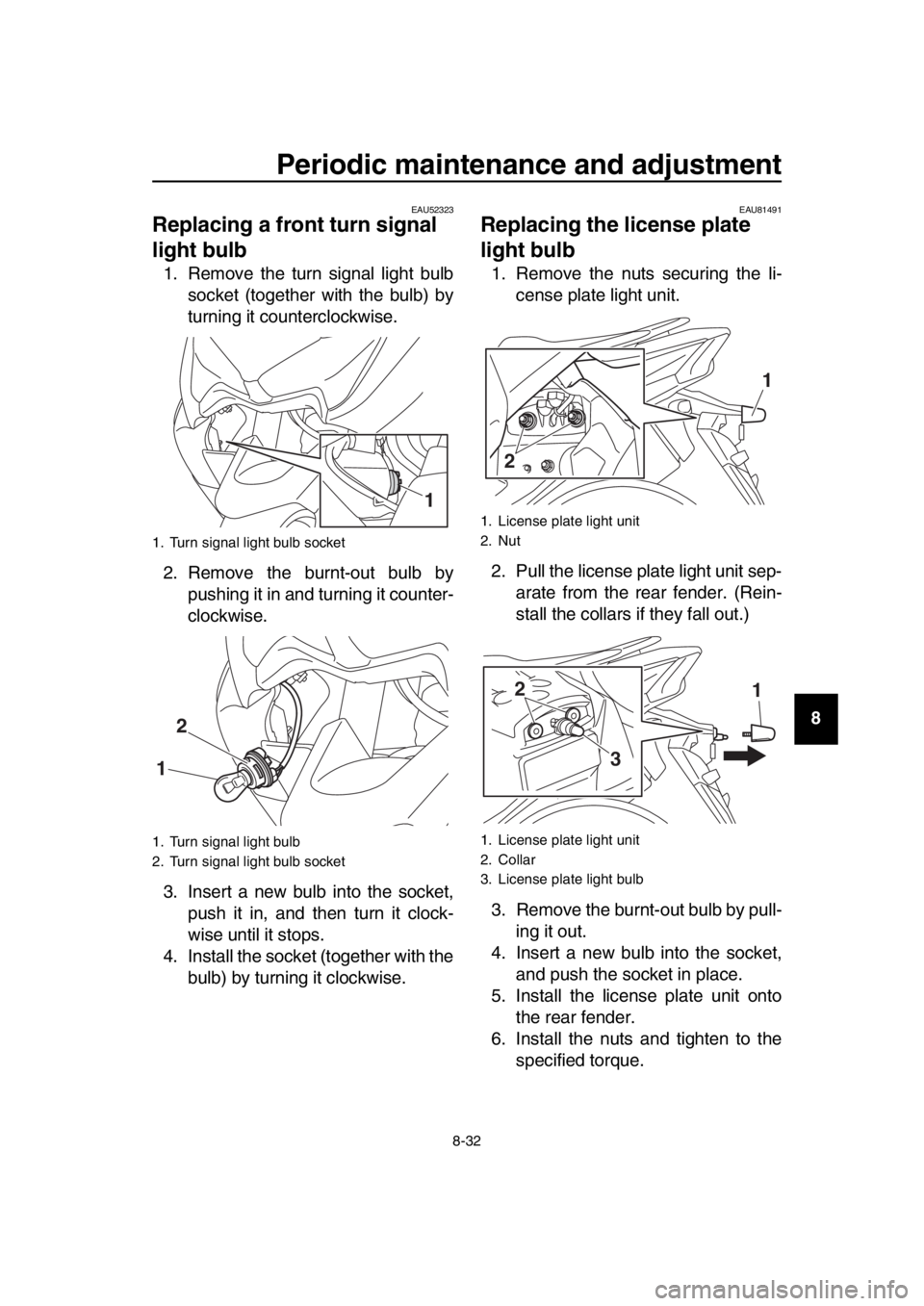
1. Remove the turn signal light bulb socket (together with the bulb) by
turning it counterclockwise.
2. Remove the burnt-out bulb by pushing it in and turning it counter-
clockwise.
3. Insert a new bulb into the socket, push it in, and then turn it clock-
wise until it stops.
4. Install the socket (together with the bulb) by turning it clockwise.
EAU81491
Replacing the license plate
light bulb
1. Remove the nuts securing the li-cense plate light unit.
2. Pull the license plate light unit sep- arate from the rear fender. (Rein-
stall the collars if they fall out.)
3. Remove the burnt-out bulb by pull- ing it out.
4. Insert a new bulb into the socket, and push the socket in place.
5. Install the license plate unit onto the rear fender.
6. Install the nuts and tighten to the specified torque.
1. Turn signal light bulb socket
1. Turn signal light bulb
2. Turn signal light bulb socket
1
12
1. License plate light unit
2. Nut
1. License plate light unit
2. Collar
3. License plate light bulb
2 1
2
1
3
BV1-9-E2.book 32 ページ 2018年8月28日 火曜日 午後5時28分
Page 104 of 122
Periodic maintenance and adjustment
8-33
1
2
3
4
5
6
7
8
9
10
11
12
13
14
EAU25865
Troubleshooting
Although your Yamaha received a thor-
ough inspection before shipment from
the factory, trouble may occur during
operation. Any problem in the fuel,
compression, or ignition systems, for
example, can cause poor starting and
loss of power.
The following troubleshooting chart
represents a quick and easy procedure
for checking these vital systems your-
self. However, should your vehicle re-
quire any repair, take it to an authorized
Yamaha dealer whose skilled techni-
cians have the necessary tools, experi-
ence, and know-how to properly
service your Yamaha vehicle.
Be sure to use only genuine Yamaha
replacement parts. Although imitation
parts may look similar to genuine parts,
they are often inferior in quality, have a
shorter service life, and can lead to an
expensive repair bill later on.
WARNING
EWA15142
When checking the fuel system, do
not smoke, and make sure there are
no open flames or sparks in the ar-
ea, including pilot lights from water
heaters or furnaces. Gasoline or
gasoline vapors can ignite or ex-
plode, causing severe injury or
property damage.
EAU77992Smart key system troubleshooting
Please check the following items when
the smart key system does not work.
Is the smart key turned on? (See
page 3-5.)
Is the smart key battery dis-
charged? (See page 3-6.)
Tightening torque: License plate light unit nut:
3.8 N·m (0.38 kgf·m, 2.8 lb·ft)
BV1-9-E2.book 33 ページ 2018年8月28日 火曜日 午後5時28分
Page 108 of 122

Periodic maintenance and adjustment
8-37
1
2
3
4
5
6
7
8
9
10
11
12
13
14
EAU77372
Emergency mode
When the smart key is lost, damaged,
or its battery has discharged, the vehi-
cle can still be turned on and the engine
started. You will need a mechanical key
and the smart key system identification
number. To operate the vehicle in
emergency mode, carry out the follow-
ing steps.
TIP
Emergency mode operation will be
cancelled if the respective steps are not
carried out within the time set for each
operation or if the “OFF/LOCK” switch
is pushed. 1. Stop the vehicle in a safe place.
2. Unlock the seat by inserting the mechanical key into the lock locat-
ed right side of body and turn it
counter clockwise.
3. Open the seat and check that the trunk light comes on.
4. Push the “ON/ ” switch once.
5. Without completely shutting the seat, raise and lower it three times
within 10 seconds.
TIP
Use the rear storage compartment light
as a guide when raising and lowering
the seat. The smart key system indicator
light on the speedometer will come
on for three seconds to indicate
the transition to emergency mode.
6. After the smart key system indica- tor light goes off, use the “ / ”
switch to enter the identification
number.
7. Inputting the identification number is done by counting the number of
flashes of the smart key system in-
dicator light.
For example, if the identification
number is 123456:
Push and hold the “ / ” switch.
The smart key system indicator
light will start to flash.
1. Smart key system indicator light “ ”
1. Identification number
1
12345 6
1
BV1-9-E2.book 37 ページ 2018年8月28日 火曜日 午後5時28分