engine YAMAHA TRICITY 300 2020 Owner's Manual
[x] Cancel search | Manufacturer: YAMAHA, Model Year: 2020, Model line: TRICITY 300, Model: YAMAHA TRICITY 300 2020Pages: 114, PDF Size: 11.27 MB
Page 54 of 114
Instrument and control functions
5-23
5
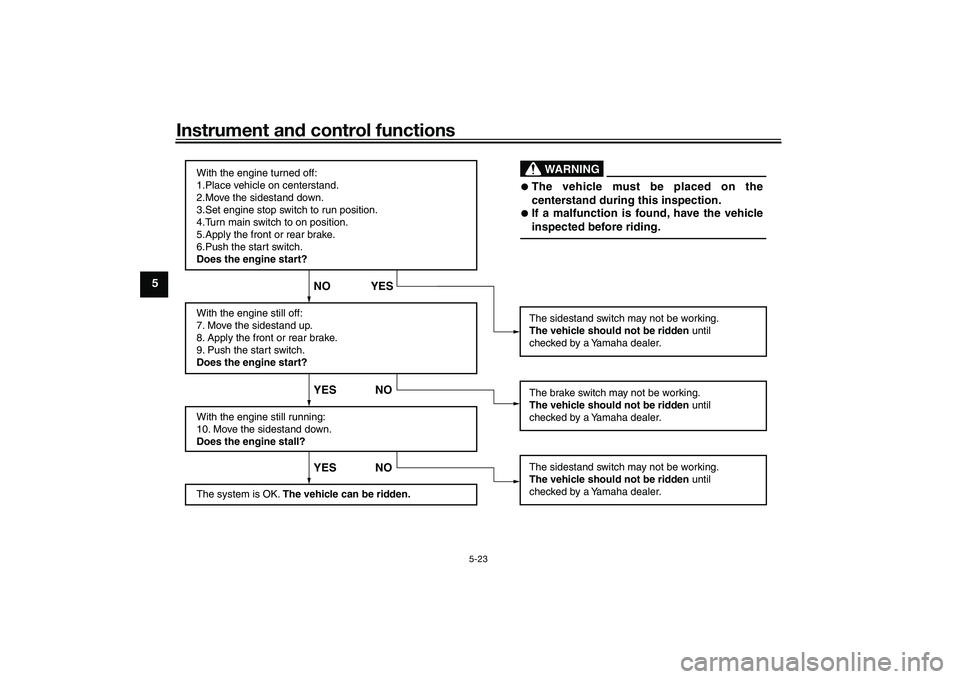
With the engine still off:
7. Move the sidestand up.
8. Apply the front or rear brake.
9. Push the start switch.
Does the engine start?
With the engine still running:
10. Move the sidestand down.
Does the engine stall?
The system is OK. The vehicle can be ridden. The sidestand switch may not be working.
The vehicle should not be ridden
until
checked by a Yamaha dealer.
The sidestand switch may not be working.
The vehicle should not be ridden until
checked by a Yamaha dealer.
YES NO YES NO NO YES
The brake switch may not be working.
The vehicle should not be ridden until
checked by a Yamaha dealer.
WARNING
The vehicle must be placed on the
centerstand during this inspection.
If a malfunction is found, have the vehicle
inspected before riding.
With the engine turned off:
1.Place vehicle on centerstand.
2.Move the sidestand down.
3.Set engine stop switch to run position.
4.Turn main switch to on position.
5.Apply the front or rear brake.
6.Push the start switch.
Does the engine start?
UBX9E0E0.book Page 23 Monday, January 20, 2020 10:54 AM
Page 55 of 114
For your safety – pre-operation checks
6-1
6
EAU1559B
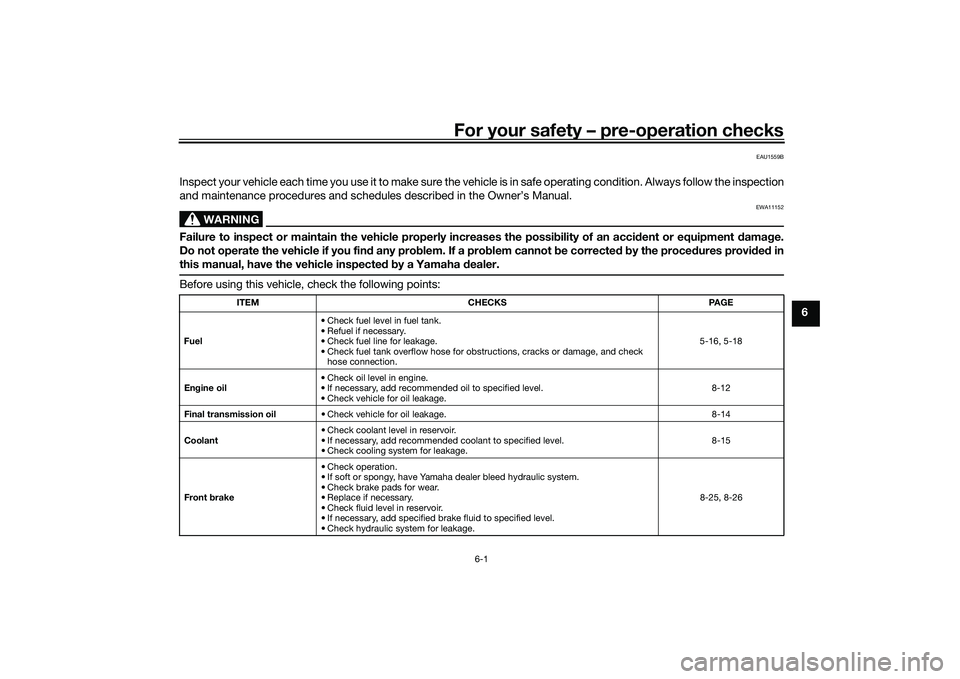
Inspect your vehicle each time you use it to make sure the vehicle is in safe operating condition. Always follow the inspection
and maintenance procedures and schedules described in the Owner’s Manual.
WARNING
EWA11152
Failure to inspect or maintain the vehicle properly increases the possibility of an acci dent or equipment damag e.
Do not operate the vehicle if you fin d any pro blem. If a pro blem cannot be corrected b y the proce dures provi ded in
this manual, have the vehicle inspecte d b y a Yamaha dealer.Before using this vehicle, check the following points:
ITEM CHECKS PAGE
Fuel • Check fuel level in fuel tank.
• Refuel if necessary.
• Check fuel line for leakage.
• Check fuel tank overflow hose for obstructions, cracks or damage, and check
hose connection. 5-16, 5-18
En gine oil • Check oil level in engine.
• If necessary, add recommended oil to specified level.
• Check vehicle for oil leakage. 8-12
Final transmission oil • Check vehicle for oil leakage. 8-14
Coolant • Check coolant level in reservoir.
• If necessary, add recommended coolant to specified level.
• Check cooling system for leakage. 8-15
Front brake • Check operation.
• If soft or spongy, have Yamaha dealer bleed hydraulic system.
• Check brake pads for wear.
• Replace if necessary.
• Check fluid level in reservoir.
• If necessary, add specified brake fluid to specified level.
• Check hydraulic system for leakage. 8-25, 8-26
UBX9E0E0.book Page 1 Monday, January 20, 2020 10:54 AM
Page 57 of 114
Operation and important ri din g points
7-1
7
EAU15952
Read the Owner’s Manual carefully to
become familiar with all controls. If
there is a control or function you do not
understand, ask your Yamaha dealer.
WARNING
EWA10272
Failure to familiarize yourself with
the controls can lead to loss of con-
trol, which coul d cause an acci dent
or injury.
EAU16842
En gine break-inThere is never a more important period
in the life of your engine than the period
between 0 and 1600 km (1000 mi). For
this reason, you should read the fol-
lowing material carefully.
Since the engine is brand new, do not
put an excessive load on it for the first
1600 km (1000 mi). The various parts in
the engine wear and polish themselves
to the correct operating clearances.
During this period, prolonged full-throt-
tle operation or any condition that
might result in engine overheating
must be avoided.
EAU88951
0–1000 km (0–600 mi)
Avoid prolonged operation above 4500
r/min. NOTICE: After 1000 km (600
mi) of operation, be sure to replace
the en gine oil, final transmission oil
an d the oil filter element.
[ECA12932]
1000–1600 km (600–1000 mi)
Avoid prolonged operation above 5400
r/min. 1600 km (1000 mi) an
d b eyon d
The vehicle can now be operated nor-
mally.
NOTICE
ECA23060
Keep the en gine spee d out of
the tachometer hi gh-r/min zo-
ne.
If any en gine trou ble shoul d oc-
cur during the en gine break-in
perio d, imme diately have a
Yamaha dealer check the vehi-
cle.
UBX9E0E0.book Page 1 Monday, January 20, 2020 10:54 AM
Page 58 of 114
Operation and important rid ing points
7-2
7
EAU86720
Startin g the eng ineThe ignition circuit cut-off system will
enable starting when the sidestand is
be up.
To start the engine1. Turn the main switch on and set
the engine stop switch to the run
position.
2. Confirm the indicator and warning light(s) come on for a few sec-
onds, and the go off. (See page
5-1.)TIPDo not start the engine if the en-
gine trouble warning light remains
on.
The ABS warning light should
come on and stay on until the ve-
hicle reaches a speed of 10 km/h
(6 mi/h).NOTICE
ECA24110
If a warnin g or in dicator li ght does
not work as d escribed a bove, have a
Yamaha dealer check the vehicle.3. Close the throttle completely. 4. While applying the front or rear
brake, push the start switch.
5. Release the start switch when the engine starts, or after 5 seconds.
Wait 10 seconds before pressing
the switch again to allow battery
voltage to restore.
NOTICE
ECA11043
For maximum en gine life, never ac-
celerate har d when the en gine is
col d!
EAU78221
TIPThis model is equipped with a lean an-
gle sensor to stop the engine in case of
a turnover. In this case, the engine
trouble warning light will come on but
this is not a malfunction. Before re-
starting the engine, turn the main
switch off and then back on to reset the
engine trouble warning light. Failing to
do so will prevent the engine from
starting even though the engine will
crank when pushing the start switch.
UBX9E0E0.book Page 2 Monday, January 20, 2020 10:54 AM
Page 60 of 114
Operation and important rid ing points
7-4
7
EAU16821
Tips for re ducin g fuel con-
sumptionFuel consumption depends largely on
your riding style. Consider the follow-
ing tips to reduce fuel consumption:
Avoid high engine speeds during
acceleration.
Avoid high engine speeds with no
load on the engine.
Turn the engine off instead of let-
ting it idle for an extended length
of time (e.g., in traffic jams, at traf-
fic lights or at railroad crossings).
EAU89300
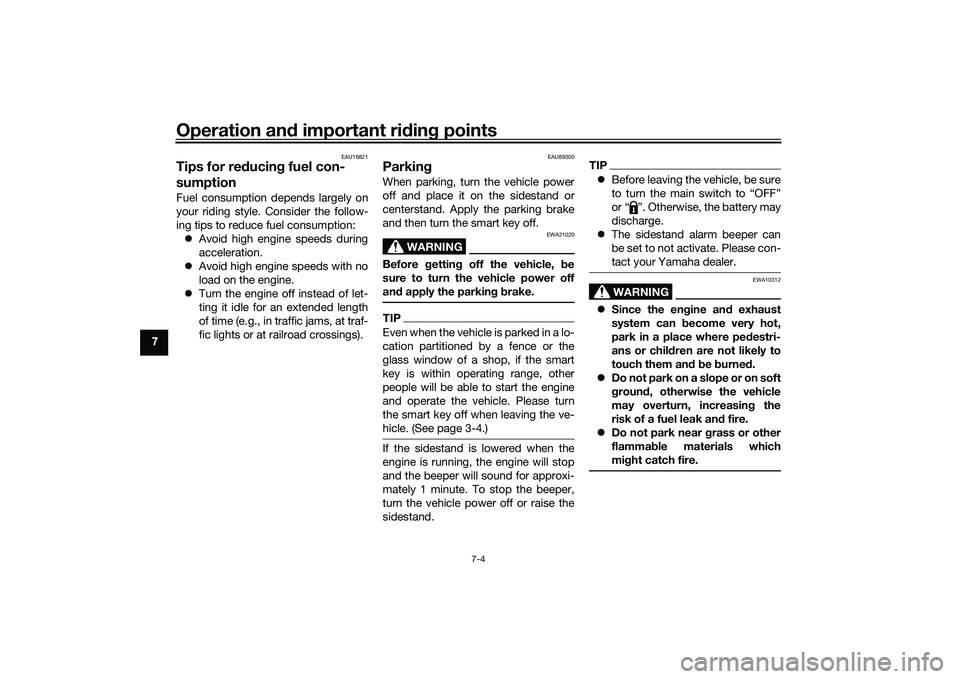
Parkin gWhen parking, turn the vehicle power
off and place it on the sidestand or
centerstand. Apply the parking brake
and then turn the smart key off.
WARNING
EWA21020
Before gettin g off the vehicle, be
sure to turn the vehicle power off
an d apply the parkin g b rake.TIPEven when the vehicle is parked in a lo-
cation partitioned by a fence or the
glass window of a shop, if the smart
key is within operating range, other
people will be able to start the engine
and operate the vehicle. Please turn
the smart key off when leaving the ve-
hicle. (See page 3-4.)If the sidestand is lowered when the
engine is running, the engine will stop
and the beeper will sound for approxi-
mately 1 minute. To stop the beeper,
turn the vehicle power off or raise the
sidestand.
TIP Before leaving the vehicle, be sure
to turn the main switch to “OFF”
or “ ”. Otherwise, the battery may
discharge.
The sidestand alarm beeper can
be set to not activate. Please con-
tact your Yamaha dealer.
WARNING
EWA10312
Since the en gine an d exhaust
system can become very hot,
park in a place where pe destri-
ans or chil dren are not likely to
touch them an d b e burne d.
Do not park on a slope or on soft
groun d, otherwise the vehicle
may overturn, increasin g the
risk of a fuel leak an d fire.
Do not park near grass or other
flammab le materials which
mi ght catch fire.
UBX9E0E0.book Page 4 Monday, January 20, 2020 10:54 AM
Page 61 of 114
Periodic maintenance an d a djustment
8-1
8
EAU17246
Periodic inspection, adjustment, and
lubrication will keep your vehicle in the
safest and most efficient condition
possible. Safety is an obligation of the
vehicle owner/operator. The most im-
portant points of vehicle inspection,
adjustment, and lubrication are ex-
plained on the following pages.
The intervals given in the periodic
maintenance charts should be simply
considered as a general guide under
normal riding conditions. However, de-
pending on the weather, terrain, geo-
graphical location, and individual use,
the maintenance intervals may need to
be shortened.
WARNING
EWA10322
Failure to properly maintain the vehi-
cle or performin g maintenance ac-
tivities incorrectly may increase
your risk of injury or death during
service or while usin g the vehicle. If
you are not familiar with vehicle ser-
vice, have a Yamaha d ealer perform
service.
WARNING
EWA15123
Turn off the en gine when performin g
maintenance unless otherwise
specified .
A runnin g en gine has movin g
parts that can catch on b ody
parts or clothin g an d electrical
parts that can cause shocks or
fires.
Runnin g the eng ine while ser-
vicin g can lead to eye injury,
b urns, fire, or car bon monoxi de
poisonin g – possi bly lea din g to
d eath. See pag e 1-2 for more in-
formation a bout car bon monox-
i d e.
WARNING
EWA15461
Brake discs, calipers, drums, an d
linin gs can b ecome very hot during
use. To avoi d possi ble burns, let
b rake components cool before
touching them.
EAU17303
Emission controls not only function to
ensure cleaner air, but are also vital to
proper engine operation and maximum
performance. In the following periodic
maintenance charts, the services relat-
ed to emissions control are grouped
separately. These services require
specialized data, knowledge, and
equipment. Maintenance, replace-
ment, or repair of the emission control
devices and systems may be per-
formed by any repair establishment or
individual that is certified (if applicable).
Yamaha dealers are trained and
equipped to perform these particular
services.
UBX9E0E0.book Page 1 Monday, January 20, 2020 10:54 AM
Page 63 of 114
Periodic maintenance an d a djustment
8-3
8
EAU71033
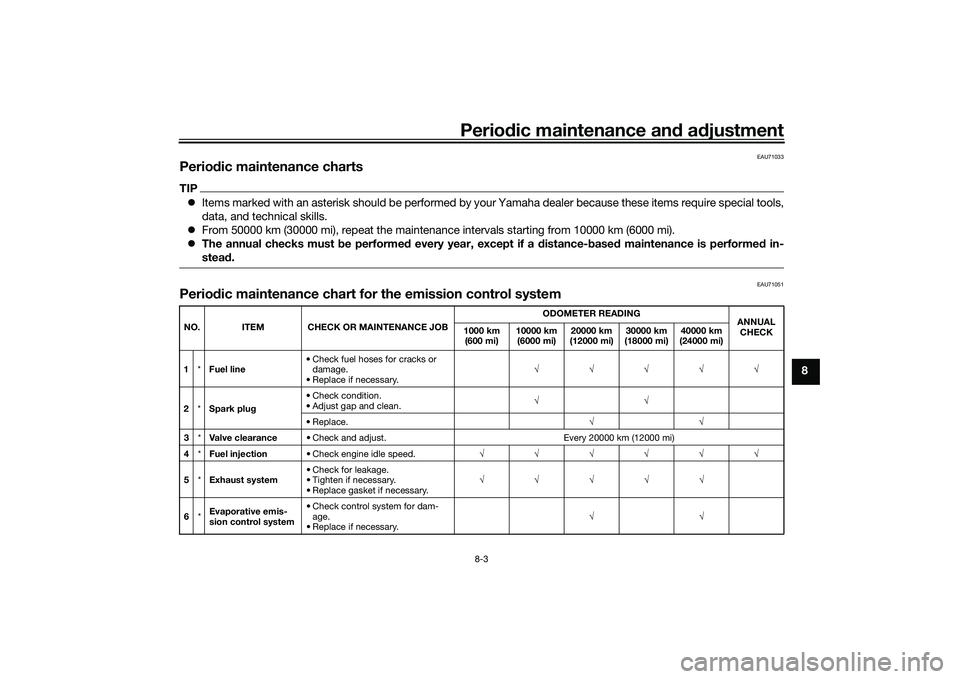
Perio dic maintenance chartsTIP Items marked with an asterisk should be performed by your Yamaha dealer because these items require special tools,
data, and technical skills.
From 50000 km (30000 mi), repeat the maintenance intervals starting from 10000 km (6000 mi).
The annual checks must be performe d every year, except if a distance- based maintenance is performe d in-
stea d.
EAU71051
Perio dic maintenance chart for the emission control systemNO. ITEM CHECK OR MAINTENANCE JOB ODOMETER READING
ANNUAL
CHECK
1000 km
(600 mi) 10000 km
(6000 mi) 20000 km
(12000 mi) 30000 km
(18000 mi) 40000 km
(24000 mi)
1 *Fuel line • Check fuel hoses for cracks or
damage.
• Replace if necessary. √√√√√
2 *Spark plu g • Check condition.
• Adjust gap and clean.
√√
•Replace. √√
3 *Valve clearance • Check and adjust. Every 20000 km (12000 mi)
4 *Fuel injection • Check engine idle speed. √√√√√√
5 *Exhaust system • Check for leakage.
• Tighten if necessary.
• Replace gasket if necessary. √√√√√
6 *Evaporative emis-
sion control system • Check control system for dam-
age.
• Replace if necessary. √√
UBX9E0E0.book Page 3 Monday, January 20, 2020 10:54 AM
Page 66 of 114
Periodic maintenance an d a djustment
8-6
8
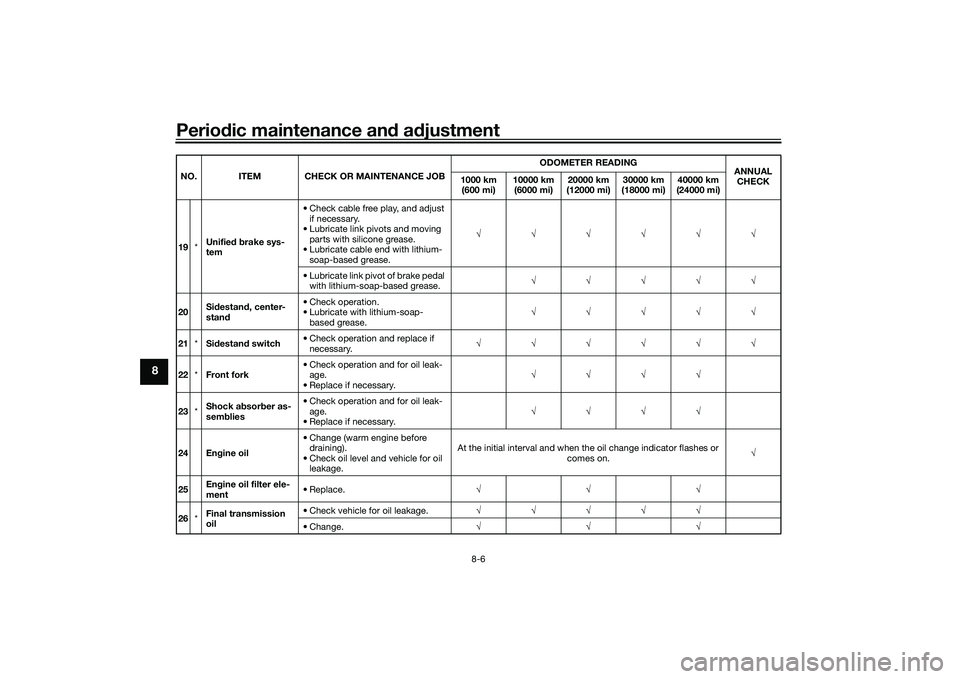
19 *Unifie
d b rake sys-
tem • Check cable free play, and adjust
if necessary.
• Lubricate link pivots and moving parts with silicone grease.
• Lubricate cable end with lithium- soap-based grease. √√√√√√
• Lubricate link pivot of brake pedal with lithium-soap-based grease. √√√√√
20 Si
destan d, center-
stan d • Check operation.
• Lubricate with lithium-soap-
based grease. √√√√√
21 *Sidestan d switch • Check operation and replace if
necessary. √√√√√√
22 *Front fork • Check operation and for oil leak-
age.
• Replace if necessary. √√√√
23 *Shock a
bsor ber as-
sem blies • Check operation and for oil leak-
age.
• Replace if necessary. √√√√
24 En gine oil • Change (warm engine before
draining).
• Check oil level and vehicle for oil leakage. At the initial interval and when the oil change indicator flashes or
comes on. √
25 En
gine oil filter ele-
ment • Replace.
√√√
26 *Final transmission
oil • Check vehicle for oil leakage.
√√√√√
• Change. √√√
NO. ITEM CHECK OR MAINTENANCE JOB
ODOMETER READING
ANNUAL
CHECK
1000 km
(600 mi) 10000 km
(6000 mi) 20000 km
(12000 mi) 30000 km
(18000 mi) 40000 km
(24000 mi)UBX9E0E0.book Page 6 Monday, January 20, 2020 10:54 AM
Page 67 of 114
Periodic maintenance an d a djustment
8-7
8
EAU79370
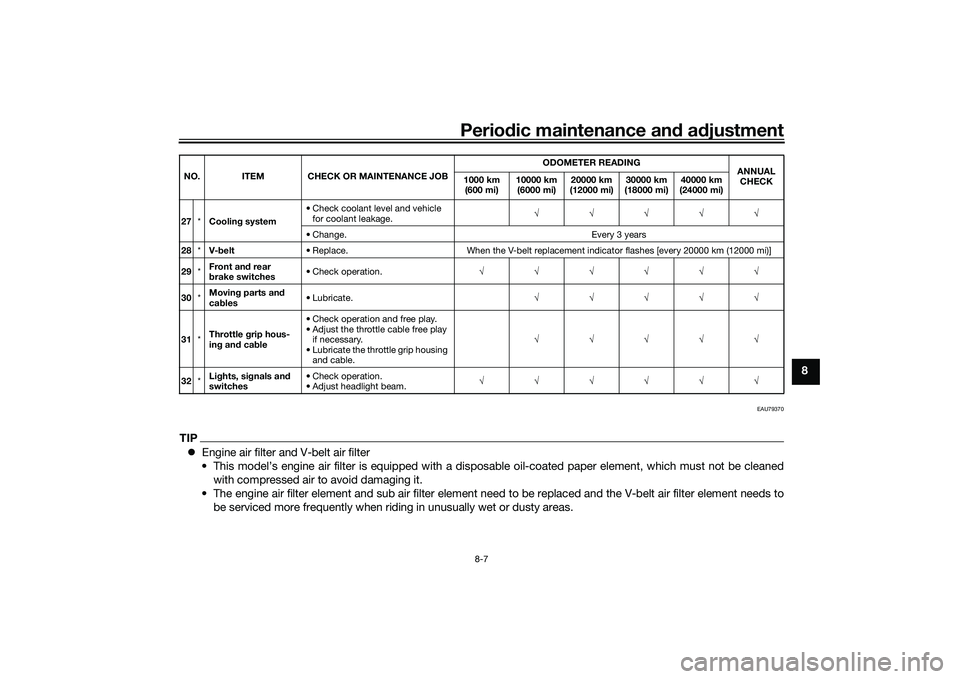
TIP Engine air filter and V-belt air filter
• This model’s engine air filter is equipped with a disposable oil-coated paper element, which must not be cleaned with compressed air to avoid damaging it.
• The engine air filter element and sub air filter element need to be replaced and the V-belt air filter element needs to be serviced more frequently when riding in unusually wet or dusty areas.27 *Coolin g system • Check coolant level and vehicle
for coolant leakage. √√√√√
• Change. Every 3 years
28 *V-belt • Replace. When the V-belt replacement indicator flashes [every 20000 km (12000 mi)]
29 *Front an
d rear
b rake switches • Check operation.
√√√√√√
30 *Movin
g parts an d
ca bles • Lubricate.
√√√√√
31 *Throttle g
rip hous-
in g an d ca ble • Check operation and free play.
• Adjust the throttle cable free play
if necessary.
• Lubricate the throttle grip housing and cable. √√√√√
32 *Li
ghts, si gnals an d
switches • Check operation.
• Adjust headlight beam.
√√√√√√
NO. ITEM CHECK OR MAINTENANCE JOB
ODOMETER READING
ANNUAL
CHECK
1000 km
(600 mi) 10000 km
(6000 mi) 20000 km
(12000 mi) 30000 km
(18000 mi) 40000 km
(24000 mi)
UBX9E0E0.book Page 7 Monday, January 20, 2020 10:54 AM
Page 70 of 114
Periodic maintenance an d a djustment
8-10
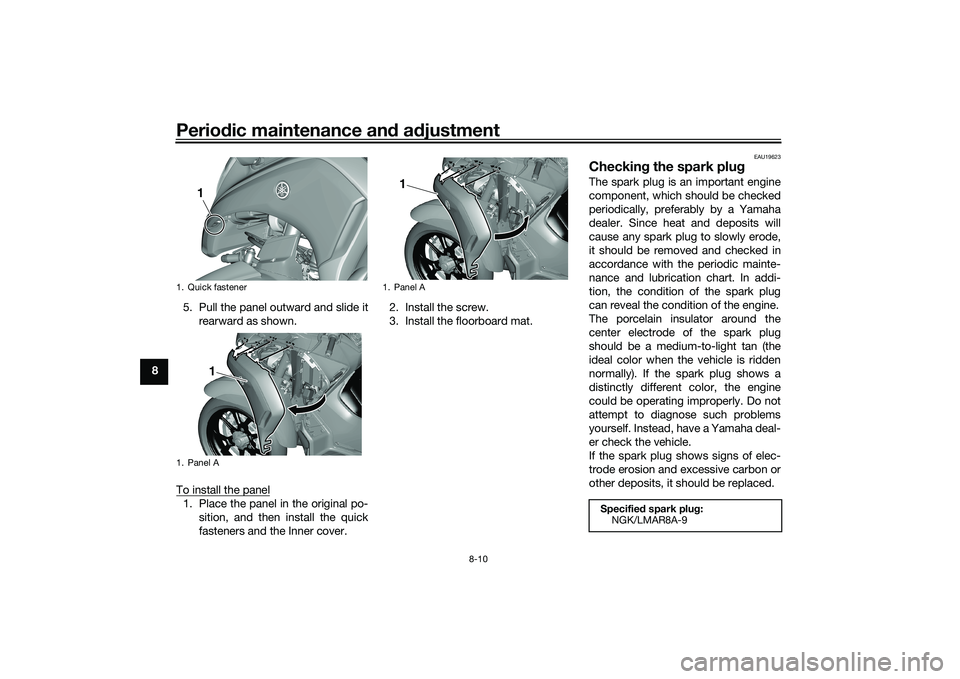
8 5. Pull the panel outward and slide it
rearward as shown.
To install the panel
1. Place the panel in the original po- sition, and then install the quick
fasteners and the Inner cover. 2. Install the screw.
3. Install the floorboard mat.
EAU19623
Checkin
g the spark plu gThe spark plug is an important engine
component, which should be checked
periodically, preferably by a Yamaha
dealer. Since heat and deposits will
cause any spark plug to slowly erode,
it should be removed and checked in
accordance with the periodic mainte-
nance and lubrication chart. In addi-
tion, the condition of the spark plug
can reveal the condition of the engine.
The porcelain insulator around the
center electrode of the spark plug
should be a medium-to-light tan (the
ideal color when the vehicle is ridden
normally). If the spark plug shows a
distinctly different color, the engine
could be operating improperly. Do not
attempt to diagnose such problems
yourself. Instead, have a Yamaha deal-
er check the vehicle.
If the spark plug shows signs of elec-
trode erosion and excessive carbon or
other deposits, it should be replaced.
1. Quick fastener
1. Panel A
1
1
1. Panel A
1
Specified spark plu g:
NGK/LMAR8A-9
UBX9E0E0.book Page 10 Monday, January 20, 2020 10:54 AM