lock YAMAHA WR 450F 2016 Owner's Manual
[x] Cancel search | Manufacturer: YAMAHA, Model Year: 2016, Model line: WR 450F, Model: YAMAHA WR 450F 2016Pages: 426, PDF Size: 10.86 MB
Page 118 of 426
ENGINE
3-20
EAS2GC1099ADJUSTING THE VALVE CLEARANCE
TIP
• This section is intended for those who have basic knowledge and skill concerning the ser-
vicing of Yamaha motorcycles (e.g., Yamaha
dealers, service engineers, etc.). Those who
have little knowledge and skill concerning ser-
vicing are requested not to undertake inspec-
tion, adjustment, disassembly, or reassembly
only by reference to this manual. It may lead
to servicing trouble and mechanical damage.
• Make sure that the valve clearance is checked or adjusted while the engine is cold
(at room temperature).
• While the valve clearance is checked or ad- justed, make sure that the piston is positioned
in the top dead center (TDC).
1. Remove: • Seat
• Side cover (left/right)
• Air scoop (left/right)Refer to “GENERAL CHASSIS” on page 5-
1.
• Fuel tank
Refer to “FUEL TANK” on page 8-1.
•ECU
2. Remove:
• Spark plug
• Cylinder head coverRefer to “CAMSHAFT” on page 6-11.
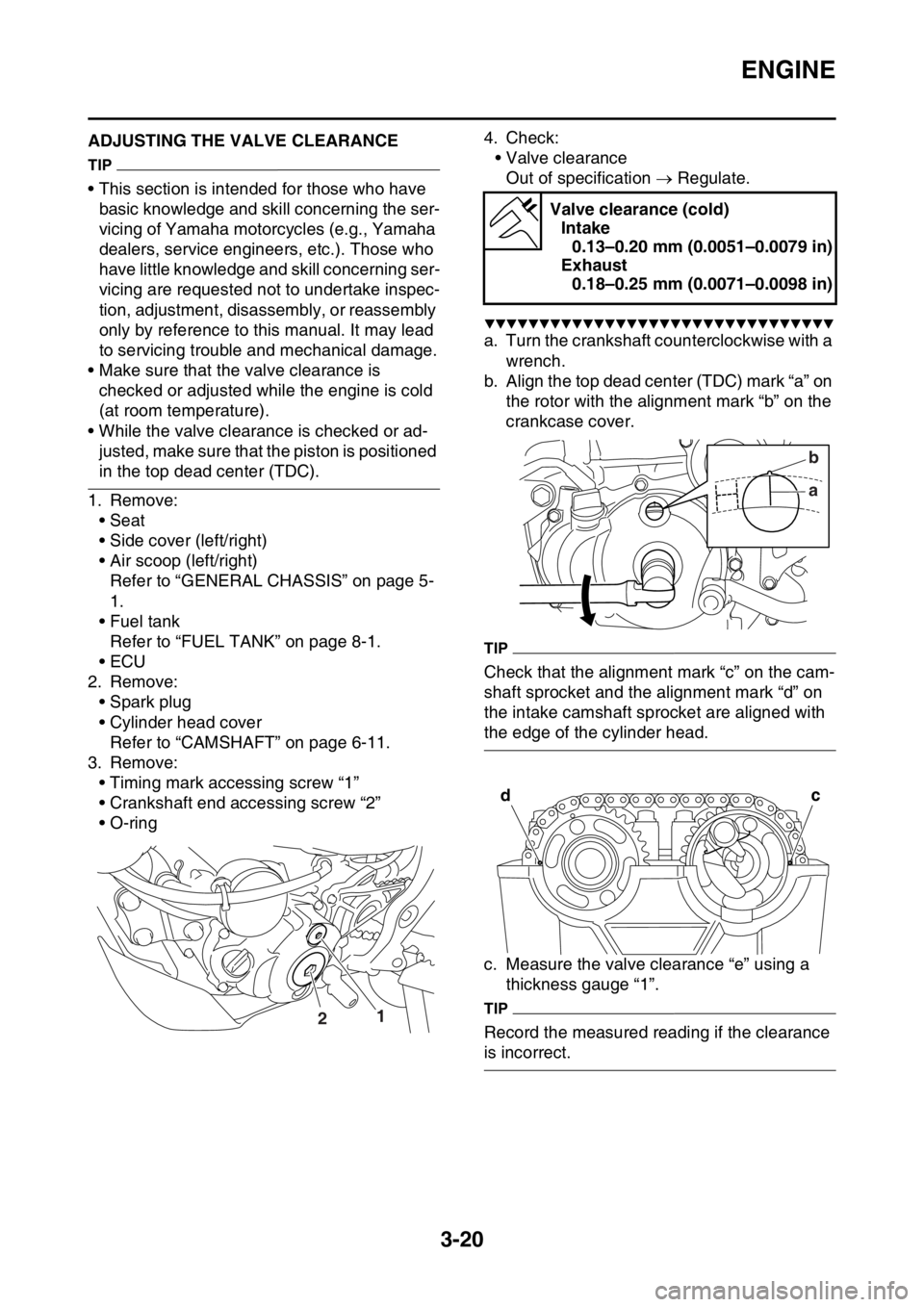
3. Remove: • Timing mark accessing screw “1”
• Crankshaft end accessing screw “2”
• O-ring 4. Check:
• Valve clearanceOut of specification Regulate.
▼▼▼▼▼▼▼▼▼▼▼▼▼▼▼▼▼▼▼▼▼▼▼▼▼▼▼▼▼▼▼▼
a. Turn the crankshaft counterclockwise with a
wrench.
b. Align the top dead center (TDC) mark “a” on the rotor with the alignment mark “b” on the
crankcase cover.
TIP
Check that the alignment mark “c” on the cam-
shaft sprocket and the alignment mark “d” on
the intake camshaft sprocket are aligned with
the edge of the cylinder head.
c. Measure the valve clearance “e” using a
thickness gauge “1”.
TIP
Record the measured reading if the clearance
is incorrect.
12
Valve clearance (cold)Intake 0.13–0.20 mm (0.0051–0.0079 in)
Exhaust 0.18–0.25 mm (0.0071–0.0098 in)
ab
d
c
Page 124 of 426
CHASSIS
3-26
EAS2GC1103CHECKING THE BRAKE HOSE
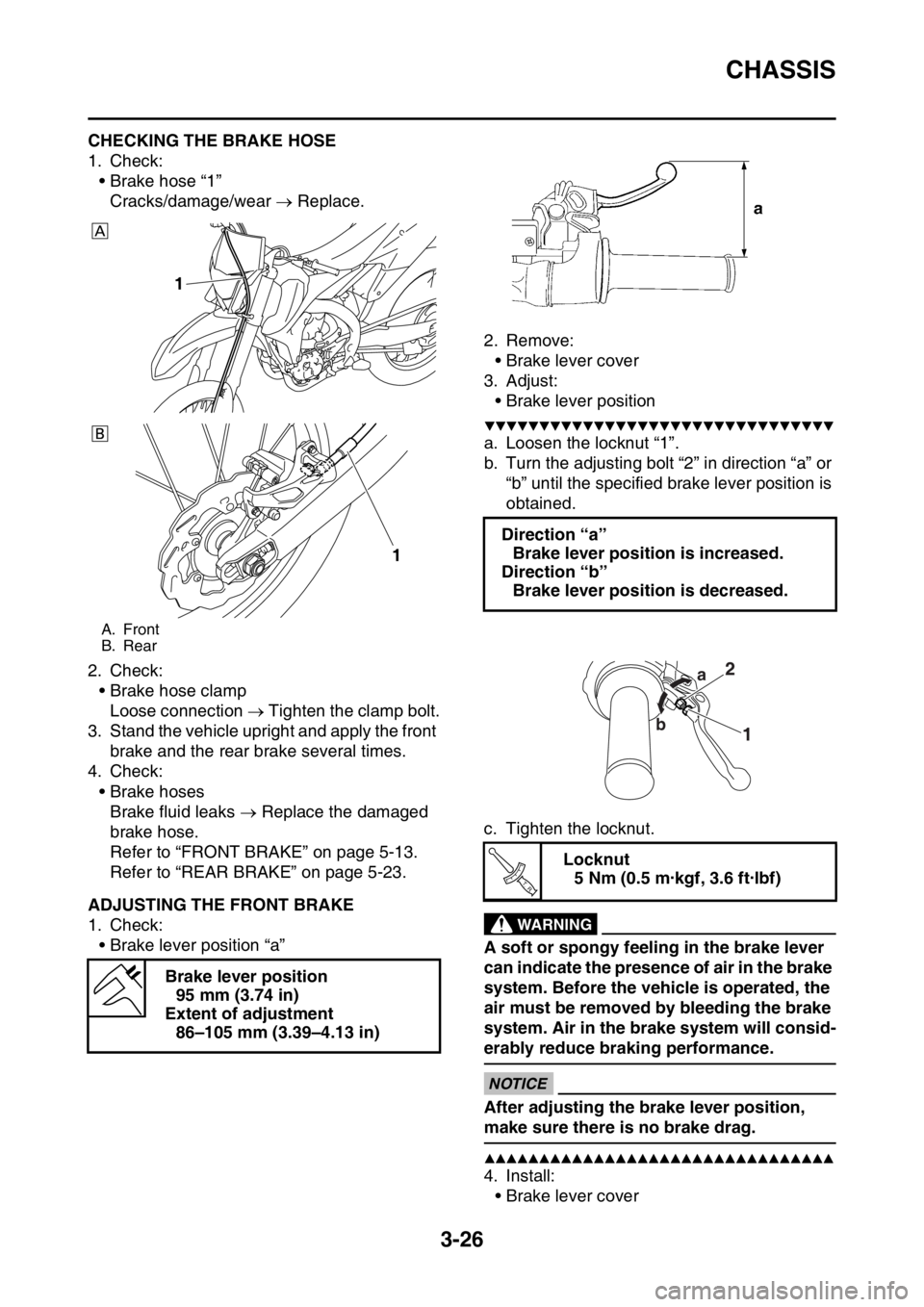
1. Check:• Brake hose “1”Cracks/damage/wear Replace.
2. Check: • Brake hose clamp
Loose connection Tighten the clamp bolt.
3. Stand the vehicle upright and apply the front brake and the rear brake several times.
4. Check: • Brake hosesBrake fluid leaks Replace the damaged
brake hose.
Refer to “FRONT BRAKE” on page 5-13.
Refer to “REAR BRAKE” on page 5-23.
EAS2GC1104ADJUSTING THE FRONT BRAKE
1. Check: • Brake lever position “a” 2. Remove:
• Brake lever cover
3. Adjust: • Brake lever position
▼▼▼▼▼▼▼▼▼▼▼▼▼▼▼▼▼▼▼▼▼▼▼▼▼▼▼▼▼▼▼▼
a. Loosen the locknut “1”.
b. Turn the adjusting bolt “2” in direction “a” or “b” until the specified brake lever position is
obtained.
c. Tighten the locknut.
EWA13050
WARNING
A soft or spongy feeling in the brake lever
can indicate the presence of air in the brake
system. Before the vehicle is operated, the
air must be removed by bleeding the brake
system. Air in the brake system will consid-
erably reduce braking performance.
ECA13490
NOTICE
After adjusting the brake lever position,
make sure there is no brake drag.
▲▲▲▲▲▲▲▲▲▲▲▲▲▲▲▲▲▲▲▲▲▲▲▲▲▲▲▲▲▲▲▲
4. Install: • Brake lever cover
A. Front
B. Rear
Brake lever position95 mm (3.74 in)
Extent of adjustment 86–105 mm (3.39–4.13 in)
1
1
Direction “a”Brake lever position is increased.
Direction “b” Brake lever position is decreased.
Locknut5 Nm (0.5 m·kgf, 3.6 ft·lbf)
a
b
T R..
Page 125 of 426
CHASSIS
3-27
EAS2GC1105ADJUSTING THE REAR BRAKE
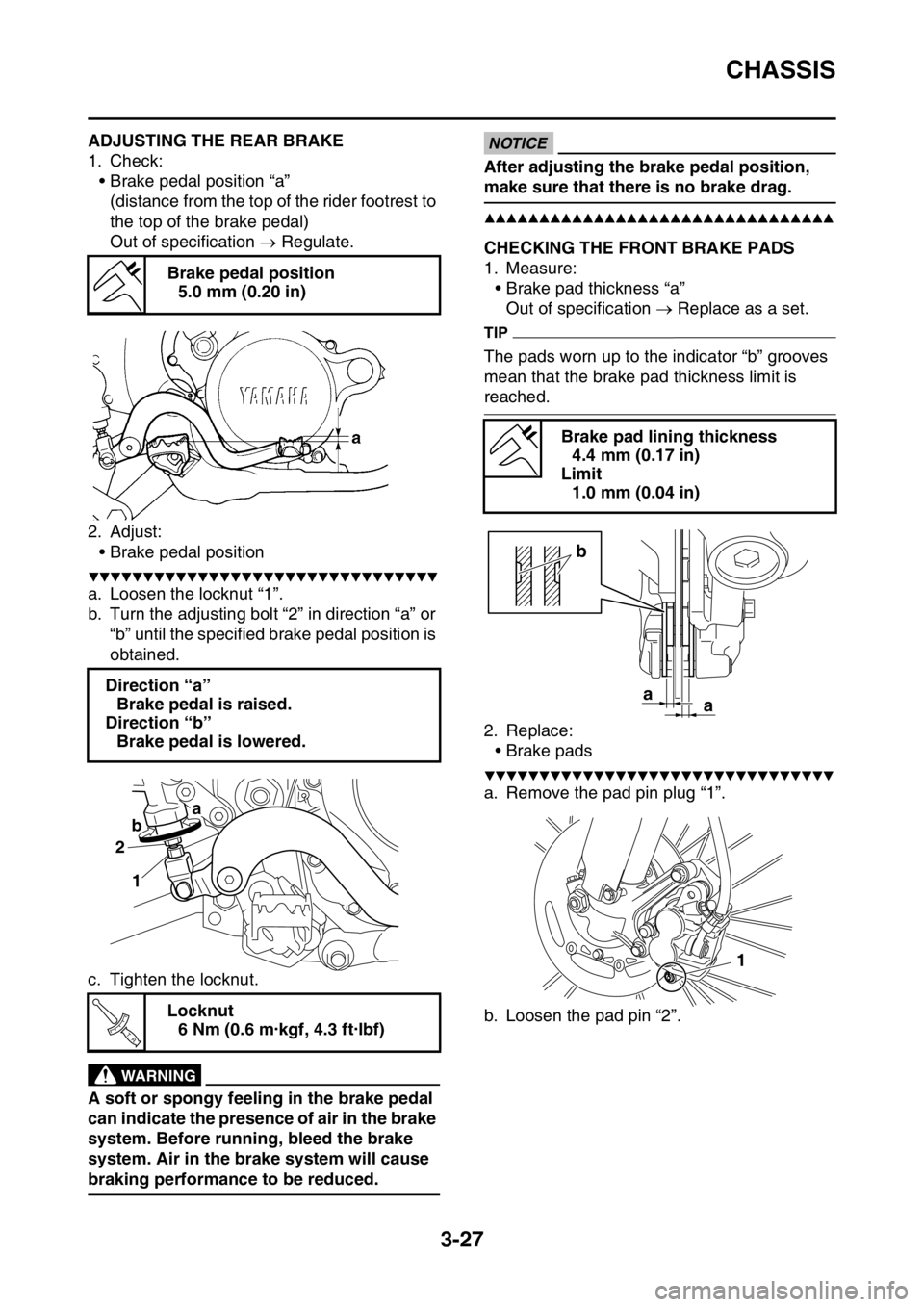
1. Check:• Brake pedal position “a”(distance from the top of the rider footrest to
the top of the brake pedal)
Out of specification Regulate.
2. Adjust: • Brake pedal position
▼▼▼▼▼▼▼▼▼▼▼▼▼▼▼▼▼▼▼▼▼▼▼▼▼▼▼▼▼▼▼▼
a. Loosen the locknut “1”.
b. Turn the adjusting bolt “2” in direction “a” or “b” until the specified brake pedal position is
obtained.
c. Tighten the locknut.
EWA
WARNING
A soft or spongy feeling in the brake pedal
can indicate the presence of air in the brake
system. Before running, bleed the brake
system. Air in the brake system will cause
braking performance to be reduced.
ECA
NOTICE
After adjusting the brake pedal position,
make sure that there is no brake drag.
▲▲▲▲▲▲▲▲▲▲▲▲▲▲▲▲▲▲▲▲▲▲▲▲▲▲▲▲▲▲▲▲
EAS2GC1106CHECKING THE FRONT BRAKE PADS
1. Measure: • Brake pad thickness “a”Out of specification Replace as a set.
TIP
The pads worn up to the indicator “b” grooves
mean that the brake pad thickness limit is
reached.
2. Replace:
• Brake pads
▼▼▼▼▼▼▼▼▼▼▼▼▼▼▼▼▼▼▼▼▼▼▼▼▼▼▼▼▼▼▼▼
a. Remove the pad pin plug “1”.
b. Loosen the pad pin “2”.
Brake pedal position
5.0 mm (0.20 in)
Direction “a” Brake pedal is raised.
Direction “b”
Brake pedal is lowered.
Locknut6 Nm (0.6 m·kgf, 4.3 ft·lbf)
1
2
a
b
T R..
Brake pad lining thickness
4.4 mm (0.17 in)
Limit 1.0 mm (0.04 in)
a
b
a
1
Page 129 of 426
CHASSIS
3-31
• When refilling, be careful that water does not enter the brake fluid reservoir. Water
will significantly lower the boiling point of
the brake fluid and could cause vapor
lock.
ECA
NOTICE
Brake fluid may damage painted surfaces
and plastic parts. Therefore, always clean
up any spilt brake fluid immediately.
EAS2GC1110ADJUSTING THE DRIVE CHAIN SLACKECA
NOTICE
A drive chain that is too tight will overload
the engine and other vital parts, and one
that is too loose can skip and damage the
swingarm or cause an accident. Therefore,
keep the drive chain slack within the speci-
fied limits.
1. Use a suitable stand to raise the rear wheel off the ground.
EWA
WARNING
Securely support the vehicle so that there is
no danger of it falling over.
2. Shift the transmission into the neutral posi-
tion.
3. Pull the drive chain up above the drive chain guide installation bolt with a force of about
50 N (5.0 kgf, 36 lbf).
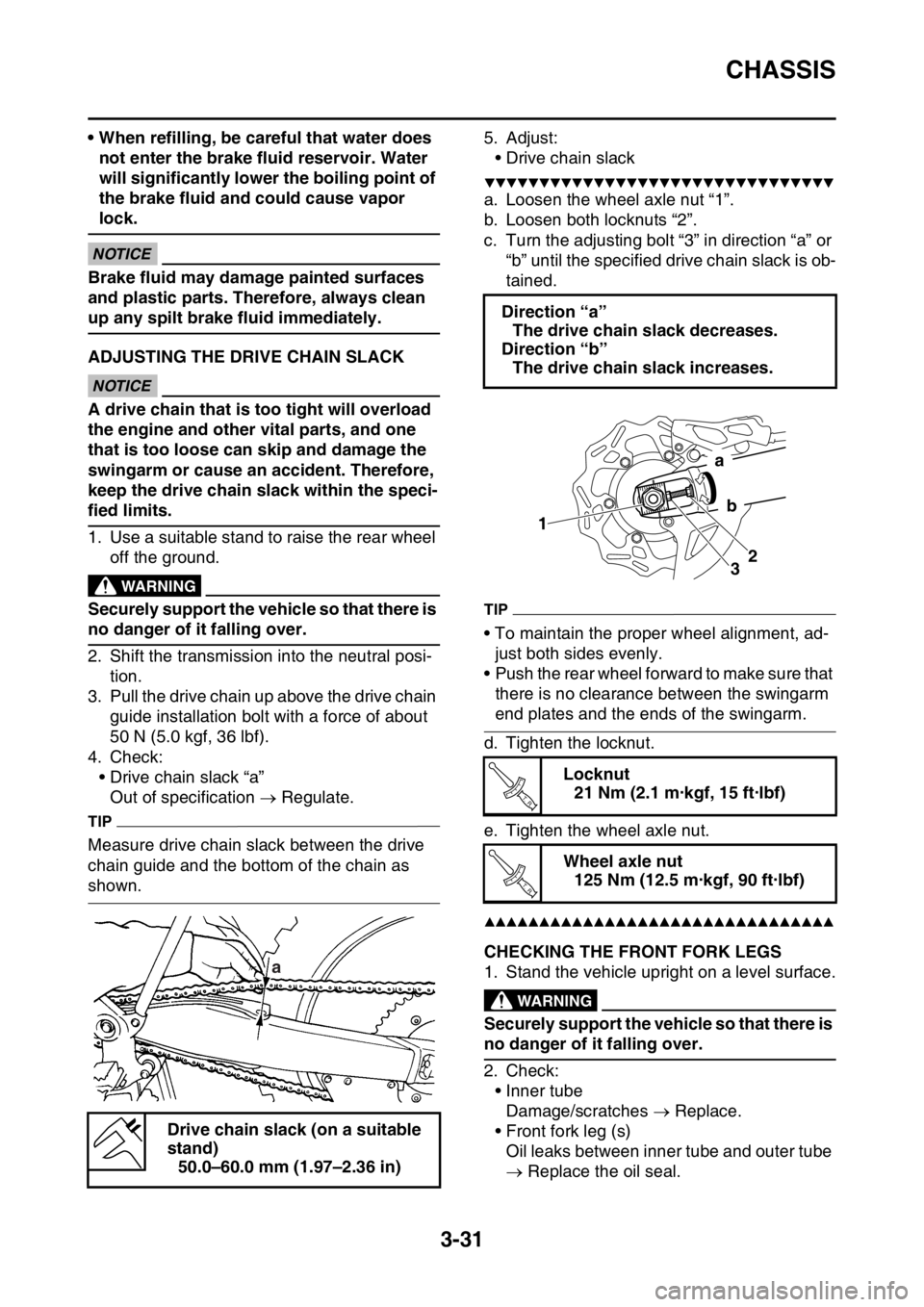
4. Check: • Drive chain slack “a”
Out of specification Regulate.
TIP
Measure drive chain slack between the drive
chain guide and the bottom of the chain as
shown. 5. Adjust:
• Drive chain slack
▼▼▼▼▼▼▼▼▼▼▼▼▼▼▼▼▼▼▼▼▼▼▼▼▼▼▼▼▼▼▼▼
a. Loosen the wheel axle nut “1”.
b. Loosen both locknuts “2”.
c. Turn the adjusting bolt “3” in direction “a” or “b” until the specified drive chain slack is ob-
tained.
TIP
• To maintain the proper wheel alignment, ad-just both sides evenly.
• Push the rear wheel forward to make sure that
there is no clearance between the swingarm
end plates and the ends of the swingarm.
d. Tighten the locknut.
e. Tighten the wheel axle nut.
▲▲▲▲▲▲▲▲▲▲▲▲▲▲▲▲▲▲▲▲▲▲▲▲▲▲▲▲▲▲▲▲
EAS2GC1111CHECKING THE FRONT FORK LEGS
1. Stand the vehicle upright on a level surface.
EWA
WARNING
Securely support the vehicle so that there is
no danger of it falling over.
2. Check: • Inner tubeDamage/scratches Replace.
• Front fork leg (s) Oil leaks between inner tube and outer tube
Replace the oil seal.
Drive chain slack (on a suitable
stand)
50.0–60.0 mm (1.97–2.36 in)
a
Direction “a”The drive chain slack decreases.
Direction “b” The drive chain slack increases.
Locknut21 Nm (2.1 m·kgf, 15 ft·lbf)
Wheel axle nut 125 Nm (12.5 m·kgf, 90 ft·lbf)
1
32
a
b
T R..
T R..
Page 132 of 426
CHASSIS
3-34
EAS2GC1116CHECKING THE SWINGARM OPERATION
1. Check:• Swingarm smooth action
• Swingarm free playRefer to “SWINGARM” on page 5-65.
EAS2GC1117CHECKING THE REAR SUSPENSION
1. Stand the vehicle upright on a level surface.
EWA
WARNING
Securely support the vehicle so that there is
no danger of it falling over.
2. Check:• Rear shock absorber assemblyGas leaks/oil leaks Replace the rear
shock absorber assembly.
Refer to “REAR SHOCK ABSORBER AS-
SEMBLY” on page 5-58.
3. Check: • Rear shock absorber assembly smooth ac-tion
• Rear suspension link smooth action Sit astride the seat and shake your body up
and down several times to check whether
the rear shock absorber assembly operates
smoothly.
Unsmooth operation Correct or replace.
Refer to “REAR SHOCK ABSORBER AS-
SEMBLY” on page 5-58.
EAS2GC1118ADJUSTING THE REAR SHOCK ABSORB-
ER ASSEMBLY
Use a suitable stand to raise the rear wheel off
the ground.
EWA
WARNING
Securely support the vehicle so that there is
no danger of it falling over. Spring preload
ECA
NOTICE
Do not turn the adjuster forcibly beyond its
adjusting range.
1. Remove:
• Rear frameRefer to “REAR SHOCK ABSORBER AS-
SEMBLY” on page 5-58.
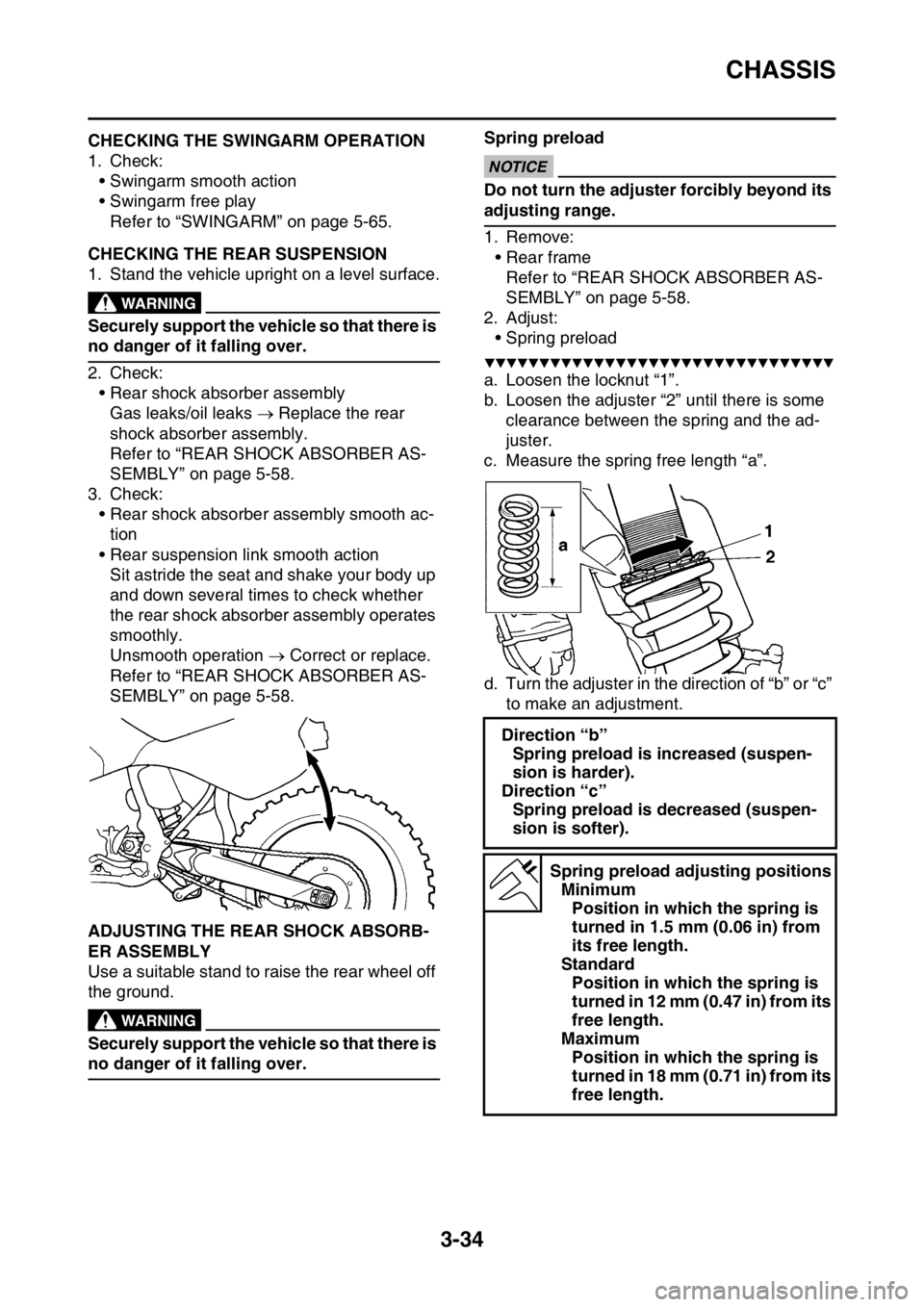
2. Adjust: • Spring preload
▼▼▼▼▼▼▼▼▼▼▼▼▼▼▼▼▼▼▼▼▼▼▼▼▼▼▼▼▼▼▼▼
a. Loosen the locknut “1”.
b. Loosen the adjuster “2” until there is some clearance between the spring and the ad-
juster.
c. Measure the spring free length “a”.
d. Turn the adjuster in the direction of “b” or “c” to make an adjustment.
Direction “b”Spring preload is increased (suspen-
sion is harder).
Direction “c” Spring preload is decreased (suspen-
sion is softer).
Spring preload adjusting positionsMinimum Position in which the spring is
turned in 1.5 mm (0.06 in) from
its free length.
Standard Position in which the spring is
turned in 12 mm (0.47 in) from its
free length.
Maximum Position in which the spring is
turned in 18 mm (0.71 in) from its
free length.
Page 133 of 426
CHASSIS
3-35
TIP
• Be sure to remove all dirt and mud from around the locknut and adjusting ring before
adjustment.
• The length of the spring (installed) changes
1.5 mm (0.06 in) per turn of the adjusting ring.
e. Tighten the locknut.
▲▲▲▲▲▲▲▲▲▲▲▲▲▲▲▲▲▲▲▲▲▲▲▲▲▲▲▲▲▲▲▲
3. Install: • Rear frameRefer to “REAR SHOCK ABSORBER AS-
SEMBLY” on page 5-58.
Rebound damping
ECA
NOTICE
Do not turn the adjuster forcibly beyond its
adjusting range.
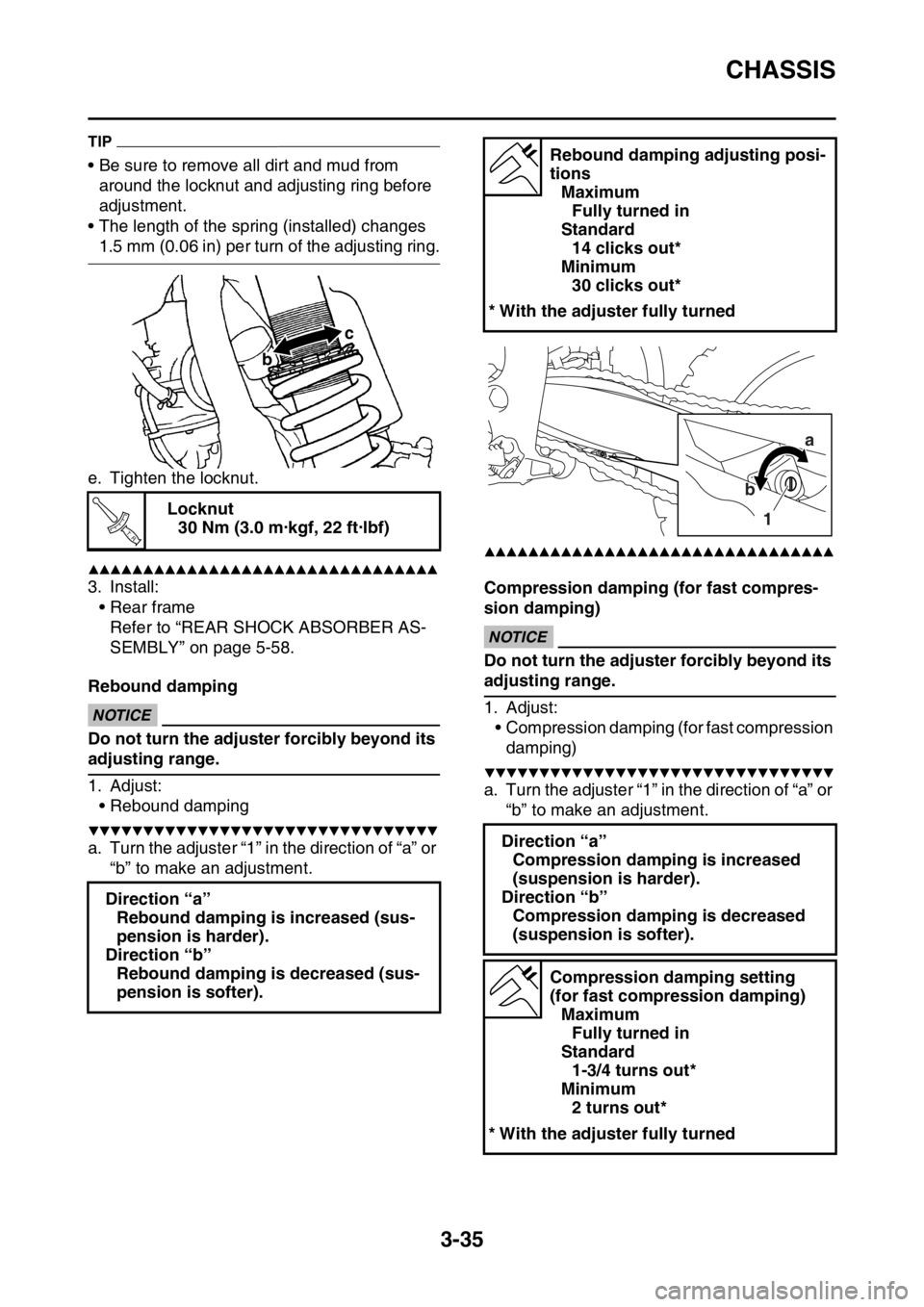
1. Adjust: • Rebound damping
▼▼▼▼▼▼▼▼▼▼▼▼▼▼▼▼▼▼▼▼▼▼▼▼▼▼▼▼▼▼▼▼
a. Turn the adjuster “1” in the direction of “a” or “b” to make an adjustment.
▲▲▲▲▲▲▲▲▲▲▲▲▲▲▲▲▲▲▲▲▲▲▲▲▲▲▲▲▲▲▲▲
Compression damping (for fast compres-
sion damping)
ECA
NOTICE
Do not turn the adjuster forcibly beyond its
adjusting range.
1. Adjust:
• Compression damping (for fast compression damping)
▼▼▼▼▼▼▼▼▼▼▼▼▼▼▼▼▼▼▼▼▼▼▼▼▼▼▼▼▼▼▼▼
a. Turn the adjuster “1” in the direction of “a” or “b” to make an adjustment.
Locknut
30 Nm (3.0 m·kgf, 22 ft·lbf)
Direction “a” Rebound damping is increased (sus-
pension is harder).
Direction “b” Rebound damping is decreased (sus-
pension is softer).
c
b
T R..
Rebound damping adjusting posi-
tions Maximum Fully turned in
Standard 14 clicks out*
Minimum 30 clicks out*
* With the adjuster fully turned
Direction “a”Compression damping is increased
(suspension is harder).
Direction “b” Compression damping is decreased
(suspension is softer).
Compression damping setting
(for fast compression damping)Maximum Fully turned in
Standard 1-3/4 turns out*
Minimum 2 turns out*
* With the adjuster fully turned
a
b
1
Page 138 of 426
ELECTRICAL SYSTEM
3-40
EAS2GC1130
ELECTRICAL SYSTEM
EAS2GC1131CHECKING THE SPARK PLUG
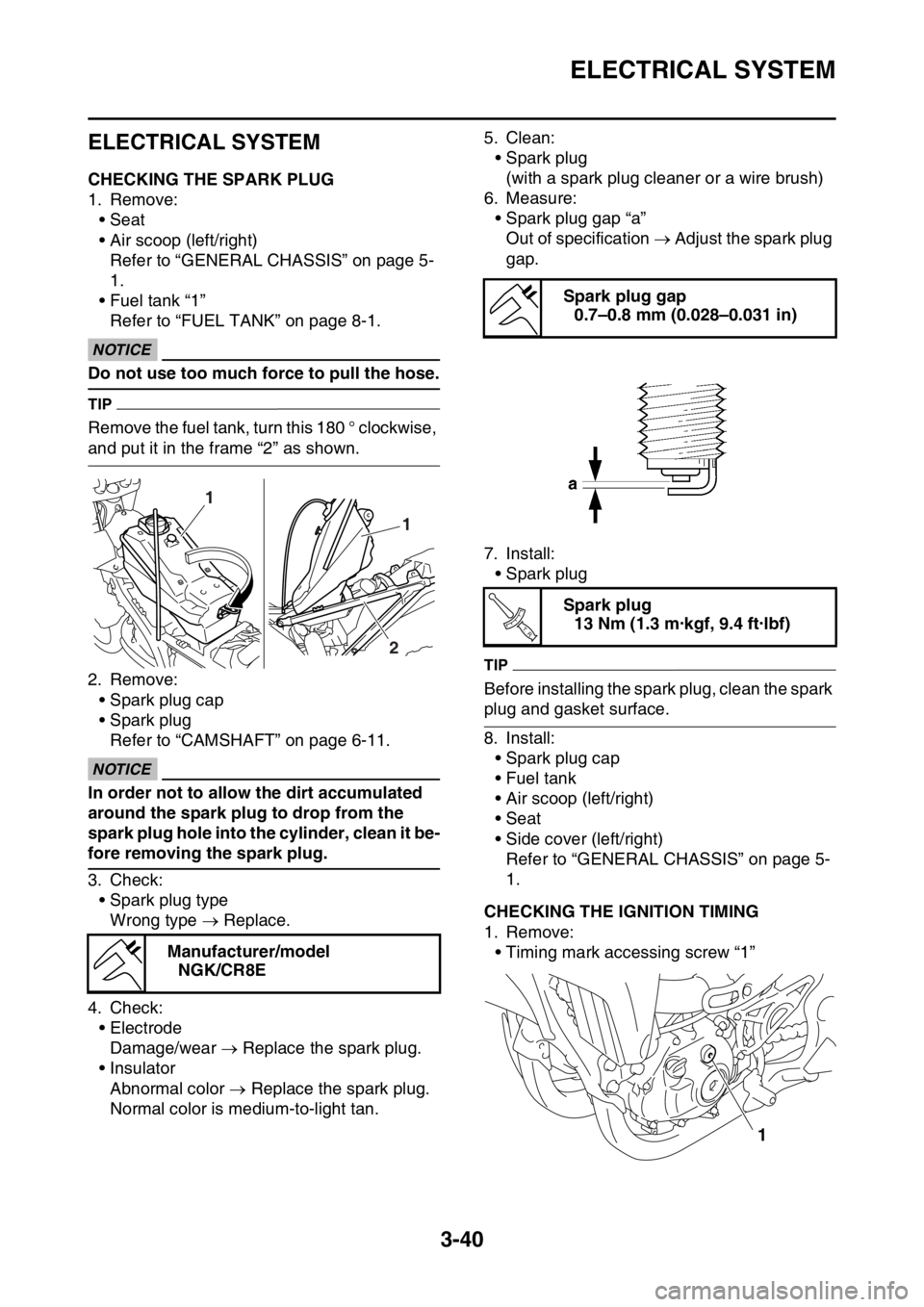
1. Remove:• Seat
• Air scoop (left/right)
Refer to “GENERAL CHASSIS” on page 5-
1.
• Fuel tank “1” Refer to “FUEL TANK” on page 8-1.
ECA
NOTICE
Do not use too much force to pull the hose.
TIP
Remove the fuel tank, turn this 180 ° clockwise,
and put it in the frame “2” as shown.
2. Remove:• Spark plug cap
• Spark plugRefer to “CAMSHAFT” on page 6-11.
ECA
NOTICE
In order not to allow the dirt accumulated
around the spark plug to drop from the
spark plug hole into the cylinder, clean it be-
fore removing the spark plug.
3. Check:• Spark plug type
Wrong type Replace.
4. Check: • ElectrodeDamage/wear Replace the spark plug.
• Insulator Abnormal color Replace the spark plug.
Normal color is medium-to-light tan. 5. Clean:
• Spark plug(with a spark plug cleaner or a wire brush)
6. Measure: • Spark plug gap “a”Out of specification Adjust the spark plug
gap.
7. Install: • Spark plug
TIP
Before installing the spark plug, clean the spark
plug and gasket surface.
8. Install:• Spark plug cap
• Fuel tank
• Air scoop (left/right)
• Seat
• Side cover (left/right)Refer to “GENERAL CHASSIS” on page 5-
1.
EAS2GC1132CHECKING THE IGNITION TIMING
1. Remove:
• Timing mark accessing screw “1”
Manufacturer/model
NGK/CR8E
1
1
2
Spark plug gap 0.7–0.8 mm (0.028–0.031 in)
Spark plug 13 Nm (1.3 m·kgf, 9.4 ft·lbf)
T R..
1
Page 144 of 426
CHASSIS
4-3
TIP
Generally a stiff spring gives a stiff riding feel-
ing. Rebound damping tends to become weak-
er, resulting in lack of a sense of contact with
the road surface or in a vibrating handlebar.
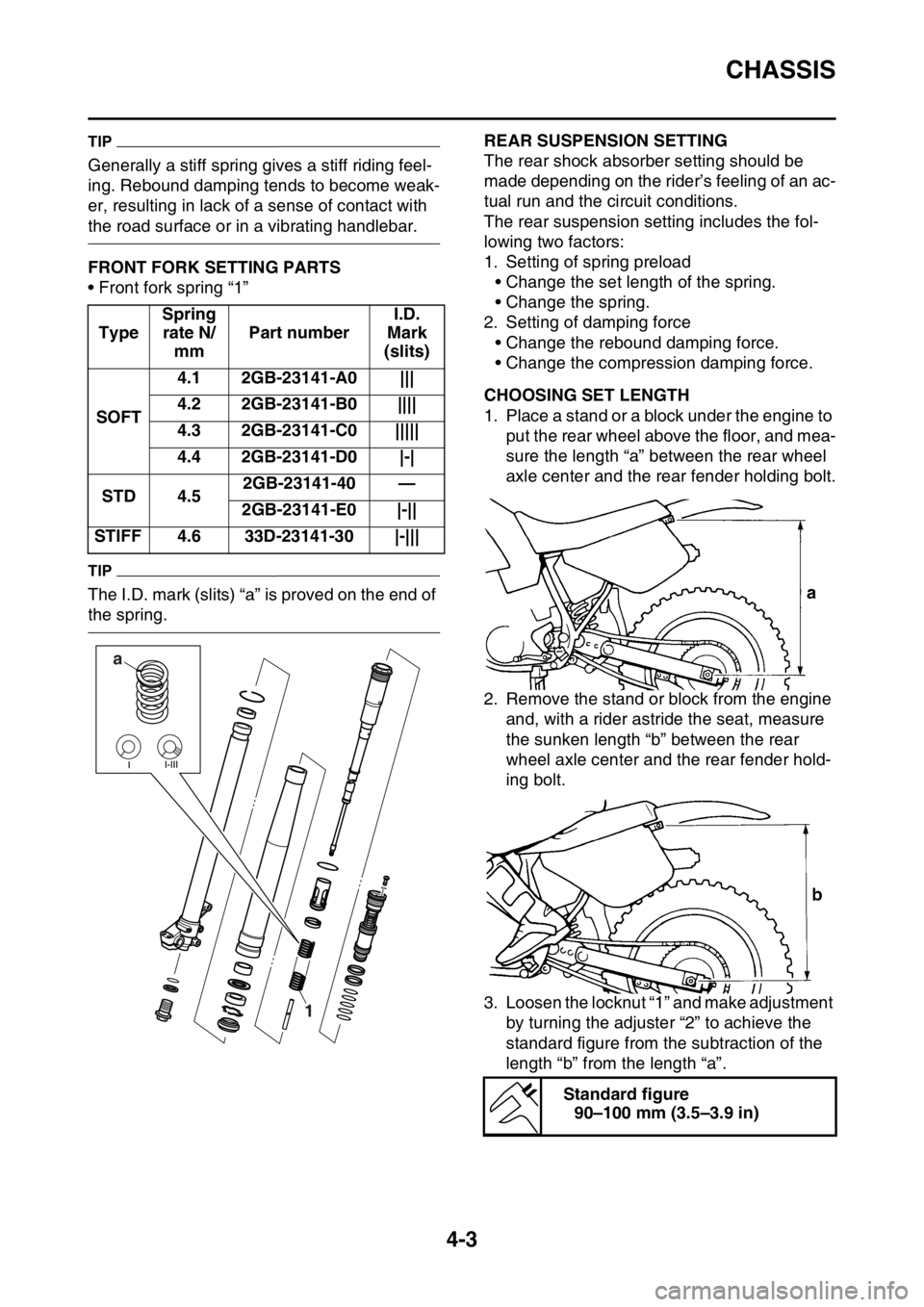
EAS2GC1143FRONT FORK SETTING PARTS
• Front fork spring “1”
TIP
The I.D. mark (slits) “a” is proved on the end of
the spring.
EAS2GC1144REAR SUSPENSION SETTING
The rear shock absorber setting should be
made depending on the rider’s feeling of an ac-
tual run and the circuit conditions.
The rear suspension setting includes the fol-
lowing two factors:
1. Setting of spring preload • Change the set length of the spring.
• Change the spring.
2. Setting of damping force
• Change the rebound damping force.
• Change the compression damping force.
EAS2GC1145CHOOSING SET LENGTH
1. Place a stand or a block under the engine to put the rear wheel above the floor, and mea-
sure the length “a” between the rear wheel
axle center and the rear fender holding bolt.
2. Remove the stand or block from the engine and, with a rider astride the seat, measure
the sunken length “b” between the rear
wheel axle center and the rear fender hold-
ing bolt.
3. Loosen the locknut “1” and make adjustment by turning the adjuster “2” to achieve the
standard figure from the subtraction of the
length “b” from the length “a”.
Type
Spring
rate N/ mm Part number I.D.
Mark
(slits)
SOFT 4.1 2GB-23141-A0 |||
4.2 2GB-23141-B0 ||||
4.3 2GB-23141-C0 |||||
4.4 2GB-23141-D0 |-|
STD 4.5 2GB-23141-40 —
2GB-23141-E0 |-||
STIFF 4.6 33D-23141-30 |-|||
a
1
Standard figure90–100 mm (3.5–3.9 in)
Page 147 of 426
CHASSIS
4-6
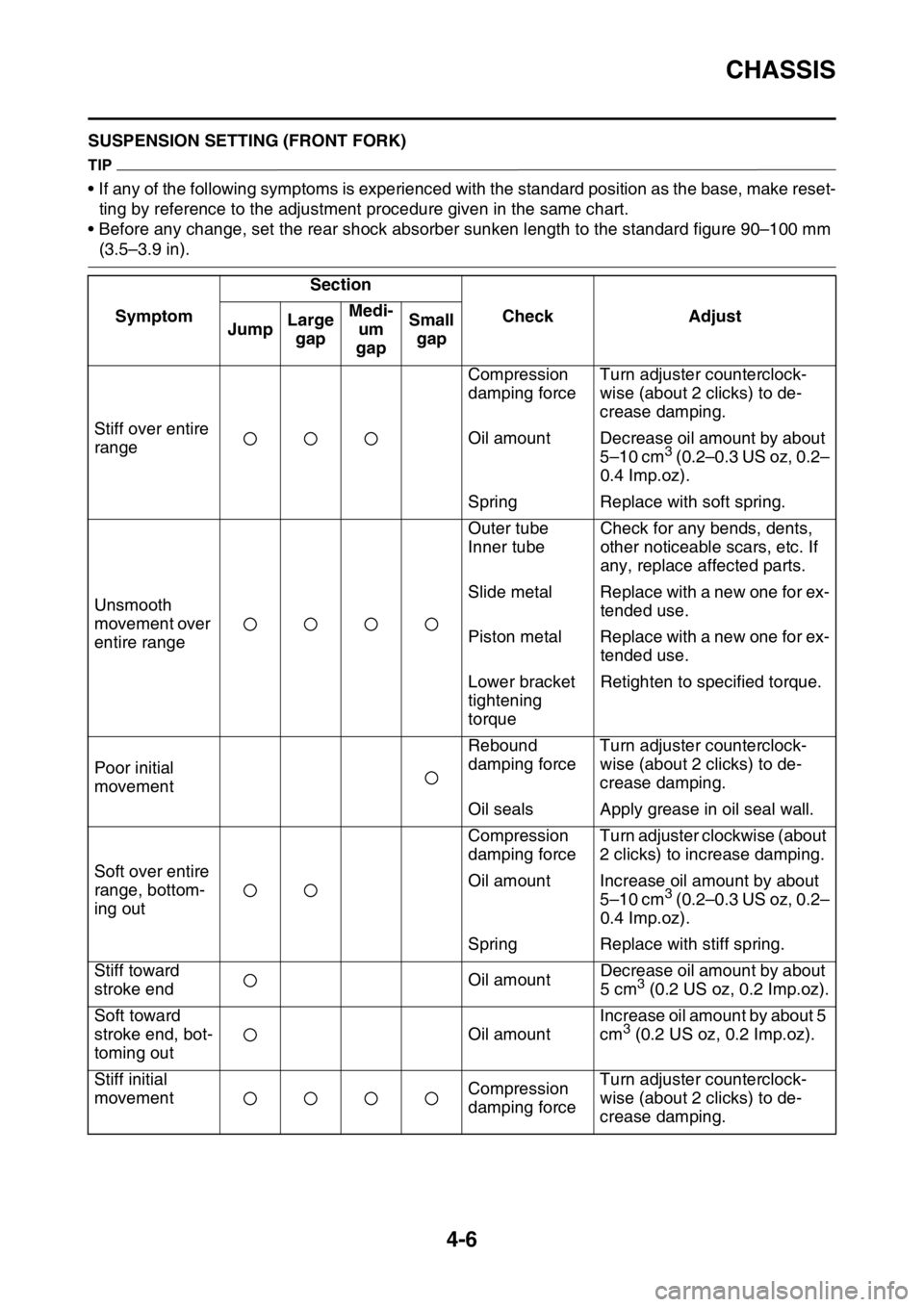
EAS2GC1148SUSPENSION SETTING (FRONT FORK)
TIP
• If any of the following symptoms is experienced with the standard position as the base, make reset-ting by reference to the adjustment procedure given in the same chart.
• Before any change, set the rear shock absor ber sunken length to the standard figure 90–100 mm
(3.5–3.9 in).
Symptom Section
CheckAdjust
Jump Large
gap Medi-
um
gap Small
gap
Stiff over entire
range Compression
damping force
Turn adjuster counterclock-
wise (about 2 clicks) to de-
crease damping.
Oil amount Decrease oil amount by about 5–10 cm
3 (0.2–0.3 US oz, 0.2–
0.4 Imp.oz).
Spring Replace with soft spring.
Unsmooth
movement over
entire range Outer tube
Inner tube
Check for any bends, dents,
other noticeable scars, etc. If
any, replace affected parts.
Slide metal Replace with a new one for ex- tended use.
Piston metal Replace with a new one for ex- tended use.
Lower bracket
tightening
torque Retighten to specified torque.
Poor initial
movement Rebound
damping force
Turn adjuster counterclock-
wise (about 2 clicks) to de-
crease damping.
Oil seals Apply grease in oil seal wall.
Soft over entire
range, bottom-
ing out Compression
damping force
Turn adjuster clockwise (about
2 clicks) to increase damping.
Oil amount Increase oil amount by about 5–10 cm
3 (0.2–0.3 US oz, 0.2–
0.4 Imp.oz).
Spring Replace with stiff spring.
Stiff toward
stroke end Oil amountDecrease oil amount by about
5 cm
3 (0.2 US oz, 0.2 Imp.oz).
Soft toward
stroke end, bot-
toming out Oil amountIncrease oil amount by about 5
cm
3 (0.2 US oz, 0.2 Imp.oz).
Stiff initial
movement Compression
damping forceTurn adjuster counterclock-
wise (about 2 clicks) to de-
crease damping.
Page 148 of 426
CHASSIS
4-7
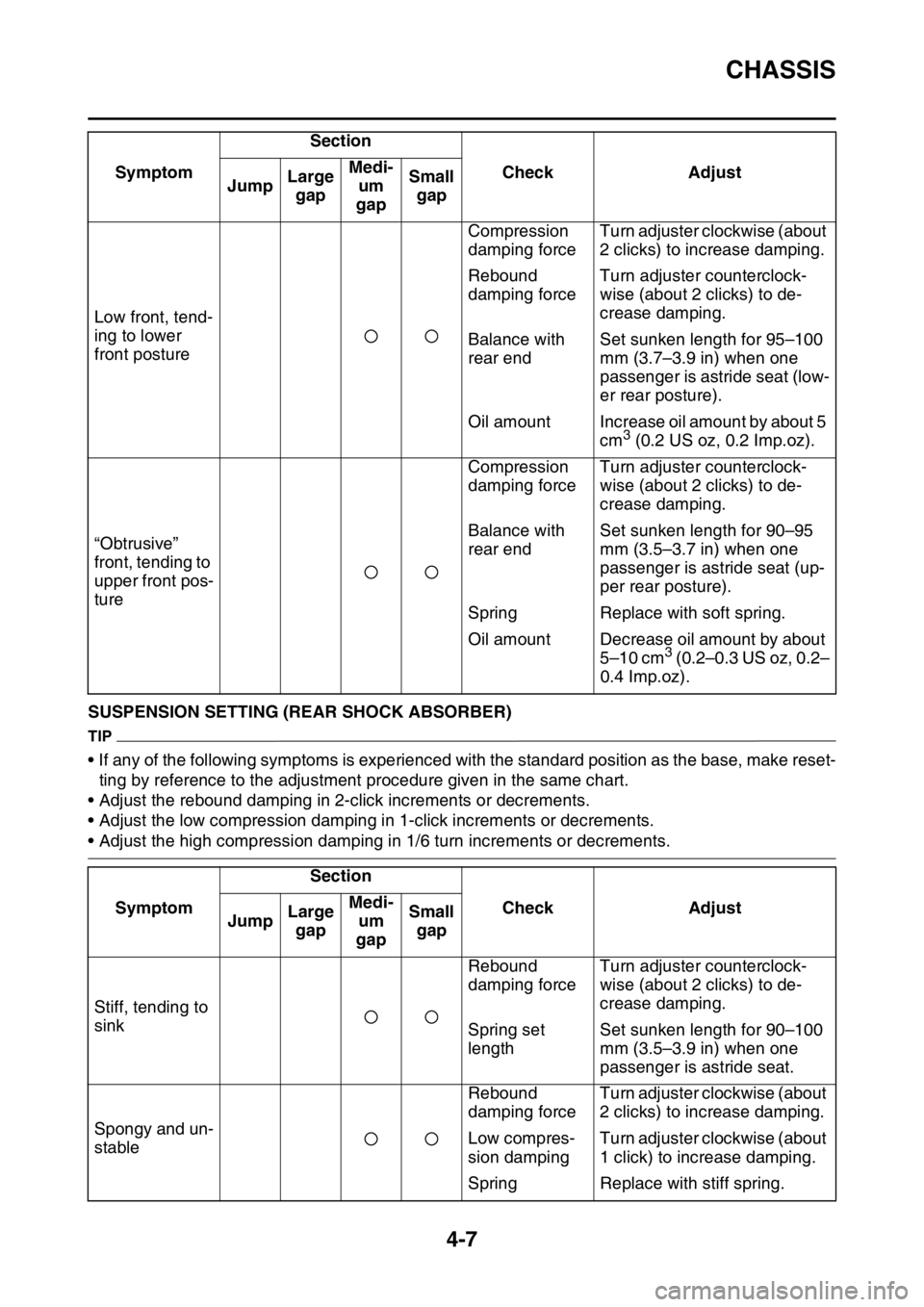
EAS2GC1149SUSPENSION SETTING (REAR SHOCK ABSORBER)
TIP
• If any of the following symptoms is experienced with the standard position as the base, make reset-ting by reference to the adjustment procedure given in the same chart.
• Adjust the rebound damping in 2- click increments or decrements.
• Adjust the low compression damping in 1-click increments or decrements.
• Adjust the high compression damping in 1/6 turn increments or decrements.Low front, tend-
ing to lower
front posture
Compression
damping force
Turn adjuster clockwise (about
2 clicks) to increase damping.
Rebound
damping force Turn adjuster counterclock-
wise (about 2 clicks) to de-
crease damping.
Balance with
rear end Set sunken length for 95–100
mm (3.7–3.9 in) when one
passenger is astride seat (low-
er rear posture).
Oil amount Increase oil amount by about 5 cm
3 (0.2 US oz, 0.2 Imp.oz).
“Obtrusive”
front, tending to
upper front pos-
ture Compression
damping force
Turn adjuster counterclock-
wise (about 2 clicks) to de-
crease damping.
Balance with
rear end Set sunken length for 90–95
mm (3.5–3.7 in) when one
passenger is astride seat (up-
per rear posture).
Spring Replace with soft spring.
Oil amount Decrease oil amount by about 5–10 cm
3 (0.2–0.3 US oz, 0.2–
0.4 Imp.oz).
Symptom Section
Check Adjust
Jump Large
gap Medi-
um
gap Small
gap
Stiff, tending to
sink Rebound
damping force
Turn adjuster counterclock-
wise (about 2 clicks) to de-
crease damping.
Spring set
length Set sunken length for 90–100
mm (3.5–3.9 in) when one
passenger is astride seat.
Spongy and un-
stable Rebound
damping force
Turn adjuster clockwise (about
2 clicks) to increase damping.
Low compres-
sion damping Turn adjuster clockwise (about
1 click) to increase damping.
Spring Replace with stiff spring.
Symptom
Section
Check Adjust
Jump Large
gap Medi-
um
gap Small
gap