sensor ACURA NSX 1991 Service Manual Online
[x] Cancel search | Manufacturer: ACURA, Model Year: 1991, Model line: NSX, Model: ACURA NSX 1991Pages: 1640, PDF Size: 60.48 MB
Page 935 of 1640
Cruise Control
Description
The cruise control system uses mechanically and electri-
cally operated devices to maintain vehicle speed at a
setting selected by the driver.
The ECM receives command signals from the cruise con-
trol main switch and the cruise control set/resume switch.
It receives information about operating conditions from
the brake switch, vehicle speed sensor (VSS), the clutch
switch (with manual transmission), or the A/T gear posi-
tion switch (with automatic transmission). The ECM
sends operational signals to the devices that regulate the
throttle position. The throttle position maintains the
selected vehicle speed. Essentially, the ECM compares
the actual speed of the vehicle to the selected speed.
Then, it uses the result of that comparison to open or
close the throttle.
The brake switch releases the system's control of the
throttle at the instant the driver depresses the brake
pedal. The switch sends an electronic signal to the ECM
when the brake pedal is depressed; the ECM responds
by allowing the throttle to close. The clutch switch (man-
ual transmission) or the A/T gear position switch (auto-
matic transmission) sends a disengage signal to the
ECM that also allows the throttle to close.
Operation:
The cruise control system will set and automatically
maintain any speed above 25 mph (45 km/h). To set,
make sure that the main switch is in the "ON" position.
After reaching the desired speed, press the set switch.
The ECM will receive a set signal and, in turn, will actu-
ate the throttle valve control motor. When the set switch
is depressed and the cruise control system is on, the
"cruise control" ON indicator in the gauge assembly will
light up. You can cancel the cruise control system by
pushing the main switch to "OFF". This erases the set
speed from memory. If the system is disengaged tem-
porarily by the brake switch, clutch switch, or A/T gear
position switch and vehicle speed is still above 25 mph,
press the resume switch. With the resume switch
depressed and the set memory retained, the vehicle
automatically returns to the previous set speed.
For gradual acceleration without depressing the acceler-
ator pedal, push the resume switch down and hold it
there until the desired speed is reached. This will send
an acceleration signal to the ECM. When the switch is
released, the system will be reprogrammed for the new
speed. To slow down, depress the set switch. This will
send a deceleration signal to the ECM causing the car to
coast until the desired speed is reached. When the
desired speed is reached, release the set switch. This
will reprogram the system for the new speed.ProCarManuals.com
Page 978 of 1640
This engine has the following new features.
Type
Displacement
Bore x Stroke
Compression Ratio
Cam, Valve Mechanism
Valve Train
Fuel Supply System Water-cooled V6—90° Cross Flow
2,977 cm3(181.6cu-in)
90 x 78 mm
(3.54
x
3.07
in)
10.2
Dual Overhead Camshafts, VTEC Belt Driven
Sequential Multiport Fuel Injection (SFI)VTEC; High output and a broad power band is achieved through control of low-speed and high-speed valve operation
by the Engine Control Module (ECM).
(Two knock sensors are used to detect octane level of the fuel.)
Titanium connecting rods ; Accomodate high rotation speed and high output. Titanium material of light weight and
high strength is used for the connecting rods.
(Strength is at the same level as iron.)
(Weight is about 30% lighter than iron.)
New mechanism to the intake system; Increased low and middle speed torque and higher output can be achieved by
switching the chamber volume of the intake manifold according to engine speed. This is electronically-controlled.
Cooling system for the mid-ship engine:
Radiator located in front compartment (An aluminum alloy radiator and pipes made of aluminum alloy)
Engine room cooling fan
Expansion tank
The cylinder block is highly rigid with deep water jackets. In order to achieve lighter weight, magnesium is used for the following parts: Cylinder head coverIntake manifold cover
Intake manifold chamber
Major SpecificationsProCarManuals.com
Page 990 of 1640
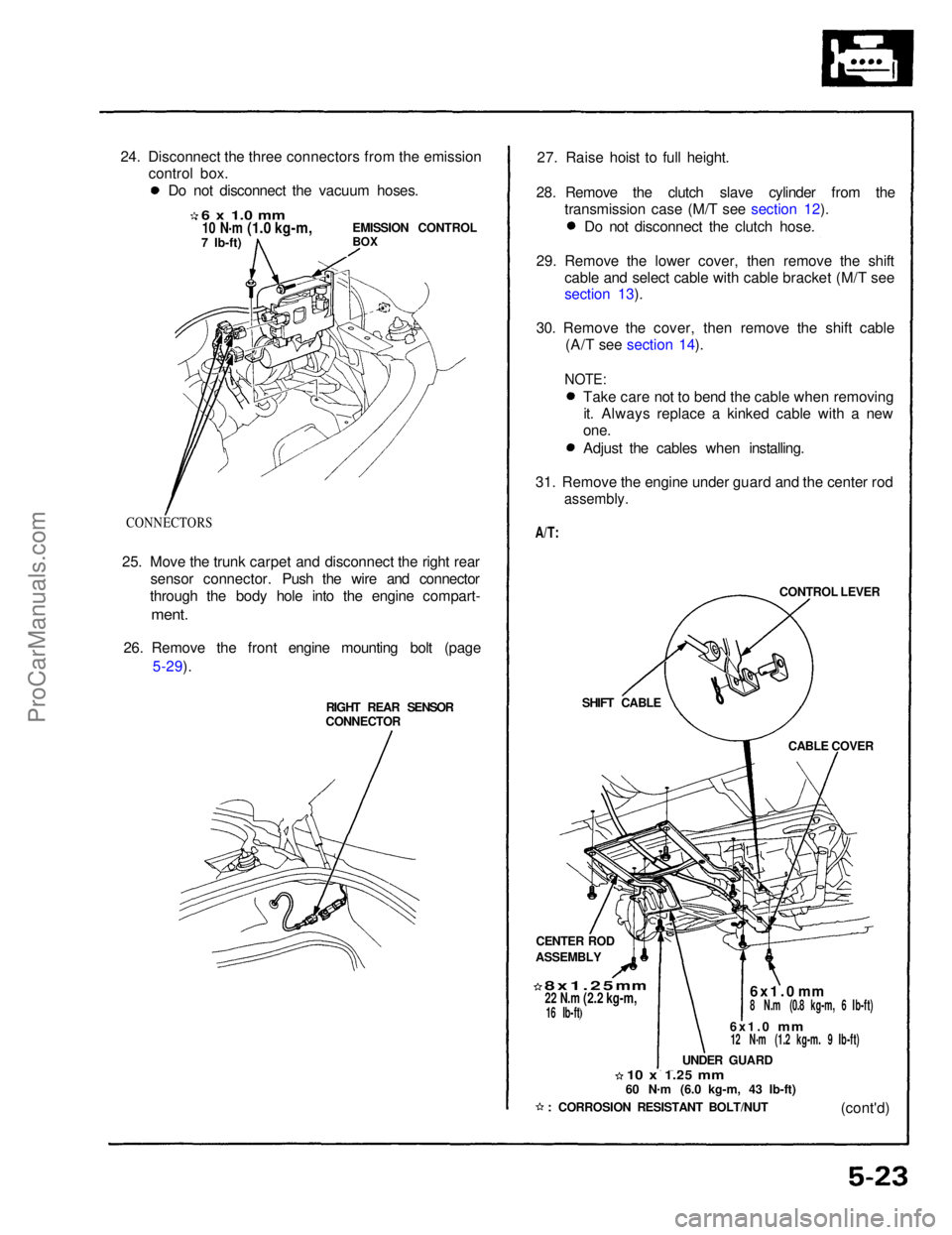
24. Disconnect the three connectors from the emission
control box.
6 x 1.0 mm
10 N .
m
(1.0 kg-m,
7 Ib-ft)
EMISSION CONTROL
BOX
CONNECTORS
25. Move the trunk carpet and disconnect the right rear sensor connector. Push the wire and connector
through the body hole into the engine compart-
ment.
26. Remove the front engine mounting bolt (page 5-29).
RIGHT REAR SENSOR
CONNECTOR 27. Raise hoist to full height.
28. Remove the clutch slave cylinder from the transmission case (M/T see section 12).
CONTROL LEVER
SHIFT CABLE CABLE COVER
CENTER ROD
ASSEMBLY
8x1.25
mm
22 N.m
(2.2 kg-m,
16 Ib-ft)
6x1.0
mm
8 N.m (0.8 kg-m, 6 Ib-ft)
6x1.0
mm
12 N
.
m (1.2 kg-m. 9 Ib-ft)
UNDER GUARD
10 x
1.25
mm
60 N
.
m (6.0 kg-m, 43 Ib-ft)
(cont'd)
: CORROSION RESISTANT BOLT/NUT
Do not disconnect the vacuum hoses.
Do not disconnect the clutch hose.
29. Remove the lower cover, then remove the shift cable and select cable with cable bracket (M/T see
section 13).
30. Remove the cover, then remove the shift cable (A/T see section 14).
NOTE:
Take care not to bend the cable when removingit. Always replace a kinked cable with a new
one.
Adjust the cables when installing.
31. Remove the engine under guard and the center rod
assembly.
A/T:ProCarManuals.com
Page 992 of 1640
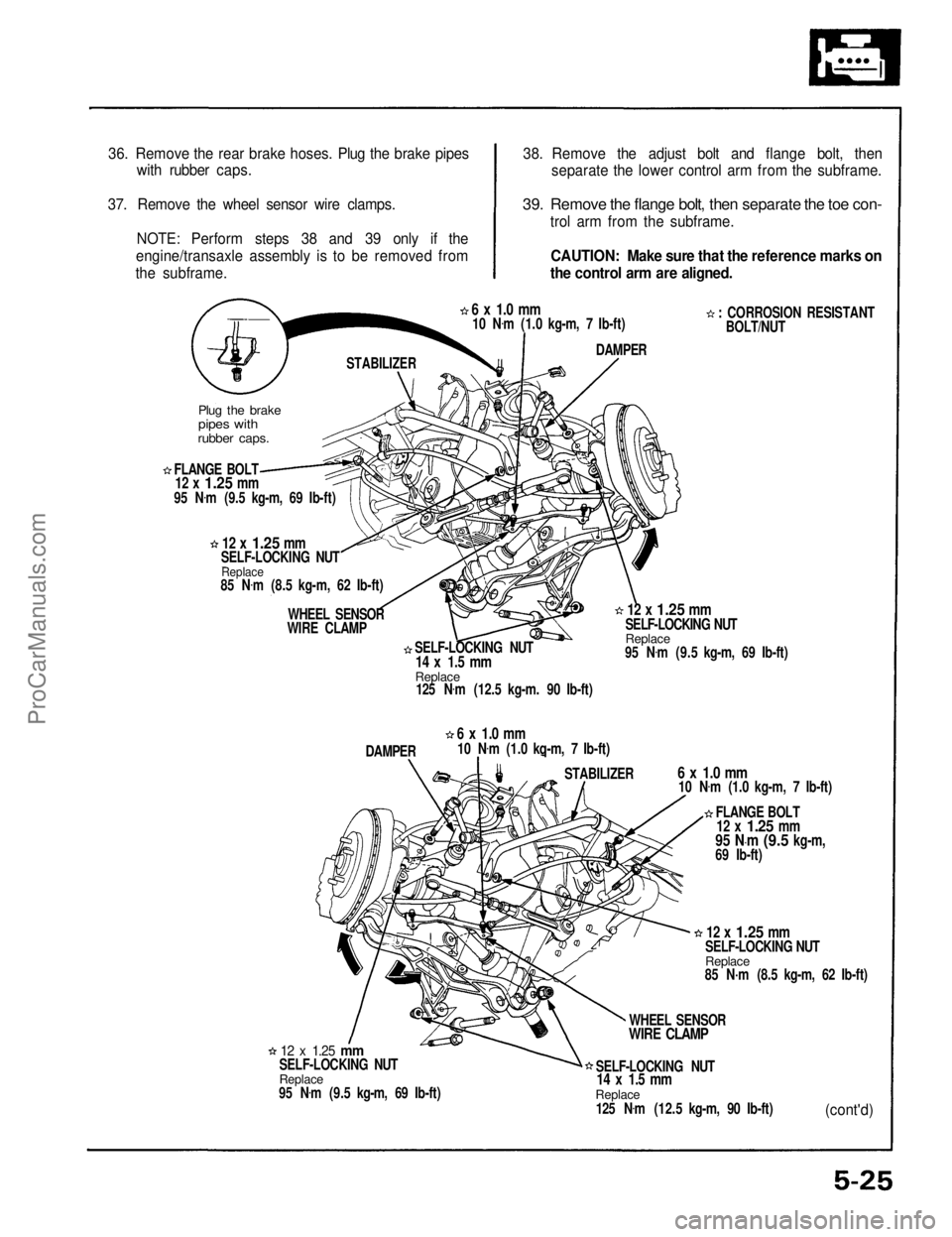
36. Remove the rear brake hoses. Plug the brake pipes
with rubber caps.
37. Remove the wheel sensor wire clamps. NOTE: Perform steps 38 and 39 only if the
engine/transaxle assembly is to be removed from
the subframe. 38. Remove the adjust bolt and flange bolt, then
separate the lower control arm from the subframe.
39. Remove the flange bolt, then separate the toe con-
trol arm from the subframe.
CAUTION: Make sure that the reference marks on
the control arm are aligned.
: CORROSION RESISTANTBOLT/NUT
6 x 1.0 mm
10 N .
m (1.0 kg-m, 7 Ib-ft)
DAMPER
STABILIZER
Plug the brake
pipes with
rubber caps.
FLANGE BOLT
12 x
1.25
mm
95 N .
m (9.5 kg-m, 69 Ib-ft)
12 x
1.25
mm
SELF-LOCKING NUT
Replace
85 N .
m (8.5 kg-m, 62 Ib-ft)
WHEEL SENSOR
WIRE CLAMP
SELF-LOCKING NUT
14 x 1.5 mm
Replace
125 N .
m (12.5 kg-m. 90 Ib-ft)
12 x
1.25
mm
SELF-LOCKING NUT
Replace
95 N .
m (9.5 kg-m, 69 Ib-ft)
DAMPER
6 x 1.0 mm
10 N .
m (1.0 kq-m, 7 Ib-ft)
STABILIZER
6 x 1.0 mm
10 N .
m (1.0 kg-m, 7 Ib-ft)
FLANGE BOLT
12 x
1.25
mm
95 N·m
(9.5
kg-m,
69 Ib-ft)
12 x
1.25
mm
SELF-LOCKING NUT
Replace
85 N·m (8.5 kg-m, 62 Ib-ft)
WHEEL SENSOR
WIRE CLAMP
SELF-LOCKING NUT
14 x 1.5 mm
Replace
125 N .
m (12.5 kg-m, 90 Ib-ft)
(cont'd)
12 x
1.25
mm
SELF-LOCKING NUT
Replace
95 N .
m (9.5 kg-m, 69 Ib-ft)ProCarManuals.com
Page 993 of 1640
Engine Removal/Installation
(cont'd)
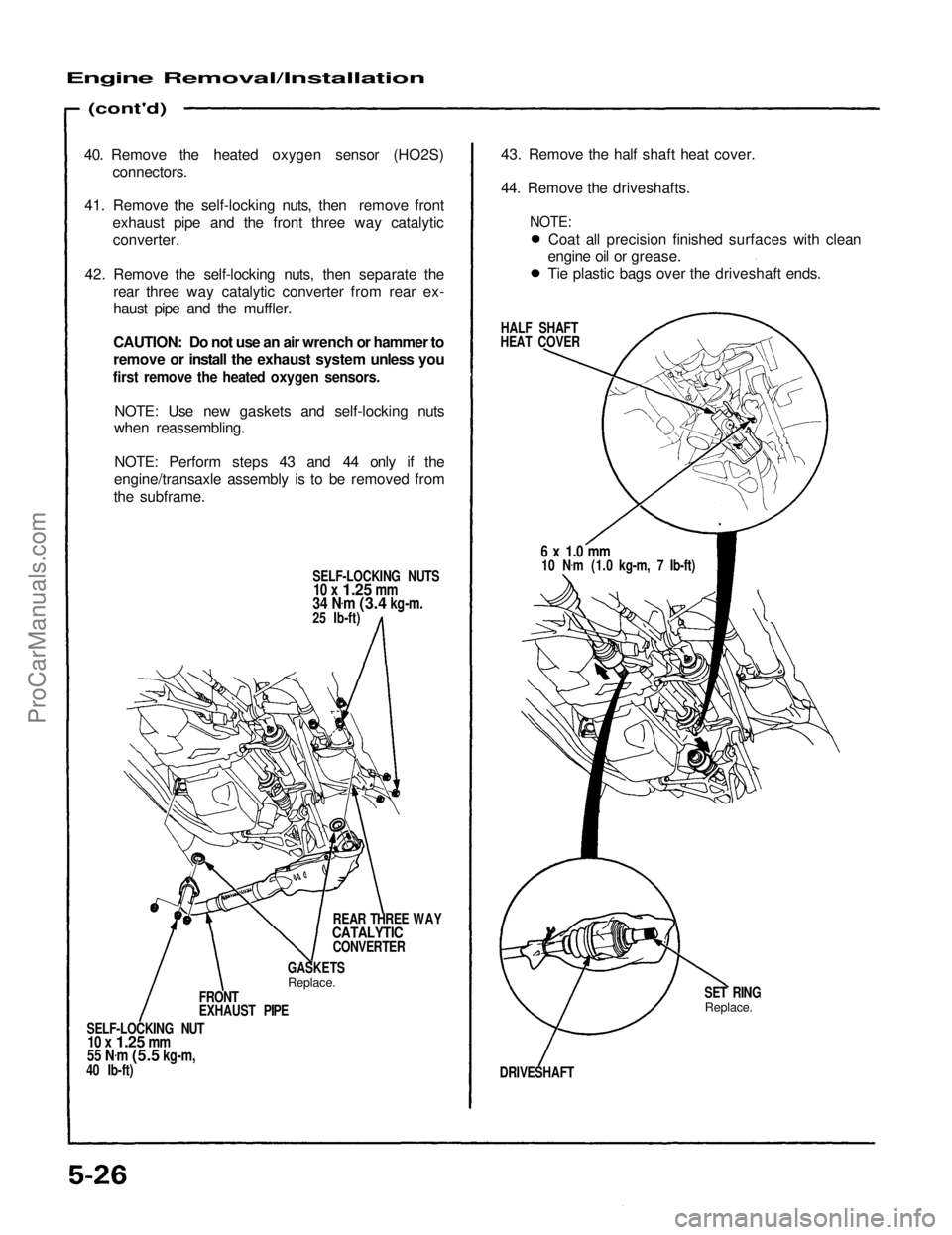
40. Remove the heated oxygen sensor (HO2S) connectors.
41. Remove the self-locking nuts, then remove front exhaust pipe and the front three way catalyticconverter.
42. Remove the self-locking nuts, then separate the rear three way catalytic converter from rear ex-
haust pipe and the muffler.
CAUTION: Do not use an air wrench or hammer to
remove or install the exhaust system unless you
first remove the heated oxygen sensors.
NOTE: Use new gaskets and self-locking nuts
when reassembling.
NOTE: Perform steps 43 and 44 only if the
engine/transaxle assembly is to be removed from
the subframe.
SELF-LOCKING NUTS
10 x
1.25
mm
34 N .
m
(3.4
kg-m.
25 Ib-ft)
REAR THREE WAY
CATALYTIC
CONVERTER
GASKETS
Replace.
FRONT
EXHAUST PIPE
SELF-LOCKING NUT
10 x
1.25
mm
55 N .
m
(5.5
kg-m,
40 Ib-ft) DRIVESHAFTSET RING
Replace.
6 x 1.0 mm
10 N .
m (1.0 kg-m, 7 Ib-ft)
HALF SHAFT
HEAT COVER
43. Remove the half shaft heat cover.
44. Remove the driveshafts.
NOTE:
Coat all precision finished surfaces with clean
engine oil or grease.
Tie plastic bags over the driveshaft ends.ProCarManuals.com
Page 1003 of 1640
Cylinder Head/Valve Train
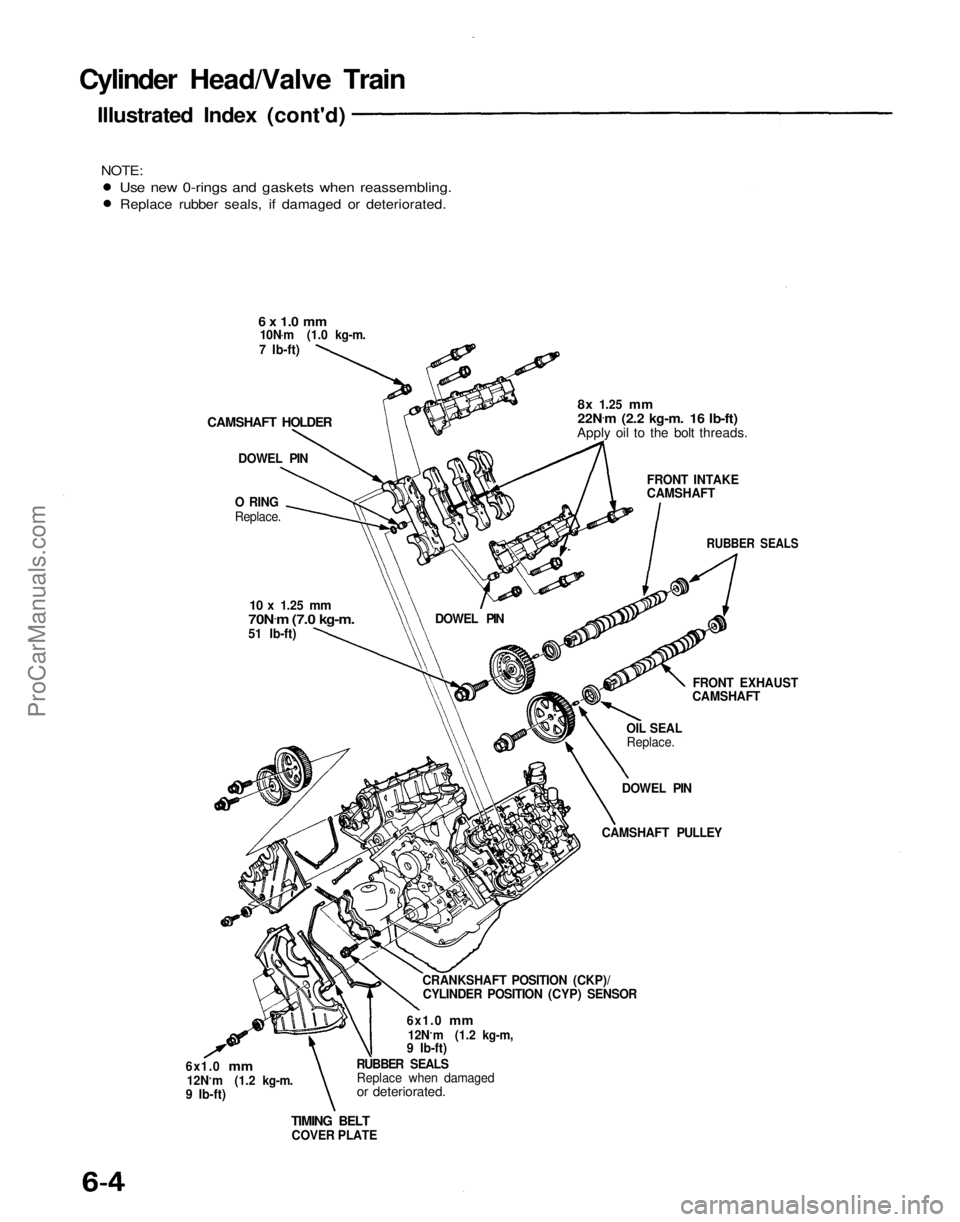
Use new 0-rings and gaskets when reassembling.
Replace rubber seals, if damaged or deteriorated.
Illustrated Index (cont'd)
6 x 1.0 mm
10N .
m (1.0 kg-m.
7 Ib-ft)
8x
1.25
mm
22N.
m (2.2 kg-m. 16 Ib-ft)
Apply oil to the bolt threads.
FRONT INTAKE
CAMSHAFT
RUBBER SEALS
FRONT EXHAUST
CAMSHAFT
OIL SEAL Replace.
DOWEL PIN
CAMSHAFT PULLEY
CRANKSHAFT POSITION (CKP)/ CYLINDER POSITION (CYP) SENSOR
6x1.0
mm
12N ·
m (1.2 kg-m,
9 Ib-ft)
RUBBER SEALS Replace when damaged
or deteriorated.
TIMING BELT
COVER PLATE
6x1.0
mm
12N ·
m (1.2 kg-m.
9 Ib-ft)
10 x
1.25
mm
70N .
m (7.0 kg-m.
51 Ib-ft) DOWEL PIN
CAMSHAFT HOLDER
DOWEL PIN
O RING
Replace.
NOTE:ProCarManuals.com
Page 1004 of 1640
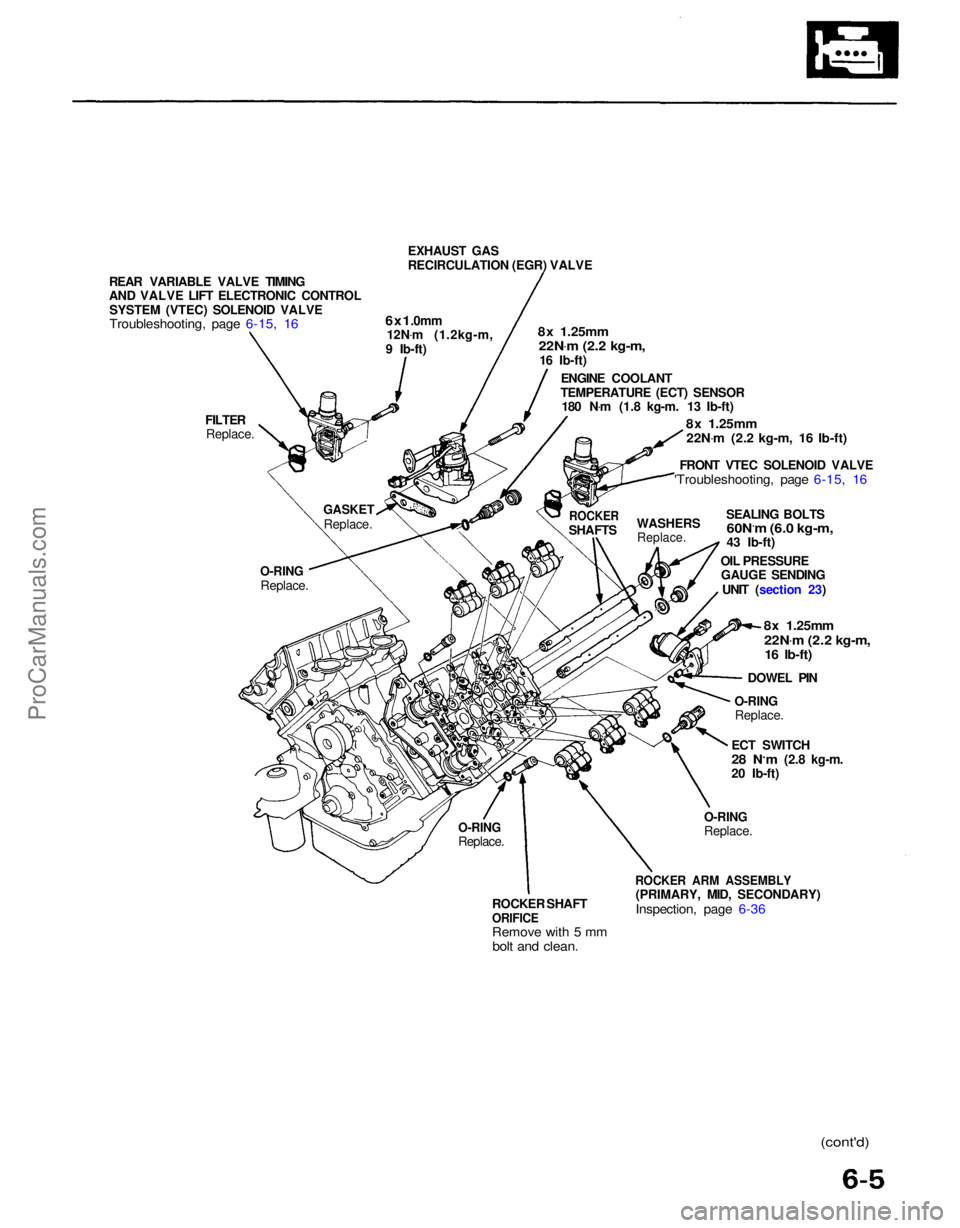
REAR VARIABLE VALVE TIMING
AND VALVE LIFT ELECTRONIC CONTROL
SYSTEM (VTEC) SOLENOID VALVE
Troubleshooting, page 6-15, 16
EXHAUST GAS
RECIRCULATION (EGR) VALVE
6x1
.0mm 12N .
m (1.2kg-m,
9 Ib-ft)
FILTER Replace.
8x 1.25mm
22N .
m (2.2 kg-m,
16 Ib-ft)
ENGINE COOLANT
TEMPERATURE (ECT) SENSOR 180 N .
m (1.8 kg-m. 13 Ib-ft)
8x 1.25mm
22N .
m (2.2 kg-m, 16 Ib-ft)
FRONT VTEC SOLENOID VALVE
'Troubleshooting, page 6-15, 16
O-RING
Replace.
GASKET
Replace.
ROCKER
SHAFTS WASHERS
Replace.
SEALING BOLTS
60N.m (6.0 kg-m,
43 Ib-ft)
OIL PRESSURE GAUGE SENDING
UNIT (section 23)
8x 1.25mm
22N .
m (2.2 kg-m,
16 Ib-ft)
DOWEL PIN
O-RING
Replace.
ECT SWITCH
28 N ·
m
(2.8 kg-m.
20 Ib-ft)
O-RING
Replace.
ROCKER ARM ASSEMBLY
(PRIMARY, MID, SECONDARY)
Inspection, page 6-36
ROCKER SHAFT
ORIFICE
Remove with 5 mm
bolt and clean.
O-RING
Replace.
(cont'd)ProCarManuals.com
Page 1013 of 1640
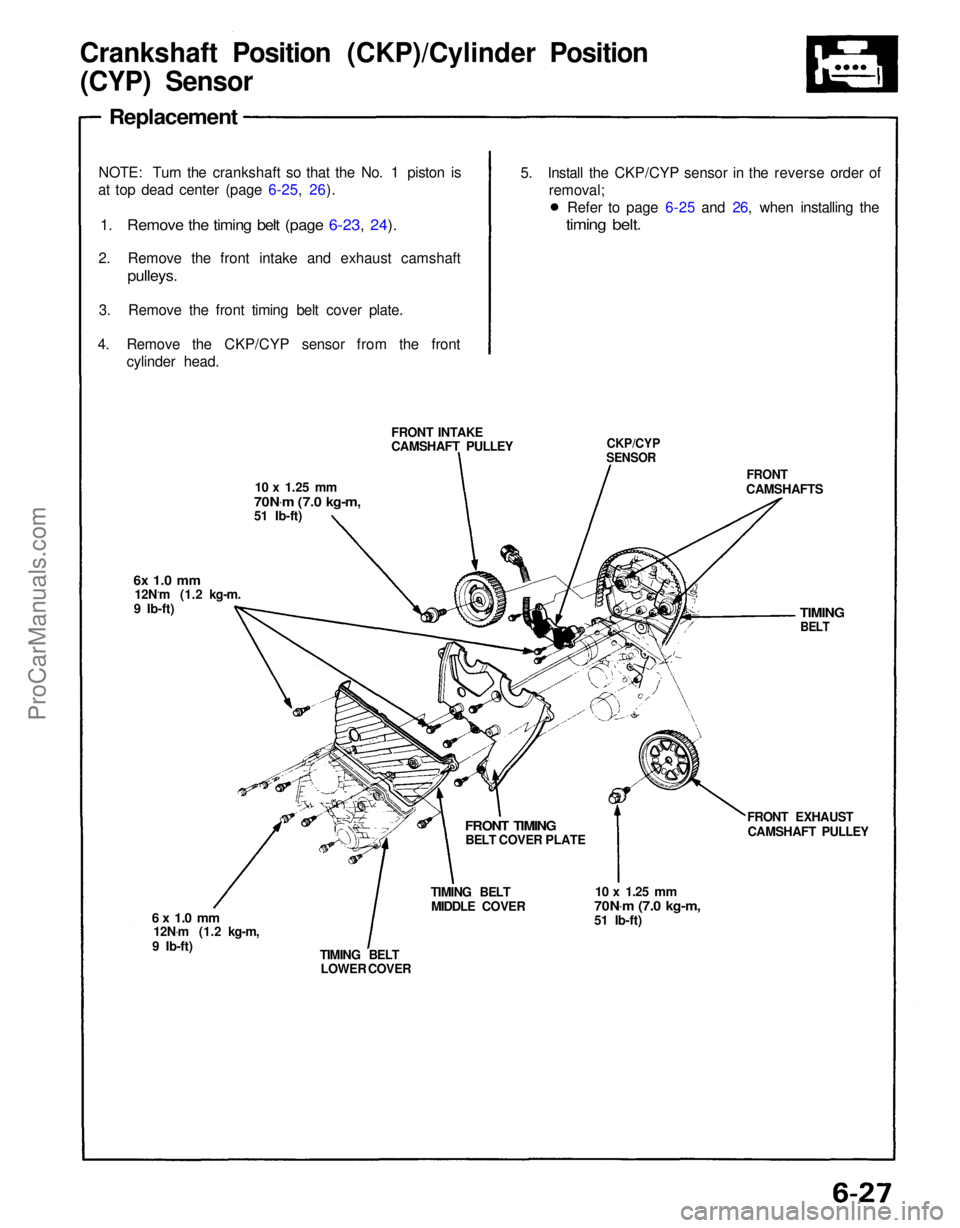
Crankshaft Position (CKP)/Cylinder Position
(CYP) Sensor
NOTE: Turn the crankshaft so that the No. 1 piston is
at top dead center (page 6-25, 26).
1. Remove the timing belt (page 6-23, 24).
2. Remove the front intake and exhaust camshaft
pulleys.
3. Remove the front timing belt cover plate.
4. Remove the CKP/CYP sensor from the front cylinder head. 5. Install the CKP/CYP sensor in the reverse order of
removal;
Replacement
FRONT INTAKE
CAMSHAFT PULLEY
10 x
1.25
mm
70N .
m (7.0 kg-m,
51 Ib-ft)
6x 1.0 mm
12N.m (1.2 kg-m.
9 Ib-ft)
6 x 1.0 mm
12N .
m (1.2 kg-m,
9 Ib-ft) TIMING BELT
LOWER COVER TIMING BELT
MIDDLE COVER
FRONT TIMING
BELT COVER PLATE
10 x
1.25
mm
70N .
m (7.0 kg-m,
51 Ib-ft) FRONT EXHAUST
CAMSHAFT PULLEY
TIMING
BELT
FRONT
CAMSHAFTS
CKP/CYP
SENSOR
Refer to page 6-25 and 26, when installing the
timing belt.ProCarManuals.com
Page 1014 of 1640
Cylinder Heads
Removal
Engine removal is not required in this procedure.
CAUTION: To avoid damaging the cylinder heads, wait until the engine coolant temperature drops below 100°F (38°C) before loosening the retaining bolts.
NOTE:
Inspect the timing belt before removing the cylinder
heads.
Turn the crankshaft so that the No. 1 piston is at top
dead center (TDC (page 6-25, 26). Mark all emission hoses before disconnecting them.
1. Disconnect the negative terminal from the battery.
2. Remove the expansion tank cap.
Use care when removing the expan-
sion tank cap to avoid scalding by engine coolant or
steam.
3. Raise the car.
4. Remove the right rear wheel/tire.
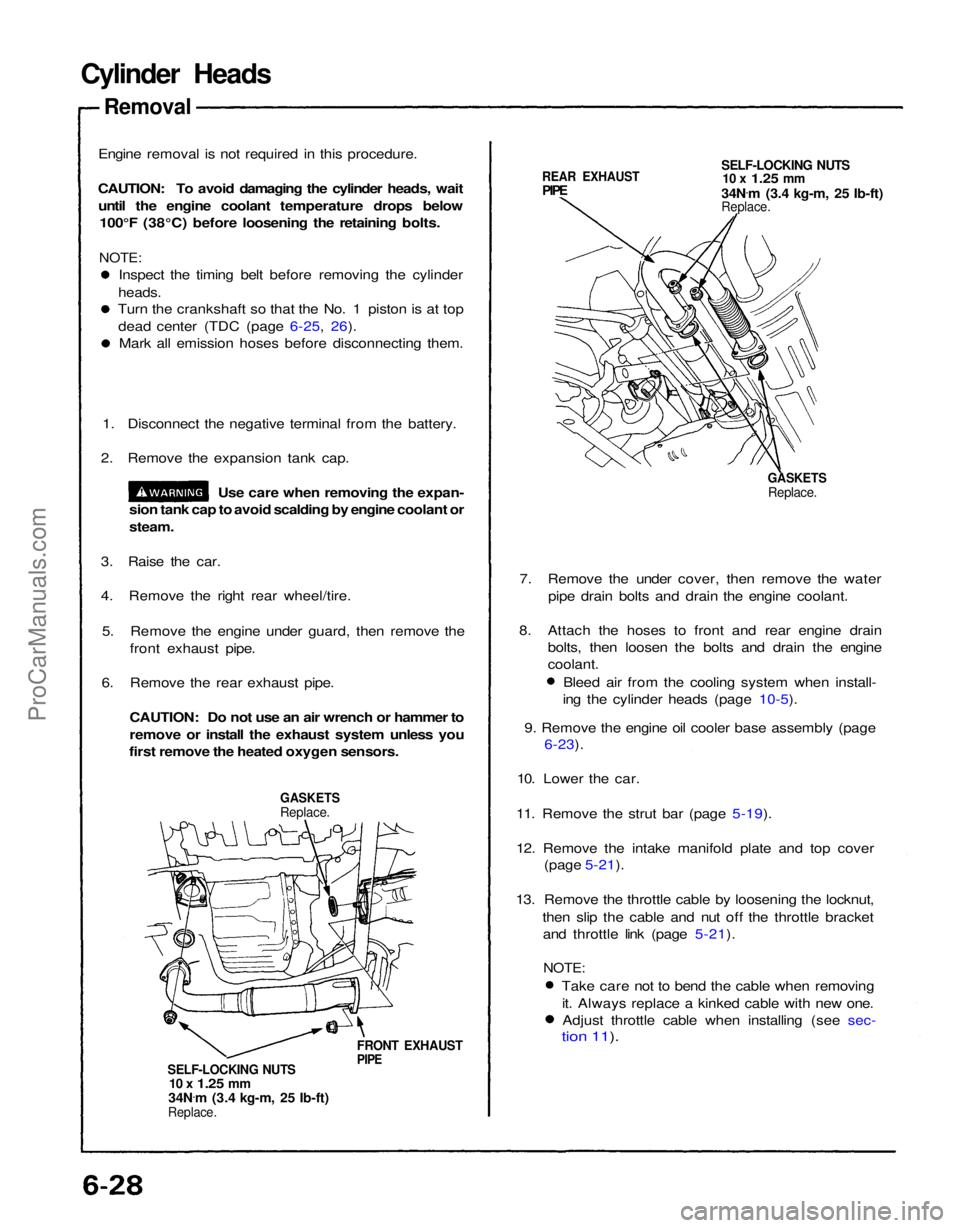
5. Remove the engine under guard, then remove the front exhaust pipe.
6. Remove the rear exhaust pipe.
CAUTION: Do not use an air wrench or hammer to
remove or install the exhaust system unless you
first remove the heated oxygen sensors.
GASKETS
Replace.
FRONT EXHAUST
PIPE
SELF-LOCKING NUTS
10 x
1.25
mm
34N .
m (3.4 kg-m, 25 Ib-ft)
Replace.
REAR EXHAUST
PIPE
SELF-LOCKING NUTS
10 x
1.25
mm
34N .
m (3.4 kg-m, 25 Ib-ft)
Replace.
GASKETS
Replace.
7. Remove the under cover, then remove the water pipe drain bolts and drain the engine coolant.
8. Attach the hoses to front and rear engine drain bolts, then loosen the bolts and drain the engine
coolant.
Bleed air from the cooling system when install-
ing the cylinder heads (page 10-5).
9. Remove the engine oil cooler base assembly (page
6-23).
10. Lower the car.
11. Remove the strut bar (page 5-19).
12. Remove the intake manifold plate and top cover (page 5-21).
13. Remove the throttle cable by loosening the locknut, then slip the cable and nut off the throttle bracketand throttle link (page 5-21).
NOTE:
Take care not to bend the cable when removingit. Always replace a kinked cable with new one.Adjust throttle cable when installing (see sec-
tion 11).ProCarManuals.com
Page 1015 of 1640
14. Relieve fuel pressure (see section 11).
Do not smoke while working on fuel
system; keep open flame or spark away from work
area. Drain fuel only into an approved container.
1 5. Disconnect the fuel feed pipe and the return hose
(page 5-21).
16. Remove the ignition coil covers, the wire harness covers, the ignition coils and the connectors (page
6-23).
17. Remove the water hoses, then remove the expan- sion tank (page 5-21).
18. Remove the breather hose, and the air cleaner housing (page 5-22).
19. Remove the brake booster hose, the evaporative emission (EVAP) control canister hose and other
hoses from the intake manifold and throttle body
(page 5-22).
20. Remove the emission control box (page 5-23). Do not disconnect emission hose.Disconnect the three connectors before
removing.
21. Remove the connector, the terminal and the alternator.
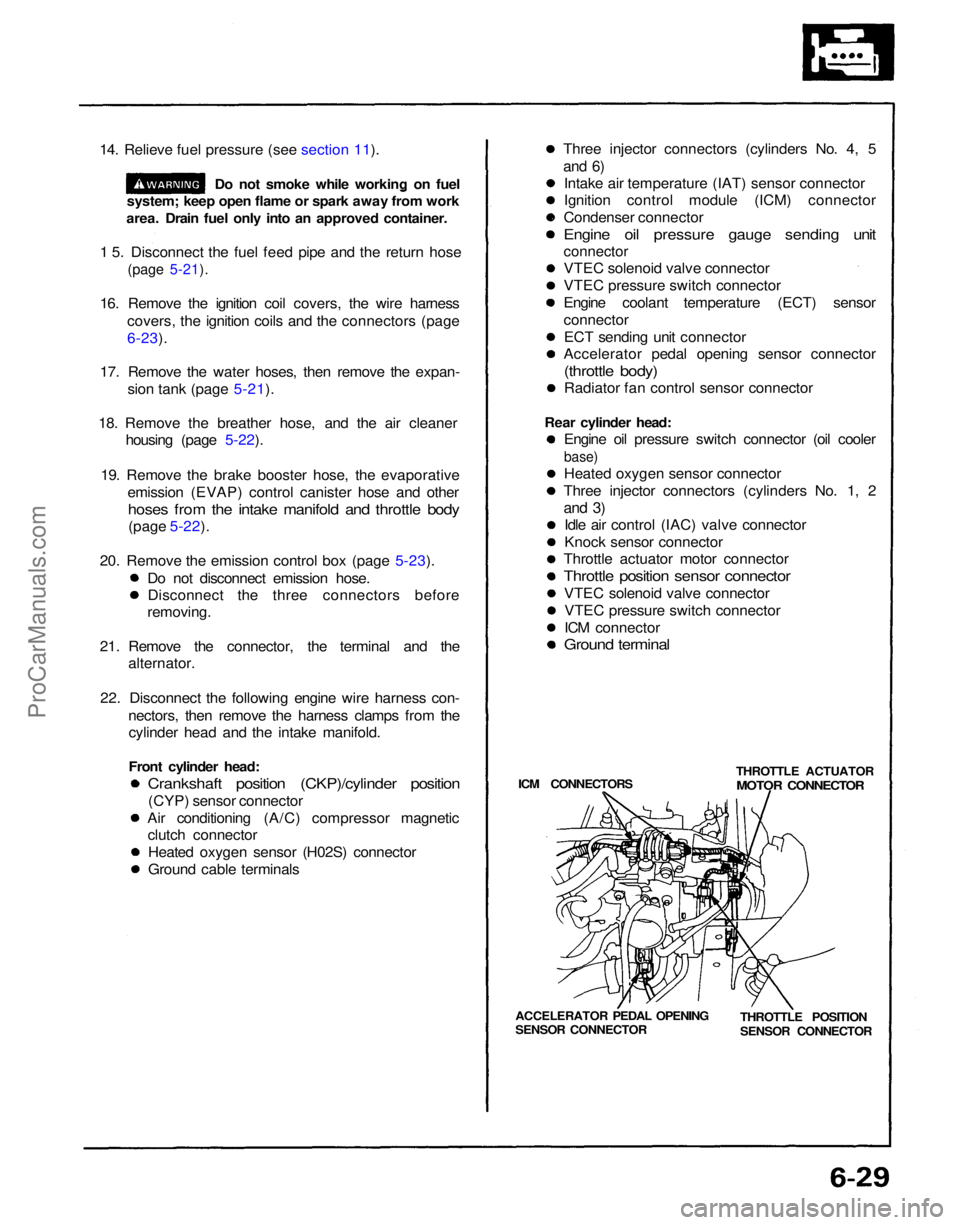
22. Disconnect the following engine wire harness con- nectors, then remove the harness clamps from thecylinder head and the intake manifold.
Front cylinder head:
Crankshaft position (CKP)/cylinder position
(CYP) sensor connector
Air conditioning (A/C) compressor magnetic clutch connector
Heated oxygen sensor (H02S) connector
Ground cable terminals Three injector connectors (cylinders No. 4, 5
and 6)
Intake air temperature (IAT) sensor connector
Ignition control module (ICM) connector
Condenser connector
Engine oil pressure gauge sending unit
connector
VTEC solenoid valve connector
VTEC pressure switch connector
Engine coolant temperature (ECT) sensor
connector
ECT sending unit connector
Accelerator pedal opening sensor connector
(throttle body)
Radiator fan control sensor connector
Rear cylinder head: Engine oil pressure switch connector (oil cooler
base)
Heated oxygen sensor connector
Three injector connectors (cylinders No. 1, 2
and 3)
Idle air control (IAC) valve connector
Knock sensor connector
Throttle actuator motor connector
Throttle position sensor connector
VTEC solenoid valve connectorVTEC pressure switch connector
ICM connector
Ground terminal
ICM CONNECTORS THROTTLE ACTUATOR
MOTOR CONNECTOR
THROTTLE POSITION
SENSOR CONNECTOR
ACCELERATOR PEDAL OPENING
SENSOR CONNECTORProCarManuals.com