sensor ACURA NSX 1991 Service Repair Manual
[x] Cancel search | Manufacturer: ACURA, Model Year: 1991, Model line: NSX, Model: ACURA NSX 1991Pages: 1640, PDF Size: 60.48 MB
Page 1053 of 1640
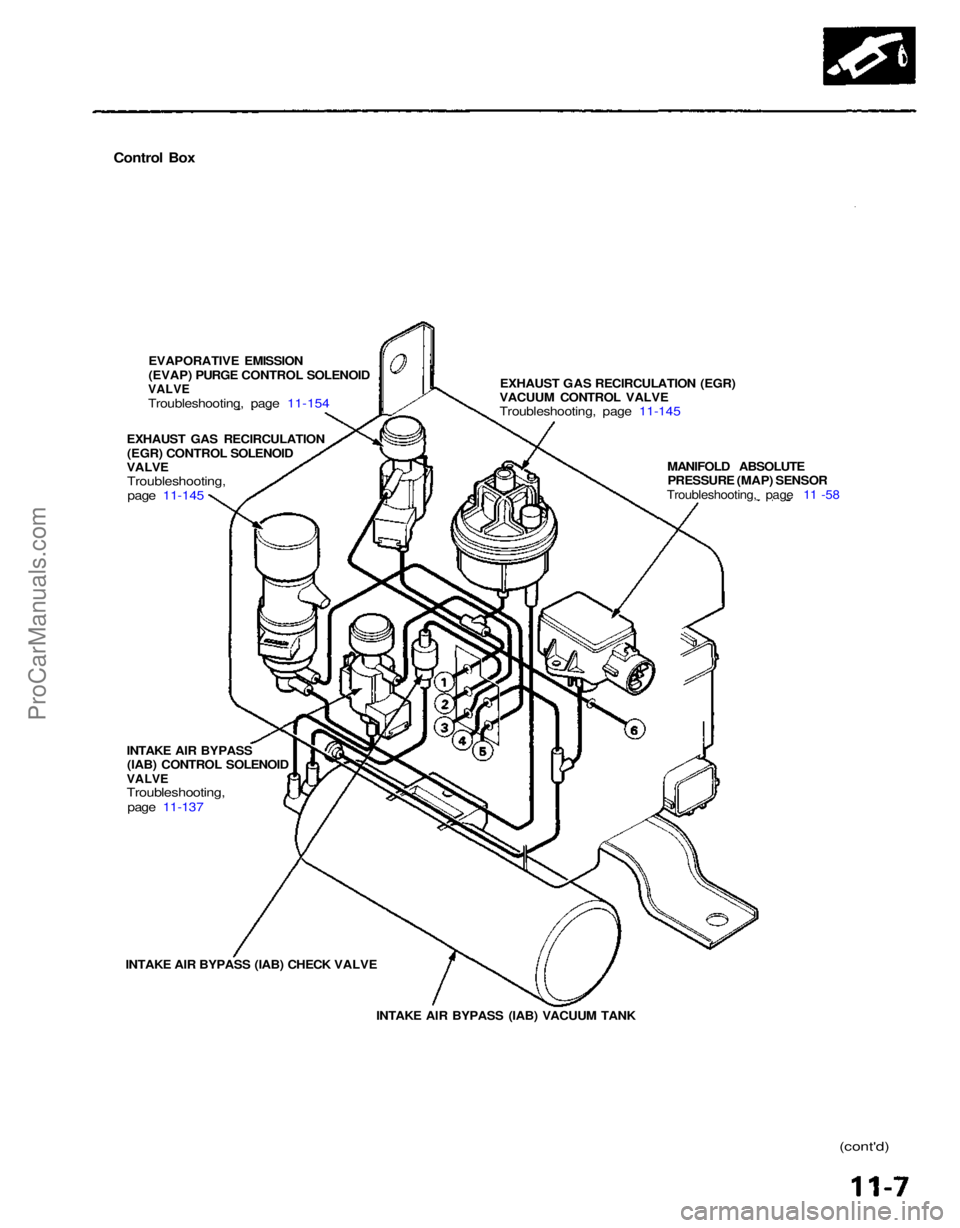
Control Box
EVAPORATIVE EMISSION
(EVAP) PURGE CONTROL SOLENOID
VALVE
Troubleshooting, page 11-154
EXHAUST GAS RECIRCULATION (EGR) CONTROL SOLENOID
VALVE
Troubleshooting,
page 11-145
EXHAUST GAS RECIRCULATION (EGR)
VACUUM CONTROL VALVE
Troubleshooting, page 11-145
MANIFOLD ABSOLUTEPRESSURE (MAP) SENSOR
Troubleshooting, page 11 -58
(cont'd)
INTAKE AIR BYPASS (IAB) VACUUM TANK
INTAKE AIR BYPASS (IAB) CHECK VALVE INTAKE AIR BYPASS
(IAB) CONTROL SOLENOID
VALVE
Troubleshooting,
page 11-137ProCarManuals.com
Page 1054 of 1640
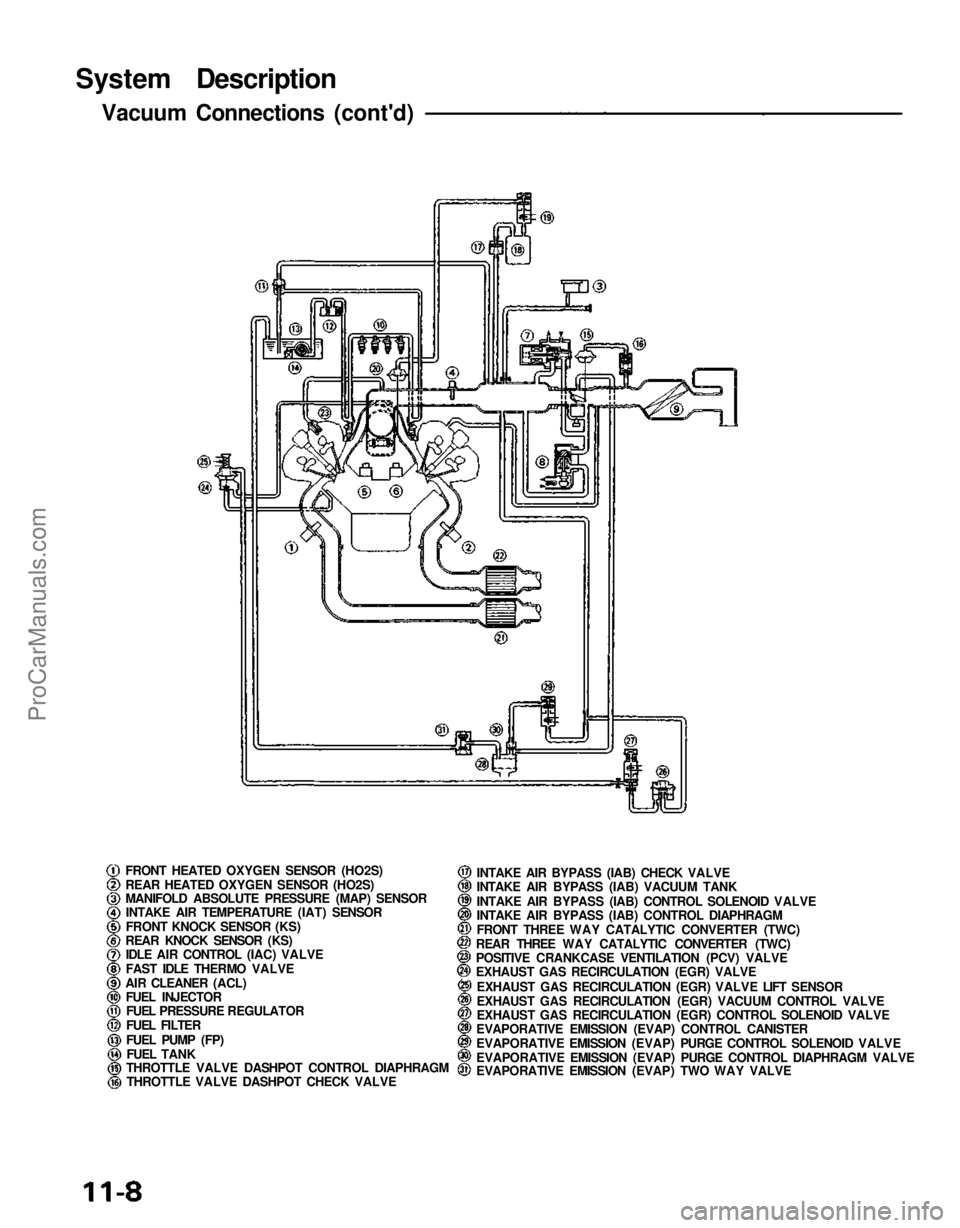
System Description
Vacuum Connections (cont'd)
FRONT HEATED OXYGEN SENSOR (HO2S)
REAR HEATED OXYGEN SENSOR (HO2S)
MANIFOLD ABSOLUTE PRESSURE (MAP) SENSORINTAKE AIR TEMPERATURE (IAT) SENSOR
FRONT KNOCK SENSOR (KS)
REAR KNOCK SENSOR (KS) IDLE AIR CONTROL (IAC) VALVE
FAST IDLE THERMO VALVE
AIR CLEANER (ACL) FUEL INJECTORFUEL PRESSURE REGULATOR
FUEL FILTER
FUEL PUMP (FP)
FUEL TANK
THROTTLE VALVE DASHPOT CONTROL DIAPHRAGM
THROTTLE VALVE DASHPOT CHECK VALVE INTAKE AIR BYPASS (IAB) CHECK VALVE
INTAKE AIR BYPASS (IAB) VACUUM TANK
INTAKE AIR BYPASS (IAB) CONTROL SOLENOID VALVE
INTAKE AIR BYPASS (IAB) CONTROL DIAPHRAGM
FRONT THREE WAY CATALYTIC CONVERTER (TWC)
REAR THREE WAY CATALYTIC CONVERTER (TWC)
POSITIVE CRANKCASE VENTILATION (PCV) VALVE
EXHAUST GAS RECIRCULATION (EGR) VALVE
EXHAUST GAS RECIRCULATION (EGR) VALVE LIFT SENSOR
EXHAUST GAS RECIRCULATION (EGR) VACUUM CONTROL VALVE
EXHAUST GAS RECIRCULATION (EGR) CONTROL SOLENOID VALVE
EVAPORATIVE EMISSION (EVAP) CONTROL CANISTER
EVAPORATIVE EMISSION (EVAP) PURGE CONTROL SOLENOID VALVE
EVAPORATIVE EMISSION (EVAP) PURGE CONTROL DIAPHRAGM VALVE
EVAPORATIVE EMISSION (EVAP) TWO WAY VALVEProCarManuals.com
Page 1055 of 1640
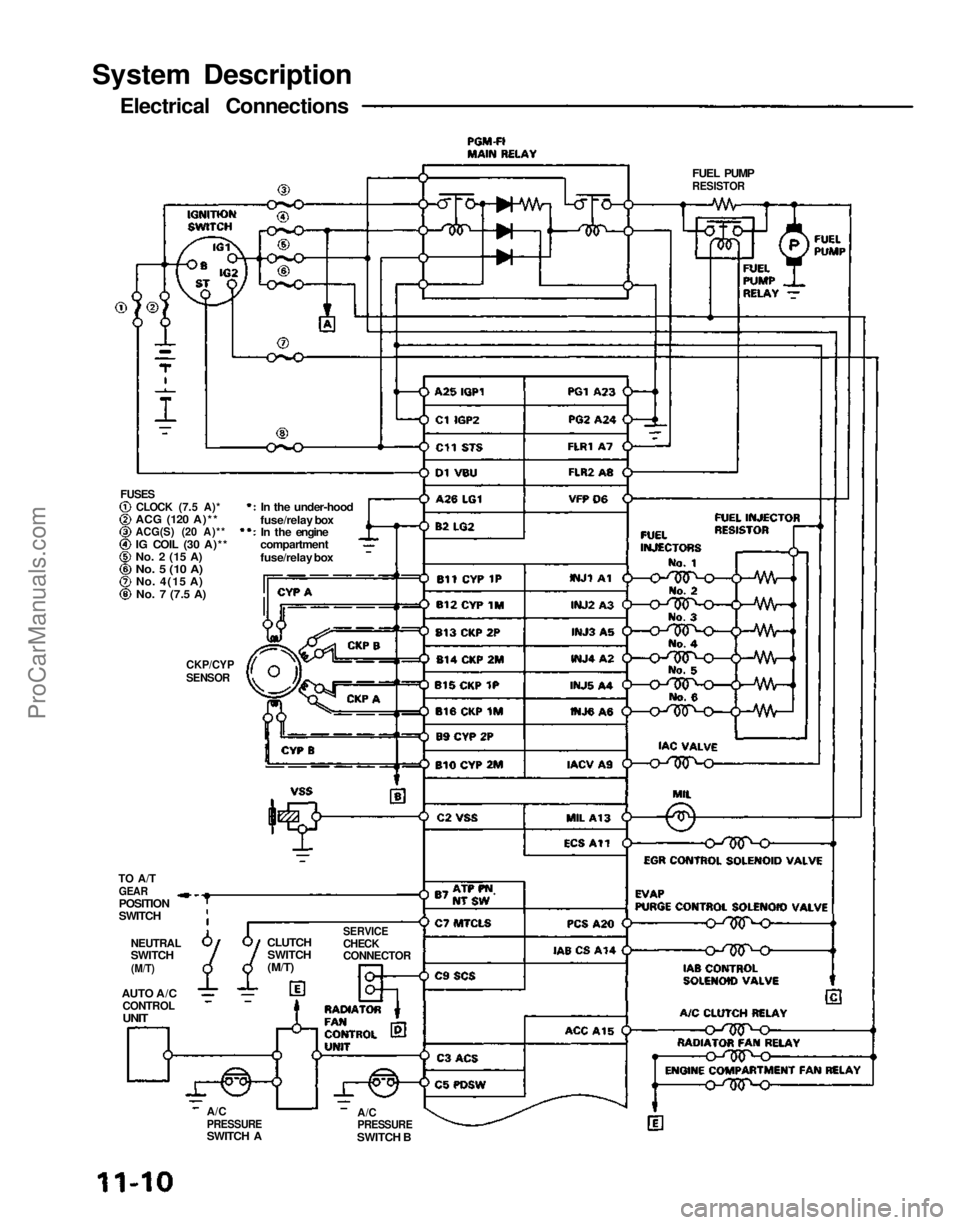
System Description
Electrical Connections
FUSES
CLOCK (7.5 A)*
ACG
(120 A)**
ACG(S) (20 A)**
IG COIL (30 A)**
No. 2 (15 A)
No. 5 (10 A)
No.
4(15
A)
No. 7
(7.5
A)
In the under-hood
fuse/relay box In the engine
compartment
fuse/relay box
CKP/CYP
SENSOR
TO A/T
GEAR
POSITION
SWITCH
NEUTRAL
SWITCH
(M/T)
AUTO A/C
CONTROL
UNIT
CLUTCH
SWITCH
(M/T)
SERVICE
CHECK
CONNECTOR
A/C
PRESSURE
SWITCH A
A/C
PRESSURE
SWITCH B FUEL PUMP
RESISTORProCarManuals.com
Page 1056 of 1640
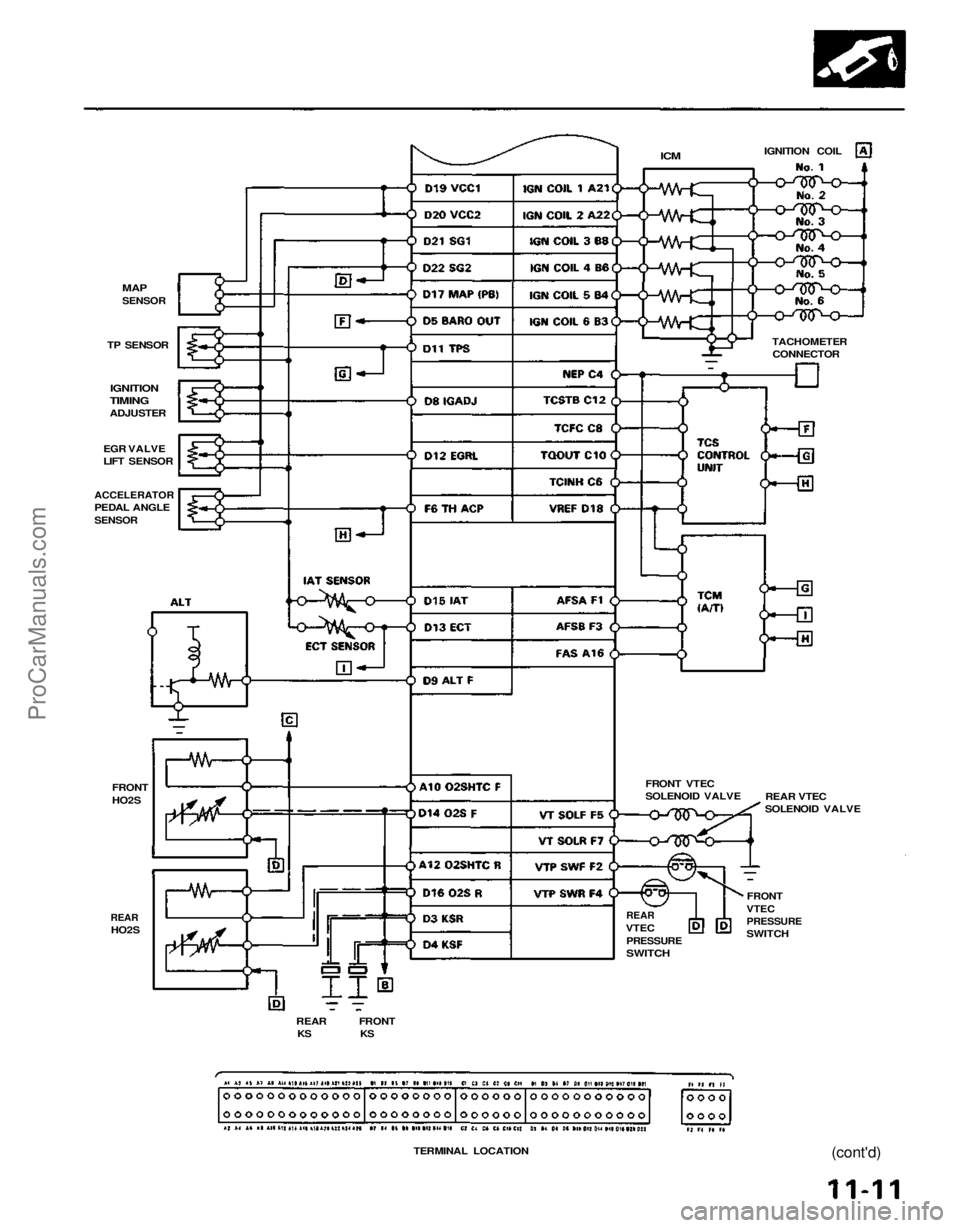
MAP
SENSOR
TP SENSOR
IGNITION
TIMING
ADJUSTER
EGR VALVE
LIFT SENSOR
ACCELERATOR
PEDAL ANGLE
SENSOR
FRONT
HO2S
REAR
HO2S
REAR FRONT
KS KS
TERMINAL LOCATION
(cont'd)
REAR VTEC
SOLENOID VALVE
FRONT VTEC
SOLENOID VALVE
FRONT
VTEC
PRESSURE
SWITCH
REAR
VTEC
PRESSURE
SWITCH
TACHOMETER
CONNECTOR
IGNITION COIL
ICMProCarManuals.com
Page 1066 of 1640
![ACURA NSX 1991 Service Repair Manual
System Description
System Connecors [Engine Compartment (Right Side)] (cont'd)
C132
C171
C130
C133
KNOCK SENSOR
HARNESS
C143
C173C172
C141
C139
C140
C138
C101
C137
C146
C144 C152
C151
C](/img/32/56988/w960_56988-1065.png "ACURA NSX 1991 Service Repair Manual
System Description
System Connecors [Engine Compartment (Right Side)] (cont'd)
C132
C171
C130
C133
KNOCK SENSOR
HARNESS
C143
C173C172
C141
C139
C140
C138
C101
C137
C146
C144 C152
C151
C")
System Description
System Connecors [Engine Compartment (Right Side)] (cont'd)
C132
C171
C130
C133
KNOCK SENSOR
HARNESS
C143
C173C172
C141
C139
C140
C138
C101
C137
C146
C144 C152
C151
C149
C142
ENGINE WIRE
HARNESS
C148 C136
C135
C134
ProCarManuals.com
Page 1076 of 1640
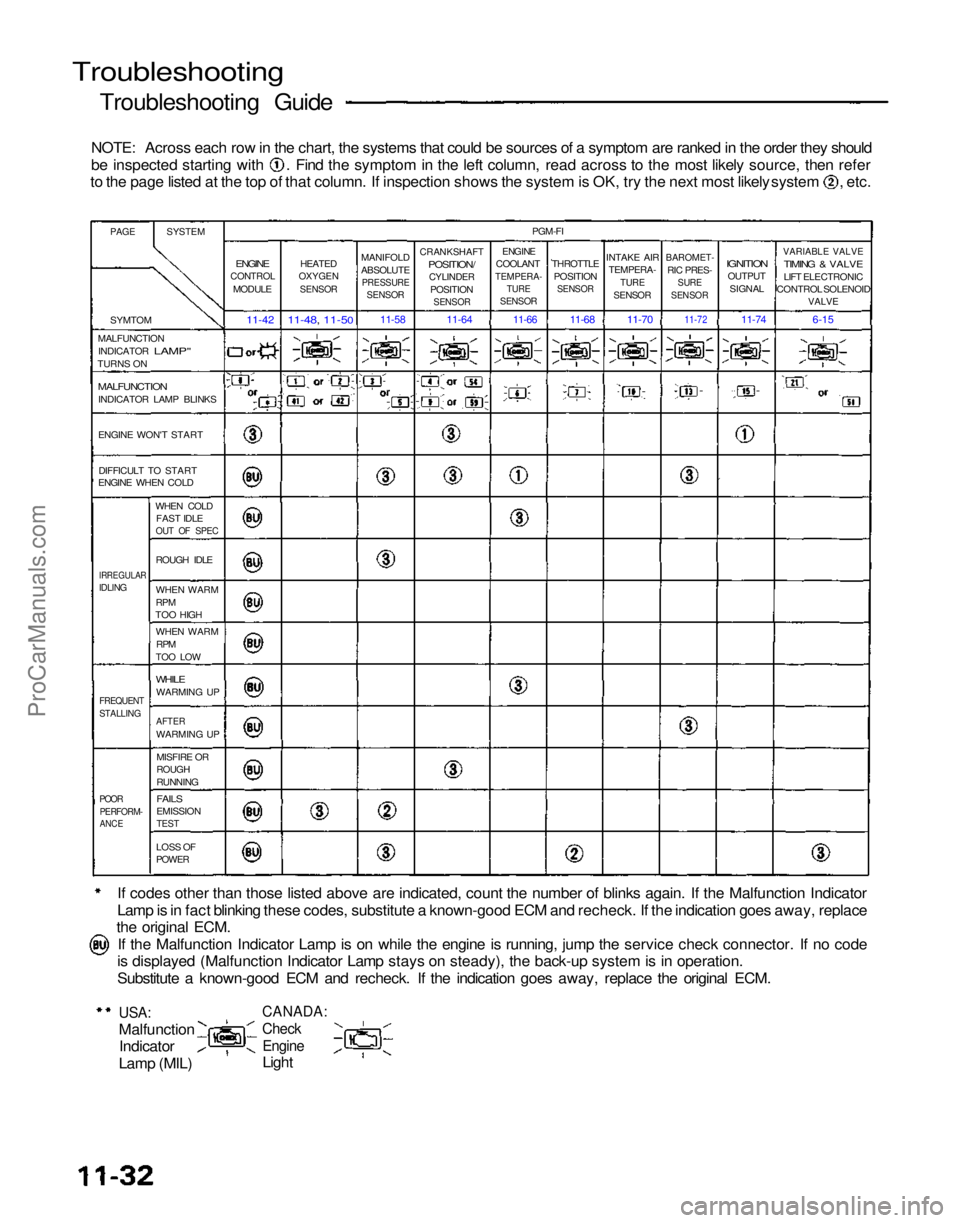
Troubleshooting
Troubleshooting Guide
NOTE: Across each row in the chart, the systems that could be sources of a symptom are ranked in the order they should be inspected starting with . Find the symptom in the left column, read across to the most likely source, then refer
to the page listed at the top of that column. If inspection shows the system is OK, try the next most likely system , etc.
If codes other than those listed above are indicated, count the number of blinks again. If the Malfunction Indicator
Lamp is in fact blinking these codes, substitute a known-good ECM and recheck. If the indication goes away, replace
the original ECM.
If the Malfunction Indicator Lamp is on while the engine is running, jump the service check connector. If no code
is displayed (Malfunction Indicator Lamp stays on steady), the back-up system is in operation.
Substitute a known-good ECM and recheck. If the indication goes away, replace the original ECM.
USA:
Malfunction
Indicator
Lamp (MIL)
CANADA:
Check
Engine
Light
PAGE
SYSTEM
SYMTOM
MALFUNCTION INDICATOR
LAMP"
TURNS ON
MALFUNCTION
INDICATOR LAMP BLINKS
ENGINE WON'T START
DIFFICULT TO START
ENGINE WHEN COLD
WHEN COLDFAST IDLE
OUT OF SPEC
IRREGULAR
IDLING
ROUGH IDLE
WHEN WARM
RPM
TOO HIGH
WHEN WARM
RPM
TOO LOW
WHILE
WARMING UP
FREQUENT
STALLING
AFTER
WARMING UP
MISFIRE OR
ROUGH
RUNNING
POOR
PERFORM-
ANCE
FAILS
EMISSION
TEST
LOSS OF
POWER
ENGINE
CONTROL
MODULE
11-42
HEATED
OXYGEN
SENSOR
11-48, 11-50
MANIFOLD
ABSOLUTE
PRESSURE
SENSOR
11-58
CRANKSHAFT
POSITION/
CYLINDER
POSITION
SENSOR
11-64
PGM-FI
ENGINE
COOLANT
TEMPERA-
TURE
SENSOR
THROTTLE
POSITION
SENSOR
INTAKE AIR
TEMPERA-
TURE
SENSOR
BAROMET-
RIC PRES-
SURE
SENSOR
IGNITION
OUTPUT
SIGNAL
VARIABLE VALVE
TIMING & VALVE
LIFT ELECTRONIC
CONTROL SOLENOID
VALVE
6-15
11-74
11-72
11-70
11-68
11-66
ProCarManuals.com
Page 1077 of 1640
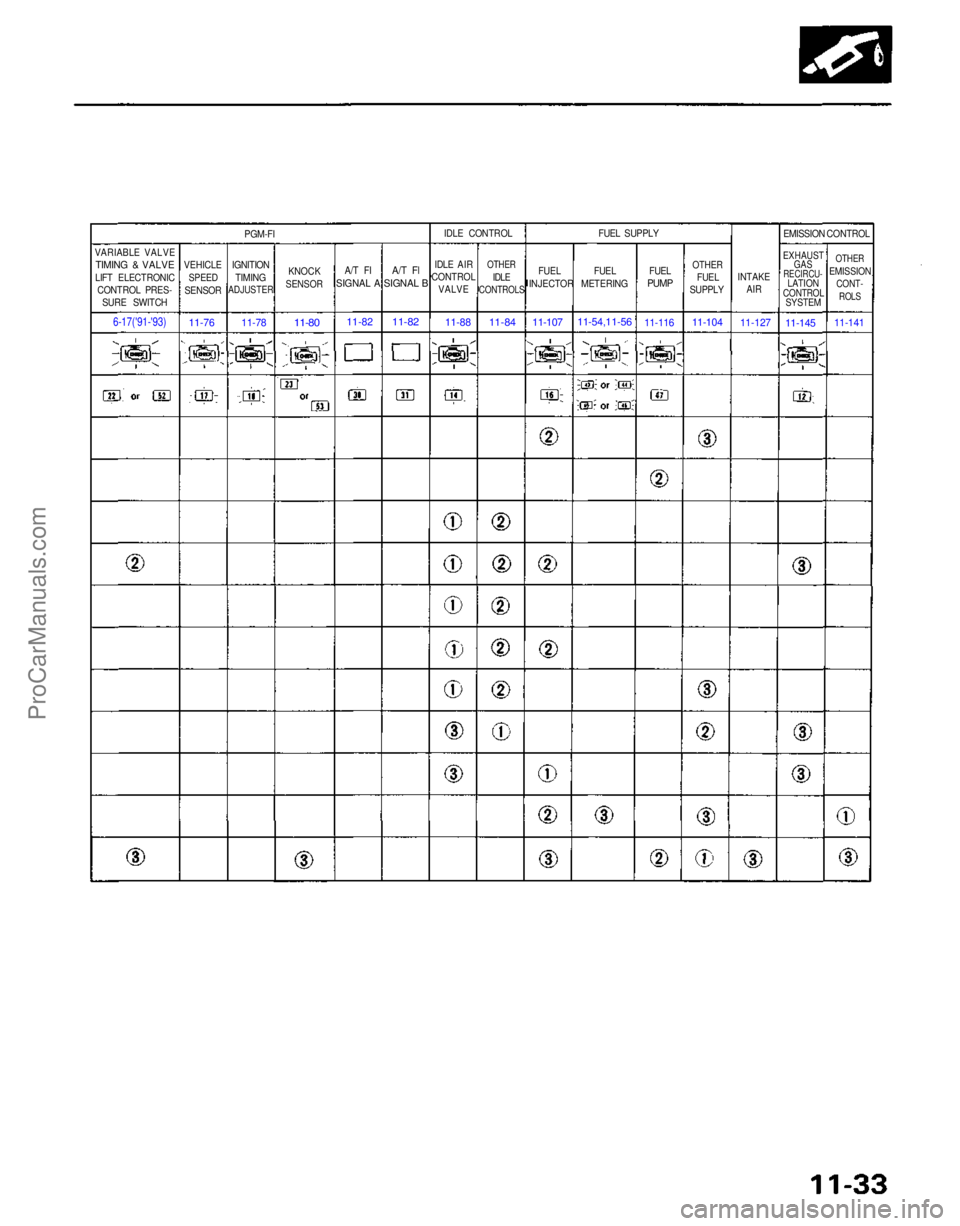
PGM-FI
VARIABLE VALVE
TIMING & VALVE
LIFT ELECTRONIC CONTROL PRES- SURE SWITCH VEHICLE
SPEED
SENSOR IGNITION
TIMING
ADJUSTER
KNOCK
SENSOR
A/T FI
SIGNAL A
A/T Fl
SIGNAL B
IDLE AIR
CONTROL VALVE
OTHER
IDLE
CONTROLS
FUEL
INJECTOR
FUEL
METERING
OTHER
FUEL
SUPPLY INTAKE
AIR
EXHAUST
GAS
RECIRCU-
LATION
CONTROL
SYSTEM
EMISSION CONTROL
OTHER
EMISSION
CONT-
ROLS
11-141
11-145
11-127
11-104
11-116
11-54,11-56
11-107
11-84
11-88
11-82
11-82
11-80
11-78
11-76
6-17('91-'93)
IDLE CONTROL
FUEL SUPPLY
FUEL
PUMPProCarManuals.com
Page 1084 of 1640
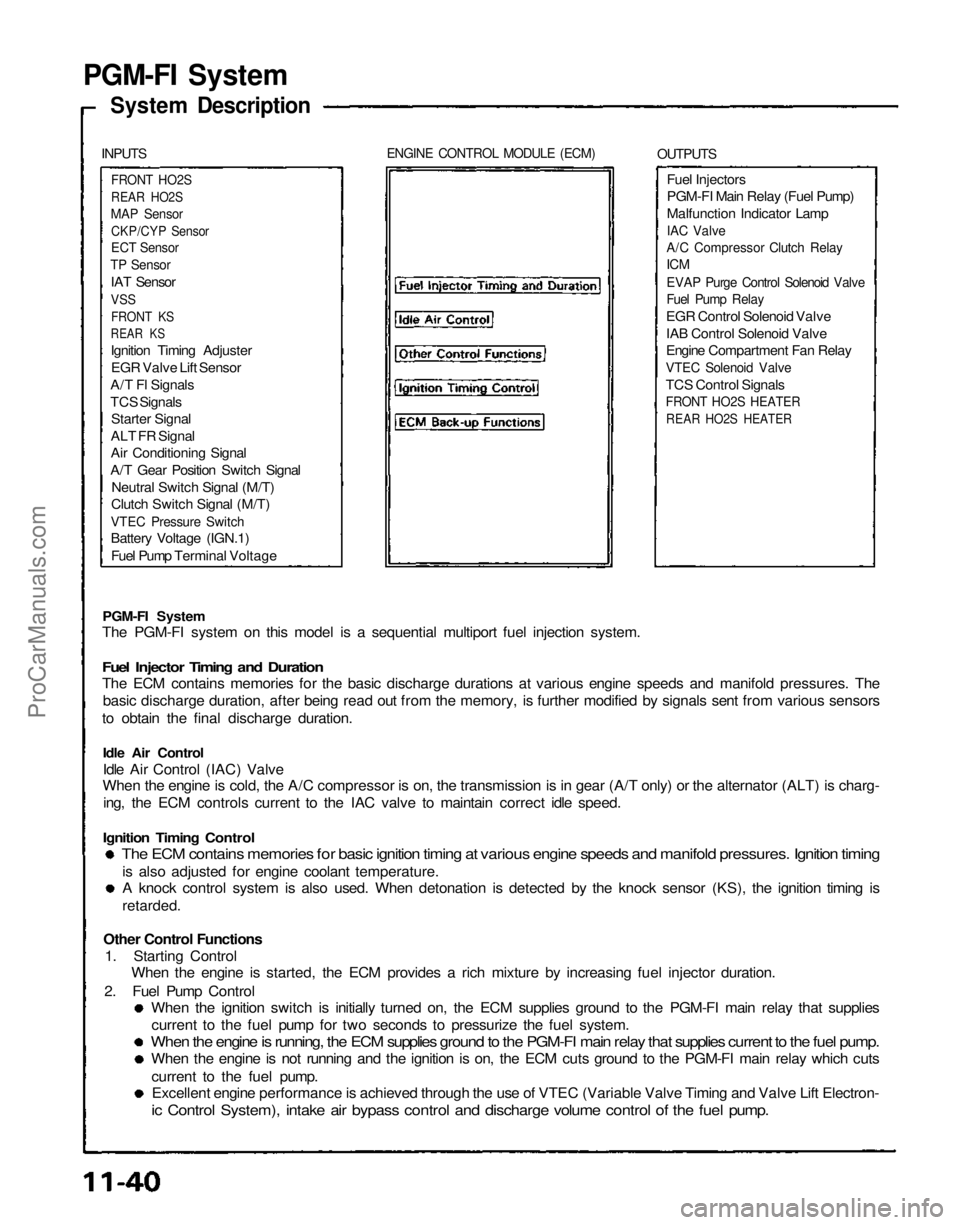
PGM-FI System
System Description
INPUTS
ENGINE CONTROL MODULE (ECM)
OUTPUTS
FRONT HO2S
REAR HO2S
MAP Sensor
CKP/CYP Sensor
ECT Sensor
TP Sensor
IAT Sensor
VSS
FRONT KS
REAR KS
Ignition Timing Adjuster
EGR Valve Lift Sensor
A/T Fl Signals
TCS Signals
Starter Signal
ALT FR Signal
Air Conditioning Signal
A/T Gear Position Switch Signal
Neutral Switch Signal (M/T)
Clutch Switch Signal (M/T)
VTEC Pressure Switch
Battery Voltage (IGN.1)
Fuel Pump Terminal Voltage
Fuel Injectors
PGM-FI Main Relay (Fuel Pump)
Malfunction Indicator Lamp
IAC Valve
A/C Compressor Clutch Relay
ICM
EVAP Purge Control Solenoid Valve
Fuel Pump Relay
EGR Control Solenoid Valve
IAB Control Solenoid Valve
Engine Compartment Fan Relay
VTEC Solenoid Valve
TCS Control Signals
FRONT HO2S HEATER
REAR HO2S HEATER
PGM-FI System
The PGM-FI system on this model is a sequential multiport fuel injection system.
Fuel Injector Timing and Duration
The ECM contains memories for the basic discharge durations at various engine speeds and manifold pressures. The
basic discharge duration, after being read out from the memory, is further modified by signals sent from various sensors
to obtain the final discharge duration.
Idle Air Control
Idle Air Control (IAC) Valve
When the engine is cold, the A/C compressor is on, the transmission is in gear (A/T only) or the alternator (ALT) is charg-
ing, the ECM controls current to the IAC valve to maintain correct idle speed.
Ignition Timing Control
The ECM contains memories for basic ignition timing at various engine speeds and manifold pressures. Ignition timing
is also adjusted for engine coolant temperature.
A knock control system is also used. When detonation is detected by the knock sensor (KS), the ignition timing is
retarded.
Other Control Functions
1. Starting Control
When the engine is started, the ECM provides a rich mixture by increasing fuel injector duration.
2. Fuel Pump Control
When the ignition switch is initially turned on, the ECM supplies ground to the PGM-FI main relay that supplies
current to the fuel pump for two seconds to pressurize the fuel system.
When the engine is running, the ECM supplies ground to the PGM-FI main relay that supplies current to the fuel pump.
When the engine is not running and the ignition is on, the ECM cuts ground to the PGM-FI main relay which cuts
current to the fuel pump.
Excellent engine performance is achieved through the use of VTEC (Variable Valve Timing and Valve Lift Electron-
ic Control System), intake air bypass control and discharge volume control of the fuel pump.ProCarManuals.com
Page 1085 of 1640
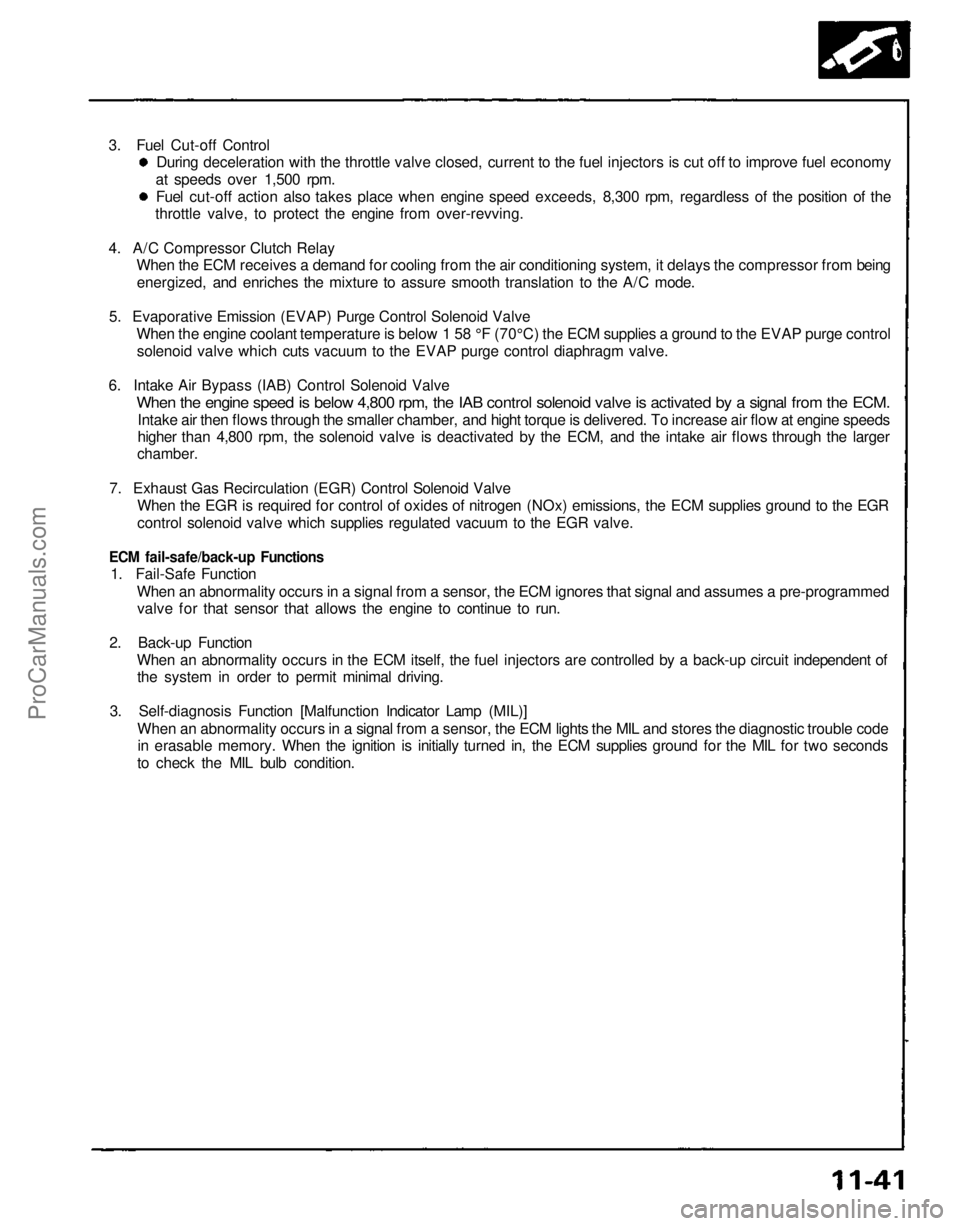
3. Fuel Cut-off Control
During deceleration with the throttle valve closed, current to the fuel injectors is cut off to improve fuel economy
at speeds over 1,500 rpm.
Fuel cut-off action also takes place when engine speed exceeds, 8,300 rpm, regardless of the position of the
throttle valve, to protect the engine from over-revving.
4. A/C Compressor Clutch Relay
When the ECM receives a demand for cooling from the air conditioning system, it delays the compressor from being
energized, and enriches the mixture to assure smooth translation to the A/C mode.
5. Evaporative Emission (EVAP) Purge Control Solenoid Valve
When the engine coolant temperature is below 1 58 °F (70°C) the ECM supplies a ground to the EVAP purge control
solenoid valve which cuts vacuum to the EVAP purge control diaphragm valve.
6. Intake Air Bypass (IAB) Control Solenoid Valve
When the engine speed is below 4,800 rpm, the IAB control solenoid valve is activated by a signal from the ECM.
Intake air then flows through the smaller chamber, and hight torque is delivered. To increase air flow at engine speeds
higher than 4,800 rpm, the solenoid valve is deactivated by the ECM, and the intake air flows through the larger
chamber.
7. Exhaust Gas Recirculation (EGR) Control Solenoid Valve
When the EGR is required for control of oxides of nitrogen (NOx) emissions, the ECM supplies ground to the EGR
control solenoid valve which supplies regulated vacuum to the EGR valve.
ECM fail-safe/back-up Functions
1. Fail-Safe Function
When an abnormality occurs in a signal from a sensor, the ECM ignores that signal and assumes a pre-programmed
valve for that sensor that allows the engine to continue to run.
2. Back-up Function
When an abnormality occurs in the ECM itself, the fuel injectors are controlled by a back-up circuit independent of
the system in order to permit minimal driving.
3. Self-diagnosis Function [Malfunction Indicator Lamp (MIL)]
When an abnormality occurs in a signal from a sensor, the ECM lights the MIL and stores the diagnostic trouble code
in erasable memory. When the ignition is initially turned in, the ECM supplies ground for the MIL for two seconds
to check the MIL bulb condition.ProCarManuals.com
Page 1089 of 1640
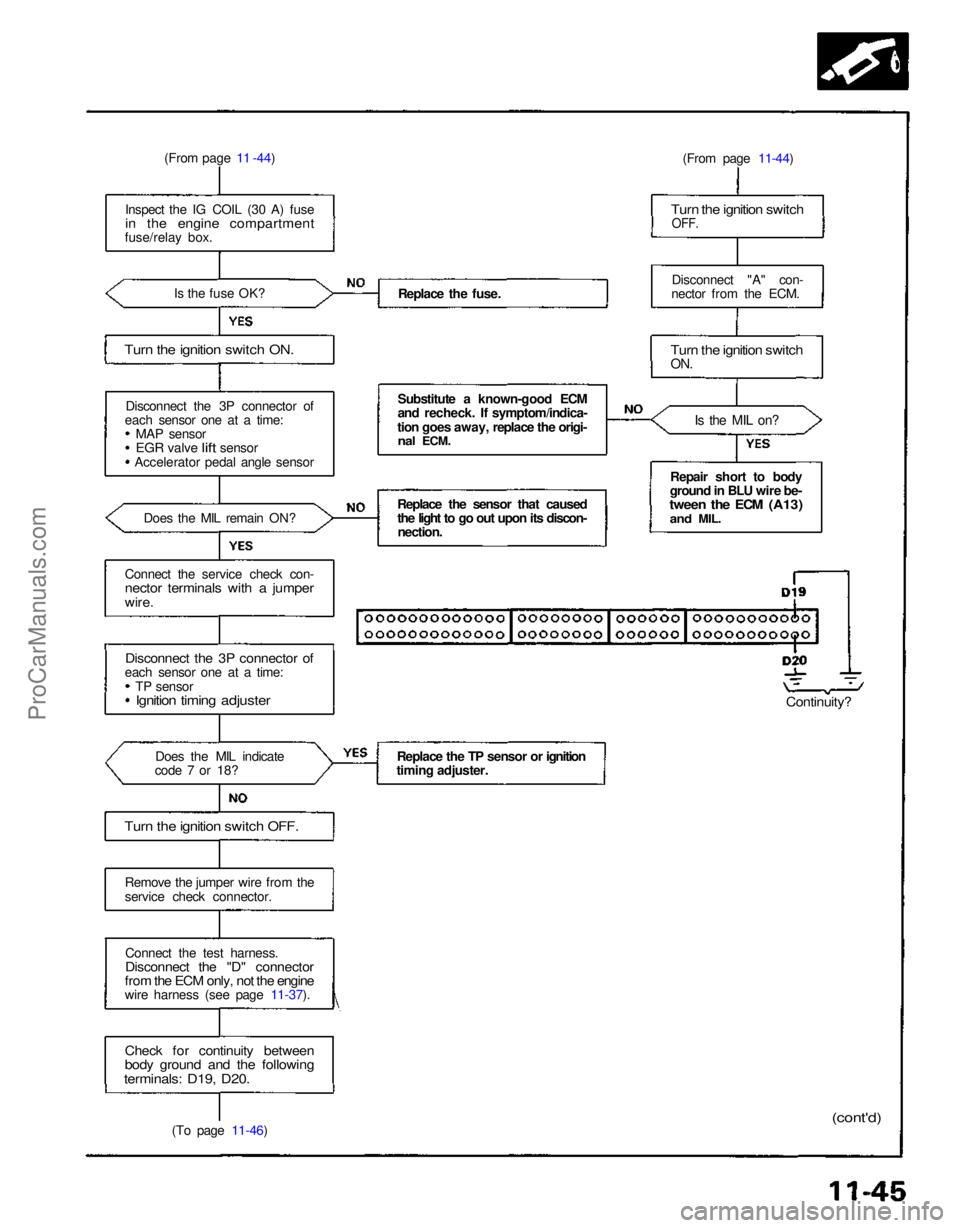
(From page 11 -44)
Inspect the IG COIL (30 A) fuse
in the engine compartment
fuse/relay box.
Is the fuse OK?
Turn the ignition switch ON.
Disconnect the 3P connector of
each sensor one at a time: MAP sensor
EGR
valve
lift
sensor
Accelerator pedal angle sensor
Does the MIL remain ON?
Connect the service check con-
nector terminals with a jumper
wire.
Disconnect the 3P connector of
each sensor one at a time:
TP sensor
Ignition timing adjuster
Does the MIL indicate
code 7 or 18?
Turn the ignition switch OFF.
Remove the jumper wire from the
service check connector.
Connect the test harness.
Disconnect the "D" connector
from the ECM only, not the engine
wire harness (see page 11-37).
Check for continuity between
body ground and the following
terminals: D19, D20.
(To page 11-46) Replace the fuse.
Substitute a known-good ECM
and recheck. If symptom/indica-
tion goes away, replace the origi-
nal
ECM.
Replace the sensor that caused
the light to go out upon its discon- nection.
Replace the TP sensor or ignition
timing adjuster. (From page 11-44)
Turn the ignition switch
OFF.
Disconnect "A" con-
nector from the ECM.
Turn the ignition switch
ON.
Is the MIL on?
Repair short to body
ground in BLU wire be-
tween the ECM (A13)
and
MIL.
Continuity?
(cont'd)ProCarManuals.com