sensor ACURA NSX 1991 Service Manual PDF
[x] Cancel search | Manufacturer: ACURA, Model Year: 1991, Model line: NSX, Model: ACURA NSX 1991Pages: 1640, PDF Size: 60.48 MB
Page 698 of 1640
Outside Ai r Temperatur e Senso r
Remova l
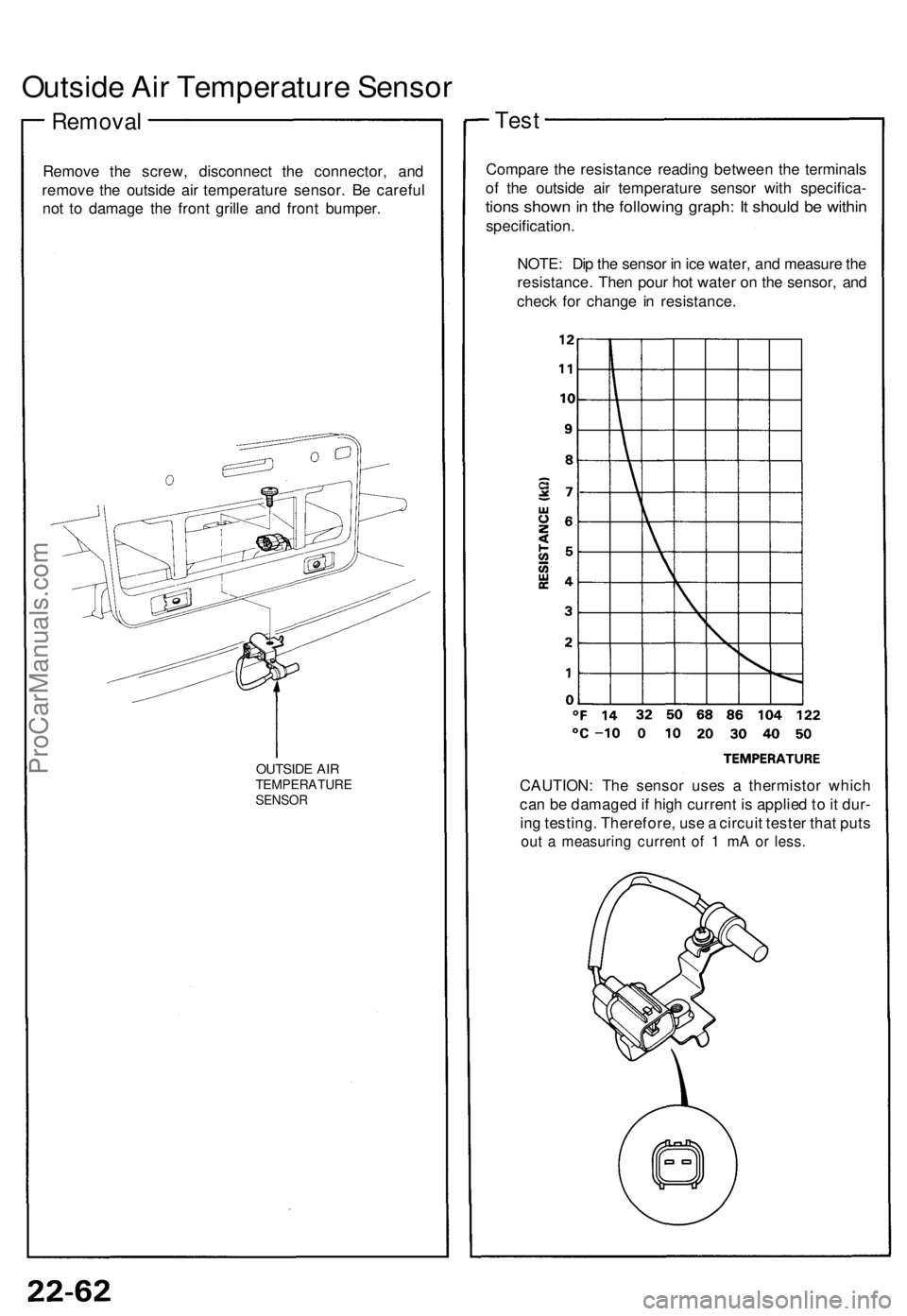
Remove th e screw , disconnec t th e connector , an d
remov e th e outsid e ai r temperatur e sensor . B e carefu l
no t t o damag e th e fron t grill e an d fron t bumper .
OUTSIDE AI RTEMPERATUR ESENSOR
Test
Compar e th e resistanc e readin g betwee n th e terminal s
o f th e outsid e ai r temperatur e senso r wit h specifica -
tions show n in th e followin g graph : I t shoul d b e withi n
specification .
NOTE : Di p th e senso r i n ic e water , an d measur e th e
resistance . The n pou r ho t wate r o n th e sensor , an d
chec k fo r chang e i n resistance .
CAUTION : Th e senso r use s a thermisto r whic h
ca n b e damage d if hig h curren t i s applie d to it dur -
in g testing . Therefore , us e a circui t teste r tha t put s
out a measurin g curren t o f 1 m A o r less .
ProCarManuals.com
Page 699 of 1640
Sunlight Sensor
Removal
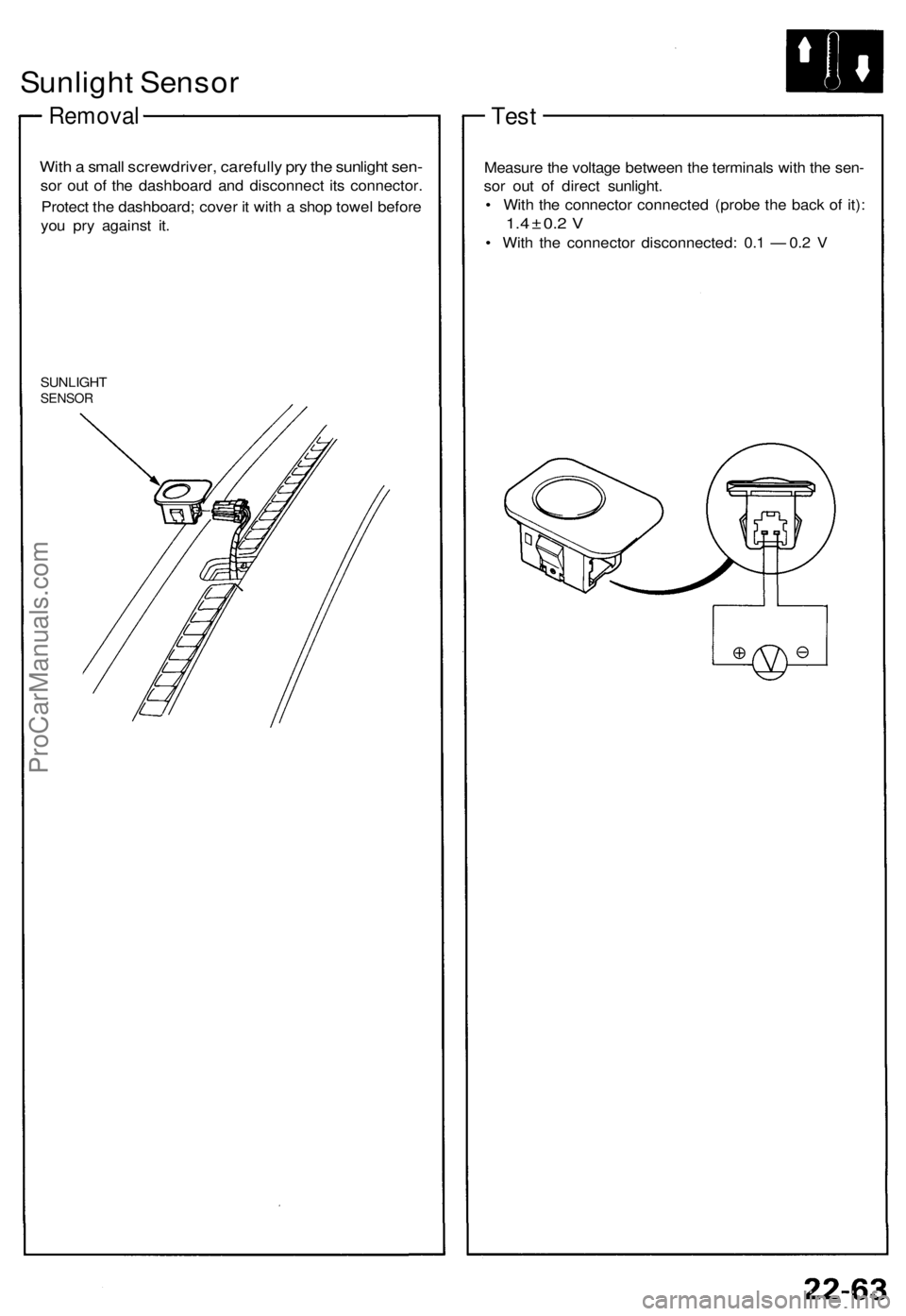
With a small screwdriver, carefully pry the sunlight sen-
sor out of the dashboard and disconnect its connector.
Protect the dashboard; cover it with a shop towel before
you pry against it.
SUNLIGHT
SENSOR
Test
Measure the voltage between the terminals with the sen-
sor out of direct sunlight.
• With the connector connected (probe the back of it):
1.4 ± 0.2 V
• With the connector disconnected: 0.1 — 0.2 VProCarManuals.com
Page 700 of 1640
Heater Core Temperature Sensor
Removal
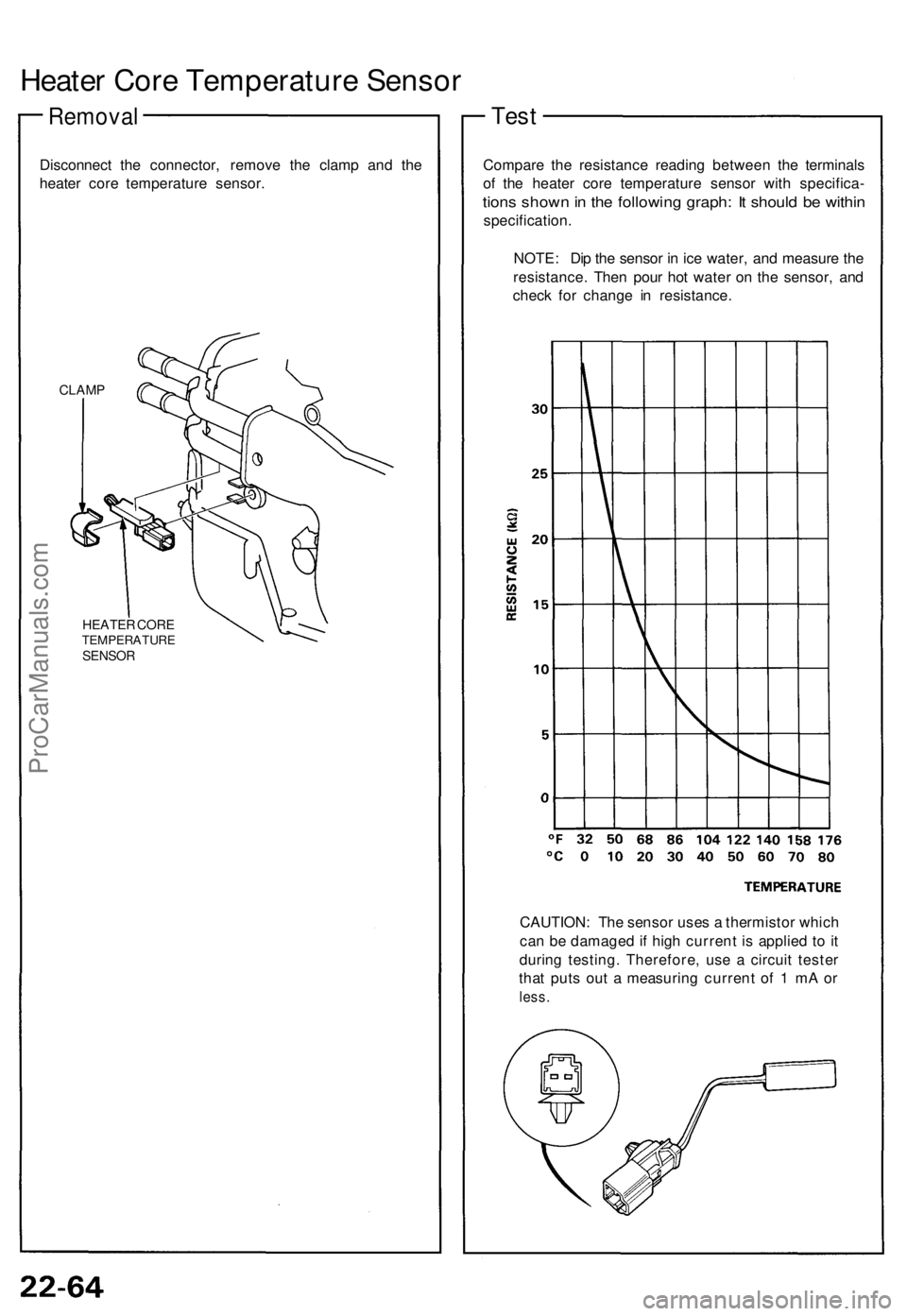
Disconnect the connector, remove the clamp and the
heater core temperature sensor.
CLAMP
HEATER CORE
TEMPERATURE
SENSOR
Compare the resistance reading between the terminals
of the heater core temperature sensor with specifica-
tions shown in the following graph: It should be within
specification.
NOTE: Dip the sensor in ice water, and measure the
resistance. Then pour hot water on the sensor, and
check for change in resistance.
CAUTION: The sensor uses a thermistor which
can be damaged if high current is applied to it
during testing. Therefore, use a circuit tester
that puts out a measuring current of 1 mA or
less.
TestProCarManuals.com
Page 701 of 1640
Evaporator Temperatur e
Sensor
Remova l
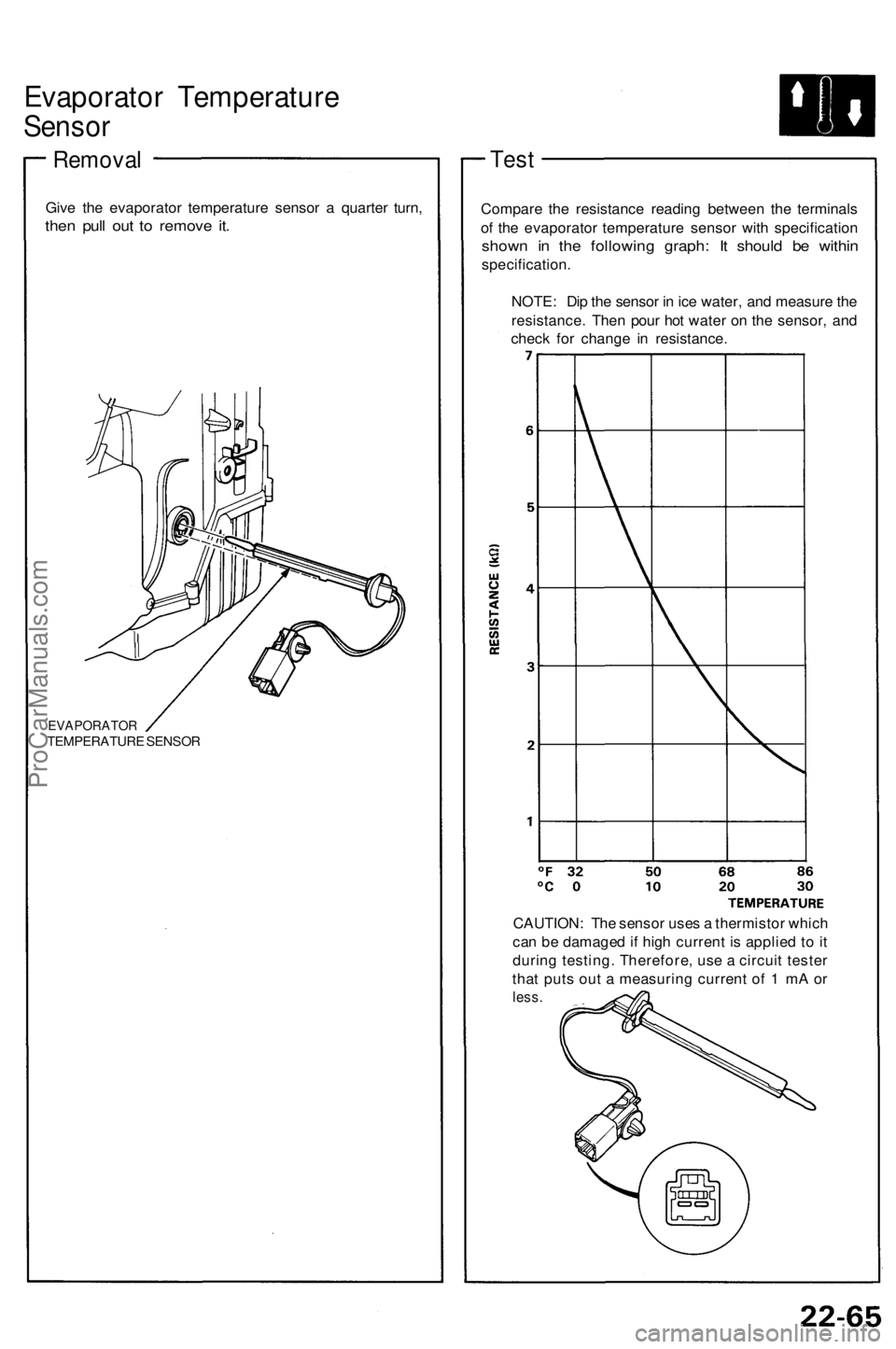
Give th e evaporato r temperatur e senso r a quarte r turn ,
then pul l ou t t o remov e it .
EVAPORATO RTEMPERATUR E SENSO R
Test
Compar e th e resistanc e readin g betwee n th e terminal s
o f th e evaporato r temperatur e senso r wit h specificatio n
shown i n th e followin g graph : I t shoul d b e withi n
specification .
NOTE : Di p th e senso r i n ic e water , an d measur e th e
resistance . The n pou r ho t wate r o n th e sensor , an d
chec k fo r chang e i n resistance .
CAUTION : Th e senso r use s a thermisto r whic h
ca n b e damage d if hig h curren t i s applie d t o it
durin g testing . Therefore , us e a circui t teste r
tha t put s ou t a measurin g curren t o f 1 m A o r
less .
ProCarManuals.com
Page 709 of 1640
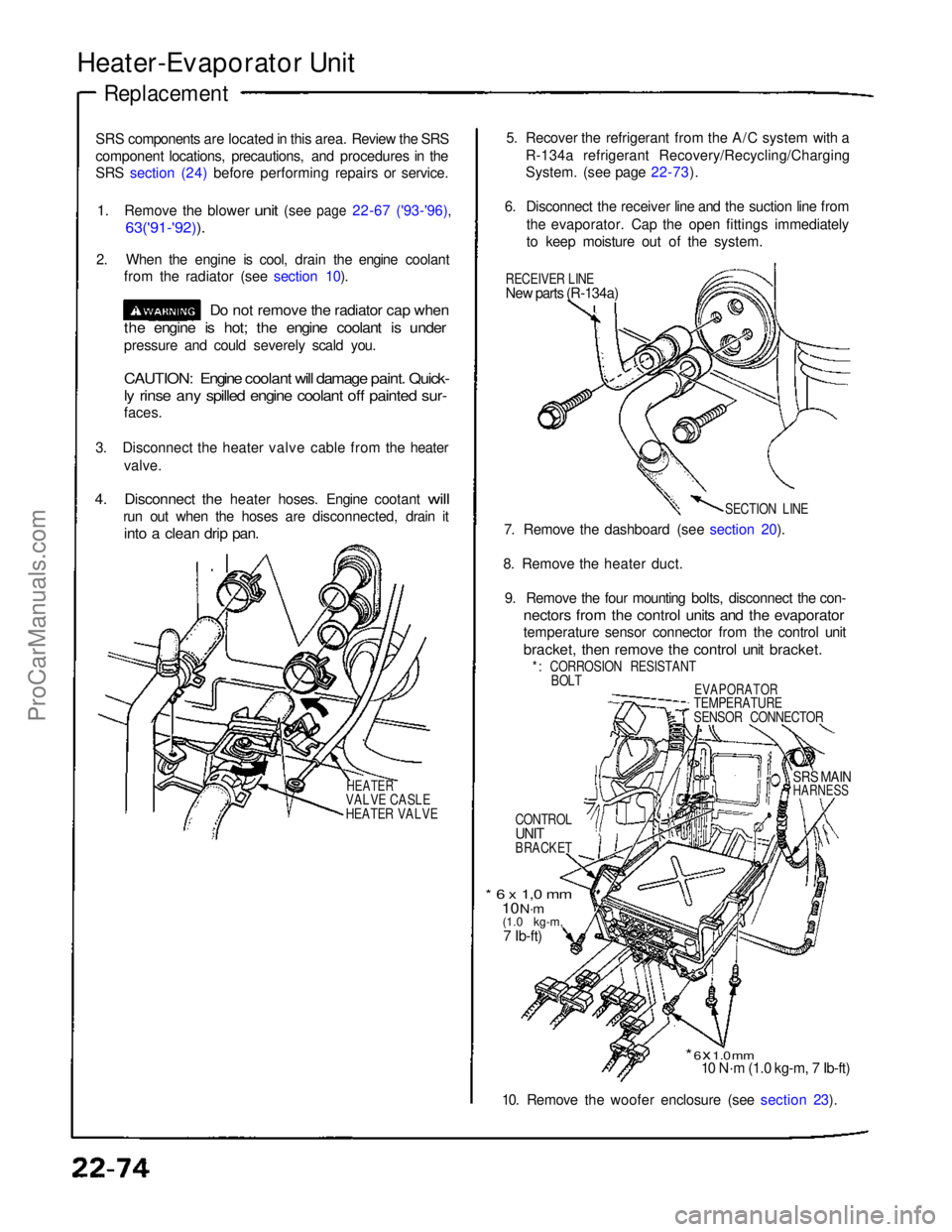
Heater-Evaporator Unit
Replacement
SRS components are located in this area. Review the SRS
component locations, precautions, and procedures in the
SRS section (24) before performing repairs or service.
1.
Remove
the
blower
unit
(see
page
22-67 ('93-'96),
63('91-'92)).
2. When the engine is cool, drain the engine coolant from the radiator (see section 10).
Do not remove the radiator cap when
the engine is hot; the engine coolant is under
pressure and could severely scald you.
CAUTION: Engine coolant will damage paint. Quick-
ly rinse any spilled engine coolant off painted sur-
faces.
3. Disconnect the heater valve cable from the heater valve.
4.
Disconnect
the
heater hoses. Engine cootant
will
run out when the hoses are disconnected, drain it
into a clean drip pan.
HEATER
VALVE CASLE
HEATER VALVE
5. Recover the refrigerant from the A/C system with a
R-134a refrigerant Recovery/Recycling/Charging
System. (see page 22-73).
6. Disconnect the receiver line and the suction line from the evaporator. Cap the open fittings immediately
to keep moisture out of the system.
RECEIVER LINE
New parts (R-134a)
SECTION LINE
7. Remove the dashboard (see section 20).
8. Remove the heater duct. 9. Remove the four mounting bolts, disconnect the con-
nectors from the control units and the evaporator
temperature sensor connector from the control unit
bracket, then remove the control unit bracket.
*: CORROSION RESISTANT BOLT
EVAPORATOR
TEMPERATURE
SENSOR CONNECTOR
CONTROL
UNIT
BRACKET
SRS MAIN
HARNESS
* 6 x 1,0 mm
10 N·m
(1.0 kg-m,
7 Ib-ft)
* 6 x 1.0 mm
10 N·m (1.0 kg-m, 7 Ib-ft)
10. Remove the woofer enclosure (see section 23).ProCarManuals.com
Page 710 of 1640
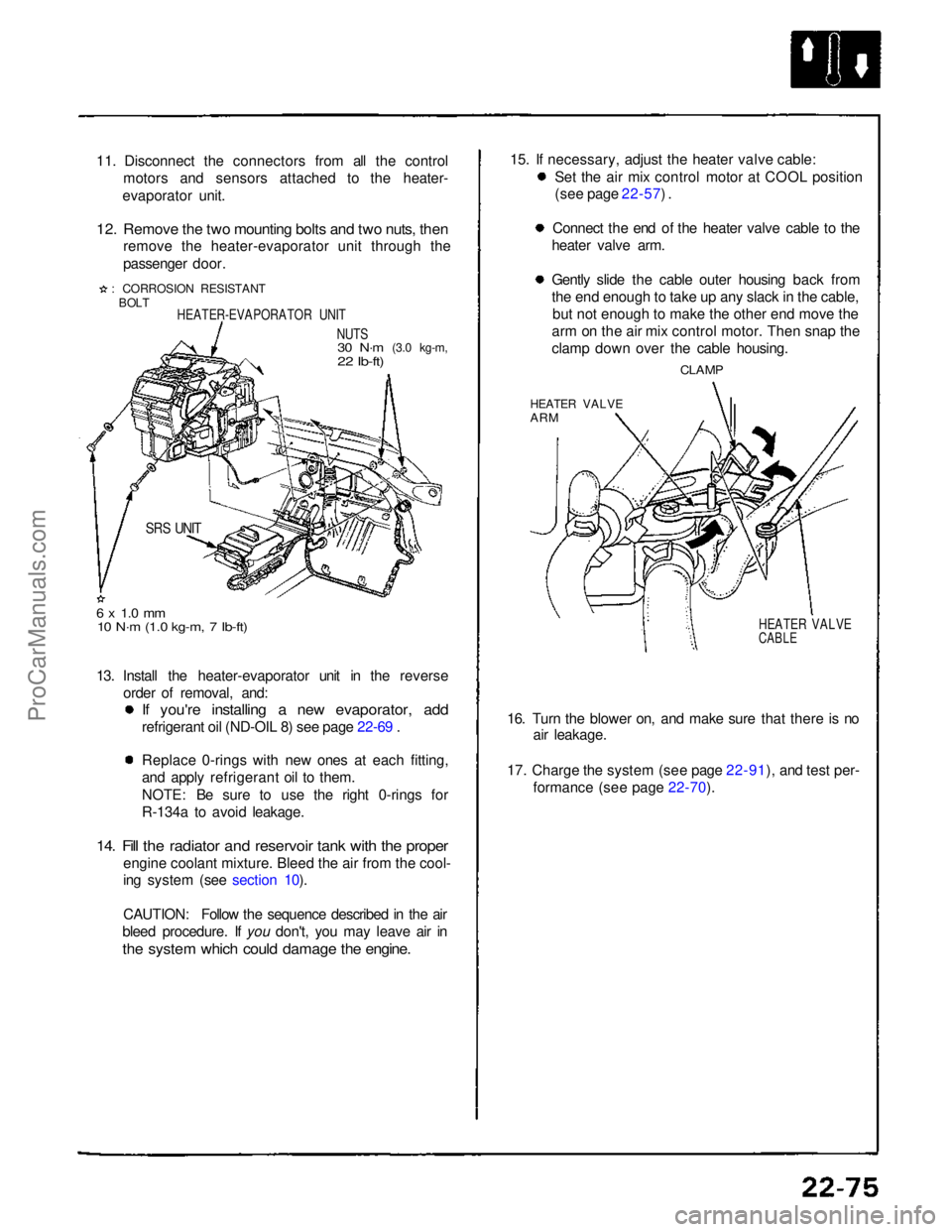
11. Disconnect the connectors from all the control
motors and sensors attached to the heater-
evaporator unit.
12. Remove the two mounting bolts and two nuts, then
remove the heater-evaporator unit through the
passenger door.
: CORROSION RESISTANT
BOLT
HEATER-EVAPORATOR UNIT
NUTS
30 N·m
(3.0 kg-m,
22 Ib-ft)
SRS UNIT
6 x 1.0 mm
10 N·m (1.0 kg-m, 7 Ib-ft)
13. Install the heater-evaporator unit in the reverse order of removal, and:
If you're installing a new evaporator, add
refrigerant oil (ND-OIL 8) see page 22-69 .
Replace 0-rings with new ones at each fitting,
and apply refrigerant oil to them.
NOTE: Be sure to use the right 0-rings for
R-134a to avoid leakage.
14. Fill the radiator and reservoir tank with the proper
engine coolant mixture. Bleed the air from the cool-
ing system (see section 10).
CAUTION: Follow the sequence described in the air
bleed procedure. If you don't, you may leave air in
the system which could damage the engine.
15. If necessary, adjust the heater valve cable:
Set the air mix control motor at COOL position
(see page 22-57) .
Connect the end of the heater valve cable to the
heater valve arm. Gently slide the cable outer housing back from
the end enough to take up any slack in the cable,
bu
t not enough to make the other end move the
arm on the air mix control motor. Then snap the
clamp down over the cable housing.
CLAMP
HEATER VALVE
ARM
HEATER VALVE
CABLE
16. Turn the blower on, and make sure that there is no air leakage.
17. Charge the system (see page 22-91), and test per- formance (see page 22-70).ProCarManuals.com
Page 758 of 1640
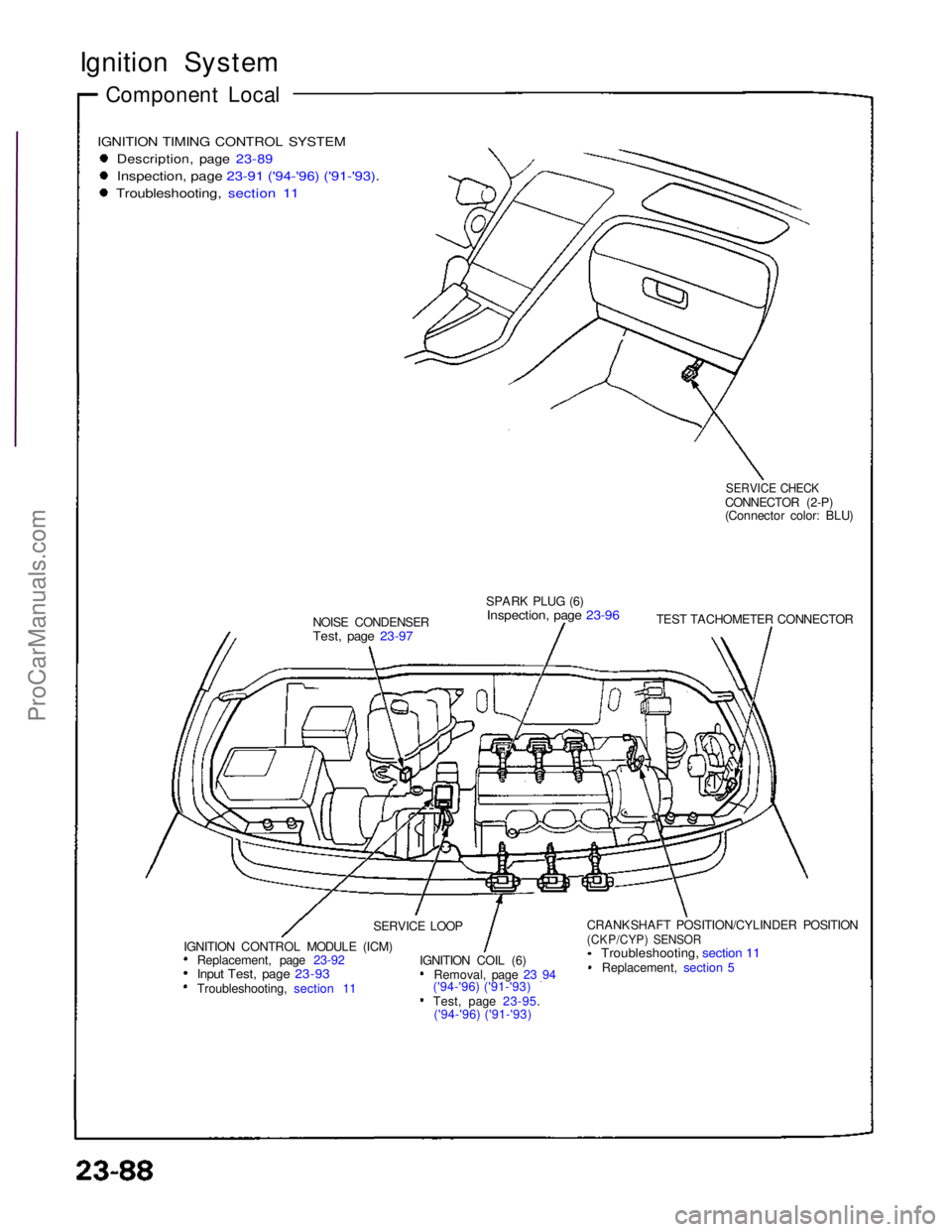
Ignition System
Component Local
IGNITION TIMING CONTROL SYSTEM
Description, page 23-89
Inspection, page 23-91 ('94-'96) ('91-'93).
Troubleshooting, section 11
NOISE CONDENSER
Test, page 23-97
SPARK PLUG (6)
Inspection, page 23-96
TEST TACHOMETER CONNECTOR
SERVICE CHECK
CONNECTOR (2-P)
(Connector color: BLU)
CRANKSHAFT POSITION/CYLINDER POSITION
(CKP/CYP) SENSOR
Troubleshooting, section 11
Replacement, section 5
IGNITION COIL (6)
Removal, page 23 94
('94-'96) ('91-'93) Test, page 23-95.
('94-'96) ('91-'93)
IGNITION CONTROL MODULE (ICM)
Replacement, page 23-92
Input Test, page 23-93
Troubleshooting, section 11
SERVICE LOOP
ProCarManuals.com
Page 759 of 1640
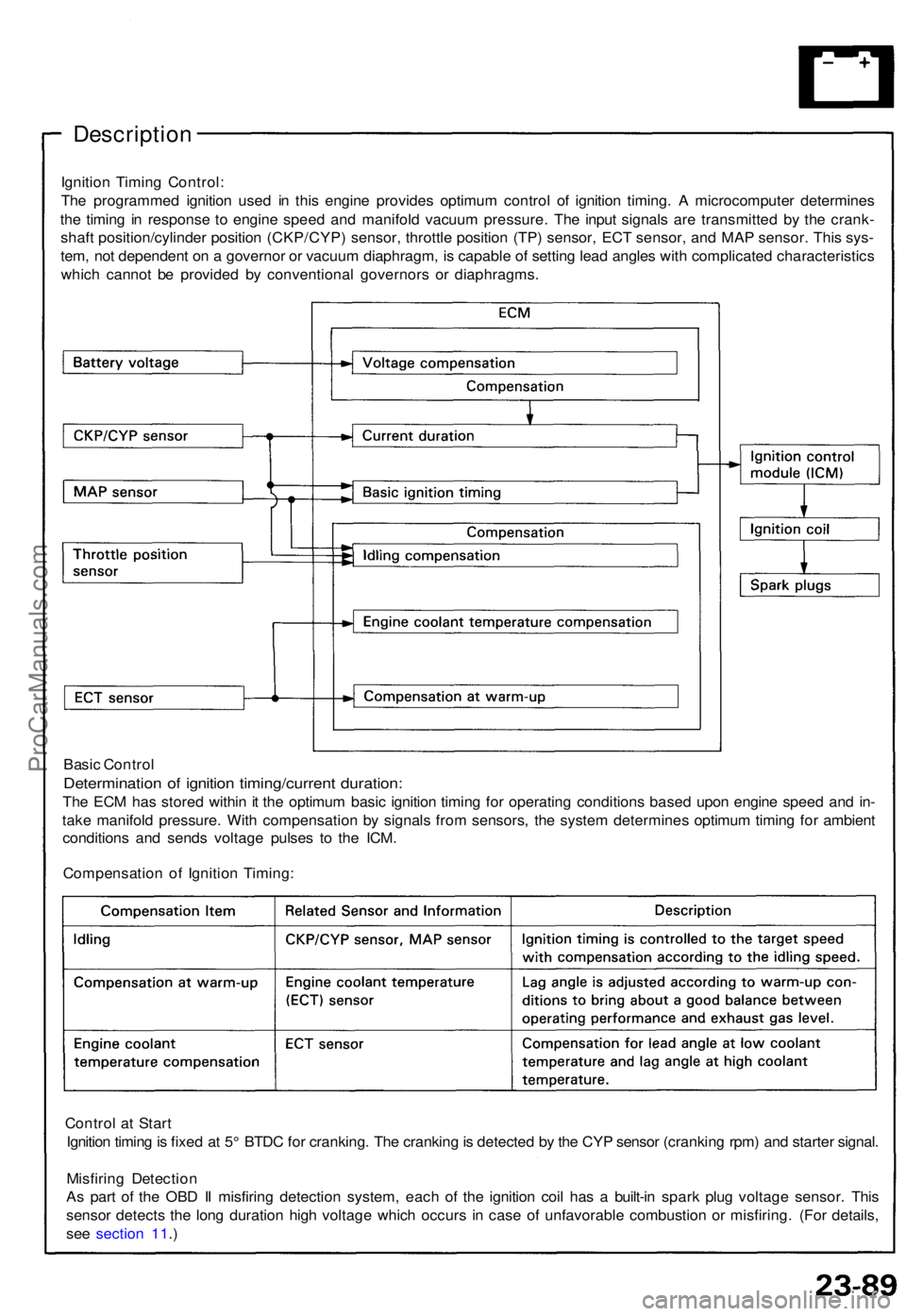
Control a t Star t
Ignitio n timin g is fixe d a t 5 ° BTD C fo r cranking . Th e crankin g is detecte d b y th e CY P senso r (crankin g rpm ) an d starte r signal .
Misfirin g Detectio n
A s par t o f th e OB D II misfirin g detectio n system , eac h o f th e ignitio n coi l ha s a built-i n spar k plu g voltag e sensor . Thi s
senso r detect s th e lon g duratio n hig h voltag e whic h occur s i n cas e o f unfavorabl e combustio n o r misfiring . (Fo r details ,
se e sectio n 11 .)
Compensatio
n o f Ignitio n Timing :
Basi
c Contro l
Determinatio n o f ignitio n timing/curren t duration :
The EC M ha s store d withi n it th e optimu m basi c ignitio n timin g fo r operatin g condition s base d upo n engin e spee d an d in -
tak e manifol d pressure . Wit h compensatio n b y signal s fro m sensors , th e syste m determine s optimu m timin g fo r ambien t
condition s an d send s voltag e pulse s t o th e ICM .
Ignitio
n Timin g Control :
Th e programme d ignitio n use d i n thi s engin e provide s optimu m contro l o f ignitio n timing . A microcompute r determine s
th e timin g i n respons e t o engin e spee d an d manifol d vacuu m pressure . Th e inpu t signal s ar e transmitte d b y th e crank -
shaf t position/cylinde r positio n (CKP/CYP ) sensor , throttl e positio n (TP ) sensor , EC T sensor , an d MA P sensor . Thi s sys -
tem , no t dependen t o n a governo r o r vacuu m diaphragm , i s capabl e o f settin g lea d angle s wit h complicate d characteristic s
whic h canno t b e provide d b y conventiona l governor s o r diaphragms .
Description
ProCarManuals.com
Page 763 of 1640
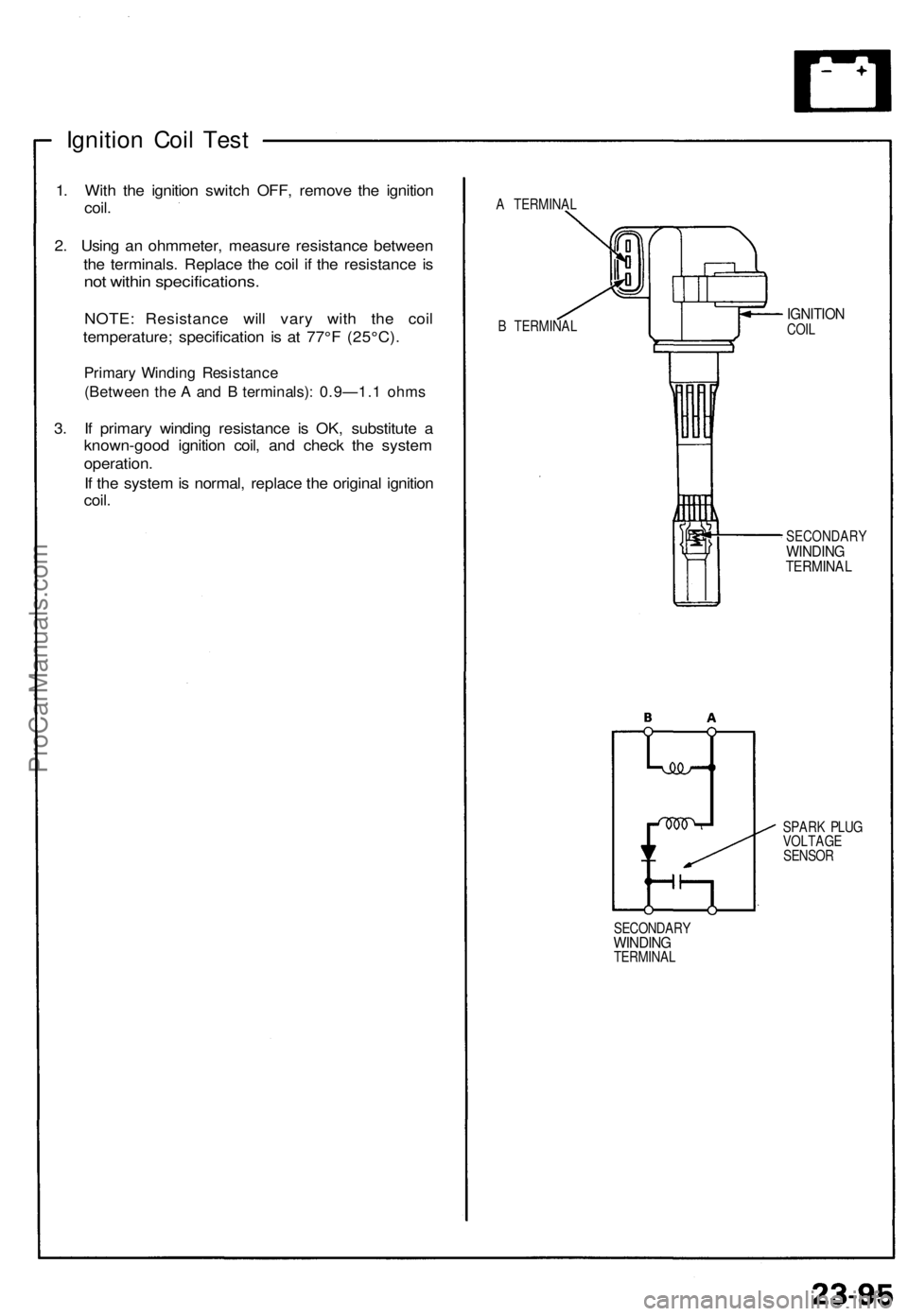
Ignition Coil Test
1. With the ignition switch OFF, remove the ignition
coil.
2. Using an ohmmeter, measure resistance between
the terminals. Replace the coil if the resistance is
not within specifications.
NOTE: Resistance will vary with the coil
temperature; specification is at 77°F (25°C).
Primary Winding Resistance
(Between the A and B terminals): 0.9—1.1 ohms
3. If primary winding resistance is OK, substitute a
known-good ignition coil, and check the system
operation.
If the system is normal, replace the original ignition
coil.
A TERMINAL
B TERMINAL
IGNITION
COIL
SECONDARY
WINDING
TERMINAL
SPARK PLUG
VOLTAGE
SENSOR
SECONDARY
WINDING
TERMINALProCarManuals.com
Page 779 of 1640
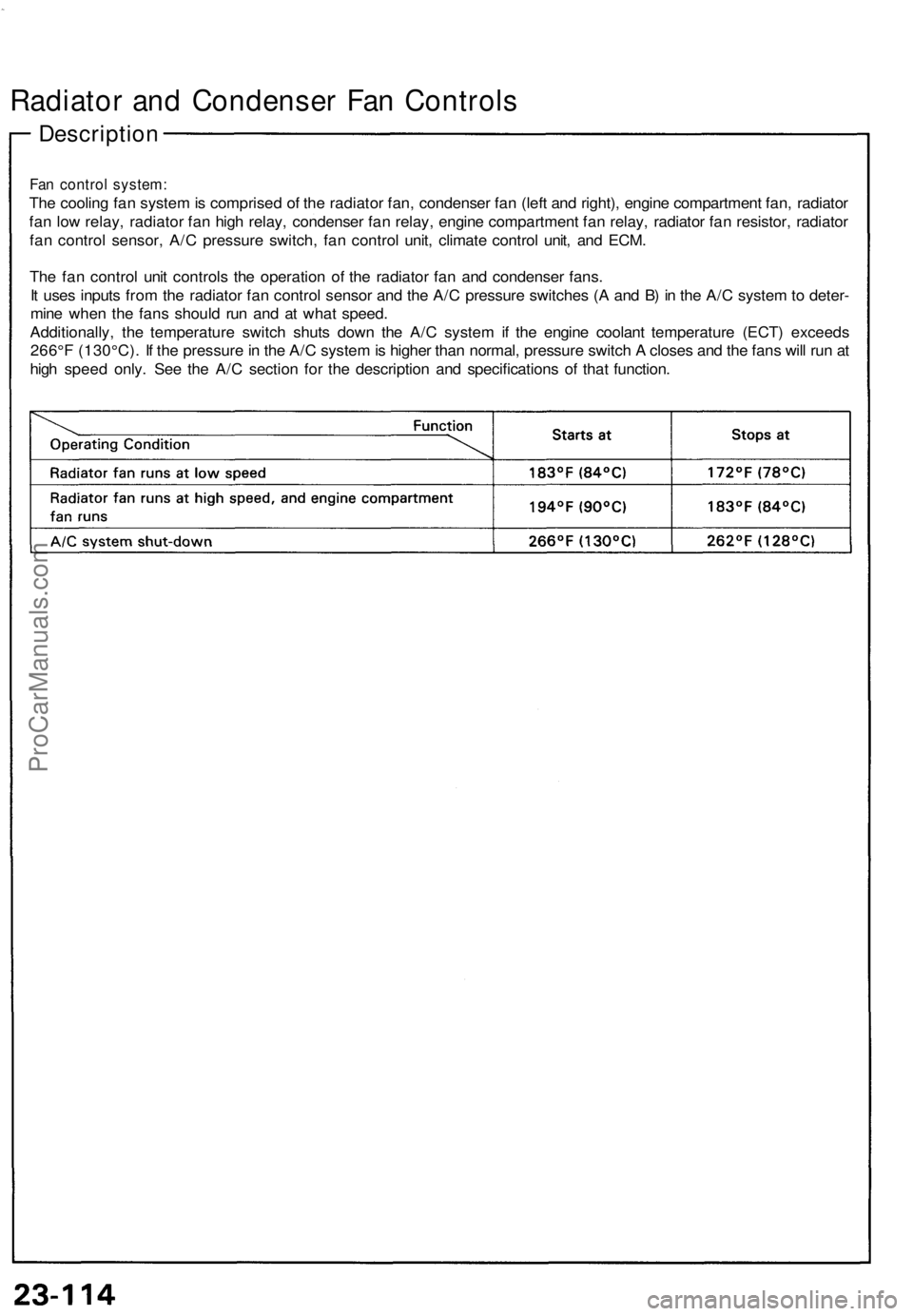
Radiator and Condenser Fan Controls
Description
Fan control system:
The cooling fan system is comprised of the radiator fan, condenser fan (left and right), engine compartment fan, radiator
fan low relay, radiator fan high relay, condenser fan relay, engine compartment fan relay, radiator fan resistor, radiator
fan control sensor, A/C pressure switch, fan control unit, climate control unit, and ECM.
The fan control unit controls the operation of the radiator fan and condenser fans.
It uses inputs from the radiator fan control sensor and the A/C pressure switches (A and B) in the A/C system to deter-
mine when the fans should run and at what speed.
Additionally, the temperature switch shuts down the A/C system if the engine coolant temperature (ECT) exceeds
266°F (130°C). If the pressure in the A/C system is higher than normal, pressure switch A closes and the fans will run at
high speed only. See the A/C section for the description and specifications of that function.ProCarManuals.com