Test ACURA TL 1995 Service Repair Manual
[x] Cancel search | Manufacturer: ACURA, Model Year: 1995, Model line: TL, Model: ACURA TL 1995Pages: 1771, PDF Size: 62.49 MB
Page 867 of 1771
Troubleshooting
Troubleshooting Procedures (cont'd)
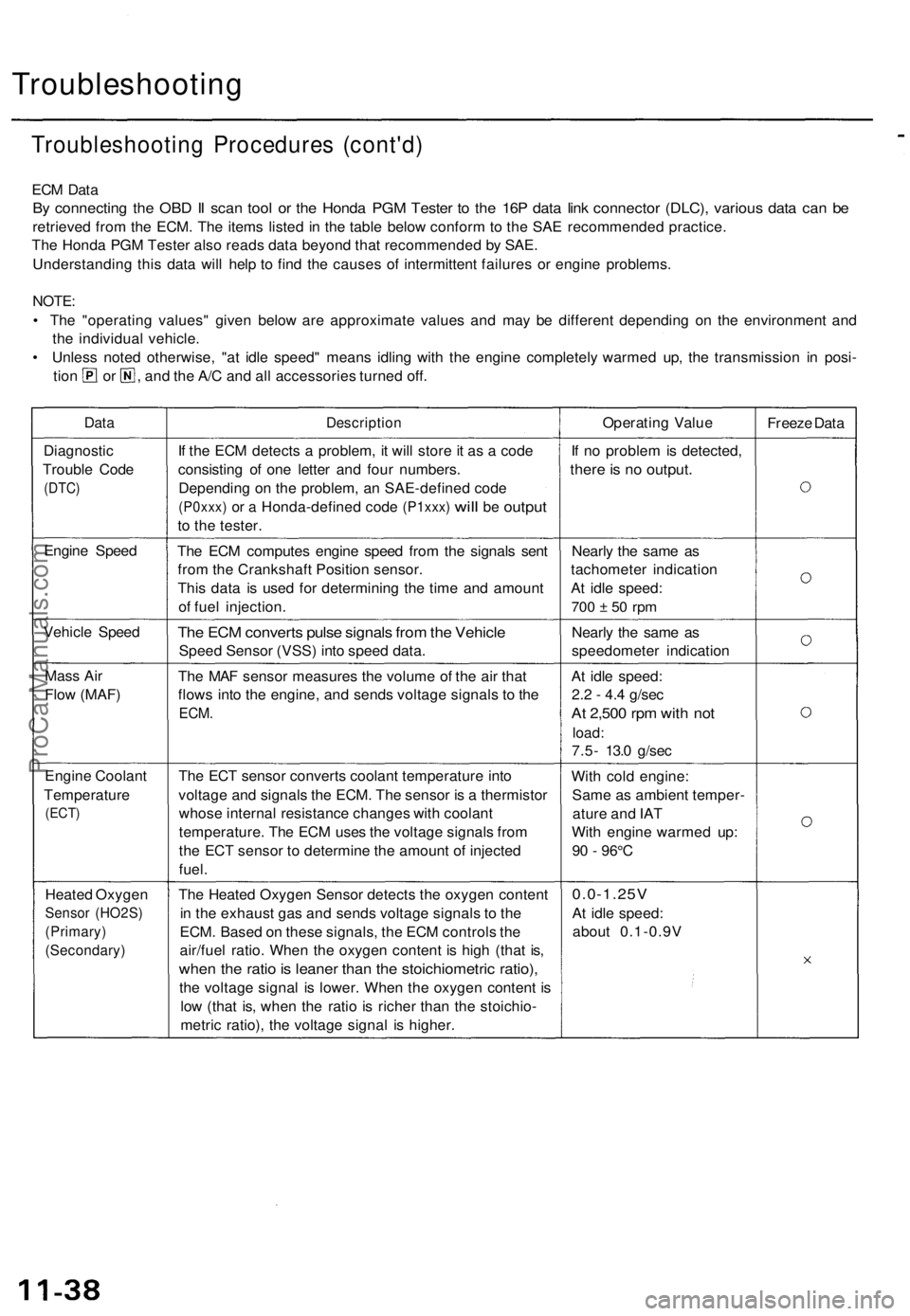
ECM Data
By connecting the OBD II scan tool or the Honda PGM Tester to the 16P data link connector (DLC), various data can be
retrieved from the ECM. The items listed in the table below conform to the SAE recommended practice.
The Honda PGM Tester also reads data beyond that recommended by SAE.
Understanding this data will help to find the causes of intermittent failures or engine problems.
NOTE:
• The "operating values" given below are approximate values and may be different depending on the environment and
the individual vehicle.
• Unless noted otherwise, "at idle speed" means idling with the engine completely warmed up, the transmission in posi-
tion or , and the A/C and all accessories turned off.
Data
Description
Operating Value
Freeze Data
Diagnostic
Trouble Code
(DTC)
If the ECM detects a problem, it will store it as a code
consisting of one letter and four numbers.
Depending on the problem, an SAE-defined code
(P0xxx)
or a
Honda-defined code
(P1xxx)
will
be
output
to the tester.
If no problem is detected,
there is no output.
Engine Speed
The ECM computes engine speed from the signals sent
from the Crankshaft Position sensor.
This data is used for determining the time and amount
of fuel injection.
Nearly the same as
tachometer indication
At idle speed:
700 ± 50 rpm
Vehicle Speed
The ECM converts pulse signals from the Vehicle
Speed Sensor (VSS) into speed data.
Nearly the same as
speedometer indication
Mass Air
Flow (MAF)
The MAF sensor measures the volume of the air that
flows into the engine, and sends voltage signals to the
ECM.
At idle speed:
2.2 - 4.4 g/sec
At 2,500 rpm with not
load:
7.5- 13.0 g/sec
Engine Coolant
Temperature
(ECT)
The ECT sensor converts coolant temperature into
voltage and signals the ECM. The sensor is a thermistor
whose internal resistance changes with coolant
temperature. The ECM uses the voltage signals from
the ECT sensor to determine the amount of injected
fuel.
With cold engine:
Same as ambient temper-
ature and IAT
With engine warmed up:
90 - 96°C
Heated Oxygen
Sensor (HO2S)
(Primary)
(Secondary)
The Heated Oxygen Sensor detects the oxygen content
in the exhaust gas and sends voltage signals to the
ECM. Based on these signals, the ECM controls the
air/fuel ratio. When the oxygen content is high (that is,
when the ratio is leaner than the stoichiometric ratio),
the voltage signal is lower. When the oxygen content is
low (that is, when the ratio is richer than the stoichio-
metric ratio), the voltage signal is higher.
0.0-1.25V
At idle speed:
about 0.1-0.9VProCarManuals.com
Page 876 of 1771
How to Read Flowcharts
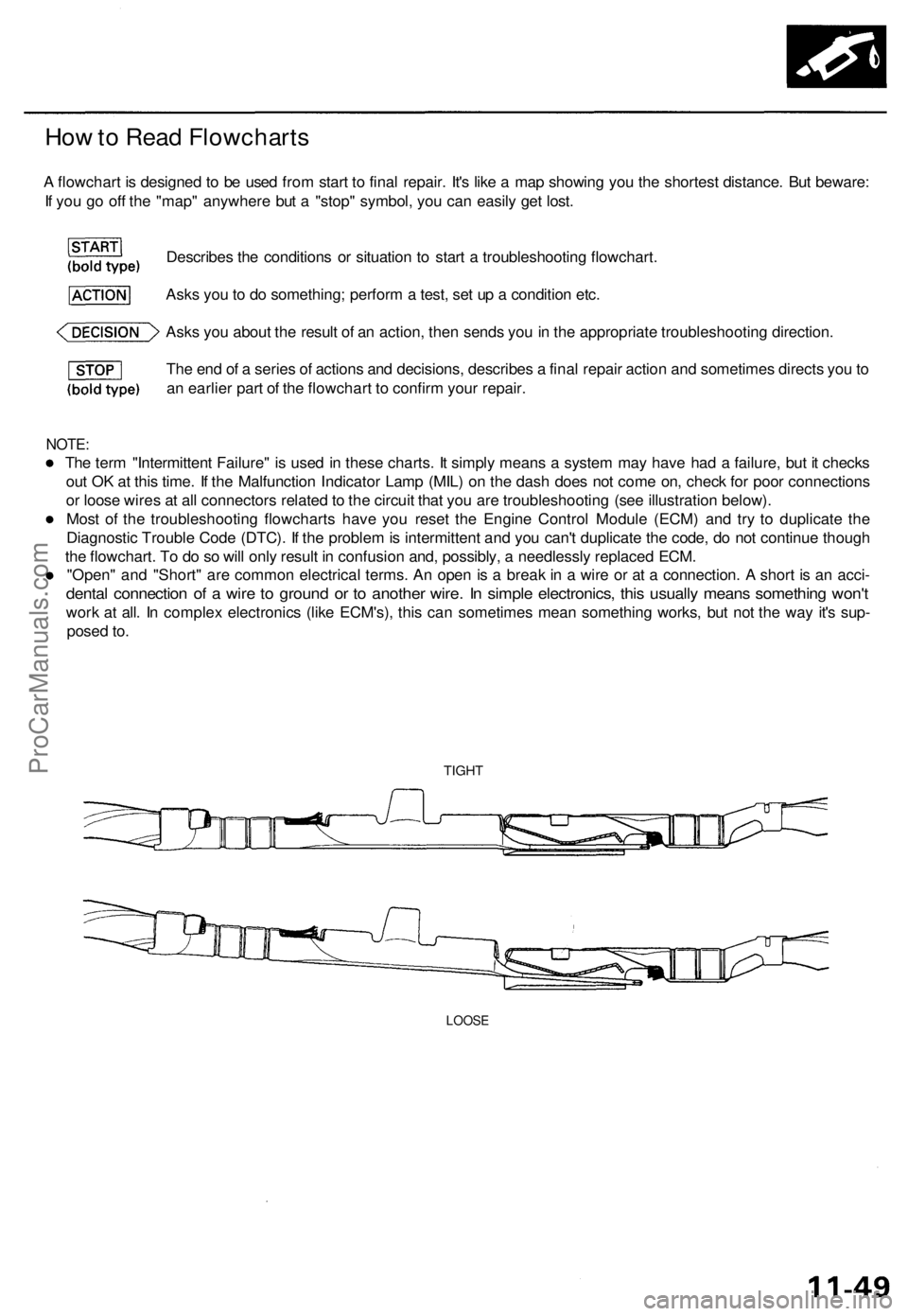
A flowchart is designed to be used from start to final repair. It's like a map showing you the shortest distance. But beware:
If you go off the "map" anywhere but a "stop" symbol, you can easily get lost.
Describes the conditions or situation to start a troubleshooting flowchart.
Asks you to do something; perform a test, set up a condition etc.
Asks you about the result of an action, then sends you in the appropriate troubleshooting direction.
The end of a series of actions and decisions, describes a final repair action and sometimes directs you to
an earlier part of the flowchart to confirm your repair.
NOTE:
The term "Intermittent Failure" is used in these charts. It simply means a system may have had a failure, but it checks
out OK at this time. If the Malfunction Indicator Lamp (MIL) on the dash does not come on, check for poor connections
or loose wires at all connectors related to the circuit that you are troubleshooting (see illustration below).
Most of the troubleshooting flowcharts have you reset the Engine Control Module (ECM) and try to duplicate the
Diagnostic Trouble Code (DTC). If the problem is intermittent and you can't duplicate the code, do not continue though
the flowchart. To do so will only result in confusion and, possibly, a needlessly replaced ECM.
"Open" and "Short" are common electrical terms. An open is a break in a wire or at a connection. A short is an acci-
dental connection of a wire to ground or to another wire. In simple electronics, this usually means something won't
work at all. In complex electronics (like ECM's), this can sometimes mean something works, but not the way it's sup-
posed to.
TIGHT
LOOSEProCarManuals.com
Page 880 of 1771
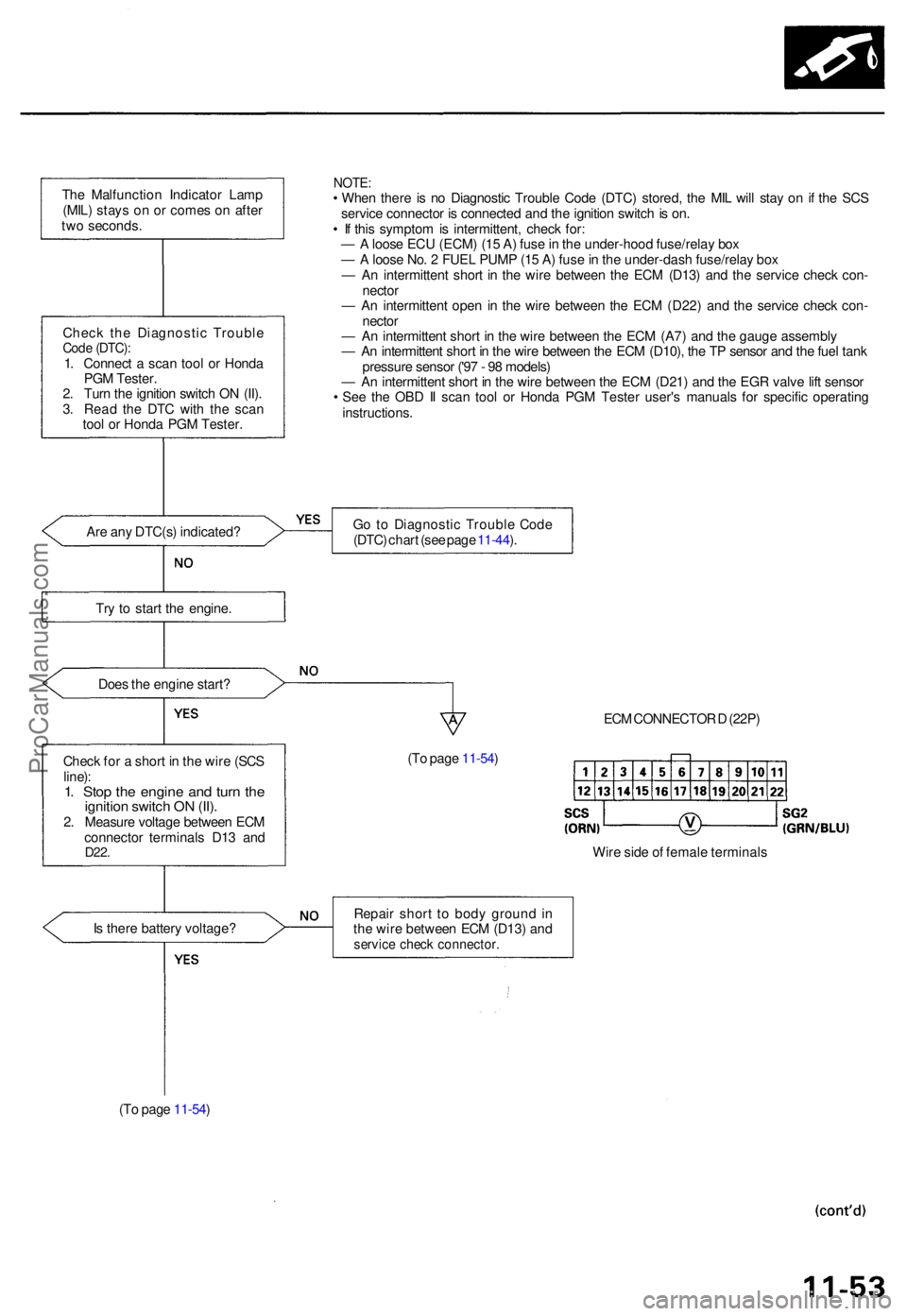
The Malfunctio n Indicato r Lam p
(MIL ) stay s o n o r come s o n afte r
tw o seconds .
Chec k th e Diagnosti c Troubl e
Code (DTC) :1. Connec t a sca n too l o r Hond a
PG M Tester .
2 . Tur n th e ignitio n switc h O N (II) .
3 . Rea d th e DT C wit h th e sca n
too l o r Hond a PG M Tester .
NOTE:• Whe n ther e i s n o Diagnosti c Troubl e Cod e (DTC ) stored , th e MI L wil l sta y o n i f th e SC S
servic e connecto r i s connecte d an d th e ignitio n switc h is on .
• I f thi s sympto m is intermittent , chec k for :
— A loos e EC U (ECM ) (1 5 A ) fus e in th e under-hoo d fuse/rela y bo x
— A loos e No . 2 FUE L PUM P (1 5 A ) fus e in th e under-das h fuse/rela y bo x
— A n intermitten t shor t i n th e wir e betwee n th e EC M (D13 ) an d th e servic e chec k con -
necto r
— A n intermitten t ope n i n th e wir e betwee n th e EC M (D22 ) an d th e servic e chec k con -
necto r
— A n intermitten t shor t i n th e wire betwee n th e EC M (A7 ) an d th e gaug e assembl y
— A n intermitten t shor t i n th e wir e betwee n th e EC M (D10) , th e T P senso r an d th e fue l tan k
pressur e senso r ('9 7 - 9 8 models )
— A n intermitten t shor t i n th e wir e betwee n th e EC M (D21 ) an d th e EG R valv e lif t senso r
• Se e th e OB D II sca n too l o r Hond a PG M Teste r user' s manual s fo r specifi c operatin g
instructions .
Ar e an y DTC(s ) indicated ? G
o t o Diagnosti c Troubl e Cod e
(DTC ) char t (se e pag e 11-44 ).
Tr y t o star t th e engine .
Doe s th e engin e start ?
Chec k fo r a shor t i n th e wir e (SC S
line) :
1. Sto p th e engin e an d tur n th eignitio n switc h O N (II) .2. Measur e voltag e betwee n EC M
connecto r terminal s D1 3 an d
D22 .
(To pag e 11-54 ) EC
M CONNECTO R D (22P )
Wir e sid e o f femal e terminal s
I s ther e batter y voltage ? Repai
r shor t t o bod y groun d in
th e wir e betwee n EC M (D13 ) an d
servic e chec k connector .
(To pag e 11-54 )
ProCarManuals.com
Page 894 of 1771
Idle Contro l Syste m
Fast Idl e Therm o Valv e
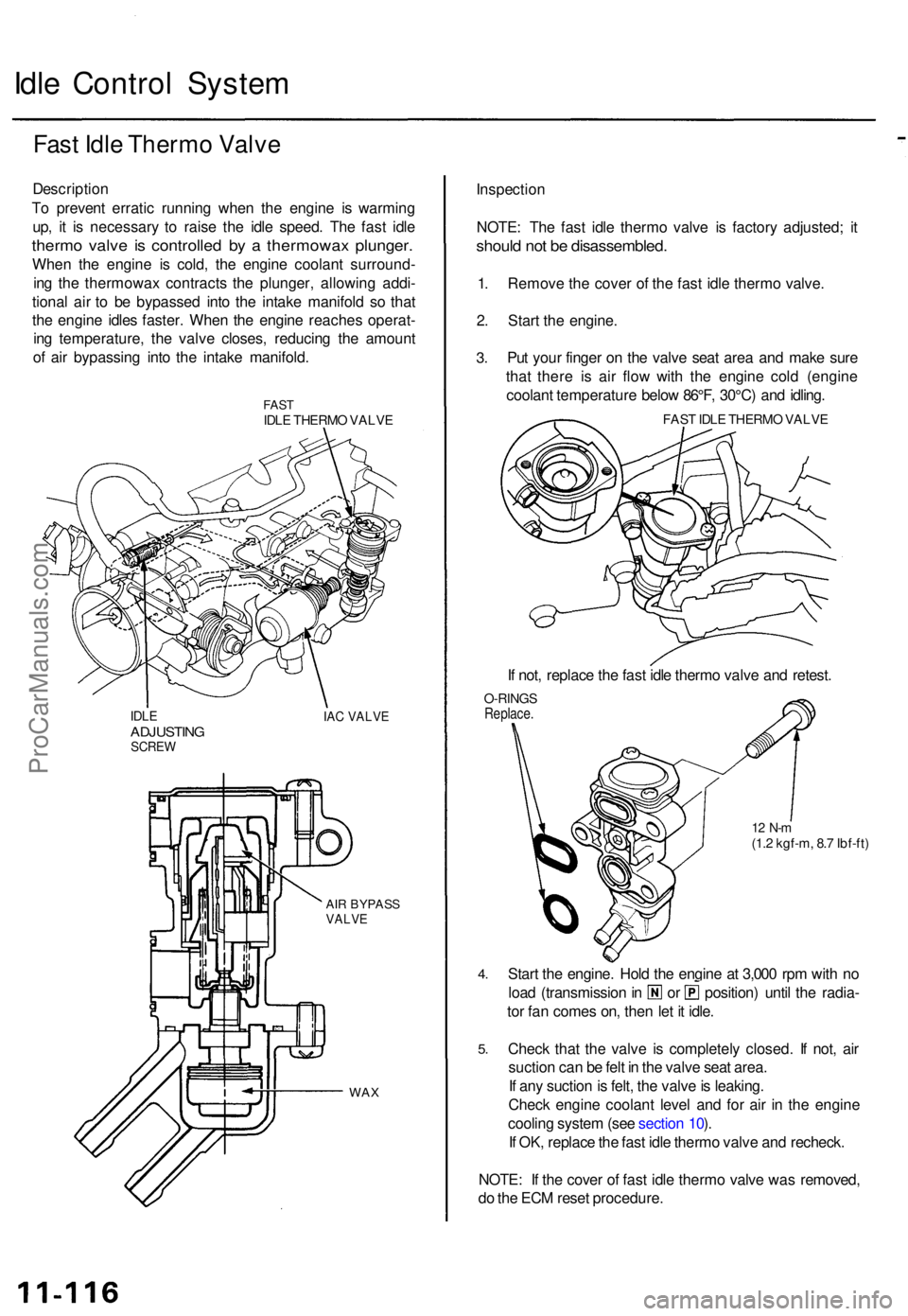
Descriptio n
T o preven t errati c runnin g whe n th e engin e i s warmin g
up , i t i s necessar y t o rais e th e idl e speed . Th e fas t idl e
therm o valv e i s controlle d b y a thermowa x plunger .
When th e engin e i s cold , th e engin e coolan t surround -
in g th e thermowa x contract s th e plunger , allowin g addi -
tiona l ai r t o b e bypasse d int o th e intak e manifol d s o tha t
th e engin e idle s faster . Whe n th e engin e reache s operat -
in g temperature , th e valv e closes , reducin g th e amoun t
o f ai r bypassin g int o th e intak e manifold .
FASTIDLE THERM O VALV E
IDLEADJUSTIN GSCREW
IAC VALV E
AIR BYPAS SVALVE
WAX
Inspectio n
NOTE : Th e fas t idl e therm o valv e i s factor y adjusted ; i t
shoul d no t b e disassembled .
1. Remov e th e cove r o f th e fas t idl e therm o valve .
2 . Star t th e engine .
3.Pu t you r finge r o n th e valv e sea t are a an d mak e sur e
tha t ther e i s ai r flo w wit h th e engin e col d (engin e
coolan t temperatur e belo w 86°F , 30°C ) an d idling .
FAST IDL E THERM O VALV E
If not , replac e th e fas t idl e therm o valv e an d retest .
O-RING SReplace .
12 N- m(1.2 kgf-m , 8. 7 Ibf-ft )
4.
5 .
Star t th e engine . Hol d th e engin e a t 3,00 0 rp m wit h n o
loa d (transmissio n in o r position ) unti l th e radia -
to r fa n come s on , the n le t i t idle .
Chec k tha t th e valv e i s completel y closed . I f not , ai r
suctio n ca n b e fel t i n th e valv e sea t area .
I f an y suctio n is felt , th e valv e is leaking .
Chec k engin e coolan t leve l an d fo r ai r i n th e engin e
coolin g syste m (se e sectio n 10 ).
I f OK , replac e th e fas t idl e therm o valv e an d recheck .
NOTE : I f th e cove r o f fas t idl e therm o valv e wa s removed ,
d o th e EC M rese t procedure .
ProCarManuals.com
Page 908 of 1771
Fuel Suppl y Syste m
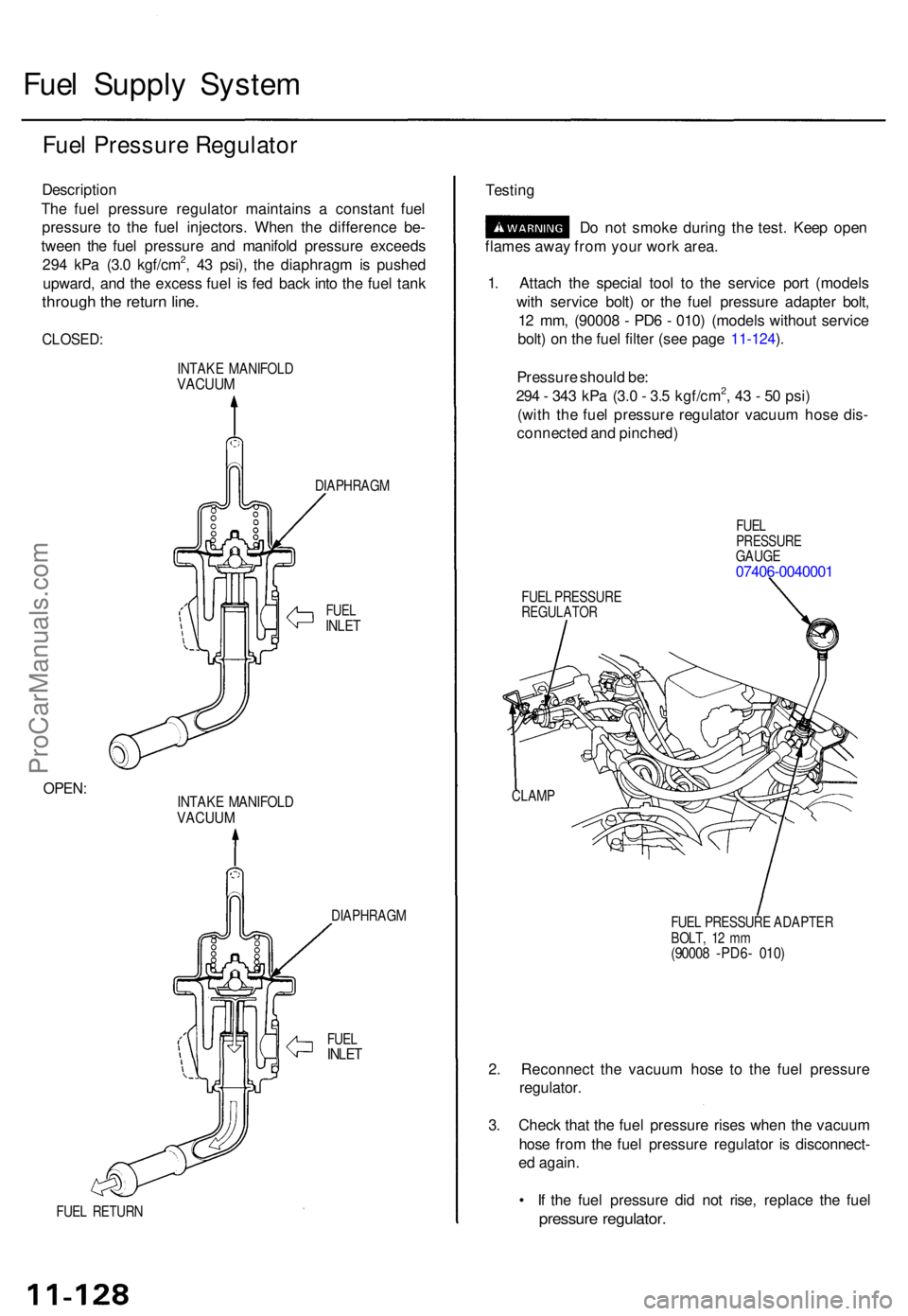
Fuel Pressur e Regulato r
Descriptio n
Th e fue l pressur e regulato r maintain s a constan t fue l
pressur e t o th e fue l injectors . Whe n th e differenc e be -
twee n th e fue l pressur e an d manifol d pressur e exceed s
29 4 kP a (3. 0 kgf/cm
2, 4 3 psi) , th e diaphrag m is pushe d
upward , an d th e exces s fue l i s fe d bac k int o th e fue l tan k
throug h th e retur n line .
CLOSED :
INTAKE MANIFOL DVACUUM
DIAPHRAG M
FUELINLE T
OPEN :INTAK E MANIFOL DVACUUM
FUEL RETUR N DIAPHRAG
M
FUE L
INLE T
Testin g
Do no t smok e durin g th e test . Kee p ope n
flame s awa y fro m you r wor k area .
1 . Attac h th e specia l too l t o th e servic e por t (model s
wit h servic e bolt ) o r th e fue l pressur e adapte r bolt ,
1 2 mm , (9000 8 - PD 6 - 010 ) (model s withou t servic e
bolt ) o n th e fue l filte r (se e pag e 11-124 ).
Pressur e shoul d be :
29 4 - 34 3 kP a (3. 0 - 3. 5 kgf/cm
2, 4 3 - 5 0 psi )
(wit h th e fue l pressur e regulato r vacuu m hos e dis -
connecte d an d pinched )
FUELPRESSUR EGAUGE07406-004000 1
FUEL PRESSUR EREGULATO R
FUEL PRESSUR E ADAPTE R
BOLT , 1 2 m m
(9000 8 -PD6 - 010 )
2. Reconnec t th e vacuu m hos e t o th e fue l pressur e
regulator .
3 . Chec k tha t th e fue l pressur e rise s whe n th e vacuu m
hos e fro m th e fue l pressur e regulato r i s disconnect -
e d again .
• I f th e fue l pressur e di d no t rise , replac e th e fue l
pressur e regulator .
CLAMP
ProCarManuals.com
Page 912 of 1771
Fuel Suppl y Syste m
Fuel Pum p
Testin g
Do no t smok e durin g th e test . Kee p ope n
flam e awa y fro m you r wor k area .
I f yo u suspec t a proble m wit h th e fue l pump , chec k tha t
th e fue l pum p actuall y runs ; whe n it i s ON , yo u wil l hea r
som e nois e
if yo u hol d you r ear t o th e fue l fill por t with
the fue l fil l ca p removed . Th e fue l pum p shoul d ru n fo r
tw o second s whe n ignitio n switc h i s firs t turne d O N (II) .
I f th e fue l pum p doe s no t mak e noise , chec k a s follows :
1 . Remov e th e trun k floo r (se e sectio n 20 ).
2 . Disconnec t th e 3 P connecto r (C519) .
CAUTION : B e sur e t o tur n th e ignitio n switc h OF F
befor e disconnectin g th e wires .
3.
4.
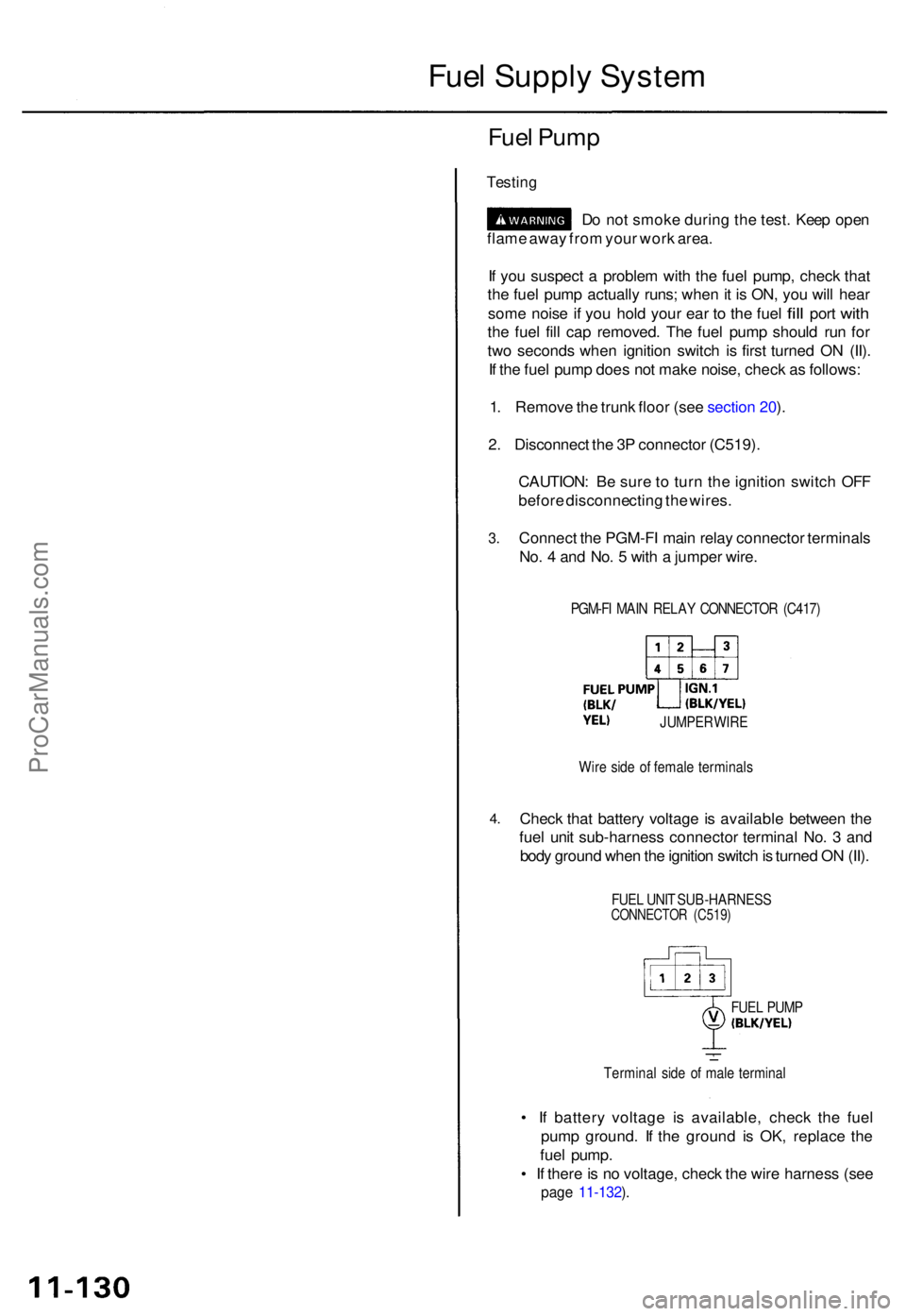
Connec t th e PGM-F I mai n rela y connecto r terminal s
No . 4 an d No . 5 wit h a jumpe r wire .
PGM-F I MAI N RELA Y CONNECTO R (C417 )
Wir e sid e o f femal e terminal s
Check tha t batter y voltag e i s availabl e betwee n th e
fue l uni t sub-harnes s connecto r termina l No . 3 an d
bod y groun d whe n th e ignitio n switc h is turne d O N (II) .
FUE L UNI T SUB-HARNES SCONNECTOR (C519 )
FUEL PUM P
Termina l sid e o f mal e termina l
• I f batter y voltag e i s available , chec k th e fue l
pum p ground . I f th e groun d i s OK , replac e th e
fue l pump .
• I f ther e is n o voltage , chec k th e wir e harnes s (se e
pag e 11-132 ).
JUMPE R WIR E
ProCarManuals.com
Page 914 of 1771
PGM-FI Main Relay
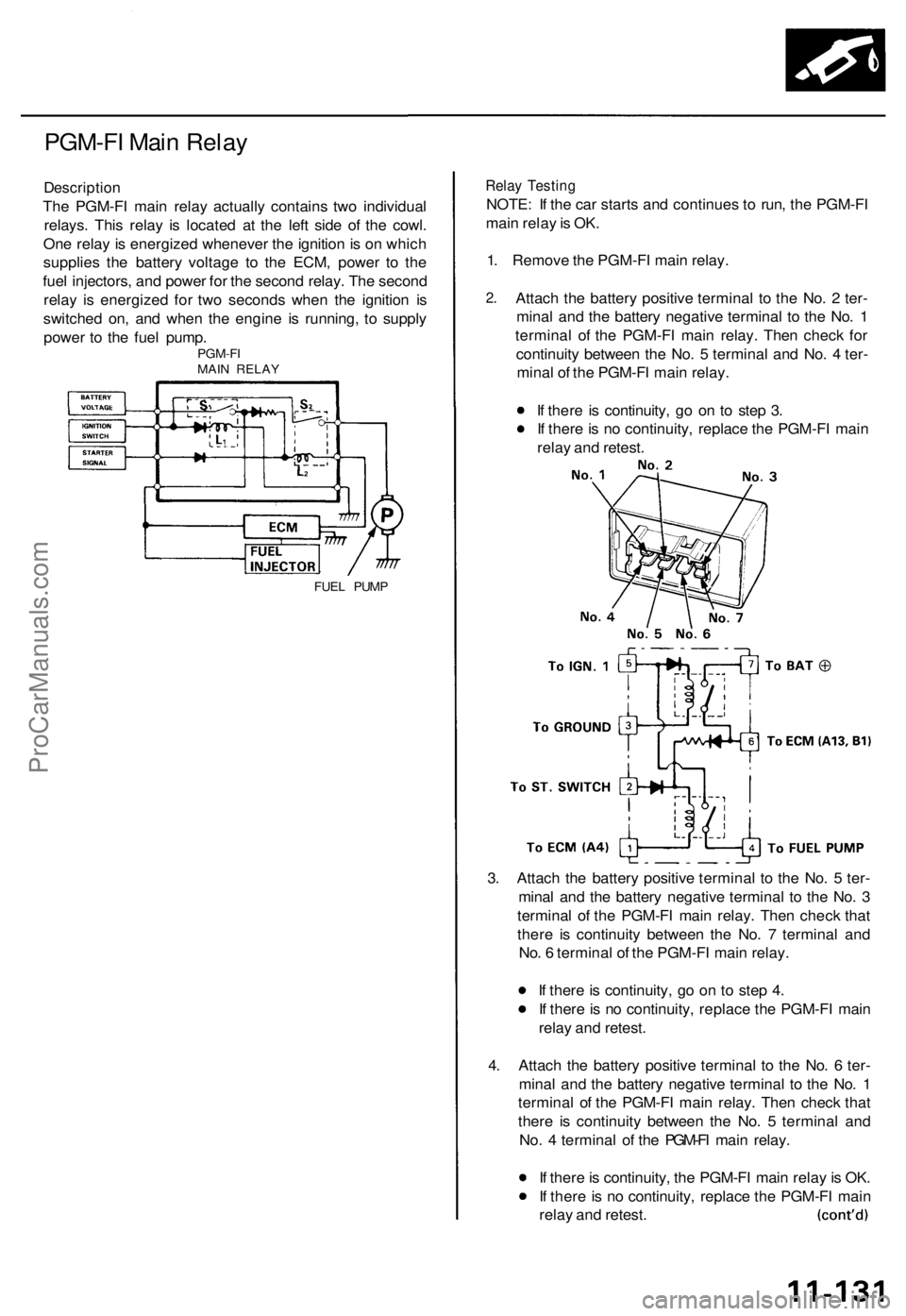
Description
The PGM-FI main relay actually contains two individual
relays. This relay is located at the left side of the cowl.
One relay is energized whenever the ignition is on which
supplies the battery voltage to the ECM, power to the
fuel injectors, and power for the second relay. The second
relay is energized for two seconds when the ignition is
switched on, and when the engine is running, to supply
power to the fuel pump.
PGM-FI
MAIN RELAY
FUEL PUMP
Relay Testing
NOTE: If the car starts and continues to run, the PGM-FI
main relay is OK.
1. Remove the PGM-FI main relay.
2.
Attach the battery positive terminal to the No. 2 ter-
minal and the battery negative terminal to the No. 1
terminal of the PGM-FI main relay. Then check for
continuity between the No. 5 terminal and No. 4 ter-
minal of the PGM-FI main relay.
If there is continuity, go on to step 3.
If there is no continuity, replace the PGM-FI main
relay and retest.
3. Attach the battery positive terminal to the No. 5 ter-
minal and the battery negative terminal to the No. 3
terminal of the PGM-FI main relay. Then check that
there is continuity between the No. 7 terminal and
No. 6 terminal of the PGM-FI main relay.
If there is continuity, go on to step 4.
If there is no continuity, replace the PGM-FI main
relay and retest.
4. Attach the battery positive terminal to the No. 6 ter-
minal and the battery negative terminal to the No. 1
terminal of the PGM-FI main relay. Then check that
there is continuity between the No. 5 terminal and
No. 4 terminal of the PGM-FI main relay.
If there is continuity, the PGM-FI main relay is OK.
If there is no continuity, replace the PGM-FI main
relay and retest.ProCarManuals.com
Page 926 of 1771
Intake Ai r Syste m Emissio
n Contro l Syste m
Intake Ai r Bypas s (IAB ) Contro l
Syste m (cont'd )
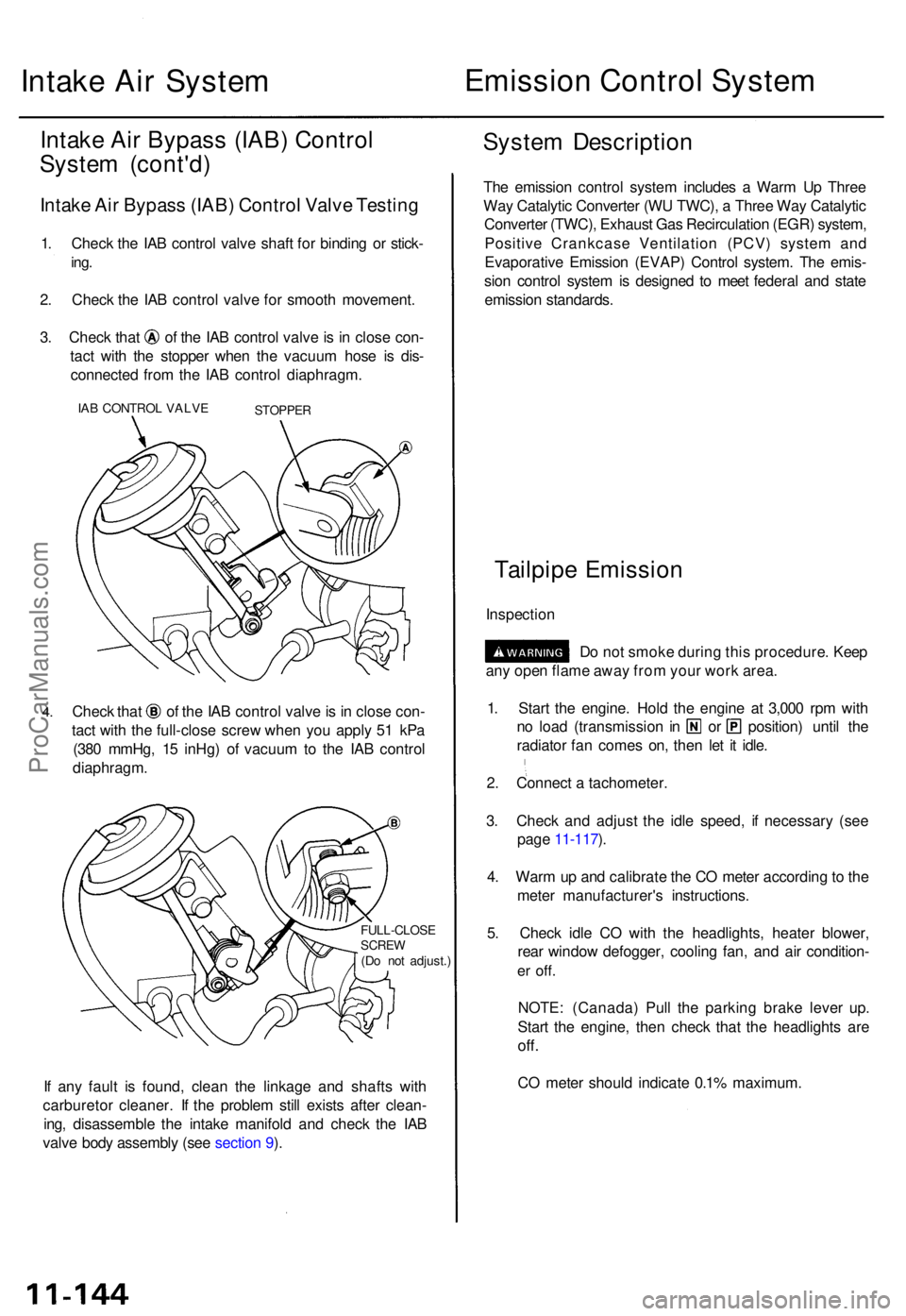
Intake Ai r Bypas s (IAB ) Contro l Valv e Testin g
1. Chec k th e IA B contro l valv e shaf t fo r bindin g o r stick -
ing.
2. Chec k th e IA B contro l valv e fo r smoot h movement .
3. Chec k tha t o f th e IA B contro l valv e is i n clos e con -
tac t wit h th e stoppe r whe n th e vacuu m hos e i s dis -
connecte d fro m th e IA B contro l diaphragm .
IAB CONTRO L VALV ESTOPPE R
4.Chec k tha t o f th e IA B contro l valv e is in clos e con -
tac t wit h th e full-clos e scre w whe n yo u appl y 5 1 kP a
(38 0 mmHg , 1 5 inHg ) o f vacuu m to th e IA B contro l
diaphragm .
FULL-CLOS ESCREW(Do no t adjust. )
If an y faul t i s found , clea n th e linkag e an d shaft s wit h
carbureto r cleaner . I f th e proble m stil l exist s afte r clean -
ing , disassembl e th e intak e manifol d an d chec k th e IA B
valv e bod y assembl y (se e sectio n 9 ).
Syste m Descriptio n
The emissio n contro l syste m include s a War m U p Thre e
Wa y Catalyti c Converte r (W U TWC) , a Thre e Wa y Catalyti c
Converte r (TWC) , Exhaus t Ga s Recirculatio n (EGR ) system ,
Positiv e Crankcas e Ventilatio n (PCV ) syste m an d
Evaporativ e Emissio n (EVAP ) Contro l system . Th e emis -
sio n contro l syste m is designe d t o mee t federa l an d stat e
emissio n standards .
Tailpipe Emissio n
Inspectio n
Do no t smok e durin g thi s procedure . Kee p
an y ope n flam e awa y fro m you r wor k area .
1 . Star t th e engine . Hol d th e engin e a t 3,00 0 rp m wit h
no loa d (transmissio n i n o r position ) unti l th e
radiato r fa n come s on , the n le t i t idle .
2 . Connec t a tachometer .
3 . Chec k an d adjus t th e idl e speed , i f necessar y (se e
pag e 11-117 ).
4 . War m u p an d calibrat e th e C O mete r accordin g to th e
mete r manufacturer' s instructions .
5 . Chec k idl e C O wit h th e headlights , heate r blower ,
rea r windo w defogger , coolin g fan , an d ai r condition -
er off .
NOTE : (Canada ) Pul l th e parkin g brak e leve r up .
Star t th e engine , the n chec k tha t th e headlight s ar e
off.
CO mete r shoul d indicat e 0.1 % maximum .
ProCarManuals.com
Page 933 of 1771
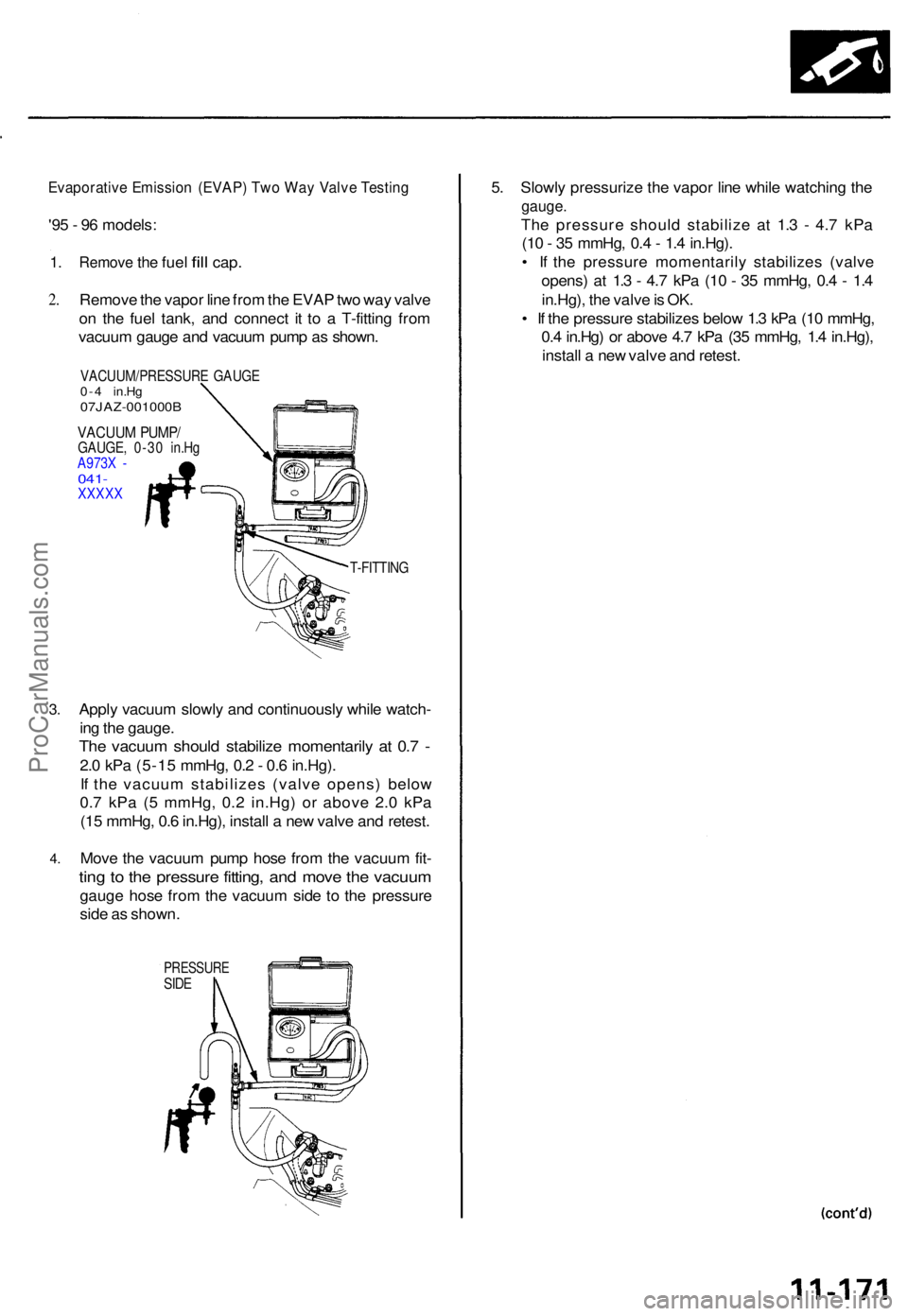
Evaporative Emissio n (EVAP ) Tw o Wa y Valv e Testin g
'95 - 9 6 models :
1. Remov e the fue l fill cap .
2.
3 .
4 .
Remov e th e vapo r lin e fro m th e EVA P tw o wa y valv e
o n th e fue l tank , an d connec t i t t o a T-fittin g fro m
vacuu m gaug e an d vacuu m pum p a s shown .
VACUUM/PRESSUR E GAUG E0-4 in.H g07JAZ-001000 B
VACUUM PUMP /GAUGE , 0-3 0 in.H g
A973 X -
041 -XXXX X
T-FITTING
Apply vacuu m slowl y an d continuousl y whil e watch -
in g th e gauge .
The vacuu m shoul d stabiliz e momentaril y a t 0. 7 -
2. 0 kP a (5-1 5 mmHg , 0. 2 - 0. 6 in.Hg) .
I f th e vacuu m stabilize s (valv e opens ) belo w
0. 7 kP a ( 5 mmHg , 0. 2 in.Hg ) o r abov e 2. 0 kP a
(1 5 mmHg , 0. 6 in.Hg) , instal l a ne w valv e an d retest .
Mov e th e vacuu m pum p hos e fro m th e vacuu m fit -
ting to th e pressur e fitting , an d mov e th e vacuu m
gauge hos e fro m th e vacuu m sid e t o th e pressur e
sid e a s shown .
PRESSUR ESIDE
5. Slowl y pressuriz e th e vapo r lin e whil e watchin g th e
gauge .
The pressur e shoul d stabiliz e a t 1. 3 - 4. 7 kP a
(1 0 - 3 5 mmHg , 0. 4 - 1. 4 in.Hg) .
• I f th e pressur e momentaril y stabilize s (valv e
opens ) a t 1. 3 - 4. 7 kP a (1 0 - 3 5 mmHg , 0. 4 - 1. 4
in.Hg) , th e valv e is OK .
• I f th e pressur e stabilize s belo w 1. 3 kP a (1 0 mmHg ,
0. 4 in.Hg ) o r abov e 4. 7 kP a (3 5 mmHg , 1. 4 in.Hg) ,
instal l a ne w valv e an d retest .
ProCarManuals.com
Page 934 of 1771
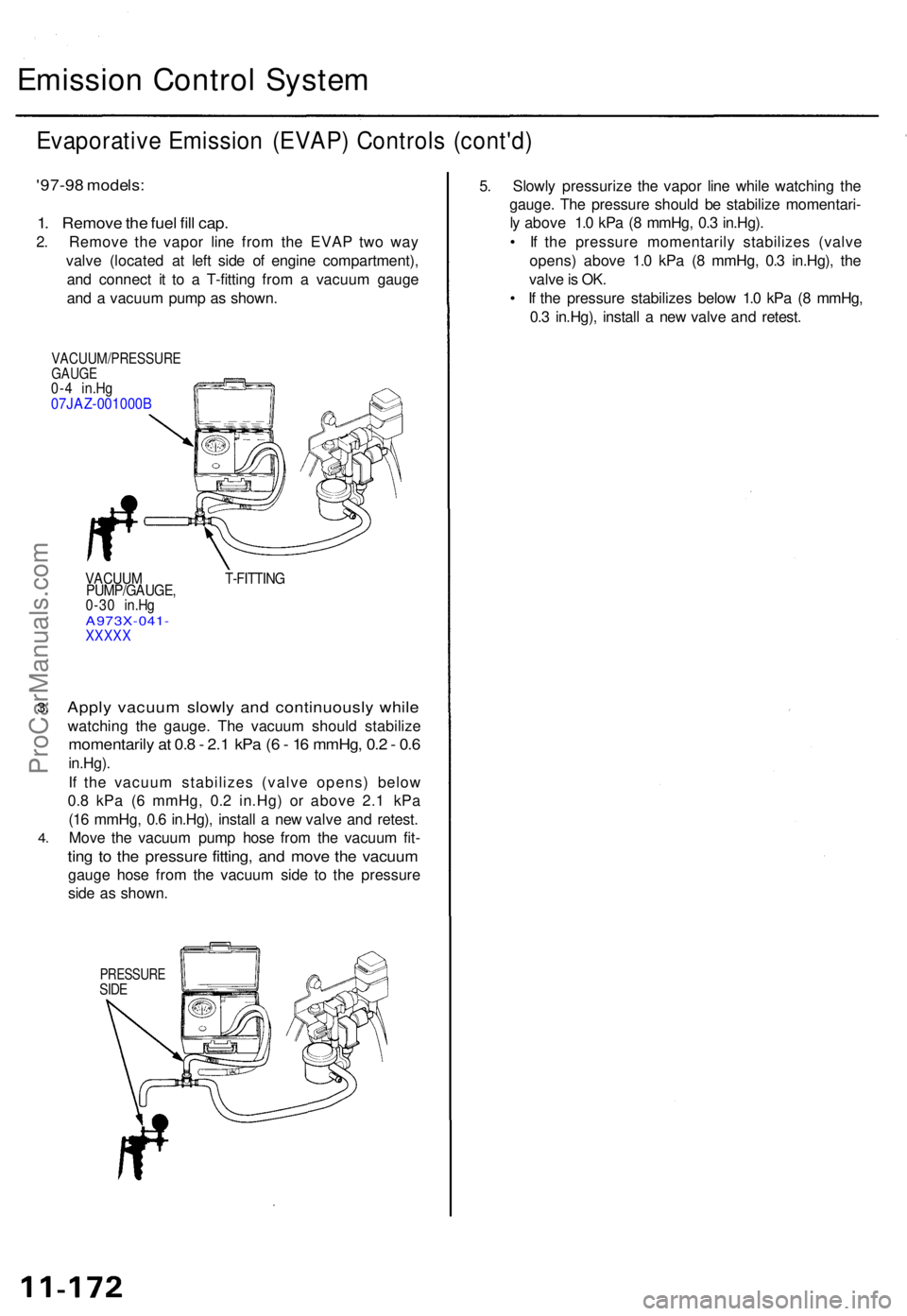
Emission Contro l Syste m
Evaporativ e Emissio n (EVAP ) Control s (cont'd )
'97-98 models :
1. Remov e th e fue l fil l cap .
2. Remov e th e vapo r lin e fro m th e EVA P tw o wa y
valv e (locate d a t lef t sid e o f engin e compartment) ,
an d connec t i t t o a T-fittin g fro m a vacuu m gaug e
an d a vacuu m pum p a s shown .
VACUUM/PRESSUR EGAUGE0-4 in.H g07JAZ-001000 B
3.
4 .
VACUU M T-FITTIN G
PUMP/GAUGE ,
0-3 0 in.H g
A973X-041 -XXXXX
Apply vacuu m slowl y an d continuousl y whil e
watchin g th e gauge . Th e vacuu m shoul d stabiliz e
momentaril y a t 0. 8 - 2. 1 kP a ( 6 - 1 6 mmHg , 0. 2 - 0. 6
in.Hg) .
I f th e vacuu m stabilize s (valv e opens ) belo w
0. 8 kP a ( 6 mmHg , 0. 2 in.Hg ) o r abov e 2. 1 kP a
(1 6 mmHg , 0. 6 in.Hg) , instal l a ne w valv e an d retest .
Mov e th e vacuu m pum p hos e fro m th e vacuu m fit -
ting t o th e pressur e fitting , an d mov e th e vacuu m
gauge hos e fro m th e vacuu m sid e t o th e pressur e
sid e a s shown .
PRESSUR ESIDE
5. Slowl y pressuriz e th e vapo r lin e whil e watchin g th e
gauge . Th e pressur e shoul d b e stabiliz e momentari -
l y abov e 1. 0 kP a ( 8 mmHg , 0. 3 in.Hg) .
• I f th e pressur e momentaril y stabilize s (valv e
opens ) abov e 1. 0 kP a ( 8 mmHg , 0. 3 in.Hg) , th e
valv e is OK .
• I f th e pressur e stabilize s belo w 1. 0 kP a ( 8 mmHg ,
0. 3 in.Hg) , instal l a ne w valv e an d retest .
ProCarManuals.com