check engine ACURA TL 1995 Service Service Manual
[x] Cancel search | Manufacturer: ACURA, Model Year: 1995, Model line: TL, Model: ACURA TL 1995Pages: 1771, PDF Size: 62.49 MB
Page 511 of 1771
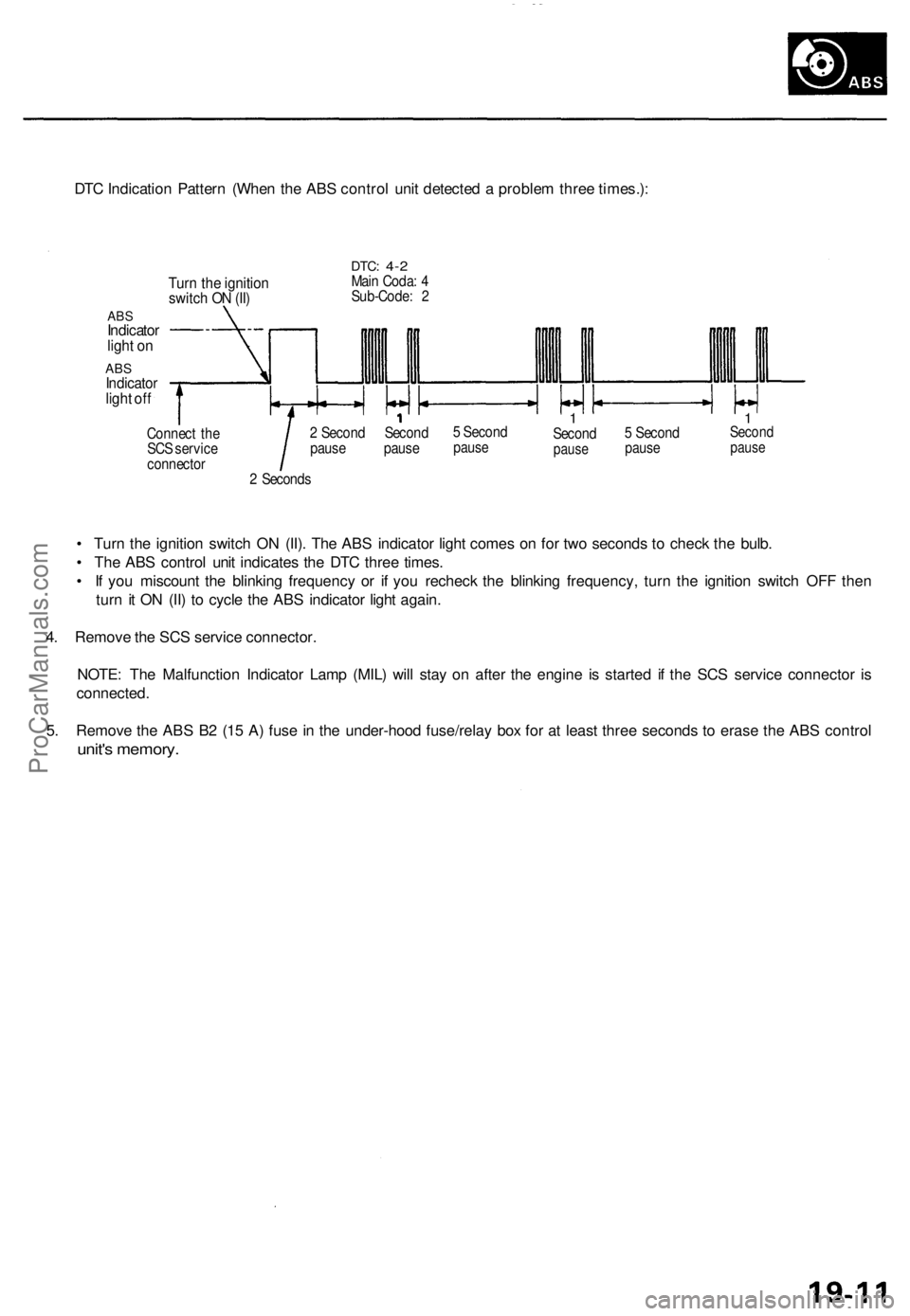
DTC Indication Pattern (When the ABS control unit detected a problem three times.):
Turn the ignition
switch ON (II)
ABS
Indicator
light on
ABS
Indicator
light off
DTC:
4-2
Main Coda: 4
Sub-Code: 2
Connect the
SCS service
connector
2 Second Second
pause pause
5 Second
pause
1
Second
pause
5 Second
pause
1
Second
pause
2 Seconds
• Turn the ignition switch ON (II). The ABS indicator light comes on for two seconds to check the bulb.
• The ABS control unit indicates the DTC three times.
• If you miscount the blinking frequency or if you recheck the blinking frequency, turn the ignition switch OFF then
turn it ON (II) to cycle the ABS indicator light again.
4. Remove the SCS service connector.
NOTE: The Malfunction Indicator Lamp (MIL) will stay on after the engine is started if the SCS service connector is
connected.
5. Remove the ABS B2 (15 A) fuse in the under-hood fuse/relay box for at least three seconds to erase the ABS control
unit's memory.ProCarManuals.com
Page 539 of 1771
Electronic Component s
Steering Angl e Senso r Replacemen t
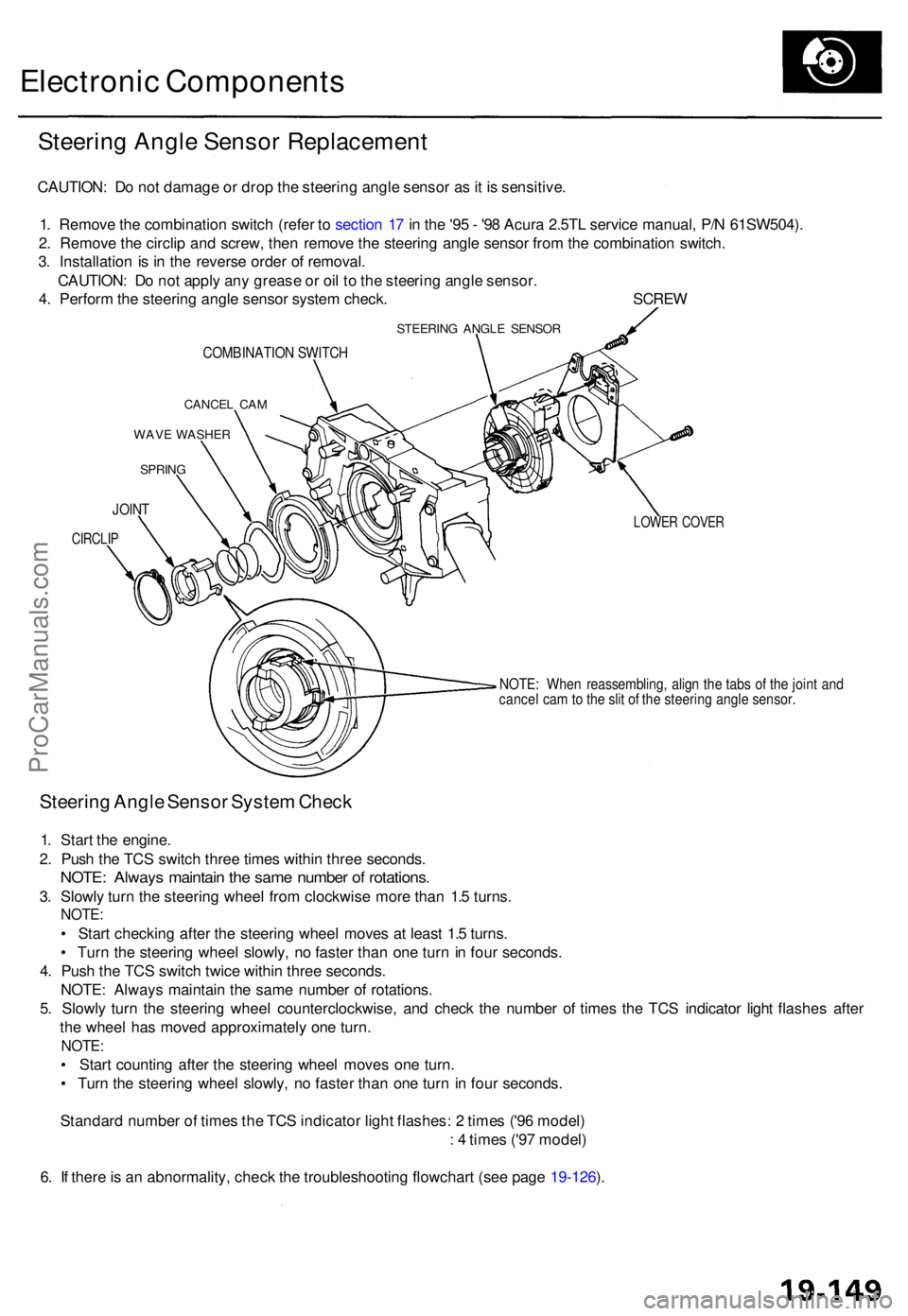
CAUTION: D o no t damag e o r dro p th e steerin g angl e senso r a s it i s sensitive .
1 . Remov e th e combinatio n switc h (refe r t o sectio n 1 7 in th e '9 5 - '9 8 Acur a 2.5T L servic e manual , P/ N 61SW504) .
2 . Remov e th e circli p an d screw , the n remov e th e steerin g angl e senso r fro m th e combinatio n switch .
3 . Installatio n i s i n th e revers e orde r o f removal .
CAUTION : D o no t appl y an y greas e o r oi l t o th e steerin g angl e sensor .
4 . Perfor m th e steerin g angl e senso r syste m check . SCRE W
STEERING ANGL E SENSO R
COMBINATIO N SWITC H
CANCE L CA M
WAV E WASHE R
SPRING
LOWER COVE R
NOTE: Whe n reassembling , alig n th e tab s o f th e join t an d
cance l ca m to th e sli t o f th e steerin g angl e sensor .
Steering Angl e Senso r Syste m Chec k
1. Star t th e engine .
2 . Pus h th e TC S switc h thre e time s withi n thre e seconds .
NOTE: Alway s maintai n th e sam e numbe r o f rotations .
3. Slowl y tur n th e steerin g whee l fro m clockwis e mor e tha n 1. 5 turns .
NOTE :
• Star t checkin g afte r th e steerin g whee l move s a t leas t 1. 5 turns .
• Tur n th e steerin g whee l slowly , n o faste r tha n on e tur n in fou r seconds .
4 . Pus h th e TC S switc h twic e withi n thre e seconds .
NOTE : Alway s maintai n th e sam e numbe r o f rotations .
5 . Slowl y tur n th e steerin g whee l counterclockwise , an d chec k th e numbe r o f time s th e TC S indicato r ligh t flashe s afte r
th e whee l ha s move d approximatel y on e turn .
NOTE :
• Star t countin g afte r th e steerin g whee l move s on e turn .
• Tur n th e steerin g whee l slowly , n o faste r tha n on e tur n i n fou r seconds .
Standar d numbe r o f time s th e TC S indicato r ligh t flashes : 2 time s ('9 6 model )
: 4 time s ('9 7 model )
6 . I f ther e is a n abnormality , chec k th e troubleshooting flowchart (se e pag e 19-126 ).
JOIN T
CIRCLI P
ProCarManuals.com
Page 562 of 1771
Troubleshooting
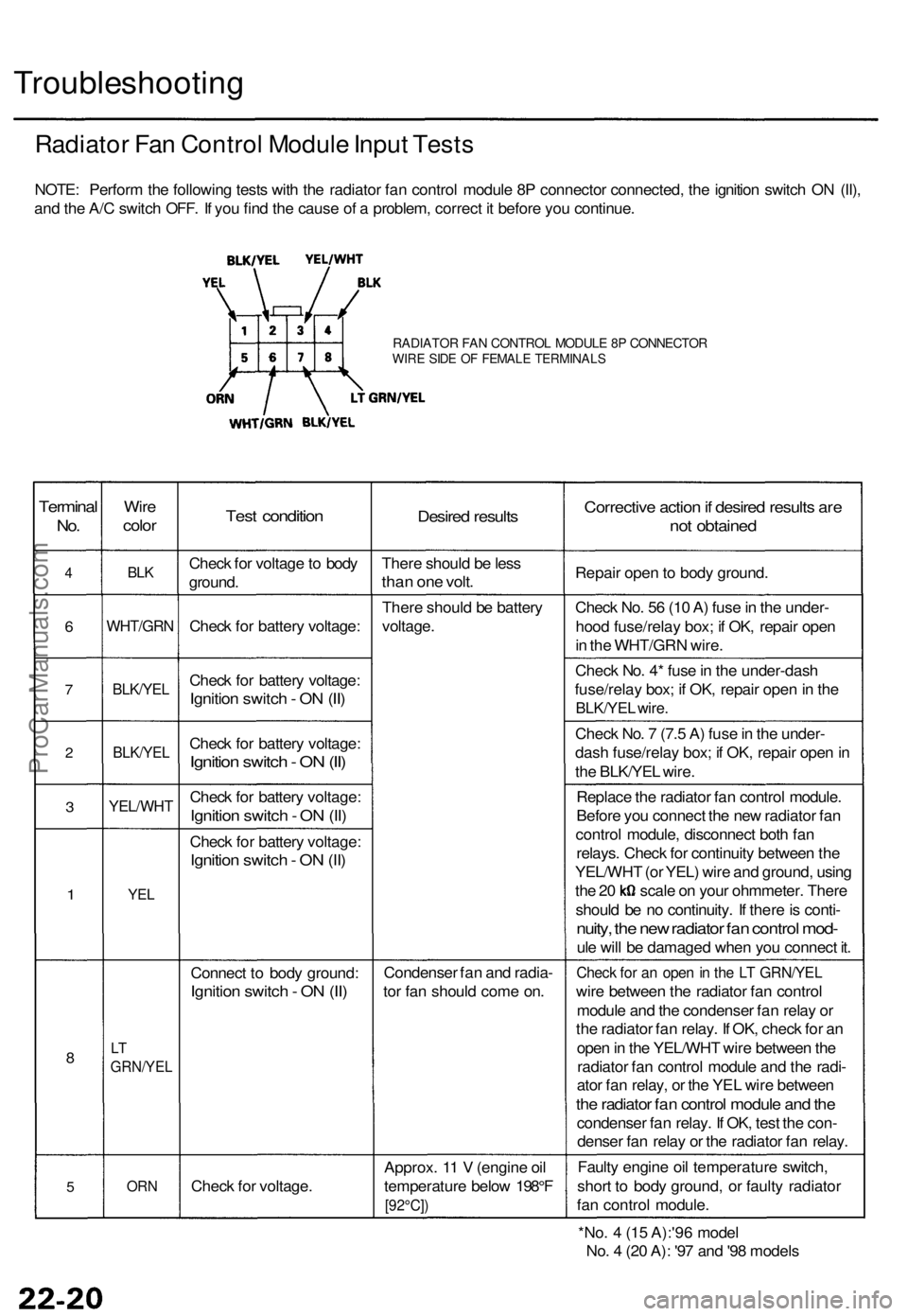
Radiator Fan Control Module Input Tests
NOTE: Perform the following tests with the radiator fan control module 8P connector connected, the ignition switch ON (II),
and the A/C switch OFF. If you find the cause of a problem, correct it before you continue.
RADIATOR FAN CONTROL MODULE 8P CONNECTOR
WIRE SIDE OF FEMALE TERMINALS
Terminal
No.
4
6
7
2
3
1
8
5
Wire
color
BLK
WHT/GRN
BLK/YEL
BLK/YEL
YEL/WHT
YEL
LT
GRN/YEL
ORN
Test condition
Check for voltage to body
ground.
Check for battery voltage:
Check for battery voltage:
Ignition switch - ON (II)
Check for battery voltage:
Ignition switch - ON (II)
Check for battery voltage:
Ignition switch - ON (II)
Check for battery voltage:
Ignition switch - ON (II)
Connect to body ground:
Ignition switch - ON (II)
Check for voltage.
Desired results
There should be less
than one volt.
There should be battery
voltage.
Condenser fan and radia-
tor fan should come on.
Approx. 11 V (engine oil
temperature below 198°F
[92°C])
Corrective action if desired results are
not obtained
Repair open to body ground.
Check No. 56 (10 A) fuse in the under-
hood fuse/relay box; if OK, repair open
in the WHT/GRN wire.
Check No. 4* fuse in the under-dash
fuse/relay box; if OK, repair open in the
BLK/YEL wire.
Check No. 7 (7.5 A) fuse in the under-
dash fuse/relay box; if OK, repair open in
the BLK/YEL wire.
Replace the radiator fan control module.
Before you connect the new radiator fan
control module, disconnect both fan
relays. Check for continuity between the
YEL/WHT (or YEL) wire and ground, using
the 20 scale on your ohmmeter. There
should be no continuity. If there is conti-
nuity, the new radiator fan control mod-
ule will be damaged when you connect it.
Check for an open in the LT GRN/YEL
wire between the radiator fan control
module and the condenser fan relay or
the radiator fan relay. If OK, check for an
open in the YEL/WHT wire between the
radiator fan control module and the radi-
ator fan relay, or the YEL wire between
the radiator fan control module and the
condenser fan relay. If OK, test the con-
denser fan relay or the radiator fan relay.
Faulty engine oil temperature switch,
short to body ground, or faulty radiator
fan control module.
*No. 4 (15 A):'96 model
No. 4 (20 A): '97 and '98 modelsProCarManuals.com
Page 585 of 1771
Check for Wear and Damage
The starter should crank the engine smoothly and steadily.
If the starter engages, but cranks the engine erratically,
remove it, and inspect the starter drive gear and torque
converter ring gear for damage.
• Check the drive gear overrunning clutch for binding
or slipping when the armature is rotated with the
drive gear held. If the clutch is damaged, replace the
clutch assembly.
Check Cranking Voltage and Current Draw
Cranking voltage should be no less than 8.0 volts.
Current draw should be no more than 450 amperes.
If cranking voltage is too low, or current draw too high,
check for:
Dead or low battery
Open circuit in starter armature commutator segments
Starter armature dragging
Shorted armature winding
Excessive drag in engine
Check Cranking rpm
Engine speed during cranking should be above 100 rpm.
If speed is too low, check for:
Loose battery or starter terminals
Excessively worn starter brushes
Open circuit in commutator segments
Dirty or damaged helical spline or drive gear
Defective drive gear overrunning clutch
Check Starter Disengagement
With the shift lever in or , turn the ignition switch to
"START (III)", and release to "ON (II)". The starter drive
gear should disengage from the flywheel ring gear when
you release the key.
If the drive gear hangs upon the flywheel ring gear, check
for:
• Solenoid plunger and switch malfunction
• Dirty drive gear assembly or damaged overrunning
clutchProCarManuals.com
Page 727 of 1771
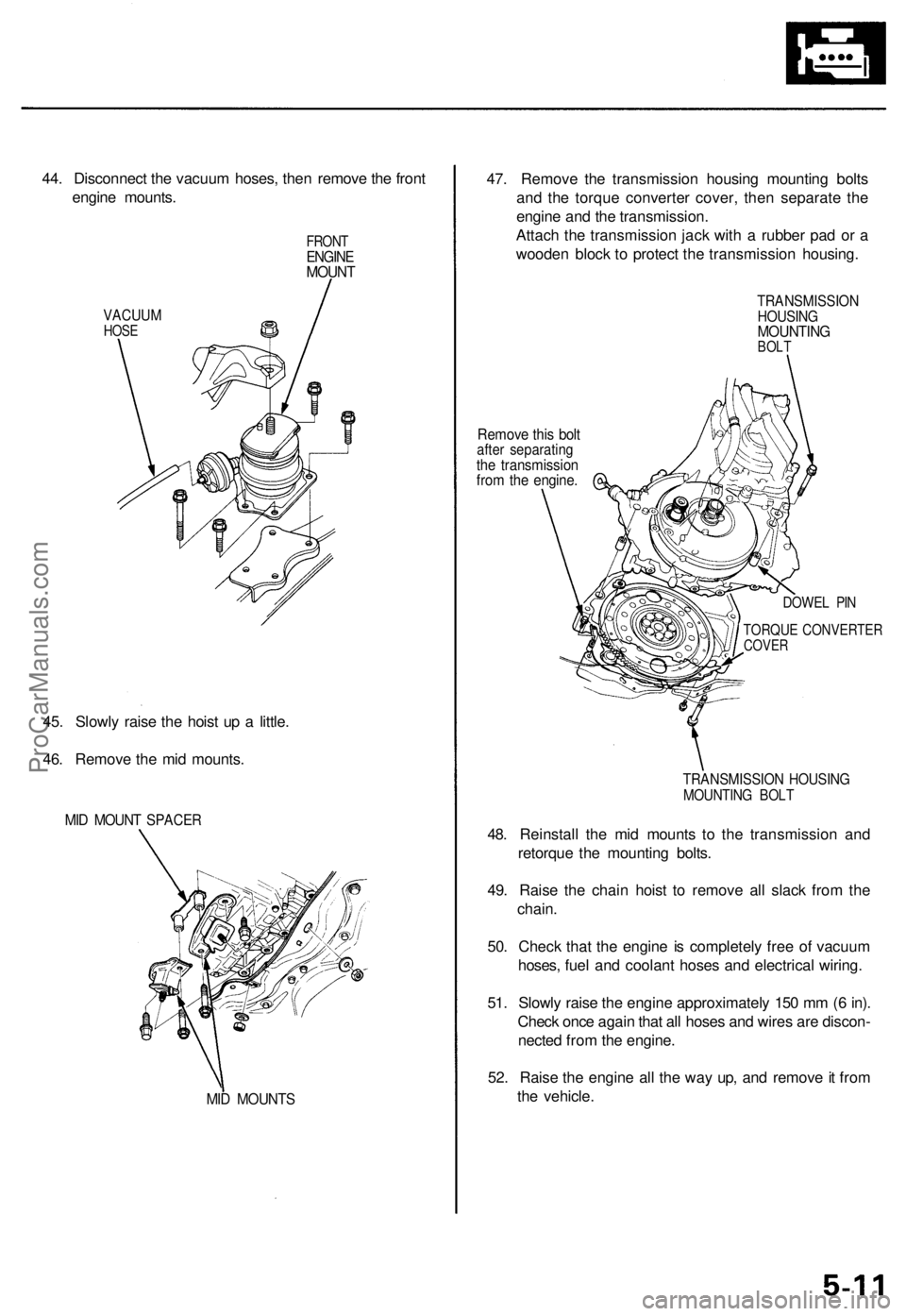
44. Disconnect the vacuum hoses, then remove the front
engine mounts.
VACUUM
HOSE
FRONT
ENGINE
MOUNT
45. Slowly raise the hoist up a little.
46. Remove the mid mounts.
MID MOUNT SPACER
MID MOUNTS
47. Remove the transmission housing mounting bolts
and the torque converter cover, then separate the
engine and the transmission.
Attach the transmission jack with a rubber pad or a
wooden block to protect the transmission housing.
Remove this bolt
after separating
the transmission
from the engine.
TRANSMISSION
HOUSING
MOUNTING
BOLT
DOWEL PIN
TORQUE CONVERTER
COVER
TRANSMISSION HOUSING
MOUNTING BOLT
48. Reinstall the mid mounts to the transmission and
retorque the mounting bolts.
49. Raise the chain hoist to remove all slack from the
chain.
50. Check that the engine is completely free of vacuum
hoses, fuel and coolant hoses and electrical wiring.
51. Slowly raise the engine approximately 150 mm (6 in).
Check once again that all hoses and wires are discon-
nected from the engine.
52. Raise the engine all the way up, and remove it from
the vehicle.ProCarManuals.com
Page 733 of 1771
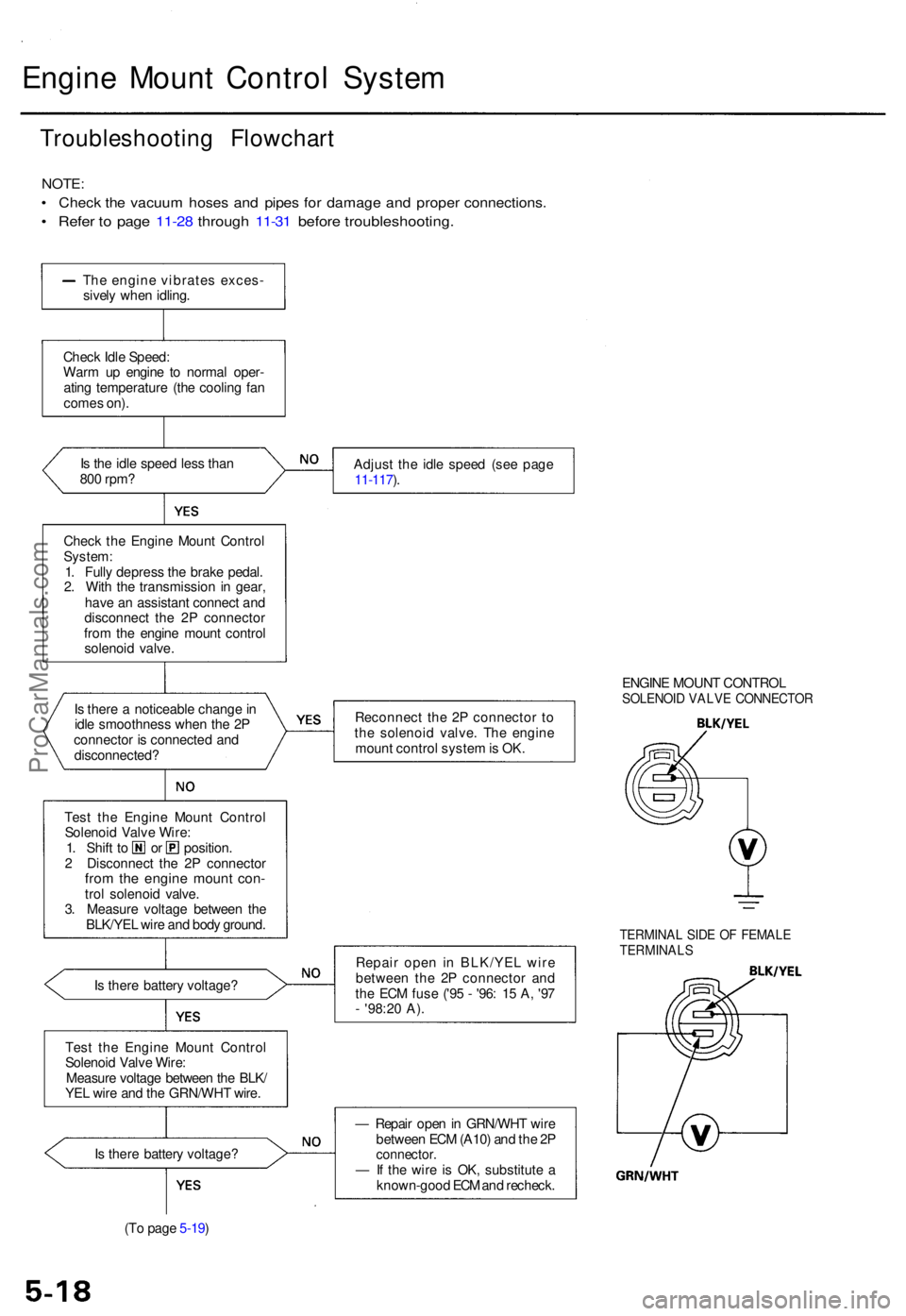
Engine Moun t Contro l Syste m
Troubleshootin g Flowchar t
NOTE:
• Chec k th e vacuu m hose s an d pipe s fo r damag e an d prope r connections .
• Refe r t o pag e 11-2 8 throug h 11-3 1 befor e troubleshooting .
The engin e vibrate s exces -
sivel y whe n idling .
Chec k Idl e Speed :
War m u p engin e t o norma l oper -
atin g temperatur e (th e coolin g fa n
come s on) .
I s th e idl e spee d les s tha n
80 0 rpm ?
Chec k th e Engin e Moun t Contro l
System :
1 . Full y depres s th e brak e pedal .
2 . Wit h th e transmissio n i n gear ,
hav e a n assistan t connec t an d
disconnec t th e 2 P connecto r
fro m th e engin e moun t contro l
solenoi d valve .
I s ther e a noticeabl e chang e in
idl e smoothnes s whe n th e 2 P
connecto r i s connecte d an d
disconnected ?
Tes t th e Engin e Moun t Contro l
Solenoi d Valv e Wire :
1. Shif t t o o r position .
2 Disconnec t th e 2 P connecto r
from th e engin e moun t con -trol solenoi d valve .
3 . Measur e voltag e betwee n th e
BLK/YE L wir e an d bod y ground .
I s ther e batter y voltage ?
Tes t th e Engin e Moun t Contro l
Solenoi d Valv e Wire :
Measur e voltag e betwee n th e BLK /
YE L wir e an d th e GRN/WH T wire . Adjus
t th e idl e spee d (se e pag e
11-117 ).
Reconnec t th e 2 P connecto r t o
th e solenoi d valve . Th e engin e
moun t contro l syste m is OK . ENGIN
E MOUN T CONTRO L
SOLENOID VALV E CONNECTO R
Repair ope n i n BLK/YE L wir e
betwee n th e 2 P connecto r an d
th e EC M fus e ('9 5 - '96 : 1 5 A , '9 7
- '98:2 0 A) .
TERMINA L SID E O F FEMAL ETERMINAL S
Is ther e batter y voltage ?
(T o pag e 5-19 ) —
Repai r ope n in GRN/WH T wir e
betwee n EC M (A10 ) an d th e 2 Pconnector .— If th e wir e i s OK , substitut e a
known-goo d EC M an d recheck .
ProCarManuals.com
Page 734 of 1771
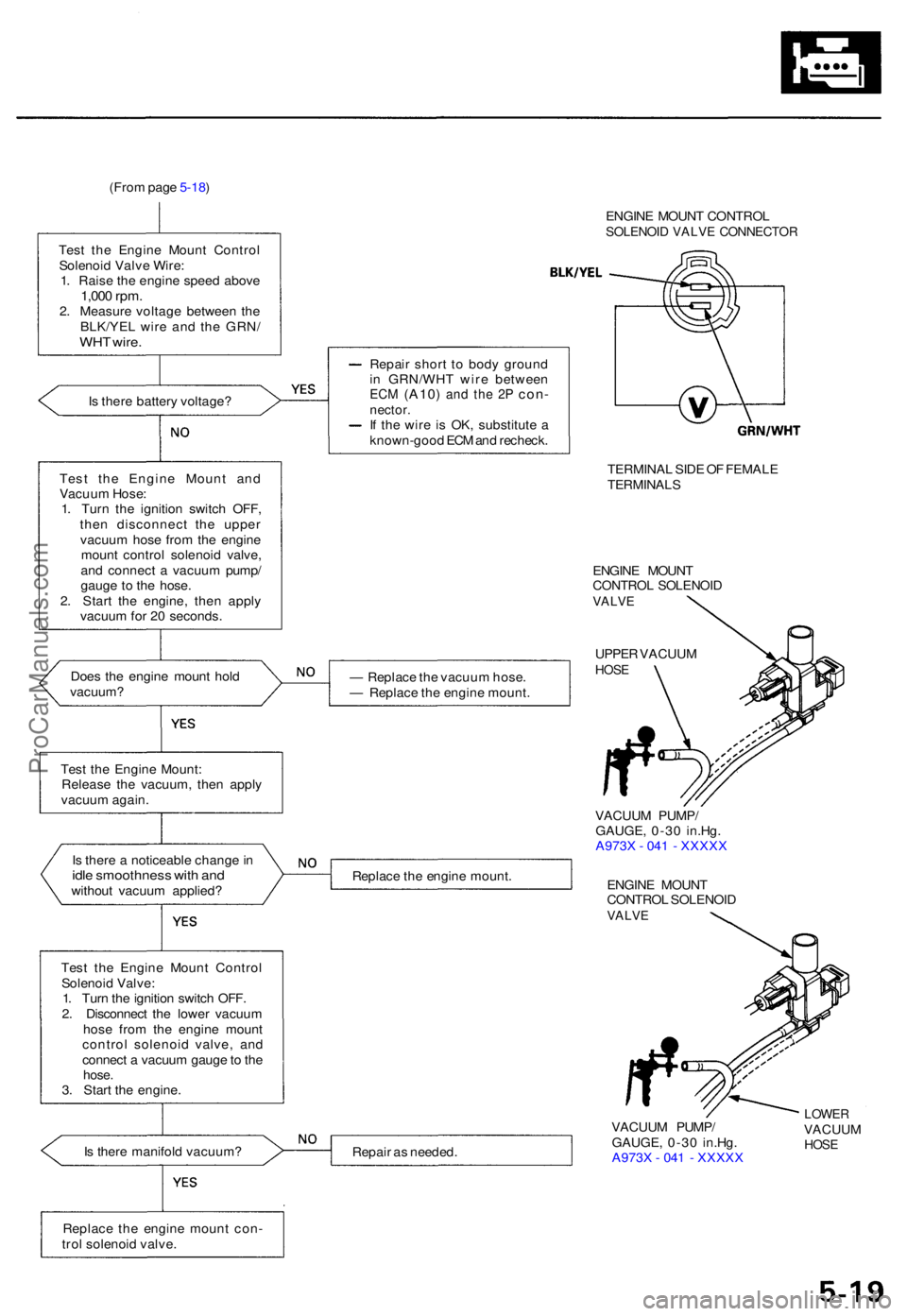
(From pag e 5-18 )
Tes t th e Engin e Moun t Contro l
Solenoi d Valv e Wire :
1 . Rais e th e engin e spee d abov e
1,000 rpm .2. Measur e voltag e betwee n th e
BLK/YE L wir e an d th e GRN /
WHT wire .
ENGIN E MOUN T CONTRO LSOLENOID VALV E CONNECTO R
Is ther e batter y voltage ?
Tes t th e Engin e Moun t an d
Vacuu m Hose :
1 . Tur n th e ignitio n switc h OFF ,
the n disconnec t th e uppe r
vacuu m hos e fro m th e engin e
moun t contro l solenoi d valve ,
an d connec t a vacuu m pump /
gaug e t o th e hose .
2 . Star t th e engine , the n appl y
vacuu m fo r 2 0 seconds .
Doe s th e engin e moun t hol d
vacuum ?
Test th e Engin e Mount :
Releas e th e vacuum , the n appl y
vacuu m again .
I s ther e a noticeabl e chang e in
idl e smoothnes s wit h an dwithou t vacuu m applied ?
Tes t th e Engin e Moun t Contro l
Solenoi d Valve :
1 . Tur n th e ignitio n switc h OFF .
2 . Disconnec t th e lowe r vacuu m
hos e fro m th e engin e moun t
contro l solenoi d valve , an d
connec t a vacuu m gaug e to th e
hose .3. Star t th e engine .
I s ther e manifol d vacuum ? Repai
r shor t t o bod y groun d
i n GRN/WH T wir e betwee n
ECM (A10 ) and th e 2 P con -nector .If th e wir e i s OK , substitut e a
known-goo d EC M an d recheck .
— Replac e th e vacuu m hose .
— Replac e th e engin e mount . TERMINA
L SID E O F FEMAL E
TERMINAL S
ENGINE MOUN TCONTRO L SOLENOI DVALVE
UPPER VACUU MHOSE
Replac e th e engin e mount . VACUU
M PUMP /
GAUGE , 0-3 0 in.Hg .
A973 X - 04 1 - XXXX X
ENGIN E MOUN T
CONTRO L SOLENOI D
VALVE
Repair a s needed . VACUU
M PUMP /
GAUGE , 0-3 0 in.Hg .
A973 X - 04 1 - XXXX X
LOWERVACUU MHOSE
Replac e th e engin e moun t con -
tro l solenoi d valve .
ProCarManuals.com
Page 775 of 1771
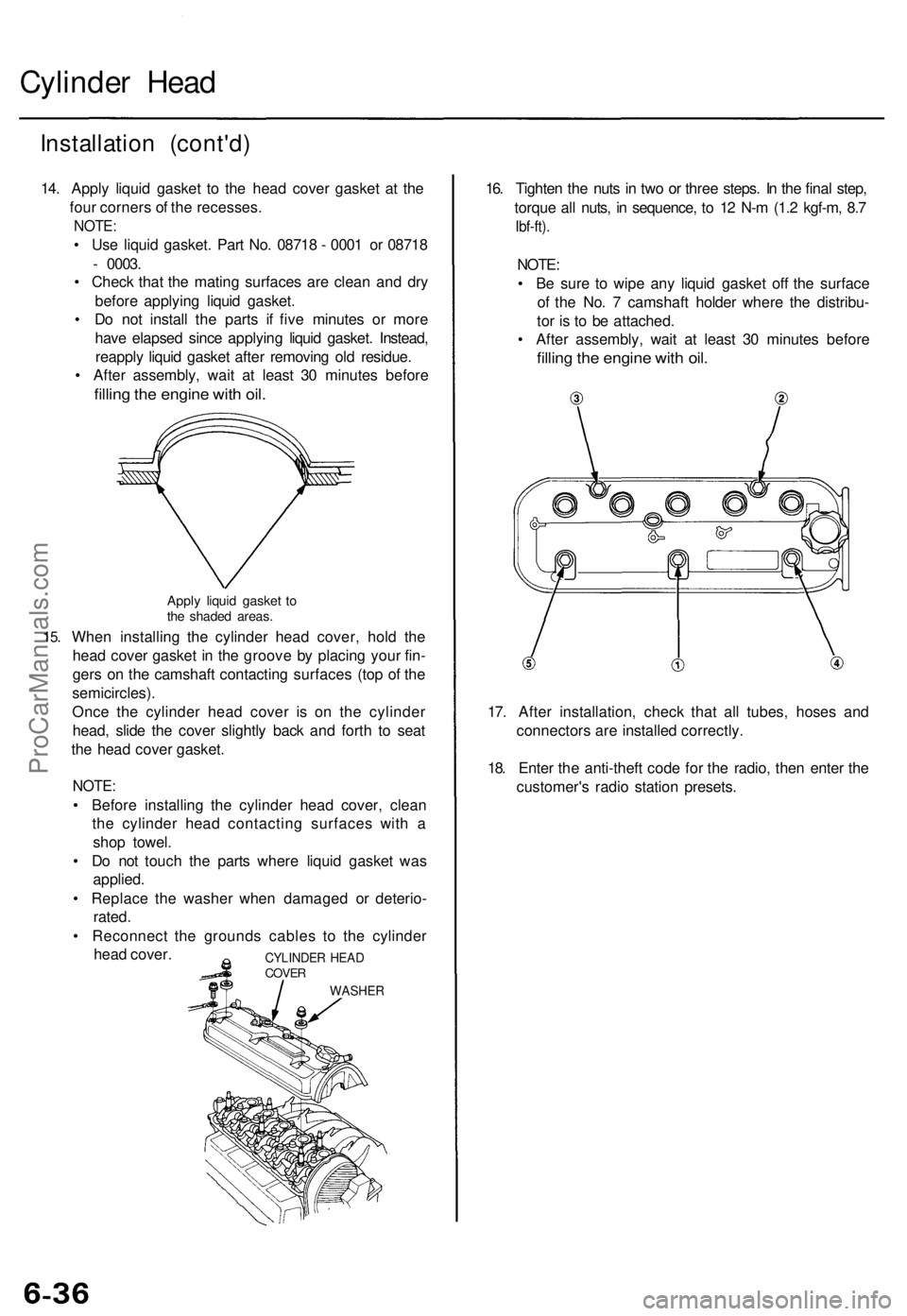
Cylinder Head
Installation (cont'd)
14. Apply liquid gasket to the head cover gasket at the
four corners of the recesses.
NOTE:
• Use liquid gasket. Part No. 08718 - 0001 or 08718
- 0003.
• Check that the mating surfaces are clean and dry
before applying liquid gasket.
• Do not install the parts if five minutes or more
have elapsed since applying liquid gasket. Instead,
reapply liquid gasket after removing old residue.
• After assembly, wait at least 30 minutes before
filling the engine with oil.
15.
Apply liquid gasket to
the shaded areas.
When installing the cylinder head cover, hold the
head cover gasket in the groove by placing your fin-
gers on the camshaft contacting surfaces (top of the
semicircles).
Once the cylinder head cover is on the cylinder
head, slide the cover slightly back and forth to seat
the head cover gasket.
NOTE:
• Before installing the cylinder head cover, clean
the cylinder head contacting surfaces with a
shop towel.
• Do not touch the parts where liquid gasket was
applied.
• Replace the washer when damaged or deterio-
rated.
• Reconnect the grounds cables to the cylinder
head cover.
16. Tighten the nuts in two or three steps. In the final step,
torque all nuts, in sequence, to 12 N-m (1.2 kgf-m, 8.7
Ibf-ft).
NOTE:
• Be sure to wipe any liquid gasket off the surface
of the No. 7 camshaft holder where the distribu-
tor is to be attached.
• After assembly, wait at least 30 minutes before
filling the engine with oil.
17. After installation, check that all tubes, hoses and
connectors are installed correctly.
18. Enter the anti-theft code for the radio, then enter the
customer's radio station presets.
CYLINDER HEAD
COVER
WASHERProCarManuals.com
Page 781 of 1771
Main Bearings
Clearance
1. To check main bearing-to-journal oil clearance,
remove the main caps and bearing halves.
2. Clean each main journal and bearing half with a
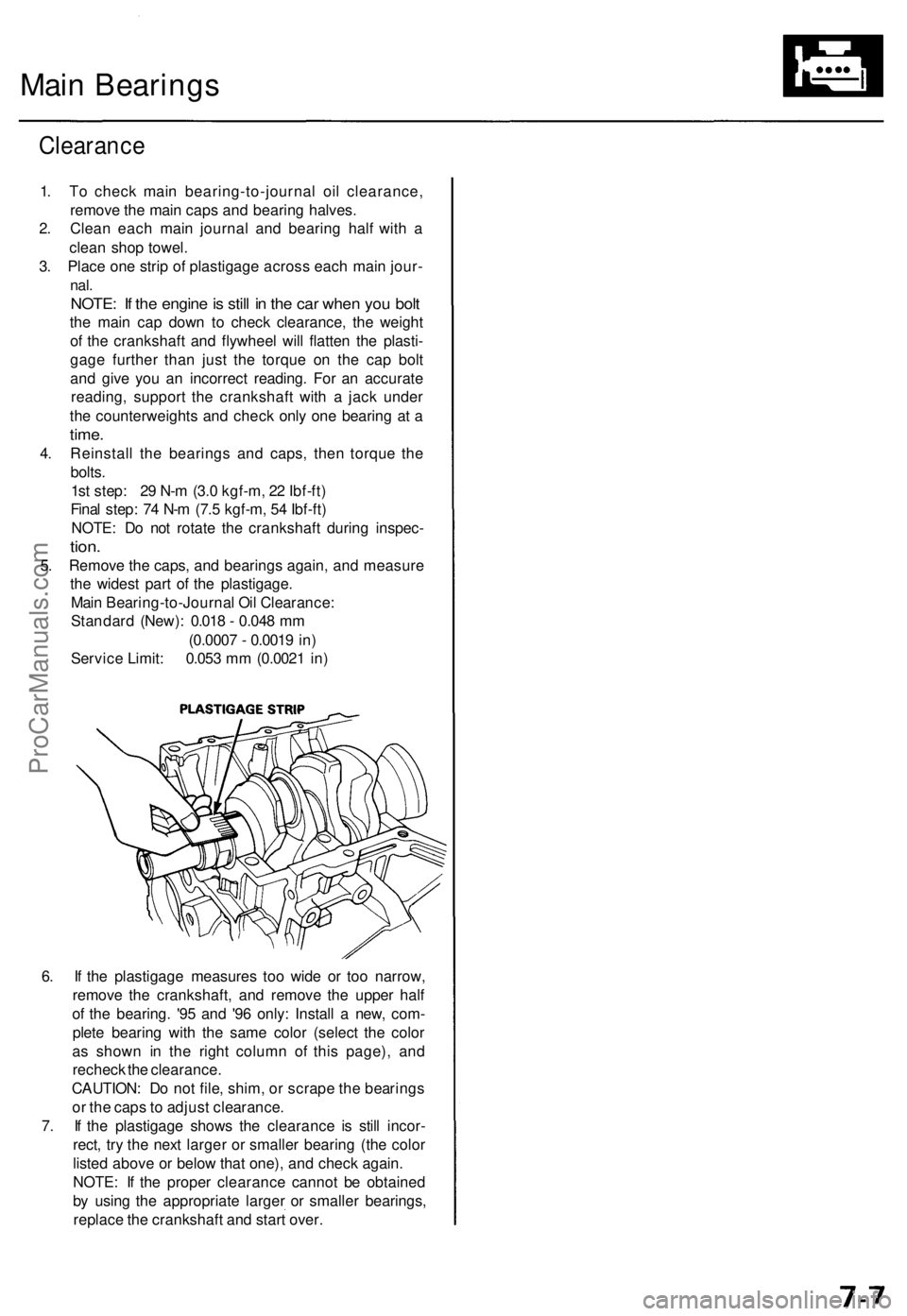
clean shop towel.
3. Place one strip of plastigage across each main jour-
nal.
NOTE: If the engine is still in the car when you bolt
the main cap down to check clearance, the weight
of the crankshaft and flywheel will flatten the plasti-
gage further than just the torque on the cap bolt
and give you an incorrect reading. For an accurate
reading, support the crankshaft with a jack under
the counterweights and check only one bearing at a
time.
4. Reinstall the bearings and caps, then torque the
bolts.
1st step: 29 N-m (3.0 kgf-m, 22 Ibf-ft)
Final step: 74 N-m (7.5 kgf-m, 54 Ibf-ft)
NOTE: Do not rotate the crankshaft during inspec-
tion.
5. Remove the caps, and bearings again, and measure
the widest part of the plastigage.
Main Bearing-to-Journal Oil Clearance:
Standard (New): 0.018 - 0.048 mm
(0.0007 - 0.0019 in)
Service Limit: 0.053 mm (0.0021 in)
6. If the plastigage measures too wide or too narrow,
remove the crankshaft, and remove the upper half
of the bearing. '95 and '96 only: Install a new, com-
plete bearing with the same color (select the color
as shown in the right column of this page), and
recheck the clearance.
CAUTION: Do not file, shim, or scrape the bearings
or the caps to adjust clearance.
7. If the plastigage shows the clearance is still incor-
rect, try the next larger or smaller bearing (the color
listed above or below that one), and check again.
NOTE: If the proper clearance cannot be obtained
by using the appropriate larger or smaller bearings,
replace the crankshaft and start over.ProCarManuals.com
Page 798 of 1771
Pistons
Installation
Before installing the piston, apply a coat of
engine oil to the ring grooves and cylinder
bores.
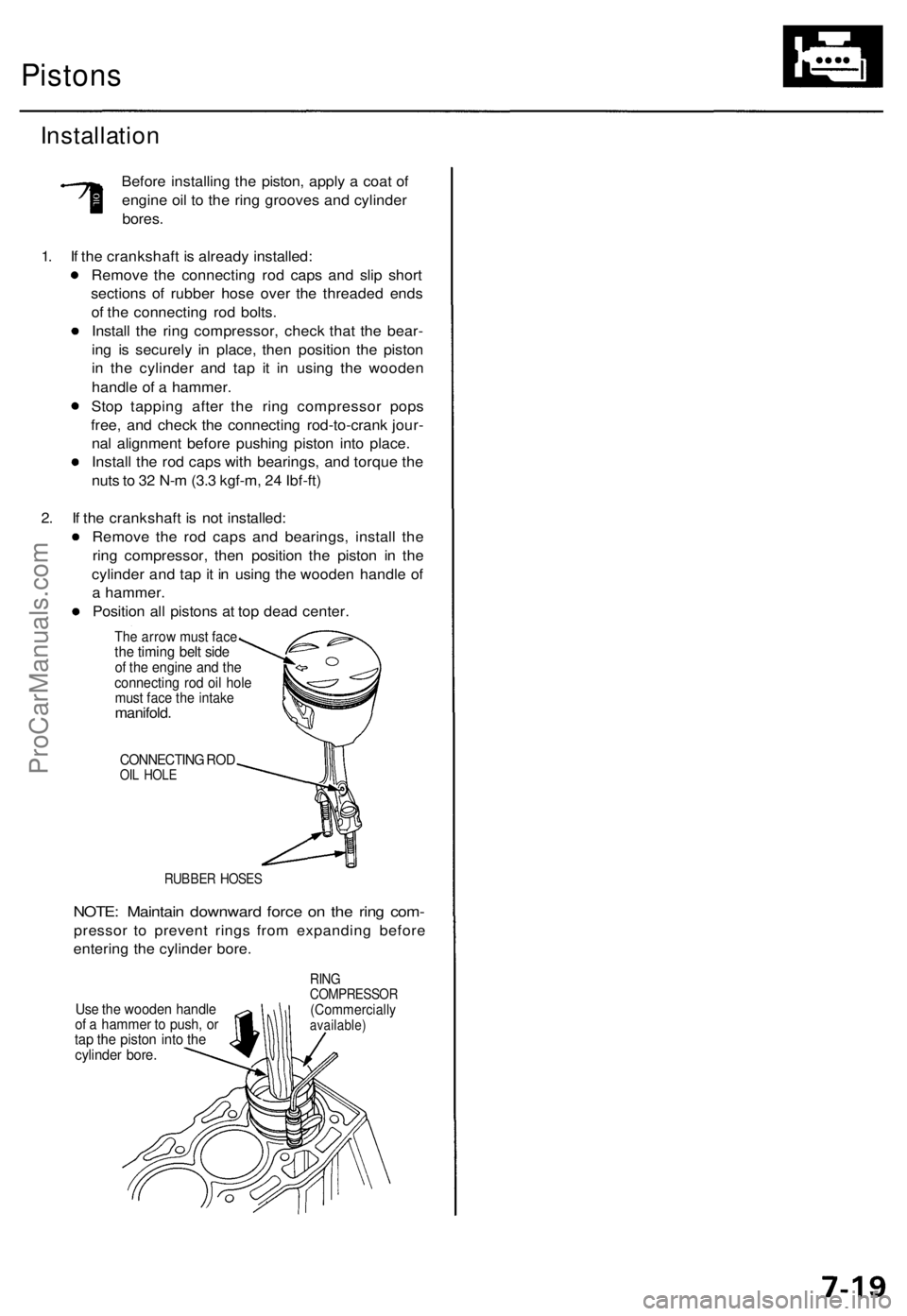
1. If the crankshaft is already installed:
Remove the connecting rod caps and slip short
sections of rubber hose over the threaded ends
of the connecting rod bolts.
Install the ring compressor, check that the bear-
ing is securely in place, then position the piston
in the cylinder and tap it in using the wooden
handle of a hammer.
Stop tapping after the ring compressor pops
free, and check the connecting rod-to-crank jour-
nal alignment before pushing piston into place.
Install the rod caps with bearings, and torque the
nuts to 32 N-m (3.3 kgf-m, 24 Ibf-ft)
2. If the crankshaft is not installed:
Remove the rod caps and bearings, install the
ring compressor, then position the piston in the
cylinder and tap it in using the wooden handle of
a hammer.
Position all pistons at top dead center.
The arrow must face
the timing belt side
of the engine and the
connecting rod oil hole
must face the intake
manifold.
CONNECTING ROD
OIL HOLE
RUBBER HOSES
NOTE: Maintain downward force on the ring com-
pressor to prevent rings from expanding before
entering the cylinder bore.
Use the wooden handle
of a hammer to push, or
tap the piston into the
cylinder bore.
RING
COMPRESSOR
(Commercially
available)ProCarManuals.com