check engine ACURA TL 1995 Service Owner's Guide
[x] Cancel search | Manufacturer: ACURA, Model Year: 1995, Model line: TL, Model: ACURA TL 1995Pages: 1771, PDF Size: 62.49 MB
Page 319 of 1771
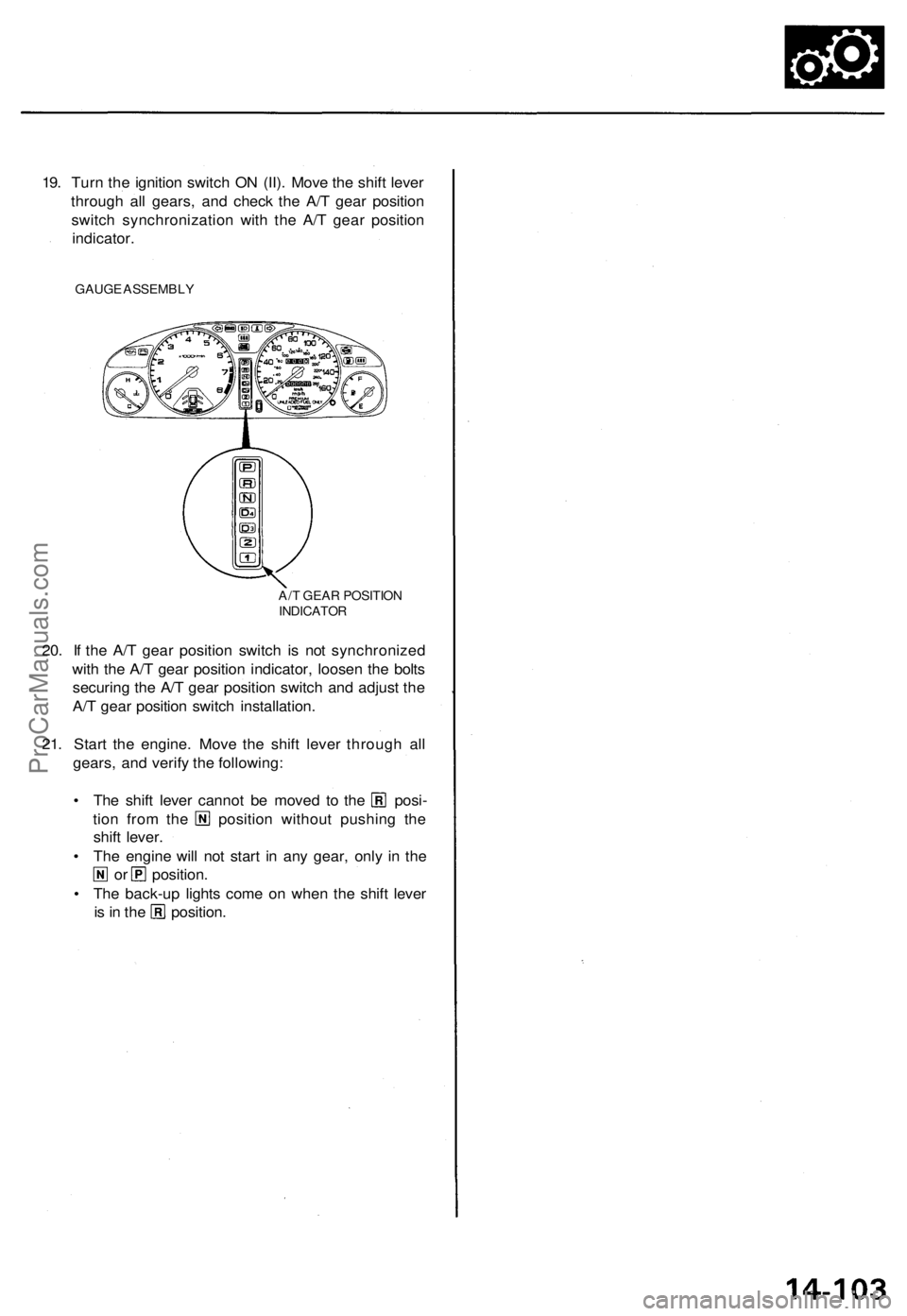
19. Turn the ignition switch ON (II). Move the shift lever
through all gears, and check the A/T gear position
switch synchronization with the A/T gear position
indicator.
GAUGE ASSEMBLY
20. If the A/T gear position switch is not synchronized
with the A/T gear position indicator, loosen the bolts
securing the A/T gear position switch and adjust the
A/T gear position switch installation.
21. Start the engine. Move the shift lever through all
gears, and verify the following:
• The shift lever cannot be moved to the posi-
tion from the position without pushing the
shift lever.
• The engine will not start in any gear, only in the
or position.
• The back-up lights come on when the shift lever
is in the position.
A/T GEAR POSITION
INDICATORProCarManuals.com
Page 320 of 1771
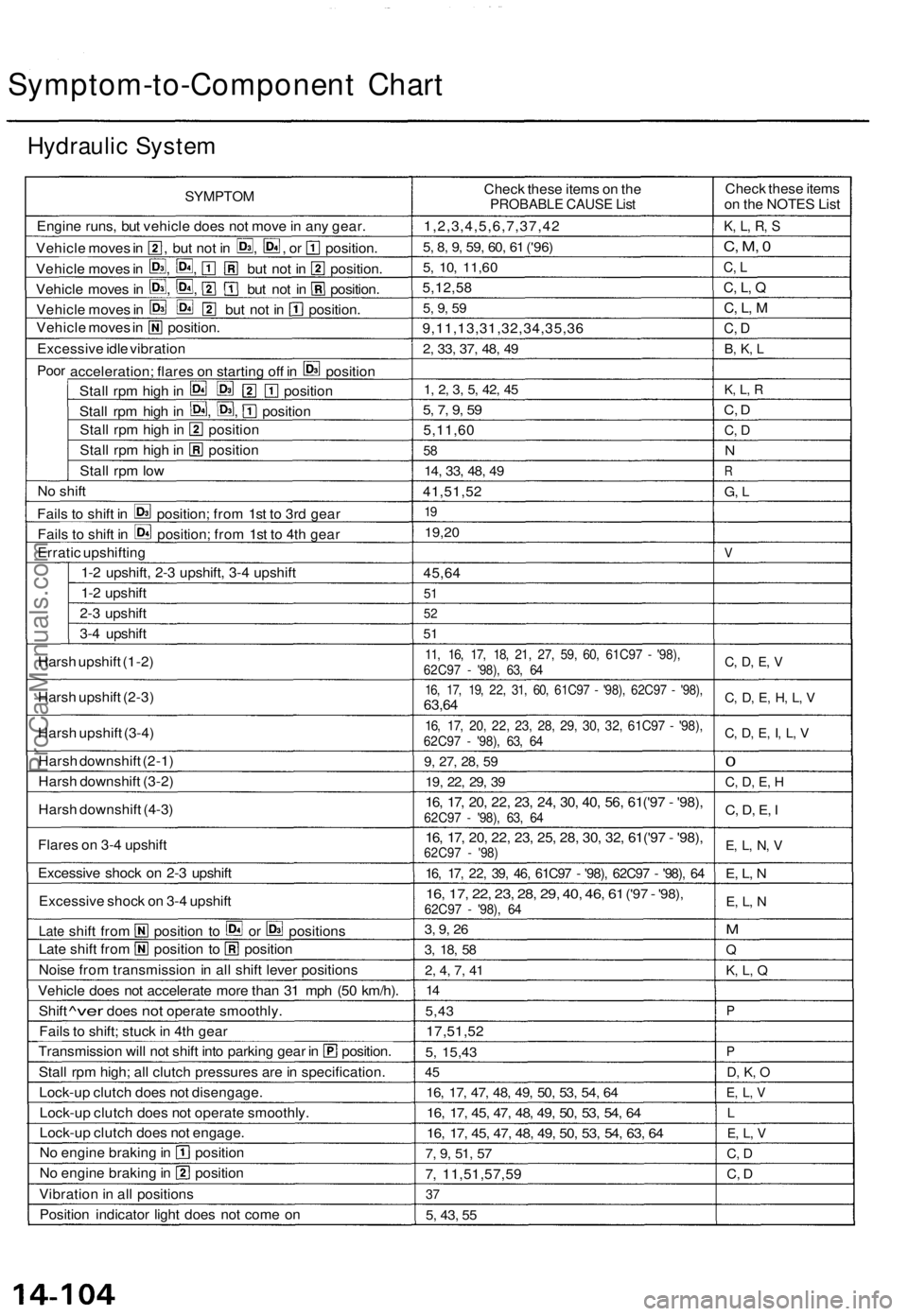
Symptom-to-Component Chart
Hydraulic System
SYMPTOM
Engine runs, but vehicle does not move in any gear.
Vehicle moves in , but not in , , or position.
Vehicle moves in , , but not in position.
Vehicle moves in , , but not in position.
Vehicle moves in but not in position.
Vehicle moves in position.
Excessive idle vibration
Poor
acceleration; flares on starting off in position
Stall rpm high in position
Stall rpm high in , , position
Stall rpm high in position
Stall rpm high in position
Stall rpm low
No shift
Fails to shift in position; from 1st to 3rd gear
Fails to shift in position; from 1st to 4th gear
Erratic upshifting
1-2 upshift, 2-3 upshift, 3-4 upshift
1-2 upshift
2-3 upshift
3-4 upshift
Harsh upshift (1-2)
Harsh upshift (2-3)
Harsh upshift (3-4)
Harsh downshift (2-1)
Harsh downshift (3-2)
Harsh downshift (4-3)
Flares on 3-4 upshift
Excessive shock on 2-3 upshift
Excessive shock on 3-4 upshift
Late
shift from position to or positions
Late shift from position to position
Noise from transmission in all shift lever positions
Vehicle does not accelerate more than 31 mph (50 km/h).
Shift
^ver
does
not
operate smoothly.
Fails to shift; stuck in 4th gear
Transmission will not shift into parking gear in position.
Stall
rpm high; all clutch pressures are in specification.
Lock-up clutch does not disengage.
Lock-up clutch does not operate smoothly.
Lock-up clutch does not engage.
No engine braking in position
No engine braking in position
Vibration in all positions
Position indicator light does not come on
Check these items on the
PROBABLE CAUSE List
1,2,3,4,5,6,7,37,42
5, 8, 9, 59, 60, 61
('96)
5, 10,
11,60
5,12,58
5, 9, 59
9,11,13,31,32,34,35,36
2, 33, 37, 48, 49
1, 2, 3, 5, 42, 45
5, 7, 9, 59
5,11,60
58
14, 33, 48, 49
41,51,52
19
19,20
45,64
51
52
51
11, 16, 17, 18, 21, 27, 59, 60, 61C97 - '98),
62C97 - '98), 63, 64
16, 17, 19, 22, 31, 60, 61C97 - '98), 62C97 - '98),
63,64
16, 17, 20, 22, 23, 28, 29, 30, 32, 61C97 - '98),
62C97 - '98), 63, 64
9, 27, 28, 59
19, 22, 29, 39
16, 17, 20, 22, 23, 24, 30, 40, 56, 61('97 - '98),
62C97 - '98), 63, 64
16, 17, 20, 22, 23, 25, 28, 30, 32, 61('97 - '98),
62C97 - '98)
16, 17, 22, 39, 46, 61C97 - '98), 62C97 - '98), 64
16, 17, 22, 23, 28, 29, 40, 46, 61
('97
-
'98),
62C97 - '98), 64
3, 9, 26
3, 18, 58
2, 4, 7, 41
14
5,43
17,51,52
5,
15,43
45
16, 17, 47, 48, 49, 50, 53, 54, 64
16, 17, 45, 47, 48, 49, 50, 53, 54, 64
16, 17, 45, 47, 48, 49, 50, 53, 54, 63, 64
7, 9, 51, 57
7, 11,51,57,59
37
5, 43, 55
Check these items
on the NOTES List
K, L, R, S
C, M, 0
C, L
C, L, Q
C, L, M
C, D
B, K, L
K, L, R
C, D
C, D
N
R
G, L
V
C, D, E, V
C, D, E, H, L, V
C, D, E, I, L, V
0
C, D, E, H
C, D, E, I
E, L, N, V
E, L, N
E, L, N
M
Q
K, L, Q
P
P
D, K, O
E, L, V
L
E, L, V
C, D
C, DProCarManuals.com
Page 321 of 1771
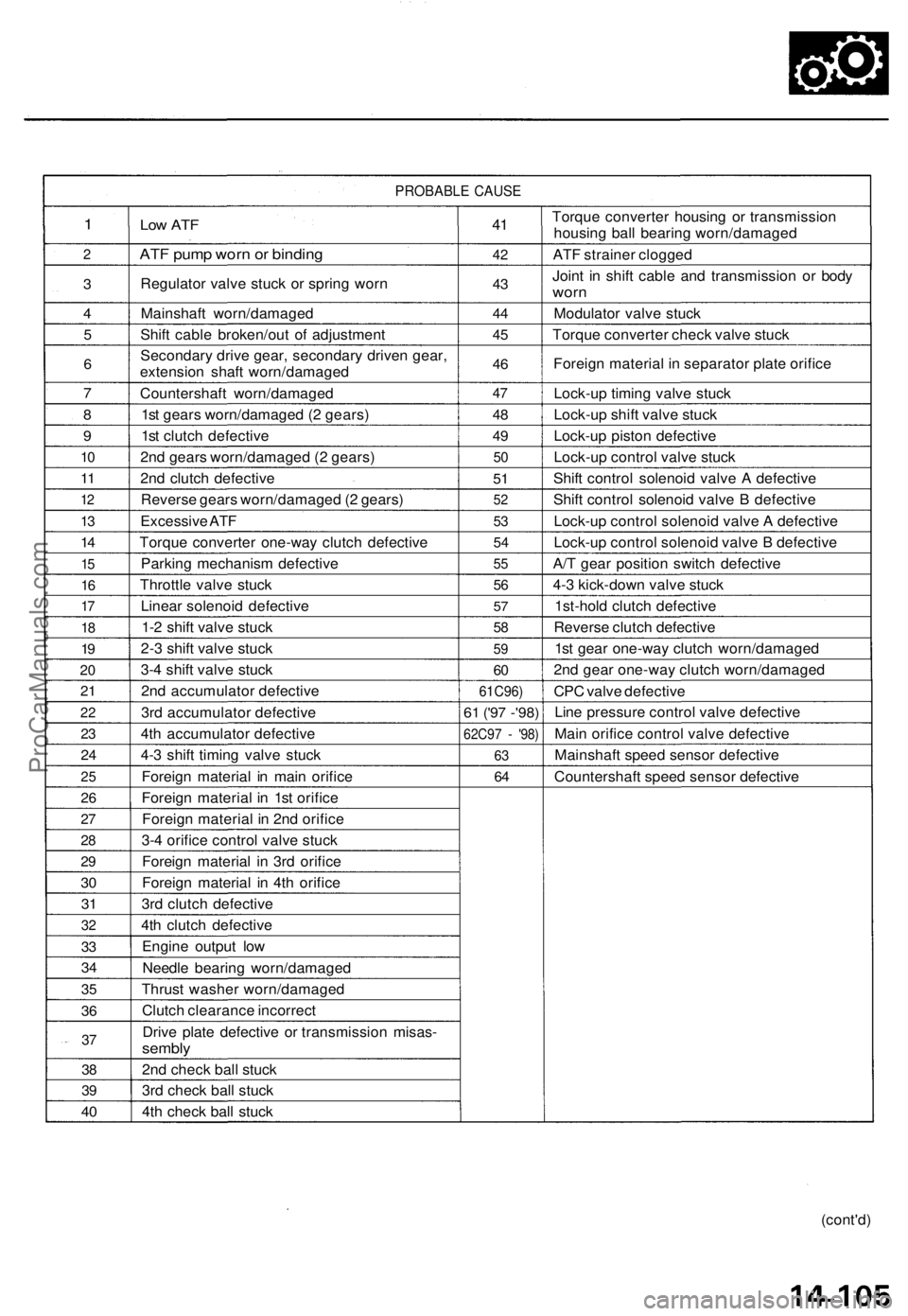
PROBABLE CAUSE
1
2
3
4
5
6
7
8
9
10
11
12
13
14
15
16
17
18
19
20
21
22
23
24
25
26
27
28
29
30
31
32
33
34
35
36
37
38
39
40
Low ATF
ATF pump worn or binding
Regulator valve stuck or spring worn
Mainshaft worn/damaged
Shift cable broken/out of adjustment
Secondary drive gear, secondary driven gear,
extension shaft worn/damaged
Countershaft worn/damaged
1st gears worn/damaged (2 gears)
1st clutch defective
2nd gears worn/damaged (2 gears)
2nd clutch defective
Reverse gears worn/damaged (2 gears)
Excessive ATF
Torque converter one-way clutch defective
Parking mechanism defective
Throttle valve stuck
Linear solenoid defective
1-2 shift valve stuck
2-3 shift valve stuck
3-4 shift valve stuck
2nd accumulator defective
3rd accumulator defective
4th accumulator defective
4-3 shift timing valve stuck
Foreign material in main orifice
Foreign material in 1st orifice
Foreign material in 2nd orifice
3-4 orifice control valve stuck
Foreign material in 3rd orifice
Foreign material in 4th orifice
3rd clutch defective
4th clutch defective
Engine output low
Needle bearing worn/damaged
Thrust washer worn/damaged
Clutch clearance incorrect
Drive plate defective or transmission misas-
sembly
2nd check ball stuck
3rd check ball stuck
4th check ball stuck
41
42
43
44
45
46
47
48
49
50
51
52
53
54
55
56
57
58
59
60
61C96)
61
('97 -'98)
62C97 - '98)
63
64
Torque converter housing or transmission
housing ball bearing worn/damaged
ATF strainer clogged
Joint in shift cable and transmission or body
worn
Modulator valve stuck
Torque converter check valve stuck
Foreign material in separator plate orifice
Lock-up timing valve stuck
Lock-up shift valve stuck
Lock-up piston defective
Lock-up control valve stuck
Shift control solenoid valve A defective
Shift control solenoid valve B defective
Lock-up control solenoid valve A defective
Lock-up control solenoid valve B defective
A/T gear position switch defective
4-3 kick-down valve stuck
1st-hold clutch defective
Reverse clutch defective
1st gear one-way clutch worn/damaged
2nd gear one-way clutch worn/damaged
CPC valve defective
Line pressure control valve defective
Main orifice control valve defective
Mainshaft speed sensor defective
Countershaft speed sensor defective
(cont'd)ProCarManuals.com
Page 326 of 1771
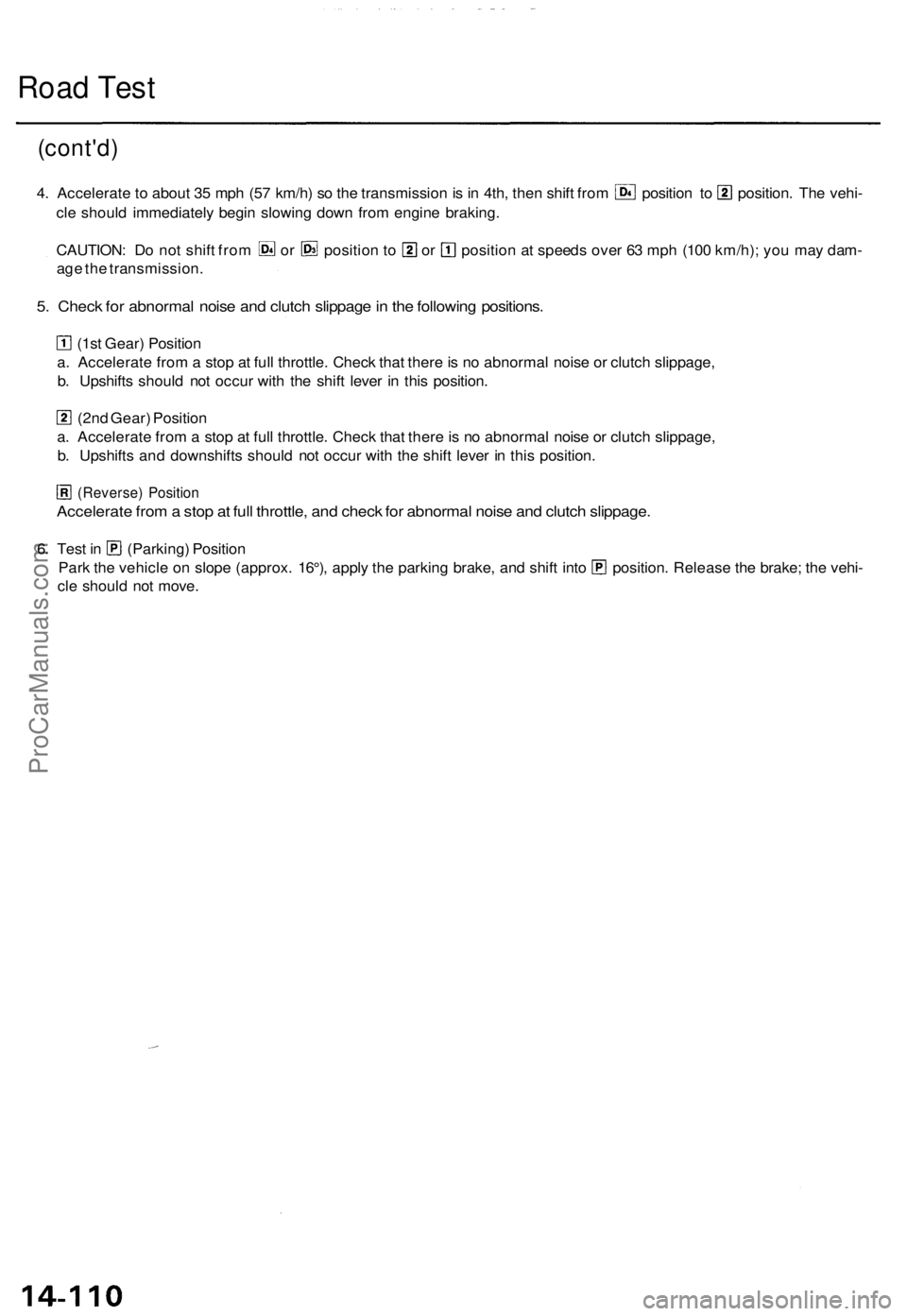
Road Test
(cont'd)
4. Accelerate to about 35 mph (57 km/h) so the transmission is in 4th, then shift from position to position. The vehi-
cle should immediately begin slowing down from engine braking.
CAUTION: Do not shift from or position to or position at speeds over 63 mph (100 km/h); you may dam-
age the transmission.
5. Check for abnormal noise and clutch slippage in the following positions.
(1st Gear) Position
a. Accelerate from a stop at full throttle. Check that there is no abnormal noise or clutch slippage,
b. Upshifts should not occur with the shift lever in this position.
(2nd Gear) Position
a. Accelerate from a stop at full throttle. Check that there is no abnormal noise or clutch slippage,
b. Upshifts and downshifts should not occur with the shift lever in this position.
(Reverse) Position
Accelerate from a stop at full throttle, and check for abnormal noise and clutch slippage.
6. Test in (Parking) Position
Park the vehicle on slope (approx. 16°), apply the parking brake, and shift into position. Release the brake; the vehi-
cle should not move.ProCarManuals.com
Page 328 of 1771
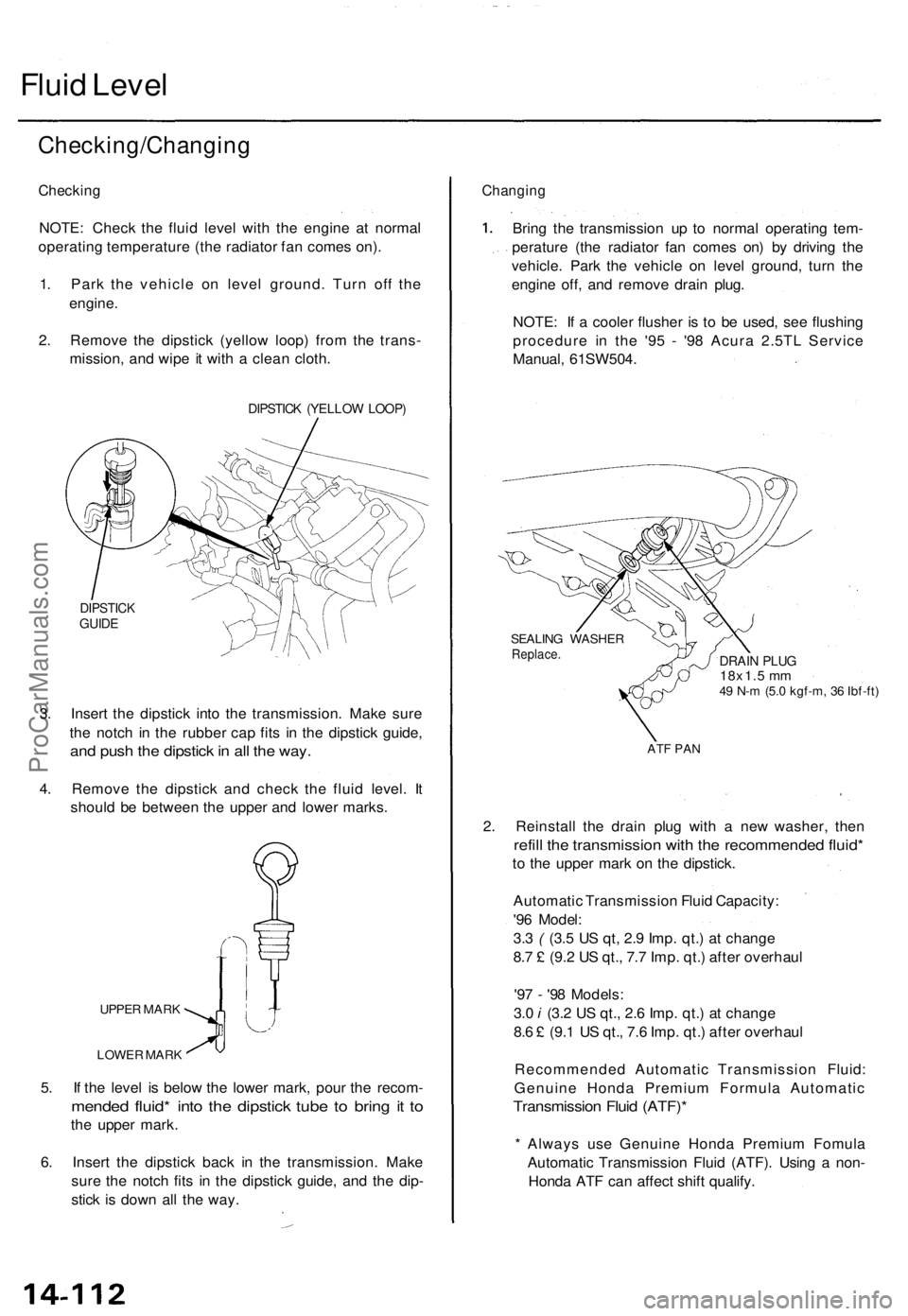
Fluid Level
Checking/Changing
Checking
NOTE: Check the fluid level with the engine at normal
operating temperature (the radiator fan comes on).
1. Park the vehicle on level ground. Turn off the
engine.
2. Remove the dipstick (yellow loop) from the trans-
mission, and wipe it with a clean cloth.
DIPSTICK (YELLOW LOOP)
DIPSTICK
GUIDE
3. Insert the dipstick into the transmission. Make sure
the notch in the rubber cap fits in the dipstick guide,
and push the dipstick in all the way.
4. Remove the dipstick and check the fluid level. It
should be between the upper and lower marks.
UPPER MARK
LOWER MARK
5. If the level is below the lower mark, pour the recom-
mended fluid* into the dipstick tube to bring it to
the upper mark.
6. Insert the dipstick back in the transmission. Make
sure the notch fits in the dipstick guide, and the dip-
stick is down all the way.
Changing
Bring the transmission up to normal operating tem-
perature (the radiator fan comes on) by driving the
vehicle. Park the vehicle on level ground, turn the
engine off, and remove drain plug.
NOTE: If a cooler flusher is to be used, see flushing
procedure in the '95 - '98 Acura 2.5TL Service
Manual, 61SW504.
SEALING WASHER
Replace.
DRAIN PLUG
18x1.5 mm
49 N-m (5.0 kgf-m, 36 Ibf-ft)
ATF PAN
2. Reinstall the drain plug with a new washer, then
refill the transmission with the recommended fluid*
to the upper mark on the dipstick.
Automatic Transmission Fluid Capacity:
'96 Model:
3.3 ( (3.5 US qt, 2.9 Imp. qt.) at change
8.7 £ (9.2 US qt., 7.7 Imp. qt.) after overhaul
'97 - '98 Models:
3.0 i (3.2 US qt., 2.6 Imp. qt.) at change
8.6 £ (9.1 US qt., 7.6 Imp. qt.) after overhaul
Recommended Automatic Transmission Fluid:
Genuine Honda Premium Formula Automatic
Transmission Fluid (ATF)*
* Always use Genuine Honda Premium Fomula
Automatic Transmission Fluid (ATF). Using a non-
Honda ATF can affect shift qualify.ProCarManuals.com
Page 334 of 1771
![ACURA TL 1995 Service Owners Guide
6. Disconnect the transmission sub-harness connector (14P).
7. Start the engine, and run it at 2,000 rpm.
TRANSMISSION SUB-HARNESS
CONNECTOR (14P)
8. Shift to the [HI or [P] position, and measure](/img/32/56993/w960_56993-333.png "ACURA TL 1995 Service Owners Guide
6. Disconnect the transmission sub-harness connector (14P).
7. Start the engine, and run it at 2,000 rpm.
TRANSMISSION SUB-HARNESS
CONNECTOR (14P)
8. Shift to the [HI or [P] position, and measure")
6. Disconnect the transmission sub-harness connector (14P).
7. Start the engine, and run it at 2,000 rpm.
TRANSMISSION SUB-HARNESS
CONNECTOR (14P)
8. Shift to the [HI or [P] position, and measure line pressure at fully-opened throttle.
9. Connect battery voltage to the linear solenoid terminals of the transmission sub-harness connector as shown.
10. Measure line pressure at fully-closed throttle.
If line pressure is out of specification, check and repair the probable cause in the table below.
PRESSURE
Line
SHIFT LEVER
POSITION
or
SYMPTOM
No (or
low)
line pressure
PROBABLE CAUSE
Torque converter,
ATF pump, pres-
sure regulator.
torque converter
check valve
FLUID PRESSURE
Standard
520 kPa
(5.3 kgf/cm2, 75 psi)
Fully closed throttle
|
910 kPa
(9.3 kgf/cm2, 130 psi)
Fully opened throttle
Service Limit
500 kPa
(5.1 kgf/cm2, 73 psi)
Fully closed throttle
790 kPa
(8.1 kgf/cm2, 120 psi)
Fully opened throttle
11. Stop the engine, and connect the transmission sub-harness connector (14P).
12. Disconnect the special tool from line pressure inspection hole, and connect the special tool to each inspection hole.
13. Start the engine, and run it at 2,000 rpm.
(cont'd)ProCarManuals.com
Page 424 of 1771
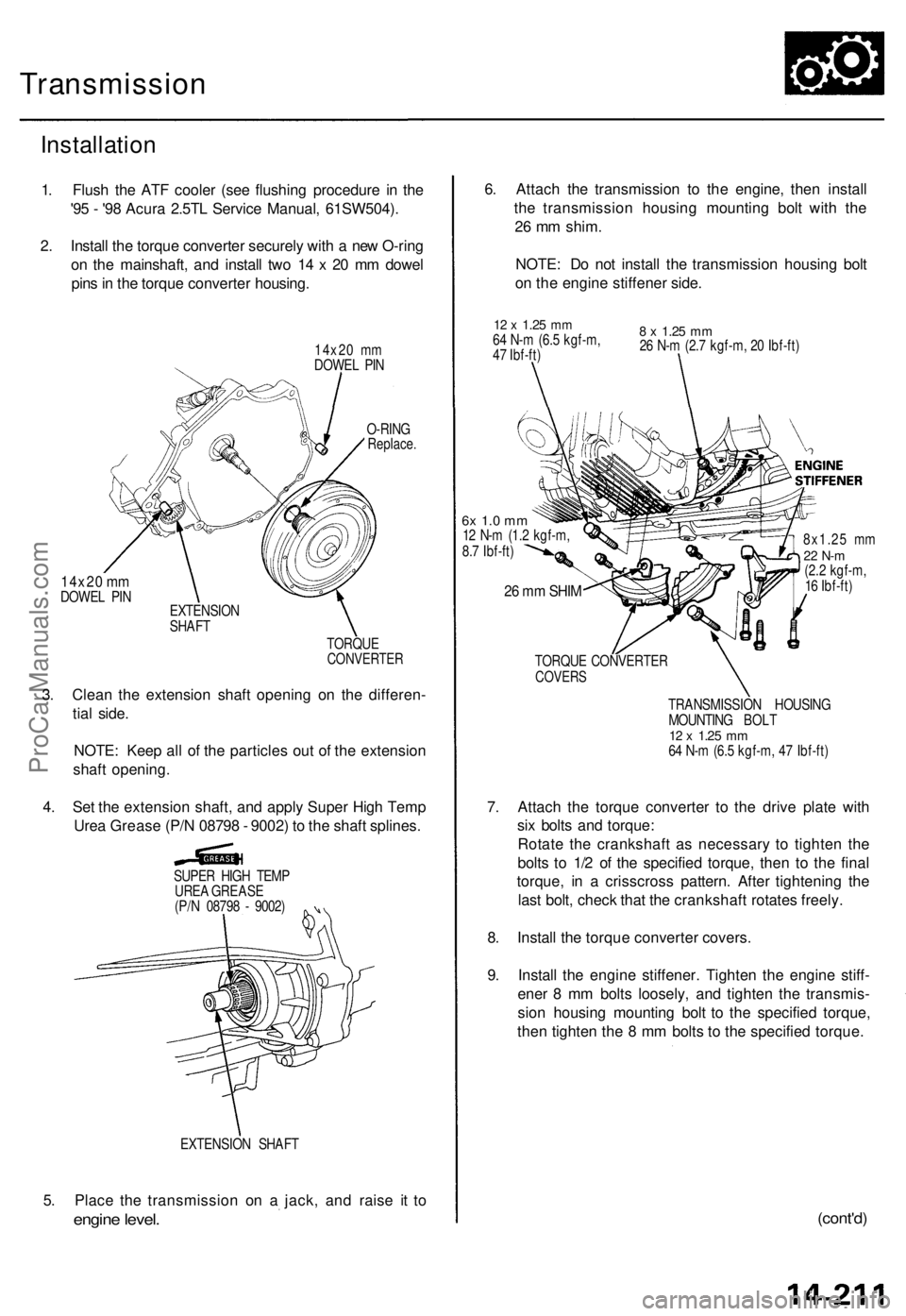
Transmission
Installation
1. Flush the ATF cooler (see flushing procedure in the
'95 - '98 Acura 2.5TL Service Manual, 61SW504).
2. Install the torque converter securely with a new O-ring
on the mainshaft, and install two 14 x 20 mm dowel
pins in the torque converter housing.
14x20 mm
DOWEL PIN
14x20 mm
DOWEL PIN
O-RING
Replace.
EXTENSION
SHAFT
TORQUE
CONVERTER
3. Clean the extension shaft opening on the differen-
tial side.
NOTE: Keep all of the particles out of the extension
shaft opening.
4. Set the extension shaft, and apply Super High Temp
Urea Grease (P/N 08798 - 9002) to the shaft splines.
SUPER HIGH TEMP
UREA GREASE
(P/N 08798 - 9002)
EXTENSION SHAFT
5. Place the transmission on a jack, and raise it to
engine level.
6. Attach the transmission to the engine, then install
the transmission housing mounting bolt with the
26 mm shim.
NOTE: Do not install the transmission housing bolt
on the engine stiffener side.
12 x
1.25
mm
64 N-m (6.5 kgf-m,
47 Ibf-ft)
8 x
1.25
mm
26 N-m (2.7 kgf-m, 20 Ibf-ft)
6x 1.0 mm
12 N-m (1.2 kgf-m,
8.7 Ibf-ft)
26 mm SHIM
8x1.25 mm
22 N-m
(2.2 kgf-m,
16 Ibf-ft)
TORQUE CONVERTER
COVERS
TRANSMISSION HOUSING
MOUNTING BOLT
12 x
1.25
mm
64 N-m (6.5 kgf-m, 47 Ibf-ft)
7. Attach the torque converter to the drive plate with
six bolts and torque:
Rotate the crankshaft as necessary to tighten the
bolts to 1/2 of the specified torque, then to the final
torque, in a crisscross pattern. After tightening the
last bolt, check that the crankshaft rotates freely.
8. Install the torque converter covers.
9. Install the engine stiffener. Tighten the engine stiff-
ener 8 mm bolts loosely, and tighten the transmis-
sion housing mounting bolt to the specified torque,
then tighten the 8 mm bolts to the specified torque.
(cont'd)ProCarManuals.com
Page 488 of 1771
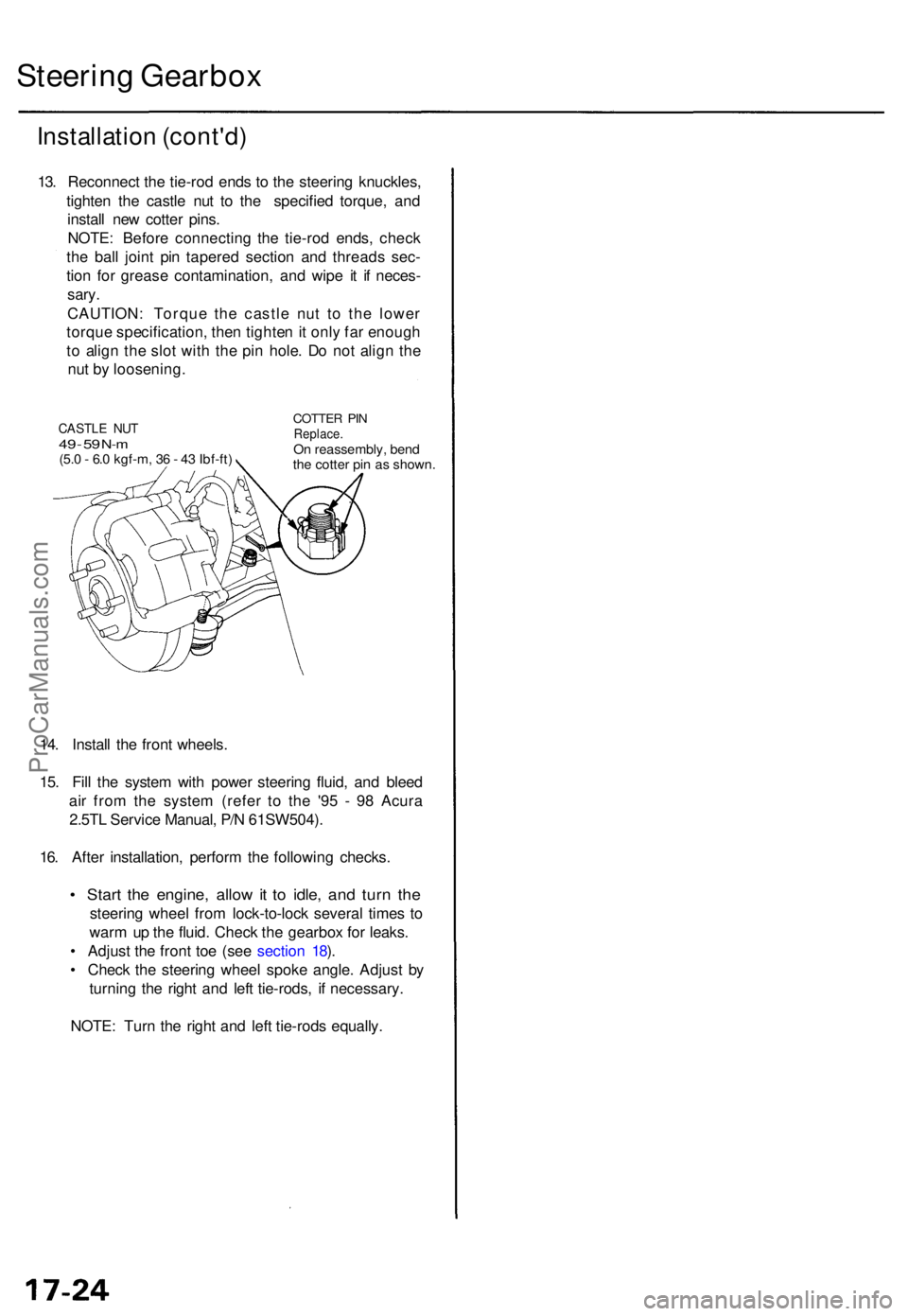
Steering Gearbo x
Installatio n (cont'd )
13. Reconnec t th e tie-ro d end s t o th e steerin g knuckles ,
tighte n th e castl e nu t t o th e specifie d torque , an d
instal l ne w cotte r pins .
NOTE : Befor e connectin g th e tie-ro d ends , chec k
th e bal l join t pi n tapere d sectio n an d thread s sec -
tio n fo r greas e contamination , an d wip e i t i f neces -
sary.
CAUTION : Torqu e th e castl e nu t t o th e lowe r
torqu e specification , the n tighte n it onl y fa r enoug h
t o alig n th e slo t wit h th e pi n hole . D o no t alig n th e
nu t b y loosening .
14 . Instal l th e fron t wheels .
15 . Fil l th e syste m wit h powe r steerin g fluid , an d blee d
ai r fro m th e syste m (refe r t o th e '9 5 - 9 8 Acur a
2.5T L Servic e Manual , P/ N 61SW504) .
16 . Afte r installation , perfor m th e followin g checks .
• Star t th e engine , allo w it t o idle , an d tur n th e
steerin g whee l fro m lock-to-loc k severa l time s t o
war m u p th e fluid . Chec k th e gearbo x fo r leaks .
• Adjus t th e fron t to e (se e sectio n 18 ).
• Chec k th e steerin g whee l spok e angle . Adjus t b y
turning the righ t an d lef t tie-rods , i f necessary .
NOTE : Tur n th e righ t an d lef t tie-rod s equally .
CASTLE NU T49 - 5 9 N- m(5. 0 - 6. 0 kgf-m , 3 6 - 4 3 Ibf-ft )
COTTE R PI NReplace .On reassembly , ben d
th e cotte r pi n a s shown .
ProCarManuals.com
Page 508 of 1771
Troubleshooting Precautions
ABS Indicator Light:
The ABS indicator light comes on for three seconds and then goes off when the control unit detects no problem during the
initial diagnosis right after the engine starts. However, the ABS indicator light can stay on for up to 40 seconds when the
control unit starts to check for pump overrun, etc. during the initial diagnosis. The ABS indicator light comes on, and the
ABS control unit memorizes the diagnostic trouble code (DTC) under certain conditions.
• The parking brake is applied for more than 30 seconds while the vehicle is being driven. (DTC 2-1)
• The transmission downshifted excessively. (DTC 4-1, 4-2)
• The vehicle loses traction, and the front wheels spin for more than one minute when starting from a stuck condition on
a muddy, snowy, or sandy road. (DTC 4-8)
• Tire adhesion is lost due to excessive cornering speed. (DTC 5, 5-4, 5-8)
• The vehicle is driven on an extremely rough road. (DTC 8-1)
• The vehicle is interfered by strong radio waves (noise), for example, illegal radio, etc. (DTC 8-2)
NOTE: If there is any trouble in the system, the ABS indicator light comes on during driving.
Diagnostic Trouble Code (DTC):
• When the control unit detects a problem and the ABS indicator light comes on, the control unit memorizes the DTC.
• The control unit has three memory registers. When a problem occurs, the control unit stores the DTC in the first memory
register. If another problem occurs, or the same problem occurs again, the control unit moves the first DTC to the next
memory register, and stores the second DTC in the first register. If there's a third problem occurrence, the two existing
DTCs are moved up one register, and the third DTC is stored in the first register. If problems continue to occur, the oldest
problem is moved out of the last register and lost, and the most recent problem is stored in the first register. When the
same problem occurs three times, the same DTC is stored in all memory registers. (Refer to the Symptom-to-System
Chart for diagnostic period.)
• The most recent DTC is indicated first, and the oldest DTC is indicated last.
• The DTCs are erased from the control unit when the ABS control unit +B2 power supply or connector is disconnected.
• The control unit's memory can be erased by disconnecting the ABS B2 fuse for more than three seconds.
Self-diagnosis:
• There are three self-diagnosises described below.
Initial diagnosis: Performed right after the engine starts until the ABS indicator light goes off.
Regular diagnosis: Continuously performed (under some conditions) after the ABS indicator light goes off until the
engine stops.
Individual part/system diagnosis: Diagnosis about a specific part/system under its operating conditions.
• The CPU (central processing unit) controls the following when it detects a problem during self-diagnosis:
Turns the ABS indicator light ON.
Turns the front and rear fail-safe relays off.
Stops the ABS control.
Stops the ABS pump. (The pump may work under some conditions.)
After the DTC is stored in the control unit, the CPU stops self-diagnosis.ProCarManuals.com
Page 509 of 1771
Kickback and Pump Operation:
• When the engine is started, the ABS control unit begins the initial diagnosis and operates the solenoid valve one time.
The kickback may be felt when the brake pedal is depressed.
• When the ABS control unit detects the pressure switch OFF signal during the initial diagnosis, it operates the pump
motor, and performs the pump motor over-run diagnosis and pump motor diagnosis. Therefore, there are two cases
where the pump motor operates or does not operate after the engine is started.
• Normally, after the initial diagnosis, the pump motor operates based on the pressure switch signal, regardless of the
vehicle speed.
Troubleshooting:
• When two or three DTCs are stored in the control unit, perform troubleshooting for the DTC that appears first.
• When a customer's reported problem cannot be verified on the car, ask the customer about the conditions when the
ABS indicator light came ON, and test-drive the car under those conditions, if possible. When the ABS indicator light
does not come ON during the test, check for loose terminals and check by shaking the harnesses and connectors while
following the flowchart.
• The connector terminal numbers are viewed from the wire side for the female terminals, and from the terminal side for
the male terminals.
• After the repair is completed, test-drive the car and check that the ABS indicator light does not come ON again during
the test. (Refer to the Symptom-to-System Chart for diagnostic period.)ProCarManuals.com