light Acura ZDX 2012 Manual Online
[x] Cancel search | Manufacturer: ACURA, Model Year: 2012, Model line: ZDX, Model: Acura ZDX 2012Pages: 370, PDF Size: 10.06 MB
Page 331 of 370
329Continued
Handling the Unexpected
Jump Starting
Turn off the power to electric devices, such as audio and lights. Turn off the engine,
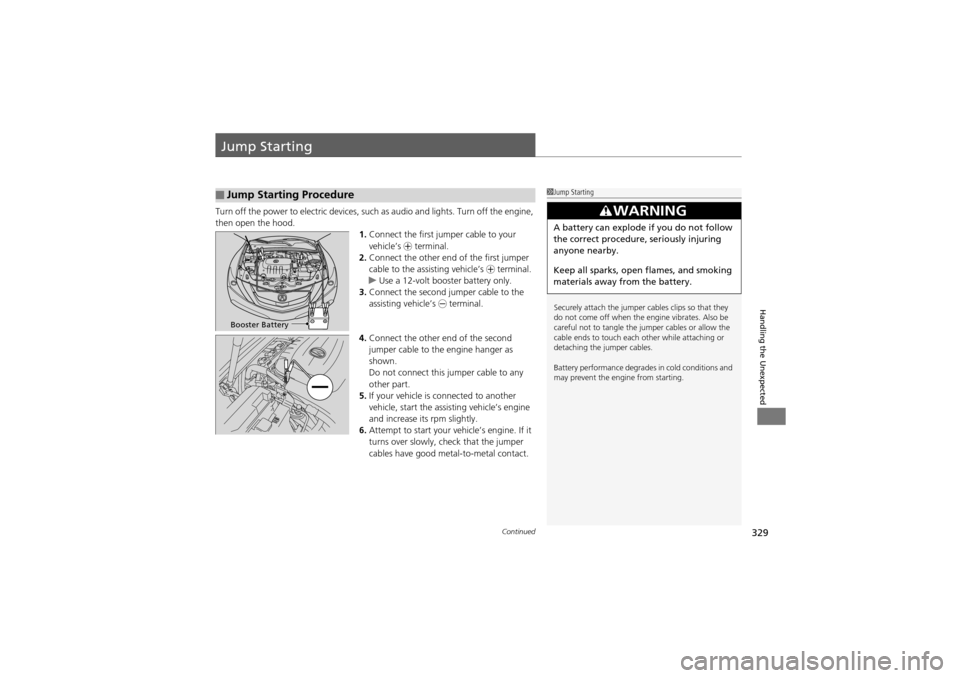
then open the hood. 1.Connect the first jumper cable to your
vehicle’s + terminal.
2. Connect the other end of the first jumper
cable to the assisting vehicle’s + terminal.
u Use a 12-volt booster battery only.
3. Connect the second ju mper cable to the
assisting vehicle’s - terminal.
4. Connect the other end of the second
jumper cable to the engine hanger as
shown.
Do not connect this jumper cable to any
other part.
5. If your vehicle is connected to another
vehicle, start the assi sting vehicle’s engine
and increase its rpm slightly.
6. Attempt to start your vehicle’s engine. If it
turns over slowly, ch eck that the jumper
cables have good metal-to-metal contact.
■Jump Starting Procedure1 Jump Starting
Securely attach the jumper cables clips so that they
do not come off when the e ngine vibrates. Also be
careful not to tangle the jumper cables or allow the
cable ends to touch each other while attaching or
detaching the jumper cables.
Battery performance degrades in cold conditions and
may prevent the engine from starting.
3WARNING
A battery can explode if you do not follow
the correct procedure, seriously injuring
anyone nearby.
Keep all sparks, open flames, and smoking
materials away from the battery.
Booster Battery
Page 334 of 370
332
Handling the Unexpected
Overheating
How to Handle Overheating
Overheating symptoms are as follows:
•The temperature gauge needle is at the mark or the engine suddenly loses
power.
• Steam is coming out of the engine compartment.
■First thing to do
1. Immediately park the vehicle in a safe place.
u Move the shift lever to
P and set the parking brake. Turn off all accessories
and turn on the hazard warning lights.
2. No steam coming out: Keep the engine running and open the hood.
Steam coming out: Turn off the engine and wait until steam goes away.
Then, open the hood.
1 How to Handle Overheating
NOTICEContinuing to drive with the temperature gauge
needle at the mark may damage the engine.
3WARNING
Steam and spray from an overheated
engine can seriously scald you.
Do not open the hood if steam is coming
out.
H
H
Page 336 of 370
334
Handling the Unexpected
Indicator, Coming On/Blinking
If the Low Oil Pressure Indicator Comes On
■Reasons for the indicator to come on
Comes on when the engine oil pressure is low.
■What to do as soon as the indicator comes on
1. Immediately park the vehicle in a safe place.
2. If necessary, turn the hazard warning lights on.
■What to do after parking the vehicle
1. Stop the engine and let it sit for about one minute.
2. Open the hood and check the oil level.
u Add oil as necessary.
3. Start the engine and check th e low oil pressure indicator.
u The light goes out: Start driving again.
u The light does not go out within 10 seconds: Stop the engine and
contact a dealer for repairs immediately.
If the Charging System Indicator Comes On
■Reasons for the indicator to come on
Comes on when the battery is not being charged.
■What to do when the indicator comes on
Turn off the climate control system, rear defogger, and other electrical
systems, and immediately contact a dealer for repairs.
1 If the Low Oil Pressure Indicator Comes On
NOTICERunning the engine with lo w oil pressure can cause
serious mechanical damage almost immediately.
1 If the Charging System Indicator Comes On
If you need to stop temporarily, do not turn off the
engine. Restarting the engi ne may rapidly discharge
the battery.
Page 338 of 370
336
uuIndicator, Coming On/Blinking uIf the Brake System Indicator (Red) Comes On
Handling the Unexpected
If the Brake System Indicator (Red) Comes On
■Reasons for the indicator to come on
• The brake fluid is low.
• There is a malfunction in the brake system.
■What to do when the indicator comes on while driving
Press the brake pedal lightly to check pedal pressure.
• If normal, check the brake fluid level the next time you stop.
• If abnormal, take immediate action. If necessary, downshift the
transmission to slow the vehicle using engine braking.
If the ECPS Indicator* Comes On
■Reasons for the indicator to come on
• Comes on when there is a problem with ECPS.
• If you depress the accelerator pedal repeatedly to increase the engine
speed while the engine is idling, the indicator comes on, and
sometimes the steering wheel becomes harder to operate.
■What to do when the indicator comes on
Stop the vehicle in a safe place and restart the engine.
If the indicator comes on and stays on, immediately have your vehicle
inspected by a dealer.
1 If the Brake System In dicator (Red) Comes On
Have your vehicle repaired immediately.
It is dangerous to drive with low brake fluid. If there
is no resistance from the brake pedal, stop
immediately in a safe plac e. If necessary downshift
the gears.
If the brake system indica tor and ABS indicator come
on simultaneously, the electronic brake distribution
system is not working. This can result in vehicle
instability under sudden braking.
Have your vehicle inspected by a dealer immediately.U.S.
Canada
1 If the ECPS Indicator* Comes On
NOTICEIf you repeatedly turn the steering wheel at an
extremely low speed, or ho ld the steering wheel on
the full left or right position for a while, the system
heats up. The system goes into a protective mode,
and limits its performance. The steering wheel
becomes harder and harder to operate. Once the
system cools down, ECPS is restored. Repeated
operation under these conditions can eventually
damage the system.
* Not available on all models
Page 342 of 370
340
uuFuses uCircuit Protected and Amps for Each Fuse
Handling the Unexpected
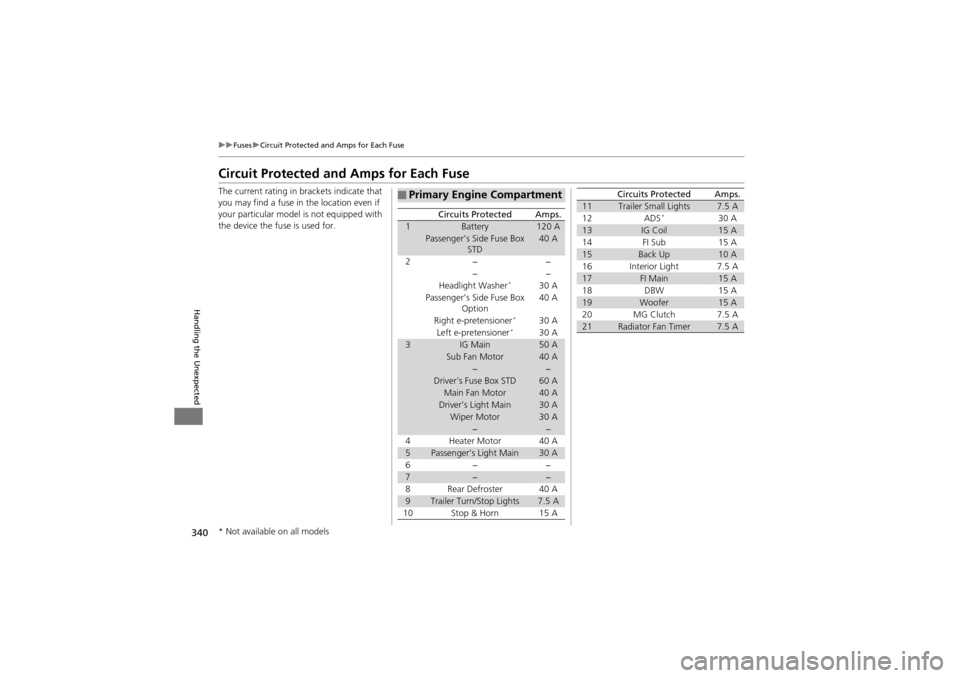
Circuit Protected and Amps for Each Fuse
The current rating in brackets indicate that
you may find a fuse in the location even if
your particular model is not equipped with
the device the fuse is used for.■Primary Engine Compartment
Circuits ProtectedAmps.
1Battery120 A
Passenger’s Side Fuse Box STD40 A
2−−
−−
Headlight Washer*30 A
Passenger’s Side Fuse Box Option40 A
Right e-pretensioner*30 A
Left e-pretensioner*30 A
3IG Main50 A
Sub Fan Motor40 A
−−
Driver’s Fuse Box STD60 A
Main Fan Motor40 A
Driver’s Light Main30 A
Wiper Motor30 A
−−
4Heater Motor40 A
5Passenger’s Light Main30 A
6−−
7−−
8Rear Defroster40 A
9Trailer Turn/Stop Lights7.5 A
10Stop & Horn15 A
11Trailer Small Lights7.5 A
12ADS*30 A
13IG Coil15 A
14FI Sub15 A
15Back Up10 A
16Interior Light7.5 A
17FI Main15 A
18DBW15 A
19Woofer15 A
20MG Clutch7.5 A
21Radiator Fan Timer7.5 A
Circuits ProtectedAmps.
* Not available on all models
Page 343 of 370
341
uuFuses uCircuit Protected and Amps for Each Fuse
Continued
Handling the Unexpected
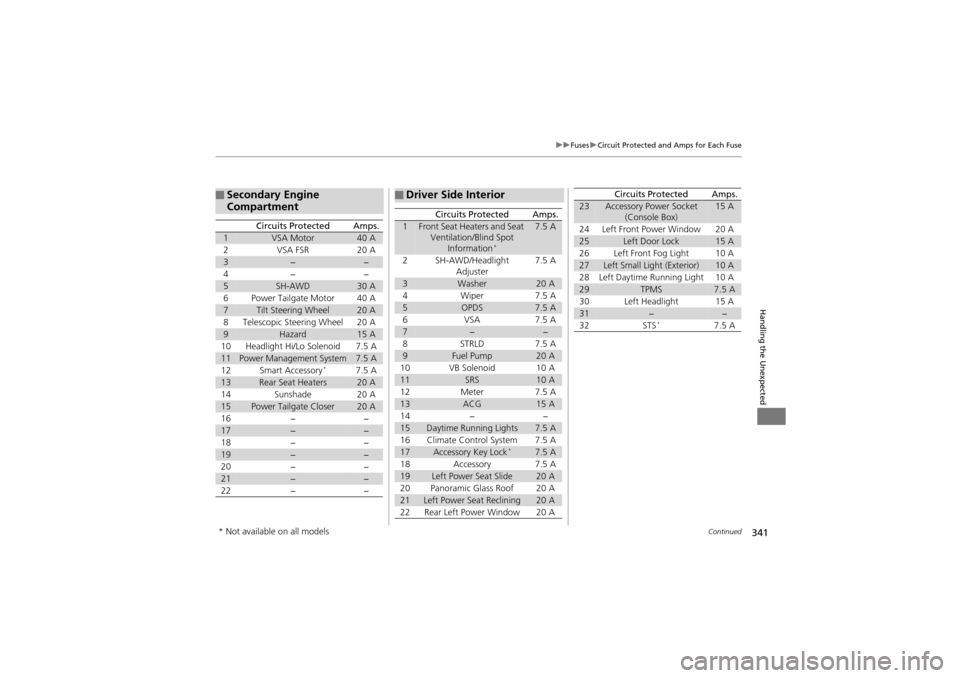
■Secondary Engine
Compartment
Circuits ProtectedAmps.
1VSA Motor40 A
2VSA FSR20 A
3−−
4−−
5SH-AWD30 A
6Power Tailgate Motor40 A
7Tilt Steering Wheel20 A
8Telescopic Steering Wheel20 A
9Hazard15 A
10Headlight Hi/Lo Solenoid7.5 A
11Power Management System7.5 A
12Smart Accessory*7.5 A
13Rear Seat Heaters20 A
14Sunshade20 A
15Power Tailgate Closer20 A
16−−
17−−
18−−
19−−
20−−
21−−
22−−
■Driver Side Interior
Circuits ProtectedAmps.
1Front Seat Heaters and Seat
Ventilation/Blind Spot Information
*
7.5 A
2SH-AWD/Headlight
Adjuster7.5 A
3Washer20 A
4Wiper7.5 A
5OPDS7.5 A
6VSA7.5 A
7−−
8STRLD7.5 A
9Fuel Pump20 A
10VB Solenoid10 A
11SRS10 A
12Meter7.5 A
13ACG15 A
14−−
15Daytime Running Lights7.5 A
16Climate Control System7.5 A
17Accessory Key Lock*7.5 A
18Accessory7.5 A
19Left Power Seat Slide20 A
20Panoramic Glass Roof20 A
21Left Power Seat Reclining20 A
22Rear Left Power Window20 A
23Accessory Power Socket (Console Box)15 A
24Left Front Power Window20 A
25Left Door Lock15 A
26Left Front Fog Light10 A
27Left Small Light (Exterior)10 A
28Left Daytime Running Light10 A
29TPMS7.5 A
30Left Headlight15 A
31−−
32STS*7.5 A
Circuits ProtectedAmps.
* Not available on all models
Page 344 of 370
342
uuFuses uCircuit Protected and Amps for Each Fuse
Handling the Unexpected
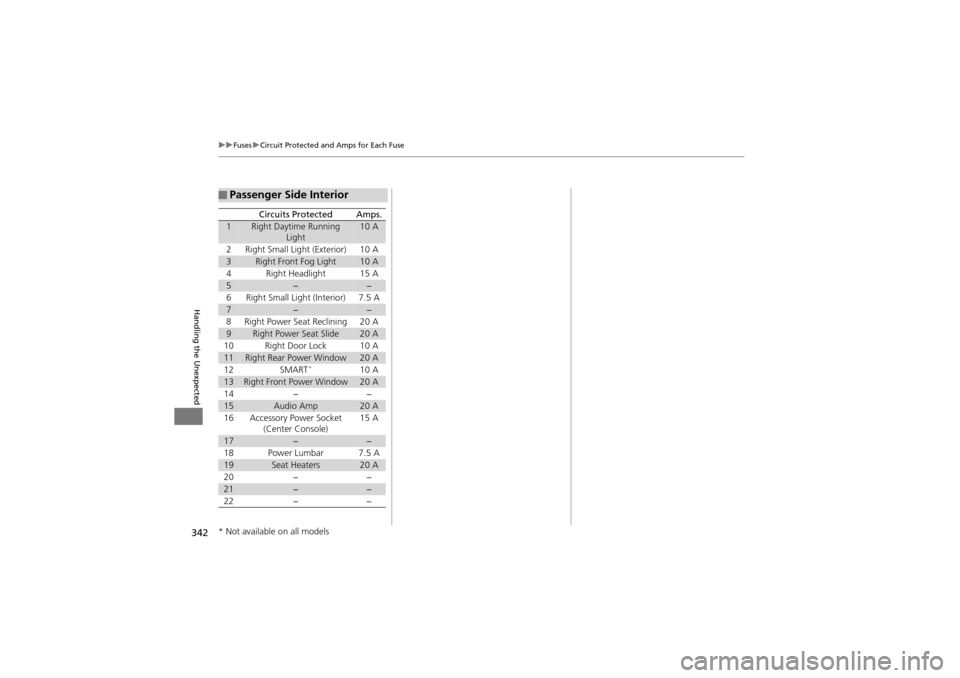
■Passenger Side Interior
Circuits ProtectedAmps.
1Right Daytime Running
Light10 A
2Right Small Light (Exterior)10 A
3Right Front Fog Light10 A
4Right Headlight15 A
5−−
6Right Small Light (Interior)7.5 A
7−−
8Right Power Seat Reclining20 A
9Right Power Seat Slide20 A
10Right Door Lock10 A
11Right Rear Power Window20 A
12SMART*10 A
13Right Front Power Window20 A
14−−
15Audio Amp20 A
16Accessory Power Socket (Center Console)15 A
17−−
18Power Lumbar7.5 A
19Seat Heaters20 A
20−−
21−−
22−−
* Not available on all models
Page 345 of 370
343
uuFuses uInspecting and Changing Fuses
Handling the Unexpected
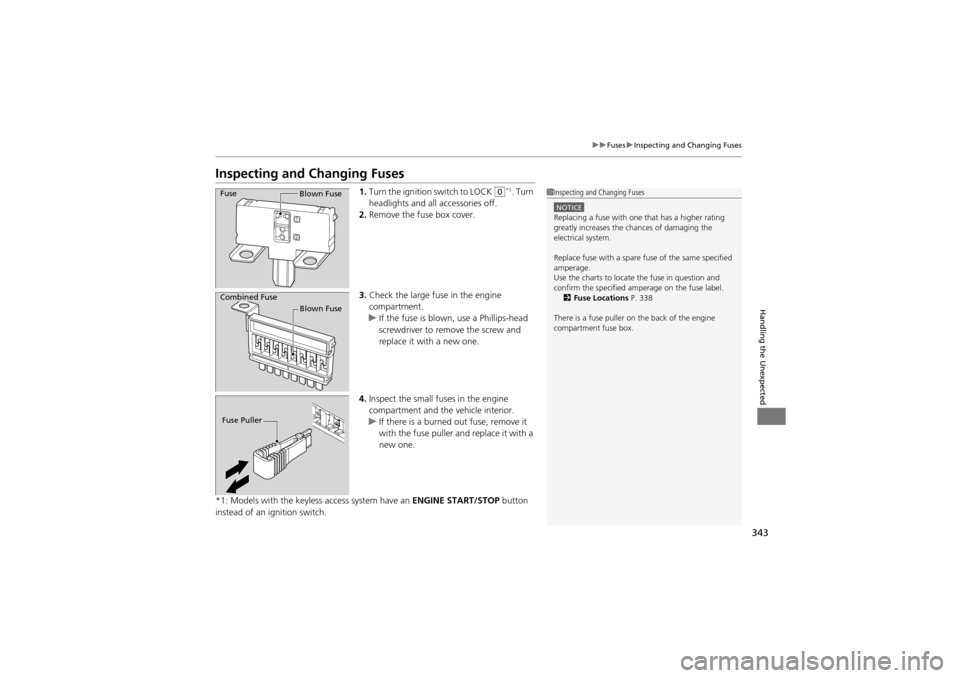
Inspecting and Changing Fuses
1. Turn the ignition switch to LOCK 0*1. Turn
headlights and all accessories off.
2. Remove the fuse box cover.
3. Check the large fuse in the engine
compartment.
u If the fuse is blown, use a Phillips-head
screwdriver to remo ve the screw and
replace it with a new one.
4. Inspect the small fuses in the engine
compartment and the vehicle interior.
u If there is a burned out fuse, remove it
with the fuse puller an d replace it with a
new one.
*1: Models with the keyless access system have an ENGINE START/STOP button
instead of an ig nition switch.1Inspecting and Changing Fuses
NOTICEReplacing a fuse with one that has a higher rating
greatly increases the chances of damaging the
electrical system.
Replace fuse with a spare fuse of the same specified
amperage.
Use the charts to locate the fuse in question and
confirm the specified ampe rage on the fuse label.
2 Fuse Locations P. 338
There is a fuse puller on the back of the engine
compartment fuse box.
Blown Fuse
Fuse
Combined Fuse
Blown Fuse
Fuse Puller
Page 352 of 370
350
Information
Specifications
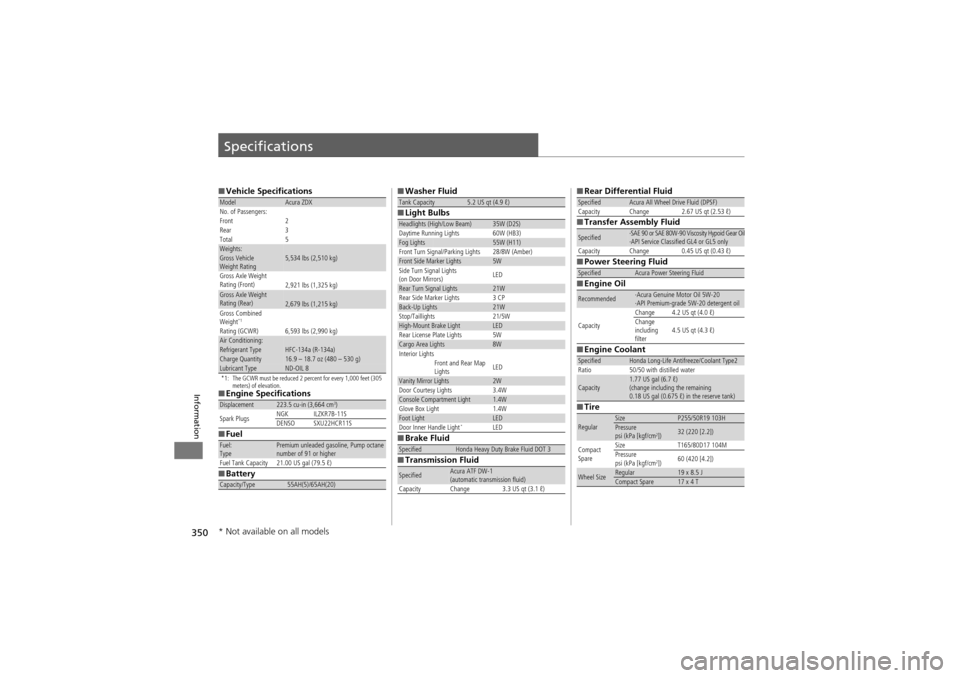
■Vehicle Specifications
*1: The GCWR must be reduced 2 percent for every 1,000 feet (305
meters) of elevation.
■Engine Specifications
■ Fuel
■ Battery
ModelAcura ZDX
No. of Passengers:
Front 2
Rear 3
Total 5
Weights:Gross Vehicle
Weight Rating 5,534 lbs (2,510 kg)
Gross Axle Weight
Rating (Front)2,921 lbs (1,325 kg)Gross Axle Weight
Rating (Rear)2,679 lbs (1,215 kg)
Gross Combined
Weight
*1
Rating (GCWR) 6,593 lbs (2,990 kg)
Air Conditioning:Refrigerant Type HFC-134a (R-134a)Charge Quantity16.9 – 18.7 oz (480 – 530 g)Lubricant TypeND-OIL 8
Displacement223.5 cu-in (3,664 cm3)
Spark Plugs NGK ILZKR7B-11S
DENSO SXU22HCR11S
Fuel:
TypePremium unleaded gasoline, Pump octane
number of 91 or higher
Fuel Tank Capacity 21.00 US gal (79.5 ℓ)
Capacity/Type55AH(5)/65AH(20)
■ Washer Fluid
■ Light Bulbs
■ Brake Fluid
■ Transmission FluidTank Capacity5.2 US qt (4.9 ℓ)
Headlights (High/Low Beam)35W (D2S)
Daytime Running Lights 60W (HB3)
Fog Lights55W (H11)
Front Turn Signal/Parking Lights 28/8W (Amber)
Front Side Marker Lights5W
Side Turn Signal Lights
(on Door Mirrors) LED
Rear Turn Signal Lights21W
Rear Side Marker Lights 3 CP
Back-Up Lights21W
Stop/Taillights 21/5W
High-Mount Brake LightLED
Rear License Plate Lights 5W
Cargo Area Lights8W
Interior Lights
Front and Rear Map
LightsLED
Vanity Mirror Lights2WDoor Courtesy Lights3.4WConsole Compartment Light1.4WGlove Box Light1.4WFoot LightLEDDoor Inner Handle Light*LED
SpecifiedHonda Heavy Duty Brake Fluid DOT 3
SpecifiedAcura ATF DW-1
(automatic transmission fluid)
Capacity Change 3.3 US qt (3.1 ℓ)
■ Rear Differential Fluid
■ Transfer Assembly Fluid
■ Power Steering Fluid
■ Engine Oil
■ Engine Coolant
■ TireSpecifiedAcura All Wheel Drive Fluid (DPSF)
Capacity Change 2.67 US qt (2.53 ℓ)
Specified·SAE 90 or SAE 80W-90 Viscosity Hypoid Gear Oil
·API Service Classified GL4 or GL5 only
Capacity Change 0.45 US qt (0.43 ℓ)
SpecifiedAcura Power Steering Fluid
Recommended·Acura Genuine Motor Oil 5W-20
·API Premium-grade 5W-20 detergent oil
Capacity Change 4.2 US qt (4.0 ℓ)
Change
including
filter
4.5 US qt (4.3 ℓ)
SpecifiedHonda Long-Life Antifreeze/Coolant Type2
Ratio 50/50 with distilled water
Capacity1.77 US gal (6.7 ℓ)
(change including the remaining
0.18 US gal (0.675 ℓ) in the reserve tank)
RegularSizeP255/50R19 103HPressure
psi (kPa [kgf/cm2])32 (220 [2.2])
Compact
Spare Size T165/80D17 104M
Pressure
psi (kPa [kgf/cm
2])
60 (420 [4.2])
Wheel SizeRegular19 x 8.5 JCompact Spare17 x 4 T
* Not available on all models
Page 357 of 370
355
uuEmissions Testing uTesting of Readiness Codes
Information
7. Select a nearby, lightly traveled major highway where you can maintain a speed
of 50 to 60 mph (80 to 97 km/h) for at least 20 minutes. Drive on the highway in
D. Do not use cruise control. When traffi c allows, drive for 90 seconds without
moving the accelerator pedal. (Vehicle speed may vary slightly; this is okay.) If you
cannot do this for a continuous 90 seconds because of traffic conditions, drive for
at least 30 seconds, then repeat it two more times (for a total of 90 seconds).
8. Drive in city/suburban traffic for at l east 10 minutes. When traffic conditions
allow, let the vehicle coast for several se conds without using the accelerator pedal
or the brake pedal.
9. Park the vehicle and leave the engine off for 30 minutes.