steer Alfa Romeo Giulietta 2013 Owner handbook (in English)
[x] Cancel search | Manufacturer: ALFA ROMEO, Model Year: 2013, Model line: Giulietta, Model: Alfa Romeo Giulietta 2013Pages: 292, PDF Size: 13.06 MB
Page 106 of 292
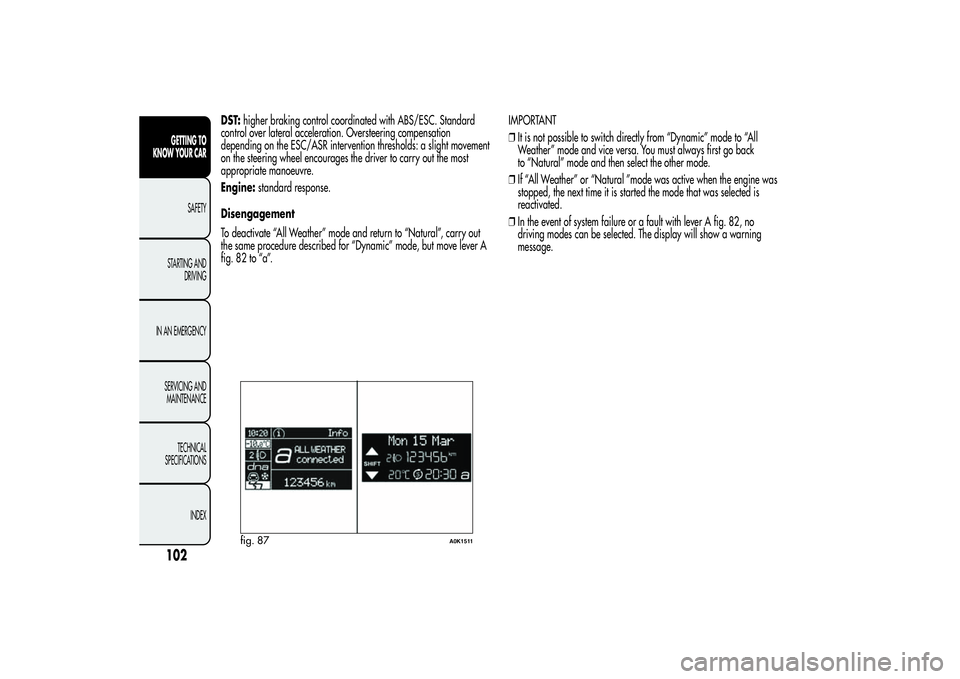
DST:higher braking control coordinated with ABS/ESC. Standard
control over lateral acceleration. Oversteering compensation
depending on the ESC/ASR intervention thresholds: a slight movement
on the steering wheel encourages the driver to carry out the most
appropriate manoeuvre.
Engine:standard response.
Disengagement
To deactivate “All Weather” mode and return to “Natural”, carry out
the same procedure described for “Dynamic” mode, but move lever A
fig. 82 to “a”.IMPORTANT
❒It is not possible to switch directly from “Dynamic” mode to “All
Weather” mode and vice versa. You must always first go back
to “Natural” mode and then select the other mode.
❒If “All Weather” or “Natural ”mode was active when the engine was
stopped, the next time it is started the mode that was selected is
reactivated.
❒In the event of system failure or a fault with lever A fig. 82, no
driving modes can be selected. The display will show a warning
message.
fig. 87
A0K1511
102GETTING TO
KNOW YOUR CAR
SAFETY
STARTING AND
DRIVING
IN AN EMERGENCY
SERVICING AND
MAINTENANCE
TECHNICAL
SPECIFICATIONS
INDEX
Page 111 of 292
DUAL PINION ACTIVE STEERINGThis only operates with the key turned to MAR and the engine started.
The steering allows the force required at the steering wheel to be
adjusted to suit driving conditions. The different power assistance
modes can be selected via the d,n,a positions of the “Alfa DNA
System” lever (see paragraph entitled “Alfa DNA System”).
IMPORTANT After the battery is disconnected, the steering must be
initialised. The warning light switches on to indicate this. To carry out
this procedure, simply turn the steering wheel all the way from one end
to the other or drive in a straight line for about a hundred metres.
It is absolutely forbidden to carry out any after-market
operation involving steering system or steering column
modifications (e.g.: installation of anti-theft device)
that could badly affect performance and safety, invalidate the
warranty and also result in non-compliance of the car with
type-approval requirements.
WIRING FOR RADIO SYSTEM(for versions/markets, where provided)
If no car radio was requested at the time of purchase, the car is
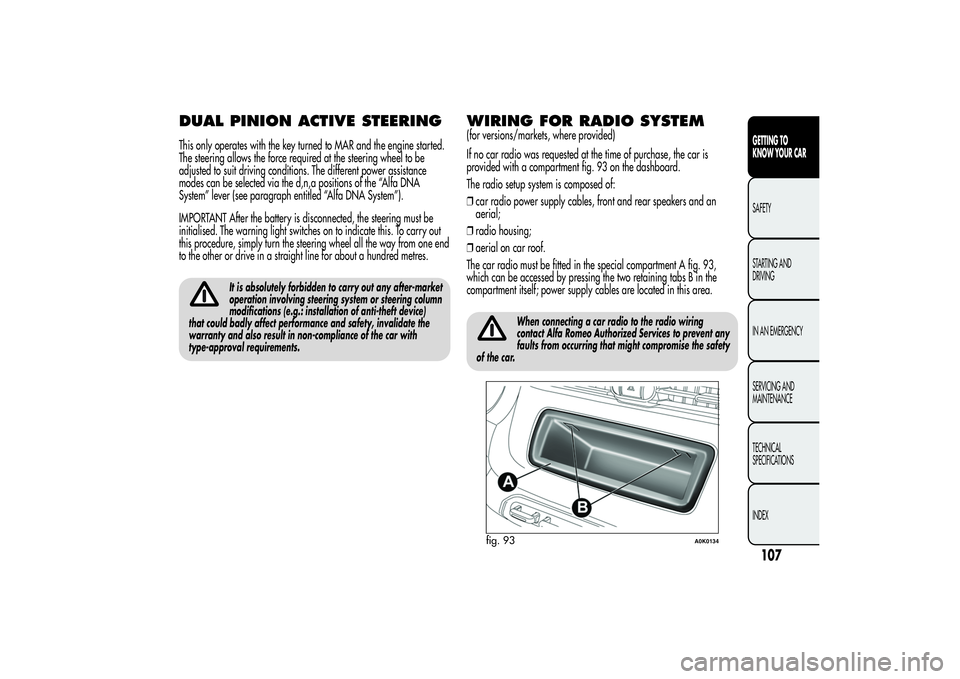
provided with a compartment fig. 93 on the dashboard.
The radio setup system is composed of:
❒car radio power supply cables, front and rear speakers and an
aerial;
❒radio housing;
❒aerial on car roof.
The car radio must be fitted in the special compartment A fig. 93,
which can be accessed by pressing the two retaining tabs B in the
compartment itself; power supply cables are located in this area.
When connecting a car radio to the radio wiring
contact Alfa Romeo Authorized Services to prevent any
faults from occurring that might compromise the safety
of the car.
fig. 93
A0K0134
107GETTING TO
KNOW YOUR CARSAFETY
STARTING AND
DRIVING
IN AN EMERGENCY
SERVICING AND
MAINTENANCE
TECHNICAL
SPECIFICATIONS
INDEX
Page 133 of 292
FRONT AIRBAGSThe car features multistage front airbags (“Smart bags”) for driver and
passenger.“SMART BAG” SYSTEM
(MULTISTAGE FRONT AIRBAGS)The front (driver and passenger) airbags protect occupants in the event
of head-on crashes of medium-high severity, by placing the a cushion
between the occupant and the steering wheel or dashboard.
Therefore non-deployment in other types of impacts (side impacts, rear
shunts, roll-overs, etc.) does not indicate a system malfunction.
The airbags do not replace, but rather complement, the use of seat
belts, which should always be worn. In the event of an impact,
someone not wearing a seat belt could move forward and come into
contact with a bag which is still in the opening phase. The protection
offered by the bag is compromised in these circumstances.
Front airbags may not activate in the following situations:
❒frontal impacts against highly deformable objects not involving the
front surface of the car (e.g. wing collision against guard rail);
❒jamming of the car underneath other vehicles or protective barriers
(e.g. underneath a truck or a guard rail); in this case, the bags
would offer no additional protection with respect to the seat belt and
their deployment would be inappropriate. In these cases, non-
deployment does not indicate a system malfunction.
Do not apply stickers or other objects to the steering
wheel, to the passenger's side air bag cover or on the
roof side lining. Do not place objects on the passenger
side of the dashboard because these could interfere with the
correct opening of the passenger airbag and cause injury to
occupants.
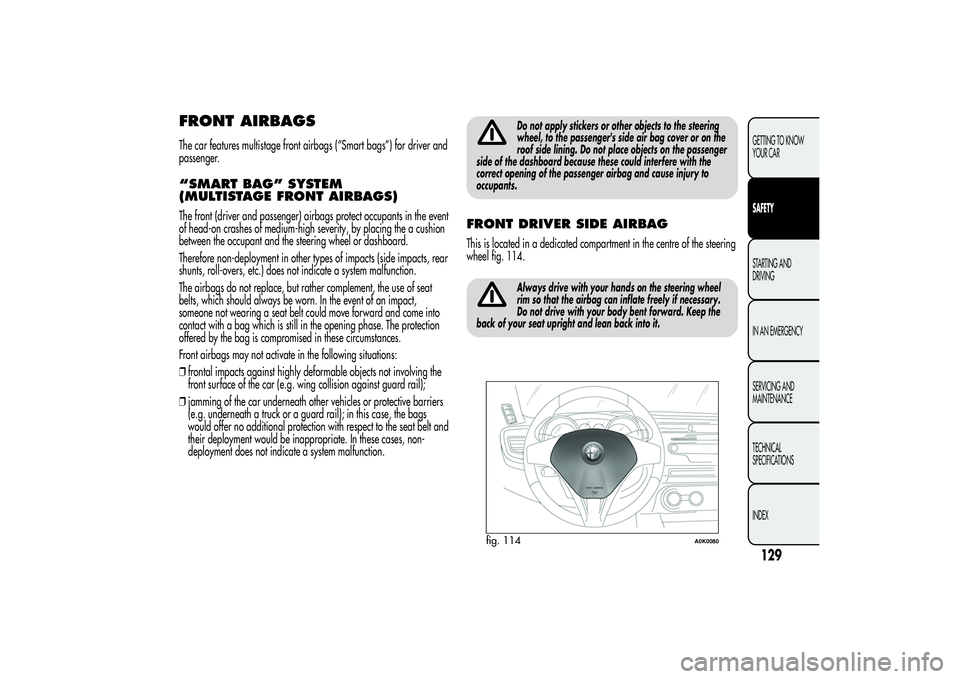
FRONT DRIVER SIDE AIRBAGThis is located in a dedicated compartment in the centre of the steering
wheel fig. 114.
Always drive with your hands on the steering wheel
rim so that the airbag can inflate freely if necessary.
Do not drive with your body bent forward. Keep the
back of your seat upright and lean back into it.
fig. 114
A0K0080
129GETTING TO KNOW
YOUR CARSAFETYSTARTING AND
DRIVING
IN AN EMERGENCY
SERVICING AND
MAINTENANCE
TECHNICAL
SPECIFICATIONS
INDEX
Page 139 of 292
Remember that the brake servo and electromechanical
power steering are not operational until the engine
has been started, therefore much more effort than
usual is required on the brake pedal and steering wheel.Never start the engine by pushing, towing or driving
downhill. These manoeuvres may damage the catalytic
converter.
WARMING UP THE ENGINE JUST
AFTER IT HAS STARTEDProceed as follows:
❒drive off slowly, letting the engine turn at medium revs and without
accelerating abruptly;
❒do not demand maximum performance for the first few kilometres. It
is advisable to wait until the engine coolant temperature indicator
starts moving.STOPPING THE ENGINETurn the ignition key to STOP while the engine is idling.
IMPORTANT After a demanding drive, before turning the engine off
you should allow it to idle to allow the temperature in the engine
compartment to decrease.
A quick burst on the accelerator before stopping the engine
serves absolutely no practical purpose. It wastes fuel and
is especially damaging to turbocharged engines.
PARKINGSwitch off the engine and pull up the handbrake. Engage a gear (1
stif
the car is facing uphill or reverse if it is facing downhill) and leave
the wheels steered to one side.
If the car is parked on a steep slope block the wheels with a wedge or
stone. Always remove the ignition key when leaving the car.
Never leave children unattended in the car. Always
remove the key from the ignition when leaving the car
and take it with you.
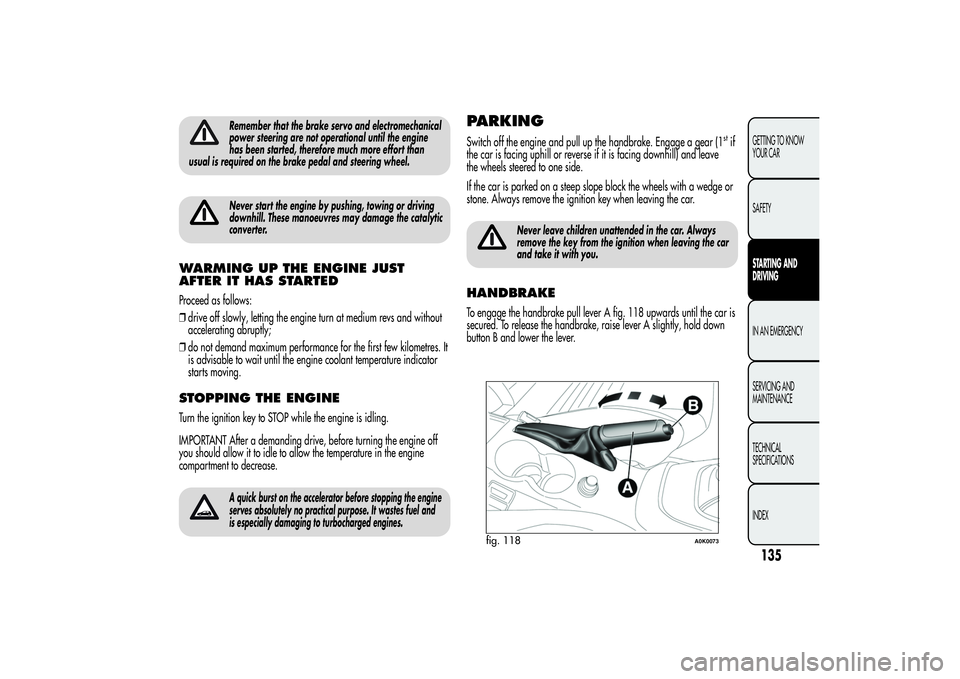
HANDBRAKETo engage the handbrake pull lever A fig. 118 upwards until the car is
secured. To release the handbrake, raise lever A slightly, hold down
button B and lower the lever.
fig. 118
A0K0073
135GETTING TO KNOW
YOUR CAR
SAFETYSTARTING AND
DRIVINGIN AN EMERGENCY
SERVICING AND
MAINTENANCE
TECHNICAL
SPECIFICATIONS
INDEX
Page 148 of 292
The vehicle's driving characteristics will be modified
with the space-saver wheel fitted. Avoid violent
acceleration and braking, sharp steering and fast
cornering. The total life of a space-saver wheel is approximately
3,000 km, after which it must be replaced by another wheel of
the same type. Never attempt to fit a conventional tyre on a rim
designed for use as a space-saver wheel. Repair and refit the
standard wheel as soon as possible. Two or more space-saver
wheels should never be used together. Do not grease the threads
of bolts before fitting them: they might slip out.The jack provided is only intended to be used for
replacing tyres on the vehicle with which it is supplied,
or on same-model vehicles. Never use the jack for
other purposes, such as lifting other car models. Never use it for
repair operations under the vehicle. Incorrect positioning of the
jack may cause the car to fall. Do not use the jack for loads
higher than those shown on the label. Never install snow chains
on the small spare wheel; if a front tyre (driving wheel) is
punctured and you need to use snow chains, use a standard
wheel from the rear axle and install the small spare wheel on the
rear axle. In this way, with two normal front drive wheels, it is
possible to use snow chains.Incorrectly fitting the hubcap may cause it to fall off
when the vehicle is in motion. Never tamper with the
inflating valve. Never introduce tools of any kind
between rim and tyre. Regularly check the inflation pressure of
the tyres and space-saver wheel (see chapter "Technical
specifications").
JACKPlease note that:
❒the jack weight is 1.76 kg;
❒the jack requires no adjustment;
❒the jack cannot be repaired and in the event of a fault it must be
replaced by another original one;
❒no tool other than its cranking device may be fitted on the jack.
To change a wheel proceed as follows:
❒stop the car in a position that is not dangerous for oncoming traffic
where you can change the wheel safely. The ground must be flat
and sufficiently compact;
❒switch off the engine, pull up the handbrake and engage 1
agear or
reverse; put on the high visibility jacket (required by law) before
leaving the vehicle;
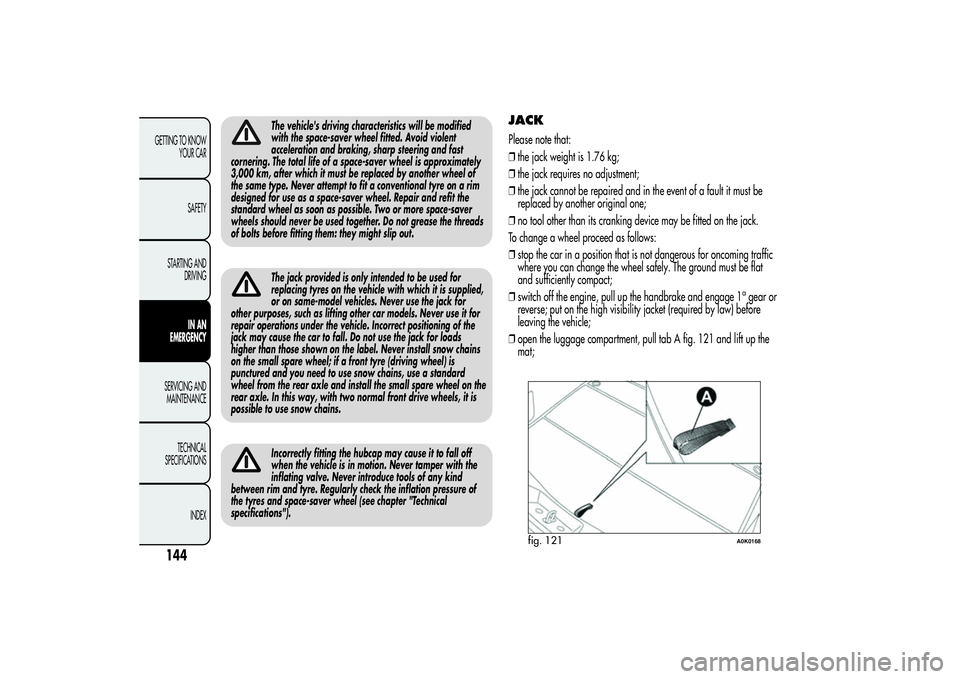
❒open the luggage compartment, pull tab A fig. 121 and lift up the
mat;
fig. 121
A0K0168
144GETTING TO KNOW
YOUR CAR
SAFETY
STARTING AND
DRIVING
IN AN
EMERGENCY
SERVICING AND
MAINTENANCE
TECHNICAL
SPECIFICATIONS
INDEX
Page 170 of 292
Contact Alfa Romeo Authorized Services if a safety
system (air bags, brakes), engine system (engine,
gearbox) or steering system general protection fuse
blows.
FUSE LOCATIONFuses are grouped together in three fuse boxes located in the engine
compartment, dashboard and luggage compartment.
Engine compartment fuse box
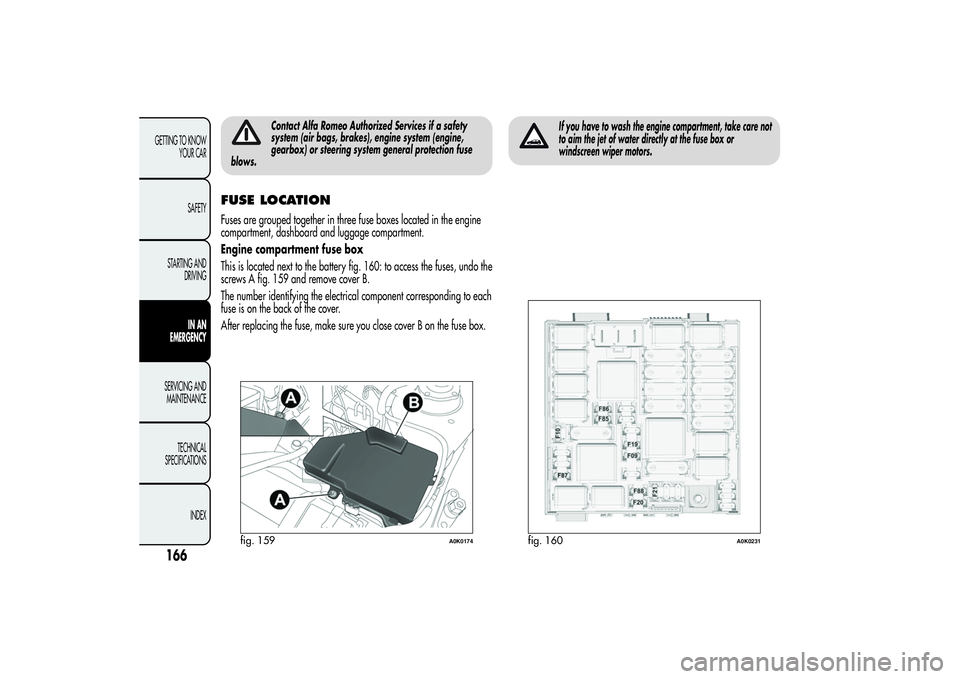
This is located next to the battery fig. 160: to access the fuses, undo the
screws A fig. 159 and remove cover B.
The number identifying the electrical component corresponding to each
fuse is on the back of the cover.
After replacing the fuse, make sure you close cover B on the fuse box.
If you have to wash the engine compartment, take care not
to aim the jet of water directly at the fuse box or
windscreen wiper motors.
fig. 159
A0K0174
fig. 160
A0K0231
166GETTING TO KNOW
YOUR CAR
SAFETY
STARTING AND
DRIVING
IN AN
EMERGENCY
SERVICING AND
MAINTENANCE
TECHNICAL
SPECIFICATIONS
INDEX
Page 179 of 292
TOWING THE CARThe tow ring provided with the car is housed in the tool box in the
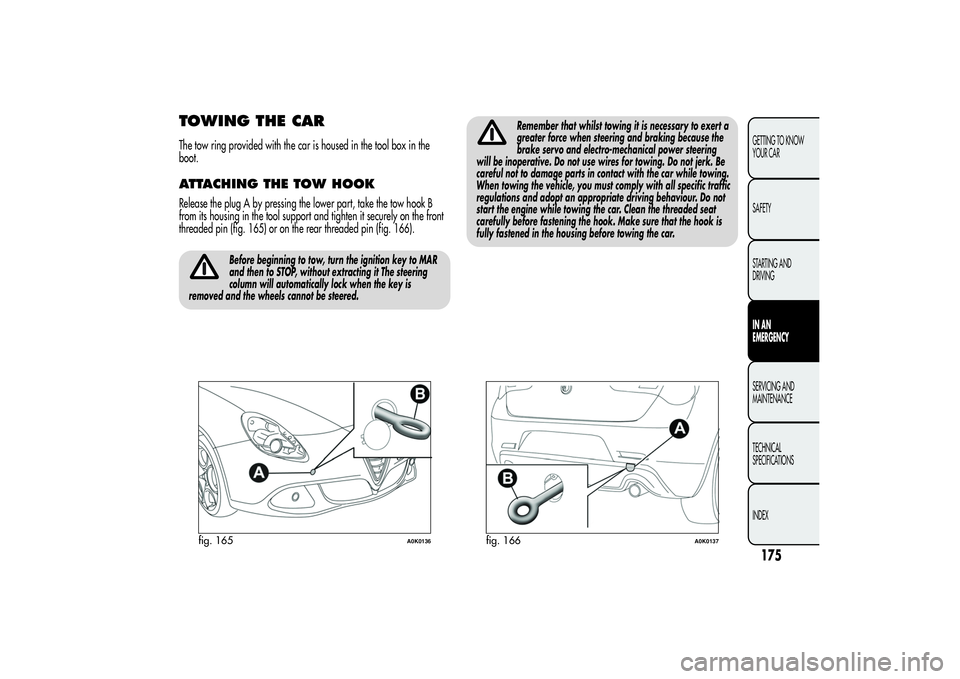
boot.ATTACHING THE TOW HOOKRelease the plug A by pressing the lower part, take the tow hook B
from its housing in the tool support and tighten it securely on the front
threaded pin (fig. 165) or on the rear threaded pin (fig. 166).
Before beginning to tow, turn the ignition key to MAR
and then to STOP, without extracting it The steering
column will automatically lock when the key is
removed and the wheels cannot be steered.
Remember that whilst towing it is necessary to exert a
greater force when steering and braking because the
brake servo and electro-mechanical power steering
will be inoperative. Do not use wires for towing. Do not jerk. Be
careful not to damage parts in contact with the car while towing.
When towing the vehicle, you must comply with all specific traffic
regulations and adopt an appropriate driving behaviour. Do not
start the engine while towing the car. Clean the threaded seat
carefully before fastening the hook. Make sure that the hook is
fully fastened in the housing before towing the car.
fig. 165
A0K0136
fig. 166
A0K0137
175GETTING TO KNOW
YOUR CAR
SAFETY
STARTING AND
DRIVINGIN AN
EMERGENCYSERVICING AND
MAINTENANCE
TECHNICAL
SPECIFICATIONS
INDEX
Page 196 of 292
AIR CLEANER/POLLEN
FILTER/DIESEL FILTERContact Alfa Romeo Authorized Services to replace the filters.
BATTERYBattery F (see previous pages) does not require the electrolyte to be
topped up with distilled water. A periodic check carried out at Alfa
Romeo Authorized Services is, however, necessary to check efficiency.REPLACING THE BATTERYIf necessary, replace the battery with another genuine battery with the
same specifications. Follow the battery manufacturer's instructions
for maintenance.USEFUL ADVICE FOR EXTENDING THE
LIFE OF YOUR BATTERYTo avoid draining your battery rapidly and maintain its efficiency over
time, carefully observe the following instructions:
❒when you park the car, ensure that the doors, bonnet and flaps are
closed correctly, to prevent any roof lights from remaining on inside
the passenger compartment;
❒switch off all roof lights inside the car: the car is however equipped
with a system which switches all internal lights off automatically;
❒do not keep accessories (e.g. sound system, hazard lights, etc.)
switched on for a long time when the engine is not running;
❒before performing any operation on the electrical system, disconnect
the negative battery pole;
IMPORTANT After the battery is disconnected, the steering must be
initialised. The
warning light switches on to indicate this. To carry
out this procedure, simply turn the steering wheel all the way from one
end to the other or drive in a straight line for about a hundred metres.
192GETTING TO KNOW
YOUR CAR
SAFETY
STARTING AND
DRIVING
IN AN EMERGENCYSERVICING AND
MAINTENANCE
TECHNICAL
SPECIFICATIONS
INDEX
Page 200 of 292
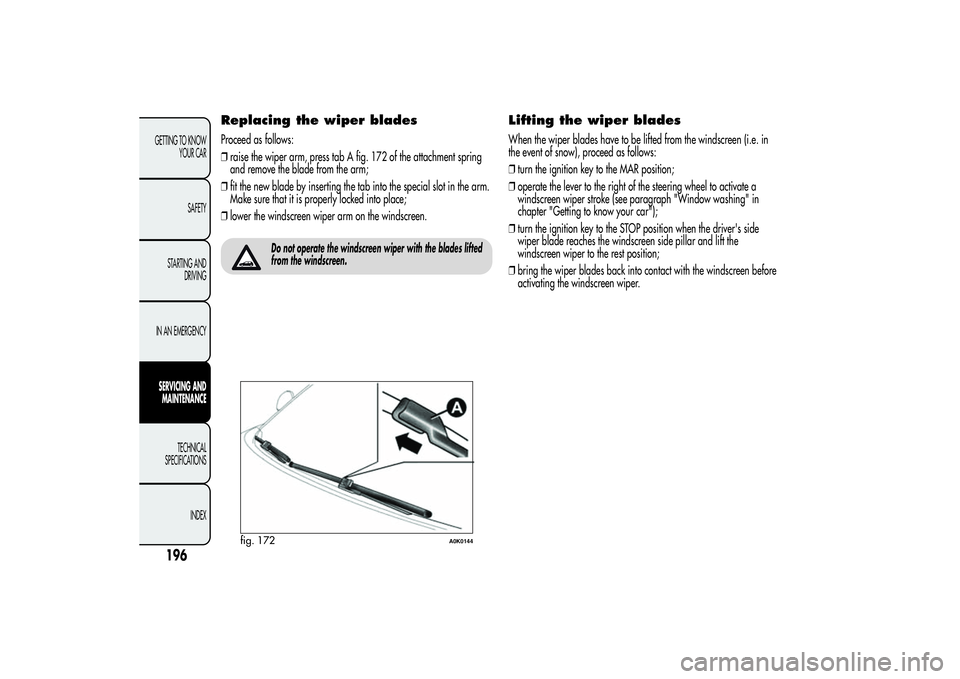
Replacing the wiper bladesProceed as follows:
❒raise the wiper arm, press tab A fig. 172 of the attachment spring
and remove the blade from the arm;
❒fit the new blade by inserting the tab into the special slot in the arm.
Make sure that it is properly locked into place;
❒lower the windscreen wiper arm on the windscreen.
Do not operate the windscreen wiper with the blades lifted
from the windscreen.
Lifting the wiper bladesWhen the wiper blades have to be lifted from the windscreen (i.e. in
the event of snow), proceed as follows:
❒turn the ignition key to the MAR position;
❒operate the lever to the right of the steering wheel to activate a
windscreen wiper stroke (see paragraph "Window washing" in
chapter "Getting to know your car");
❒turn the ignition key to the STOP position when the driver's side
wiper blade reaches the windscreen side pillar and lift the
windscreen wiper to the rest position;
❒bring the wiper blades back into contact with the windscreen before
activating the windscreen wiper.
fig. 172
A0K0144
196GETTING TO KNOW
YOUR CAR
SAFETY
STARTING AND
DRIVING
IN AN EMERGENCYSERVICING AND
MAINTENANCE
TECHNICAL
SPECIFICATIONS
INDEX
Page 218 of 292
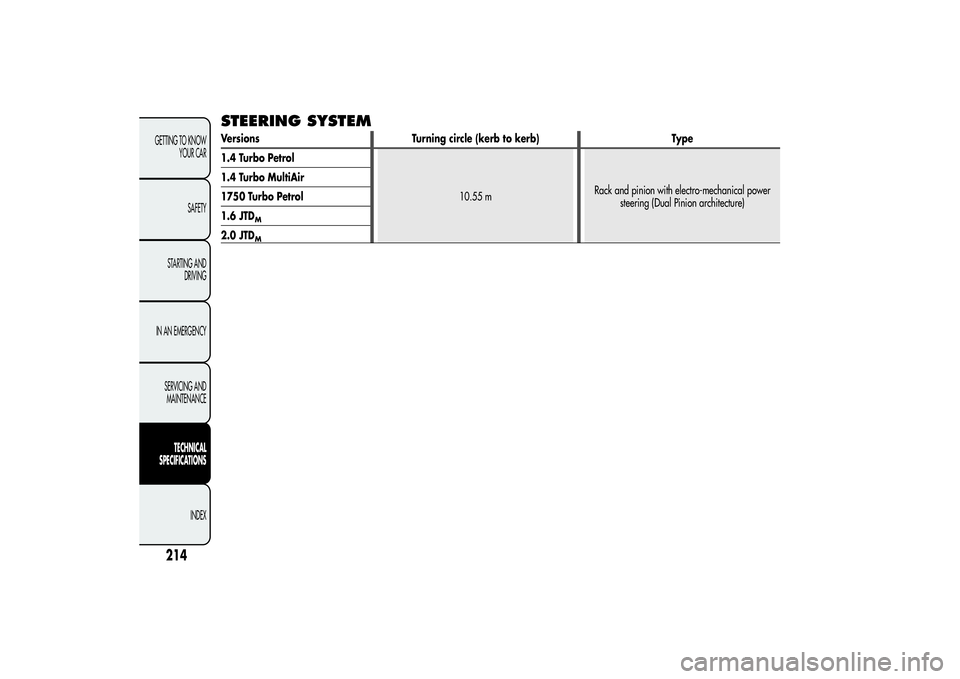
STEERING SYSTEMVersions Turning circle (kerb to kerb) Type
1.4 Turbo Petrol
10.55 mRack and pinion with electro-mechanical power
steering (Dual Pinion architecture) 1.4 Turbo MultiAir
1750 Turbo Petrol
1.6 JTD
M
2.0 JTD
M
214GETTING TO KNOW
YOUR CAR
SAFETY
STARTING AND
DRIVING
IN AN EMERGENCY
SERVICING AND
MAINTENANCE
TECHNICAL
SPECIFICATIONS
INDEX