light Alfa Romeo Giulietta 2013 Owner handbook (in English)
[x] Cancel search | Manufacturer: ALFA ROMEO, Model Year: 2013, Model line: Giulietta, Model: Alfa Romeo Giulietta 2013Pages: 292, PDF Size: 13.06 MB
Page 37 of 292
Activation of warning light while driving
❒If the
warning light switches on, this means that the system is
running a self-diagnosis (for example due to a voltage drop).
❒If thewarning light remains on, contact Alfa Romeo Authorized
Services.The electronic components inside the key may be damaged
if the key is subjected to strong shocks.
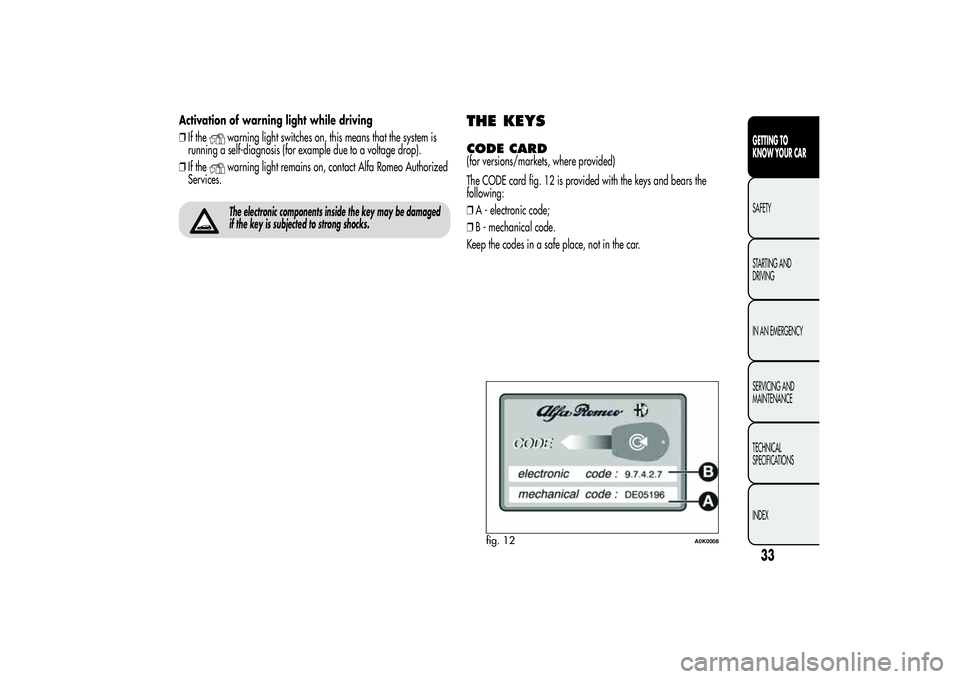
THE KEYSCODE CARD(for versions/markets, where provided)
The CODE card fig. 12 is provided with the keys and bears the
following:
❒A - electronic code;
❒B - mechanical code.
Keep the codes in a safe place, not in the car.
fig. 12
A0K0008
33GETTING TO
KNOW YOUR CARSAFETY
STARTING AND
DRIVING
IN AN EMERGENCY
SERVICING AND
MAINTENANCE
TECHNICAL
SPECIFICATIONS
INDEX
Page 38 of 292
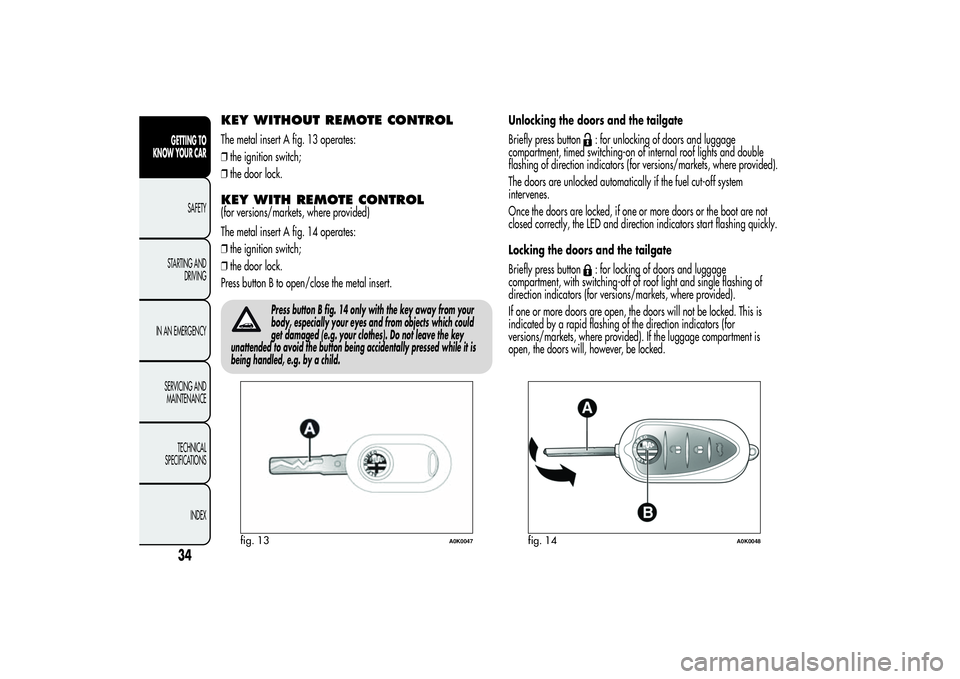
KEY WITHOUT REMOTE CONTROLThe metal insert A fig. 13 operates:
❒the ignition switch;
❒the door lock.KEY WITH REMOTE CONTROL(for versions/markets, where provided)
The metal insert A fig. 14 operates:
❒the ignition switch;
❒the door lock.
Press button B to open/close the metal insert.
Press button B fig. 14 only with the key away from your
body, especially your eyes and from objects which could
get damaged (e.g. your clothes). Do not leave the key
unattended to avoid the button being accidentally pressed while it is
being handled, e.g. by a child.
Unlocking the doors and the tailgate
Briefly press button
: for unlocking of doors and luggage
compartment, timed switching-on of internal roof lights and double
flashing of direction indicators (for versions/markets, where provided).
The doors are unlocked automatically if the fuel cut-off system
intervenes.
Once the doors are locked, if one or more doors or the boot are not
closed correctly, the LED and direction indicators start flashing quickly.
Locking the doors and the tailgate
Briefly press button: for locking of doors and luggage
compartment, with switching-off of roof light and single flashing of
direction indicators (for versions/markets, where provided).
If one or more doors are open, the doors will not be locked. This is
indicated by a rapid flashing of the direction indicators (for
versions/markets, where provided). If the luggage compartment is
open, the doors will, however, be locked.
fig. 13
A0K0047
fig. 14
A0K0048
34GETTING TO
KNOW YOUR CAR
SAFETY
STARTING AND
DRIVING
IN AN EMERGENCY
SERVICING AND
MAINTENANCE
TECHNICAL
SPECIFICATIONS
INDEX
Page 42 of 292
ALARM(for versions/markets, where provided)ALARM ACTIVATIONThe alarm activates in the following cases:
❒wrongful opening of a door/bonnet/luggage compartment
(perimeter protection);
❒wrongful operation of the ignition switch (key turned to MAR);
❒cutting of the battery cables;
❒movement inside the passenger compartment (volumetric protection);
❒anomalous lifting/tilting of the car (for versions/markets, where
provided).
Operation of the alarm is indicated by an acoustic and visual signal
(flashing of the direction indicators for several seconds). The alarm
activation modes may vary according to the market. There is a
maximum number of acoustic/visual cycles. When this is reached the
system returns to normal operation.
IMPORTANT The engine locking function is guaranteed by the Alfa
Romeo CODE, which is automatically activated when the ignition key
is extracted from the ignition switch.
IMPORTANT The alarm is adapted to meet requirements in various
countries.
SWITCHING ON THE ALARMWith the doors and bonnet closed and the ignition key either turned to
STOP or removed, direct the key with the remote control towards the
car, then press and release the
button. Except for specific markets,
the system emits a visual and acoustic signal and enables door locking.
A self-diagnosis stage precedes the switching on of the alarm: in the
event of faults, the system will generate a further acoustic and/or
visual signal through the LED on the dashboard.
If after the alarm is switched on, a second acoustic signal is emitted
and/or a visual signal via the LED on the dashboard, wait about
4 seconds and switch off the alarm by pressing the
button, check
that the doors, bonnet and luggage compartment are closed correctly
and then reactivate the system by pressing the
button.
If the alarm emits an acoustic signal even when the doors, bonnet and
boot are correctly closed, a fault has occurred in system operation:
in this case, contact Alfa Romeo Authorized Services.
ALARM SELF-ACTIVATION(for versions/markets, where provided)
If the alarm has not been activated using the remote control, once
about 30 seconds have elapsed from when the ignition key was turned
to STOP and a door or the tailgate was last opened and then closed,
the alarm activates automatically.
This is indicated by the LED on the button A fig. 18 lighting up
intermittently and the indications of activation described previously.
To deactivate the alarm, press the
button on the remote control.
The alarm also activates when the doors are closed by turning the
metal insert of the key in the driver side door latch. If the system
self-activates, the doors are not locked.
38GETTING TO
KNOW YOUR CAR
SAFETY
STARTING AND
DRIVING
IN AN EMERGENCY
SERVICING AND
MAINTENANCE
TECHNICAL
SPECIFICATIONS
INDEX
Page 44 of 292
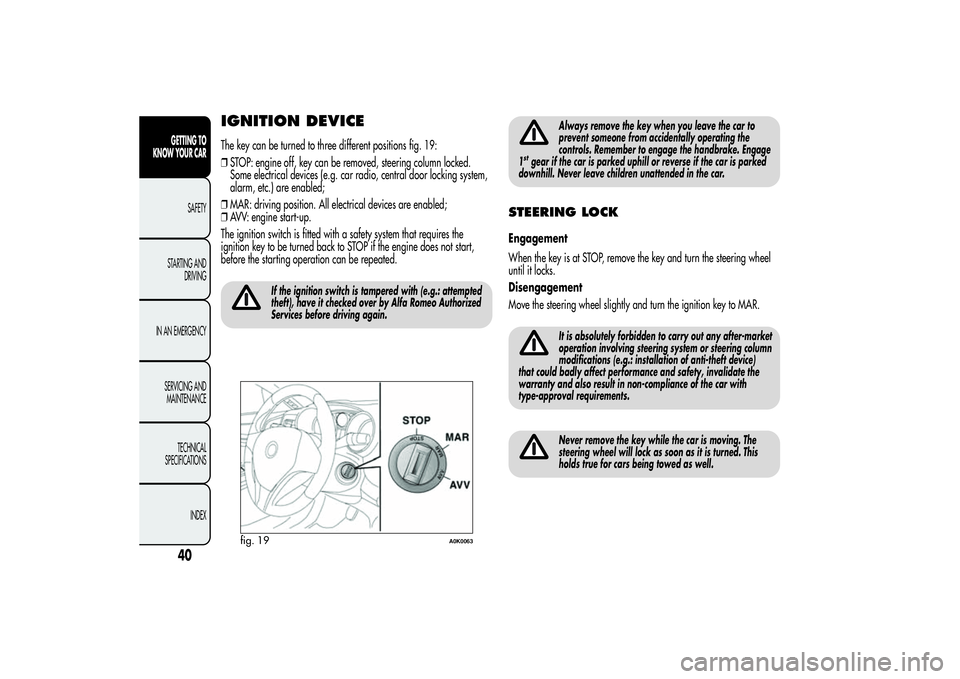
IGNITION DEVICEThe key can be turned to three different positions fig. 19:
❒STOP: engine off, key can be removed, steering column locked.
Some electrical devices (e.g. car radio, central door locking system,
alarm, etc.) are enabled;
❒MAR: driving position. All electrical devices are enabled;
❒AVV: engine start-up.
The ignition switch is fitted with a safety system that requires the
ignition key to be turned back to STOP if the engine does not start,
before the starting operation can be repeated.
If the ignition switch is tampered with (e.g.: attempted
theft), have it checked over by Alfa Romeo Authorized
Services before driving again.
Always remove the key when you leave the car to
prevent someone from accidentally operating the
controls. Remember to engage the handbrake. Engage
1
stgear if the car is parked uphill or reverse if the car is parked
downhill. Never leave children unattended in the car.
STEERING LOCKEngagement
When the key is at STOP, remove the key and turn the steering wheel
until it locks.
Disengagement
Move the steering wheel slightly and turn the ignition key to MAR.
It is absolutely forbidden to carry out any after-market
operation involving steering system or steering column
modifications (e.g.: installation of anti-theft device)
that could badly affect performance and safety, invalidate the
warranty and also result in non-compliance of the car with
type-approval requirements.Never remove the key while the car is moving. The
steering wheel will lock as soon as it is turned. This
holds true for cars being towed as well.
fig. 19
A0K0063
40GETTING TO
KNOW YOUR CAR
SAFETY
STARTING AND
DRIVING
IN AN EMERGENCY
SERVICING AND
MAINTENANCE
TECHNICAL
SPECIFICATIONS
INDEX
Page 51 of 292
DOOR MIRRORS
As the driver's door mirror is curved, it may slightly
alter the perception of distance.
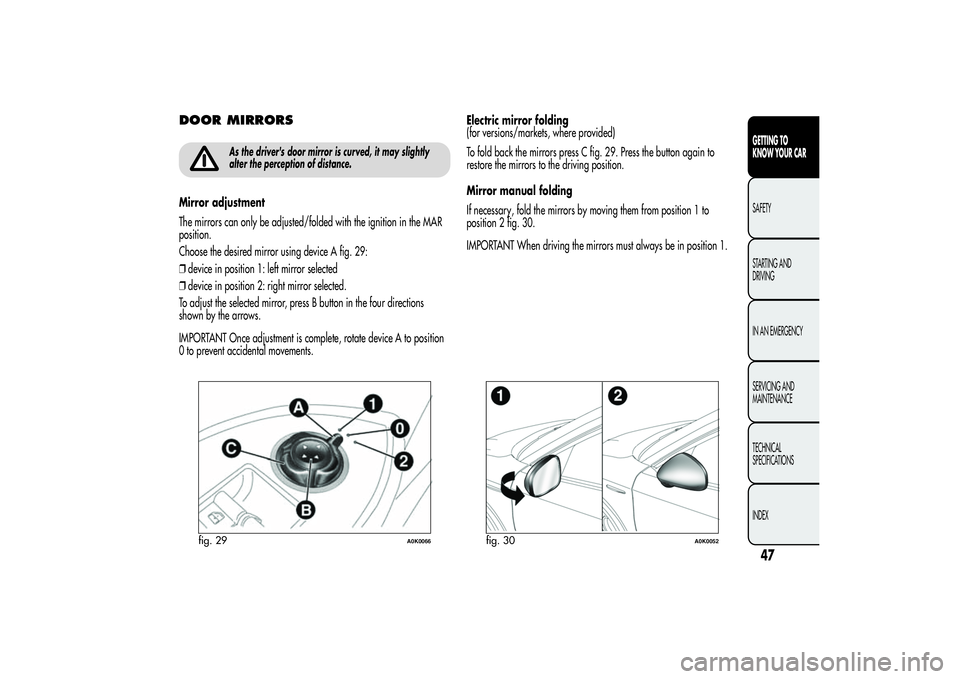
Mirror adjustment
The mirrors can only be adjusted/folded with the ignition in the MAR
position.
Choose the desired mirror using device A fig. 29:
❒device in position 1: left mirror selected
❒device in position 2: right mirror selected.
To adjust the selected mirror, press B button in the four directions
shown by the arrows.
IMPORTANT Once adjustment is complete, rotate device A to position
0 to prevent accidental movements.Electric mirror folding
(for versions/markets, where provided)
To fold back the mirrors press C fig. 29. Press the button again to
restore the mirrors to the driving position.
Mirror manual folding
If necessary, fold the mirrors by moving them from position 1 to
position 2 fig. 30.
IMPORTANT When driving the mirrors must always be in position 1.
fig. 29
A0K0066
fig. 30
A0K0052
47GETTING TO
KNOW YOUR CARSAFETY
STARTING AND
DRIVING
IN AN EMERGENCY
SERVICING AND
MAINTENANCE
TECHNICAL
SPECIFICATIONS
INDEX
Page 56 of 292
CLIMATE CONTROL (cooling)Proceed as follows to cool the passenger compartment:
❒turn knob A to blue section;
❒press button F to turn air recirculation on (circular LED around the
button on);
❒turn knob E to
;
❒press button B to turn the climate control system on and turn C knob
to at least 1 (1stspeed); for faster action, turn knob C to 6
(maximum fan speed).
Adjusting cooling
❒turn knob A rightwards to increase the temperature;
❒press button F to turn internal air recirculation off (circular LED
around the button off);
❒turn knob C to reduce the fan speed.
PASSENGER COMPARTMENT HEATINGProceed as follows to rapidly heat the passenger compartment:
❒turn knob A to the red section;
❒press button F to turn on the air recirculation system;
❒turn knob E to
;
❒turn knob C to 6 (maximum fan speed).
Then use the controls to maintain the desired comfort conditions and
press button F to turn air recirculation off (circular LED around the
button off) and prevent misting.
IMPORTANT When the engine is cold, it takes a few minutes to obtain
fast heating.
AUTOMATIC DEMISTING/DEFROSTING
(MAX-DEF function)This function activates automatic demisting/defrosting of: front
windows (windscreen and side windows), heated nozzles, heated
exterior rear view mirrors.
To activate the function, turn knob E to the “Defrosting” symbol
identified by the
symbol.
The manual climate control system will automatically set itself to the
following configuration:
❒the demisting symbol
will turn from red to orange (to indicate
that the function has been activated);
❒the heated rear window (and all defrosting devices in the car) will
be turned on. The circular LED around the
button will light up
to indicate that the function has been activated;
❒the air flow will go to maximum speed (6);
❒air circulation will be opened, if it was closed (the circular LED
around the corresponding button will be off);
❒air mixing will go to “maximum heat”;
❒the additional electric heater (for versions/markets, where provided)
will be turned on;
❒the compressor will be activated (the circular LED will switch on to
indicate that the AC function is on).
52GETTING TO
KNOW YOUR CAR
SAFETY
STARTING AND
DRIVING
IN AN EMERGENCY
SERVICING AND
MAINTENANCE
TECHNICAL
SPECIFICATIONS
INDEX
Page 61 of 292
During automatic operation, you can change the set temperatures, air
distribution and fan speed at any time by using the relevant buttons
or knobs: the system will automatically change the settings to adjust to
the new requirements.
During fully automatic operation (AUTO), the word AUTO will
disappear if the air distribution and/or flow rate and/or engagement
of the compressor and/or recirculation settings are changed.
During fully automatic operation (FULL AUTO), the word FULL will
disappear if the air distribution and/or flow rate and/or activation of
the compressor and/or recirculation settings are changed.
In this way the climate control system will continue to automatically
manage all functions except for those that have been manually
adjusted. The fan speed is the same in all the zones of the passenger
compartment.ADJUSTING THE AIR TEMPERATURETurn the A or L knob right or left to adjust the air temperature: A knob
for the front left-hand area, L knob for the front right-hand area of
the passenger compartment. The set temperatures are shown on
the displays.
Press the MONO button to align the air temperature between the two
areas:
Turn the L knob to return to the separate management of air
temperatures in the two zones.
Turn the knobs fully right or left to engage HI (maximum heating) or LO
(maximum cooling) respectively. To deactivate these functions, turn
the temperature knob to the desired temperature.
SETTING THE AIR DISTRIBUTIONBy pressing the buttons (
/
/
), it is possible to set one of the
7 possible air distributions manually:
Air flow to the windscreen and front side window diffusers to
demist/defrost them.Air flow at central and side dashboard vents to ventilate the chest
and the face during the hot season.Air flow to the front and rear footwell diffusers. This air
distribution setting heats the passenger compartment most
quickly, giving a prompt sensation of warmth.
Air flow distributed between footwell vents (hotter air) and
central and side dashboard vents (cooler air). This
distribution setting is useful in spring and autumn on sunny
days.Air flow distributed between footwell diffusers and
windscreen and front side window defrosting/demisting
diffusers. This distribution setting allows the passenger
compartment to warm up efficiently and prevents the
windows from misting up.Air flow distribution between windscreen demisting/
defrosting diffusers and side and central dashboard vents.
This allows air to be sent to the windscreen in conditions
of strong sunlight.
Air flow distribution to all vents on the car.
In AUTO mode, the climate control system automatically manages air
distribution (the LEDs on buttons H are off). When set manually, the air
distribution is shown by the LEDs on the selected buttons.
57GETTING TO
KNOW YOUR CARSAFETY
STARTING AND
DRIVING
IN AN EMERGENCY
SERVICING AND
MAINTENANCE
TECHNICAL
SPECIFICATIONS
INDEX
Page 66 of 292
Automatic dual zone climate control system
(for versions/markets, where provided)
The additional heater activates automatically depending on the
environmental conditions and with engine started.
Manual climate control system
The additional heater activates automatically when knob A is turned to
the end of the red section and the fan is set to at least 1
stspeed.
IMPORTANT The heater only works if the outside temperature and
engine coolant temperature are low. The heater will not activate if the
battery voltage is too low.
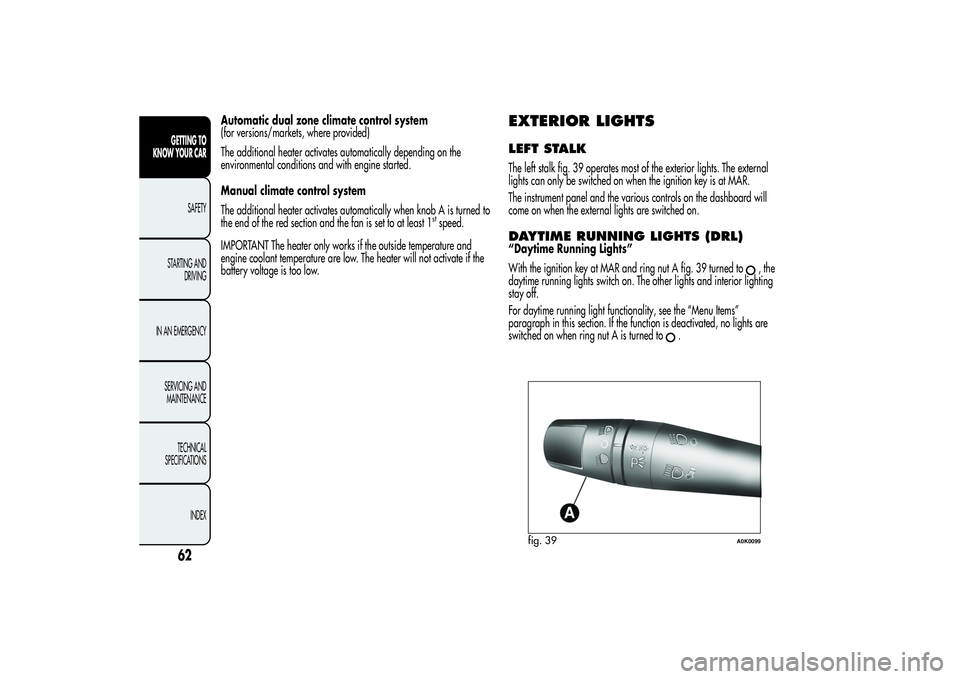
EXTERIOR LIGHTSLEFT STALKThe left stalk fig. 39 operates most of the exterior lights. The external
lights can only be switched on when the ignition key is at MAR.
The instrument panel and the various controls on the dashboard will
come on when the external lights are switched on.DAYTIME RUNNING LIGHTS (DRL)“Daytime Running Lights”
With the ignition key at MAR and ring nut A fig. 39 turned to
,the
daytime running lights switch on. The other lights and interior lighting
stay off.
For daytime running light functionality, see the “Menu Items”
paragraph in this section. If the function is deactivated, no lights are
switched on when ring nut A is turned to
.
fig. 39
A0K0099
62GETTING TO
KNOW YOUR CAR
SAFETY
STARTING AND
DRIVING
IN AN EMERGENCY
SERVICING AND
MAINTENANCE
TECHNICAL
SPECIFICATIONS
INDEX
Page 67 of 292
SIDE LIGHTS/DIPPED BEAM
HEADLIGHTSWith the ignition key turned to MAR, turn ring nut A fig. 39 to
.
The daytime running lights are switched off and the side lights and
dipped headlights are switched on. The warning light
switches
on on the instrument panel.
PARKING LIGHTSThese lights can only be switched on with ignition key at STOP or
removed, by moving ring nut A fig. 39 first to position
and then to
position
.
The warning light
switches on on the instrument panel.
When the direction indicator stalk is activated the side for the lights
(left or right) can be selected.
AUTOMATIC LIGHTING CONTROL
(AUTOLIGHT) (Dusk sensor)(for versions/markets, where provided)
This infrared LED sensor, combined with the rain sensor and located on
the windscreen, detects the variations in outside brightness depending
on the light sensitivity set with the Set-up Menu: the greater the
sensitivity, the less external light is required to activate the exterior
lights.Activation
The dusk sensor activates when ring nut A fig. 39 is turned to
.In
this way the side lights and dipped headlights are activated
automatically according to the external light level.
IMPORTANT The sensor is unable to detect the presence of fog.
Therefore under these circumstances, these lights must be turned on
manually.
When the lights are turned on by the sensor, the fog lights (for
versions/markets, where provided) and the rear fog lights may be
turned on.
When the lights are automatically switched off, the front and rear fog
lights (if activated) are also switched off. The next time the lights are
switched on automatically, the fog lights must be reactivated manually
(if required).
With the sensor active, it is possible to flash the headlights but the
main beam headlights cannot be switched on. If you need to turn these
lights on, turn ring nut A to position
and turn the dipped
headlights on.
When the lights have been activated automatically and are then
switched off by the sensor, the dipped beam headlights are switched
off first, followed by the side lights a few seconds later.
If the sensor is activated but is malfunctioning, the side lights and
dipped beam headlights are switched on irrespective of the outside
light level and the sensor failure is indicated on the instrument panel
display.
It is also possible to deactivate the sensor and switch on these lights if
necessary.
63GETTING TO
KNOW YOUR CARSAFETY
STARTING AND
DRIVING
IN AN EMERGENCY
SERVICING AND
MAINTENANCE
TECHNICAL
SPECIFICATIONS
INDEX
Page 68 of 292
MAIN BEAM HEADLIGHTSWith ring nut A at
pull the stalk towards the steering wheel (stable
position). The warning light
switches on on the instrument panel.
To turn the lights off, pull the stalk towards the steering wheel (dipped
headlights will stay on). It is not possible to switch on the main beam
headlights in fixed mode if the automatic lighting control system is
active.
FLASHINGPull the stalk towards the steering wheel (unstable position) regardless
of the position of ring nut A. The warning light
switches on on
the instrument panel.
DIRECTION INDICATORSBring the stalk into (stable) position:
❒upwards: activates right direction indicator;
❒downwards: activates left direction indicator.
Warning light
or
will flash in the instrument panel.
The indicators are switched off automatically when the steering wheel
is straightened.
"Lane change" function
If you want to signal that you are changing lane, hold the left stalk in
the unstable position for less than half a second. The direction indicator
on the side selected will flash five times and then switch off
automatically.
"FOLLOW ME HOME" DEVICEThis device allows you to illuminate the area in front of the car for a
certain amount of time.
Activation
With the ignition key at STOP or removed, pull stalk A towards the
steering wheel and move it within 2 minutes of the engine switching
off.
At each single movement of the stalk, the lights will remain on for an
extra 30 seconds up to a maximum of 210 seconds; then the lights are
switched off automatically.
The
warning light on the instrument panel will light up (and the
corresponding message will appear on the display) as long as the
function is active.
The light comes on when the stalk is first moved and stays on until the
function is automatically deactivated. Each movement of the stalk
only increases the amount of time the lights stay on.
Deactivation
Keep stalk A pulled towards the steering wheel for more than 2
seconds.
64GETTING TO
KNOW YOUR CAR
SAFETY
STARTING AND
DRIVING
IN AN EMERGENCY
SERVICING AND
MAINTENANCE
TECHNICAL
SPECIFICATIONS
INDEX