light Alfa Romeo Giulietta 2013 Owner handbook (in English)
[x] Cancel search | Manufacturer: ALFA ROMEO, Model Year: 2013, Model line: Giulietta, Model: Alfa Romeo Giulietta 2013Pages: 292, PDF Size: 13.06 MB
Page 137 of 292
Do not travel carrying objects in your lap, in front of
your chest or between your lips (pipe, pencils, etc.):
they could cause severe injury if the airbag is
deployed.If the car has been subject to theft, attempted theft,
vandalism, or flooding, have the airbag system
inspected at Alfa Romeo Authorized Services.The airbags may also be deployed when the car is not
moving, if the key is in the ignition and turned to MAR
even when the engine is off, if the car is hit by another
moving vehicle. For this reason, children must never sit on the
front seat, even if the car is not moving. Also remember that no
safety device (airbags or pretensioners) will activate in the event
of impact when the key is at STOP. Non-deployment of these
devices under these circumstances does not therefore indicate a
system malfunction.
When the ignition key is turned to MAR, the
warning light (with passenger side front airbag
activated) switches on and flashes for a few seconds to
remind you that the passenger airbag will be deployed in a
crash, after which it should switch off.
The front airbag is designed to be deployed for
impacts of a greater intensity than for the
pretensioners. For impacts whose intensity falls
between the two levels, it is normal for only the pretensioners to
be activated.The airbag does not replace seat belts but increases
their effectiveness. Because front airbags are not
deployed for low-speed crashes, side collisions,
rear-end shunts or rollovers, occupants are protected, in addition
to any side bags, only by their seat belts, which must therefore
always be fastened.
133GETTING TO KNOW
YOUR CARSAFETYSTARTING AND
DRIVING
IN AN EMERGENCY
SERVICING AND
MAINTENANCE
TECHNICAL
SPECIFICATIONS
INDEX
Page 138 of 292
STARTING AND DRIVING
STARTING THE ENGINEPROCEDURE FOR PETROL VERSIONSProceed as follows:
❒engage the handbrake and place the gearbox lever in neutral;
❒fully depress the clutch pedal, without touching the accelerator;
❒turn the ignition key to AVV and release it as soon as the engine
starts.
IMPORTANT
❒If the engine does not start at the first attempt, return the ignition key
to STOP before repeating the starting procedure.
❒If, when the ignition key is at MAR, the instrument panel warning
light
remains on together with warning light
, turn the
key to STOP and then back to MAR; if the warning light remains on,
try the other keys provided. If you are still unable to start the engine
contact Alfa Romeo Authorized Services.
❒Never leave the ignition key at MAR when the engine is stopped.
PROCEDURE FOR DIESEL VERSIONSProceed as follows:
❒engage the handbrake and place the gearbox lever in neutral;
❒turn the ignition key to MAR: the warning lights
and
on
the instrument panel will switch on;
❒wait for the warning lights to switch off;❒fully depress the clutch pedal, without touching the accelerator;
❒turn the ignition key to AVV;
warning light switches off.
Waiting too long will waste the heating work carried out by the
glow plugs. Release the key as soon as the engine starts.
If the
warning light flashes for about 1 minute after
starting or during prolonged cranking, this indicates a fault
in the glow plug preheating system. Use the car normally
if the engine starts and go to Alfa Romeo Authorized Services as soon
as possible.
It is dangerous to run the engine in enclosed areas. The
engine takes in oxygen and releases carbon dioxide,
carbon monoxide and other toxic gases.It is advisable not to demand maximum performance from
your car (e.g. excessive acceleration, long distances at
maximum rpm, excessively intense braking, etc.) when it is
first used.When the engine is off, do not leave the ignition key turned
to MAR to prevent unnecessary electrical consumption from
draining the battery.
134GETTING TO KNOW
YOUR CAR
SAFETYSTARTING AND
DRIVINGIN AN EMERGENCY
SERVICING AND
MAINTENANCE
TECHNICAL
SPECIFICATIONS
INDEX
Page 139 of 292
Remember that the brake servo and electromechanical
power steering are not operational until the engine
has been started, therefore much more effort than
usual is required on the brake pedal and steering wheel.Never start the engine by pushing, towing or driving
downhill. These manoeuvres may damage the catalytic
converter.
WARMING UP THE ENGINE JUST
AFTER IT HAS STARTEDProceed as follows:
❒drive off slowly, letting the engine turn at medium revs and without
accelerating abruptly;
❒do not demand maximum performance for the first few kilometres. It
is advisable to wait until the engine coolant temperature indicator
starts moving.STOPPING THE ENGINETurn the ignition key to STOP while the engine is idling.
IMPORTANT After a demanding drive, before turning the engine off
you should allow it to idle to allow the temperature in the engine
compartment to decrease.
A quick burst on the accelerator before stopping the engine
serves absolutely no practical purpose. It wastes fuel and
is especially damaging to turbocharged engines.
PARKINGSwitch off the engine and pull up the handbrake. Engage a gear (1
stif
the car is facing uphill or reverse if it is facing downhill) and leave
the wheels steered to one side.
If the car is parked on a steep slope block the wheels with a wedge or
stone. Always remove the ignition key when leaving the car.
Never leave children unattended in the car. Always
remove the key from the ignition when leaving the car
and take it with you.
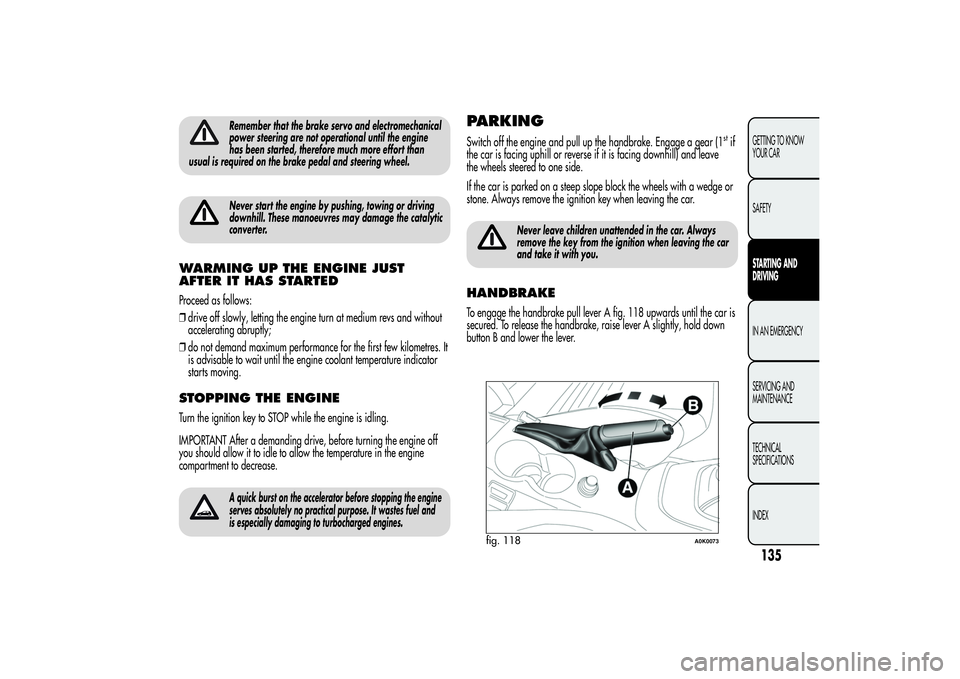
HANDBRAKETo engage the handbrake pull lever A fig. 118 upwards until the car is
secured. To release the handbrake, raise lever A slightly, hold down
button B and lower the lever.
fig. 118
A0K0073
135GETTING TO KNOW
YOUR CAR
SAFETYSTARTING AND
DRIVINGIN AN EMERGENCY
SERVICING AND
MAINTENANCE
TECHNICAL
SPECIFICATIONS
INDEX
Page 141 of 292
Press the clutch pedal fully to change gears correctly. It
is therefore essential that there is nothing under the
pedals: make sure the mats are lying flat and do not
get in the way of the pedals.Do not drive with your hand resting on the gear lever as
the force exerted, even if slight, could lead over time to
premature wear of the gearbox internal components.
SAVING FUELHere are some suggestions which can help you to save fuel and lower
harmful emissions.GENERAL CONSIDERATIONSCar maintenance
Have checks and adjustments carried out in accordance with the
“Scheduled Servicing Plan” (see chapter “Maintenance and care”).
Ty r e s
Check the tyre pressure at least once every 4 weeks: if the pressure is
too low, consumption levels increase as resistance to rolling is higher.
Unnecessary loads
Do not travel with an overloaded boot. The weight of the car and its
arrangement greatly affect fuel consumption and stability.
Roof rack/ski rack
Remove the roof rack or the ski rack from the roof after use. These
accessories lower aerodynamic penetration and adversely affect
consumption levels. It is better to use a trailer to transport particularly
bulky objects.
Electrical devices
Only use electrical devices for the time needed. The heated rear
window, additional headlights, windscreen wipers and heater fan
require a considerable amount of energy; increasing the current uptake
increases fuel consumption (by up to +25% in an urban cycle).
137GETTING TO KNOW
YOUR CAR
SAFETYSTARTING AND
DRIVINGIN AN EMERGENCY
SERVICING AND
MAINTENANCE
TECHNICAL
SPECIFICATIONS
INDEX
Page 142 of 292
Climate control system
Using the climate control system will increase consumption: use the air
vents when the external temperature allows it.
Devices for aerodynamic control
The use of non-certified devices for aerodynamic control may adversely
affect air drag and fuel consumption.DRIVING STYLEStarting
Do not warm up the engine at low or high revs when the vehicle is
stationary; this causes the engine to warm up more slowly, thereby
increasing fuel consumption and emissions. It is therefore advisable to
move off immediately, slowly, avoiding high speeds: in this way the
engine will warm up more quickly.
Unnecessary actions
Avoid revving up when at traffic lights or before switching off the
engine. The latter action, like double-declutching, is unnecessary and
causes increased fuel consumption and pollution.
Gear selection
Use a higher gear when traffic and road conditions allow it. Using a
low gear for faster acceleration will increase consumption. In the same
way improper use of a high gear increases consumption, emissions
and engine wear.Maximum speed
Fuel consumption considerably increases as speed increases. Keep
your speed as even as possible, avoiding unnecessary braking and
acceleration which cause excessive fuel consumption and increased
emissions.
Acceleration
Accelerating violently severely affects consumption and emissions:
acceleration should be gradual and should not exceed the maximum
torque.
CONDITIONS OF USECold starting
Short distances and frequent cold start-ups will prevent the engine from
reaching optimal running temperature. This results in a significant
increase in consumption levels (from +15 to +30% on the urban cycle)
and emissions.
Traffic and road conditions
High fuel consumption is caused by heavy traffic, for instance when
travelling in a queue with frequent use of low gears or in large towns
with many traffic lights. Winding mountain roads and rough road
surfaces also adversely affect consumption.
Stops in traffic
During prolonged stops (e.g. level crossings) switch the engine off.
138GETTING TO KNOW
YOUR CAR
SAFETYSTARTING AND
DRIVINGIN AN EMERGENCY
SERVICING AND
MAINTENANCE
TECHNICAL
SPECIFICATIONS
INDEX
Page 145 of 292
STORING THE CARIf the car is to be left inactive for longer than a month, the following
precautions should be noted:
❒park the vehicle in a dry, covered and, if possible, ventilated area;
engage a gear and check that the handbrake is not engaged;
❒disconnect the negative battery terminal and check the battery
charge. Repeat this check once every three months during storage;
❒if you have not disconnected the battery, check the battery charge
every thirty days;
❒clean and protect the painted parts using protective wax;
❒clean and protect the shiny metal parts using special compounds
available commercially;❒sprinkle talcum powder on the windscreen and rear window wiper
rubber blades and lift them off the glass;
❒slightly open the windows;
❒cover the car with a cloth or perforated plastic sheet. Do not use
compact plastic sheets which do not allow humidity to evaporate
from the surface of the car.
❒inflate tyres to +0.5 bar above the standard specified pressure and
check it at intervals;
❒do not drain the engine cooling system.
IMPORTANT After turning the ignition key to STOP, wait at least 1
minute before disconnecting the battery power supply.
141GETTING TO KNOW
YOUR CAR
SAFETYSTARTING AND
DRIVINGIN AN EMERGENCY
SERVICING AND
MAINTENANCE
TECHNICAL
SPECIFICATIONS
INDEX
Page 146 of 292
IN AN EMERGENCY
In an emergency we recommend that you call the freephone number found in the Warranty Booklet. You can also
consult www.alfaromeo.com to find your nearest Alfa Romeo Authorized Services.STARTING THE ENGINEIf the
warning light on the instrument panel remains on constantly,
contact Alfa Romeo Authorized Services immediately.
JUMP STARTINGIf the battery is flat, the engine may be started using an auxiliary
battery with the same capacity or a little higher than the flat one.
Proceed as follows to start the vehicle:
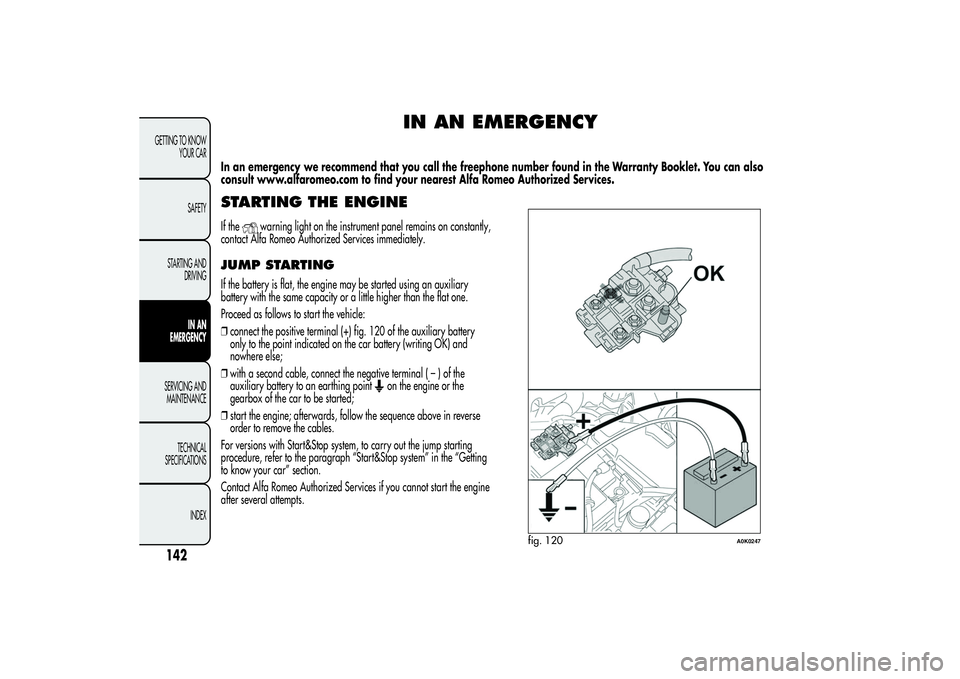
❒connect the positive terminal (+) fig. 120 of the auxiliary battery
only to the point indicated on the car battery (writing OK) and
nowhere else;
❒with a second cable, connect the negative terminal(–)ofthe
auxiliary battery to an earthing point
on the engine or the
gearbox of the car to be started;
❒start the engine; afterwards, follow the sequence above in reverse
order to remove the cables.
For versions with Start&Stop system, to carry out the jump starting
procedure, refer to the paragraph “Start&Stop system” in the “Getting
to know your car” section.
Contact Alfa Romeo Authorized Services if you cannot start the engine
after several attempts.
fig. 120
A0K0247
142GETTING TO KNOW
YOUR CAR
SAFETY
STARTING AND
DRIVING
IN AN
EMERGENCY
SERVICING AND
MAINTENANCE
TECHNICAL
SPECIFICATIONS
INDEX
Page 147 of 292
IMPORTANT Never connect the negative terminals of the two batteries
directly! If the auxiliary battery is installed on another car, prevent
accidental contact between metallic parts of the two cars.
Never use a fast battery-charger to start the engine as this
could damage the electronic systems of your car,
particularly the ignition and fuel supply control units.This starting procedure must be performed by expert
personnel because incorrect actions could cause
electrical discharge of considerable intensity.
Furthermore, battery fluid is poisonous and corrosive: avoid
contact with skin and eyes. Keep naked flames and lighted
cigarettes away from the battery and do not cause sparks.
BUMP STARTINGNever start the engine by pushing, towing or coasting downhill.
REPLACING A WHEELGENERAL INSTRUCTIONSThe car is equipped with the “Fix&Go Automatic Kit”: see the
paragraph “Fix&Go Automatic Kit” for how to use this device.
As an alternative to the “Fix&Go Automatic Kit” the car may be
equipped with a space-saver wheel: see the instructions on the
following pages for changing the tyre.
The spare wheel is specific for your car. Do not use it
on cars of different models. Do not use spare wheels of
different models on your car. The space-saver wheel
must only be used in case of emergency. It must only be used for
the distance necessary to reach a service point and the car speed
must not exceed 80 km/h. The space-saver wheel has an orange
sticker that summarises the main cautions for use and limitations.
Never remove or cover the label. Never apply any hub cap to
the space-saver spare wheel.Alert other drivers that the car is stationary in
compliance with local regulations: hazard warning
lights, warning triangle, etc. Any passengers on board
should leave the car, especially if it is heavily laden. Passengers
should stay away from on-coming traffic while the wheel is
being changed. In case of steep slopes or rough slopes, place
wedges or other materials suitable to stop the vehicle under the
wheels.
143GETTING TO KNOW
YOUR CAR
SAFETY
STARTING AND
DRIVINGIN AN
EMERGENCYSERVICING AND
MAINTENANCE
TECHNICAL
SPECIFICATIONS
INDEX
Page 155 of 292
INFLATION PROCEDURE
Wear the protective gloves provided with the kit.
Proceed as follows:
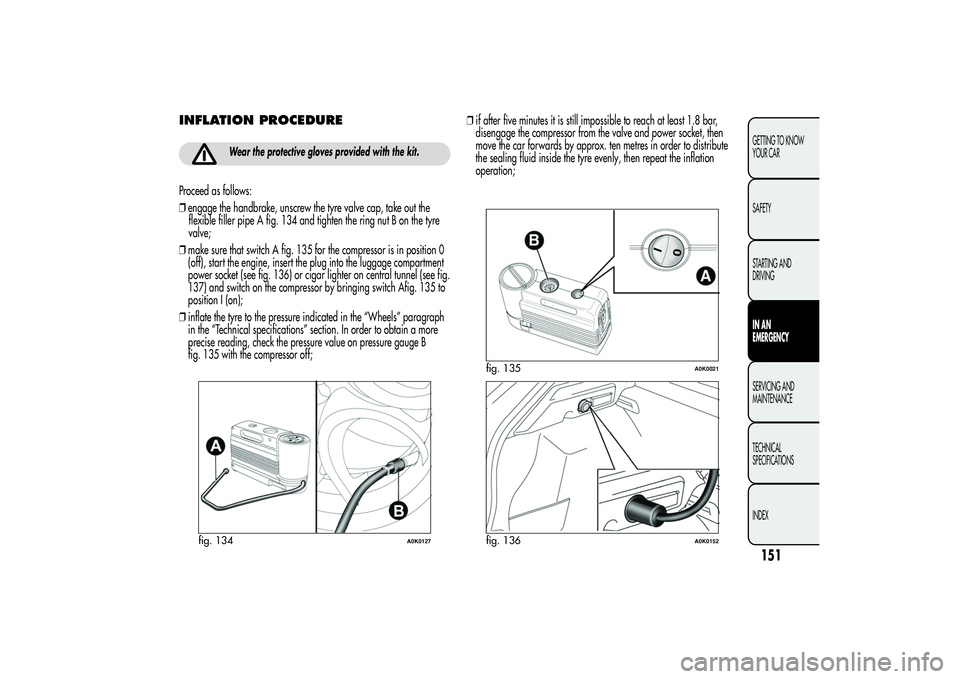
❒engage the handbrake, unscrew the tyre valve cap, take out the
flexible filler pipe A fig. 134 and tighten the ring nut B on the tyre
valve;
❒make sure that switch A fig. 135 for the compressor is in position 0
(off), start the engine, insert the plug into the luggage compartment
power socket (see fig. 136) or cigar lighter on central tunnel (see fig.
137) and switch on the compressor by bringing switch Afig. 135 to
position I (on);
❒inflate the tyre to the pressure indicated in the “Wheels” paragraph
in the “Technical specifications” section. In order to obtain a more
precise reading, check the pressure value on pressure gauge B
fig. 135 with the compressor off;❒if after five minutes it is still impossible to reach at least 1.8 bar,
disengage the compressor from the valve and power socket, then
move the car forwards by approx. ten metres in order to distribute
the sealing fluid inside the tyre evenly, then repeat the inflation
operation;
fig. 134
A0K0127
fig. 135
A0K0021
fig. 136
A0K0152
151GETTING TO KNOW
YOUR CAR
SAFETY
STARTING AND
DRIVINGIN AN
EMERGENCYSERVICING AND
MAINTENANCE
TECHNICAL
SPECIFICATIONS
INDEX
Page 158 of 292
CHANGING A BULBGENERAL INSTRUCTIONS❒Before changing a bulb check the contacts for oxidation;
❒blown bulbs must be replaced with others of the same type and
power;
❒after replacing a headlight bulb, always check its alignment;
❒when a light is not working, check that the corresponding fuse is
intact before changing a bulb. For the location of fuses, refer to
the paragraph “Replacing fuses” in this section.
Halogen bulbs must be handled holding the metal part
only. Touching the transparent part of the bulb with your
fingers may reduce the intensity of the emitted light and
even reduce the lifespan of the bulb. In case of accidental contact, wipe
the bulb with a cloth moistened with alcohol and let the bulb dry.Modifications or repairs to the electric system that are
not carried out properly or do not take the system
technical specifications into account can cause
malfunctions leading to the risk of fire.Halogen bulbs contain pressurised gas which may
cause small fragments of glass to be projected
outwards if the bulb is broken.
Due to the high power supply voltage, gas discharge
bulbs (Bi-Xenon) should only be replaced by
specialised personnel: danger of death! Contact Alfa
Romeo Authorized Services.
IMPORTANT When the weather is cold or damp or after heavy rain or
washing, the surface of headlights or rear lights, may steam up and/or
form drops of condensation on the inside. This is a natural
phenomenon due to the difference in temperature and humidity
between the inside and the outside of the glass which does not indicate
a fault and does not compromise the normal operation of lighting
devices. The mist disappears quickly when the lights are turned on,
starting from the centre of the diffuser, extending progressively towards
the edges.
154GETTING TO KNOW
YOUR CAR
SAFETY
STARTING AND
DRIVING
IN AN
EMERGENCY
SERVICING AND
MAINTENANCE
TECHNICAL
SPECIFICATIONS
INDEX